

The status and empowerment of women are now front and center on the agenda of the international development community. Social policies can play an important role in this respect. Interest in these issues has coincided with a fundamental shift in strategies toward poverty alleviation throughout much of the developing world. Since the mid-1990s, countries in Latin America, Asia, and Africa have sought to address the intergenerational transmission of poverty through the adoption of cash transfer programs (Fiszbein et al. Reference Fiszbein, Schady and Ferreira2009; Sugiyama Reference Sugiyama2012; De la O Reference De la O2015; Garay Reference Garay2016). Although intended mainly to alleviate poverty and develop the human capital of children rather than to advance gender equity (Sacchet Reference Sacchet2014), most cash transfers are “gender-sensitive,” insofar as they target grants to mothers. But do they go beyond helping mothers attend to their children and enhance women’s own position in the home, society, economy, and polity? In other words, do cash transfers empower women in their own right?
It is tempting to regard any social policy program that provides resources to poor women as status-enhancing. Often it is assumed, rather than substantiated, that conditional cash transfers (CCTs) strengthen the position of women. For example, an Inter-American Development Bank report asserts, “CCTs empower women by giving them control over resources and involving them in networks of program participants” (IDB 2007, 9). This view resembles that of early advocates of microcredit schemes, who thought that greater access to resources would naturally enhance women’s agency in intrahousehold decisionmaking.Footnote 1
There are indeed some logical reasons to think that targeting family grants directly and exclusively to mothers would strengthen their autonomy and decisionmaking power compared with male partners, bolster their engagement in activities that lift their standing in the community, and bring them out of social and political isolation by cultivating links to other grantees and to the state itself. Moreover, empirical evidence suggests that CCTs do sometimes generate important gains for low-income women by virtue of the regular and direct payoffs the state makes to them (Hagen-Zanker et al. Reference Hagen-Zanker, Pellerano, Bastagli, Harmon, Barca, Sturge, Schmidt and Laing2017).
There are, however, grounds for questioning the extent to which direct payments lead automatically to gains for women. Even if a grant eases financial burdens in a household, it may not fundamentally alter family power dynamics. Being the formal beneficiary of a monthly cash stipend may not increase bargaining power in a relationship. What, for example, prevents male partners from appropriating the funds, perhaps even through violent means (Handa et al. Reference Handa, Peterman, Davis and Stampini2009)? Some studies suggest that low levels of female education and limited experience in making financial transactions allow male domination to persist (Center for Global Development and Microsave 2017). Furthermore, grants may have differential effects depending on the outcome in question. For example, an income stream of $75 per month could be sufficient to increase a mother’s decisionmaking influence over household purchases but not allow her to leave an abusive partner.
Feminist scholars have been at the forefront of questioning whether CCTs empower women. They have emphasized aspects of CCT design that place gendered obligations on women beneficiaries. For example, Molyneaux’s influential study (2006) of Mexico’s PROGRESA noted that designating women to meet program conditionalities, such as attending meetings and taking children to school and health clinics, could come at the expense of female labor market participation and its empowering potential. More recently, researchers of Latin America more broadly have highlighted the paternalistic and “patriarchal materialistic” dimensions of CCTs (Martínez-Franzoni and Voorend Reference Martínez-Franzoni and Voorend2012) and the ordeals women face in meeting conditionalities (Cookson Reference Cookson2018).
Although these studies raise important questions about how governments harness gendered roles and stereotypes to further state interests, it is possible that programs centered on gendered motherhood roles can advance women’s empowerment nonetheless. We do not question women’s strong identification with motherhood.
Furthermore, we maintain that this identity need not mean that women sublimate themselves to men as “compliant dupes of patriarchy” (Narayan Reference Narayan, Louise and Charlotte2002, 420). Programs that harness the role of motherhood and the responsibilities therein are not necessarily disempowering if women gain newfound status, autonomy, and agency through their participation.
We take up these matters with respect to the Bolsa Família. Inspired by Tendler’s classic work, Good Government in the Tropics (1997), we maintain that it is crucial to see how policies unfold on the ground. The present study draws on our original field research, which captures the lived experiences and voices of poor women in Northeast Brazil, and on our interviews with street-level bureaucrats, as well as policymakers. We situate our research within a body of existing studies to reach broader conclusions. To be clear from the outset, our exclusive focus is on adult women, not on the gendered impact of the program on girls. We leverage the case study approach to assess theoretical arguments, as suggested by scholars of qualitative methods (Levy Reference Levy2008). Analyzing Brazil’s Bolsa Família as a “most likely case” to empower women, we evaluate what the evidence suggests and draw broader lessons. A truly transformative CCT in Brazil would represent one of the most significant developments in the promotion of gender equity in a major country in the last two decades, thereby yielding lessons for emulation. If even the Bolsa falls short, we need to understand why that is, and identify the adjustments that should be undertaken.
Remarkably, CCTs have not been subject to extensive and systematic program evaluation for their impact on gender. Compared to studies that have examined issues like poverty alleviation, nutritional intake, and educational attainment among child beneficiaries, the question of how adult women fare under CCTs is vastly underexplored, as other scholars recognize as well (e.g., Bradshaw et al. Reference Bradshaw, Chant, Linneker, Cupples, Palomino-Schalsa and Prieto2019; Chant and McIlwaine 2016). To date, few major studies have addressed whether, to what extent, and how CCTs enhance the standing of women designated recipients. Few feature randomized research designs that compare grant recipients with non–grant recipients who are similar on other analytically relevant variables, a standard strategy in program evaluation.Footnote 2 Even fewer studies capture sex-disaggregated information. Some qualitative studies—including our own—focus on women’s experiences, thereby allowing their voices to be heard (Rego and Pinzani Reference Rego and Pinzani2014).
The Bolsa, an exceptionally clean, well-run, and comprehensive program, in operation for nearly two decades, contains several features with strong potential to empower women, even though this was never a central intention of the program architects.Footnote 3 These include the regular and direct nature of its payouts; the supportive and rights-based framing of the grant by its administrative home, the Ministry of Social Development (Ministério do Desenvolvimento Social, or MDS); and the program’s effective coordination with other key institutions. As the largest CCT in the world, the benefit goes to approximately one-quarter of Brazil’s population.Footnote 4 In several impoverished Northeastern states, over half of all families are enrolled (Camargo et al. Reference Camargo, Curralero, Licio, Mostafa, Campello and Neri2013, 163).Footnote 5
Designated beneficiaries—90 percent of whom are women (Costanzi and Fagundes Reference Costanzi, Fagundes, Castro and Modesto2010, 267; Camargo et al. Reference Camargo, Curralero, Licio, Mostafa, Campello and Neri2013, 175)—receive a bank card and a PIN number that give them the exclusive ability to withdraw the monthly entitlement, with no stipulations on how the money is spent.Footnote 6 Although the program does contain conditionalities and monitoring, its rights-based framing lends a supportive tone. Failure to meet specified requirements will trigger a visit by a social worker, under the holistic and sympathetic view that families who are having difficulty complying need assistance (Soares Reference Soares2011).
The existing network of social protection in which the Bolsa is embedded reinforces its empowering potential. Crucially, the Bolsa does not work in institutional isolation. Brazil has a legal framework that protects women’s rights, an extensive banking infrastructure that helps deliver grant payments, an established primary health care network, and a social assistance system for vulnerable families. These institutions are in direct coordination with the Bolsa Família and the MDS. The community-based Family Health Program (Programa Saúde da Família, or PSF), a vital component of Brazil’s universal health care system, is widely regarded as exemplary in meeting primary health care needs (McGuire Reference McGuire2010; Sugiyama Reference Sugiyama2012; Harris Reference Harris2017). Teams of professionals, including community health agents who are personally connected to the territorial areas they serve, are important conduits of health and social service information for the poor.Footnote 7 Brazil also has a national social assistance system. Located in the most marginalized communities, the Reference Centers for Social Assistance (Centros de Referênda da Assistência Social, or CRAS) are responsible for outreach to communities and individuals. These centers feature social workers who prioritize vulnerable segments of the population and link them to necessary social services (MDS 2015).
Previewing our findings, the Bolsa Família has contributed to considerable advances in women’s decisionmaking autonomy, health (broadly defined), and sense of self-worth and agency. The program’s design, together with aspects of the context in which it is embedded, has enhanced the standing of women recipients in important ways. Yet there are some missed opportunities for further long-term economic empowerment. Understanding the Bolsa’s successes and shortcomings is important not only for Brazil but for other developing countries. Given that upward of 750 million people in low- and middle-income countries worldwide are now recipients of cash transfers (Arnold et al. Reference Arnold, Conway and Greenslade2011, as cited in Molyneux et al. Reference Molyneux, Jones and Samuels2016, 1087), the stakes are high for getting the policy design and implementation right.
Research Design and Methods
This study is based on a survey, focus groups, and elite interviews. Primary field research took place in two waves: the focus groups and survey in June–July 2009 and interviews of elites and street-level bureaucrats in June–July 2011. Follow-up elite interviews were conducted in May 2014.
Understanding how women fare under the Bolsa Família requires that we ask them about their experiences. The analysis is based on research in three municipalities characteristic of Brazil’s Northeast: Camaragibe and Jaboatão dos Guararapes, both in the state of Pernambuco, and Pau Brasil in the state of Bahia. We surveyed 1,104 individuals, recipients and nonrecipients, who resided in poor neighborhoods. The survey employed a quota sampling method to capture their experiences.Footnote 8 We also conducted 11 focus groups with program beneficiaries across the study sites. Men and women met in separate groups to facilitate trust and exchanges on sensitive topics. Discussions were led by trained social scientists who came from the area. Group participants were recruited through local community contacts.Footnote 9
Focus groups allow participants to engage with one another, find consensus, and frame their experiences in their own words. We interpret participants’ testimonies for what was said as well as unsaid. Interviews with street-level bureaucrats, such as social workers and primary health care officials, contextualized our information gathering. In addition, interviews with federal technocrats in Brasília shed light on the operational dynamics of the program, as well as the complementary interventions necessary to bring about gender empowerment. Research by other scholars supplements our analysis. Where informational gaps persist, we concede the limits of existing knowledge and suggest pathways for future research.
Empowerment and Its Many Faces
What is women’s empowerment? Although concepts like enhanced capabilities, autonomy, and feminist consciousness come to mind, there is a notable lack of convergence on the definition of “women’s empowerment” in the international development and gender studies literatures (Kabeer Reference Kabeer1999; Hawkins and Edwards Reference Hawkins and Edwards2014). Studies differ over how the concept is operationalized and what policies are thought to elevate women’s standing (Van Eerdewijk et al. Reference Van Eerdewijk, Wong, Vaast, Newton, Tyszler and Pennington2017).
We see empowerment as the expansion of assets and capabilities that give people more control of their lives. This framework moves beyond a welfarist focus to one that considers agency. According to Amartya Sen in Development as Freedom, both well-being and agency are crucial to achieving freedom (1999, 189–91). While improving well-being is important, enhancing agency is also critical because it can help remove the inequities that depress well-being. Inspired by Sen, we focus on three dimensions of empowerment.
The economic dimensions of empowerment center on the material underpinnings of women’s unequal status, including limitations on the ability to engage in independent financial decisionmaking (Sen Reference Sen1999). With respect to CCTs, the specific effects that concern us involve whether women take actions that enhance their ability to navigate modern financial life, such as obtaining identity documents and utilizing banking institutions; play a central role in deciding how the money they receive is spent; and invest in activities that increase their economic independence in the long run; for example, by furthering their education or obtaining remunerated work.
Enhanced physical autonomy and integrity constitute a second dimension we investigate. Making decisions that protect one’s body is fundamental in this regard (Nussbaum Reference Nussbaum2000, 78). It is conceivable that having an independent income stream
enhances autonomy in this way. The observable reflections of empowerment that interest us are, do women beneficiaries increase their own use of health services? Do women who receive the grant engage in a higher rate of contraceptive use and, relatedly, do they have fewer children? Do female grant recipients avoid premature death by further reducing self-inflicted harm and intimate partner violence?Footnote 10
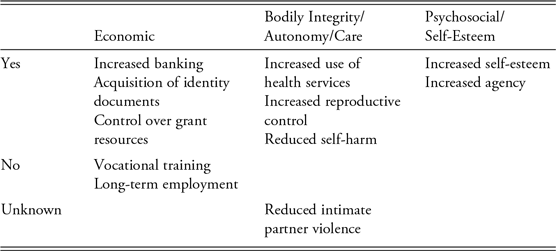
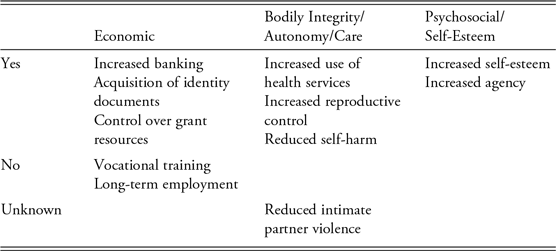
Empowerment through psychosocial growth is the final category that we examine. Deprivation has important psychological as well as material dimensions (Samuels and Stavropoulou Reference Samuels and Stavropoulou2016; Narayan et al. Reference Narayan, Chambers, Shah and Petesch2000). Psychosocial growth is crucial for a woman’s advancement over her lifetime. Self-esteem is critical for developing agency, which itself is essential for taking further steps to better one’s lot in life. It is also key to bringing women out of social isolation, which itself can set in motion multiple positive dynamics. The specific elements of psychosocial growth that interest us include whether the program enhances women’s sense of self-worth and draws them out of social isolation. Table 1 provides a summary of our main findings.
The Bolsa Família on Three Dimensions of Women’s Empowerment
Economic Dimensions of Empowerment
Does the Bolsa Família contribute to economic empowerment? If there is any area for change, we would expect it in this dimension, given that the grant transfers money.
Did enrollment in the program require women to obtain identity documents and utilize banking institutions? Applying for the grant—through registration in the federal Cadastro Único (Unified Registry)—requires that applicants provide legal documents. Among those required are a state identification card and an individual taxpayer identification number (Cadastro de Pessoas Físicas, CPF). Women, especially those in rural areas, are less likely than men to have these documents (Pires Reference Pires2012; Butto Reference Butto2011). Also required is a birth certificate for every child on the application (Hunter and Sugiyama Reference Hunter and Sugiyama2018).
Official documentation is necessary not only to obtain the grant but also to navigate modern political, economic, and social life. Without official papers, women cannot vote, buy on credit, or open a bank account. Policymakers in Brasília knew that many poor women could not fulfill the program’s documentary demands, but they went ahead anyway to make the Bolsa Família as bureaucratically clean as possible. Importantly, they also took measures to assist people in obtaining official papers (Modesto Reference Modesto2011). The Ministry of Justice and the Ministry of Agrarian Development intensified large national campaigns with mobile itinerant outreach to facilitate documentation in the hardest-to-reach territories of the country.
Our research suggests that many women did indeed acquire identity documents in order to enroll in the Bolsa, revealing an underappreciated downstream effect of family transfers.Footnote 11 Some of these documents were for themselves; others were for their children. As one longtime PSF nurse explained, before the Bolsa Família, many women lacked documents, and their children lacked birth certificates (Moura Reference Moura2011). In response to our survey question, “Did you obtain (or renew) documents for the purpose of applying to the Bolsa Família?,” 18.6 percent of the cardholders responded that they had sought at least one kind of document in order to apply. The most frequently obtained items were taxpayer identification cards, followed by voter registration cards, state identification cards, worker identification cards, and birth certificates. In a region of widespread underdocumentation, this represents a positive development for a sizable group of people.
Focus group participants revealed that they were well versed in the program’s documentary requirements and that many had obtained documentation as part of the application process. For instance, one group spelled out that applicants needed “a CPF, identification card, children’s birth certificates, and worker’s card” (Women’s Focus Group 2, Camaragibe). Several women in Jaboatão also noted that they had obtained documentation to apply. As one explained, “I got documents. Before, I was married and I didn’t have documents at that time. But then we separated. I went to Victória City and got my birth certificate, identity card, a taxpayer ID card” (Women’s Focus Group 3, Jaboatão). Another in Camaragibe reported, “I had to get the CPF, identity card, everything in one day (and fast!). I had to get all those documents, the voter registration, which I didn’t have” (Women’s Focus Group 2, Camaragibe). In a different focus group, discussion turned to whether the Bolsa Família motivated documentation.
Anon 1: It’s an incentive for people to get birth certificates, for their children and themselves.
Anon 2: It was in my case. When I went to register, I could only register one [child]. The other child I didn’t have a birth certificate for…. Later I was able to receive more for both. (Women’s Focus Group 1, Camaragibe)
These advances were not born entirely of beneficiaries’ newfound demand, but also of the state’s significant commitment and capacity to supply documentation for those without it. Multiple institutional arms of the government stepped up to facilitate the provisioning of basic documents, confirming the importance of ancillary institutions in supporting broad inclusion in the program (Garrido Reference Garrido2014; Leonardes Reference Leonardes2014; Butto Reference Butto2011; Cordeiro Reference Cordeiro2011; CRAS Focus Group 2011).
Do women withdraw the grant money on their own? A crucial first step in controlling Bolsa Família funds is for beneficiaries to retrieve them independently from the bank. Our focus group research suggests that most women do. A survey by Lav- inas et al. (2012, 38) reaches a similar conclusion: of the female beneficiaries they polled, 81 percent said they retrieve funds by themselves. Only rarely does someone else withdraw the money: in 9 percent of the cases, women reported sending one of their children, and in 5 percent their partner.
Reports of autonomous retrieval are especially noteworthy, given that the majority of women beneficiaries had no banking experience before they enrolled in the Bolsa Família (Moreira et al. Reference Moreira, Ferreira, de Freitas Carvalho Lima and Ckagnazaroff2012, 414). Program designers devised procedures to increase the likelihood that beneficiaries would have direct and unmediated access to their money, including the requirement that beneficiaries use a PIN. We heard local administrators emphasize the importance of keeping PINs secret. For the most part, the program’s design features, together with the counsel of local agents, have protected women’s ability to withdraw the money, including from their own partners.Footnote 12
Focus groups revealed a general consensus on the need to keep one’s PIN private. Interestingly, one interview subject recounted an incident she observed of a drunken male partner unsuccessfully trying to withdraw funds from his wife’s Bolsa Família card without having the PIN.
The card had the wife’s name on it, but the man wanted to withdraw the funds. He claimed his wife withdrew funds “without a PIN number.” But the teller refused to liberate any funds without the PIN. He caused a major commotion. I think the guy wanted the money so he could drink even more. But the teller was fearless and refused him. He left there in a rage. (Women’s Focus Group 1, Camaragibe)
Several factors facilitate women’s ability to access their funds. Brazil has a well- established banking infrastructure, which extends to remote parts of the country (Economist 2018, 4). Existing cultural norms surrounding women’s public behavior and a decent rate of basic literacy (IPEA 2015) support their independent retrieval of the grant money. We do not take these factors for granted, since in contexts where they do not exist, similar efforts have failed.Footnote 13 The mechanisms people interact with have to be understandable and appropriate if a social program is to empower them.
Once in women’s hands, who controls how the money is administered? We found evidence of women’s increased ability to make financial decisions. Across the board, our focus group respondents affirmed that women exercise significant influence over how the grants are administered, especially when it comes to purchases for the children. Food, clothing, and school supplies were among the most often mentioned essentials. As two participants explained,
Anon 1: My life changed because it was like this, everything I had to ask my husband [for permission and money]. Now I want something, I go and buy it for my kids.
Anon 2: We can buy things without asking. Oh! I bought this…. Now you go and get it and that’s it.
Moderator: I understand, now you are in charge.
Anon 1: Now I can buy things without needing someone else to pay. (Women’s Focus Group 4, Jaboatão)
Many women we spoke with also talked about how the grant enabled them to recover from cycles of past debt and to prevent new debt.
These testimonies mirror findings by numerous surveys. Impact evaluations by well-established research teams confirm that Bolsa recipients report at higher rates than nonrecipients that they are the sole decisionmakers when it comes to food purchases, clothes for children and themselves, children’s health expenses, durable goods, and contraception.Footnote 14 In a large, NGO-led study conducted in 2007, 39.2 percent of grant holders claimed that their decisionmaking power over the family’s income had increased (IBASE 2008, 15). Only a small percentage of the sample, 3.7 percent, indicated the existence of family conflict over use of Bolsa money (Costa Reference Costa2008, 8). We venture that this may result from the program’s structure, which, as testimonies reveal, allows women to work around their partners. In a case in which one woman thought her husband would misappropriate funds, she boasted that she was savvy enough to pursue the grant without his knowledge (Women’s Focus Group 2, Camaragibe). Indeed, autonomy can extend to women’s heightened ability to navigate complex household dynamics.
Did the grant money stimulate job seeking or vocational training? A final consideration is whether the program led women to pursue activities, such as meaningful employment or vocational training, that would put them on firmer financial ground in the long term. Having more income could conceivably free up beneficiaries to make future plans, cover transportation costs, or improve their appearance so as to engage more effectively with the public. Yet none of our focus group participants reported trying to find a better job or enroll in a training program as a result of the Bolsa.Footnote 15 At the same time, we found no evidence that the Bolsa depressed paid work. Large surveys have reached similar conclusions (de Brauw et al. Reference De Brauw, Daniel, Hoddinott and Roy2015; MDS 2012, 31). Most funds are used to meet basic needs, which is not surprising, given the grant’s small amount and the program’s emphasis on the human capital formation of children rather than of mothers.
Notably, some women told us they wished that the Bolsa Família included training and job opportunities.
Anon1: It would be better if there were a [training] course for us to do.
Moderator: For women to do?
Anon 2: Yes, yes, for the women, right! If the program did it, it would be terrific.
Anon 1: The thing is jobs. I would like it if [the Bolsa] opened a door for work. To do something. There are many women who are unemployed and need a job. I’ve been unemployed for than two years and I haven’t been able to find anything. Even something basic. (Women’s Focus Group 4, Jaboatão)
Just as these beneficiaries expressed interest in working and viewed the lack of job training as lamentable, social workers also talked about the lack of training programs linked to the Bolsa as a missed opportunity that needed to be rectified (CRAS Focus Group).
Bodily Integrity
Bodily integrity is an essential component of well-being (Nussbaum Reference Nussbaum2000, Reference Nussbaum2005). Here we are interested in whether women who receive the Bolsa are more likely to protect their own health, take charge of their fertility, and preserve their survival through decreased rates of suicide. Although our survey and focus groups did not include questions about all these dimensions, our field observations and conversations with street-level bureaucrats suggest ways that the Bolsa Família empowers women in these dimensions. It does so largely by encouraging contact with two key ancillary programs: the PSF and the CRAS.
Do women beneficiaries increase their own use of health services? We might expect beneficiary mothers to take greater care of their health when compared to nonbeneficiary counterparts of similar education and income levels, due either to enjoying greater income or becoming more Famíliar with the public health sector through meeting health conditionalities for their children. Beneficiaries must interact with health providers for their children’s regular checkups, as well as comply with requirements for their own prenatal and postpartum care. Our interviews with public health nurses indicated the Bolsa’s importance for getting women into PSF clinics (Bispo Reference Bispo2009; Moura 2009). Nurses see Bolsa-related visits as important opportunities to promote women’s health by educating them on the importance of self-care, including regular breast exams and cervical cancer screenings. As nurse Ana Claudia Bispo explained, many women had never previously received these exams.
There is a lot of cultural resistance to cervical exams, and many women are ashamed of their bodies…. I convince them that the Bolsa program wants to see that the mothers are healthy. Mothers need to be healthy to take care of their children, and the annual exam is a good thing. It is my hope that once they have gone through an exam or two, it becomes habit-forming. (Bispo Reference Bispo2009)
Preventive health care for women clearly goes beyond the scope of the program narrowly defined. Although leveraging women’s motherhood role in this way is initially instrumental—some might even say coercive—the Bolsa does open one of the few paths available to educate women about their bodies and potentially save lives, two very empowering outcomes. The Bolsa’s role in expanding health care utilization was not unique to the communities we studied. Survey research by IBASE suggests a broader impact: 42 percent of the five thousand grant holders interviewed (94 percent being women) stated that they had increased their own use of health services after receiving the grant (IBASE 2008). Part of this increase stems from greater prenatal care, well known to reduce maternal as well as infant mortality. One study estimates that the percentage of women who received no prenatal care declined from approximately 17.7 percent in 2005 (a year after the Bolsa’s inauguration) to 5.7 percent in 2009 (Bartholo et al. Reference Bartholo, Passos and Fontoura2017, 16). If such numbers extend to the broader beneficiary population, it means that many women now receive prenatal care who otherwise would not.Footnote 16
Do women grantees assume greater decisionmaking authority over contraceptive use? Since family planning reflects an effort to exercise control over the future, it is plausible that increased independence extends to influence over fertility matters. Birth spacing between children is positively associated with better health outcomes for both mothers and their offspring (Nussbaum Reference Nussbaum2000; Ahmed et al. Reference Ahmed, Li, Liu and Amy2012). Survey research by de Brauw et al. found that participation in the Bolsa Família increased the share of women who reported exclusive control over contraception decisions by 10 percentage points (2014, 488). In urban areas, exclusive control over contraception was found to be even larger, with increases in the range of 16 to 18 percentage points (de Brauw et al. Reference De Brauw, Daniel, Hoddinott and Roy2014, 496).Footnote 17
These numbers could reflect gains in decisionmaking autonomy or greater contact with the health system through the program, or both. As one PSF nurse explained, the Bolsa Família brings women into the clinic, which provides counseling on family planning and makes contraception available as well (Bispo Reference Bispo2009). This exemplifies, once again, how Brazil’s CCT interacts with complementary programs. Access to contraception through the national health system does not exist in many developing countries.
Do female grant recipients avoid premature death by engaging in less self-harm? Another crucial aspect of health care involves mental health care and its ability to reduce self-harm. Families who are eligible for programs like the Bolsa Família typically encounter high rates of stress, which income volatility exacerbates (CRAS 2011; Ribas-Prado et al. Reference Ribas-Prado, Calais and Cardoso2016).Footnote 18 Nurses we spoke to related that before the Bolsa’s advent they saw more instances of extreme stress among women who could not obtain sufficient food for their families. That incidence seems now to have abated. Furthermore, CRAS teams reported engaging in considerable mental health outreach (CRAS Focus Group 2011).
Taking one’s life represents one of the strongest expressions of a breakdown in mental health. Only recently have scholars begun to examine the relationship between Brazil’s CCT and suicides. Alves et al. (2019) examined the relationship between suicide rates (attempted and completed) and enrollment in the Bolsa Família for more than five thousand municipalities across the country between 2004 and 2012. They found that suicide incidence was significantly lower in municipalities with coverage rates of between 30 and 70 percent. Notably, the association between high Bolsa Família coverage (70 percent) and suicides showed the greatest decline, with pronounced reductions for women but not men. While the exact mechanisms that drive down suicides are still unknown, these results suggest that the Bolsa Família may well have important spillover effects that contribute to well-being.
Our fieldwork offers clues about how Bolsa participation might alleviate mental health problems. Fewer suicides could be the fairly direct result of the stabilizing impact of more regular income. This would not be surprising, as many focus group participants emphasized the importance of having predictable income. Additionally, fewer suicides could reflect the intervention of CRAS social services. Social workers with training in mental health challenges have been a longstanding part of the CRAS. Since 2011, CRAS teams have incorporated psychologists in their professional workforce to better address the emotional needs of the poor (Solon et al. Reference Solon, Scott, de Sousa, de Lima and de Oliveira2018). For Bolsa recipients, CRAS regularly offers outreach seminars, workshops, and programs on a variety of mental health challenges (see, e.g., Dourados Prefeitura n.d.; Município de Santa Isabel 2018). We met women in the field who spontaneously mentioned that they attend CRAS classes (Women’s Focus Group 1, Pau Brasil). This exemplifies the important interaction between the CCT and the broader institutional network in which it is embedded.
Has the Bolsa Família enabled women to confront domestic violence? Domestic violence has deep roots in Brazil and remains a serious problem (Gukovas et al. Reference Gukovas, Muller, Pereira and Reimao2016), which CRAS and PSF teams are acutely aware of. As Bradshaw et al. (Reference Bradshaw, Chant, Linneker, Cupples, Palomino-Schalsa and Prieto2019) acknowledge, the roots of gender-based violence are complex, and their links to the feminization of poverty difficult to disentangle. Whether CCTs can mitigate intimate partner violence (IPV) is only now being explored.Footnote 19 Recent research finds that Bolsa Família coverage is associated with lower homicide rates and hospitalizations from violence. Importantly, one study observes that there are cumulative effects for the target population. “When coverage of the target population was at least 70 percent for one year, hospitalizations from violence decreased by 8 percent; two years 14 percent, three years 20 percent, and four years 25 percent” (Machado et al. Reference Machado, Laura, Rasella, Barreto and Araya2018, 1). Much like our observations about suicides, Machado et al. speculate that this result could stem directly from “increased family income, which might result in stress reduction, less family disruption, or decreased alcohol consumption.” Or “the health conditionality can increase access to health and social care, for instance, when there is intimate partner violence. Access to health and social care can increase assessments and/or support for IPV victims and those seem to be important to prevent female homicide” (Machado 2018, 8). More research on these important matters is clearly needed.
Psychosocial Dynamics: Increased Self-Esteem and Agency
Family grants do more than transfer material resources. They can also exert a positive psychological impact. For example, financial autonomy has the potential to elevate women’s sense of self-worth, which, in turn, can stimulate a virtuous cycle of personal development. The value of coming out of social isolation and engaging with the state and the public should not be underestimated. Women play multiple roles: as individuals in the community, partners in households, and mothers. Aspects of the program affect how women feel about themselves in these various capacities.Footnote 20
Has the Bolsa Família contributed to elevating women’s self-esteem? One spinoff of enrollment that has done so is increased documentation. This makes sense, given the salience of documentation as a marker of social status and citizenship in Brazil historically (Santos Reference Santos1987).Footnote 21 Our field research, including participant observation in an itinerant documentation campaign, gave us insight into the importance of documentation for people’s sense of hope and belonging.Footnote 22
This was apparent in people’s outward expressions of joy and relief, and in what women related in informal conversations. In one case, a woman who finally obtained a birth certificate for her 11-year-old daughter came away with a sense of resolve for having moved forward. The girl’s father had denied paternity, which had hindered progress over the previous decade. The Bolsa provided the nudge needed for the mother to go ahead despite not having his name on the document.Footnote 23 In other cases, we saw people obtain formal worker cards for the first time. They proudly showed us their new documents. Establishing an official connection to the state through newly acquired papers has clearly elevated women’s sense of their own status.Footnote 24 In the words of Suárez and Libardoni, “The documentation required to obtain the [Bolsa Família] card caused a radical change in the consciousness of [women] and the social space to which they can aspire to belong” (2007, 146).
Another potential effect of financial empowerment concerns women’s elevated sense of self-worth. Mothers enrolled in the program report feeling better about themselves because they can more readily meet their children’s basic needs. Focus group participants often remarked on their ability to purchase children’s shoes (Hunter and Sugiyama Reference Hunter and Sugiyama2014). The underlying issue here is that mothers perceive that how children appear in public is a reflection on themselves. All over the world, shoes and decent clothing appear to be crucial for human dignity (Narayan et al. Reference Narayan, Chambers, Shah and Petesch2000).
Not having to beg is also dignifying. As we heard from focus group participants, before the Bolsa Família it was common for needy mothers to send children out to beg. This now happens with much less frequency (Women’s Focus Group 2, Pau Brasil). Not being indebted to local shopkeepers, a well-known source of shame and psychological burden, is also elevating. Brandão et al. (2007) note that beneficiary mothers reported a heightened sense of status, due to their newfound consumption power and liberation from indebtedness to store owners. They also attested to feeling better about themselves, given that they no longer needed to appeal to religious organizations or extended family for help. These same researchers observe elsewhere that a significant number of interviewees reported that the treatment of their families in the local community had improved after inclusion in the program (Brandão et al. 2007, 109).
Has the Bolsa Família contributed to women’s sense of agency? A heightened sense of agency seems to arise from having a Bolsa ATM card in one’s own name and under one’s exclusive control. The feelings of autonomy that result from controlling Bolsa funds are what interest us here. Focus groups revealed this sentiment: “I feel satisfied, I get so happy when my grant arrives” (Women’s Focus Group 1, Pau Brasil). As another woman explained, “I myself, feel independent. It’s me, it’s as if I worked and had a salary” (Women’s Focus Group 2, Camaragibe).
Having the ability to plan is also crucial for the development of agency. We heard this plainly.
The husbands work here and there (irregular day jobs); that money goes toward paying rent, gas, buys you little things. So, with us the money is regular, you can buy a pair of sandals, clothes, food for the child. It’s that difference that you feel. (Women’s Focus Group 2, Camaragibe)
The reference to the regularity of the grant reveals how important this factor is for attaining a sense of control, the absence of which contributes to pessimism and resignation (Narayan et al. Reference Narayan, Chambers, Shah and Petesch2000). Contexts in which stable work is hard to come by and many live by doing odd jobs fazendo bico in the Northeastern lexicon) or working in seasonally based agriculture render this sense of financial control almost impossible to achieve. In a major qualitative study of indigent women in the most remote and poorest areas of Brazil between 2006 and 2011, Rego and Pinzani (Reference Rego and Pinzani2014) heard repeatedly that the regularity of the income stream gave respondents a sense that they were better able to take charge of their lives. In line with their findings, Campara and Viera (Reference Campara and Viera2016, 999) found that the money from the Bolsa represented a key subsidy for managing finances in a balanced way, allowing people to avoid living from hand to mouth and having to incur debts to get through the month.
What helps to reinforce this sense of agency is that the MDS has cast the program not as a hand-out (with beneficiaries as passive and dependent recipients) but rather as the government’s obligation to the poor. Notably, the ministry expressed it in the following way in material distributed to beneficiaries: “Keep in mind: if your family meets the eligibility requirements of the program, receipt of the benefit is your right, not a favor from anyone” (MDS 2006, 9). This is not just abstract rhetoric; street-level bureaucrats employ similar language (Wampler et al. Reference Wampler, Sugiyama and Touchton2019, chap. 8).
Throughout this analysis, beyond reporting existing results, we have identified important gaps in the research and suggested productive pathways for future investigations in Brazil and elsewhere. The task of sorting out causal relationships, their magnitude, and their policy implications awaits future researchers.
Concluding Reflections
CCTs have emerged as a popular development strategy with the potential to contribute to women’s advancement. This article has identified three major dimensions for empowering women—economic agency, enhanced physical integrity, and psychosocial growth—and has assessed whether the Bolsa Família contributes to transforming women’s lives. While not a silver bullet, this “most likely” case for women’s advancement unleashes dynamics that enhance women’s standing along all three dimensions. The Bolsa’s pathways for empowerment leverage many women’s strong identification as mothers. The grant gives women recipients heightened decisionmaking autonomy over household finances and integrates them as economic actors in their own right, induces them to take better care of their bodies and mental health, and leads to greater feelings of self-worth and agency.
With respect to the Bolsa’s long-term impact, we have suggested ways in which improvements in women’s lives will extend beyond the years in which they receive the children’s portion of the income transfer. For example, becoming documented, having a bank account, and getting regular medical check-ups promise to confer lifelong advantages on women who were part of the program. The Bolsa, however, is deficient in advancing mothers’ human development. Educational investments and preparation for employment should ideally extend to mothers. The Cadastro Único can identify vulnerable women (precisely those who enroll in the Bolsa Família), a crucial first step. Educating or training of mothers would be needed to enhance their capabilities for the rest of their lives. Efforts to address this missed opportunity are essential if Brazil is to fulfill the constitutionally guaranteed social, economic, and political rights of women.
Much of the credit behind the Bolsa’s positive empowerment results, short- and long-term, goes to the broader institutional context in which it is embedded. The provisioning of childhood education, health, and social assistance works in close institutional coordination with Brazil’s CCT. The availability of documentation and banking facilities is also important. As one of our focus group participants described the program: “I like that it has everything. The money, the requirement that kids go to school, vaccines, medical care…. It’s a complete package” (Women’s Focus Group 1, Pau Brasil). This strongly suggests that CCTs need complementary services to advance women’s empowerment. Notably, conditionalities can generate positive outcomes when carried out by ancillary institutions designed to advance social inclusion. The “nudge” that conditionalities provide may even be an argument in their favor (compared to unconditional grants), but only when a program is rights- based and situated in a favorable institutional context.
In substantive and geographic areas where complementary infrastructure is weaker, we expect and see fewer gains for women beneficiaries. For example, having better-trained police and more domestic violence shelters would be necessary to bolster the program’s ability to decrease domestic violence nationally. Subnational differences constitute a variation on the theme that context matters (Chant and McIl- waine 2016; Wampler et al. Reference Wampler, Sugiyama and Touchton2019). Brazil is home to teeming, well-serviced urban areas, as well as desolate, underserviced rural communities. Since supportive infrastructure is crucial in the Bolsa’s potential to empower women, it is likely that the program works best in urban areas. Notably, differential impacts across municipal- ities—for example, urban and rural areas on contraceptive decisionmaking—suggest that a small amount of money in the most impoverished areas will not necessarily yield the largest impact on women’s empowerment.
It would be a mistake to think that the Bolsa Família’s positive outcomes could be easily replicated in countries without a similarly strong architecture of social support. In The Fix (2016), Jonathan Tepperman features the Bolsa Família as a model program for developing countries to emulate and, in fact, notes that “since the program’s creation more than 63 countries have sent experts to Brazil to copy its model” (47). Whirlwind visits to Brasília with an eye toward replicating the Bolsa as a single policy intervention are insufficient. To achieve similar results, delegates would also need to learn about Brazil’s universal health system and social assistance network, and their countries would need to institute similar institutional complements. This becomes a much taller order. As our analysis makes clear, there are no quick fixes. As with development more generally, women’s empowerment is a complex and multifaceted enterprise and therefore depends on an integrated approach.
Focus Groups with Bolsa Beneficiaries
All focus groups were conducted in 2009, except where noted.
Camaragibe, Pernambuco
CRAS Focus Group. 2011. Timbi Neighborhood, July 7.
Women’s Focus Group No. 1, June 9.
Women’s Focus Group No. 2, June 11.
Men’s Focus Group No. 1, June 11.
Men’s Focus Group No. 2, June 12.
Jaboatão dos Guararapes, Pernambuco
Women’s Focus Group No. 1, June 13.
Women’s Focus Group No. 2, June 17.
Women’s Focus Group No. 3, June 25.
Women’s Focus Group No. 4, June 26.
Pau Brasil, Bahia
Women’s Focus Group No. 1, June 8.
Women’s Focus Group No. 2, June 9.
Men’s Focus Group No. 1, June 8.