I. INTRODUCTION
The attack on public sector collective bargaining rights and the subsequent protests in Wisconsin in 2011 broadcast to the nation the new face of the labor movement. Public sector union members outnumbered private sector union members for the first time in U.S. history. This shift is at odds with coverage of the union movement by academics, who have consistently focused their study and attention on private sector unions.Footnote 2 The overwhelming conclusion in their accounts is one of union decline: The labor movement reached its zenith in 1953 and union density levels have fallen steadily since that time. This narrative of union decline is misleading because it obscures the experience of public sector unions, instead portraying private sector unions as synonymous with organized labor as a whole.
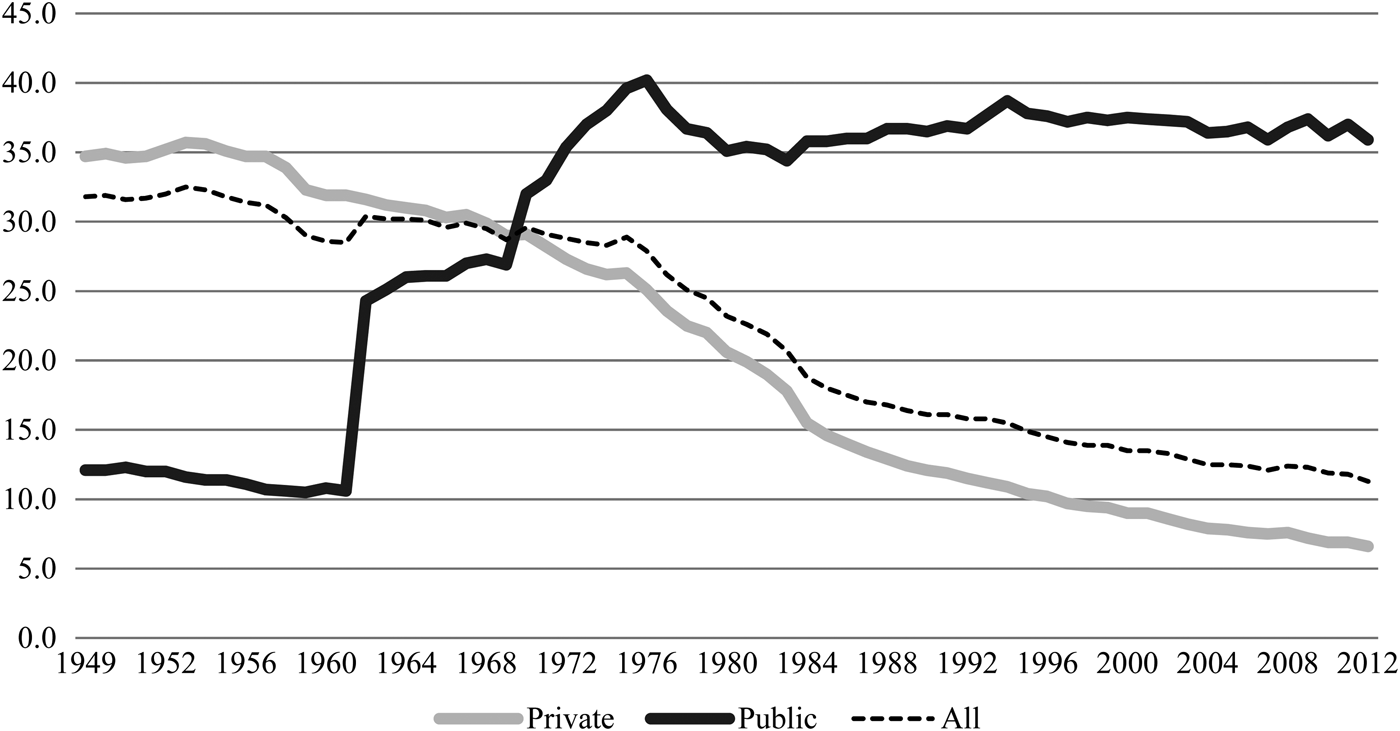
When we examine private and public sector union density together, the simple story of union decline becomes far more complicated. Figure 1 shows the striking divergence of private and public sector union density as a percentage of the total private and public sector workforce in the United States over the last half-century.Footnote 3 The two crossed paths in the late 1960s with private sector density continuing on a downward trajectory and public sector density increasing rapidly until plateauing at more than 35 percent by the end of the 1970s.
Public, Private and Total Union Density as a Percentage of the Total Workforce, 1949–2012.

Focusing only on the decline of private sector union density misses the more fundamental puzzle of the U.S. labor movement: Just as the private sector began declining, public sector union density surged over a brief twenty-year span and then plateaued. Why does the path of the public sector differ so significantly from the path of the private sector in U.S. history? In particular, why did public sector unionization rise so dramatically and then plateau at the same time as a precipitous decline in private sector unionization was occurring? To explain this puzzle, I provide an account that is sensitive to institutions and argue that the brief rise and then plateauing of public sector union density is the legacy of a distinct institutional arrangement—divided labor law—that was locked into place at a specific moment in time. In particular, the decision by the drafters of the Wagner Act to exclude public sector employees in 1934–1935—at a time when public sector unions lacked public support and momentum for their own national level law—created separate legal and institutional jurisdictions that private and public sector labor laws operate within, which had lasting consequences for organized labor's development.
Understanding the development trajectory of public sector unions reveals the powerful consequences that public policies and institutional arrangements—in this case federalism—can have on the strength and development of seemingly private organizations. The exclusion of public sector employees from the centerpiece of private sector labor law, the Wagner Act, left the question of public sector collective bargaining rights unanswered at the federal level, leaving the matter up to the states and localities to decide. While federalism created more opportunities for innovation, the lack of an institutionalized national floor of protection resulted in state and local provisions that are inevitably more unequal and vulnerable to retrenchment, as the most recent attacks in 2011 on public sector collective bargaining rights have made abundantly clear. Forced to pursue their own legislation, public sector collective bargaining rights were slow to develop as public sector employees struggled to overcome fears of public sector unionism and gain enough legislative momentum. When demand for public sector collective bargaining rights reached a critical mass in the 1960s—after private sector union density had peaked—political demand-making was relegated to the state and local level, with important ramifications for the quality and durability of public sector collective bargaining rights.
Most problematic for organized labor, bifurcated labor has shaped the size and strength of the labor movement as a whole. By delaying and limiting the growth of public sector union density, divided labor law put the public and private sector union movements' development out of alignment; private sector union density peaked nearly a decade before the first major statutes granting public sector collective bargaining rights were passed. The incongruent timing and sequencing of public and private sector union development represents a missed opportunity for organized labor: Private and public sector union strength peaked at very different times, preventing a strong union movement comprised of private and public sector unions at the height of their membership and influence. Instead, public sector unions grew as the power of private sector unions had already begun waning. Bifurcated labor law, by preventing a large public/private union movement, contributed to labor's inability to pass national labor law reform and the resulting decline in the size and strength of organized labor in the twentieth century.
Ultimately, we cannot fully understand the fate of private sector unions without studying the path of public sector unions. The timing, sequencing, and institutional arrangements of U.S. labor law have patterned labor relations over the last half-century, resulting in missed opportunities and divided fortunes for organized labor as a whole. Thus the remainder of this article will explore the unique development trajectory of public sector unions and the important consequences the public sector's path has had for the development of organized labor in the United States.
II. TRADITIONAL EXPLANATIONS OF UNION DENSITY
Traditional explanations of union density patterns in the United States have focused primarily on explaining private sector union density, particularly private sector density decline since its peak in the 1950s. These theories, on their own, cannot account for the unique pattern of delayed growth, a brief rise, and then plateauing of public sector union density.Footnote 4 First, economic arguments point to major changes in the economy, especially the emergence of new technologies, the rise of global competition and consequent decline in union strongholds such as manufacturing and growth of the service sector, part-time work, and other employment arrangements that have typically not been areas of union strength as the source of union decline. Thus unionization trends in the United States reflect changes happening to the overall workforce: Broad economic changes—such as deindustrialization—combined with wide-ranging societal changes—such as the rise of a highly educated, upper class—diminished all mass membership organizations and particularly hindered the growth of unionization.Footnote 5 Over the last half-century, jobs in traditional union strongholds such as manufacturing declined, whereas public sector employment grew from 6 million workers in 1946 to just under 30 million in 2010.Footnote 6 Private sector unions face an uphill battle to even maintain current membership levels given the annual loss of jobs in union-dominant industries and turnover as older workers retire, whereas public sector unions have the benefit of a growing workforce to target for unionization.
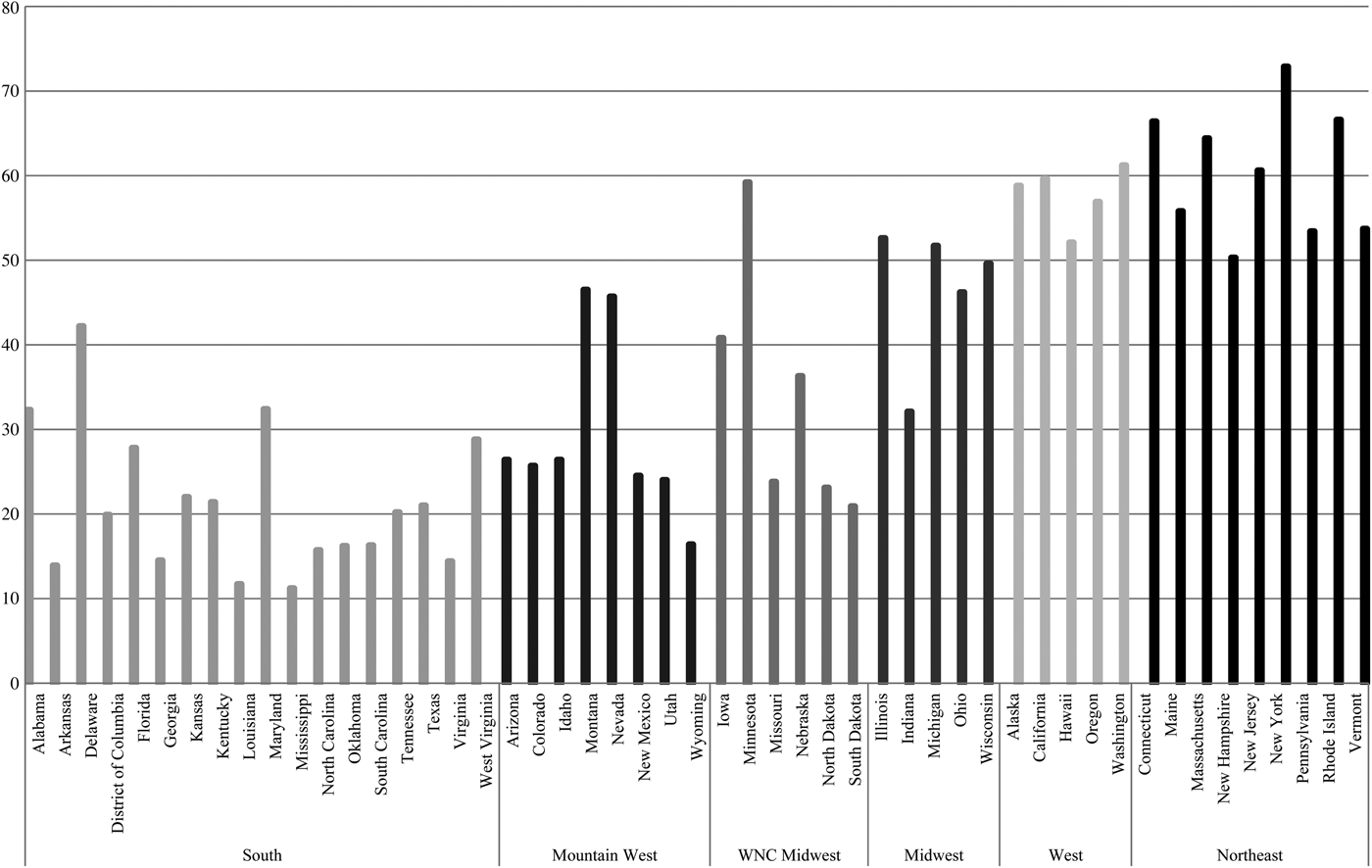
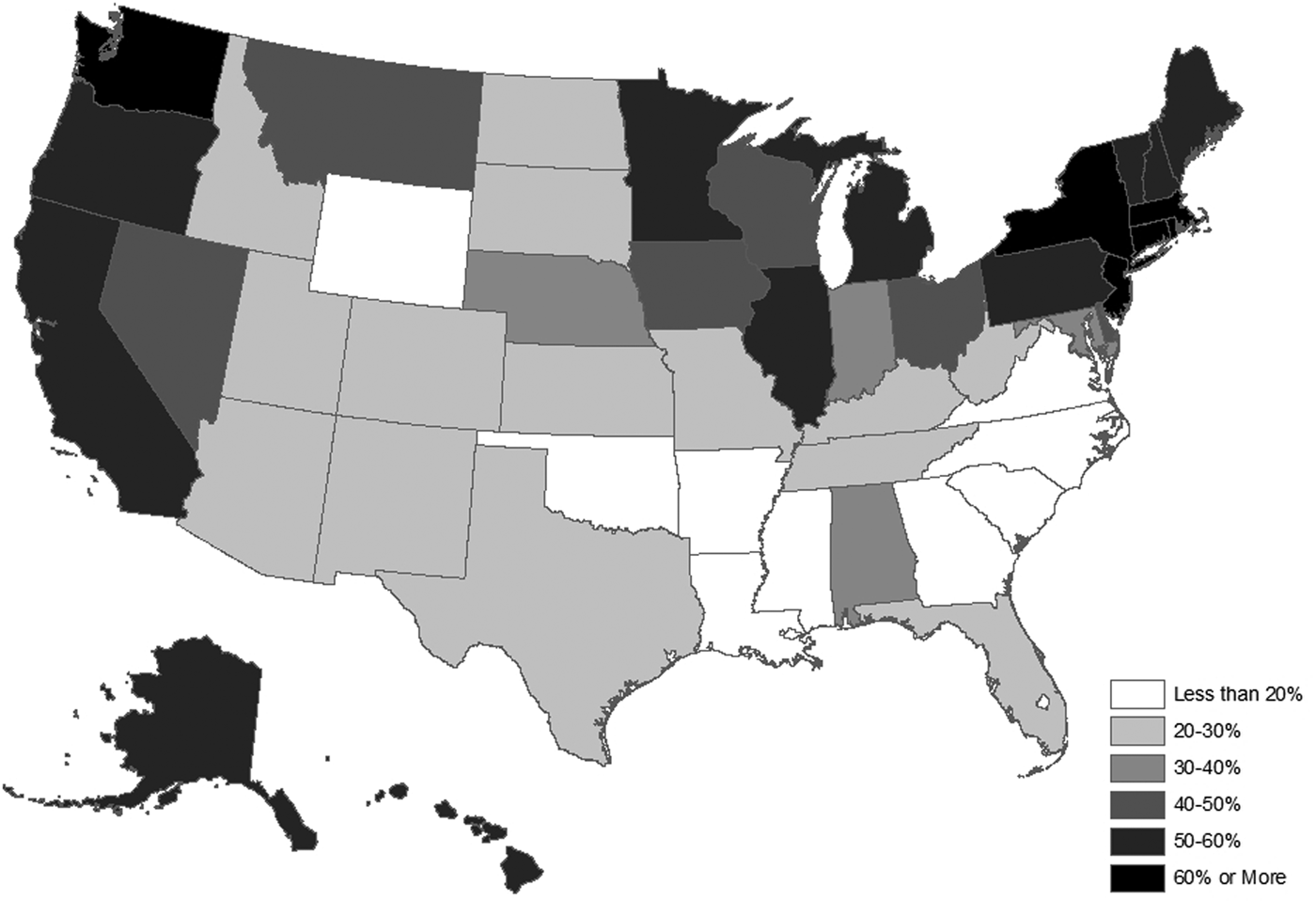
However, if this were simply a macroeconomic process, then we would expect economic indicators to predict passage of public sector collective bargaining laws and public sector unionization increases, but research has not found a significant link between the two.Footnote 7 Public sector unionization also varies tremendously across subjurisdictions. Although an economic explanation would expect some variation by state and region, the extent of divergence is surprising, especially between similarly situated states. As illustrated in Figure 2, states vary significantly in the percent of the public sector workforce that is unionized.Footnote 8 In 2010, Mississippi had the lowest density, with only 11.2 percent of the state's public sector workforce belonging to a union, but other states in the South had density levels approaching one-third of the workforce unionized, including Mississippi's neighbor, Alabama, with 32.3 percent. New York had the highest density with nearly three-fourths of the state's public sector workforce unionized. Texas had more than 1.64 million public sector workers, but fewer than 276 thousand were union members. In contrast, New York had just over 1.5 million public sector workers and more than 1 million were union members. Thus in 2010, nearly 50 percent more of New York's public sector workforce belonged to a union compared to Texas.Footnote 9 The extreme variation of public sector unionism across states and regions suggests that we need look beyond a purely economic account.Footnote 10
Public Sector Union Density by State and Region, 2010.
A second explanation for private sector union density patterns is cultural. Cultural arguments point to a distinct American ethos that evokes less sympathy toward unions, eroding union support and diminishing union organizing success. The cultural argument's most active and vocal proponent is Seymour Martin Lipset.Footnote 11 Using a most-similar systems comparison with Canada, he argues that
Higher union density in Canada, compared with the United States, is rooted in Canada's statist, social democratic traditions, which are in turn attributable to its Tory and decidedly European conservative lineage. The United States has an individualistic, laissez-faire tradition that is generally not supportive of more collectivist approaches.Footnote 12
This unique American culture has hindered the creation of a labor party and limited the passage of legislation that could support union growth.
For Lipset, the brief period of private sector union growth following the passage of the Wagner Act in 1935, rather than union decline, is puzzling because this pro-union period runs counter to U.S. political culture. He reasons that “only in extraordinary circumstances, such as war or prolonged economic downturns, has the United States moved closer to the statist model.”Footnote 13 The decline of private sector unionism since the unique moment of the Great Depression and World War II, for Lipset, reflects union density regressing to be more in line with the American cultural mean. However, the timing and durability of public sector union density challenges Lipset's cultural account. Returning to Figure 1, public sector union density rose beginning in the early 1960s, a period without the “extraordinary circumstances” of a war or prolonged economic downturn to explain the sudden growth of public sector unions. Further, public sector union density plateaued at the end of the 1970s and has remained relatively stable at over 35 percent since that time, rather than declining to be more in line with America's cultural antipathy to such communitarian endeavors.
In the following analysis, both economic and cultural forces are at play but are not sufficient on their own to explain the path of public sector union development. For the economic explanation, the growth of public sector employment certainly laid the groundwork for a large, public sector union movement to demand legal recognition in the 1960s and 1970s, but other factors shaped where and in what form this demand-making took place. For the cultural explanation, as I discuss later, there was a strong cultural bias against public sector unionism that set the public sector union movement back decades. Thus culture is certainly influencing attitudes, but it lacks the analytical specificity to explain much that is unique about public sector labor in the United States, including the brief rise and then plateauing of public sector union density; state and regional variation; and the volatility of public sector collective bargaining rights. Instead, culture should be seen as mediated through institutions: Culture can help create or close windows of opportunity, but attitudes and values are ultimately channeled through institutional arrangements, which in turn take on a life of their own. The design of institutions as well as the timing and sequencing of institutional development have consequences independent of their cultural origins. Thus only by understanding the interaction of culture and institutions can we make sense of American political development. Taken together, neither a purely cultural or economic explanation can account for the brief rise in the 1960s and 1970s and then plateauing of public sector union density. Instead, we need to turn our attention to institutions.
III. AN INSTITUTIONALIST EXPLANATION FOR PUBLIC SECTOR LABOR'S PATH
Drawing on Kathleen Thelen and Wolfgang Streeck'sFootnote 14 definition, institutions are defined here as “socially sanctioned, that is, collectively enforced expectations” of behavior and typically “involve mutually related rights and obligations for actors, distinguishing between appropriate and inappropriate, ‘right’ and ‘wrong,’ ‘possible’ and ‘impossible’ actions and thereby organizing behavior into predictable and reliable patterns.”Footnote 15 Thus we can think of political institutions—both formal institutions such as Congress and more informal institutions such as public policies—as active participants in politics that structure and constrain the behavior of individuals and groups, shaping a multitude of activities, including where actors target their political activities, what policy alternative are considered, and the potential for change.
When comparing the United States to similarly advanced industrialized nations,Footnote 16 American public sector labor law is distinct. In other industrialized nations, with very few exceptions, public sector workers possess the right to collectively bargain, and “a single, national collective bargaining law prevails for all public workers.”Footnote 17 As Chris Brewster and colleagues note, “[i]n most industrialized countries, public sector employment is synonymous with unionized employment; union membership…has been just as much a feature of public service as employment security.”Footnote 18 In contrast, there is no national level law governing public sector workers in the United States and various courts have held that public sector employees have no constitutional right to bargain collectively.Footnote 19
The absence of a national level law governing public sector labor relations has had important consequences for the development of public sector unions in the United States. In particular, the exclusion of public sector employees from the Wagner Act created a durable divide between public and private sector labor law. Private sector labor law was institutionalized at the national level with a growing body of case law to reinforce this position. In contrast, public sector collective bargaining was an open question. Public sector unions lacked the public acceptance and momentum to pursue national level protection on their own before the window of opportunity for such legislation closed; thus the question of public sector collective bargaining rights was left up to the states and localities. Barring public sector employees from the cornerstone of private sector labor law delayed public sector union expansion as cultural fears and limited public sector organizing prevented immediate legislation at the state and local level.
This delay was consequential for organized labor's timing and sequencing, placing public and private sector union development out of alignment. To understand organized labor, it is crucial to “know not just what, but when.”Footnote 20 Thus we must know not just that private sector and public sector employees obtained collective bargaining rights, but also when they obtained them in relation to each other. Public sector employees only started to gain such rights three decades after than their private sector counterparts. This delay is causally important because it shapes when the bulk of public sector unions formed and tried to join the labor movement—after the private sector had entered a period of decline.
Being attentive to timing and sequencing reveals how things may have been different, focusing our attention on the critical moments in time that lead to one outcome over another and bringing to light the counterfactuals in labor history.Footnote 21 These critical moments, by helping to reveal what could have been—a stronger, more resilient, and diverse labor movement—adds another chapter to the perennial debate first put forward by Werner Sombart when he asked in 1906, “Why is there no socialism in the United States?”Footnote 22 The delayed growth, incongruous timing of public sector union power, and the public sector's continued unequal and vulnerable collective bargaining rights all add a new layer to understanding why the labor movement in the United States has appeared relatively weak compared to other countries. This study should push us to be more attentive to the role of the state and public policies in understanding the U.S. labor movement's comparative weakness.
The division between public and private sector unions in the United States and the comparative weakness of the U.S. labor movement are not foregone conclusions, but rather the result of historically situated institutional developments and the politics they engender. Focus on passage of the Wagner Act illustrates the separate institutional environments created for private and public sector unions. As Paul Pierson notes, “In some cases, specific relationships are institutionalized through specific positive feedback…In still another group of cases, what is crucial is the failure of consolidation in this initial period, and the resulting persistent instability.”Footnote 23 Private sector labor law was consolidated at the national level with passage of the Wagner Act in 1935, and this consolidation has been reinforced through more than seventy-five years of National Labor Relations Board (NLRB) rulings. In contrast, public sector labor law was not consolidated during this time and has remained institutionally unstable since, as public sector employees have pursued collective bargaining rights in every state and locality, but without the institutionalized floor of protection that makes the national level more enduring. Divided labor law relegated public sector employees' subsequent political efforts to gain legal recognition to the state and local level—sites of demand-making where, lacking nationally institutionalized rights, the fruits of their struggle would never compare to their private sector counterparts.
The role of federalism in constraining and shaping the development of organized labor in the United States both affirms and challenges existing research on federalism. There is a tendency within federalism research to assume that federal arrangements that empower states and localities are either positive, enabling innovation at the local levelFootnote 24 or negative, enabling bastions of prejudice to be formalized into law.Footnote 25 As the following analysis will demonstrate, both assessments of federalism are accurate when looking at organized labor and David Brian Robertson's conclusion that “[f]ederalism's results are inconsistent; federalism has been used by and against Republicans as well as Democrats, liberals as well as conservatives, and innovators as well as those who resist change” is fitting.Footnote 26 However, previous research has underemphasized a central feature of American federalism that is illustrated by the distinct path of public sector labor in the United States: Federalism's results are inconsistent not just because states and localities have been laboratories for both liberal and conservative causes, but also because rights, left uninstitutionalized at the national level and relegated to the state level, lack the protections and egalitarianism of those set at the national level.
When rights are left unconsolidated at the national level and instead states and localities are given the freedom to define these rights, the rights granted at the state and local level are not only unequal but also inherently more tenuous due to the nature of this institutional instability. First, national level rights become reinforcing as case law over time creates path-dependent pressures to maintain existing law, whereas rights lacking such institutional consolidation are marked by “persistent instability.”Footnote 27 In Wisconsin, opponents of Governor Walker's bill to strip public sector collective bargaining rights in 2011 were on shaky ground to claim public sector workers have a protected right to collectively bargain because no national statute exists. Indeed, the Supreme Court has affirmed the lack of national institutionalization of public sector collective bargaining rights, rather than a floor of protection.Footnote 28 Second, absent a national standard, at any time, a state or locality has abundant examples of policy alternatives in action. For example, Governor Walker had the nearby state of Indiana as inspiration, whose governor had scaled back public sector collective bargaining rights in 2005. Third, groups engaged in political conflicts that have become intractable at the national level can often find more success capturing politics at lower levels of government. This tactic is particularly appealing when national law leaves an issue unaddressed—like public sector collective bargaining rights—enabling contention at the state and local level.
Fourth, federalism as a governing structure welcomes and even encourages variation and innovation at the local level. Supreme Court Justice Brandeis first invoked the metaphor of states as policy laboratories in a dissenting opinion in 1932, writing, “It is one of the happy incidents of the federal system that a single courageous state may, if its citizens choose, serve as a laboratory; and try novel social and economic experiments without risk to the rest of the country.”Footnote 29 Presidents from Ronald Reagan to Clinton to Obama have all included the idea of states as sites of experimentation in executive orders and memoranda they have issued regarding federalism.Footnote 30 As Ronald Reagan noted, it is “[the] nature of our constitutional system” that “individual States and communities are free to experiment with a variety of approaches to public issues.”Footnote 31 From Supreme Court justices to presidents, there is a pervading belief that experimentation at the state and local level is a natural, and laudable, feature of American federalism.
Finally, states and localities lack the expectations of national standards and equality—in other words, a floor of protection—that have been central to rights protections at the national level. Thus, dividing public and private sector labor law not only set labor on two different paths but also made them inherently unequal: Public sector labor law—lacking national institutionalization—has had more room for innovation, but the rights and standards established have been more vulnerable to outright retrenchment of collective bargaining rights. Leaving public sector collective bargaining rights unanswered at the national level, states answered the question in a variety of ways. Many states, not having to match the actions of other states, deliberately denied their public sector employees collective bargaining rights. As a consequence, states and localities remain sites where the basic tenets of public sector unionism can be contested leading to the volatility surrounding public sector collective bargaining rights.
Federalism is not the single, causal factor affecting the development of organized labor, but the divided nature of U.S. labor law has shaped the development trajectories of private and public sector union density in the United States. Divided labor law has channeled union behavior, prompting public and private sector unions to focus their collective bargaining rights demand-making at separate levels of government, and placing the timing and sequencing of public and private union development out of alignment. Thus when mounting public sector union militancy helped turn public opinion in favor of public sector unionism in the 1960s, public sector unions, lacking a national level law, targeted the state and local level for recognition of their collective bargaining rights.Footnote 32 The gains they were able to achieve at the state and local level occurred much later than the private sector unions—missing a crucial opportunity for a strong, united labor movement—and were mixed, unequal, and tenuous in comparison to the Wagner Act's unswerving commitment to all private sector workers. Labor's enduring divide began with an ostensibly minor decision within one clause of the Wagner Act that has had far-reaching ramifications.
IV. PASSAGE OF THE WAGNER ACT: A CRITICAL EXCLUSION
The National Labor Relations Act (NLRA), also known as the Wagner Act, was a cornerstone of New Deal legislation and the foundation for modern day private sector labor law. Passed in 1935, the Wagner Act provided federal protections to private sector workers' efforts to unionize, outlined anti-union practices employers could no longer use, and put in place the NLRB to oversee union representation elections, hear employee complaints, and interpret the Act in subsequent cases.
The NLRA is known as the Wagner Act because of the pivotal role Senator Robert F. Wagner played in the Act's passage. Senator Wagner was inspired to draft the Act because of his experience serving as head of the National Labor Board from 1933 to 1934, which was one of mounting frustration as existing statutes lacked the specificity and enforcement tools to protect the right to unionize in the face of employer resistance. During his tenure on the NLB, Senator Wagner instructed his legislative aide, Leon Keyserling, and his staff to draft a new law that would specifically outline illegal employer practices and make collective bargaining a reality for U.S. workers. The resulting Wagner Act stands out for its bold commitment to employee rights, particularly the opening proclamation that “[e]mployees shall have the right to self-organization, to form, join, or assist labor organizations, to bargain collectively through representatives of their own choosing, and to engage in other concerted activities for the purpose of collective bargaining or other mutual aid or protection.”Footnote 33 By affirming employees' right to self-organize and collectively bargain, the Act affirms a positive right of employees to join unions, placing the federal government firmly in the middle of industrial relations.Footnote 34
The bold and unswerving commitment to workers' rights did not apply equally to all workers in the Act. In an acknowledgment of the tenuousness of the New Deal coalition, particularly the Southern Democratic wing, the definition of employees in the Act excluded agricultural laborers and domestic servants.Footnote 35 In addition, employers in the Act were defined as “any person acting as an agent of an employer, directly or indirectly, but shall not include the United States or any wholly owned Government corporation, or any Federal Reserve Bank, or any State or political subdivision thereof…,” thereby excluding public sector workers.Footnote 36 The exclusion of agricultural and domestic workers was a de facto barring of many African Americans, women, and Southern laborers from the Act's protections, generating some controversy during the Act's passage.Footnote 37
In contrast, there was virtually no discussion of the exclusion of public sector workers from the Act. Our knowledge of the drafting of the Wagner Act is limited by what documents have survived—a variety of personal and public documents on the drafting, debate, and passage of the ActFootnote 38—which do not clarify explicitly why the drafters chose to exclude public sector employees. In early drafts of the bill, public sector employees were not specifically mentioned. Their exclusion did not come until Wagner's aide Leon Keyserling's fifth draft, sometime between January and June of 1934.Footnote 39 Keyserling's drafts include many notes and asides, but unfortunately the exclusion of public sector employees is typed with no notes on the topic to elucidate Keyserling's intentions.
Keyserling likely felt little need to discuss or explain the exclusion of public sector workers because those most affected, public sector employees, were not in a position to lobby on behalf of their own inclusion. In many of the leading public sector union publications, the Wagner Act was not mentioned before or after passage and The American Federationist, the American Federation of Labor (AFL)'s official magazine, includes much discussion on the Wagner Act but never addresses the exclusion.Footnote 40 Even more intriguingly, within the papers of the Wisconsin State Employee Association (WSEA), the founding local of the American Federation of State, County and Municipal Employees (AFSCME), the discussion of the Wagner Act is limited to wholehearted support. Arnold S. Zander, the Secretary of the WSEA and later the first president of AFSCME, wrote letters to Wisconsin's two senators as well as the representative for Dane County (which encompasses Madison, Wisconsin), urging them to vote in favor of the Wagner Act without mention of the exclusion of public employees.Footnote 41
The silence of one of the most prominent public sector unions of the time on the exclusion of public sector workers may seem surprising but, for the WSEA, pursuing collective bargaining rights would have been extreme overreaching given the climate toward public sector unionism at the time.Footnote 42 As will be discussed in the next section, during this period, policymakers, driven by the inherent differences between the private and public sector, as well as negative memories of earlier public sector strikes, viewed public sector unionism as a threat to democratic sovereignty that should not be allowed. In a 1934 letter to the Secretary of the Minnesota State Employees Association, Zander explained that “it is our hope that we will get some measure of recognition, at least from the next legislature…I doubt that we will make a direct request for recognition, but will present several bills, the passage of which would get our name in the statutes and give us some measure of recognition, although it might be indirect.”Footnote 43 Zander's wish that the Wisconsin legislature would offer an indirect acknowledgment of the name and existence of the WSEA is a vivid illustration of the difficulties public employee unions faced for even basic recognition, much less full inclusion in the Wagner Act, in the 1930s.
Public sector unions were silent on their exclusion and for the most part others were as well. The exclusion of public sector employees was only mentioned twice in the documents examined. First, on June 5, 1934, the American Civil Liberties Union (ACLU) wrote a letter to Senator Wagner, which outlined their opposition to the Act because, tellingly, they recognized many of the shortcomings of the bill and feared it “will inevitably serve as a weapon in the hands of employers to crush organized labor.”Footnote 44 Among the ACLU's fifteen pages of disagreements with the bill, they briefly note: “We see no reason why the United States should be exempted from the employers governed by the Act and, therefore, urge the amendment of section 3(2) by deleting the United States from the exemption.”Footnote 45 The letter has handwritten asides by Leon Keyserling that include his reactions, check marks next to proposed amendments, and other portions of the letter that are crossed out. Next to the ACLU's suggestion on public sector employees, Keyserling put two lines through the section and an “x” next to it. We cannot know Keyserling's thinking on the matter, but his notations suggest he either did not agree with the ACLU's suggestion or felt it could not or should not be included in the Wagner bill.
Public sector employees were mentioned a second time during the House Committee on Labor debate of the bill on March 19, 1935. Francis Biddle, chairman of the interim labor board, testified on behalf of the bill. Representative Ramspeck (D-GA) framed a theoretical question for Mr. Biddle in reference to mail carriers. Representative Dunn (D-MS) asked for clarification on whether mail carriers would be covered under the bill. This exchange followed:
Mr. BIDDLE. That is true; I was taking it as a theoretical question. They [mail carriers] would of course have no relief here. I suppose Mr. Connery [Chairman] in drawing the bill thought it wise to exclude Government employees as that is suggesting a debatable question and he did not want to overload the bill. The CHAIRMAN. We thought that Mr. Ramspect's [sic] committee will have to take care of that eventually. Mr. RAMSPECK. I was not objecting to that feature of the bill. I think the States and Government should be excluded. The CHAIRMAN. And I felt it would be a very good example to the Government and very unselfish.Footnote 46
Mr. Biddle suggests that public sector employees were excluded from the Wagner Act because there was a lack of consensus over their standing and including them in the bill would have overloaded the bill, likely meaning that public sector inclusion may have created undue controversy that could have prevented passage through Congress. The Chairman, Rep. Connery (D-MA), who was the House sponsor of the bill, responds by pointing out that he expects public sector employee collective bargaining to be handled by Rep. Ramspeck's committee, which is the Committee on Civil Service. Rep. Ramspeck went on to say that he agreed with the exclusion of public sector employees to the Wagner Act and the Chairman adds that he thinks the Wagner Act will be a nice example for public sector workers to follow.
This brief aside in a legislative history more than three thousand pages long cannot tell us conclusively why public sector employees were explicitly denied protection by the Wagner Act. However, taken together, the scant documentary evidence suggests three implications. First, Senator Wagner, Leon Keyserling, and other drafters of the bill were at the very least aware and consciously choosing to exclude public sector employees. Second, this exclusion was not discussed extensively and received little attention from those following the bill, particularly in comparison to other key exclusions like agricultural workers. Finally, public sector employees were likely excluded from the Wagner Act because there was no consensus on their inclusion: It likely would have generated controversy, and public sector labor law was seen as belonging in a separate discussion on the Civil Service because the nature of public sector employment did not entitle public sector workers to the same rights as their private sector counterparts.Footnote 47 During the Wagner Act's drafting and passage, its supporters could not be sure whether the Supreme Court would even uphold the law. The Court's “switch in time that saved nine” would lead the Court to ultimately affirm the constitutionality of the Wagner Act, but this was not a forgone conclusion in 1935. This uncertainty may have contributed to the decision to exclude public sector workers rather than increase the risk that the Supreme Court might overturn the law.
Ultimately, the exclusion was incorporated into the Wagner Act and signed into law. While the possibility of public sector employees being deliberately included in the Act was difficult given the fears of public sector unionism at the time, legislators need only look to Great Britain as an example of a country that had already provided collective bargaining rights to public sector employees, albeit with important distinctions from private sector employees' rights.Footnote 48 There was also the possibility that public sector workers would have inadvertently been included. Public sector unionism was still a relatively minor phenomenon at the time, especially when compared to the private sector union movement, whose very public strike wave in 1934 was still fresh on everyone's minds. Keyserling's first four drafts of the Act did not contain the exclusion and the issue of public sector unionism did not animate debate over the bill.
What minor discussion did occur during passage of the Wagner Act also suggests that national public sector collective bargaining rights was within the realm of possibility. During the congressional hearing discussed earlier, Chairman Connery remarked that Representative Ramspeck's committee, the Committee on Civil Service, “will have to take care of that [public sector collective bargaining rights] eventually.”Footnote 49 This suggests that Chairman Connery, at least, expected Congress to address the issue of public sector collective bargaining sometime after passage of the Wagner Act, although he is not specific about the time frame.Footnote 50 AFSCME and other public sector unions were still in their formative years in the 1930s and 1940s but growing and increasingly aware of the difficulties posed by their exclusion from the Wagner Act. For example, Marjorie MurphyFootnote 51 notes that over the course of the 1930s, teachers' unions, which had largely thought of themselves as professional associations, “gained a sense of definition, a place in the labor movement, and a firm grasp of the importance of trade unionism in their particular job.”Footnote 52 This growing awareness resulted in the American Federation of Teachers (AFT) at their 1936 convention complaining that “new labor legislation systematically discriminated against public employees” and calling for inclusion in the Wagner Act.Footnote 53 Thus there was some recognition within Congress and among public sector unionists that a national level law addressing public sector collective bargaining rights most likely would and should happen.
What Chairman Connery and the AFT could not have foreseen is how slow momentum for such legislation developed as public sector unions, excluded from the Wagner Act, had to start from the ground up building the case for their own legislation. The AFT may have become more politicized in the 1930s, but it would be several decades later before they received the legal protections to enable substantial growth in their membership. Likewise, public sector unions emerging in Wisconsin, New York City, and elsewhere in the 1930s did not blossom under a protected legal environment but instead had to engage in protracted legal battles for recognition that would take decades to come to fruition.
The Wagner Act was a unique legislative moment contingent on the cooperation of the Southern Democrats in the New Deal Coalition.Footnote 54 Recreating similar pressure and cooperation for a national public sector law after passage of the Wagner Act was a tall order. When momentum finally developed several decades later, the explicit exclusion from the Wagner Act channeled much of the public sector energy into the state and local level limiting the strength and durability of the rights gained. The public sector union movement that finally emerged came of age over a decade after private sector union density and power had peaked. Thus the choice to exclude public sector employees from the Wagner Act was a little discussed or debated decision at the time but has since had far-sweeping consequences for public sector unions and labor as a whole.
The passage of the Wagner Act in 1935 was consequential for the development of organized labor because it institutionalized private sector labor law while leaving public sector labor unresolved, resulting in the persistent instability and delayed growth of public sector unionism. As Paul PiersonFootnote 55 notes, timing and sequencing matters and when key moments pass, certain opportunities also can be lost, constraining future possibilities. For example, Jacob HackerFootnote 56 shows how the United States' passage of national health coverage for the poor and elderly, rather than the majority of working Americans, just as health care costs were beginning to skyrocket led to a series of developments that made the possibility of universal healthcare in this country increasingly remote. The Wagner Act was equally pivotal: Public sector workers were explicitly excluded from the Wagner Act, and it would not be until the 1970s that they would have enough momentum on their own to pursue a national level law—after the window of opportunity to pass such legislation had closed and after the private sector union movement had peaked.
The delayed recognition of public sector unions constrained public sector union growth at the very same time private sector union membership skyrocketed. Inclusion in the Wagner Act or their own national level law would have been a tremendous boon to the public sector union movement, still in its early stages of development. Having missed that opening, public sector unions lacked the strength on their own to seek a national level law—especially given that they did not have the momentum of the private sector union movement also focused on passing their own legislation. The only national level attention public sector employees had received was exclusion from the Wagner Act. Thus the public sector union movement's weak position and the lack of momentum for a national law pushed public sector unions to focus their demand-making for legal recognition at the state and local level. Paradoxically, however, leaving public sector labor law to the states and separating it from private sector labor law has allowed public sector unions to flourish when the absence of labor law reform at the national level has proven so disastrous for private sector unions. Thus the story of public sector labor law is both one of missed opportunities and modern (imperfect) innovation that has had striking consequences for labor in the United States. The next sections will explore in greater detail the decades following the passage of the Wagner Act to illustrate how exclusion of public sector employees set public sector unions on a different development trajectory than their private sector counterparts.
V. PRE-1960S: PRIVATE SECTOR LABOR'S HEYDAY BUT FRUSTRATION IN THE PUBLIC SECTOR
The pro-union legal and institutional environment realized with passage of the Wagner Act and massive war mobilization during World War II led to skyrocketing private sector union membership, reaching levels previously unheard of in U.S. history. Private sector union membership grew from just under 7 percent of the U.S. workforce in 1935 to 14 percent by 1939, a doubling of union density in just four years. Union density reached 23 percent by the early 1940s.Footnote 57 While private sector unions were riding high on the beneficial effects of the Wagner Act, public sector unions were struggling to gain legal recognition as the collective voice of employees in their workplaces. Judges routinely denied public sector workers any collective protections.Footnote 58 Public sector union successes for legal recognition were virtually nonexistent during this period because, across the United States, there was a shared understanding that public sector unionism should not be permitted.
Several features of public sector employment fed the idea that public sector unionism was inherently different and dangerous. First, the public sector is primarily involved in service provision of nontradable goods rather than industrial production. Thus when public sector unions strike, rather than halting the production of goods, they instead may halt vitally important services such as police and fire protection, public education, and mass transit. Second, public sector employers, unlike their private sector counterparts, are often elected officials. Thus public sector unions can influence their employers through collective bargaining and political action. Finally, the nature of public sector labor relations is fundamentally different: Profit and marketplace demands do not solely govern public sector labor relations and additional actors, such as voters and interest groups, complicate the simple bargaining relationship between the employer and employee.Footnote 59 As a result of these differences, some fear that the balance between union and employer may be disrupted with public sector unions exerting undue influence, thereby subverting the democratic process.
For judges and legislators during the 1930s and 1940s, public sector workers were seen as wholly separate from private sector workers because of their employer—the state, local, or federal government. In an open letter to the president of the National Federation of Federal Employees and the president of the Congress of Industrial Organizations (CIO), President Franklin D. Roosevelt (FDR) outlined the dominant position of the time:
All government employees should realize that the process of collective bargaining, as usually understood, cannot be transplanted into the public service…The very nature and purposes of government make it impossible for administrative officials to represent fully or to bind the employer in mutual discussions with government employee organizations.Footnote 60
By the very nature and purposes of government, FDR likely meant the differences listed earlier, which led him and other policymakers to conclude that public sector unionism was fundamentally different from private sector unionism and threatened the democratic, accountable relationship between an elected official and the voting public. An article in the Wall Street Journal succinctly stated the dominant fear of the time in the article's title: “Governed by Our Servants.”Footnote 61 Judges and policymakers' greatest worry was that public sector unions would tie the hands of policymakers and wrest power from elected officials to an outside group threatening state sovereignty.Footnote 62 The courts and policymakers coupled their fear of devolving democratic power to a private entity with fears that public sector unions would be identical to their private sector counterparts, including engaging in militant strike activity. This fear and subsequent backlash emerged in reaction to early public sector organizing efforts.
The first public sector employee actions can be traced back as early as the 1820s when workers in federal shipyards fought for a ten-hour workday.Footnote 63 Postal workers formed organizations beginning in the 1860s and the first teacher, firefighter, and police organizations emerged in the late 1800s.Footnote 64 These early organizations were met with outright hostility. At the federal level, President Theodore Roosevelt responded to postal worker political activism by issuing a gag rule forbidding federal employees from lobbying for legislation on their behalf.Footnote 65 The Lloyd-La Follette Act of 1912 overturned Roosevelt's gag rule, but hostility and union-busting efforts against federal workers continued. Such antagonism limited the expansion of public sector unionism.
At the state and local level, public sector workers' union actions were met with equal hostility culminating in the 1919 Boston police officer strike, which made national headlines. During the 1800s, police and firefighter associations formed to provide pensions and insurance programs for their members, but they quickly expanded to more closely resemble unions.Footnote 66 In 1918–1919, there was a particularly high number of police and firefighter strikes as part of the broader 1919 postwar strike wave. In September of 1919, the majority of Boston's police force went on strike for several days in what was seen by critics as a Bolshevik takeover.Footnote 67 The police commissioner refused the police officers' demands, did not recognize them as a union, and the strikers' were ultimately replaced. During the strike, there were several nights of mild lawlessness in the city that were heavily reported on by the media. Critics of the strike came to see it as an embodiment of what public sector unionism would become—unbridled chaos and a Bolshevist threat to America. Facing public condemnation and hostile government officials, the disastrous 1919 strike hobbled the public sector union movement for years to come.
Judges in particular continued to reference the Boston strike well into the 1930s and 1940s. Private sector union strike activity was growing and judges were fearful of enabling militant strikes among public sector workers by granting them collective bargaining rights. They rejected the possibility that public sector unions could be defined on different terms than their private sector counterparts.Footnote 68 The near universal dominance of this shared understanding of public sector unionism among judges and policymakers meant municipal agreements between unions and elected officials were a rarity as courts and legislatures sided unanimously against public sector unions. In 1941 and 1946, the National Institute of Municipal Law Officers (NIMLO), a group that sought to promote cooperation among municipalities on legal matters, surveyed state Attorneys General, available court decisions, and 365 city attorneys. Citing the threat to state sovereignty, they found unanimity that collective bargaining agreements between public employees and municipalities were illegal.Footnote 69
The findings of the NIMLO are not surprising; through the 1950s, the courts, state legislatures and municipalities overwhelmingly decided against public sector unionization. Public sector workers could be fired without legal recourse for joining a union. Yellow dog contracts were outlawed for private sector unions in 1932, but they were still permissible in the public sector well into the 1950s.Footnote 70 Laws recognizing unions as the collective bargaining unit of public employees would not be passed until the 1960s. Public sector unions were not strong enough on their own to push for such legislation, particularly given the public's and policymakers' fear of public sector unionism. Because the national and state legislatures refused to recognize public sector unions and the courts routinely sided against them, public sector unions only made headway by (a) organizing public sector workers without the guarantee of legal protections or collective bargaining and (b) finding individual towns, departments, or officials who were willing to acknowledge the union in negotiations. As a result, public sector union membership grew slowly through the 1950s, with few dividends for workers. Without legal recognition, public sector unions possessed limited bargaining tools.
VI. THE 1960S: PRIVATE SECTOR DECLINE AND A BIG STEP FORWARD FOR PUBLIC SECTOR UNIONS
During World War II and the years that followed, in the face of private sector labors' tremendous gains, anti-union forces did not fade away. The Taft-Hartley Act passed in 1947, over President Truman's veto, and weakened private sector unionism in this country by strengthening the power of management. The provisions in Taft-Hartley changed the course of private sector industrial relations in the United States. Whereas the Wagner Act affirmed the right of employees to unionize, the Taft-Hartley Act strengthened the power of employers and states to oppose unionization efforts. Momentum has largely been on the side of Taft-Hartley supporters ever since as obstruction in the U.S. Senate has prevented private sector labor law reform and judicial and NLRB decisions have “deradicalized” much of its protections.Footnote 71 As a result, the Wagner Act has become increasingly out of date for regulating modern labor relations, failing to reign in hostile employer resistance and ultimately contributing to the decline of private sector union density.
While private sector labor law reached an impasse after Taft-Hartley, major changes were happening to create a “window of opportunity” for public sector laws to pass at the state and local level.Footnote 72 Public sector employees drove the change by pressing for recognition of their grievances and defiantly organizing and joining unions regardless of legal provisions, forcing policymakers to address the issue. During and after World War II, public sector employment increased as the New Deal expanded the size and scope of the local, state, and federal government. The number of federal employees rose from just fewer than 1 million in 1945 to nearly 2.2 million in 1960. Likewise, the number of state and local government employees increased from 3.2 million in 1945 to more than 4.7 million by 1960, with the largest increases occurring in the 1950s.Footnote 73 Wages and salaries in these expanding fields still lagged behind the private sector, frustrating the growing federal, state, and local workforce and feeding their demand for representation.Footnote 74
As a result, public employees were increasingly forming and joining unions in spite of the lack of legal recognition and protection. As Irving BernsteinFootnote 75 notes, exclusion from the Wagner Act “did not forbid public workers to engage in collective bargaining, but prevented them from doing so within the carefully crafted NLRB system.”Footnote 76 Public employees seeking to redress grievances defiantly formed employee organizations, but these unions lacked many of the key hallmarks of private sector unions, including NLRB certification elections, arbitration processes, and the guarantee of employer recognition. These organizing efforts achieved some success at the municipal level where public sector unions had been organizing for some time.Footnote 77
For example, under Mayors Joseph S. Clark, Jr. and Richardson Dilworth, Philadelphia developed collective bargaining procedures and negotiated agreements for police, firefighters, and city employees during the latter half of the 1950s.Footnote 78 This was done despite the lack of state law empowering Philadelphia's mayors to take such steps. Founded in 1932, AFSCME, the American Federation of State, County and Municipal Employees, was at the forefront of driving such change. AFSCME grew steadily from 9,737 members in 1936 to 286,283 members by 1966.Footnote 79 AFSCME and other public sector unions such as the American Federation of Government Employees, which represented federal workers, as well as teacher, firefighter, and police unions, actively sought to change the legal climate for public sector bargaining through political activity. They represented an increasingly organized workforce with unaddressed grievances and no legal framework to cope with their demands.
Public sector unions were also emboldened by the Civil Rights Movement. African Americans often found greater success and acceptance in public sector employment, and they gained recognition and leadership positions within public sector unions and helped push for union progressivism on Civil Rights and heightened politicization overall.Footnote 80 AFSCME consistently was on the progressive wing of the labor movement and was particularly active in the Civil Rights Movement, but the AFT and other public sector unions' activities overlapped with the movement as well.Footnote 81 Moreover, the Civil Rights Movement's tactic of civil disobedience legitimized public sector unions' efforts to defy laws that criminalized their strike activity.Footnote 82 The social foment of the time over Civil Rights occurred in tandem with and helped fuel public sector unions' efforts to gain legal recognition.Footnote 83
In an era of growing social unrest, public sector unions' efforts were increasingly resulting in both formal and informal recognition. They engaged in heightened levels of demand-making, including strikes, despite the legal prohibitions against them. Public sector union leaders and members faced jail time and financial punishments for striking but, in some instances, succeeded in gaining union recognition and agreements to their demands. The public sector union movement's efforts helped shift the public's attitude on government unions. It is difficult to measure the climate of public opinion at the time, but newspaper coverage, academic discourse, and legal opinion from the period suggests a growing acceptance that public sector workers had the same need for representation as private sector workers.Footnote 84 Rising tolerance was undoubtedly helped by the fact that private sector union density reached its peak in 1953 with more than a third of the workforce unionized, making labor unions a normal part of American life.
Robust private sector unionism served as a powerful example for public sector employees to emulate, and the labor movement also offered support to the emerging public sector unions. Since the 1940s, the CIO was a vocal proponent of pro public sector labor laws and, after the merger with the AFL in 1955, the AFL-CIO increasingly moved from a vocal supporter to an involved ally in the effort for new legislation.Footnote 85 However, it would be misleading to attribute public sector success to the AFL-CIO. The AFL-CIO did not form a public sector unit until the 1970s, and relations between the more progressive (and rapidly growing) AFSCME and the AFL-CIO were strained at times—after all, public sector union power would require the current AFL-CIO leadership to relinquish some of their influence within the movement. In the end, powerful and active public sector unions and employees—frustrated by stagnating wages and the gains being made by private sector unions—demanded acknowledgment from their employers and the labor movement; it was their activism that drove the change in laws and within organized labor.
Public sector unions' demands were ultimately translated into law by the election of Democratic mayors, legislatures, and chief executives whose elections almost always preceded passage of public sector collective bargaining laws. Democratic politicians owed much of their success to the politically mobilized and active private and public sector unions.Footnote 86 In New York City, Mayor Robert F. Wagner, Jr. promoted public sector unionism because it provided him with loyal supporters independent of the city's political machine.Footnote 87 In Wisconsin, Governor Gaylord Nelson had served as a field representative for the municipal employees union and remained friends with the union's leaders prior to signing the state's public sector collective bargaining law as governor.Footnote 88 In the decade leading up to passage of the law, Democrats received 20–30 percent of their political funds from unions.Footnote 89 For Democrats and public sector unions, Joseph A. McCartin's conclusion is apt that “each side in that relationship knew well how much it needed the other.”Footnote 90 Public sector labor laws served as the fruits of the marriage between labor and the Democratic Party.Footnote 91 The public sector union movement's increasing activism made Democratic politicians take notice and provided the incentives for the passage of public sector collective bargaining rights. Newly elected Democrats attributed their success to labor's political prowess, and Democrats were self-interested in promoting increased public sector unionization.
Public sector unions' efforts and the assistance of Democratic politicians created a window of opportunity for passage of state laws acknowledging the legal standing of public sector unions. As SlaterFootnote 92 notes, “the legal regime had become brittle, as popular opinion and actual practices increasingly tolerated unions of government workers.”Footnote 93 Quantitative analysis of the emergence of public sector labor laws has identified several key factors that made some states more likely to pass pro public sector labor legislation than others. Berkeley Miller and William Canak,Footnote 94 for example, found that “the presence of strong statewide labor movements and earlier private sector union successes, the long-term incumbency of especially northern Democrats, and high levels of interparty competition” all were correlated with state laws favorable to public sector collective bargaining.Footnote 95 Interparty competition, Democratic Party electoral success and an already strong and established labor movement were evident in events that marked the turning point for public sector labor law.
Three events were particularly important during this period to help break open the “brittle” legal regime. First, in December 1961, in a highly publicized episode, the United Federation of Teachers (UFT) was recognized by the city as the collective bargaining representative of all city teachers. Lacking legal protections, New York City municipal workers agitated for decades to little avail until Robert F. Wagner, Jr. was elected mayor in 1953.Footnote 96 Wagner's support for labor could be traced back to his father, the architect of the Wagner Act. Upon entering office, Mayor Wagner created a department of labor and set the new department to the task of creating a labor policy for city employees. Wagner issued Executive Order 49 in 1958 in essence creating “a little Wagner Act for the city,” which through expansions over the next decade would come to cover all of the city's employees.Footnote 97 While the 1958 order was a milestone, the Act initially did not cover many of the city's workers including teachers.
The UFT formed in 1960 to organize and address teacher grievances in a more confrontational fashion than previous New York City teacher professional associations, especially the National Education Association, and force Mayor Wagner's hand on teacher exclusion from the city's little Wagner Act. On November 7, 1960, the UFT organized a strike involving more than one-fifth of the city's teachers.Footnote 98 The strike only lasted a day, but created enough pressure that Mayor Wagner formed a committee to put in place the framework for teacher collective bargaining.Footnote 99 The city's teachers first voted in June 1961 in favor of collective bargaining for teachers (27,000 for and 7,000 against). Then on December 16, 1961, receiving 20,045 of 32,390 votes cast, the UFT beat out rival teachers' unions to represent the city's teachers in collective bargaining.Footnote 100 Teachers, school boards, and unions across the country closely followed the events. The Los Angeles Times called it “one of the most significant events in the teaching profession” and a New York Times editorial declared that the success of UFT in New York City had “a significance that extends far beyond New York. It will set patterns for school systems everywhere and for the still ill-defined systems of collective bargaining in government.”Footnote 101 The developments in New York City inspired increased teacher activism and organizing to demand similar treatment in cities across the country.
The second key event was President Kennedy's signing on January 17, 1962, of Executive Order 10988, which recognized and protected the right of federal employees to join unions. The election of Kennedy, a Democrat from a northern union-friendly state, created an opportune time for new policies dealing with federal workers. One of the crucial developments pressuring Kennedy to act was that federal employees were already organizing. By 1961, fully one-third of federal employees, 762 thousand workers, were members of employee organizations but the executive branch had no definitive policy for addressing these groups' demands on issues such as wages, which lagged behind the private sector.Footnote 102 Recognizing the need to deal with federal employee organizations, nineteen different federal employee collective bargaining bills were introduced in Congress in early 1961. One of these nineteen bills was likely to pass but whether the form of the legislation was to the executive branch's liking was unclear.
If President Kennedy hoped to influence the outcome, he could not wait for Congress to act. Instead, the President created an informal study group to explore the issue and, after they recommended an executive order to sidestep the chaos of nineteen different pieces of legislation, formed a task force to draft the order.Footnote 103 The task force's recommendation of a comprehensive policy permitting many of the rights outlined in the Wagner Act but with key limitations, including barring the right to strike and upholding the primacy of Civil Service, was incorporated into Executive Order 10988.Footnote 104 While limited in the rights granted federal employees, the order was a milestone for public sector unionization and led to a rise in union organization with more than a million federal employees belonging to a union only five years later.Footnote 105 For the public sector labor movement more broadly, Kennedy's recognition of federal workers' right to unionize finally displaced the fear of public sector unionism and legitimized public sector workers' demands for legal recognition. However, the majority of public sector employees worked (and still do) for the state and local rather than the federal government making Kennedy's executive order largely symbolic: Absent a national law, collective bargaining rights would still have to be won at each state or locality for the majority of public sector workers.
Finally, on January 31, 1962, this newfound legitimacy was made real when Wisconsin became the first state to pass comprehensive collective bargaining rights for municipal public sector workers.Footnote 106 The law was the culmination of a decade of work by the founding AFSCME local, WSEA. WSEA had been politically active on behalf of its members since its founding in 1932 but struggled in the absence of legal protections. AFSCME's continuing demand for legal recognition in Wisconsin finally gained sway in the 1950s because of evolving public support for public sector unionization. Moreover, in the 1950s there was intense party competition in Wisconsin between the Democrats and Republicans with labor forming a core support for Democratic politicians in the state.Footnote 107 Democrats were keenly aware of the role labor played in their success and this spurred their support of labor law reform. Legislation was close to passing several times in the 1950s. The ultimate breakthrough came from the continued efforts of AFSCME and the election of the first Democratic governor in decades, Gaylord Nelson, and a Democratic state assembly.Footnote 108 Wisconsin marked the first in a large upsurge of state legislatures enacting public sector labor legislation over the next several decades.
The recognition of the UFT in New York City, Kennedy's issuing of Executive Order 10988, and the passage of collective bargaining rights in Wisconsin all occurred within the span of two months. They highlighted that existing labor law—or the lack thereof—was out of step with the increasingly mobilized public sector union movement and the nation's growing support of public sector unionism that the movement helped inspire. Increasingly prominent public sector unions and more regularized and legally structured collective bargaining helped foster acceptance of public sector unions—conditions that could have been met earlier if public sector unions received national level collective bargaining rights in the 1930s or 1940s. The change in the public's attitude was captured by NIMLO. In the 1940s, NIMLO had found overwhelming opposition to granting collective bargaining rights to public sector unions. Now, in 1968, NIMLO held a labor relations seminar devoted to the subject of public employment unionism. Instead of summarizing the wealth of legal and public opinion opposed to public sector unionism as they had in the 1940s, NIMLO in 1968 displayed a dramatic turnaround by discussing public sector collective bargaining rights as a foregone conclusion for municipalities.Footnote 109 The seminar met just days after Martin Luther King, Jr. was assassinated while assisting striking public sanitation workers in Memphis. In the shadow of this violent act and the subsequent rioting, participants believed “a revolutionary change in the employee relations picture of cities” had occurred.Footnote 110 As a result, municipalities must accept this “new endeavor” and plan, prepare, and adapt to this new environment by passing new labor legislation.Footnote 111 The participants in the NIMLO seminar were not exaggerating; the 1960s was a period of dramatic change for public sector union density and legislation.
While pressure for change in public sector collective bargaining rights had reached a boiling point, this pressure manifested itself in specific ways: The majority of activity took place at the state and local level by disparate union locals in separate movements for union recognition. The exception, of course, was federal employees who simultaneously lobbied at the federal level for changes to the Civil Service laws. The passage of the Wagner Act occurred during a unique window of opportunity that was difficult for public sector unions to match. Because they lacked the size and influence to pursue legislation at the national level and the Wagner Act left public sector unionism an open question, the states and localities became the locus of answering the question of public sector collective bargaining. The dispersed movements for public sector legislation reflect the federalized nature of U.S. labor law. Excluded from the Wagner Act and lacking their own national level law, public sector unions had to fight the battle in every state and locality.
Over the next two decades, dozens of states followed the example of Wisconsin by extending collective bargaining rights for public sector workers. Quantifying just how much legislative change occurred during this period is difficult because laws varied both in the degree to which they were universal or targeted specific workers, such as teachers, and in the generosity of their collective bargaining rights. Richard B. Freeman and Robert G. VallettaFootnote 112 compiled a data set attempting to measure the degree of probargaining or antibargaining laws for public sector workers in the fifty United States. Using their most stringent measure of probargaining, only five states qualified as probargaining in 1969. By 1984, twenty-one states qualified as probargaining.Footnote 113 Looking at change over time, forty of the fifty states moved in a probargaining direction from 1969 to 1984.Footnote 114 Henry S. FarberFootnote 115 used the same data set to assess the development of laws allowing collective bargaining for public sector workers in four categories of workers. Overall, “the total increased from one state in 1955 to over 40 states for firefighters and teachers and to over 30 states for police and state workers by 1979.”Footnote 116 The degree of reform is visually striking as well.
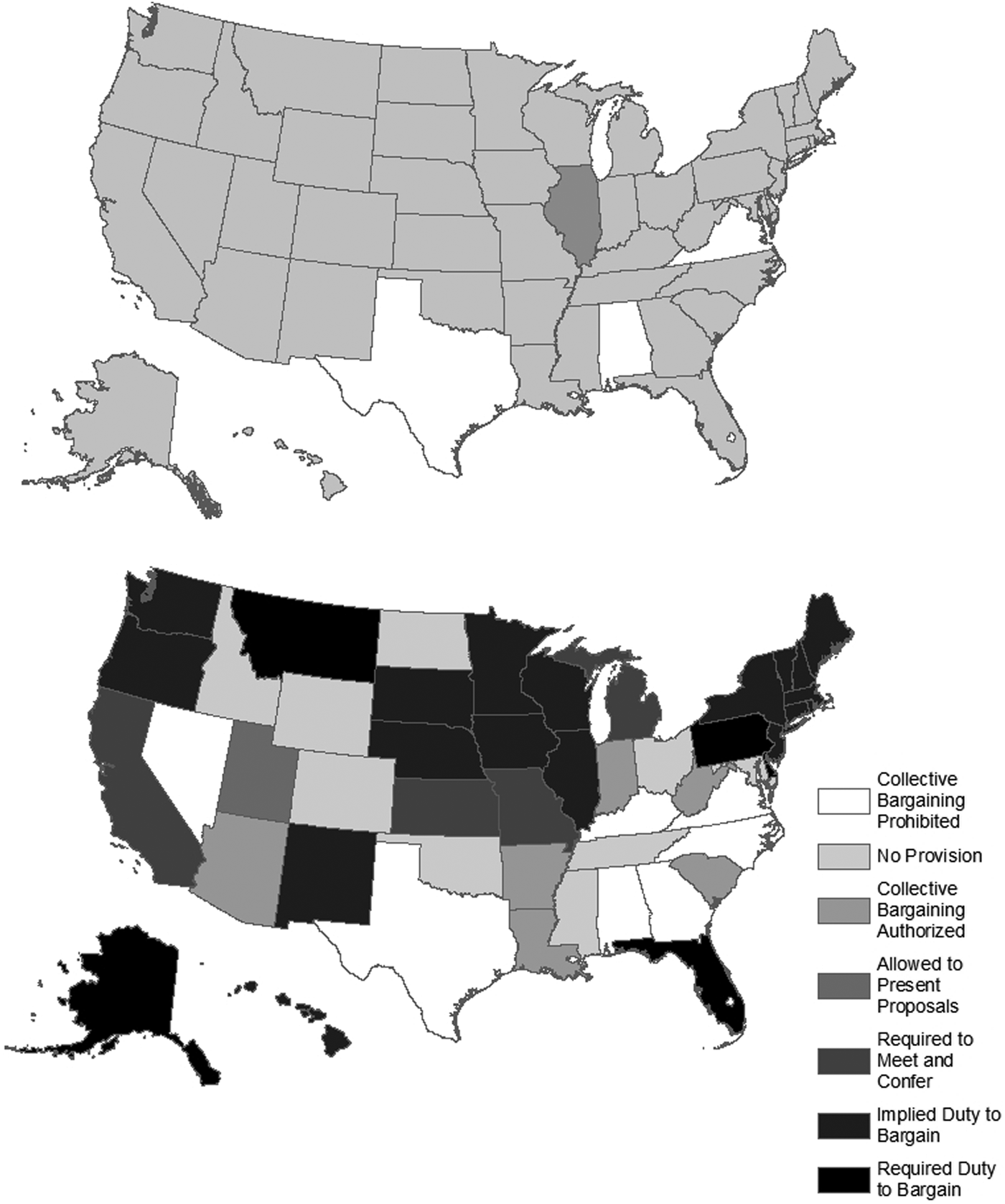
Figure 3 provides a visual illustration of how much change occurred during this period in the area of state employee labor law. In 1955, every state either prohibited or had no statute allowing state employee collective bargaining, save Illinois.Footnote 117 By 1980, only nine states still had no provision regarding state employee collective bargaining. Thirty-four states now granted state employees some degree of collective bargaining rights: six authorized but did not require the employer to bargain collectively with employees, one allowed employees the right to present proposals, four gave employees the right to meet and confer with their employers, eighteen had laws with an implied duty of employers to collective bargaining, and, most generously, five states explicitly required employers to collectively bargain with employees.Footnote 118 No longer was an entrenched opposition to public sector collective bargaining dominating the legal landscape.
The Proliferation of Public Sector Collective Bargaining Laws.
Probargaining public sector legislation has been associated with rising union membershipFootnote 119 and this was certainly the case during this time period. Public sector union density increased from 10.8 percent in 1960 to more than 35 percent in the 1980s.Footnote 120 However, probargaining public sector legislation is not enough to explain the rise of public sector unionization. With the Wagner Act, the private sector also had the foundation for robust organizing. However, the Taft-Hartley Act and labor law “ossification” led to rising employer resistance that has hindered private sector organizing.Footnote 121 The organizing environment in the public sector is very different from the private sector because there are unique pressures on public sector employers that prevent similar resistance to union organizing. Thus, once the legal barrier was overcome and public sector employees gained collective bargain rights, they had greater success due to the more hospitable organizing environment.
Two major factors led public sector employers to be less likely to resist unionization and commit unfair labor practices than private sector employers. First, public sector employers receive less pressure to resist and more pressure to behave civilly during organizing campaigns. Public sector employers are not beholden to shareholders' financial performance expectations and largely lack a profit motive that might encourage them to oppose unionization. Instead, they face pressures from their constituents to behave civilly and not break labor laws during union representation campaigns. As Kate Bronfenbrenner and Tom JuravitchFootnote 122 note, “[m]any public officials are elected and regardless of their individual attitudes are constrained from engaging in activities that the public might perceive negatively.”Footnote 123 Moreover, public officials likely face greater punishments for breaking labor laws (like removal from office) compared to the limited punishments at the NLRB's disposal: “put crudely, management opposition to unions can gain profits in the private sector; in the public sector, it can cost votes.”Footnote 124 In general, employers in the public sector have more to lose and less to gain by opposing unionization.
Second, public sector employers lack the same tools of union resistance deployed by private sector employers. Firing private sector workers seeking to unionize is one such tool. Workers who are fired by their employer for their organizing efforts can appeal to the NLRB, but remedies often come too little and too late. Public sector workers do not operate under employment-at-will rules that allow discharges for any reason. Instead, most public sector workers are protected under Civil Service laws and can only be fired with “just cause” and further enjoy due process rights if they are fired. Thus, “[i]f a union organizer is fired in the midst of a campaign, the burden is on the employer to establish that this was not a retaliatory dismissal and that there was a good reason (not just any reason) apart from the organizing campaign to fire the employee.”Footnote 125 Unlike the private sector, employers face the hurdle of justifying their firing of an employee seeking to organize and due process rights prevent the immediate firings without review. Thus, one of the most potent tools for private sector employers seeking to hamper unionization efforts is more difficult and less common in public sector organizing campaigns. Bronfenbrenner and Juravitch find that “[w]orkers in the private sector were almost six times more likely to be fired and not reinstated before a union election than they were in the public sector.”Footnote 126 Unlike in the private sector, public sector employees need not risk their jobs and livelihoods just for seeking to form a union.
These factors combine to discourage hostile employer resistance in the public sector. Without the virulent opposition private sector workers face, public sector workers have found greater success in union representation elections. Looking at all certification elections during 1991 to 1992, Bronfenbrenner and JuravitchFootnote 127 found that unions win 85 percent of certification elections in the public sector versus just 48 percent in the private sector. Remarkably, “[i]n almost one-quarter of all campaigns in the public sector, the employer did not campaign at all against the union.”Footnote 128 Employer resistance is not unheard of in the public sector, but it does not dominate the landscape. Instead, “[p]rivate sector employers are six times more likely to commit unfair labor practices such as discharges for union activity, and more than twice as likely to use other tactics such as captive-audience meetings, employer leaflets and mailings, supervisor one-on-ones, and illegal wage increases.”Footnote 129 The passage of probargaining legislation in many states combined with more amicable labor relations in the public sector to promote union organizing efforts since the 1960s.Footnote 130 Once the legal barriers to public sector unionization were overcome, the more amicable employer relations in the public sector enabled public sector union density to expand.
The public sector union militarism of the late 1960s and 1970s is a vivid illustration of what a growing public sector movement buoyed by new state, local, and federal laws had become. For example, Martin Luther King, Jr. was in Memphis on the fateful day in 1968 to show solidarity with striking AFSCME municipal sanitation workers. While strikes were technically illegal for the vast majority of public sector workers, this did not stop teachers, policemen, firefighters, and other public workers from taking such action in increasing numbers. In 1958, there were fifteen public sector strikes involving 1,730 workers. By 1980, there were 536 strikes involving 223,600 workers.Footnote 131 Such activity was indicative of the rising prominence of organized public sector workers and their implementation of disruptive techniques to accomplish their goals. At the time, public sector unions appeared to be a permanent fixture with growing influence in local, state, and federal politics.
VII. 1980S TO TODAY: CONTINUED PRIVATE SECTOR UNION DECLINE, PUBLIC SECTOR UNIONIZATION PEAKS
The existing legal and institutional framework governing private sector labor relations created major stumbling blocks for unions to maintain or expand their membership during the past half-century. The only area of private sector labor law that has evolved over this time period is the provision left up to the states—right-to-work statutes banning union shops. States have been given leeway in their anti-union efforts, rather than permitted to pass stronger labor protections than the federal framework provides.Footnote 132 On this point, Dorian Warren'sFootnote 133 assessment is apt: “[t]he fate of the American labor movement is political, not economic, and labor policy is decisive in shaping its trajectory.”Footnote 134 Obstructionism ensured that existing labor law has become increasingly out of date, hampering labor's efforts to organize new private sector members and encouraging employers to resist more forcefully, even in the face of a union movement on the ropes.
For the public sector, the early 1970s seemed like a time of great potential. Buoyed by rising public sector union density and frustrated by the inadequacy of piecemeal state laws, Jerry Wurf, the president of AFSCME, aimed to pass a national Wagner Act for public sector workers.Footnote 135 A series of proposals sought to either set up a legal framework akin to the Wagner Act or simply extend the Wagner Act to cover public sector workers.Footnote 136 In his detailed account of the effort to pass a public sector Wagner Act, Joseph A. McCartinFootnote 137 concludes that such a proposal was close to passing until the summer of 1975 led the Supreme Court to yank the constitutional rug out from under the proposal. The Court was set to decide on extension of the Fair Labor Standards Act (FLSA) to state and local workers in 1975 when the swing vote, Justice Blackmun—still on the fence—supported delaying the decision over the summer. The delay meant that the Court's decision came after the roiling public sector conflicts of the summer.
Public sector union militancy was already high when municipal and state fiscal crises rocked the country in 1975. States responded to severe budget crises by slashing spending, which hit public employees especially hard. Public employees were loath to accept such measures and strike activity rose 24 percent that year.Footnote 138 Massive strikes in New York, Seattle, and other cities became front-page news and angry mayors (Republicans and Democrats) lashed out at public sector unions seen as frustrating their efforts at fiscal austerity. The strikes damaged Democratic support for federal public sector labor law; fueled the public's perception that public sector unions had become too powerful; provided an effective rallying point for the conservative backlash that would follow; and, most crucially, influenced Justice Blackmun to vote with the majority in National League of Cities v. Usery Footnote 139 that extension of the FLSA to state and local workers violated states' rights.Footnote 140 The Court's decision was highly contingent on the political events of the time and marked a surprising turn, given earlier decisions made extending similar rights under the Commerce Clause.Footnote 141 If the Supreme Court found the more benign extension of minimum wage and overtime laws to state and local employees unconstitutional, then it was assumed that a national public sector labor law would surely be defeated on a legal challenge. The dramatic turnaround of the Supreme Court in the late 1930s to uphold Roosevelt's New Deal legislation is well known. The Wagner Act benefitted from the Court's new approach when they upheld the Act in the 1937 decision National Labor Relations Board v. Jones & Laughlin Steel Corporation under the Commerce Clause. In the decades that followed, there were indications that the Court would uphold a national public sector Wagner Act using the same justification.Footnote 142 When public sector unions finally had the numbers and organizational capacity to push for a national labor law of their own, however, the political controversy surrounding the municipal and state fiscal crises had already shifted the Court's majority against upholding such a law.
The 1976 decision in National League of Cities halted public sector labor's dream of their own Wagner Act, marked a turn by policymakers against public sector unions, and forced public sector unions to continue their efforts for collective bargaining rights at the state and local level. Joseph McCartin's account is an invaluable description of this missed opportunity; however, his conclusion that failure to pass a national Wagner Act for public sector employees in 1975–1976 “marked the turning point for the once expansive public sector labor movement” misses the longer time horizon of public sector union development.Footnote 143 The turning point for public sector unions came much earlier when the exclusion of public sector employees from the Wagner Act and the failure to pass their own national legislation in the 1930s and 1940s led to separate development trajectories of public and private sector unions. This earlier turning point has had far more sweeping consequences for organized labor.
Passage of a national Wagner Act for public sector employees in the 1970s would have alleviated the unequal and vulnerable nature of public sector bargaining rights facilitated by federalism and institutional instability, but the bottom line is this change could not undo the crucial moments of timing and sequencing that had already passed. By the 1970s, the private sector union movement had already peaked in membership. Thus the failure to pass a national Wagner Act for public employees in the 1970s was another blow to a labor movement that had already missed their greatest opportunity for a large public and private union movement. National League of Cities entrenched the existing legal divide: The situating of public sector labor law at the state and local level, which had been reinforced by the weakened capacity of public sector unions and cultural antipathy toward public sector unionism, now received greater legal force.Footnote 144 The brief moment of public sector union growth—already delayed—was over. Public sector union density has remained relatively steady since that time, making the 1960s–1970s a short-lived period of remarkable growth for public sector unions.
VIII. THE CONSEQUENCES OF LABOR' ENDURING DIVIDE
Absent a national public sector labor law, public sector unionism was ultimately limited because state and local level innovations delayed union expansion and proved to be imperfect approximations of the Wagner Act. The lack of an overarching federal law has contributed to the dramatic variation and regional concentration of state level public sector union density.Footnote 145Figure 4 illustrates the extent to which public sector union density is geographically concentrated. As discussed earlier, states with a strong existing union movement and Democratic governors and legislatures were more likely to pass pro public sector collective bargaining laws, two features that were already regionally concentrated in the 1960s and 1970s. As a result, the regional nature of labor has continued unabated with the rise of public sector unionism. States where more than 40 percent of the public sector workforce is unionized are limited to parts of the West, Midwest, and Northeast. Nearly all of the South, Mountain-West, and Central-Midwest have less than 30 percent of their public sector workforce unionized.Footnote 146 Labor's geographical concentration, both public and private, is remarkable: “[f]ully one-half of all union members lived in only six states by 2000.”Footnote 147 Thus, while labor represents close to fourteen million Americans, its electoral clout is limited by its geographical concentration. Continued geographical concentration is particularly problematic for organized labor because it suggests that the possibility of a filibuster-proof supermajority in the Senate to support federal labor law reform is increasingly remote.
Percentage of Public Sector Workforce That Is Unionized, 2010.
If public sector employees were included in the Wagner Act or had these workers been able to pass their own national public sector law before the closing of the window of opportunity in 1976, we could imagine a different outcome. Public sector employees likely would have had greater success organizing in anti-union states than their private sector counterparts because of the constraints public sector employers face that prevent serious resistance to unionization. Private sector unions have struggled to organize new members as a result of the outdated legal framework that fails to contain employers' union avoidance strategies; hostile employer resistance—and the legal framework that permits it—is a significant barrier to union organizing at the federal level. This barrier would likely not be so debilitating for public sector unions because employer resistance is less severe in the public sector. Public sector employers face pressures that discourage such vehement resistance and lack many of the tools, such as employment-at-will, which private sector employers use to resist union organizing.
The success public sector employees have had organizing in anti-union states despite possessing no collective bargaining rights gives a sense of this possibility. Returning to Figure 2, the lowest public sector union density is still more than 10 percent in states that have no public sector collective bargaining rights. Public sector union density over 10 percent in these states is certainly due in part to federal employees, but also because public sector unions have successfully gained limited recognition from some school boards and municipalities despite the legal prohibitions.Footnote 148 Today's public sector union density levels in anti-union states represent what public sector unions have been able to achieve despite the lack of collective bargaining rights, which suggests great possibilities for growth if they were given a legal foundation to support their efforts. Instead, public sector unions have had to pursue collective bargaining rights on a state-by-state basis and have been prevented from making significant inroads in anti-union states reinforcing the geographic concentration of labor.
Public sector unions found success and expanded their membership at the same time private sector unions were being frustrated at the national level, but the victories made at the state and local level were not equivalent to the Wagner Act. The multiple points of access at the state and local level provide opportunities for reformers but decentralization and institutional instability inevitably results in laws that lack the kind of national standards needed to promote equality.Footnote 149 Legislative reforms were hard won and highly variable. In states strongly opposed to unionization, there were just as many veto points for public sector unions to navigate as private sector unions have faced at the national level. The result for public sector labor law is what AFSCME has declared “a patchwork quilt of conflicting, confusing and often inadequate legislation.”Footnote 150 This patchwork quilt includes an estimated “110 separate state statutes governing public sector labor relations, augmented by numerous local ordinances, executive orders, and other legal authority.”Footnote 151 A third of states either explicitly outlaw collective bargaining for public sector employees or have no statute addressing the issue.Footnote 152 Other states vary tremendously in their level of probargaining and which groups of public sector employees are included or excluded.
Provisions frequently apply differently for teachers, state employees, police, and other public sector workers. One of the areas of greatest variation is whether the state or locality permits public sector employees to strike, but states differ on even the most basic tenets of collective bargaining, including which groups of public sector workers are permitted to unionize and over what issues they may bargain. One consequence of this variation is that an estimated 33 percent of local and state employees, equaling 6 million workers, did not have collective bargaining rights in 2002.Footnote 153, Footnote 154 Federalism is synonymous not only with variation, but also, as Aaron Wildavsky identified nearly thirty years ago, “federalism means inequality.”Footnote 155 Suzanne MettlerFootnote 156 notes that “when social and labor policies have been left in the hands of states and localities, standards have been lowered or neglected in more areas than not.”Footnote 157 Public sector bargaining law is certainly no exception. Leaving public sector labor law uninstitutionalized at the national level and relegating it to the states not only lowered standards and created unequal treatment but also left labor law more vulnerable to the vagaries of the states.
Whereas the Wagner Act created a fundamental right of private sector workers to unionize, the rights of public sector employees has proven more vulnerable. There is no firm commitment at the national level that public sector “[e]mployees shall have the right to self-organization, to form, join, or assist labor organizations, to bargain collectively through representatives of their own choosing.”Footnote 158 Instead, federalism as a governing structure welcomes experimentation and innovation at the state and local level. Moreover, private sector labor law was institutionalized at the national level whereas public sector labor law went unaddressed, resulting in institutional instability ever since. The recent conservative turn in state legislatures across the country illustrates the precarious nature of public sector labor law and an important lesson about federalism: “for every liberal state policy ‘laboratory,’ there are at least as many—or more—conservative policy laboratories.”Footnote 159 Lou CannonFootnote 160 notes that “as of mid-June [2011], 49 bills had been enacted in 23 states and Puerto Rico that included some form of restriction on collective bargaining in the 2011 session.”Footnote 161 Even before the most recent wave of attacks, changes in public sector bargaining laws have been frequent and often regressive.Footnote 162 The attacks in Wisconsin, Ohio, Indiana, and elsewhere demonstrate the mixed blessing of federalism: excluding public sector workers from the Wagner Act allowed them to succeed at the state and local level while private sector unions struggled to reform federal law, but innovation can go both ways and public sector collective bargaining rights have been retrenched as well.
The one aspect of private sector labor law left up to the states, Section 14(b) of the Taft-Hartley Act, which enables states to pass right-to-work laws banning union shops, further illustrates the heightened legal vulnerability at the state and local level. Taft-Hartley left the question of union shops up to the states and, as a result, states have answered and continued to answer this question in a variety of ways. Michigan has been at the center of private sector union power since the great auto plants were unionized in the 1930s and was home to some of the most potent displays of union strength (including the 1934 General Motors sit-down strikes) in U.S. history. In 2011 Michigan passed right-to-work legislation, vividly illustrating the legal vulnerability that occurs when federal legislation defers a question to lower jurisdictions without establishing a floor of basic protection. Without this floor, public sector union collective bargaining rights, and private sector union shop provisions, have remained vulnerable to retrenchment.
Finally, the lack of national Wagner Act for public sector employees led public sector employees to pursue collective bargaining rights in every state and locality—a time-consuming process that delayed public sector union expansion. Divided labor law consequently “artificially repressed” public sector union expansion as the absence of a national law for public sector employees dampened union organizing at the very time public sector employment began to grow.Footnote 163 Artificially repressing public sector union expansion resulted in the incongruous development trajectories of public and private sector unions as each sectors' union movement peaked at different times, weakening the labor movement as a whole.
Public sector union growth came after the peak of private sector union strength, too late to join forces with the private sector union movement to effect change in postwar U.S. politics.Footnote 164 If given the chance, public sector unions could have made inroads in anti-union states that may have been decisive in growing the labor movement, increasing its political influence, and helping to push for crucial national labor law reform. Instead, public sector unions gained power in the 1970s when the national fiscal crises and conservative backlash were placing increasing pressure on the union movement.
The timing and sequencing of when public sector employees gained their collective bargaining rights compared to their private sector counterparts is also crucial because labor unions' power and influence comes not from the sum of the individual unions but also through their organization into a larger federation, the AFL-CIO. The timing of public sector union growth meant private sector unions peaked when almost all public sector employees still lacked collective bargaining rights. The late arrival of public sector unions—arriving during a period of strained resources and economic, political, and cultural conflict in the 1970s—fostered conflict within the labor movement.
Because of their artificial repressed growth, the public sector unions' fight for workplace rights and legal recognition took place not during the economic boom of the postwar years but rather during the midst of economic crises that made their claims and militant tactics easily criticized, alienating private sector union members.Footnote 165 Instead of growing during the peak of private sector unions gains in the postwar years, public sector union demands took place during a period of scarcity. The timing of the public sector's growth pit their needs for robust local, state, and federal budgets against the private sector's declining incomes fostering moments of conflict and lack of understanding between private and public sector unions and ultimately limiting the growth of public sector unions and the possibility of a strong, vibrant public and private sector union movement. The delayed growth of public sector unions meant the AFL-CIO was never comprised of a unified union movement representing private and public sector unions, both at their peak of power and membership.
IX. CONCLUSION
It is only through exploring the unique division within U.S. labor law between the private and public sectors that we can understand the dual trajectories of public and private sector union density in the United States. As a consequence of their exclusion from the Wagner Act and lacking the power in the 1930s and 1940s to pass their own national law, public sector unions were forced to pursue their collective bargaining rights at the state and local level. Public sector labor law was thus decided by each state individually leading to scattered, slow to develop campaigns for such legislation. It was only in the 1960s and 1970s that supporters gained enough momentum to pass laws among labor-friendly states, at the very time private sector unions were struggling to get any reforms through Congress and their density levels began declining. The location where public sector employees pursued their collective bargaining rights—the state and local level—and the delayed emergence of this legislation was shaped by the critical exclusion of public sector employees from the Wagner Act and the failure of lawmakers to create a national level law for them. Thus, through an analysis that is sensitive to institutions, the central role of divided labor law in shaping the development of organized labor becomes clear.
When taken together, the story of private and public sector unions is double-edged. On the one hand, public sector unions were excluded from federal statutes creating a floor of protection for private sector employees and this hindered their growth at the very time, spurred by the Wagner Act, that private sector unions were flourishing. On the other hand, because public sector labor law was relegated to the states and localities, public sector unions were successful in pushing for new laws that promoted their growth, even as private sector unions withered under employer resistance and an obstructionist Senate.
In the long run, however, divided labor law has not done organized labor any favors. The lack of a national statute has resulted in the persistent instability of public sector labor law. Absent a floor of protection and pressure for uniform treatment across jurisdictions, public sector collective bargaining rights have been unequal and under continual experimentation, including retrenchment, at the state and local level. Public sector unions would likely have more success than private sector unions making inroads in hostile states if given the chance through a national level law protecting their collective bargaining rights because of the constraints on public sector employer resistance. Instead, public sector unions are limited in their growth by the passage of statutes in anti-union states and renewed attacks in previously safe states; their geographic concentration and vulnerability are a result of the piecemeal nature of public sector labor law and the inherently more tenuous nature of state and local laws in a federal system. Thus, while the public sector union density spike in the 1960s–1970s slowed the decline of total union density, this trend is unlikely to continue as public sector unions have reached the limits of state level innovation.
What about the private sector? Would they benefit from private sector labor law devolving to the state and local level in order to end the national stalemate as Richard FreemanFootnote 166 and other have suggested? In the short run, private sector union density might increase as employees' collective bargaining rights would be strengthened in union-friendly states. Ultimately, however, this would leave private sector employees just as vulnerable as their public sector counterparts to retrenchment of their fundamental collective bargaining rights. The consequences of public sector unions pursuing collective bargaining at the state and local level, without a federal floor of protection, suggests that a national law protecting both public and private sector collective bargaining rights would offer the most protection and hopes for expansion for U.S. labor unions.
Most fundamentally, while changing labor law now would undoubtedly have important benefits for organized labor today, a crucial opportunity for a stronger labor movement has already been lost; separation of public sector labor law from private sector labor law prevented a large public and private union movement in the aftermath of the Wagner Act that could have pressed for more generous New Deal policies. The period from 1935 to 1970 was a brief moment of explosive private sector unionization.Footnote 167 Public sector unionization came at the tail end of this period, missing the moment when private and public sector union strength, both at their peaks, could overlap.
Tracing the separate development trajectories of public and private sector unions leads to one fundamental question: “What would have happened if the most political unions [the public sector unions] had been larger and more influential in the labor movement's formative years, or when labor was larger and more influential within society as a whole?”Footnote 168 The conclusions reached in this article emphasize the overwhelmingly negative effects of divided labor law on the size and strength of organized labor as a whole. Public sector union growth came after the peak of private sector union strength, too late to have a significant effect on New Deal politics, assist in the opposition to Taft-Hartley in 1947, or help exert pressure for national labor law overhaul before the window of opportunity closed at the end of the 1970s. Divided labor law delayed the growth of public sector unions at the very time that their power and influence could have overlapped with the private sector union movement at its height. This incongruent timing meant U.S. politics never witnessed a labor movement whose combined strength was greater than the sum of the separate private sector and public sector union peaks of the 1950s and 1970s respectively.
Looking toward the future, the volatility surrounding public sector collective bargaining rights will persist as long as states and localities remain sites where the basic tenets of public sector unionism can be contested. Without major partisan shifts in the American states, public sector unions are unlikely to dramatically increase their density. In those states where public sector unions have had success, their enduring high density has made them glaring targets as private sector union density continues to drop. Absent something drastic that enables an overhaul of private sector labor law or a federal guarantee for public sector collective bargaining rights, the U.S. labor movement faces an uphill battle to retain existing membership levels and political relevance. Organized labor confronts an uncertain future in part because of the constraints placed on it by public policies, which have molded and patterned the labor movement's development. Divided labor law shaped the development trajectory of public sector unions—including their more unequal and vulnerable collective bargaining rights—as well as contributed to today's declining, geographically concentrated labor movement. Ultimately, divided labor law has weakened organized labor as a political force with potentially important ramifications for the representation of the working class in American democracy.