I
In a storage area of the Musée de la Musique, at La Villette in Paris, stands a crate in which sits a bizarre instrument. This instrument started life as a harmonium, perhaps manufactured in Paris in the 1840s or early 1850s by a builder such as Debain.Footnote 1 By the mid 1850s, it had somehow found its way to Shanghai, although why it was sent there remains a matter of speculation. It could have been the property of a wealthy French resident or other foreigner, or it might have been sent as a gift to French missionaries, principally Jesuits, who had by that date an extensive network of missions and churches in and around the city.
Nothing of the harmonium survives inside the instrument: a quick look reveals that the harmonium was essentially ‘gutted’ (except for its treadles and bellows.) The reeds were replaced by three double ranks of pipes, all made of bamboo (now in very decrepit condition, and stored separately.) The harmonium, then, was transformed into a large and cumbersome positive organ; an orgue harmonium, according to the museum's catalogues,Footnote 2 and one built – in the manner of a hermit crab – in the shell of an earlier instrument.
This is all strange enough, but the exterior of the case poses even more perplexing questions of provenance and purpose. The original case has been enlarged, veneered and re-carved with a tremendously ornate pattern of trees, branches, vases and Chinese inscriptions. The front of the case staggered the curator of the museum, Josiane Bran-Ricci, in the early 1990s. It features the cartouche of Napoleon III, a Chinese inscription, jin sheng yu zhen ( , ‘gold sound and jade vibration’), a quotation from Mencius (
 Meng Zi, 372–289 bce), and the date ‘1858’ above the three stop-knobs (labelled
 , xiao, end-blown flute;
 , di, transverse flute; and
 , sheng, a Chinese mouth organ with free reeds). ‘Strangest of all’, according to Bran-Ricci, ‘is the Jesuit seal on a radiant sun at the center of the case, especially for an instrument given by the Chinese emperor, who used to chop the missionaries into small pieces between two planks!’Footnote 3 Finally, above the stop-knobs is an ivory plaque with the inscription jiang nan xue sheng jing xian (
 , ‘a tribute [gift] of the students of Jiangnan’, see Fig. 3.)
Bran-Ricci was correct in stating that the ‘harmonium by Debain, transformed into an organ with bamboo pipes’ was a gift to Napoleon III in celebration of the birth of his son, Eugène-Louis in 1856. However, it was certainly not given by the Chinese emperor, Xiangfeng (
 , ruled 1850–61).Footnote 4 Emperors of China were in the habit of receiving gifts, not making them; and as Bran-Ricci noted, Xiangfeng and his predecessors had various and harsh methods of dealing with the missionaries. Who were these ‘students of Jiangnan’ and why did they undertake such a truly exceptional – and frankly patriotic – project of musical homage to the French empire and its imperial family? And how can this organ assist us in acquiring a more nuanced understanding of the intersections of art, religion, imperialism and global cultural exchange?
It is beyond the scope of this article to answer the last of these questions thoroughly. Nonetheless, I will try to open a window for future discussion. In this orgue harmonium we encounter the last surviving trace of a remarkable endeavour: the construction of bamboo pipe organs by Jesuits in Shanghai in the middle decades of the nineteenth century – instruments which were long thought to have been lost entirely to the ravages of time and the often-chaotic history of twentieth-century China. This surviving instrument also allows us to touch, and get at least an oblique glimpse of, the material results of the activities of three extraordinary priests, whose work would otherwise only be known today in a rather fragmentary manner through documents. While they were not the first to employ bamboo for the construction of organ pipes, they appear to have been ignorant of earlier examples; and they very much thought that they were breaking new ground. Forgotten for more than a century, their story is one of remarkable instances of cultural interchange, and the role of music and musical instruments as vehicles of mediation in East–West relations. It also provides evidence of the global reach of Western music and technology during the height of the Romantic era.Footnote 5
II
As early as the ninth century bce, the Chinese had developed a kind of bamboo mouth organ, the sheng, which, like the European panpipe of antiquity, anticipated (or rather held latent in itself) the idea of the pipe organ.Footnote 6 The visual similarity of the sheng to the pipe organ also astonished early Western visitors to Asia. In 1596, Ruiz Mendes, the capitán mayor of the Portuguese fleet sailing from Macau to Japan, reported seeing ‘organs’Footnote 7 with bamboo pipes at the Jesuit seminary at Nagasaki. He expressed his amazement, and stated that ‘he wanted to see with his eyes, and touch with his hands to see if, as claimed, the organ was really made from bamboo, and when he saw them, he played [the organ] and listened to the stops, for which he had no small admiration (não ficou pouco admirado)’.Footnote 8 One of the earliest serious European writers on music in China, Joseph-Marie Amiot (1718–1793), included a substantial discussion of bamboo in his landmark study, Mémoire de la Musique des Chinois (1779), praising its utility and its natural ability to be adapted musically. He also described a selection process quite similar to that which the Shanghai Jesuits must have employed seven decades later for the pipes in their organs.Footnote 9 Bamboo also appears to have been used in some South American mission organs in the eighteenth century. The use of bamboo for wind instruments of both the transverse and end-blown flute types would require an encyclopedia to document. The Chinese dizi (transverse) and xiao (end-blown) are examples of flutes noted by early Western travellers, which exist to this day, and which were incorporated in the orgue harmonium.
Leaving aside the Nagasaki organs, the first well-documented use of bamboo for constructing a Western pipe organ seems to have been made by an Augustinian Recollect missionary in the Philippines, Father Diego Cera (1762–1832). Born in Spain, he was ordained a priest in 1787. In 1791 he embarked as a missionary, travelling to Mexico, where he would have observed a lively tradition of colonial organ building, and arriving in the Philippines the following year.Footnote 10 The first organ in which he included a (single) rank of bamboo pipes was constructed in the Church of St Nicholas in the Intramuros area of Manila around 1798. Helen Samson-Lauterwald has speculated that this was an experiment, by Cera, ‘on the performance and durability of this kind of wood’.Footnote 11 Between 1802 and 1806, he constructed an organ in Manila Cathedral which probably also had at least some ranks of bamboo pipes. His magnum opus, and the only one to survive to the present day, was built between 1816 and 1824 at Las Piñas, then a very small settlement eight miles south of Manila. In this Spanish Baroque-style instrument, 85 per cent of the pipes were made of bamboo; the rest (en chamade trumpet stops) were of metal, probably imported from either in Mexico or Spain.
To what extent information about Father Cera's instruments could have circulated and been known outside of the Philippines, by people who had actually seen them or had heard about them in a casual manner, is uncertain. In contemporary nineteenth-century accounts quoted here no indication is given that these Philippine instruments were known to the missionary builders in Shanghai in the 1850s. This is not conclusive evidence that they did not know (though here, the impossibility of proving a negative is immediately evident); but there might have been at least an awareness of the Philippine organs, as one of the builders had stopped briefly in Manila on his way to Shanghai in the spring of 1856 (see note 15). As will be seen, the Shanghai organs nevertheless show a different approach to adapting bamboo to an organ pipe than Father Cera's instruments.
The origins of the Shanghai organ workshop at Zikawei (Xujiahui  , a large Jesuit mission settlement then in the western suburbs of the city)Footnote 12 arose from three distinct impulses. One was the presence of three talented members of the Jesuit mission, each of whom found his own role to play in what was to come: Father François Ravary (1823–1891),Footnote 13 Father Louis Hélot (1816–1867)Footnote 14 and Brother Léopold Deleuze (1818–1865).Footnote 15 According to Ravary, in or around April 1856,
Brother Deleuze spoke to me one day, and showed me a stick of bamboo: Father, since you're an organist, you should be able to make a pipe organ with bamboos. Father Hélot has always said that the thing should be possible.Footnote 16
The second impulse was the fact that for years they had been suffering under the necessity of using small and quite impractical instruments that, inadequate as they may have been, nonetheless demonstrated their great resourcefulness. Ravary, writing to his old friend, Hippolyte Basuiau (1824–1886),Footnote 17 described the state of church music at Zikawei in the Fall of 1856:
‘At 8 o'clock, solemn mass, high mass, something rare in this country. And you'll know the reason why. If there's just one priest in the whole region, it's going to be difficult to have a complete choir. Anyway, the grand Messe of Dumont,Footnote 18 with organ accompaniment, or rather of accordion. Of accordion? I hear you say, what a strange effect that must have! Patience, good Father, and listen. It's an accordion mounted with a keyboard of three octaves, and the effect is pretty close to that of a harmonium, a nice present we received from one of our European friends.Footnote 19
The third impulse was a bit less idealistic: the purchase in 1855/56 of an organ from the British firm of Gray and Davison for the Anglican Holy Trinity Church in Shanghai, at a cost of 350 pounds sterling.Footnote 20 The presence of this instrument (one of three sent from the firm to Shanghai in the 1850s) was understandably a sore point, even a ‘loss of face’ within the Roman Catholic community, as was their lack of funds to follow up with an expensive imported instrument of their own. This supposition is confirmed by comments contained in a newspaper report published at the time of the first bamboo organ's completion:
[F]eeling the want of an organ for the more effective conduct of their services, and not having sufficient funds at their disposal to purchase an instrument in Europe, or even to command the materials hitherto deemed necessary for such a work, these ingenious men determined on trying how far the bamboo could be made applicable to such a purpose.Footnote 21
Father Augustin Colombel, in his history of the Shanghai mission written at the end of the nineteenth century, observed that Ravary was
… a good musician, enterprising, and industrious … passionate music lover that he was, he wanted to fill the vast nave [of the Cathedral of Dongjiadu] with powerful sounds; as an indigent missionary, he couldn't dream of buying an organ: enterprising, in that he resolved to make one himself; and being industrious, he sought to get the pipes from the bamboo merchants along the banks of the Huangpu River, very close to Dongjiadu.Footnote 22 He had working under him a lay brother who was a metal founder by trade, but by nature a very adroit craftsman. Father Ravary worked out the dimensions of the pipes, made the plans for the bellows, the soundboards, and keyboard, and under his direction Brother Deleuze got to work on the project with a couple of Chinese carpenters. It was necessary to raise some money for this project, and Father Ravary collected these alms from the [foreign] Concessions. A Frenchman, Mr. Arthur Smith,Footnote 23 a Protestant by birth who was a deacon of the Anglican church, but above all very devoted to the [Zikawei] mission, gave the largest donation. Later a Portuguese, Mr. Pedro Loueiro [also contributed.]Footnote 24
In his breezy style, Ravary continues the story of the early weeks of work on the instrument destined for the Dongjiadu (Tungkadoo, Tong-kia-tou) Cathedral (also referred to as the Church of St Francis Xavier), finished three years earlier in 1853:
Now that was an idea. I spoke to those in charge [principally, Hélot], and they approved. We were three in the project, which was just fine. So, to work then, and Brother Deleuze and myself, we declared ourselves to be organ-builders, without our really knowing just what an organ was! We knuckled down, we took on some workers, the workshop was put together, and after a fortnight, for the encouragement of our group, and to show everyone – especially those who said the thing was impossible, that it was an idea that would never take off – I made a drawing of an organ case, very tasteful, in the Gothic style, and I attached this to the walls of our atelier.Footnote 25
Where did a priest who had never built an organ before get his information, and how after only two weeks of self-declared organ building was Ravary able to design a case, assez gentillet, dans le genre gothique? The fact was that these facteurs improvisés, as Ravary later described them, had a secret up their sleeve. They had in the Jesuit library at Zikawei a copy of the Nouvel Manuel Complet du Facteur d'Orgues, an 1849 update (by Marie-Pierre Hamel, 1786–79) of Dom Bedos’ major study of the late eighteenth century.Footnote 26 The three-volume set of the first edition of this book (along with its enormously valuable companion volume of plates and illustrations) – the very copy used by Ravary and his colleagues – still exists in the Bibliotheca Zikawei in Shanghai. Examining this heavily annotated volume allows us to make some educated guesses about how Hélot, Ravary, Deleuze and their Chinese workers came to build the bamboo organs, utilizing it as a reference and a guide.Footnote 27
Reading through the volume, numerous stop-lists have been ticked (including the positif manual of Cavaillé-Coll's 1846 organ for the Madeleine in Paris, though significantly not its reed stops) and arithmetical figures appear in pencil throughout, showing how the Shanghai builders delved into the complex issue of scaling (pipe diameters and lengths, and their ratios.)
By September 1856, much progress had been made:
We began, naturally, with the flue pipes.Footnote 28 Things improved bit by bit, and the reed pipes are such a marvellous success, that we added a trumpet stop, and at this moment I can hear in my room four carpenters who are making the levers for the pallets. Come in, dear Father, come in for just a moment to our atelier. In one corner is a windchest, which we made two months ago for tuning and trying out our pipes. By its side is a small soundboard on which we can place about 20 pipes, and upon which we have played on certain solemn occasions, as we have had a lot of visits from the European residents. Next you will see by the door our large soundboard of 2 meters 80 centimetres in length, by 1 meter 20 deep, completely finished, on which the pipes for eight stops will be placed. Further down is the keyboard. Here someone is placing the ebony on the sharps and flats; you'll be able to tell that a Chinese worker carved these keys, it won't take an artistic eye such as your own to tell that this keyboard was not made in one of the workshops of Europe. One of these days, we'll put on the ivories. A Chinese worker is assigned to do that … Here, everything is finished materially, there's no more to do except to put together the mechanisms. After another few weeks, more or less, we will finish, repair, and varnish our pipes, and then tune them.Footnote 29
Ravary and Deleuze were able to buy their bamboo already cured, from the sellers along the Huangpu River, while Father Cera at Las Piñas had to cure at least some of his culms himself.Footnote 30 As late as the 1930s, the guild house of the wood merchants of Zhejiang province stood on the riverbank close to Dongjiadu, on ‘Bamboo Market Wharf’, at the end of ‘Bamboo Market Street’, just around the corner from the Cathedral.Footnote 31 Ravary wrote much more about the mechanism of the soundboard and the wind-chest than the pipe-work, and it is possible that Hélot helped with the logarithmic calculations about the scales of the pipes of the different stops. It is important here to look at one of the most daunting aspects of constructing an organ with bamboo: the element of ‘reverse engineering’.
The pipes of most pipe organs are built using a scale, a mathematical relationship between length and diameter. This fractional relationship is different for different types of pipes, and for pipes at different pitch levels. While the length of pipes in a given scale tends to halve at the octave, the diameter halves only at every 16th or 17th semitone. In building pipes from scratch, a graduated scale can easily be drawn to show the precise length and diameter of any pipe of a given stop in the organ (Colombel claimed that Hélot ‘calculated the sounding dimensions of the pipes; [and] Father Ravary, distinguished musician, tuned them’).Footnote 32 But when starting with the future pipe itself in the form of a stick of bamboo, the difficulty is immense: the culms of bamboo must fit the scale, not the other way round.
In this way, it can be seen that Hélot, Ravary and Deleuze (and Father Cera before them) faced a very time-consuming and vexatious task. They undoubtedly needed to obtain much more bamboo than they required – at a minimum three times as much, according to Cealwyn TagleFootnote 33 – work out the scales (using the sample scales given in the Roret manual), and then pick and choose culms which would have a fair likelihood of fitting their scales when cut, reamed, and drilled into the form of an organ pipe:
An experiment was tried with a set of four-feet [sic] pipes [presumably the Flûte douce 4’ in the instrument: see Table 1 below], in making which, very many difficulties were at first encountered. Their tone was irregular; some, from imperfect construction, sounded their octaves instead of their proper [fundamental] tone, others were husky and unsteady; but after discovering the causes of these defects and applying proper remedies, the amateurs found sufficient encouragement to induce them to persevere.Footnote 34
These problems are not surprising. Bamboo, while circular, rarely forms a perfect circle in cross-section. In consequence of this, either a uniquely shaped foot-joint must be made for each pipe, or a cap is used to cover a cut-out mouth at the bottom of the pipe. The latter strategy was adopted in the case of Deleuze's pipes, and this is a strong indication that he had not seen Cera's pipes in Manila. (Figures 1a and 1b). Pipes with even a hairline crack are likely to sound an octave higher than their length: hence the comment by Ravary indicating that they had to be varnished, probably with shellac. The interior of the pipe has to be smoothed out to remove the ‘lip’ created by the node of the bamboo, a very difficult task in the case of longer pipes. In light of all this, it is clear why the issues of voicing and scaling were of such great interest.
Bamboo organ pipe, Las Piñas, Philipines (Diego Cera, 1824)

Bamboo organ pipe, Shanghai, Zikawei workshop (F. Ravary/L. Deleuze, 1858)
Having got the 4′ rank to sound properly, they began to work on other stops, and by the middle of November 1856, part of the organ was playable in its temporary erection room at Zikawei:
The 16th of November, a day of happy memory, a day the artists of China have anxiously awaited, the day we made the first attempt to play on our organ. After having put together the whole mechanism, the bellows, the pipes, etc., Brother Deleuze sealed up for the last time his famous soundboard, which has cost him so much time and effort; he placed in their holes all the reed pipes, clarinet and oboe, a rank of 4 octaves; and in the presence of many of our European friends, of Reverend Father Borgniet,Footnote 35 of the Reverend Father Superior [Hélot] and many other influential persons of this place, your faithful servant (the word humble is a bit vulgar) placed his clumsy hands on the keyboard. No one breathed, a solemn silence, the keys went down; victory, the mighty chords were heard, and proved, just as plain as two plus two make four, that the make-do builder [facteur improvisé] had triumphed in his work. On the same day I placed alongside the reeds, which were far from being [properly] tuned, an octave of the 8 foot flute stop, and yesterday and today by using the harmonium we have passably tuned the octave stops of 4 foot and 2 foot [pitch]. To tell the truth, dear Father, the bamboo pipes are just charming. Our reed stop is a little bit rough, except for the third octave and part of the fourth, but the flue pipes have an exquisitely melting tone, above all in the bass and the middle octaves.Footnote 36
Ravary then reflected on what this meant for the Zikawei community and for organ building, and he added an interesting detail about the construction of the instrument:
In the hands of a European [organ-]builder who's something of an artist, if I am not fooling myself, bamboo is going to completely replace metal in the organs of today, and be the cause of a complete revolution in organ manufacture. Unfortunately, this kind of wood is rather expensive here: nonetheless, I think I can claim that one could get (that is, build) an organ which would cost 10,000 francs in Paris, for 2,000 francs. Ours, relatively speaking, was a bit more expensive. But that's because a year ago dear Brother Deleuze knew about as much, or even less, than I did about the mechanism of a pipe organ. However, thanks to his energetic character, his natural talents which are so evident in mechanics, and above all thanks to an organ found in the Anglican church of Shanghai, which we have visited on many occasions, and which the builders of Zikawei have carefully measured, we now have an organ just as complete as one you could buy.Footnote 37
Ravary and Deleuze had made the most of their contacts with generous (and influential) Mr Arthur Smith, and gained admission to Holy Trinity Church to study the object of their desire, the shiny new Gray and Davison two-manual and pedal organ.
Ravary's dream of a world full of bamboo organs was, perhaps, one of the more signal instances of his happy amateur status. The whole notion of constructing a pipe organ in China – a ‘resonance’ of European cultural life – also passes without comment. But he was at least aware that this was a dream, one which might or might not become reality:
On top of everything, the price is really a secondary issue when it comes to an achievement of this kind. My joking and my pride apart, we have made a scientific step here in this distant country, and who knows if Providence has not ordained that our successors, better educated and funded than we are, will not carry our work to a supreme conclusion? I know for certain that the sounds of our bamboos will be heard all the way to Shanghai [Zikawei was then in the semi-rural countryside]. The number of European visitors, which gets larger every day and who come solely to see the organ, very much proves that we have created a sensation among the knowledgeable people of this city.Footnote 38
Ravary and Deleuze's finished organ, set up for testing at Zikawei in late 1856, originally had eight stops, as he explained:
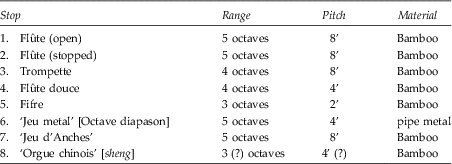
We have two 8′ flute stops, one open, the other stopped, of five octaves; a trumpet stop of four octaves; a flute douce of four octaves; a fife stop [of] three octaves; and a five-octave 4’ stop of metal (lead pipes); a very charming reed stop of five octaves, in the first octave it's a bassoon, in the second and third octaves a clarinet, and in the fourth and fifth octaves an oboe; Finally, the eighth [stop] is a stop of a small Chinese organ [sheng], of three octaves.Footnote 39
So, in a witty gesture of cross-cultural communication Ravary and Deleuze paid compliment to their adoptive country by including in their pipe organ a sheng stop.Footnote 40 To put Ravary's description into more readable terms, Table 1 shows the original specifications.
Ravary, Deleuze, et al., ‘The Bamboo Organ of Tungkadoo’ (SHA1857, numbering according to The Pipe Organ in China Project census), 1 manual (C to C3), Dongjiadu Cathedral (Church of St. Francis Xavier), Shanghai, China. Original (1856) specs.
Even as the organ was set up, in the winter of 1856/57, Ravary and Deleuze realized that not all of their ‘improvisations’ were as successful as they had hoped. Writing to Basuiau right after the initial erection of the organ, Ravary made the following request:
I have one other commission which is also important … that's if you would send to us first thing, by the March mail-boat, some harmonium reeds, already tuned and ready to mount on wood[en shallots] … The reeds for our organ … run over five octaves from C to c′′′, and we really need these. So, if you would please send us the reeds in question, you'll be doing us a great service. For shipping them, the best way would undoubtedly be to wrap them well in waxed cloth, and send them to Mr. Ducros in Marseille, who will know the best way to get them to us.Footnote 41
By Easter 1857, the harmonium reeds had arrived, and once this major feast was out of the way Ravary could turn his attention back to the organ.
Before I finish [my letter], a word about our bamboo organ … the magnificent work of our dear Brother Deleuze will be finished shortly … We hope to have it installed in the Cathedral of Dongjiadu for the Feast of the Assumption. Let me say simply that this organ which we have constructed, I should say completely invented, is beautiful. At this moment, we are re-erecting it after having put in place the [pipes for the] pedals. We have only had to replace two and a half of the eight stops. And so, the organ is really powerful, but at the same time of an exquisite … It has eight complete ranks and a keyboard of five octaves. All the pipes are finished and almost tuned.Footnote 42 It only remains to place them in the organ and make them perfect. Everything is made of bamboo: there is a Musette stop (brass reeds), 1 Trumpet stop, a 16 foot pedal stop, 1 Clarinet of five octaves with [grooved] basses. Two flute stops, a fife stop, and another stop, unnamed, and unnamable, because it is so strange.Footnote 43
Against (or perhaps better, complementing) Ravary's account, we have to place the anonymous critic for The North-China Herald, who seems to have been very well informed about organs, and about this instrument in particular. He maintained that the organ as first heard in August 1857 had
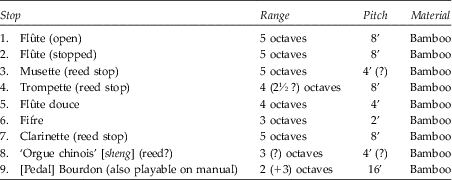
9 complete stops, a trumpet stop of two octaves and half, and a 16 feet [sic] Bourdon of rather more than two octaves. The sounding board is so arranged as to permit the use of either the upper or the lower half of most of the stops, so that each may be played as a solo organ [sic]. The Bourdon can be played on the key board or with the feet. The key board is coupled to the pedals. There is no swell action, but it is intended hereafter to add a small swell organ, the bellows being amply powerful for the addition of either this or a choir organ … The full power of the instrument is very great, while the softer stops which answer to our clarionet, flute and wald-flöte are exceedingly mellow and delicate. From the preponderance of 8 feet [sic] stops, the bass possesses great depth and richness – the 16 feet [sic] Bourdon is a fine stop, but wants a little more power; the difficulty of getting bamboos of large diameter is the cause of this. The tone of the Trumpets [sic] is between that of a Cremona and a Hautboy, resembling most the Cor Anglais of French organs.Footnote 44
Thus, over the course of five months the specifications had changed. When the two accounts are reconciled, it seems that the organ now had the specifications shown in Table 2.
Ravary, Deleuze, et al., ‘The Bamboo Organ of Tungkadoo’ (SHA1857), 1 manual and pedal, Dongjiadu Cathedral (Church of St. Francis Xavier), Shanghai, China. 1857 specs.

The Bassoon-Clarinet-Oboe stop was converted into a Clarinet, and when Ravary qualified it as ‘avec les basses’ he probably meant that the lower octave or so utilized borrowed flue pipes, as the bass reeds for this stop seem never to have worked out. This solution (the so-called ‘grooved bass’) was something he and Deleuze had undoubtedly noticed in the Dulciana and Clarionet Flute stops on the Gray and Davison organ at Holy Trinity Church.
Between May and August, the organ was dismantled and taken, piece by piece, by barge down the canals that linked inland Zikawei with Dongjiadu near the river.Footnote 45 Dongjiadu Cathedral had been completed four years earlier (in 1853) without an organ loft, so it was necessary to construct one, above the south door.Footnote 46 (It is still there, still looking like an uncomfortable addition to the original design of the interior of the church.) With the organ finally completed, the service of dedication was held as Ravary had planned on the 15th of August, 1857, the Feast of the Assumption as well as the Fête Napoleon – a most auspicious day. Unfortunately, we have no direct, first-hand account from Ravary of the occasion: his original letter of 30 August 1857 has disappeared, and what survives is an edited and abridged transcript made by Father Colombel in the 1890s:
‘At last, at last, at last! The facteurs improvisés of Ziakwei have sung the song of triumph … On the beautiful day of the Assumption of the Mother of our Lord, there were 1500 or 1600 people present … Everyone awaited this day with impatience, above all the European colony displayed the greatest and liveliest impressions. For my own reasons, I invited the organist of the Anglican church [a certain Mr Marques] a charming young man of 25 or 26, gifted with a quite remarkable talent for music. This young man had come to Zikawei two or three times while we were constructing the instrument, and seemed to take the greatest interest in our work. He accepted my invitation very heartily; he came the evening before to help me out, and we got everything ready for the following day. On the 15th at 8:30, High Solemn Mass, sung by the Reverend Father Superior … before the Mass, the inauguration of the organ, a prelude with large orchestra, a really big show. Our young English artist had the honour of the organ, and rejoiced in his soul over the lively sensation it produced in the crowd. The church was almost packed. At the first chords of the organ, more than 1,000 heads, even those deeply inclined towards the ground, turned spontaneously and devoured the instrument with curious eyes, [an instrument] unknown to them, which cried out so loudly with all its stops drawn. For myself, up the organ loft, I was a happy witness to the general astonishment. After this long voluntary, where all the stops were successively displayed, your very humble servant took over, and the organ sounded very solemnly the Mass of Dumont … after the Mass, the organist and your well-regarded pupil spent a quarter of an hour making as much noise as possible.Footnote 47
Alongside this account we can place the extensive coverage the inauguration received in the local English-language press. The North-China Herald's anonymous reporter added some other interesting details. ‘The ceremony,’ continues the report,
opened with an introductory performance on the organ, after which mass commenced, the alternate sentences of the Kyrie being intoned by the priest at the Altar supported by the choir and responded to by the organ. The Credo was sung by a Chinese convert in a very creditable manner, the alternate sentences being again taken by the choir. A sermon followed and the first part of the mass was brought to a close by a Hymn to the VirginFootnote 48 sung by the Choir with an organ companiment [sic]. After an interval of about half an hour the Te Deum was performed, a considerable number of the Foreign community having arrived meanwhile. The service concluded with a performance on the organ accompanied by Chinese instruments,Footnote 49 the native artists exerting themselves to the utmost, and making up in fervor what they lacked in delicacy and justness of intonation …Footnote 50
III
The organ for Dongjiadu finished, the question understandably arose what to do with the atelier they had spent so much time, money, and effort setting up. Colombel takes up the story:
After the first organ for Dongjiadu, Brother Deleuze made other, smaller ones, and made a very special one a little bit after this which was sent to Paris to the Prince Imperial, son of Napoleon III, in the name of the students of Zikawei. Some acknowledgements came from the Tuileries, but it seems that this work of patience and skill was not so highly esteemed [there] as in Shanghai, and very little was said about it.Footnote 51
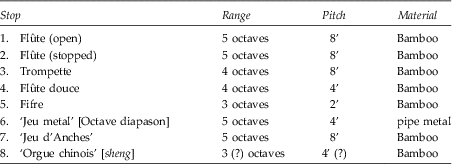
Deleuze, then, kept busy, gutting the harmonium (which perhaps he had raided for its reeds) and with his apprentices remaking it into a three-rank positive organ with bamboo pipes. This included a new pump lever for the bellows, located at the back of the organ, as well as a new keyboard. With this understanding, the Jesuit emblem no longer seems so strange, and the inscription, ‘from the students of Jiangnan’ makes sense. This was no gift from a Chinese emperor, but a token of esteem to a far-away monarch and his little son from a group of boys who only vaguely understood that Paris was a lot further away than the other side of the Huangpu River (see Table 3).
Ravary, Deleuze, et al., Positive organ built for the son of Napoleon III (SHA1858), 1 manual, 3 ranks. Museum of Musical Instruments, Paris, France.

The three instruments represented by the stops, along with the qin, were part of the Confucian ceremonial orchestra. This was a fact of which Ravary was probably keenly aware,Footnote 52 and if so, then additional layers of meaning lie behind the obvious cross-cultural adaptation found here.
The elaborate case (Fig. 2) is covered with symbolic figures and auspicious words; here it must be enough to comment on the Chinese inscription on the keyboard cover, jin sheng yu zhen, of Mencius, designed to be visible even when open. Considered the first great Confucian philosopher after Confucius himself, Mencius’ philosophy appealed widely to some, though not all, Western religious leaders and teachers in China.Footnote 53 Literally, the phrase jin sheng yu zhen means gold sound [bells] and jade vibration [chime stones]. But such a ‘translation’ reduces a complex idea to near inanity. Gold (jin) and jade (yu) are complementary antitheses, like yin and yang. Mencius referred here on the most basic level to the fact that most ancient Chinese musical instruments were made of either metal or stone. The supratextual philosophical idea is that the whole of playing music is a continuous process; there is no sound without vibration, and everything has a beginning and an ending. The passage from which this comes in The Mencius (as it is known in English) discusses four great Chinese philosophers: Po Yi, Yi Yin, Liu Hsia Hui and Confucius. Confucius, asserted Mencius,
SHA1858. 3-rank positive organ built for the son of Napoleon III. Paris, Museum of Musical Instruments (F. Ravary/L. Deleuze, 1858).
SHA1858, detail of keyboard and stopboard.
… was the one who gathered together all that was good [i.e., the best of earlier thinkers]. To do this is to open with bells and conclude with jade tubes [jin sheng yu zhen]. To open with bells is to begin in an orderly fashion; to conclude with jade tubes [chime stones] is to end in an orderly fashion. To begin in an orderly fashion is the concern of the wise while to end in an orderly fashion is the concern of the sage. Wisdom is like skill, shall I say, while sageness is like strength. It is like shooting from beyond a hundred paces. It is due to your strength that the arrow reaches the target, but it is not due to your strength that it hits the mark.Footnote 54
Other ways of interpreting the passage suggest ‘high moral behaviour’ (implied by the preciousness of gold and jade), or simply ‘loud and harmonious music’. Its multiple levels of meaning can only be suggested here, but the analogy between music correctly performed, and good and orderly governance, is unmistakable. The quotation is celebrated enough to be carved over one of the archways at the Temple of Confucius in his home town of Qufu, in Shandong Province.
In terms of cultural mediation, this is the complementary antithesis to Ravary and Deleuze's sheng stop on the organ at Dongjiadu, as well as the retrofitting of the orgue harmonium with three stops imitative of Chinese instruments (as European organs at this date were rapidly adding stops imitative of Western orchestral instruments.) As a gift to an infant prince, the priests chose to incorporate not a passage from the Bible or other Christian literature,Footnote 55 but instead, something they had learned in China: a motto which emphasized the importance of attaining to high moral values, a quotation from a Chinese philosopher who valued the innate goodness of human nature, and whose liberal views of education were radical until the twentieth century. In ‘sinifying’ the harmonium, with its bamboo pipes and Chinese carvings, they sent back to France something that had been altered by the same forces by which they themselves had been changed. In its small way, this is an important example of the simultaneous interaction on both local and global levels that has been called histoire croisée. Moving beyond the polarities of Edward Said's orientalism, histoire croisée examines the ‘multilevel entanglements that occur in a temporal and spatial framework where many actors interact together on different levels, in different directions. Histoire croisée illuminates the synchronic tangle of political, economic, intellectual, artistic and human dynamics involved in processes of cultural exchange.’Footnote 56 In fact, it may well have been just this cross-cultural feature that led to such an unenthusiastic reception in Paris. Given the timing, in the middle of both the Taiping Rebellion and the Second Opium War, which culminated in the summer of 1860 with the infamous burning of the Yuan Ming Yuan Palace, the gift of a Franco-Chinese positive may even have been considered to be in bad taste, a faux pas politically as well as musically and socially.Footnote 57
Today, however, we can understand the 1858 positive as a remarkable instance of intercultural exchange. To do this, however, is to accept an alternative to the confrontational rhetoric of post-colonial dogma, and to consider the Shanghai experiment with bamboo not primarily as an instance of imperialism operating under the guise of mission work, but as mission work operating under the forces of a nascent (and generally unperceived) globalization:
In the aftermath of Mongol expansion across Eurasia, the unprecedented rise of imperial states in the early modern period set in motion interactions between people from around the world. These included new commercial networks, large-scale migration streams, global biological exchanges, and transfers of knowledge across oceans and continents. These in turn wove together the major regions of the world. In an age of extensive cultural, political, military, and economic contact, a host of individuals, companies, tribes, states, and empires were in competition. Yet they also cooperated with one another, leading ultimately to the integration of global space.Footnote 58
Ravary, Deleuze and Hélot did not, of course, have the benefit of our hindsight in all these ‘de-territorializations and ‘re-territorializations’ (to borrow these terms from a later – and more renowned – Deleuze.) Nonetheless they were not completely without self-awareness; they understood that their work in China was a form of knowledge transfer and integration, which had ebbs and flows, and at least Ravary avidly accepted this:
The more I see of the Celestial Empire, the more I reconsider, and the more my limited thinking changes, and that in favour of the Chinese … I knew quite well that I was not going to find barbarians or cannibals here, but I imagined that the Chinese were savage and brutal, which is to say that these poor people did not stand very high in my esteem … But, believe you me, I am close to friends with the Chinese, like a Chinese; I have encountered such beautiful things here, such qualities in the people that I have become their admirer: in a word, I love the Chinese.Footnote 59
IV
Despite all their optimism for the future, Ravary and Deleuze had picked a bad time to build such delicate instruments. With the war at their doorstep, it was inevitable that the churches should suffer damage. By the summer of 1861, things had returned to normality sufficient to get around to fixing the organ. And Deleuze, though living at Dongjiadu from 1858, was now very much the master of the situation, and took the opportunity to enlarge the organ as he had always intended:
Dear Brother Deleuze has put his hand again to the great organ of Dongjiadu, and with a talent which I admire without fully comprehending it, has repaired it admirably. The pallets of the soundboard have been replaced; the keyboard is less stiff; the stops speak more readily, and what's more, he has added a second manual which is now in place. He has made a second soundboard which is to have seven stops. He has made a swell box which you can see [externally]. To the existing eight stops, he is adding seven new ones, in total we will have fifteen stops.Footnote 60
Deleuze's industry was remarkable, and the surviving orgue harmonium in Paris was only one of six that he made between 1858 and 1861, in addition to periodic repairs and expansions of the Dongjiadu organ. Colombel reported that in addition to the organ at St Joseph's, Deleuze made another grande orgue for the church at Zikawei.Footnote 61 Ravary noted further in 1861 that:
‘Brother Deleuze is not delaying in making a grand organ for the new church of Father Desjacques [St. Joseph's] in the European Quarter.Footnote 62 The organ will have two manuals and 12 or 14 complete stops. Dear Brother Deleuze has already made 6 harmoniums with bamboo pipes, and 2 harmoniums with brass reeds (2 ranks). He receives orders from all over …’Footnote 63
There are no descriptions of the Zikawei bamboo organ, but writing much later, in 1889, Ravary briefly described the organ in St Joseph's: ‘the organ loft across the nave [of St. Joseph's], at the entry to the church, is almost completely filled by the great organ, and leaves only a very narrow space for singers and instruments’.Footnote 64 But Deleuze's story now turns heroic, then tragic. In 1861/62, when the Taiping rebels attempted to take Shanghai, Deleuze was put in charge of defending the residences. Colombel praised him for ‘his ardour, his sang froid, which was of great authority with the men he commanded, and which frightened the rebels’.Footnote 65 At Christmas, 1864, he was transferred away from Dongjiadu to oversee the workshops at the newly founded orphanage at Tushanwan (
 ,'Tou-se-we’), next door to Zikawei and part of the Jesuit ‘village’. Although he was not the director of the orphanage, it seems that most of the work fell on his shoulders in the first six months of operation. His sense of duty kept him working in exhausting conditions, exacerbated during a typhus epidemic in 1864/65. In May 1865, he was put into the Zikawei infirmary, and he died of typhus on 24 May, after exactly nineteen years and one day in China.
After Deleuze's death Ravary tinkered with the Dongjiadu organ from time to time. Colombel wrote that in December 1879, ‘At Dongjiadu, Father Ravary revived the Zikawei brass band of 1856/57 [Basuiau had sent the instruments from France in this year]. He also fixed up the great organ, over which he had taken so many pains ten years [sic] earlier, and he added some new ranks which he was happy to be able to play’.Footnote 66 But the repairs don't seem to have taken, and a complete rebuilding appears to have been needed. Two years later, another priest, one Father Faixpoux, wrote in a letter of 8 December 1881 that ‘we spent the Feast of St Francis Xavier [3 December] at Dongjiadu with Monsignor Garnier. The Cathedral was very well decorated, and Father Ravary inaugurated 4 stops of his organ, the only ones which were ready under the circumstances. When the other 20 are in place, it will truly be an instrument worthy of a cathedral, even in France’.Footnote 67
We must assume that Ravary completed his work, probably the final expansion of the organ to a three-manual and pedal, 24-stop instrument, in the early 1880s. For some reason, perhaps due to the two decades that had passed since Deleuze's death, he included some standard wooden pipes for the open diapasons in this renovation, and possibly for some other stops as well. It may well be that some of the more complex stops, such as a six-rank cornet marked in the old Roret manual, also finally found their way in the organ at this time. In 1886, he reported in a letter to a Dr Dufour, that ‘solemn chords from the famous bamboo organ, made years ago by Brother Deleuze, were heard as our young scholastics and some seminarists sang during the Episcopal mass’.Footnote 68
With Ravary's death in 1891, it was inevitable that the organ would see much less maintenance. During the last two decades of the Qing dynasty, it received little attention. The final rebuilding came in 1918, when Mgr Henri Lécroart (1864–1939) was installed as Bishop co-adjutor of Southern Chili (Zhili) province. Lécroart, who was quite interested in pipe organs and music generally, was consecrated at Dongjiadu on 2 February 1918, at a service in which ‘[a]n interesting feature was … that the singing was accompanied on the old bamboo organ …’.Footnote 69 Some repair seems to have been done prior to this service, without however much effect.Footnote 70 The North-China Daily News later commented that ‘It would be better if it were completely in tune, for a long wave beat, similar to the short one which gives the beauty of the tremulous vox cœlestis, betrays the fact that it is not’.Footnote 71 Lécroart swiftly set about arranging for a renovation of the organ, with some alarming changes:
The organ, which was built some fifty [sic] years ago, looks its age, though time has not apparently impaired its functions. Nevertheless its unique character is about to be lost, for metal pipes are to take the place of the bamboo which has made the organ so remarkable … The keys are stained by time … [and] of the stops … all of them [are] performing their work efficiently … The bellows are frankly mediæval. On each side of the organ are two short boards with thickened foot pieces on which the blower stands and works his legs much as if he were riding a bicycle.Footnote 72
It is not clear if metal pipes (perhaps only used in some ranks) were indeed eventually included in the 1918 renovation, but concerns were readily expressed about this, one writer commenting that as a result ‘the noted instrument will lose much of its public interest’.Footnote 73 After that, the old curiosity was occasionally singled out as a tourist attraction. In 1928, F.L. Hawks Pott, the president of St John's University, noted the organ in his seminal historical study of the foreign presence in the city, calling it ‘an organ constructed by the French Fathers, which is unique, as the pipes are made of bamboo, and, as far as we know, is the only one of its kind in the world’.Footnote 74 Six years later, an anonymous guidebook to Shanghai commented that ‘The Cathedral of Tungkadoo will be … of interest. It is a great church found in a fairly broad Chinese thoroughfare, built by Bishop de Besco [sic, Bési] … It is a large edifice in the classic [Jesuit] style, white walled. There is a fine organ in the gallery’.Footnote 75
While the positive for the son of Napoleon III has survived to our day, tragically, the ‘Bamboo Organ of Tungkadoo’ was destroyed in 1966 during the Cultural Revolution.Footnote 76 Little could Ravary and Deleuze have known that their unappreciated positive would become our only material culture link to this short-lived but creative and intercultural flowering of art and science in mid-nineteenth-century Shanghai. From its storage room in Paris it still sings for the discerning listener, in cymbalis bene sonantibus.Footnote 77
 ’, and instead are stamped with an enigmatic Maltese cross. They probably came from a non-Jesuit source into the Library's collection sometime in the early twentieth century, according to Arthur Xu, Assistant Librarian, Bibliotheca Zikawei (personal communication, April 2010).
 ) variety. Ravary and Deleuze may also have been intrigued by the similarity (and difference) of Mencius's quotation to an aphorism of Cicero (106–43