

Introduction
To help consumers make informed decisions, policy-makers often require entities to give consumers ‘disclosures’, informational materials that state product terms, provide warnings or clarify agreements (Kozup et al., Reference Kozup, Taylor, Capella and Kees2012). Consumers receive disclosures to help them make many decisions, including those about health care insurance, online privacy rights, electricity use and mortgages (Ben-Shahar & Schneider, Reference Ben-Shahar and Schneider2014). Yet existing research provides limited insight into the real-world factors that affect disclosure use, as few studies have used field experiments to examine consumer responses to disclosures (Hogarth & Merry, Reference Hogarth and Merry2011; Perry & Blumenthal, Reference Perry and Blumenthal2012; Johnson & Leary, Reference Johnson and Leary2017). Instead, the majority of policy and academic research on disclosures has used laboratory methods (e.g., Lacko & Pappalardo, Reference Lacko and Pappalardo2010; Chin & Bruine de Bruin, Reference Chin and Bruine de Bruinin press).
Without field research, it is unclear whether consumers actually pay attention to disclosures (Ayres & Schwartz, Reference Ayres and Schwartz2014). We address this lack of research by examining two factors that we predict affect consumers’ attention: the mere presence of another person; and a mandatory waiting period after receiving a disclosure. Drawing on social psychology, we predict that the mere presence of another person will reduce attention to disclosures, even when that person does not directly interfere with a consumer's attention through conversation or explicit social pressure. Additionally, based on economic theory, we predict that a mandatory waiting period after a consumer receives a disclosure will increase attention to disclosed information. Using two field experiments and a large survey of mortgage borrowers, we find support for these predictions.
Mortgage closing disclosures: a motivating case
The decision to study mere presence and mandatory waiting periods was inspired by the Consumer Financial Protection Bureau's mortgage disclosure rule, which requires that home mortgage borrowers receive their mortgage disclosures three business days before consummation of their loan (Integrated Mortgage Disclosures, 2013). This three-business-day requirement may lead to changes in attention for at least two reasons, which we discuss separately below. First, multiple stakeholders often attend ‘mortgage closing’ meetings (Consumer Financial Protection Bureau, 2017). Given that merely being in the presence of an observer may affect attention (e.g., Guerin, Reference Guerin1989; Risko & Kingstone, Reference Risko and Kingstone2011), consumers who receive disclosures at closing may be less likely to pay attention to them than consumers who have the opportunity to read them earlier, in isolation. Second, the rule's three-day waiting period reduces the opportunity costs associated with reading disclosures, which may lead to increased attention. Together, these factors underlie our first hypothesis:
Hypothesis 1 (H1): Consumers who receive a disclosure in the presence of another person, without a mandatory waiting period, will be less likely to pay attention to it than those who receive the disclosure in isolation, with a mandatory waiting period.
Mere presence effects and disclosures
Over a century of research in social psychology demonstrates that the presence of others can affect human behavior (e.g., Triplett, Reference Triplett1898; Zajonc, Reference Zajonc1965; Guerin, Reference Guerin1989; Risko & Kingstone, Reference Risko and Kingstone2011). A meta-analysis of 241 studies published between 1898 and the 1980s shows systematic differences in behavior performed in the presence of others, with people performing simple tasks faster and more accurately when around others, and complex tasks more slowly and inaccurately (Bond & Titus, Reference Bond and Titus1983). The prevailing explanation for these effects is that the presence of others heightens arousal, which interacts with task complexity to affect behavior (Zajonc, Reference Zajonc1965). Specifically, heightened arousal can increase the speed and likelihood of correct responses for simple tasks and incorrect responses for complex tasks (Zajonc, Reference Zajonc1965).
When applied to disclosures, which are often complex (Ben-Shahar & Schneider, Reference Ben-Shahar and Schneider2011, Reference Ben-Shahar and Schneider2014), arousal theories predict that consumers receiving disclosures in the presence of others are less likely to read them thoroughly. To date, research on disclosures has not tested the effect of mere presence, and has instead concentrated on cases where there is explicit social influence. For example, research on mortgage lending finds that some mortgage borrowers are asked to “sign [documents] without reading them” (Hill & Kozup, Reference Hill and Kozup2007, p. 36). Study participants may sign research consent disclosures with egregious terms after an experimenter (meaninglessly) states, “[T]hat is the way that the consent form was drafted” (Choplin et al., Reference Choplin, Stark and Ahmad2011, p. 78). Given that existing disclosure research explores conversations, a central contribution of our research is to investigate whether mere presence affects consumers’ attention to disclosures.
Consistent with the idea that disclosures are difficult to process (Ben-Shahar & Schneider, Reference Ben-Shahar and Schneider2011, Reference Ben-Shahar and Schneider2014), our hypothesis is that the presence of others will decrease consumers’ attention. However, we acknowledge that some empirical findings on mere presence are inconsistent with this hypothesis. For example, a study of reading comprehension showed that people reading texts in their native language were not negatively influenced by the presence of others (Rai et al., Reference Rai, Loschky and Harris2015). Furthermore, being observed by an experimenter or filmed by a video camera can increase participants’ ability to pay attention and identify specific visual objects (Miyazaki, Reference Miyazaki2013, Reference Miyazaki2015). The author of these latter studies suggests that watching study participants may motivate them to perform well, thereby increasing their attention (Miyazaki, Reference Miyazaki2013, Reference Miyazaki2015). While we hypothesize that mere presence will negatively impact attention, our studies allow us to uncover the opposite pattern. Stated formally:
Hypothesis 2a (H2a): All else equal, consumers who receive a disclosure in the presence of another person will be less likely to pay attention to it than those who receive the disclosure in isolation.
Mandatory waiting periods and disclosures
Economic models of information search suggest that search behavior is driven by a trade-off between associated benefits and costs (Stigler, Reference Stigler1961). Benefits include the information gained from search, while costs include the effort associated with search, the opportunity cost of one's time and costs from delayed consumption (for further review, see Johnson & Russo, Reference Johnson and Russo1984; Schmidt & Spreng, Reference Schmidt and Spreng1996; Chin & Williams, Reference Chin and Williams2018). When consumers can immediately make a decision about a product, reading a disclosure incurs marginal opportunity costs. Perhaps because of these costs, only a small proportion of consumers in certain circumstances pay attention to disclosures. For example, in one study, 80% of undergraduate participants reported not reading software agreements like the iTunes Terms of Service (Plaut & Bartlett, Reference Plaut and Bartlett2012). Another, using clickstream data, found that only 0.1% of website visitors viewed the terms of a software purchase (Bakos et al., Reference Bakos, Marotta-Wurgler and Trossen2014).
Beyond delayed consumption, costs of reading can include perceived time pressure that comes from an external party. In Inbar et al. (Reference Inbar, Botti and Hanko2011), laboratory participants took more time to make a choice when an experimenter said, “Take your time” (p. 534). Researchers have suggested that there is a ‘no reading’ norm for mortgages given that closing meetings are typically scheduled for a limited time (say, an hour) and there are many documents to sign (Stark & Choplin, Reference Stark and Choplin2009).
We define a ‘mandatory waiting period’ as an externally imposed delay between the time a consumer receives a disclosure and the time the consumer may act upon it. Mandatory waiting periods reduce the marginal costs of reading, as reading during the waiting period no longer delays consumption (although other opportunity costs may still exist). As such, we predict that:
Hypothesis 2b (H2b): All else equal, consumers who receive a disclosure with a mandatory waiting period will be more likely to pay attention to it than those who receive the disclosure without a mandatory waiting period.
Overview of the current research
We build on psychological findings regarding mere presence effects and economic theories of search to study two factors that may influence consumer use of disclosures: the mere presence of others and mandatory waiting periods. We hypothesize that having another person present and removing a mandatory waiting period will decrease attention to disclosures (H1), and that mere presence (H2a) and the mandatory waiting period (H2b) will each separately affect attention. To test our hypotheses, we use two experiments and a survey of mortgage borrowers.
Study 1: The combined effect of mere presence and mandatory waiting periods
In our first experiment, we examined the combined effect of our two factors of interest – the mere presence of an observer and a mandatory waiting period – on attention to disclosures (H1).
Method
Participants
Participants were 192 students from a private, liberal arts college who had finished an unrelated 90-minute economics experiment in which they made repeated choices on a computer (57% female; 55% who had not participated in a prior experiment, see Beckett & Chin, Reference Beckett and Chin2019b). These participants were compensated based on their performance in that computerized experiment, with a minimum payment provided for participation.
Mere presence and mandatory waiting periods
Participants were randomly assigned to one of two conditions, which varied the way that disclosures were delivered. In the control condition, an experimenter called each participant individually to a payment window in a separate room and handed them a disclosure. The experimenter remained present while the participant held the disclosure (thereby instituting a mere presence effect), but would accept the disclosure immediately after the participant signed it.
In the treatment condition, participants received the same disclosure at the end of the preceding computerized experiment while sitting alone at their computer workstations. These participants had to wait until they were called to the payment window before they could return the disclosure to the experimenter (thereby instituting a mandatory waiting period). While participants were waiting to be called, their computers were disabled and their personal effects were stored. We expected that the mandatory waiting period caused by waiting for other participants to finish payment procedures, together with being relatively isolated at one's computer workstation, would increase attention to the disclosure in the treatment condition relative to the control (H1).
Attention
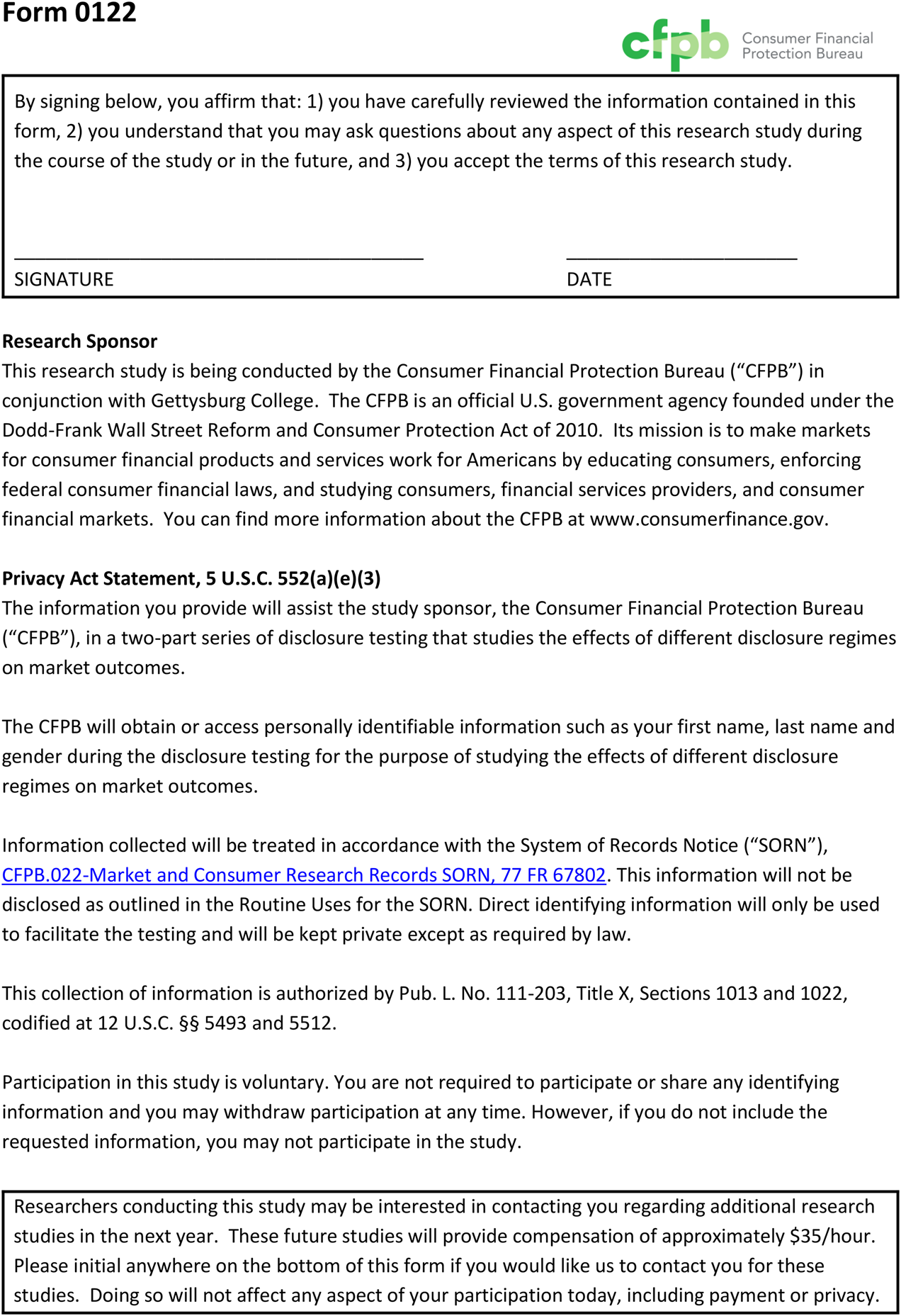
The disclosure received by participants contained standard information on informed consent and privacy rights (Figure 1). Additionally, it contained a paragraph instructing participants to initial the disclosure if they were interested in being contacted about participation in future research studies that paid approximately $35 per hour.Footnote 1 Since participants had just completed an experiment advertised to pay approximately $19 per hour, we expected that all of them should be interested in participating in a future experiment that paid more.Footnote 2 We therefore considered initialing to indicate attention.
Disclosure provided to participants in Study 1
Note: The bottom rectangle outlines the paragraph of text that asks participants whether they want to participate in future experiments that will pay approximately $35 per hour. The top rectangle shows the text that participants were required to sign. These rectangles of text were not present in the experiment.

Results
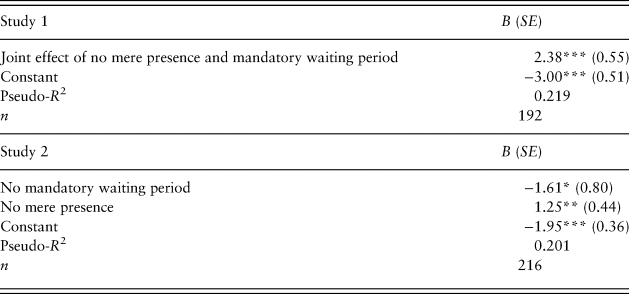
Overall, 4.8% of participants in the control condition (who read the form in the presence of an experimenter, with no mandatory waiting period) initialed the form. In contrast, 35.2% of participants in the treatment condition (who received the disclosure alone and were required to wait at their workstation) initialed it, representing a significant increase (t(190) = 5.4, p < 0.001). These results are consistent with H1, and are confirmed in a logistic regression (Table 1). Specifically, the odds that a participant initialed the disclosure were approximately 11 times higher among those who received the disclosure in relative isolation and with a mandatory waiting period.Footnote 3
Logistic regression results predicting whether participants initialed the disclosure

*p < 0.05, **p < 0.01, ***p < 0.001
Discussion
The results of this study show that delivering disclosures to consumers in isolation and with a mandatory waiting period can increase consumers’ attention to the disclosures, supporting H1. The next study tests the individual components of this hypothesis, regarding mere presence (H2a) and mandatory waiting periods (H2b).
Study 2: Separating the effects of mere presence and mandatory waiting periods
The primary goal of this study was to uncover the determinants of the effect demonstrated in Study 1. In particular, we wanted to examine whether attention decreased with the mere presence of an observer (H2a) or whether attention decreased with the removal of a mandatory waiting period (H2b).
Method
Participants
Participants were 216 students from a small, liberal arts college who had just completed an unrelated 120-minute economics experiment (56% female; 46% who had not participated in a prior experiment; see Beckett & Chin, Reference Beckett and Chin2019b). The economics experiment was similar to the one that preceded Study 1, with participants making repeated choices on a computer. Participants were compensated based on performance, with a minimum payment for participation.
Mere presence and mandatory waiting periods
Following the computerized experiment, an experimenter called participants individually to a payment window in a separate room. To standardize this interaction, the experimenter handed participants a disclosure and recited a short, predetermined script. After that, participants’ experiences varied according to a 2 (mere presence of an observer: present vs. absent) × 2 (mandatory waiting period: 0 seconds vs. 60 seconds) between-subjects design.
To manipulate mere presence, after handing participants the disclosure, the experimenter either remained observing the participant (present) or walked into a separate room (absent). When present, the experimenter stood quietly approximately two and a half feet away from the participant on the opposite side of a Dutch door. If a participant attempted conversation, the experimenter answered politely but succinctly and disengaged from conversation. This first experimenter would not accept the signed disclosure from the participant. To manipulate the mandatory waiting period, a second experimenter either arrived immediately after the participant received the disclosure (0 seconds) or waited 1 minute before arriving (60 seconds). Only this second experimenter would accept the signed disclosure from the participant. To control the total number of people who were present, the first experimenter walked away when the second experimenter arrived.
We hypothesized a priori that there would be no difference between the 0 seconds-present and 0 seconds-absent conditions, as the immediate arrival of the second experimenter meant that an observer was always present. As such, we assigned half as many participants to each of these two conditions and collapsed these cells in our analysis.Footnote 4 Because it was not possible to simultaneously have an experimenter hand the disclosure to participants and be absent, we treat these merged conditions as ‘0 seconds-present’. Our results therefore describe the effect of mere presence conditional on having a mandatory waiting period, and the effect of a mandatory waiting period conditional on having an observer present.
Attention
The disclosure was a shortened version of the one used in Study 1 (Figure 1), with information removed to improve the likelihood that participants could read all of the information in 60 seconds, if they chose to do so. As in Study 1, the disclosure contained a paragraph instructing participants to initial the form if they were interested in being contacted about participation in future research studies that paid approximately $35 per hour. The preceding experiment had been advertised for a rate of approximately $13 per hour, so again we believed that initialing indicated attention.
Results
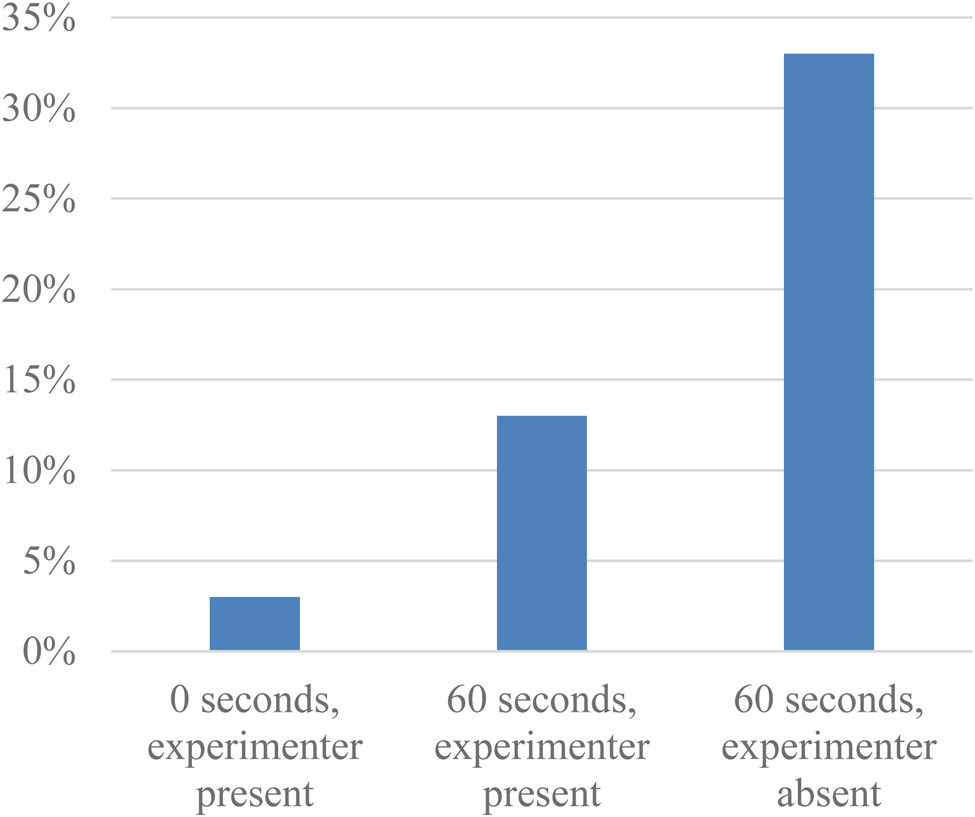
Overall, 33% of participants initialed the disclosure in the 60 seconds-absent condition (Figure 2). This rate was significantly higher than the 13% that initialed in the 60 seconds-present condition (t(142) = 2.23, p = 0.027), providing support for H2a. Additionally, 3% of participants initialed the disclosure in the 0 seconds-present condition, representing a statistically significant decrease in attention, consistent with H2b (t(142) = 3.20, p = 0.002). These differences were confirmed using a logistic regression (Table 1).Footnote 5 Specifically, conditional on having a mandatory waiting period of 60 seconds, removing an observer increased the odds of initialing by a factor of 3.5 (H2a; Table 1). Additionally, conditional on having an observer present, removing the mandatory waiting period reduced the odds of initialing by a factor of 5 (H2b).
Proportion of participants initialing the disclosure in Study 2

Discussion
This study provides support for H2a, which states that, holding all else constant, the mere presence of an observer can decrease attention to disclosures, and H2b, which states that, holding all else constant, removing a mandatory waiting period can decrease attention to disclosures. Since both factors decrease attention, both factors are likely to have contributed to the results from Study 1.
Both Studies 1 and 2 use realistic field experiments conducted in a university research lab. Our results are therefore highly relevant for researchers and institutional review boards who are interested in ensuring that study participants provide informed consent (e.g., Krishnamurti & Argo, Reference Krishnamurti and Argo2016). Outside of laboratory contexts, the results may underestimate the true effect of having another person present. In particular, the experimenters in this study did not try to diminish participants’ attention to the disclosure by asking them questions, showing them attention-grabbing advertisements or using high-pressure sales tactics. It is unlikely that consumers will face such neutral observers in other real-world situations.
Study 3: Mortgage closing disclosures
This study analyzes whether receiving mortgage disclosures in different contexts is associated with different levels of attention to those disclosures. To investigate this question, it compares two sets of mortgage borrowers: those who report receiving disclosures before a ‘mortgage closing’ meeting to finalize their loan; and those who report receiving these disclosures at the closing meeting.
Mortgage closing meetings often include multiple stakeholders, such as representatives for the lender and title insurance company, and attorneys for the buyer and seller (Consumer Financial Protection Bureau, 2017). As such, borrowers who receive disclosures at closing are likely reading in the presence of others and with no waiting period. In contrast, those who receive disclosures before the closing meeting are unlikely to be around such observers. Notably, however, mortgage closing meetings may involve stronger social influences than mere presence, as these meetings are likely to involve conversations between participants (see Hill & Kozup, Reference Hill and Kozup2007; LeBoeuf et al., Reference LeBoeuf, Choplin and Stark2016).
Due to financial regulations in place at the time of this study, most mortgage borrowers should have received their mortgage disclosures at least three business days in advance of the closing meeting (Integrated Mortgage Disclosures, 2013), leading to questions about whether borrowers who received their documents ‘late’ were qualitatively different from those who received them on time. There are at least two reasons why borrowers may not have received their final disclosures in advance of closing. First, the rule allows borrowers to receive multiple copies of their mortgage disclosures, and certain changes to the disclosures do not require reissuance (Integrated Mortgage Disclosures, 2013). If lenders issue disclosures multiple times, some borrowers may only receive their final version at closing. Second, some mortgage lenders had difficulties complying with the new rules, including having “loans closed prior to the three day waiting period” (Association of Mortgage Investors, 2016, p. 9). Reflecting these difficulties, the original implementation date of the rule was postponed to help facilitate compliance (Murin, Reference Murin2016) and Consumer Financial Protection Bureau examinations of creditors were based on whether those creditors made “good faith efforts” to comply with the rule (Cordray, Reference Cordray2015, p. 1).
Method
Participants
Our sample contains data from 3124 recent mortgage borrowers who bought a home during the summer of 2016, used a mortgage to make the purchase (as opposed to paying in cash) and answered key survey questions about their closing experience (M age = 38.8 years, SD ≈ 11.9Footnote 6; 80% non-Hispanic white; median education = college degree; median annual household income = between $50,000 and $99,000; 73% employed full-time; 64% married; 56% repeat homebuyer). These data were collected as part of a larger study on mortgages and homeownership (see Chin & Williams, Reference Chin and Williams2018; Beckett & Chin, Reference Beckett and Chin2019a; Chin et al., Reference Chin, Couper and Beckett2019), but results on closing meetings have not been described elsewhere. The characteristics of the sample are similar to the most recent nationally representative data on US homebuyers, but with a higher proportion of young and non-Hispanic white respondents (Avery et al., Reference Avery, Bilinski, Clement, Critchfield, Frumkin, Keith and Schultz2017).
Presence and mandatory waiting periods
The survey asked borrowers to report when they received their mortgage disclosures, with possible options of: ‘at closing’, ‘the same day but before closing’, ‘one or two business days before closing’ or ‘three or more business days before closing’. It is possible that some borrowers received their mortgage disclosures before their closing meeting but did not realize it; similarly, it is possible that some borrowers who received mortgage-related information before closing mistakenly referred to the timing of these documents instead of their final mortgage disclosures. Due to our inability to independently verify when borrowers received their mortgage disclosures, we take responses as given. Borrowers who received their disclosures ‘at closing’ were unlikely to have experienced a waiting period and would often have received and reviewed their disclosures in the presence of others. In contrast, borrowers who received their disclosures prior to closing experienced a waiting period and were more likely to have had an opportunity to review their disclosures in isolation. Our analysis therefore focuses on differences in attention between those who received disclosures ‘at closing’ versus all other times.Footnote 7
Attention
The survey asked borrowers to report whether they had questions about their mortgage disclosures. Given that mortgage disclosures consist of five pages of information on loan terms, fees, calculations and other contract details, we expected that most borrowers who reviewed their disclosures would have at least one question about them. Additionally, prior homebuying experience would not necessarily have made borrowers comfortable with these disclosures, as new mortgage rules meant that they had recently changed in both formatting and content (Integrated Mortgage Disclosures, 2013). As such, we used whether a respondent had questions as our measure of attention to the disclosure; this measure requires that borrowers paid attention to their disclosures, but misclassifies borrowers who paid attention and had no questions.
Demographic and psychological characteristics
The survey collected additional demographic and psychological characteristics, including age, educational attainment, race/ethnicity, employment status, household income, self-reported credit score, homebuying experience, subjective numeracy (Fagerlin et al., Reference Fagerlin, Zikmund-Fisher, Ubel, Jankovic, Derry and Smith2007), financial literacy (Lusardi, Reference Lusardi2008) and need for cognition (Cacioppo et al., Reference Cacioppo, Petty and Kao1984; Bizer et al., Reference Bizer, Krosnick, Petty, Rucker and Wheeler2000; see Beckett & Chin, Reference Beckett and Chin2019a, for more details). We used these characteristics to control for factors correlated with when borrowers received disclosures or whether they had questions, but did not have specific hypotheses for these variables.
Results
Mandatory waiting periods and presence of others
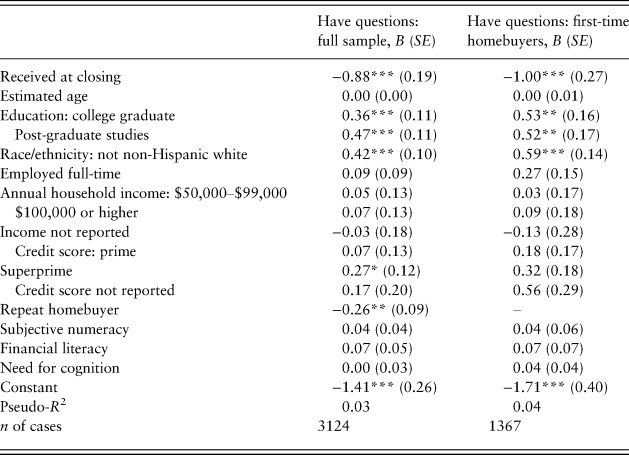
Overall, 6.3% of participants reported receiving their mortgage disclosures at closing, while an additional 38.6% reported receiving them less than the three days in advance of closing. To see which variables were associated with having questions about disclosures, we ran a logistic regression containing an indicator variable for receiving disclosures ‘at closing’ (versus all other times) and variables for demographic and psychological characteristics. The results showed, consistent with H1, that the odds of having questions were 2.4 times higher for participants who received their disclosures before the closing meeting than those who received them at closing (Table 2).
Logistic regression results predicting having questions from Study 3

*p < 0.05, **p < 0.01, ***p < 0.001
Note: ‘Received at closing’ is an indicator variable representing whether respondents reported receiving their closing disclosure at closing versus before closing. Age was reported in one of ten response categories ranging from 18–24 years to 65+ years. We used the midpoint of each bin and coded those in the 65+ category as 67 years of age to create an estimated age measure. Education was coded as one of three mutually exclusive categories: less than college graduate, college graduate or post-graduate studies. Annual household income was coded into one of four categories: less than $50,000, $50,000–$99,000, $100,000 or higher and not reported. Credit score was a self-reported measure in one of 12 bins: less than 580, nine bins from 580–599 through 740–759, 760 or above and ‘I don't know’. We created three groups, with participants who reported a score of less than 680 as subprime, those between 680 and 739 as prime and those with a score of 740 or over as superprime. Subjective numeracy was measured using the average of three questions from Fagerlin et al. (Reference Fagerlin, Zikmund-Fisher, Ubel, Jankovic, Derry and Smith2007). Financial literacy was measured using a three-item scale based on Lusardi (Reference Lusardi2008). Need for cognition was a normalized measured based on two questions from Cacioppo et al. (Reference Cacioppo, Petty and Kao1984) and Bizer et al. (Reference Bizer, Krosnick, Petty, Rucker and Wheeler2000); see Beckett and Chin (Reference Beckett and Chin2019a) for more details on all measures
Demographic and psychological characteristics
The regression results also show that certain demographic characteristics were associated with having questions about mortgage disclosures. In particular, highly educated participants, those with high credit scores, first-time homebuyers and minorities were more likely to have questions (Table 2). There was no relationship between having questions and financial literacy, subjective numeracy or need for cognition. A second regression, run only for first-time homebuyers, showed the same overall pattern of results (Table 2).
Discussion
This study expands our research by investigating whether receiving mortgage disclosures under different circumstances is correlated with having questions about those disclosures, a measure that we use as a proxy for attention. Our results are consistent with H1 in that borrowers who received their mortgage disclosures at a closing meeting were less likely to have questions about their disclosures than those who received them before closing. Additionally, our results show that borrowers’ attention correlated with demographic characteristics.
General discussion
Disclosures are a common policy intervention for encouraging informed consumer decision-making (Lacko & Pappalardo, Reference Lacko and Pappalardo2010; Ben-Shahar & Schneider, Reference Ben-Shahar and Schneider2014). Our research addresses concerns about external validity and reliance on laboratory testing (Perry & Blumenthal, Reference Perry and Blumenthal2012; Loewenstein et al., Reference Loewenstein, Sunstein and Golman2014) by examining whether consumer responses to disclosures vary with the mere presence of an observer or mandatory waiting periods. In Studies 1 and 2, we conducted field experiments where we carefully controlled the delivery of disclosures. As hypothesized, we found that receiving a disclosure in isolation and with a mandatory waiting period increased attention to that disclosure (H1). These changes had a large effect, with an 11-fold increase in the odds of attention when studied together (Study 1). Individually, each variable also made a difference: removing an observer (conditional on a waiting period) led to a seven-fold increase in the odds of attention (H2a), and introducing a mandatory waiting period (conditional on the existence of an observer) led to a five-fold increase in the odds of attention (H2b; Study 2). In Study 3, using survey data on mortgage closings, we found that receiving closing documents before the closing meeting is positively associated with consumers having questions about their disclosures, which is consistent with H1.
The mere presence effects that we uncovered contribute to social psychological research showing that the presence of others can affect human behavior (e.g., Triplett, Reference Triplett1898; Zajonc, Reference Zajonc1965; Bond & Titus, Reference Bond and Titus1983; Guerin, Reference Guerin1989; Risko & Kingstone, Reference Risko and Kingstone2011). Importantly, however, by highlighting the effect of mere presence on attention, these results expand beyond previous disclosure research that has concentrated on stronger forms of social pressure, such as conversation or explicit encouragement to not read (Hill & Kozup, Reference Hill and Kozup2007; LeBoeuf et al., Reference LeBoeuf, Choplin and Stark2016). The effects of mandatory waiting periods are consistent with economic theory, suggesting that reducing the opportunity costs of reading disclosures will lead to increased attention (Stigler, Reference Stigler1961).
A natural question arising from our research is whether other factors (besides removing observers or implementing mandatory waiting periods) can raise consumers’ attention to disclosures. These factors may be particularly important after situations that result in mental fatigue, including long laboratory experiments, as mental fatigue is associated with difficulties in focusing attention, sustaining attention and ignoring irrelevant information (Boksem & Tops, Reference Boksem and Tops2008). Fortunately, the possibility of receiving rewards can increase attention to relevant stimuli among people experiencing mental fatigue (Hopstaken et al., Reference Hopstaken, van der Linden, Bakker, Kompier and Leung2016), so policy-makers interested in raising attention may want to focus on ways to increase the perceived benefits of reading (Stigler, Reference Stigler1961). To that end, it may be fruitful for policy-makers to redesign disclosures to emphasize decision-relevant, actionable information, and for consumer advocates to educate consumers about the importance of reading.
Policy implications
In recent years, policy-makers have become increasingly interested in studying the effects of disclosures (e.g., Lacko & Pappalardo, Reference Lacko and Pappalardo2007; Johnson & Leary, Reference Johnson and Leary2017). However, there are many questions about whether disclosures are effective, how they can be made more effective or whether policy-makers should consider other approaches (Perry & Blumenthal, Reference Perry and Blumenthal2012). Some scholars suggest that, given the number of challenges facing disclosures, they are unlikely to achieve policy-makers’ goals (Ben-Shahar & Schneider, Reference Ben-Shahar and Schneider2011, Reference Ben-Shahar and Schneider2014). If this is true, resources that are devoted to disclosure development could be reallocated to activities that are more helpful in encouraging informed decision-making.
Our research contributes to this discussion by emphasizing the importance of the context in which disclosures are received, an area that has received relatively little scholarly attention. In particular, we demonstrate that a seemingly minor change in the environment – the presence of an observer – can have large detrimental effects on attention. These results pertain to many real-world situations; for instance, consumers make decisions around bank tellers, financial advisors, medical professionals and notaries. Moreover, inattention may increase when these parties decide to talk with consumers (Choplin et al., Reference Choplin, Stark and Ahmad2011), use high-pressure sales tactics or show consumers distracting advertisements. While it may be tempting to conclude that reading in isolation is the best strategy to combat these social influences, there may be associated welfare concerns. In particular, although some consumers want to make their own financial decisions, others may prefer to have an advisor or financial planner available to help (see, e.g. Scholl et al., Reference Scholl, Hung, Chin, Anderson, Bongard, Carman, Clancy, Dominitz, Kelly, McKenna, Smith, Tankard and Steinberg2018).
Our results also suggest that mandatory waiting periods could help increase attention to disclosures. Currently, mandatory waiting periods exist for mortgages and other consumer loans, with states like Florida and Virginia requiring payday loan borrowers to postpone borrowing after repaying a loan (Consumer Financial Protection Bureau's Office of Research, 2014). Instituting mandatory waiting periods on a broader scale could be costly. The waiting periods implemented in Studies 1 and 2 were long enough that participants could read the relatively short, one-page disclosure that we designed, but disclosures are often longer. If policy-makers want consumers to have sufficient time to read disclosures, they might need to require longer waiting periods that significantly slow consumer transactions.
Ultimately, our results suggest that isolated disclosure delivery and mandatory waiting periods could help increase the attention consumers pay to disclosures. Policy-makers who are interested in increasing attention to disclosures should carefully weigh the costs and benefits of these policies.
Disclaimer
This article is the result of the authors’ independent research and does not necessarily reflect the views of the Bureau of Consumer Financial Protection or the United States. The Public Company Accounting Oversight Board, as a matter of policy, disclaims responsibility for any private publication or statement by any of its economic research fellows, consultants or employees.
Acknowledgements
We thank John Cadigan and Sue Holz for facilitating our use of their laboratory, and Mohin Banker, Anirudh Rajashekar, Alanna Williams and David Zimmerman for research assistance. We thank Eric Johnson, Heidi Johnson, Melissa Knoll, Brianna Middlewood, Suzanne Shu, Mary Steffel and participants at RAND's Behavioral Finance Forum and the CFP Board's Academic Research Colloquium for comments given at various stages of this research. This work was supported by the Bureau of Consumer Financial Protection.