Introduction
The African sharptooth catfish, Clarias gariepinus Burchell, 1822, is generally considered to be one of the most important tropical catfish species for aquaculture in West Africa (Awachie & Ezenwaji, Reference Awachie and Ezenwaji1981; Abdel-Gaber et al., Reference Abdel-Gaber, El Ghary and Morsy2015). This African catfish is widely distributed throughout Africa, inhabiting tropical swamps, lakes and rivers (Olufemi et al., Reference Olufemi, Akinlabi and Agbede1991). With growing interest in the development of aquaculture, there is also an increase in the awareness of the role of parasites as a biological indicator for different forms of pollution in the aquatic environment (Dural et al., Reference Dural, Genc, Sangun and Güner2011). The relationship between pollution and parasitism in aquatic organisms and the potential role of parasites as water quality indicators have received increasing attention during the past two decades (Marcogliese et al., Reference Marcogliese, Brambilla, Gagne and Gendron2005, Reference Marcogliese, King, Salo, Fournier, Brousseau, Spear, Champoux, McLaughlin and Boily2009, Reference Marcogliese, Dautremepuits, Gendron and Fournier2010; Sures, Reference Sures2008; Abdel-Ghaffar et al., Reference Abdel-Ghaffar, Abdel-Gaber, Bashtar, Morsy, Mehlhorn, Al Quraishy and Saleh2014). Several studies have revealed rich parasitic fauna in freshwater fish, ranging from ecto- to endoparasites, which affect fish health, growth and survival (Oniye et al., Reference Oniye, Adebote and Ayanda2004). The helminth fauna of African teleosts has been studied since the middle of the 19th century, when Leydig (Reference Leydig1853) and Wedl (Reference Wedl1861) described the first tapeworms from bichirs and clariid fish, respectively. According to Paperna (Reference Paperna1996), cestodes occur almost exclusively in siluriform fish, most commonly in Clariidae and Polypteridae. Polyonchobothrium clarias was of much interest because it was among the important cestodes that might have a tendency to interfere with the nutritive element of their hosts, as most of these worms prefer to localize in gastric and intestinal regions where the maximal intestinal absorption is performed (Sures et al., Reference Sures, Scheef, Klar, Kloas and Taraschewski2002; Mohammed, Reference Mohammed2012; Abdel-Gaber et al., Reference Abdel-Gaber, El Ghary and Morsy2015). This cestode species was first described by Woodland (Reference Woodland1925) from the Sudanese Clarias anguillaris under the name Clastobothirium clarias. Janicki (Reference Janicki and Jägerskiöld1926) described the parasite from Egyptian Clarias anguillaris in more detail, proposing the occurrence of short and long forms, so both Polyonchobothrium cylindericum minor and Polyonchobothrium cylindericum were assigned to Clastobothirium clarias Woodland (Reference Woodland1925). Tadros (Reference Tadros1966) re-described P. clarias and synonymized it with P. cylindericum minor (Janicki Reference Janicki and Jägerskiöld1926). Imam (Reference Imam1971), Negm-El Din (Reference Negm-El Din1987), Hassan (Reference Hassan1992) and Ramadan (Reference Ramadan1994) re-described the parasite as P. clarias.
Therefore the aim of the present investigation was to evaluate the effect of P. clarias within the African catfish as a bioindicator for metal accumulation in Lake Manzala, Egypt. In addition, morphological and morphometric characteristics for the recovered species were carried out using light and scanning electron microscopy, to determine its exact taxonomic position within the family Ptychobothriidae.
Materials and methods
Collection and examination of fish and cestodes
Lake Manzala is the largest lake in the north-east quadrant of the Nile Delta, Egypt (Bahnasawy et al., Reference Bahnasawy, Khidr and Dheina2011) (fig. 1). It extends between 31°45′–32°22′E and 31°00′–31°30′N. It is bordered by the Mediterranean Sea at the north, the Suez Canal at the east, Damietta province in the north-west, and Dakahlia province in the south-west. A total number of 100 African catfish C. gariepinus (Family Clariidae) were caught, using gill nets, during the period of February–December 2014, i.e. 25 fish per season. Fish were kept in glass aquaria and supplied with chlorine-free tap water with continuous aeration and filtration, according to Innes (Reference Innes1966), to be transferred to the Laboratory of Parasitology Research at the Zoology Department, Faculty of Science, Cairo University, Egypt. Fish samples were identified based on the external features, as described by Idodo-Umeh (Reference Idodo-Umeh2003). Fish were sacrificed by severing the spinal cord behind the head and were then dissected by making an insertion from the anus towards the head. The intestine of each fish was removed, placed in 0.6% physiological saline solution in a Petri dish and opened up to observe and count any emerging helminths. The prevalence and mean intensity of infection were evaluated according to Bush et al. (Reference Bush, Lafferty, Lotz and Shostak1997). Cestodes were relaxed in saline solution, fixed in hot alcohol–formalin–acetic acid (AFA) solution, preserved in 70% alcohol and then stained with Semichon's acetocarmine stain, according to Woodland (Reference Woodland2006). Cestodes were recovered and identified according to the identification key of Yamaguti (Reference Yamaguti1961). For scanning electron microscopy, specimens were fixed in 3% glutaraldehyde (pH 7.2) for 4 h, then washed in sodium cacodylate buffer and dehydrated in a graded series of ethanol. After passing through an ascending series of Genosolv-D (HIO, Morristown, USA) they were processed in a critical point drier ‘Bomer-900’ with Freon 13, and sputter-coated with gold–palladium in a Technics Hummer V, then examined and photographed under an Etec Auto scan (QMSI, San Diego, California, USA) at 20 kV. All drawings were made with the aid of a camera lucida. Measurements were taken in millimetres, as a range followed by mean ± SD in parentheses, unless otherwise stated.
Geographical location of Lake Manzala, Dakahlia province, Egypt.

Chemical and data analyses
Fish and parasite tissues were analysed to detect heavy metals, according to the procedure described by UNEP/FAO/IOC/IAEA (1984). Samples were digested with concentrated nitric acid and perchloric acid (2:1 v/v) at 60°C for 3 days. After the complete digestion, samples were diluted with bi-distilled water and then analysed for trace elements in an inductively coupled plasma mass spectrometer (Varian Model-Liberty Series II, Analytical West, Inc., Corona, California, USA) using a flame and graphite furnace technique. Values of all monitored heavy metals are presented in μg/g wet-weight, comparing with values detected by FAO/WHO (2004). The absorption wavelengths and detection limits for the heavy metals by using an Elbert mount diffraction grating monochromator (Horiba Scientific, New Jersey, USA) were, respectively, 217.0 nm and 0.001 ppm for Pb, 228.8 nm and 0.002 ppm for Cd, 279.5 nm and 0.01 ppm for Mn, 213.9 nm and 0.001 ppm for Zn, 324.7 nm and 0.02 ppm for Cu, and 232.0 nm and 0.01 ppm for Ni. In addition, the bioaccumulation factor (BAF) was determined to quantify bioaccumulation of the heavy metals in fish tissues, according to Sures et al. (Reference Sures, Siddall and Taraschewski1999).
All values from chemical analyses were presented as mean ± SE. Data obtained from the experiment were subjected to one-way analysis of variance (ANOVA) test using the Statistical Package for the Social Sciences, v. 10, 1998 (SPSS, Chicago, Illinois, USA) after the logarithmic transformation was done on the data to improve normality, followed by Duncan's multiple range test as a multiple comparison procedure to assess whether the means of metal concentrations varied significantly among fish species. P values < 0.05 were considered statistically significant.
Results
Adult specimens of P. clarias were found in the upper part of the intestine in all fish examined; with a prevalence of 38% and a mean intensity of 5.53. The infection was increased during winter to 92.0% (23 out of 25), compared to 60.0% (15 out of 25) during summer, with no records in other seasons.
Taxonomic summary
Parasite name. Polyonchobothrium clarias Woodland, Reference Woodland1925; family Ptychobothriidae Luhe, 1902.
Host type. African sharptooth catfish Clarias gariepinus Burchell, 1822; family Clariidae Bonaparte, 1846.
Site of infection. Located in the upper portion of the intestine of the infected fish.
Locality. Lake Manzala, Dakahlia Governorate, Egypt.
Prevalence and mean intensity. (38 out of 100) and 5.53.
Etymology. The specific name of the parasite is derived from Clarias which is the generic name for the host fish from which the parasite was isolated for the first time.
Material deposition. Voucher specimens were deposited in the Zoology Department, Faculty of Science, Cairo University, Cairo, Egypt.
Microscopical examination
The adult worm (figs 2–4) was somewhat contracted, grey to whitish opaque in colour, and measured 7.23–27.31 (9 ± 0.1) mm in length, with a total number of proglottids ranging from 51 to 175 (130). The scolex was rectangular with a flat to slightly raised rostellum armed with a crown of 26–30 (28) hooks. It measured 0.43–0.58 (0.49 ± 0.1) mm long and 0.15–0.21 (0.19 ± 0.1) mm wide. The rostellum was divided into two semicircles each bearing 13–15 hooks. Hooks at the end of each semicircle were smaller than the others. There were two longitudinally elongated bothria in line with gaps between the crowns of hooks. There was no neck where the scolex was followed directly by the immature proglottids, about 29–55 (45) in number and measuring 0.071–0.092 (0.081 ± 0.01) mm in length and 0.137–0.167 (0.154 ± 0.1) mm in width; then the mature proglottids, each containing a single set of genitalia, were about 16–30 (24) in number, measuring 0.119–0.142 (0.128 ± 0.1) mm in length and 0.124–0.158 (0.129 ± 0.1) mm in width. Testes were medullary in two lateral fields, oval in shape, ranging from 25 to 55 in number per proglottid and each measuring 0.09–0.13 (0.11 ± 0.01) mm long and 0.05–0.08 (0.06 ± 0.01) mm wide. The ovaries were large in size, distinctly bi-lobed, situated near the posterior margin of the proglottid, extending laterally up to the longitudinal excretory canals. The isthmus was short, wide, connecting the two ovarian lobes. Ootype was large in size, round in shape, postero-ventral to the ovary and isthmus, near the posterior margin of the proglottid. Vitelline follicles were cortical, in lateral bands dorsally and ventrally, occasionally continuous around lateral margins of the proglottid. The longitudinal excretory canals were of medium width. Uterus was tubular, arising from the ootype, and extending anteriorly, up to the anterior margin of the proglottid. The gravid proglottids were about 15–39 (28) in number, measured 0.22–0.48 (0.31 ± 0.1) mm and 0.29–0.61 (0.57 ± 0.1) mm in length and width, respectively, and the greater portion – occupied by the uterus – was filled with eggs. The mature eggs were unoperculate and embryonated.
The morphology of P. clarias to show an adult worm: (a) with rectangular scolex (SC), rostellum armed with hooks (HO), bothria followed by immature (IM), mature (M) and gravid (G) proglottids; (b) scolex (SC), rostellum (R), hooks (HO), bothria (B) and immature proglottid (IM); (c) rostellum (R) armed with a crown of hooks (HO); (d) high magnifications of hooks (HO); (e) immature proglottid (IM); (f) mature proglottid (M) with ovary (OV), uterus (U) filled with a few eggs (EG); (g) early stage of gravid proglottid (G) with ovary (OV), uterus (U) and eggs – note the presence of vitelline follicles (VF); (h) later stage of gravid proglottid (G) with uterus and numerous eggs (EG), and excretory canal (EC); (i) grouping of eggs (EG); (j) mature egg with hexacanth embryo (HE) surrounded by eggshell (ES).

The morphology of P. clarias to show an adult worm: (a) with scolex (SC), rostellum, hooks (HO), bothria (B), immature (IM), mature (M) and gravid (G) proglottids; (b) scolex (SC) with rostellum (R), hooks (HO), bothria (B) and immature proglottid (IM); (c, d) hooks (HO); (e) mature proglottid (M) with ovary (OV), ootype (OO), uterus (U) opening via uterine pore (UP), genital atrium (GA) opening via genital pore (GP), vitelline follicles (VF), testes (TE), excretory canal (EC); (f) gravid proglottid (G) with uterus (U) filled with numerous eggs (EG), and excretory canal (EC); (g) mature egg with hexacanth embryo (HE) surrounded by eggshell (ES).

Scanning electron microscopy of P. clarias to show an adult worm: (a) with scolex (SC), rostellum (R), hooks (HO), bothria (B), immature (IM) and mature (M) proglottids; (b, c, d) scolex (SC), rostellum (R), hooks (HO) and bothria (B); (e) immature proglottid (IM); (f) mature proglottid (M); (g) gravid proglottid (G).

Chemical analyses
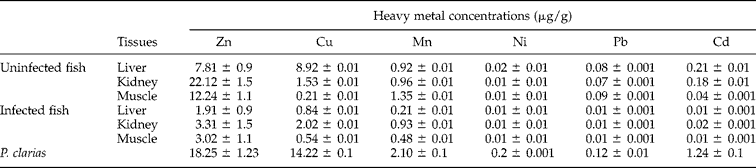
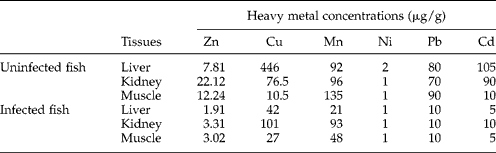
The concentrations (μg/g) of the trace metals in the host–parasite system are shown in table 1. Mean concentrations of heavy metals in fish decrease in the order: Zn > Cu > Mn > Cd > Pb > Ni. Considering the mean concentrations of accumulated heavy metals, the kidney was found to be a key target organ, followed by the liver and muscles. Zinc was the dominant element in all of the evaluated fish tissues. Large quantities of Zn can accumulate in the kidney, higher than those in the remaining tissues. The liver represented the main site for Cu accumulation, while the highest amounts of Pb and Mn were found in the muscles, and Cd was predominant in the liver and kidney. Concentrations of the heavy metals detected in parasites were higher than those in the tissues of host fish, with the exception of Zn, which was found at higher levels in fish kidneys than in the parasite tissues. In addition, the bioaccumulation factor indicated that the concentration of the heavy metals in different tissues of fish were higher than those in water (table 2).
Mean heavy metal concentrations (mg/g wet weight ± SE) in the liver, kidney and muscles of fish, together with mean values for P. clarias (± SE).

Estimates of the bioaccumulation factor of heavy metals in the liver, kidney and muscle of fish infected with P. clarias and uninfected fish.

Discussion
Lake Manzala is the largest of the northern deltaic lakes of Egypt and served as a significant source of inexpensive fish for human consumption in Egypt, but pollution and lake drainage have reduced the lake's productivity. Fish frequently serve as intermediate or transport hosts for larval parasites of many animals, including humans (Negm-El Din, Reference Negm-El Din1987; Abu El-Ezz, Reference Abu El-Ezz1988; Faisal & Shalaby, Reference Faisal and Shalaby1989; Galli et al., Reference Galli, Crosa and Occhipinti Ambrogi1998; Abdel-Gaber et al., Reference Abdel-Gaber, El Ghary and Morsy2015). In general, heavy parasite burdens seem to be more common in fish originating from wild sources (Merck Veterinary Manual, 2006). Polyonchobothrium clarias is a widely distributed cestode parasite in African freshwater siluroid fish, having been recorded from C. gariepinus Burchell, 1822 in the River Nile in Egypt (Imam, Reference Imam1971; Bassiony, Reference Bassiony2002; Eissa et al., Reference Eissa, Badran, Sohair, Mohamed and Abdelmola2010), C. lazera Cuvier and Valenciennes, 1840 in Nigeria (Aderounmu & Adeniyi, Reference Aderounmu and Adeniyi1972), Heterobranchus bidorsalis Geoffroy Saint-Hilaire, 1809 from Senegal (Khalil, Reference Khalil1973), C. gariepinus in seven dams in the Lebowa region, Limpopo Province, South Africa (Mashego, Reference Mashego1977), Bagrid catfish Chrysichthys thonneri Steindachner, 1912 from Gabon, and the mud-fish C. anguillaris Linnaeus, 1758 from Egypt (Amin, Reference Amin1978). In the present study, the African catfish C. gariepinus was found to be naturally infected with P. clarias, with a prevalence of 38.0%. These results coincide with data obtained by Imam (Reference Imam1971) who reported an incidence of P. clarias as high as 42.0% for C. gariepinus dwelling in the Nile in mid Egypt (Cairo and Giza Provinces), while a prevalence of 22% in Lake Manzala, Egypt has also been recorded. In addition, Bassiony (Reference Bassiony2002) and Eissa et al. (Reference Eissa, Badran, Sohair, Mohamed and Abdelmola2010) recorded that the highest infestation rate of C. gariepinus with P. clarias was recorded in winter, and the lowest rate occurred in summer; these data coincide with our results.
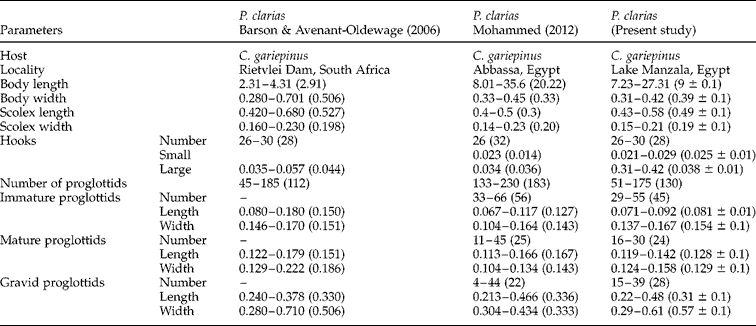
Morphological and morphometric descriptions of the present mature cestode parasite were identical to P. clarias Woodland, Reference Woodland1925, having all the characteristics described by Yamaguti (Reference Yamaguti1959) for the genus Polyonchobothrium – a nearly rectangular scolex with hooks arranged in four quadrants, two longitudinally elongated bothria in line with the gaps between the crowns of hooks, followed by a number of proglottids, eggs embryonated – and the dimensions of the body parts being more or less similar. These findings were closely similar to the previous descriptions for P. clarias given by Barson & Avenant-Oldewage (Reference Barson and Avenant-Oldewage2006) and Mohammed (Reference Mohammed2012) (table 3). Our observations for live specimens of P. clarias in the current study found that they differed from those described by Saayman et al. (Reference Saayman, Mashego, Mokgalong, Saayman, Schoonbee and Smit1991) only in that the material described by the latter authors had a triangular scolex and some specimens were found in the main bile duct of the host, which they described as ‘more robust’ than the intestinal specimen. In addition, our observations differ from those reported for P. ophiocephalina from Chinese perch (Zhongzhang, Reference Zhongzhang1982) and P. magnum from Russia (Bykhovskaya-Pavlovskaya et al., Reference Bykhovskaya-Pavlovskaya, Gusev, Dubinina, Izyumovan, Smirnova, Sokolskaya, Shtein, Shulman and Epstajn1962) by having a conical scolex and a trapezoidal scolex, respectively. Also, Saayman et al. (Reference Saayman, Mashego, Mokgalong, Saayman, Schoonbee and Smit1991) reported that the scolex apex (rostellum) is distinctly elevated, which differs from our specimens which show a more or less flattened rostellum. The scolex of the present specimens was provided with a circle of 32 hooks arranged in four quadrants of eight hooks each, and more closely resembles other species described by Barson & Avenant-Oldewage (Reference Barson and Avenant-Oldewage2006) and Mohammed (Reference Mohammed2012), while it differs significantly from those of species infecting fish in Nigeria (30; Aderounmu & Adeniyi, Reference Aderounmu and Adeniyi1972) and Zimbabwe (38; Chishawa, Reference Chishawa1991).
Comparative morphometrics (in mm) of P. clarias from Egypt with previous descriptions by Barson & Avenant-Oldewage (Reference Barson and Avenant-Oldewage2006) and Mohammed (Reference Mohammed2012).

Lake Manzala is one of the most heavily polluted areas on the Egyptian Mediterranean coast, receiving huge amounts of agricultural, industrial and sewage waste (Abdalla et al., Reference Abdalla, Zaghloul, Hassan and Moustafa1995; Ansari et al., Reference Ansari, Gill, Lanza and Rast2011). Certain organisms are able to provide information about the chemical state of their environment through their presence or absence (Schäperclaus, Reference Schäperclaus1990; Sures, Reference Sures2008; Marcogliese et al., Reference Marcogliese, King, Salo, Fournier, Brousseau, Spear, Champoux, McLaughlin and Boily2009). Others are less affected by toxic substances but show an ability to concentrate environmental pollutants inside their tissues (Rosenberg & Resh, Reference Rosenberg and Resh1993; Sures et al., Reference Sures, Scheef, Klar, Kloas and Taraschewski2002; Marcogliese et al., Reference Marcogliese, Dautremepuits, Gendron and Fournier2010). It is well known that copper, manganese, nickel and zinc are essential elements required by a wide variety of enzymes and other cell components, and having vital functions in all living organisms, but very high intakes can cause adverse health problems (Demirezen & Uruc, Reference Demirezen and Uruc2006; Elnabris et al., Reference Elnabris, Muzyed and El-Ashgar2013). On the other hand, Cd and Pb have no biological role and hence they are harmful to living organisms even at considerably low concentrations. In this study, the overall average concentrations of metals were found to accumulate in the order of Zn > Cu > Mn > Cd > Pb > Ni, with concentrations of essential elements being higher than those of non-essential elements. These results may confirm the essential role of the former metals to fish species. Although it is not always the rule, these results agreed with the observations of Chen & Chen (Reference Chen and Chen2001) (Zn = Fe > Cu = Mn > Cd) and Bahnasawy et al. (Reference Bahnasawy, Khidr and Dheina2009) (Zn > Cu > Pb > Cd). The current investigation demonstrated that the distribution of Zn in different organs of infected fish followed the order: kidney > muscles > liver, these results agreed with data obtained by Pourang (Reference Pourang1995) who studied the accumulation of different heavy metals in Esox lucius and Carassius auratus from Anzali wetland. This investigation shows that the kidney represents a key target organ, receiving the largest quantities of heavy metals from the body. On the other hand, Cu and Cd take the following order: liver > kidney > muscles. This is in agreement with WHO–IPCS–Environmental Health Criteria (1987) which reported that the liver is considered the second most important heavy-metal storage organ as it accumulates higher concentrations of Cu and Cd compared to the other fish tissues. The current investigation reported that infected fish contain low concentrations of heavy metals in their tissues as compared to non-infected fish. In addition, the metal concentrations of P. clarias were compared to those of different organs of its host, showing that it accumulates heavy metals at concentrations that are orders of magnitude higher than those in their fish hosts. These results agreed with those of Madanire-Moyo & Barson (Reference Madanire-Moyo and Barson2010), who confirmed that cestode parasites seem to be good indicators of environmental conditions.
This recent field study includes a re-description of P. clarias infecting C. gariepinus inhabiting Egyptian freshwater. In addition, it demonstrated that particular fish cestode parasites can accumulate toxic metals from the aquatic environment more than their hosts. Thus, the application of certain parasites as sentinel organisms could provide a promising new domain for future research into environmental issues.
Acknowledgements
The authors extend their appreciation to the Faculty of Science, Cairo University, Cairo, Egypt, for providing all facilities to complete this work.
Conflict of interest
None.
Ethical standards
Animal use followed a protocol approved and authorized by the Institutional Animal Care and Use Committee (IACUC) of the Faculty of Science, Cairo University, Egypt.