INTRODUCTION
The limnomedusa Olindias formosus (Goto, Reference Goto1903) (Figure 1) is a semi-benthic hydrozoan known from central and southern Japan and Jeju-do Island, Korea (Goto, Reference Goto1903; Uchida, Reference Uchida1929, Reference Uchida1938; Komai and Yamazi, Reference Komai and Yamazi1945; Komai, Reference Komai1951; Uchida, Reference Uchida1958; Yamazi, Reference Yamazi1958; Park, Reference Park2006) and is typically present from December to July, with medusae appearing in greatest numbers during April and May. During the daytime, Olindias spp. medusae typically rest near the seafloor, commonly attached to rocks, seagrass or algae. They are known to swim to the surface in search of prey at night (Breder, Reference Breder1956; Larson, Reference Larson1986). Other than observations on growth, gonad development (Chiaverano et al., Reference Chiaverano, Mianzan and Ramírez2004), and swimming behaviour (Breder, Reference Breder1956; Larson, Reference Larson1986), there is a paucity of information about the six species of Olindias (Schuchert, Reference Schuchert and Schuchert2014), and for more than a century the life cycle of medusae in this genus has remained unknown.
Olindias formosus: (A) adult hydromedusa on display at the Monterey Bay Aquarium, approximately 12 cm bell diameter; (B) adult hydromedusa under blue light and yellow filter in the fluorescence display in the ‘Jellies Experience’ exhibition. Photographs by Randy Wilder/Monterey Bay Aquarium. Scale bars: A, B, 5 cm.

Mass envenomation events involving Olindias spp. can create public safety concerns due to its potent sting (Cleland & Southcott, Reference Cleland and Southcott1965; Resgalla et al., Reference Resgalla, Rosseto and Haddad2011; Mosovich & Young, Reference Mosovich and Young2012). The sting from Olindias spp. is often described as being mildly painful for victims (Haddad Jr et al., Reference Haddad, da Silveira, Cardoso and Morandini2002), usually swimmers and beachgoers, resulting in erythema, severe dermatitis (Kokelj et al., Reference Kokelj, Mianzan, Avian and Burnett1993; personal observation) and at least one incident from Japan has resulted in death (Purcell et al., Reference Purcell, Uye and Lo2007). To better understand these envenomation events, how and why they occur, we must look at the life cycle to determine the causative factors for Olindias spp. blooms. With a potential worldwide increase in jellyfish blooms being widely debated (Brotz et al., Reference Brotz, Cheung, Kleisner, Pakhomov and Pauly2012; Condon et al., Reference Condon, Duarte, Pitt, Robinson, Lucas, Sutherland, Mianzan, Bogeberg, Purcell, Decker, Uye, Madin, Brodeur, Haddock, Malej, Parry, Eriksen, Quiñones, Achah, Harvey, Arthur and Graham2013; Gibbons & Richardson, Reference Gibbons and Richardson2013), it is essential to understand the life histories and biology of jellyfish blooms.
Due to its uncommon beauty, O. formosus is an increasingly popular display species in public aquaria worldwide. Specimens can be purchased seasonally from collectors in Japan to supply this demand (Association of Zoos & Aquariums, Aquatic Invertebrate Taxon Advisory Group, 2013). In an effort to provide reliable year-round displays of this photogenic hydrozoan, we have tried to mate individuals in vivo and pair gonad tissues in vitro for more than a decade at the Monterey Bay Aquarium. These efforts occasionally produced viable embryos and twice produced primary settlement, but the hydroid colonies perished shortly thereafter (Upton et al., Reference Upton, Widmer and Mizutani2004). The greatest challenges seem to lie in planula formation and settlement (Steve Spina, Assistant Curator and Chris Doller, Senior Aquarist, New England Aquarium, personal observations and personal communications).
In March 2012, the Monterey Bay Aquarium opened the temporary exhibition, ‘The Jellies Experience’, to demonstrate the beauty of jellyfish from around the world using living, electronic and interactive exhibits. Included in the exhibition is a jellyfish fluorescence display featuring O. formosus (Figure 1). The bright fluorescence of this species led to the visual discovery of the hydroid stage in the display tanks during routine maintenance. Hydroids and juvenile medusae were isolated, cultured, and observed, and the life cycle of this species is described here for the first time.
MATERIALS AND METHODS
Olindias formosus medusae were purchased in May 2012 from Blue Corner Co. Ltd and Izu-Chuo Trading Co., Japan, for display at the Monterey Bay Aquarium. The medusae were collected in the Mie prefecture of Japan, and ranged in bell diameter from ~4–12 cm; many appeared to be mature, with fully formed gonads. Five to six medusae of various sizes were housed together in each of two acrylic display aquaria measuring 53 × 43 × 55 cm, viewable from one side with solid black acrylic forming the remaining sides. The medusae were placed on a rigid plastic mesh (1 cm squares) to suspend them ~20 cm above the bottom of the aquaria; this provided enough space for the jellyfish tentacles to extend and capture live fish. Fish were allowed to swim freely through the aquaria, both above and under the mesh to allow for natural predation behaviour by the medusae. The rigid mesh also kept the medusae suspended in the water column and away from detritus and bacterial assemblages associated with partially digested fish and uneaten food on the bottom of the tank. The aquarium system included a 100 l reservoir, a 367 W water chiller to maintain temperature, a BlueLine 70 pump, and a 5 µm filter bag to filter water returning to the reservoir. Lighting included two 13 W, 445 nm royal blue Ecoxotic Panorama light-emitting diode (LED) fixtures which cycled on for 10 hours of daytime with a 14 hour dark period. Water temperature was maintained between 15.6°C and 17.5°C, and salinity ranged from 34 to 35 ppt. Every other day, 1–2 fish (Fundulus grandis, Jordanella floridae, and Poecilia velifera), approximately 2–8 cm, were fed to each medusa.
Olindias formosus medusae were placed on display in May 2012 and removed from display 22 November 2012, surviving an average 5–6 months. Upon removal on 22 November 2012 the royal blue LED lighting illuminated the hydroids with fluorescing medusa buds, and sections of the 1 cm plastic mesh containing hydroid clusters with developing medusae were promptly removed for further inspection. The sections of plastic mesh were isolated into three 150 mm crystallizing dishes with about 300 ml seawater, each at a different temperature: 15°C, 20°C and 25°C. The dishes were observed daily for hydroid growth and medusa bud production. Medusae produced from these dishes were also isolated in 150 mm crystallizing dishes. Seawater was changed daily and the young medusae were offered rotifers (Brachionus plicatilis) and Artemia nauplii after each water change. After 30 days, the hydroid samples were moved into screened containers (Raskoff et al., Reference Raskoff, Sommer, Hamner and Cross2003) that were flooded with a constant flow of seawater maintained at the experimental temperatures. For the measurement of the morphological characteristics of the hydroids and medusae, photographs were taken using a Motic SMZ-168 stereo microscope and a Canon T3i camera, and measurements were made using ImageJ software.
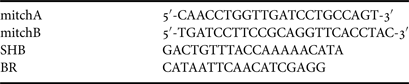
In order to confirm the identity of the discovered hydroids, samples of newly released medusae, hydroids and adult O. formosus medusae (suspected parent medusae) were sent to co-author L.C. at the Monterey Bay Aquarium Research Institute for molecular genetic analysis. The adult O. formosus medusa sample was provided separately, post hoc, to eliminate the chance of any sample contamination. Genomic DNA samples from several small medusae, hydroids, and a piece of tentacle from the adult O. formosus were extracted using a DNeasy Blood & Tissue Kit (Qiagen, Japan) following the manufacturer's protocol. A fragment of approximately 1800 base pairs (bp) of the small subunit ribosomal gene (18s) was amplified using the universal primers mitchA and mitchB modified from Medlin et al. (Reference Medlin, Elwood, Stickel and Sogin1988) (Table 1). A fragment of approximately 500 bp of the mitochondrial 16s gene was amplified using the primers 16s-SHB (Cunningham & Buss, Reference Cunningham and Buss1993) and 16s-BR (Schroth et al., Reference Schroth, Jarms, Streit and Schierwater2002) (Table 1). All amplifications were performed on a Veriti Thermal Cycler (Life Technologies, USA) or a DNA Engine (Bio-Rad, USA) using Phusion High-Fidelity Master Mix (New England Biolabs, USA). PCR products were purified using QIAquick Gel Purification Kit (Qiagen) and were sequenced using the BigDye terminator v.3.1 sequencing kit and analysed on an ABI 3130xl capillary sequencer (Life Technologies). Sequences were edited and aligned in Geneious v.6.1.2 (Biomatters, USA) using ClustalW. A BLASTN search was performed on GenBank to find matching sequences.
Olindias formosus: (A) fully developed hydroid cluster-colony; (B) hydroid characters. T, tentacle; Hp, hypostome; Hd, hydranth; Hy, hydrorhiza; (C) single polyp with single filiform tentacle. Scale bars: A, 500 µm; B, C, 1 mm.
Olindias formosus: (A) lateral budding of medusa at base of hydranth. MB, medusa bud; (B) medusa bud forming on stalk directly from hydrorhiza attached to mesh substrate. MB, medusa bud; (C) mature medusa bud; note fluorescent green patches visible at base of tentacles and manubrium already developing; (D) mature medusa bud pre-release, note bright fluorescence of the medusa; (E) newly released medusa under blue light and yellow filter to highlight fluorescence; (F) young medusa showing typical positioning of primary and secondary tentacles. p, primary tentacle; s, secondary tentacle. Scale bars: A–C, 500 µm; D, 250 µm; E, 500 µm; F, 1 mm.
Primer sequences modified from Medlin et al. (Reference Medlin, Elwood, Stickel and Sogin1988), Cunningham & Buss (Reference Cunningham and Buss1993) and Schroth et al. (Reference Schroth, Jarms, Streit and Schierwater2002), respectively.
RESULTS
Taxonomy
Frequently cited as Olindias formosa (Goto, Reference Goto1903), Calder (Reference Calder2010) points out that the correct scientific name for this species is Olindias formosus (Goto, Reference Goto1903). Goto's species name formosa is a Latin adjective meaning ‘beautiful’, and Article 31.2 of the International Code of Zoological Nomenclature specifies that the species name ending must agree with the gender of Olindias, which is taken to be masculine. Therefore the species name must be masculine, formosus (Schuchert, Reference Schuchert and Schuchert2014; Dale Calder, personal communication).
Hydroids
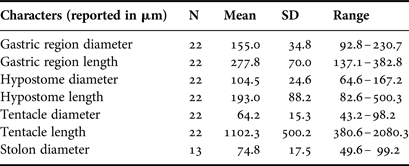
The O. formosus polyps form small colonies that are stolonal, occurring in small clusters, but which never form a network. The hydrorhizae are cylindrical with small egg-shaped or cylindrical hydranths (200–800 µm length) occurring along a relatively straight stolon up to 5 mm in length (Table 2; Figure 2). Each hydranth has a single, elongate, filiform tentacle and is transparent or whitish in colour (hydranths in our study took on an orange/pink coloration due to the daily consumption of Artemia nauplii). The single tentacles are very active, showing almost constant sweeping motions, and are highly extensible and contractile with some tentacles observed to extend to nearly 7.5× the length of the hydranths while being able to retract to the length of the hydranth (Figure 2). Medusa buds form singly at the base of hydranths and along stolons on a short stalk (Figure 3). The hydrorhizae and stolons are lightly covered with detritus and diatoms. Like other Limnomedusae, the hydroids are athecate and gonangia are absent. The hydroid clusters settled on the underside of the plastic mesh in our aquaria, directly below the medusae.
Morphological character variations for the hydroid stage of Olindias formosus.
N, number; SD, standard deviation.
At the end of 30 days, both cultures of hydroids that were isolated in the 25°C and 20°C dishes showed no new growth and both colonies perished by the end of the month; the 15°C dish was the only treatment with healthy polyps and new hydroid clusters. Of the three temperatures tested, the presence of new polyp clusters in the 15°C treatment (growing from an initial six clusters to a final 12 clusters) indicated temperature preference for asexual proliferation.
Medusae
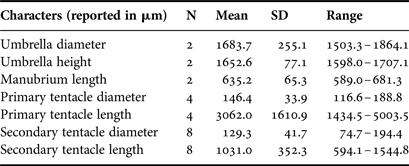
Newly released medusae were approximately 1 mm in diameter and had four radial canals, four primary tentacles located at the bases of the radial canals, and two secondary tentacles located between the primary tentacles on opposing sides on the bell margin (Figure 3). Medusae grew to 1.5–1.8 mm bell diameter over a 30-day period during which they were fed daily (Table 3). Medusa buds on the hydroids had distinctive fluorescent spots near the mouth and around the bell margin, which persisted after release (Figure 3). Juvenile medusae demonstrated behaviour similar to adults with short periods of swimming followed by longer periods of rest on the bottom. Juvenile medusae were almost always found attached to the glass dishes using their primary tentacles (Figure 3).
Morphological character variations for the newly released medusae of Olindias formosus.
N, number; SD, standard deviation.
The dishes containing hydroids at the three different temperatures produced a total of 13 medusae. The 25°C treatment produced seven medusae, 20°C produced four and 15°C produced two medusae over a period of 30 days. The medusae isolated in dishes by temperature had variable survivorship—up to 36 days in the 15°C treatment, up to 17 days in the 20oC treatment, and up to 11 days in the 25°C treatment. The medusae grew largest at 15°C.
Molecular analyses
Genes coding for 18S and 16S rRNA were identical in all samples tested. The cultured hydroids and juvenile medusae were identical to the wild adult Olindias formosus medusae from Japan. The samples were also found to be significantly similar to Olindias phosphorica: 18S–99% identical (1751 bp out of 1758 bp, GenBank accession no. KF184030), 16S–92% identical (456 bp out of 495 bp, GenBank accession no. KF184031, Collins et al., Reference Collins, Bentlage, Lindner, Lindsay, Haddock, Jarms, Norenburg, Jankowski and Cartwright2008).
DISCUSSION
No hydroids of Olindias spp. have ever been observed and documented in the field. Weill (Reference Weill1936) described Olindias spp. hydroids from laboratory observations as solitary and enclosed in a hydrotheca that is longer than the polyp; however, our observations show that Weill's polyps were very different from the O. formosus hydroids that were growing in our aquaria and also very different from other known polyps for Limnomedusae.
No hydrotheca was present on the Olindias formosus hydroids in this study, and while some polyps were solitary, others were stolonal, and the solitary polyps observed appeared to be newly settled, later becoming stolonal clusters. The O. formosus hydroids very closely resembled those of another member of Olindiidae, Eperetmus typus, which produces hydranths with a single tentacle issuing from below the hypostome and connected by non-networking stolons (Nagao, Reference Nagao1973). Mills et al. (Reference Mills, Rees and Hand1976) suggest that Nagao's E. typus is misidentified and that it represents an unidentified species of Aglauropsis. Mills et al. (Reference Mills, Rees and Hand1976) grew a very simple primary polyp for the Limnomedusa Aglauropsis aeora, which was solitary and never produced any tentacles. The freshwater Limnomedusa Craspedacusta sowerbii Lankester, 1880, well-known from many locations worldwide, also has a simple polyp with no tentacles that may be solitary or occur in small colonies of 2–7 polyps (Russell, Reference Russell1953). The hydroids of Limnomedusae in the olindiid genus Gonionemus are small, solitary polyps with 3–7 long tentacles that drag along the substrate (Joseph, Reference Joseph1925; Goy, Reference Goy1973).
It should be noted that although Weill (Reference Weill1936) reported his observations under the species name Olindias phosphorica (della Chiaje, 1841), the species that he observed around the Bermuda Islands in August 1936 would have been O. tenuis (Fewkes, 1882) (Mayer, Reference Mayer1910). Weill (Reference Weill1936) reported creeping (non-swimming) planulae that after 23 days had developed into small solitary polyps within a hydrotheca that was up to several times as long as the polyp, and the emerging polyps were without tentacles and did not further reproduce. We did not observe the O. formosus planulae, but the naked polyps forming small stolonal colonies that we report here for Olindias formosus have a morphology substantially different from that reported for O. tenuis, and ours went on to produce medusae. It is also important to note that dichotomous keys for the family Olindiidae, such as those found in Bouillon et al. (Reference Bouillon, Gravili, Gili and Boero2006), should be updated to reflect the observations presented here so that they may be of use in future research.
The medusae that were produced by the O. formosus hydroids in this study possessed defining characteristics of medusae in the genus Olindias including four radial canals, primary tentacles that originate from above the bell margin and secondary tentacles that originate at the bell margin (Bouillon et al., Reference Bouillon, Gravili, Gili and Boero2006). The characteristic centripetal canals were not observed; however, these presumably would have developed as the medusae grew. Molecular analysis of genes coding for 18S and 16S rRNA confirmed that the hydroids and juvenile medusae in this study were indeed O. formosus.
Hydroids isolated and cultured in crystallizing dishes yielded the most medusae at higher temperatures, while the lowest temperature treatment produced only two medusae. Although no statistically significant quantitative observation was possible due to limited number of hydroids available, Olindias formosus hydroids seemed to produce medusae when the temperature was above 15°C. The hydroids currently maintained in the laboratory have persisted only at 15°C, with regular asexual reproduction. The 20°C and 25°C temperature treatments eventually failed, with total loss of the hydroids. Olindias formosus hydroids appear to have a stable asexual growth state at ~15°C or below and enter medusa production at temperatures >15°C. The medusae that were isolated in dishes were observed to grow the largest and appeared in better health in the 20°C treatment than in any other. This correlates with the seasonal influence of the Kuroshio Current (Mizuno & White, Reference Mizuno and White1983) off coastal Japan and Goto's (Reference Goto1903) original observations of young medusae first appearing in December at less than 20 mm diameter, with mature medusae present until July. Bigelow (Reference Bigelow1913) asserted that Olindias formosus found off Japan must have been transported there by the Kuroshio Current from more tropical climes; however, the evidence presented here contradicts Bigelow's assertion. The results presented in this paper suggest that O. formosus hydroids can survive the winter months in the coastal waters of southern Japan.
Further research is necessary to determine if and why barriers exist for settlement of Olindias spp. planulae, as these factors could influence Olindias spp. blooms worldwide. Because Nagao (Reference Nagao1973) noted that the hydroids of Eperetmus typus were found on bivalve shells, suitable substrate could be a strong settlement cue for planulae of Olindias formosus and other members within the genus. Settlement barriers (physical and environmental) and the diminutive size of the hydroids have made O. formosus very difficult to culture in the laboratory. Numerous culture attempts by many individuals, using both in vitro and in vivo methods, resulted in either no planulae being produced or the planulae not settling (Upton et al., Reference Upton, Widmer and Mizutani2004). In the past, efforts at the Monterey Bay Aquarium focused on suspending medusae in the water column or allowing them to rest on substrate. These methods either were not suitable for planulae settlement and hydranth formation or made detection of the hydroids extremely difficult. The husbandry methods described in this paper represent a longer-term culturing effort in which the medusae were afforded the opportunity to spawn naturally in the presence of artificial habitat that could be inspected more easily for hydroids.
An important tool that was vital to the discovery of the benthic stages was the illumination by the royal blue LED lights that allowed us to see hydroid clusters with fluorescent budding medusae on the plastic mesh without magnification. The usefulness of this technique in the laboratory suggests that fluorescent illumination in the field could be an effective tool for locating the hydroids of O. formosus. Discovery of wild benthic populations of Olindias spp. would aid research into factors affecting bloom duration, size and ultimate impact upon humans. The methods utilized in this study for both jellyfish husbandry and detection of benthic life stages may be helpful to future research on life histories of other jellyfish or marine invertebrates. This recent discovery of the hydroid and early medusa stages of O. formosus should lead to new opportunities in studying the populations and ecology of other species of Olindias, an interesting and amusing genus of hydromedusae that has proved popular in public aquarium exhibits.
ACKNOWLEDGEMENTS
We thank Chad Widmer and Bruce Upton for their pioneering work on this species and sharing their experiences. Additionally we thank the husbandry staff and volunteers of the Monterey Bay Aquarium and Steve Haddock of the Monterey Bay Aquarium Research Institute. The authors also thank Steve Spina and Chris Doller of the New England Aquarium for their assistance in shipping live medusae and continued collaboration on Olindias husbandry techniques. Thank you to Chris Lowe of Stanford University, Hopkins Marine Laboratory, for providing microscopy resources, and to Mike Murray, Kevin Uhlinger and Marcus Zevalkink for their comments on the draft manuscript. Finally we thank Claudia Mills, the ‘grand duchess of jellyfish’, for her assistance with editing this manuscript.
FINANCIAL SUPPORT
This work was supported by funding from the Monterey Bay Aquarium Foundation and Packard Foundation.