Introduction
Mixed pastures have been considered a valuable alternative to monocultures, offering enhanced ecosystem multifunctionality through their diverse species composition (Pasari et al., Reference Pasari, Levi, Zavaleta and Tilman2013; Pembleton et al., Reference Pembleton, Tozer, Edwards, Jacobs and Turner2015). While these complex grassland systems can maintain both stability and productivity over time, their successful management represents a significant challenge, as it directly influences pasture stability through its effects on species interactions and community dynamics (Schulte et al., Reference Schulte, Lantinga and Struik2003). Among the various management tools available, grazing height and nitrogen fertilization have been identified as particularly important, capable of significantly altering species composition and population dynamics over time (Barreta et al., Reference Barreta, Winter, Gislon, Sollenberger and Sbrissia2023).
In grass plants, tillers function as the fundamental units that determine both production capacity and long-term persistence (Langer, Reference Langer1963). The dynamics of tiller population are characterised by their rates of appearance and death, which determine the tiller population density (TPD). The TPD, in turn, is heavily influenced by grazing management through its effects on light penetration into the canopy and plant-plant competition (Grime, Reference Grime1977), ultimately affecting sward persistence (Matthew and Hamilton, Reference Matthew and Hamilton2011).
The study of tiller demography, while labour-intensive, provides essential insights into pasture dynamics through detailed assessment of tiller age cohorts and their succession patterns (Matthew et al., Reference Matthew, Agnusdei, Assuero, Sbrissia, Scheneiter and Da Silva2013). Despite its time-consuming nature, this methodological approach yields valuable comparative data across different management strategies (Korte, Reference Korte1986; Bahmani et al., Reference Bahmani, Thom, Matthew, Hooper and Lemaire2003) and enables a deeper understanding of the mechanisms governing grass population persistence (Turchin, Reference Turchin2001; Matthew and Hamilton, Reference Matthew and Hamilton2011).
Demographic theory establishes that population equilibrium in grass pastures is achieved through a dynamic balance between tiller appearance and mortality rates (Harper, Reference Harper1980). This equilibrium becomes particularly complex in mixed pastures due to the additional influences of interspecific interactions and environmental variability (Caswell, Reference Caswell1989).
In grassland ecosystems, stability and persistence are interconnected concepts. Stability is the ability of a system to return to an equilibrium state after a disturbance, while persistence measures resilience, i.e. the capacity to absorb changes (Fränzle, Reference Fränzle and Schmithüsen1979) and resistance to disturbance (Seabloom, Reference Seabloom2007). Grimm and Wissel (Reference Grimm and Wissel1997) integrate the term ‘stability’ into three fundamental properties: (1) the ability to stay essentially unchanged (constancy), (2) the ability to return to the reference state after a temporary disturbance (resilience) and (3) persistence through time (persistence). Therefore, in this paper, stability and persistence will be considered as equivalent terms.
The persistence of perennial grass populations specifically depends on their capacity to recruit new tillers through bud banks and vegetative reproduction in response to both climate variations and disturbances (Ott and Harnett, Reference Ott and Harnett2015). A deeper understanding of these demographic processes and their interactions is fundamental for predicting how grassland communities respond to environmental changes, ultimately influencing their abundance, distribution, stability and resilience.
It is important to highlight that herbage mass is not synonymous with stability since it normally reflects the trade-off between tiller size and number (Matthew et al., Reference Matthew, Agnusdei, Assuero, Sbrissia, Scheneiter and Da Silva2013). This relationship manifests through the self-thinning process, where increased herbage mass typically results from larger but fewer tillers (Yoda et al., Reference Yoda, Kira, Ogawa and Hozumi1963). The slope of this relationship (on a log-log scale) has been used to make inferences about sward conditions, where it is normally assumed that a slope close to −3/2 indicates a constant leaf area index (LAI) across a range of changes in tiller size and number (Matthew et al., Reference Matthew, Hernandez-Garay and Hodgson1995).
In this sense, the relationship between tiller size and number has normally been associated with herbage production (Matthew et al., Reference Matthew, Hernandez-Garay and Hodgson1996) but it is also reasonable to conjecture that this approach could be used as a tool to infer sward persistence and stability over time. For example, whether a pasture managed with a given canopy height/herbage mass presents a slope of a tiller size/density relationship close to –3/2 (or higher) that would mean that the trade-off between size and number of tillers is operating to maintain a relatively constant LAI across the years, suggesting stability at that given sward conditions.
Lolium arundinaceum is a C3 perennial grass with specific leaf area (SLA) and functional traits associated with more conservative species (Duchini et al., Reference Duchini, Guzatti, Schmitt, Echeverria, Américo, Werner and Sbrissia2023), and Cenchrus clandestinus Hochst. ex Chiov is a C4 perennial grass with functional traits related to resource-acquisitive plants (Barreta et al., Reference Barreta, Winter, Gislon, Sollenberger and Sbrissia2023). Moreover, they could represent an effective alternative for a binary pasture mixture in subtropical environments due to their complementary growth patterns and distinct resource utilisation strategies, as they exhibit asynchronous peaks of forage production throughout the year (Miqueloto et al., Reference Miqueloto, Bernardon, Winter and Fischer Sbrissia2020a,b; Bernardon et al., Reference Bernardon, Miqueloto, Winter, De Medeiros Neto and Sbrissia2021), with L. arundinaceum dominating during cooler seasons and C. clandestinus during warmer periods. However, in this mixture sward, under continuous stocking, with no nitrogen input during summer, the species composition was modified under lenient grazing (around 17 cm), with L. arundinaceum predominating in the sward after 2-years of the experiment, even during summer.
Building on this background, our objective was to identify whether different pre-grazing heights (15 and 20 cm), nitrogen fertilised year-round, associated or not with strategic severe spring defoliation (aimed to reduce L. arundinaceum competition with C. clandestinus during summer), could maintain both demographic stability in a mixed pasture composed of two dominant perennial grasses (Lolium arundinaceum and C. clandestinus) under rotational grazing. Additionally, it explores the traditional demographic analysis with the application of the self-thinning law.
Three hypotheses were tested: (1) different grazing heights alter the demographic patterns (tiller appearance, survival and mortality) of each grass species (L. arundinaceum and C. clandestinus), but the mixed pasture maintains stability through complementary responses between species; (2) the compensatory relationship between tiller size and density maintains pasture stability regardless of grazing management strategy and (3) a single severe spring defoliation modifies short-term tiller demographics but does not compromise the long-term stability of the mixed pasture due to compensatory mechanisms in tiller population dynamics. To test these hypotheses, we combined traditional demographic analysis with the application of the self-thinning law to provide a comprehensive understanding of population stability in mixed pastures under varying management intensities.
Materials and methods
Study site
The experiment was conducted from November 2017 to November 2020 at the Center for Agricultural Sciences, Santa Catarina State University (UDESC/CAV) in Lages, Santa Catarina, Brazil (27°48’58″S, 50°19’34″W; elevation 930 m). The site has a humid subtropical climate with oceanic influence (Köppen classification), characterised by cold winters, mild summers and well-distributed rainfall throughout the year. No water deficits were observed during the experimental period. Figure 1 shows monthly precipitation (mm) and mean air temperature (°C) over the experimental period.
Average temperature and precipitation during the experimental period and historical means for the preceding 80 years (EPAGRI/CIRAM, 2020).

The soil at the experimental site was classified as Typic Hapludox (Santos et al., Reference Santos, Jacomine, Anjos, Oliveira, Lumbreras, Coelho, Almeida, Araujo filho, Oliveira and Cunha2018). Initial soil chemical analysis of the 0–20 cm layer showed the following characteristics: pH (SMP) = 5.8; organic matter= 3 %; K= 64 mg/dm3; P= 6.7 mg/dm3; Ca= 7.6 cmolc/dm3; Mg= 4.5 cmolc/dm3; Al+H= 6.9 cmolc/dm3; cation exchange capacity at pH 7.0= 19.2 cmolc/dm3; base saturation= 64.1 %; and clay= 42 %. Based on the Fertilization and Liming Manual for Rio Grande do Sul and Santa Catarina States (CQFS-RS/SC, 2004), neither lime application nor K and P fertilisation were required. Nitrogen fertilisation consisted of 360 kg N/ha annually, applied in six equal doses of 60 kg of N/ha at 60-day intervals throughout the year. The first N application occurred after grazing on 20 November 2017, at the start of the experimental period.
The experimental area was established in July 2014 by overseeding Lolium arundinaceum Schreb. cv. Rizomat into an existing Cenchrus clandestinus Hochst. ex Chiov sward established in the 1990s (Miqueloto et al., Reference Miqueloto, Bernardon, Winter and Fischer Sbrissia2020a,b; Bernardon et al., Reference Bernardon, Miqueloto, Winter, De Medeiros Neto and Sbrissia2021). L. arundinaceum was sown at a rate of 20 kg/ha of pure viable seed.
Experimental design and treatments
The experiment used a randomised complete block design with a 2 ×2 factorial arrangement and three replicates, comprising four grazing treatments. Each experimental unit was 140 m2, totalling 1680 m2. The first factor consisted of two pre-grazing height managements (height: 15 and 20 cm), selected based on previous studies by Miqueloto et al., (Reference Miqueloto, Bernardon, Winter and Fischer Sbrissia2020a,b) and Bernardon et al., (Reference Bernardon, Miqueloto, Winter, De Medeiros Neto and Sbrissia2021). These studies demonstrated that under continuous grazing, maintaining canopy heights between 12 and 17 cm modified sward composition without compromising forage production. Post-grazing heights were set at 40 % of pre-grazing heights (9 and 12 cm above ground, respectively), following the principle that canopy height under continuous stocking approximates the average of pre- and post-grazing heights in intermittent stocking systems (Parsons et al., Reference Parsons, Johnson and Harvey1988). This design allowed for functional equivalence between continuous and rotational grazing systems in terms of forage utilisation and residual heights. The pasture was grazed by Holstein cattle (average weight 460 kg) under intermittent stocking method.
The second factor was the presence or absence of a hard spring grazing (HSG) treatment which consisted of a single severe defoliation in mid-November (spring) that reduced canopy height to 7 cm. This defoliation strategy was also used during autumn by Miqueloto et al. (Reference Miqueloto, Bernardon, Winter and Fischer Sbrissia2020a,b) and Bernardon et al. (Reference Bernardon, Miqueloto, Winter, De Medeiros Neto and Sbrissia2021), who found that under continuous grazing, severe defoliation did not reduce overall forage production but delayed regrowth by 90–120 days. Here, we employed this factor to identify whether the removal of L. arundinaceum in the mid-spring would increase C. clandestinus participation during summer. Following HSG, pastures were managed again at their assigned pre-grazing heights (15 or 20 cm) with 40 % defoliation severity. Canopy height was monitored using a graduated ruler at 30 randomly distributed points within each experimental unit.
Tiller demographics and morphology
Tiller population density and weight
TPD was measured using two sampling frames (80 × 30 cm each) placed at representative locations within each experimental unit at the time of defoliation. All vegetation inside the frames was harvested at ground and taken to the laboratory for analysis. Samples were separated by species (L. arundinaceum and C. clandestinus), and tillers were counted and separated into leaf blades and stems (stem + pseudostem). Total TPD for the mixed pasture was calculated as the sum of individual species’ TPD values. The area of all leaves (SLA) per species was measured using a leaf area metre (LI-3100C; LICOR, Lincoln, Nebraska, USA). Tillers were then dried in a forced-air oven at 65 °C for 72 h and weighed to determine TW. The average TW for the mixed pasture was calculated using the following formula:
 $${\rm{Mixed \ pasture \ TW}} = {\rm{ }}\Sigma \left( {{\rm{TW}} \times {\rm{TPD \ per \ species}}} \right)\ /{\rm{Total \ TPD}}$$
LAI was calculated separately for each species by multiplying the leaf mass by the SLA. The LAI of the mixed pasture was obtained by summing the LAI values of L. arundinaceum and C. clandestinus.
Tiller population dynamics
The tiller population dynamics were monitored using two fixed plastic polyvinyl chloride (PVC) rings (20 cm diameter, 0.0314 m² each) placed in representative locations within each experimental unit. Monthly tiller counts were conducted at 30-day intervals from November 2017 through November 2020. At the initial evaluation (November 2017), all existing tillers were marked with species-specific coloured plastic clips and designated as ‘zero generation’. In subsequent monthly evaluations, surviving tillers from previous generations were counted, and newly emerged tillers were marked with different coloured clips and classified as the next generation. Simultaneously, the dead tillers of each species and generation were recorded and the clips were removed. Dead tillers (identified by withered, brown/yellow appearance) were recorded and their markers were removed. This monitoring continued for three years, encompassing 36 evaluations and 35 tiller generations.
Subsequently, the rates of tiller appearance (TAR), mortality (TMR) and survival (TSR) of L. arundinaceum, C. clandestinus and mixed pasture were estimated. These indices were estimated monthly and grouped by season [winter, spring and summer (summer + autumn)]. The tiller appearance rate was calculated by the relation of tiller emergence in the evaluation and the total tillers existing in the previous evaluation. The tiller survival rate (TSR) was obtained from the relationship between the total number of tillers alive (excluding the emerged tillers) and the total tillers in the previous evaluation and the tiller mortality rate was obtained by subtracting the total TSR from 1. The tiller appearance, mortality and survival rates were also calculated for the mixture, given the tiller number that appeared, died and survived from each grass.
The population stability index (SI) was calculated for individual grass species and the mixed pasture to assess tiller population dynamics between successive evaluations. This index was calculated using equation (2) (Duchini et al., Reference Duchini, Guzatti, Echeverria, Américo and Sbrissia2018):
 $$SI = P{t_1}/P{t_0} = \left( {{\rm{TAR}} + {\rm{TSR}}} \right){t_1} - {t_0}$$
where Pt 1/Pt 0 is the ratio of tiller numbers between current (t 1) and previous (t 0) evaluations. TAR is the tiller appearance rate and TSR is the TSR.
An SI value of 1 indicates a stable population, while values above 1 indicate population growth and values below 1 indicate population decline (Matthew and Hamilton, Reference Matthew and Hamilton2011).
Tiller lifespan (TLS) was determined for each grass species and the mixed pasture following Korte (Reference Korte1986), as shown in equation (3):
 $${\rm{TLS}} = {t_1}{/_2}{\rm{ = ln}}\left( 2 \right)/b$$
where t 1/t 0 is the tiller half-life in days, and b is the regression coefficient from the exponential decay of surviving tillers over time.
Statistical analysis
The data for each grass species were grouped according to the season. The summer and autumn seasons were grouped together and extended after the SHG until the first frost (May, July and June in 2018, 2019 and 2020, respectively). Winter was defined as the first frost to mid-September, and spring from mid-September to the next HSG (November). After grouping the data, the tiller population dynamics and demographic measurements were analysed by analysis of variance (ANOVA) using the linear model procedure (P <0.05) of the INFOSTAT statistical package (Infostat 2020 n.d.). The statistical model used was:
 $${Y_{[ilj}}_] = \mu + {\alpha _{[i]}} + {\beta _{[l]}} + {\delta _{[il]}} + {\varepsilon _{[ilj]}}$$
where Y [ilj]= random variable corresponding to j-th observation of the i-th treatment and l-th treatment; µ= constant effect or global average; α[i]= effect of treatment i-th treatment; β[l] = effect of treatment l-th treatment; δ[il]= effect of interaction between treatments i-th and l-th; ϵ [ilj] = error term. The fixed effects considered were management height (α[i]) and SHG (β[l]), and their interactions (δ[il]), the year was considered a random effect. Before conducting the analysis, the assumption of normality was verified. If the assumptions were not met, that is, if there was evidence of a pattern or association in our data, a nonparametric randomised approach was used.
In addition, linear regression analysis was conducted using PAST statistical package (Hammer et al., Reference Hammer, Harper and Ryan2021) to explore the relationships between tiller demography measurements per treatment:
 $${Y_{[i}}_] = \beta 0 + \beta 1{X_{[i]}} + {\rm{ }}{\varepsilon _{[i]}}$$
where Y [i]= variable response (tiller weigh); β0= intercept of the linear regression, β1X [i] = slope of change in variable (tiller density); and ϵ[i] =error term. Because sample error occurred in both axes, the regression analyses between the TPD and TW were performed using reduced major axis method for estimating the slope of lines (La Barbera, Reference La Barbera1989). We performed an ANOVA for the statistical difference between slopes, with a significance of P <0.05. In addition, the mean value for the distance between the theoretical line of slope −3/2 (on a log-log scale) and the linear regression for each treatment per season was calculated using trigonometry. Subsequently, an ANOVA for the statistical difference between each distance was calculated and post-hoc Fisher’s least significant difference test was used. The significance was set at P <0.05.
Results
Demographic traits of L. arundinaceum and C. clandestinus
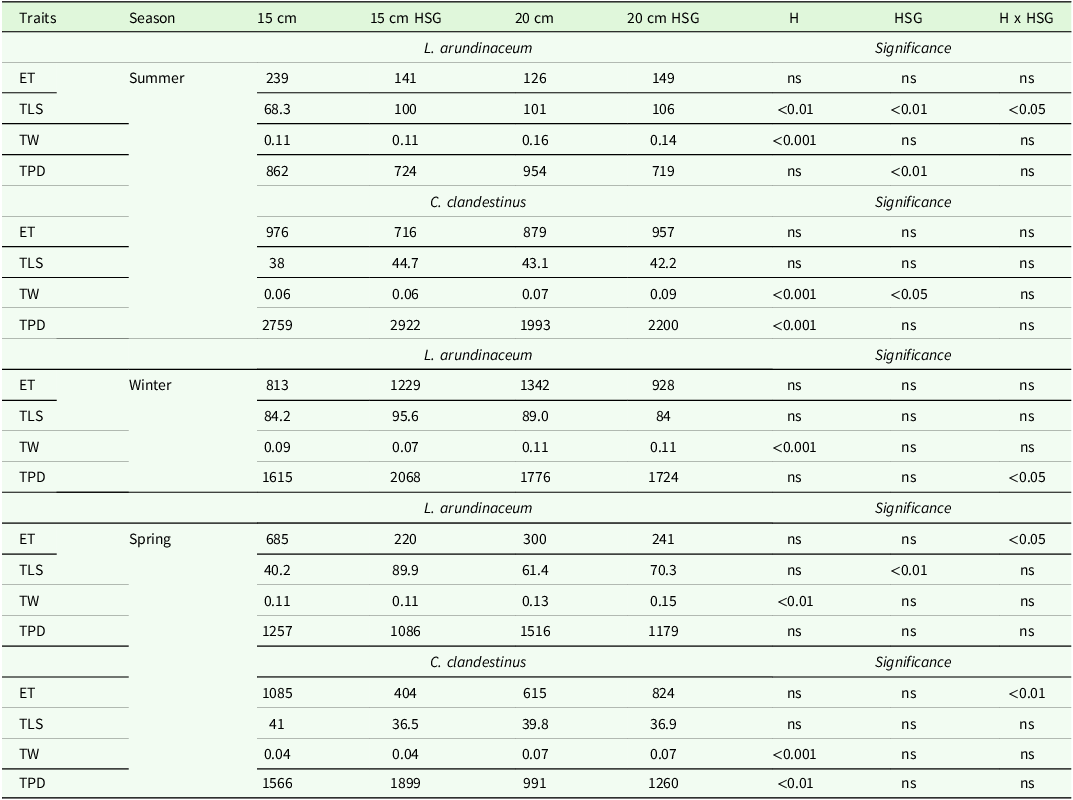
Grazing height and HSG treatments affected the demographic traits of both grass species across seasons differently (Table 1). In summer, C. clandestinus showed significant responses to grazing height, with the 15 cm treatment resulting in 26 % higher TPD but 25 % lower TW compared to the 20 cm treatment (P <0.05). For L. arundinaceum, TW decreased by 36 % under 15 cm management compared to 20 cm (P <0.05), while HSG reduced TPD by approximately 20 % (P <0.05). Neither species showed significant differences in tiller emergence (ET) between treatments. However, L. arundinaceum exhibited a significant height × HSG interaction for tiller lifespan (TLS), with the shortest lifespans observed under 15 cm management (P <0.05).
Seasonal demographic traits and tiller weight of Lolium arundinaceum and Cenchrus clandestinus under different grazing management treatments. Values represent means (n = 30) for tiller emergence (ET, tillers/m²), tiller weight (TW, g/tiller¹), tiller population density (TPD, tillers/m²) and tiller lifespan (TLS, days) across summer, winter and spring. Treatments included two pre-grazing heights (H: 15 cm and 20 cm) with or without hard spring grazing (HSG). Statistical significance: ns = not significant for main effects of height (H), HSG and their interaction (H × HSG)

Winter season dynamics were dominated by L. arundinaceum, as C. clandestinus showed minimal growth during this period. The combination of 15 cm height management and HSG significantly increased L. arundinaceum TPD (P <0.05). Additionally, TW was 37.5 % higher under 20 cm management compared to 15 cm (P <0.001), regardless of HSG treatment.
In spring, both species showed strong responses to management treatments. For C. clandestinus, taller management with HSG led to a 35 % reduction in TPD but a 45 % increase in TW (P <0.001). L. arundinaceum showed a more modest response, with only TW increasing by 27 % under taller management (P <0.05). HSG reduced TLS in L. arundinaceum (P <0.05). Both species exhibited significant height × HSG interactions for ET, with maximum tiller emergence observed under 15 cm management.
Tiller population dynamics in mixed pastures
Tiller appearance patterns
The tiller appearance rate (TAR) of the mixed pasture showed significant differences between grazing heights throughout the year (P <0.001). Under 20 cm management, TAR in summer was significantly lower (0.68 ± 0.07) compared to both winter (1.33 ± 0.11) and spring (1.20 ± 0.12). Similar seasonal patterns were observed under 15 cm management, with summer showing lower TAR (0.79 ± 0.08) than winter (1.22 ± 0.13) and spring (0.98 ± 0.15) (Figure 2a–b).
Mean ± standard error (SE) values for tiller appearance rate (grey bars) and tiller mortality rate (white bars) in the winter, spring and summer seasons in the mixture pasture; under four grazing managements: (a) 15 cm, and 15 cm HSG. (b) 20 cm, and 20 cm HSG (n: 28).

Species-specific responses were also observed, with distinct seasonal patterns in TAR (P <0.05), L. arundinaceum exhibited TAR peak during winter, while C. clandestinus showed maximum TAR in spring. For C. clandestinus, both 15 cm and 20 cm HSG treatments resulted in significantly higher TAR compared to other treatments (P <0.05; Supplementary Figure 1a–d).
Tiller mortality dynamics
Tiller mortality rate (TMR) varied significantly with grazing height across seasons (P <0.05; Figure 2a–b). Under 15 cm management, TMR was higher in summer (0.54 ± 0.05) and spring (0.56 ± 0.03) compared to winter (0.69 ± 0.05). At 20 cm, a significant season × HSG interaction was observed, with highest TMR in winter (with HSG: 0.67 ± 0.06; without HSG: 0.83 ± 0.06), intermediate values in spring (with HSG: 0.62 ± 0.07; without HSG: 0.57 ± 0.07), and lowest TMR in summer without HSG (0.51 ± 0.04).
Species-specific mortality patterns varied by treatment and season. L. arundinaceum showed the lowest mortality in winter across all treatments, though under 20 cm management, summer and winter TMR were similar. Under 15 cm management, TMR remained consistent across seasons. In contrast, C. clandestinus consistently showed the highest TMI in winter and lowest in summer across all treatments (Supplementary Figure 1a–d).
Survival patterns
The TSR of the mixed pasture showed significant seasonal variation (P <0.001), with lower values in winter (1.27 ± 0.06) compared to summer (1.42 ± 0.05) and spring (1.40 ± 0.06). Individual species showed distinct TSR responses to management treatments (P <0.05). During summer, C. clandestinus achieved highest TSR under 15 cm HSG treatment, while L. arundinaceum showed maximum TSR under 20 cm management. Both species maintained similar TSR values across treatments during winter and spring.
Demographic stability
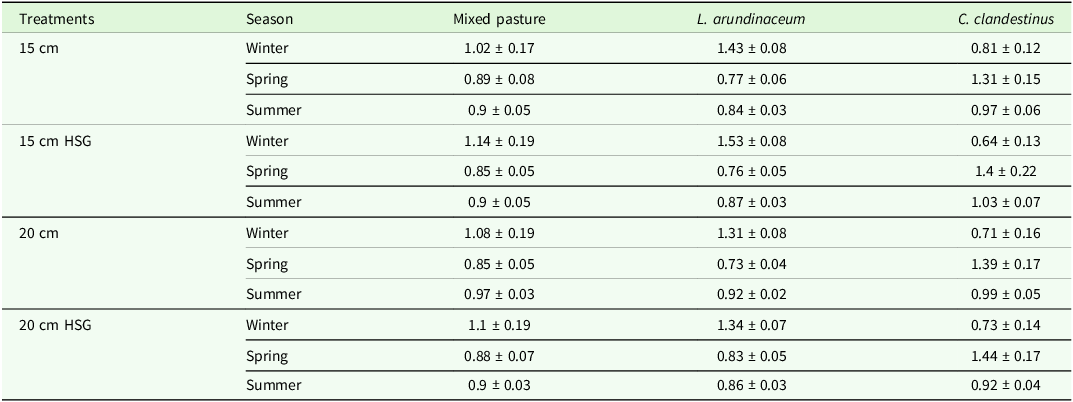
The mixed pasture maintained consistent SI values across both grazing heights and seasons, with an overall mean of 0.956 ± 0.02 (Table 2). While individual treatment effects on SI were non-significant, the two grass species showed distinct seasonal stability patterns (P <0.05). During winter, L. arundinaceum exhibited higher stability (SI = 1.40 ± 0.038) compared to C. clandestinus (SI = 0.61 ± 0.04; P <0.05). This pattern reversed in spring, with C. clandestinus showing greater stability (SI = 1.22 ± 0.05) than L. arundinaceum (SI = 0.77 ± 0.04; P <0.05). Summer stability patterns varied by treatment: under 20 cm management (with or without HSG), both species maintained similar SI values, while under 15 cm management, C. clandestinus demonstrated higher stability (with HSG: 1.07 ± 0.04; without HSG: 0.95 ± 0.04) compared to L. arundinaceum (with HSG: 0.87 ± 0.03; without HSG: 0.83 ± 0.03; P <0.05).
Seasonal demographic stability indices (SI ± SE) of mixed pasture and for individual species (L. arundinaceum and C. clandestinus) under different grazing height treatments (15 and 20 cm) with and without spring hard grazing (HSG; n = 19). SI values > 1 indicate population growth, while SI values < 1 indicate population instability

Tiller size-density relationships
TPD showed significant variation across treatments and seasons (P <0.05). The 15 cm treatment during summer presented the highest TPD (3632 ± 409 tillers m−2). TW also varied significantly with treatment and season. The 20 cm management resulted in higher TW (0.072 ± 0.009 g) compared to 15 cm (0.040 ± 0.009 g; P <0.001). HSG increased TW (with HSG: 0.060 ± 0.009 g; without HSG: 0.050 ± 0.009 g; P <0.05). Seasonal effects were also observed, with highest TW in winter (0.078 ± 0.010 g), followed by spring (0.060 ± 0.010 g) and summer (0.036 ± 0.009 g; P <0.001).
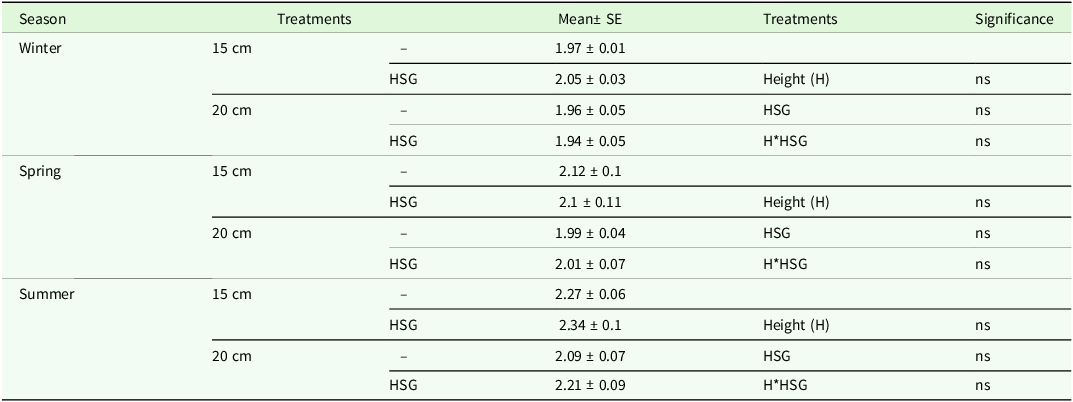
Despite these treatment effects for both traits, all managements exhibited similar compensatory relationships between TW and TPD when analysed on a log₁₀ scale (Figure 3). The regression parameters for each relationship between TW and TPD, analysed separately on a log₁₀ scale, were: 15 cm, y=3.15-1.32x, R²=0.51, P <0.001; 15 cm HSG, y=1.00-0.73x, R²=0.18, P <0.001; 20 cm, y=3.36-1.35x, R²=0.44, P <0.001; 20 cm HSG, y=3.33-1.38x, R²=0.38, P <0.001. The slopes of these relationships did not differ significantly, and their deviations from the theoretical −3/2 self-thinning line remained similar throughout the years (Table 3).
Linear regression curve showing the relationship between tiller weight (Log10) and tiller population density (Log10) in mixed pasture throughout the year under grazing management: light green represents the 15 cm group (15 cm and 15 cm HSG); light orange represents the 20 cm group (20 cm and 20 cm HSG) (n: 117), and the theoretical compensation line (y= −3/2x) is represented in violet. Regression parameters, R2 and significant P-value for each treatment: 15 cm, y=6.15-2.2x, R²=0.38, P < 0.001; 20 cm, y=4.79-1.82x, R²=0.28, P < 0.001.

Deviations from theoretical self-thinning relationship in mixed pastures under different grazing managements. Values represent mean ± standard error (SE) of the distance between linear regressions of the relationship between log₁₀-transformed tiller weight and tiller population density and the theoretical self-thinning line (slope = −3/2). Data were collected across three seasons under four grazing treatments: two pre-grazing heights (15 or 20 cm) with or without hard spring grazing (HSG) (n = 3). Treatment effects were tested for grazing height (H), HSG and their interaction (H × HSG). Statistical significance: ns = not significant

For a simple visualisation of all management regressions, Figure 3 shows the regression for the 15 cm group (which included both treatments 15 cm and 15 cm HSG), the 20 cm group (which included both: 20 cm and 20 cm HSG) and an arbitrary -3/2 self-thinning line. The regression parameters for each relationship between TW and TPD, analysed separately on a log₁₀ scale, were: 15 cm, y=6.15-2.2x, R²=0.38, P < 0.001; 20 cm, y=4.79-1.82x, R²=0.28, P <0.001.
This size-density compensation influenced canopy structure, with 20 cm management maintaining higher LAI (LAI = 2.9) compared to 15 cm management (LAI = 2.5; P <0.05). However, LAI remained stable across seasons within each treatment (15 cm; 15 cm HSG; 20 cm; 20 cm HSG).
Discussion
The complementary growth patterns of L. arundinaceum and C. clandestinus in mixed pastures have been well documented in subtropical climates, with L. arundinaceum dominating winter and spring production while C. clandestinus peaks during summer and autumn (Bernardon et al., Reference Bernardon, Miqueloto, Winter, De Medeiros Neto and Sbrissia2021). This temporal complementarity facilitates species coexistence and maintains year-round productivity (Bernardon et al., Reference Bernardon, Miqueloto, Winter, De Medeiros Neto and Sbrissia2021). Our research builds on these findings by examining how grazing management influences both stability and sward persistence. While taller (20 cm) management and strategic HSG increased forage production by 10 % (Winter et al., Reference Winter, Pittaro, Schmitt, Moncada, de Mello, Miqueloto, Bernardo, Barreta, Garzón-Camacho and Sbrissia2025), the underlying mechanisms maintaining demographic stability across these management regimes remained unclear. A key finding of our study was that despite significant differences in productivity, the mixed pasture maintained consistent stability indices (SI) across all management treatments and seasons (Table 2). This fact led us to investigate three key aspects of sward dynamics: demographic stability mechanisms, population responses to management, and the applicability of self-thinning theory to better understand sward persistence (Yoda et al., Reference Yoda, Kira, Ogawa and Hozumi1963; Matthew et al., Reference Matthew, Hernandez-Garay and Hodgson1995; Duchini et al., Reference Duchini, Guzatti, Ribeiro Filho and Sbrissia2014).
Demographic responses to grazing management
Our results revealed distinct demographic responses to grazing management in both grass species. Tiller emergence (ET) showed significant height × HSG interactions during spring, with both species producing more tillers under 15 cm management (Table 1). This enhanced tillering under shorter grazing heights likely results from increased light penetration to the sward base following senescent material removal, particularly when combined with HSG. This mechanism promotes activation of basal buds and subsequent tiller recruitment, supporting canopy regeneration.
Similar responses were observed in L. arundinaceum concerning forage mass and leaf proportion under different post-grazing cutting management regimes (Scheneiter et al., Reference Scheneiter, Camarasa, Aperlo, Ferrari, Nalino and Beribe2019) as well as in relation to leaf appearance rate (Insua et al., Reference Insua, Agnusdei, Utsumi and Berone2018). Although the physiological mechanisms responsible for these responses may differ, they share a response to height management practices in this species. Correspondingly, C. clandestinus displayed analogous responses to Andropogon gerardii (in a mixed grass prairie) following strong disturbances, where A. gerardii altered bud production and subsequently recruited vegetative tillers from young buds (Ott and Harnett, Reference Ott and Harnett2015). Although we did not directly measure bud production, observations over the three-year experiment period revealed increased tiller recruitment in response to shorter (15 cm) height management (higher TPD, Table 1), particularly for C. clandestinus.
The TPD was a sensitive trait, with significant differences observed by season and treatments in both grass species. In L. arundinaceum, changes in TPD were influenced by HSG in the summer and winter seasons, whereas in C. clandestinus, this trait was affected by height management (Table 1). Similar observations have been noted in other grass species, where intensive grazing during spring promoted increase in tiller densities (Korte et al., Reference Korte, Watkin and Harris1984), which also led to reductions in reproductive tillers and increased their longevities (Davies, 1988). Additionally, in miniature swards of Lolium perenne (plastic plots in a greenhouse assay), the TPD increased with reduction in defoliation height (Garay et al., Reference Garay, Matthew and Hodgson1999). They also observed varied relationships between TPD and TW among different treatments.
Furthermore, the TW of C. clandestinus and L. arundinaceum varied with grazing management (Table 1). Similar results were obtained in a mixed pasture with C. clandestinus and Cynodon, where taller management heights (23 cm compared to 17 cm) increased TW, herbage mass, light interception (LI) and LAI (Barreta et al., Reference Barreta, Winter, Gislon, Sollenberger and Sbrissia2023). In addition, higher TW has been associated with some plant functional traits, including the number of leaves per tiller, final leaf size and leaf appearance rate (Korte et al., Reference Korte, Watkin and Harris1985).
Additionally, these results indicate that TLS in L. arundinaceum could change after a severe disturbance in the spring season, and a significant interaction with height management was observed (Table 1). Monocultures of this grass showed stable TLS (≈200 days) under consistent 20 cm management (Duchini et al., Reference Duchini, Guzatti, Echeverria, Américo and Sbrissia2018), suggesting that L. arundinaceum may influence tiller longevity in mixed swards.
The different demographic responses to management in both species are a direct effect of their contrasting resource-use strategies and carbon fixation pathways. L. arundinaceum showed strong TW responses to height management with complex treatment interactions affecting multiple traits, while C. clandestinus demonstrated more direct responses to grazing height. These complementary responses facilitate coexistence (MacArthur and Wilson, Reference MacArthur and Wilson1967), suggesting adaptation to mixed-sward conditions. However, as noted by Parsons et al., (Reference Parsons, Harvey and Johnson1991), demographic plasticity alone cannot fully explain the observed stability of the mixed sward, indicating the involvement of additional mechanisms.
Appearance, mortality and survival rates in mixed pastures
The regulation of tiller appearance and mortality involves complex interactions among hormonal, genetic, environmental and management factors (McSteen, Reference McSteen2009; Scheneiter and Améndola, Reference Scheneiter and Améndola2012). Could the dynamics of tiller appearance and mortality explain the stable population throughout the year in a mixed pasture? Both L. arundinaceum and C. clandestinus exhibited strong seasonal patterns in tiller appearance rate (TAR), though these patterns did not consistently align with observed tiller emergence (ET) across seasons (Table 1). Most notably, C. clandestinus showed negligible tiller emergence in winter, yet maintained similar TAR values to those observed in summer and spring under 15 cm management, and summer under 20 cm and 20 cm HSG management (Supplementary Figure 1). This disconnection between TAR and actual tiller emergence suggests that traditional demographic metrics may not fully capture the complexity of tiller population dynamics and, ultimately, sward persistence. These findings contrast with previous research on three-species mixtures (Arrhenatherum elatius, F. arundinacea and D. glomerata), where TAR and tiller mortality rate (TMR) showed more consistent patterns over time (Duchini et al., Reference Duchini, Guzatti, Echeverria, Américo and Sbrissia2018).
The mixed pasture showed considerable variation in both tiller appearance and mortality rates across years (Figure 2). In addition, significant differences in TSR were detected throughout the year; therefore, could TSR be used to integrate changes in demographic population, taking into account differences in TAR and TMR? To address this, we explored the patterns of the TSRs across treatments and years. TSR reflects species-specific characteristics related to tiller regeneration and perennation strategies (Matthew et al., Reference Matthew, Agnusdei, Assuero, Sbrissia, Scheneiter and Da Silva2013) and can be modified by various factors including flowering patterns, vernalisation requirements, nitrogen availability and defoliation management (Carvalho et al., Reference Carvalho, Pereira, Sbrissia, Rocha and Santos2021). In our study, significant species differences in TSR were limited to the summer season, suggesting that survival patterns alone cannot explain the observed demographic stability. Therefore, the TSR observation alone could not clarify the stabilisation of the demographic population in the mixed pasture. However, the contrasting tiller turnover and survival strategies exhibited by these species may contribute to overall sward stability through complementary responses to environmental and management pressures (Duchini et al., Reference Duchini, Guzatti, Echeverria, Américo and Sbrissia2018). This compensation between species with different persistence mechanisms could help maintain stable populations despite seasonal fluctuations in individual species’ performance.
Relationship between tiller weight and tiller population density in the mixed pasture and the relation with the persistence in the mixed pasture
The observed differences in LAI between treatments (2.9 in 20 cm versus 2.52 in 15 cm management) reflect the functional relationship between canopy structures. Higher LAI values in taller management indicate greater light interception capacity, which directly influences photosynthetic potential and biomass production. However, the maintenance of consistent LAI values within each treatment throughout the year (P >0.05) suggests that both management heights achieved stable canopy structures. This stability in LAI, despite seasonal fluctuations in tiller demographics, demonstrates the pasture’s ability to maintain functional equilibrium through compensatory mechanisms between tiller size and density. The connection between LAI stability and productivity is evidenced by the higher forage production (approximately 15 400 kg/ha) in taller management compared to shorter management (14 100 kg/ha), indicating that stable LAI values above 2.5 support sustained productivity in these mixed grass systems (Winter et al., Reference Winter, Pittaro, Schmitt, Moncada, de Mello, Miqueloto, Bernardo, Barreta, Garzón-Camacho and Sbrissia2025).
Our findings revealed consistent size-density compensation across all treatments, despite contrasting demographic patterns. While shorter grazing heights promoted higher TPD with lower individual TW, the relationship between these variables maintained a remarkably consistent slope (−2.01) across treatments (Figure 3). We also observed a consistent distance between the compensatory relationship across treatments and theoretical slope throughout the year (Table 3). This compensatory phenomenon has been extensively discussed in the literature, initially by Yoda et al. (Reference Yoda, Kira, Ogawa and Hozumi1963), who formalised the relationship between shoot weight and shoot density for various plant species. This commonly assumes a -3/2 slope. Subsequently, many authors in agronomy and ecology have reaffirmed this relationship (Bircham and Hodgson, Reference Bircham and Hodgson1983; Hutchings, Reference Hutchings1983; Weller, Reference Weller1987; Chapman and Lemaire, Reference Chapman, Lemaire and Baker1993; Matthew et al., Reference Matthew, Hernandez-Garay and Hodgson1995; Sbrissia et al., Reference Sbrissia, Silva, Carvalho, Carnevalli, Pinto, Fagundes and Pedreira2001; Sbrissia and Silva, Reference Sbrissia and Silva2008;). Also, in this context, Matthew et al. (Reference Matthew, Hernandez-Garay and Hodgson1995) linked this compensatory relationship to the LAI and productivity in a perennial ryegrass sward subjected to cutting treatments. These authors suggested that deviations from the compensatory slope (-3/2) indicate changes in LAI index and could result in loss of productivity of sward.
The stability of mixed swards depends on multiple interacting factors, including species interactions, selective grazing and environmental variability (Schulte et al., Reference Schulte, Lantinga and Struik2003). Our three-year study demonstrated remarkable stability across management treatments, supporting previous observations that diverse grasslands exhibit greater resilience to disturbance (Seabloom, Reference Seabloom2007). The maintenance of consistent stability indices (SI) across treatments (Table 2) suggests that appropriate grazing management can preserve system stability while optimising productivity (Muir et al., Reference Muir, Pitman and Foster2011). This stability appears to be underpinned by complementary population dynamics between species (Supplementary Figure 1), enabling the sward to maintain functional equilibrium despite seasonal fluctuations in individual species performance. The stability observed at 15–20 cm grazing heights aligns with responses of these species, though more extreme defoliation heights could potentially disrupt these compensatory mechanisms and system stability.
While the self-thinning law was an effective tool for analysing sward stability in this rotational grazing system with two dominant perennial grasses (Figure 3, Table 3), its application to other grazing systems may present certain limitations. First, the compensatory relationship between tiller size and density might be more complex in systems with higher species diversity, where interspecific competition and varying growth strategies could alter the expected -3/2 slope relationship. Second, under continuous grazing systems, the maintenance of a relatively constant canopy structure may disrupt size-density relationships. In fact, slopes steeper than -3/2 have already been observed in pastures under continuous grazing system (Matthew et al., Reference Matthew, Hernandez-Garay and Hodgson1995; Sbrissia and Da Silva, Reference Sbrissia and Silva2008). Third, the presence of abiotic stress – defined as any external condition, apart from the activities of other organisms, that reduces the growth, survival and/or fecundity of a plant (Grime, Reference Grime1979) – might override the self-regulatory mechanisms that underpin the self-thinning principle. Additionally, the temporal scale of measurement could affect the detection of size-density compensation, as short-term fluctuations might mask longer-term equilibrium patterns. These limitations suggest that although the self-thinning law remains a valuable theoretical framework, its practical application should consider the specific characteristics of different grazing systems.
These findings have important implications for pasture-based animal production systems. The demonstrated stability of mixed-species swards under various management regimes suggests that farmers have flexibility in choosing grazing heights (15–20 cm) based on operational needs. Additionally, the successful integration of strategic hard grazing indicates potential for managing seasonal growth patterns without destabilising the system. Future research should examine whether these stability mechanisms persist under more extreme climatic conditions and across different species combinations.
Conclusion and implications
This study provides important insights into the mechanisms underlying demographic stability in mixed-species pastures under rotational grazing management. Our findings showed that grazing heights between 15 and 20 cm produced different demographic responses, but both management regimes were stable. Connected to our hypothesis, three key conclusions can be drawn: First, mixed pastures composed of L. arundinaceum and C. clandestinus exhibit demographic stability across a range of management conditions, suggesting a great system resilience for this mixture. Second, the self-thinning law can be useful as an analytical framework for assessing stability in perennial mixed-species systems, extending its utility beyond monoculture applications. Third, HSG can be incorporated into management strategies without compromising long-term sward stability, offering flexibility in seasonal pasture management.
Supplementary material
The supplementary material for this article can be found at https://doi.org/10.1017/S0021859625000176
Author contributions
MGP performed statistical analyses and contributed to writing the original draft. FLW conceived and designed the study, and conducted data gathering. VYMM contributed to the data gathering. AFS contributed to the conceptualisation of the study, reviewed and edited the manuscript and secured funding acquisition
Funding statement
This study was supported by National Council for Scientific and Technological Development (CNPq, grant number 421790/2023-7).
Competing interests
The authors declare there are no conflicts of interest.
Ethical standards
Not applicable.