R1. Introduction
In his book Touching the Void (1997), Joe Simpson describes his struggle to survive following an accident when he and his friend Simon Yates made the first ascent on the West Face of Siula Grande in 1985. Their ascent to the top of the 20,813 foot mountain took three days and by the time they reached the summit, they had exhausted most of their food supplies as well as their canisters of gas for melting snow to drink. The descent was even harder and on its second day, climbing in difficult snow conditions, Simpson fell and shattered his leg. In the remote Peruvian Andes, rescue was out of the question and Yates attempted the impossible task of a one-man recovery operation. He helped his friend down the mountain by lowering him on a rope 300 feet at a time, climbing down to him, and lowering him again. But in darkness and a blinding storm, Simpson was lowered over a cliff edge. As he hung in mid-air out of sight and hailing distance from his friend, his weight began to pull Yates, little-by-little, off the mountain. Yates made the decision to cut the rope and his friend fell into a seemingly bottomless crevasse. Yates continued the difficult climb back down to their base camp alone. He was unaware that his friend was still alive. An ice bridge had broken Simpson's fall and eventually he abseiled from it to a thin ice roof, and from there crawled back out onto the glacier. Badly injured, without food or water, and at times delirious, it took him three long days to crawl back to the base camp, and he reached it just hours before Yates was about to depart from the region entirely.
Twelve years later Simpson (Reference Simpson1997, p. 204–205) wrote:
Analysing after a climb what you did correctly or incorrectly is as important as being fit or talented. So it was natural that for several years I too mulled over what had happened and tried to work out where we had gone wrong and what vital mistakes we had made. At first I was convinced we had done nothing wrong. I would still have back-climbed the ice cliff the way I did, although perhaps with a little more care about the quality of the ice. We would still have climbed Alpine-style, used snow-caves instead of tents and carried the same equipment and food. It was Simon who eventually pointed out to me where we had made our fatal mistake and it happened before we left base camp.
Gas.
We hadn't allowed ourselves enough gas to keep us adequately hydrated. One small canister between the two of us per day was simply insufficient. So as to save weight we had pared everything down to the minimun. It left us no room to manoeuvre when things started to go so drastically wrong. When Simon lowered me to near the Santa Rosa col, and before we committed to descending the West Face in a gathering storm and imminent darkness, we had considered digging a snow-cave and sitting the storm out. If we had done that we could have made the lowers on a bright and sunny day. We would have seen and avoided the ice cliff, and remained in control.
Instead as the storm cloud gathered over the col, we were painfully aware that we had run out of food and gas the previous night. Already dangerously dehydrated, we couldn't risk the possibility of being trapped by a prolonged storm with no way of producing fluid. I was already suffering the dehydrating and weakening effect of a traumatic fracture of a major bone and the consequent internal bleeding. We had no choice. For the sake of a cannister of gas to melt ice and snow for warm drinks we had to carry on. And so we lost control, and nearly our lives.
Simpson's reflections on what might have been are a potent illustration of the nature of counterfactual thoughts. The commentaries on The Rational Imagination (Byrne Reference Byrne2005) go to the heart of some of the key issues in understanding this most intriguing of cognitive propensities: Is the imaginative creation of alternatives to reality irrational? What happens in childhood cognition to enable a rational imagination to develop? How are thoughts about causality, counterfactuality, and controllability intertwined? Why are some sorts of possibilities more readily imagined than others? And what is the counterfactual imagination for?
R2. Is the human imagination irrational?
Is it wishful thinking to maintain that people are capable of rational imagination – indeed, capable of any sort of rational thought – in the face of so many striking demonstrations of irrational judgments, bizarre actions, inconsistent beliefs, and poorly thought-out consequences, as illustrated so eloquently in Sternberg's commentary? Is the undoubted influence that emotions, personality characteristics, desires, motivations, opinions, and prejudices have upon thinking better conceived as an input, among several, into a rational process, or as a process in itself that obviates any rational analysis? Do bleak instances of individuals at their cognitive worst amount to evidence that we are irrational? Perhaps, not. As the excerpt from Joe Simpson's account of his accident in the mountains of South America highlights, the cognitive processes that people rely on to create counterfactual alternatives are capable of yielding rational imaginative outputs, just as the cognitive processes that people rely on to reason and make deductions are capable of yielding rational outputs. To understand the counterfactual imagination fully, we need to be able to explain not only what people get wrong, but also what they get right. Emotional responses may play an important role in modulating understanding and reasoning about counterfactual alternatives to reality, but they do not constitute an explanation of the process.
The observation that people sometimes make irrational judgments and sometimes make rational judgments poses a difficulty for anyone attempting to understand whether people are rational or irrational: which behavior reflects their true nature? The Rational Imagination advances the idea that people are rational in principle, even if they err in practice. People have the competence to be rational, but their performance may be constrained by other factors, such as their limited working memories. But, just as a glass can be viewed as half full or half empty, Church suggests that the opposite perspective is equally valid: the counterfactual imagination is irrational in practice, even if rational in principle. According to Church, people may not even have the competence to be rational, if their competence depends on a set of principles which limit the alternatives they consider to just a few possibilities.
The book outlines a fragment of the principles that guide the possibilities that people envisage – principles which constitute a competence to be rational (e.g., Ch. 2; pp. 16–29). The following example illustrates that reasoners have the competence to make valid deductions even though they tend to think initially about a limited number of possibilities. Consider the assertion “if the climbers dig a snow cave, they continue to the lowers in good weather.” The four possibilities corresponding to the occurrence and non-occurrence of the conditional's antecedent and consequent are: (1) they dig a snow cave and continue in good weather; (2) they do not dig a snow cave and they do not continue in good weather; (3) they do not dig a snow cave but they do continue in good weather; and (4) they dig a snow cave but they do not continue in good weather. A principle of truth guides people to think about true possibilities, they do not tend to think about what is false. A conditional interpretation of “if” rules out as false the last possibility – that the climbers dig a snow cave but they do not continue in good weather (Johnson-Laird & Byrne 2002). And a principle of parsimony guides people to think of few possibilities, hence they think initially about just a single one, in this case the first – that the climbers dig a snow cave and they continue in good weather (Johnson-Laird & Byrne Reference Johnson-Laird and Byrne1991). People may be aware that there are alternatives to such a possibility but they have not thought them through at this initial point. They may not be able to envisage readily multiple possibilities because of the constraints of their limited working memories.
Suppose it turns out that the climbers continued in good weather. What, if anything, follows? Individuals may conclude that the climbers dug a snow cave, based on the initial possibility they have thought about. The conclusion is an error, if they have made a conditional interpretation. But individuals have the competence to go beyond their initial representation of the possibilities to consider alternatives, such as that the climbers did not dig a snow cave but they continued in good weather (perhaps because the weather changed). As a result, people discover a counterexample to the initial conclusion. The example shows that the principles which guide the possibilities that people think about, ensure that people have the competence to be rational, although they may make mistakes in practice.
There are more possibilities to think of when people reason about counterfactual alternatives compared to when they reason about facts. The Rational Imagination describes evidence that individuals mentally represent a counterfactual conditional such as “if the climbers had dug a snow cave, they would have continued in good weather” by envisaging more possibilities than they mentally represent for its indicative counterpart, “if the climbers dug a snow cave, they continued in good weather.” When people understand the counterfactual, they think about the conjecture “they dug a snow cave and continued in good weather” and they also think about the known (or presupposed) facts “they did not dig a snow cave and they did not continue in good weather.” They keep track of the epistemic status of these possibilities as real or imagined.
Shtulman proposes that the space of counterfactual possibilities may be so large that it may be mistaken for people to apply strategies they have developed for thinking about facts when they think about counterfactual alternatives. He suggests that the search for a counterexample to an inference based on a counterfactual may fail because of the difficulty of considering many counterfactual possibilities, rather than because of the absence of a counterexample, and so the search will not guarantee a valid deduction. Nonetheless, the data show that people appear to be able to identify counterexamples to counterfactual inferences and to reject conclusions as invalid from counterfactual premises (Thompson & Byrne Reference Thompson and Byrne2002). For example, given the counterfactual conditional, “if the car had been out of petrol, it would have stalled” people reject the denial of the antecedent inference from the premise “the car was not out of petrol” to the conclusion “therefore it did not stall.” They reject the inference because they can think of the possibility, “the car was not out of petrol and it stalled,” which provides a counterexample to the conclusion. They reject the inference more readily from a counterfactual conditional than from a counterfactual biconditional, such as “if the water had been heated to 100 degrees, it would have boiled” for which they cannot think of a counterexample (Byrne Reference Byrne2005, Ch. 6, pp. 150–52). The result shows that people are able to construct and process counterexamples when they think about counterfactual alternatives.
When people create counterfactual alternatives, there are striking regularities in what they focus on: for example, actions, controllable events, or the last event in a temporal sequence. These regularities occur even in very different domains – ranging from historical analysis to fantasy – and the mutations made to the mental representation of the facts in each domain may reflect the constraints of the domain, as Legrenzi observes. The tendencies to focus on actions, controllable events, and so on are exhibited not only by individuals in their everyday lives, but also by experts such as scientists and engineers who may generate novel solutions to domain-specific problems by constructing counterfactual scenarios, as Chandrasekharan & Nersessian note. Is the observation that even experts exhibit tendencies to focus on actions or controllable events, and that they must develop ways to overcome these tendencies, an indictment of the idea of a rational imagination? To view these tendencies as “biases” misses their point: The regularities that people exhibit reflect a mechanism for computing minimal changes, based on a rational exploitation of the fault-lines that occur in the mental representation of reality (Ch. 8, pp. 189–90).
R3. How does the rational imagination develop?
If reasoning and imagination depend on the same processes, it makes sense to ask, as Van Reet, Pinkham, & Lillard (Van Reet et al.) do, whether these processes develop in children initially in the service of reasoning or in the service of imagination. The Rational Imagination examines the evidence that the counterfactual imagination relies on the same sorts of principles as reasoning does. The key claim is that just as reasoning has been found to rely on imagination (e.g., Johnson-Laird & Byrne Reference Johnson-Laird and Byrne1991), so too imagination relies on reasoning. Increasingly, evidence from the development of reasoning in children indicates that counterfactual thought is the nexus for the development of key processes in both reasoning and imagination.
A major development in childhood is the development of working memory, and consequently, the ability to envisage alternative possibilities. Children must also learn to keep track of the epistemic status of alternatives, as corresponding to reality or conjecture (e.g., Ch. 5, pp. 122–23). As Markovits observes, not only do quantitative changes occur in the number of possibilities that children can consider, but also qualitative changes in the nature of the possibilities, from experientially based to more abstract possibilities (an observation also made by Agassi). Markovits suggests that the imagination of inconsistent possibilities may be a key mechanism by which the nature of the processes for rational thought change. Evidence from adults suggests that resolving contradictions can indeed bring about belief change; and the tendency to revise beliefs by altering either the belief in the empirical evidence or the belief in the theoretical explanation may reflect the development of different strategies to deal with inconsistency (e.g., Ch. 8, pp. 181–89). Adults appear to rely on one or other of these strategies to resolve contradictions of different sorts. But whether or not these observed changes in the content of beliefs reflect developmental changes in the very processes by which beliefs are formed and maintained, as Markovits implies, is as yet unknown.
Children begin to appreciate counterfactuals as early as 2 and 3 years of age, but their understanding may not approximate adult comprehension until the later years of childhood when they have developed the ability to suppress temporarily their belief in the presupposed facts, to suppose temporarily the counterfactual possibility to be true, and to compute a comparison between the two, as Riggs & Beck note (a point also made by Van Reet et al.). Indeed, recent evidence shows that in adulthood the ability to switch attention away from one possibility to focus on a different possibility remains a crucial skill for counterfactual reasoning. Switching attention from one task to another or from one object to another carries a cost (in terms of both accuracy and latency): It is harder to do a task when the task before it was a different one compared to when it was the same task (for a review, see Pereda et al., submitted). Attention switching costs vary depending on the difficulty of the task, and a longstanding but somewhat counterintuitive finding has been that there is a greater cost to switching attention from an easy task into a hard task, compared to vice versa.
In a recent experiment, we observed such asymmetrical attention switching costs in adults when they were reasoning from indicative and counterfactual conditionals (Pereda et al., submitted). Modus ponens is an easy inference because it requires a single possibility to be envisaged and modus tollens is hard because it requires two possibilities to be fleshed out (Ch. 2, pp. 22–28). Over several hundred trials, adults continued to take more time to carry out the hard modus tollens inference (if A then B, not-B therefore not-A) when they carried it out after the easy modus ponens one (if A then B, A therefore B), compared to when they carried it out after a similar modus tollens one. However, they found it just as easy to carry out the easy modus ponens inference whether they carried it out after the hard modus tollens inference or a similar modus ponens one (Pereda et al., submitted). The discovery of an asymmetrical attention-switching cost for inferences from conditionals advances the view that switching attention effectively between two possibilities is a crucial skill required for good reasoning. The development of this attention switching skill may be important in childhood for the creation and comprehension of counterfactual alternatives.
R4. Counterfactual thought, causal thought, and controllability
Joe Simpson's thoughts about his catastrophic experiences in the mountains identify the root cause of the disaster as the decision about how much gas to carry:
It was Simon who eventually pointed out to me where we had made our fatal mistake and it happened before we left base camp. Gas. We hadn't allowed ourselves enough gas to keep us adequately hydrated. (Simpson Reference Simpson1997, p. 204)
But his thoughts about how things could have turned out differently focus instead on the decision to continue climbing rather than sit the storm out:
… we had considered digging a snow-cave and sitting the storm out. If we had done that we could have made the lowers on a bright and sunny day. We would have seen and avoided the ice cliff, and remained in control. (Simpson Reference Simpson1997, p. 204–205)
The divergence in the focus of causal and counterfactual thoughts is curious, as discussed in The Rational Imagination (Ch. 5). Spellman & Ndiaye are disinclined to believe that such a divergence reflects anything other than methodological conventions of measurement in laboratory studies. But its ready occurrence in spontaneous causal and counterfactual thoughts undermines their claim (e.g., Ch. 5, pp. 100–101). Causes and counterfactual alternatives are intricately related, as illustrated in Simpson's subsequent intertwining of the two:
Instead … we were painfully aware that we had run out of food and gas the previous night …. we couldn't risk the possibility of being trapped by a prolonged storm with no way of producing fluid … For the sake of a cannister of gas to melt ice and snow for warm drinks we had to carry on. (Simpson Reference Simpson1997, p. 205)
The Rational Imagination proposes that the close interconnectedness of causal and counterfactual thoughts, and the frequent divergence in their focus, arises because counterfactual thoughts tend to focus on enabling conditions and causal thoughts tend to focus on strong causes (e.g., Ch. 5).
A strong cause, for example, “the lack of gas caused the climbers' descent in poor conditions” is consistent with two alternative possibilities: (1) a lack of gas and a poor descent, (2) a supply of gas and a good descent. The principles that guide the possibilities that people think about ensure that people tend initially to mentally represent just the first possibility. By contrast, an enabling condition, for example, “sitting the storm out allowed the climbers to descend in good conditions” is consistent with three possibilities: (1) sitting the storm out and a good descent, (2) not sitting the storm out and a poor descent, (3) sitting the storm out and a poor descent (Johnson-Laird & Byrne 2002). People may tend initially to think about the first possibility, and they are usually able to think readily about the second possibility. Spellman & Ndiaye claim that strong causes and enablers do not differ in their logical meaning, noting that people may interpret an event as a cause in one context and as an enabler in another. But the key distinction occurs after people have reached an interpretation of an event as one or the other – a strong cause and an enabler are consistent with different possibilities, and people mentally represent them in different ways. Likewise, Mandel's contention that strong causes are by definition also enablers and therefore counterfactual thoughts should focus on them, too, overlooks the difference in their mental representation.
The account in The Rational Imagination led to the prediction that people should create more causal thoughts (which require them to think about a single possibility), rather than counterfactual thoughts (which require them to think about two possibilities). The evidence corroborates the prediction: people spontaneously produce more causal thoughts than counterfactual thoughts (Ch. 5, pp. 123–25; McEleney & Byrne Reference McEleney and Byrne2006). The observation that people can be provoked to produce more counterfactual thoughts than causal ones in specific situations, as described by Spellman & Ndiaye, is explained by prompts, such as questions or scenarios leading people to flesh out more possibilities.
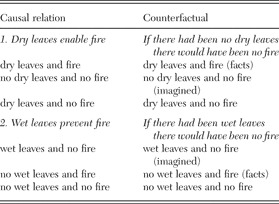
The frequent focus of counterfactual thoughts on actions that could prevent an outcome leads Mandel to propose that counterfactuals focus on disablers rather than enablers. Of course, disablers and enablers share much in common; for example, the enabler “dry leaves enable fire” and the disabler “wet leaves prevent fire” are consistent with the same three possibilities – the assertions describe the same situations, albeit in different ways (Ch. 5, p. 117).
An enabler, for example, “dry leaves enable fire,” is consistent with the three possibilities: “dry leaves and fire,” “no dry leaves and no fire,” and “dry leaves and no fire.” A disabler (or a missing enabler), “no dry leaves,” can be expressed by implicit negation as “wet leaves” (on the assumption of a binary situation in which there are leaves which are either dry or wet), and the disabling relation can be expressed by “prevent,” as in “wet leaves prevent fire.” The disabler is consistent with the same three possibilities: “wet leaves and no fire,” “no wet leaves and fire,” and “no wet leaves and no fire,” as Table R1 shows. But the different descriptions bring different possibilities most readily to mind: the enabler is understood initially by envisaging “dry leaves and fire,” with ready access to “no dry leaves and no fire”; the disabler is understood initially by envisaging “wet leaves and no fire,” with ready access to “no wet leaves and fire” (Ch. 5, pp. 117–18). The first possibility envisaged for the enabler, “dry leaves and fire,” corresponds to the presupposed facts for its corresponding counterfactual, “if there had been no dry leaves there would have been no fire”; the first possibility envisaged for the disabler “wet leaves and no fire” corresponds to the imagined conjecture in its corresponding counterfactual “if there had been wet leaves there would have been no fire.”
The relations between enablers and disablers and their corresponding counterfactuals

Note: People tend to think about two possibilities when they understand a counterfactual, the presupposed facts and the conjecture referred to explicitly in the conditional.
These nuances cannot be captured within Mandel's account that counterfactuals are understood by envisaging the facts only. The facts are known for some counterfactuals (e.g., “if Simpson had not climbed Siula Grande, he would not have fallen into a crevasse”) and they are unknown for others, such as “if Simpson had brought another gas canister, he would not have fallen into a crevasse.” But the evidence shows that people think about two possibilities even for counterfactuals with unknown facts (Ch. 2, pp. 30–34; Ch. 3, pp. 48–52). If people thought only about the facts when they understood a counterfactual, they would be unable to make a modus ponens inference (if A then B, A therefore B). In fact, when asked to consider a counterfactual and a supposition, such as, “suppose Simpson did not climb Siula Grande,” most people can conclude readily, “in that case he did not fall into a crevasse.”
Counterfactual thoughts tend to focus on enablers rather than strong causes, and people tend to focus on events they can control rather than on uncontrollable ones. The two tendencies often coincide but the theory does not confound them, contrary to Chang & Herrmann's charge – enablers can be outside an individual's control, as illustrated in the example from Chapter 5, “dry leaves enabled the forest fire.” The principles outlined in the book explain how people think about counterfactual possibilities that may once have been possible but are no longer possible. Chang & Herrmann question whether the set of principles constitute an explanation for how people create counterfactual alternatives to reality or merely a description. The query is belied by their acknowledgement that the principles lead to testable empirical predictions. The predictions are corroborated by the data (e.g., Ch. 5, pp. 119–26). The central importance of controllability in counterfactual and causal thoughts is brought into sharp relief in Simpson's conclusion from his analysis of the events leading up to his accident – “and so we lost control, and nearly our lives” (Simpson Reference Simpson1997, p. 205).
R5. Possibilities for “if”
People understand a conditional, such as, “if there were puppies, there were kittens” by thinking about possibilities. They think about true possibilities – there were puppies and there were kittens, there were no puppies and there were no kittens, there were no puppies and there were kittens. They think initially about few possibilities – there were puppies and there were kittens. They do not think about false possibilities – there were puppies and there were no kittens (Johnson-Laird & Byrne 2002). But Handley & Feeney propose instead that people think about the situations in which the antecedent occurs, in which there were puppies; that is, they think about the true situation “there were puppies and there were kittens” and also the false situation, “there were puppies and there were no kittens.” Contrary to Handley & Feeney's proposal, recent evidence shows that people do not think about false possibilities (Espino et al., submitted). The Espino et al. experiment compared conditionals and “biconditionals,” such as “if and only if there were puppies, there were kittens.” The two sorts of assertion differ in relation to the possibility in which there were no puppies but there were kittens: it is a true possibility for the conditional but it is a false possibility for the biconditional. The distinction leads to an important prediction. The view advanced in The Rational Imagination, that people think only about true possibilities, predicts that they should think about the possibility “there were no puppies and there were kittens” when they understand a conditional – for which it is true, but they should not think about it when they understand a biconditional – for which it is false. In the experiment, participants read the conditionals or biconditionals and the various conjunctions within a story (see Espino et al., submitted), such as the following:
Joey went shopping to the pet-shop. When he looked at the poster he saw written on it, “if there are puppies, there are kittens.” When he looked at the cages he saw that there were puppies and there were kittens. He checked his list of purchases.
Participants took a very short time, under 2 milliseconds, to read the conjunction “there were no puppies and there were kittens” when it was “primed” by a conditional for which it is a true possibility; they took reliably longer to read the same conjunction when it was primed by the biconditional, for which it is a false possibility. And they took the same amount of time to read the possibility “there were puppies and there were kittens” when it was primed by either the conditional or the biconditional – it is a true possibility for both assertions. These data corroborate the view that people think about true possibilities and not false possibilities (pace Handley & Feeney).
For counterfactual conditionals, people think about the presupposed facts, and they also think about the counterfactual conjecture, a false possibility temporarily supposed to be true. Some people may tend to think only about the presupposed facts, and some people may find their attention is focused on the counterfactual conjecture (Ch. 8, pp. 182–89; Byrne & Tasso Reference Byrne and Tasso1999; Thompson & Byrne Reference Thompson and Byrne2002). Markman & McMullen provide an important reminder of the tendency people exhibit to suspend sometimes any comparison of the counterfactual possibility with their representation of reality, in favor of vividly imagining the counterfactual possibility “as if” it were the case. It may be unlikely that a counterfactual possibility is ever entirely unfettered by comparison with reality: The initial construction of the counterfactual depends on mutations to the representation of reality, and its epistemic status needs to be maintained to ensure an ongoing appreciation that the counterfactual conjecture does not correspond to reality. The crucial distinction may depend on whether the counterfactual possibility is maintained within the primary focus of attention, or on what the current reality is, and what the cognitive and affective causes and consequences of focusing on one possibility or the other may be.
A key mechanism by which people create counterfactual possibilities is the mutation of those aspects of reality that are explicitly represented in their mental representation of reality (e.g., Ch. 2, pp. 34–38; Ch. 7, pp. 167–80). The book contains a brief speculation that a similar mechanism may underlie the creation of novel possibilities when people invent new ideas by expanding existing categories or combining existing concepts (Ch. 8, pp. 190–94). The nature of the possibilities that people entertain when they create new ideas may be influenced by the structure of their ideas, as Ward suggests. Their mental representation of an assertion corresponds to the structure of the way the world would be if the assertion were true, rather than to the language used to describe the world (Johnson-Laird & Byrne Reference Johnson-Laird and Byrne1991); in this important respect, the possibilities that people think about to represent the structure of the world are guided by such principles as truth and parsimony.
How people perceive and represent reality affects how they create counterfactual alternatives to it. It is not just what people imagine but how easy or hard they find it to imagine that determines their judgment, as Sanna has shown. Recent evidence highlights that what individuals find easy to imagine differs depending on whether they imagine alternatives to something that happened to them, or imagine alternatives to something that happened to someone they have merely read about (Girotto et al. Reference Girotto, Ferrante, Pighin and Gonzalez2007). Consider the scenario:
Anna, an undergraduate at your university, was asked to participate in a game by a research assistant who told her: “In order to win two chocolates, you have to mentally multiply either two one-digit numbers or two two-digit numbers, in 30 seconds. If you fail, you do not receive the chocolates. The two multiplication problems are contained in two sealed envelopes. Let us call them envelope A and envelope B. Of course, we do not know which envelope contains the one-digit multiplication problem and which one contains the two-digit multiplication problem.” Anna agreed to participate. She chose envelope A. It contained the two-digit multiplication problem. She failed. Things would have been better for Anna, if …
Most readers tend to construct counterfactuals that change Anne's choice, e.g., “if only she had chosen the other envelope.” But when individuals carry out the task as actors who take part in the game just as Anna did, rather than as readers, their counterfactuals focus on various problem features, such as “if I had had more time” or “if I had had a pen” (Girotto et al. Reference Girotto, Ferrante, Pighin and Gonzalez2007).
Following the discovery of an actor–reader difference in how people create counterfactual alternatives, we examined whether observers witnessing a situation think about it in the same way as readers or as actors (Pighin et al., submitted). Do you expect an observer to imagine an alternative in the same way as the actor imagines it, for example, by focusing on the time or the aids available, or to imagine an alternative in the same way as a reader imagines it, for example, by focusing on the choice of envelope? In a new experiment, observers were experimental participants who were present during the sequence of events that led an actor (a confederate) to experience the negative outcome. The data show that observers behaved just like actors: they tended to focus on problem features such as “if only there were more time.” Like actors, observers can gather information about the events that lead to the outcome, including not only the actors' choice but also the features of the problem-solving phase, such as the perceived shortness of the time available for the task, or the lack of a pen and paper (Pighin et al., submitted). The discovery that actors and observers create counterfactuals that are different from the ones readers create has far-reaching consequences for the methods used in the study of counterfactual thoughts.
R6. Counterfactual thoughts and the future
The commentaries on The Rational Imagination raise many wide-ranging and challenging questions about how we can reach a proper understanding of the way the human mind creates alternatives to reality, and my response has focused on the general and common themes. What is undisputed is that people engage in counterfactual thoughts frequently and it is a lynchpin of their mental, emotional, and social lives. The rationality of the counterfactual imagination may be crucial in its impact on decisions about a future goal that an individual envisages, such as climbing a mountain safely. Epstude & Roese propose that a key role of counterfactual thoughts is in goal-oriented decisions. Bonnefon notes that the influence of a rationale for action on the experience of regret is mediated through thoughts about future consequences (see also Walsh & Byrne Reference Walsh and Byrne2007). And Zeelenberg distinguishes between the influence of regret and of disappointment on future decisions for action. An individual may identify the means to achieve a goal by carrying out an accurate analysis of errors made in previous experiences, for instance, potential errors in the style of climbing, the equipment chosen, or the supplies carried. The principles that guide the possibilities that people construct to create a counterfactual alternative provide a basis for a mechanism that transforms the representation of past events and outcomes into the representation of future plans and goals. An important function of counterfactual thoughts may be to learn to recover from failure. Counterfactual thoughts may help us in our efforts to try again, as Samuel Beckett (Reference Beckett1983) put it: “Try again. Fail again. Fail better.”
ACKNOWLEDGMENT
I am grateful to Vittorio Girotto for giving me Joe Simpson's book, Touching the Void.