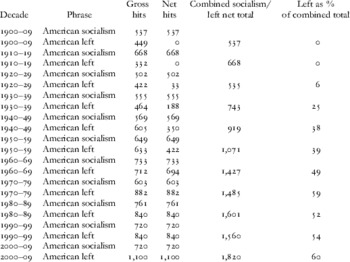
The nomenclature of the American left changed in the course of the twentieth century. In the years immediately following 1900, the phrase “American socialism” commonly occurred in political discourse. With the emergence of the term “left” in the 1930s, both the socialists themselves and nonsocialist commentators assumed that socialists were members, indeed stalwarts, of the left. But by the 1970s, the term “American left” had developed a life of its own. And by the first decade of the twenty-first century, it had not only supplanted “American socialism” in terms of usage frequency, but also embraced a new agenda.Footnote 1
This article outlines the patterns of nomenclative change. It goes on to look for explanations of the change, asking, for example, whether the Cold War was one of the reasons. It is an attempt to document and explain not the failure of socialism, to which a great deal of attention has been given, but the failure of the word “socialism.” Equally, it charts the rise of the word “left” in political parlance, and suggests possible reasons for it.
I. DEFINING NOMENCLATIVE CHANGE
Table 1 illustrates the changing nature of the American left's nomenclature. The phrase “American left” progressively took over from the phrase “American socialism.” Considered as a form of evidence, this table invites a number of observations. The first of these is about the nature of the data. All the tabulated hits were in contemporary books. Books were omitted that for reasons of digital technology appeared in the Google search listing for a particular decade but were actually published later. The statistics make no distinction as to opinion. Those who used the phrases were sometimes socialists and leftists, sometimes their critics, and sometimes neutral observers.
Table of nomenclature, from Google Books, Advanced Book Search, 26 August 2009

In the case of the “American left,” there is a necessary distinction between gross and net hits. In the first two decades of the twentieth century, none of the references to the “American left” referred to politics. Almost all had to do with military affairs and history: “Arnold's division with Morgan's corps was in advance of the American left with their right resting on the impenetrable thicket which covered the American centre.”Footnote 2 There was a revival in such military references in and after World War II, but they had faded by the 1960s because wars like that in Vietnam were tactically more fluid. Military and other nonpolitical references to the “American left” are excised for the purpose of the “net hits” table. No comparable exercise was necessary for “American socialism.”
A statistician unacquainted with the vagaries of historical data might be tempted to subject the evidence to further and more complex analysis, for example identifying peaks and long-term frequencies for “American socialism” and “American Left” separately. But long-term rises in frequency need to be treated with caution. For more and more books were being published in America, and any phrase was likely to increase in frequency of use over the decades.
“American potato” is an example. Accessed on 20 November 2008, Google Books registered a trough of 118 “American potato” hits from 1900 to 1909 and a peak at 554 from 1960 to 1969. This may well be significant, as there was a debate in the latter decade about market controls. But it would be dangerous to go further and offer a generalization on the basis that the average annual number of Google Books hits for “American potato” in the first half of the twentieth century was 22 and for the second half 47. This doubling is less suggestive of a crisis in the affairs of the humble tuber than of the expansion in the number of potato journals and in publishing generally. It could be argued that the Authors Guild class action against Google starting in 2005 slowed down the scanning of still-in-copyright titles, with a countervailing effect. But that is speculative, and possibly already mitigated by the 2009 court settlement. As with the potato, so with socialism and the left considered severally – generalizing for long periods is unpromising.
The selection of Google Books as the main source for tabular information has a drawback in that it supplies information only about books. Other digital resources tried out in the course of research and referred to in this article tapped into periodical literature. However, while they do offer corroborative evidence, they do not supply a sufficiently consistent run of hits to provide a table covering eleven decades. For example, the Lexis Nexis search engine for journal articles is strong over the last two decades, but at the time of investigation did not stretch back to earlier periods.
The New York Times offers a longer run, but is still less useful than Google Books. As a means of achieving focus and manageability, the adjective “American” was attached to “socialism” in the Google Books searches undertaken for this project. But while the digitally searchable New York Times carried many articles on (mainly foreign) socialism and communism, it was reluctant to place the “American” prefix in front of the word “socialism” – just four times in the 1900s, nine times in the 1950s and three times between 2000 and 2008.Footnote 3 One theory to explain this might be that it was too conservative to attach the booster adjective, believing socialism to be un-American. However, it did warn in a 1909 editorial that socialism was the creed of the “native born.”Footnote 4 Furthermore, the liberal journal The Nation displayed a similar reluctance. Between 1900 and 2009, if the digital technology is to be trusted, The Nation used the phrase “American socialism” only twice (both occurrences were in the 1970s).Footnote 5
The Nation did not use the term “American left” politically until the 1950s. There were eight references from the period from 1950 to 1979, then nine each in the 1990s and 2000s. If anything, this confirms that “American left” has usurped the ground of “American socialism,” but the low incidence of references is a caution against firmer conclusions. Similarly, the New York Times, having recorded no political uses of the term “American left” in the first decade of the twentieth century, yielded 35 hits in the 1950s and 99 net (116 gross) in the period from January 2000 to July 2008.Footnote 6
While greater than that of The Nation, the New York Times frequency does not match that of Google Books. The number of Google hits is superior, perhaps because books vary in character and viewpoint, perhaps because they lend themselves to more serious political discussion, and perhaps because, prior to the consolidations of the last quarter-century, there were numerous publishing houses and collectively they were less prone to the censorship of wealthy owners. But another factor must be that the database from which the hits derive is large. The Google Books aim is to scan fifteen million volumes in Oxford, Harvard, New York Public Library, Stanford and the University of Michigan. As of October 2008, seven million volumes had been thus processed. Other digital databases neither compare with Google Books in their degree of utility for this study, nor contradict the trends indicated in the Google-derived table.Footnote 7
II. CAUSES OF THE NOMENCLATIVE CHANGE
II.1. Reform ambition and personal survival
In political usage, the term “left” derives from the seating arrangement the French National Assembly established for itself in 1789 – supporters of the Revolution sat on the left of the chamber. In his influential book The Vital Center (1949), A. M. Schlesinger Jr. suggested that American terminology traced back to that episode. But when Attorney General A. Mitchell Palmer referred to “American left-wing socialists” in a House Committee on Rules Hearing on 1 June 1920 he was nevertheless a terminological pioneer. As the nomenclature table shows, the term “American left” was still rarely used in the 1920s. However, by the time Clifford Odetts wrote his play Waiting for Lefty (1935), Lefty had already arrived, terminologically speaking.Footnote 8
One reason for the relative rise of the term “American left” was the developing unpopularity of the term “American socialism.” Persecution partly explains this – only a brave man or woman would describe him-/herself as a socialist in the wake of the 1919–20 Red Scare presided over by Attorney General Palmer. Another reason, in spite of the charismatic presidential campaigns of Socialist Party of America (SPA) candidate Eugene V. Debs, was electoral failure. The failure tag is unattractive, and socialists began to call themselves something else.
The social critic Edward Bellamy had set an example in the nineteenth century. In his Looking Backward, an influential novel of 1887 set in the year 2000 when America had become a socialist paradise, Bellamy advocated widespread public ownership of property. But discarding the word “socialism,” he used instead “nationalism” and “nationalization.”Footnote 9 In his book The Forging of American Socialism (1953), historian Howard Quint aptly titled his chapter on the reformer “Bellamy Makes Socialism Respectable.”
The process continued during the “golden age” of the SPA, when socialists like John R. Commons, William M. Leiserson, Edwin E. Witte and, above all, Selig Perlman – the University of Wisconsin intellectuals who from 1913 to 1915 drew up plans for the American welfare state ultimately enacted in the New Deal – dropped the socialist label.Footnote 10 Their reason was partly tactical. If you want America to have unemployment insurance and old-age pensions, why alienate people by calling yourself a socialist? Other words like “liberal” or “progressive” were at hand if you needed a label at all, and could indicate a commitment to precisely the same causes.
Those fleeing from the word may also have been governed by personal ambition. As early as 1903, Commons had cautioned Wealth against Commonwealth (1894) author Henry Demarest Lloyd against joining the SPA. If he did so, the media would shun him. Best to articulate his views as an independent, Commons advised (Lloyd ignored his advice and joined anyway). Similarly, when Leiserson contributed articles to the socialist press, he did so anonymously. Perlman went further than any of the others, and became an apostate. He used his intimate knowledge of the socialist cause to write the neoconservative tract A Theory of the Labor Movement (1928), which would for decades serve as a staple of didactic orthodoxy. The historian Leon Fink suggests that the reasons why Commons and others dropped the socialist label had to do with personal and well as public tactics: “The radical social scientist … had his own career (and ultimately, family) to look after.”Footnote 11
II.2. The Popular Front and the rise of the etymological fashionista
Witte eschewed the socialist label when he orchestrated the Social Security Act of 1935. He and his former his former Wisconsin colleagues were by no means the only nomenclative fugitives. There was, for example, Charles Beard. A historian whose star rode high in the 1930s, Beard was what the sociologist C. Wright Mills later defined as a “plain Marxist.”Footnote 12 Before 1935 he admired some aspects of the writings of Karl Marx but not others; he was intellectually indebted to Marx but also to a wider array of thinkers.Footnote 13 When the author of a survey of American historiography in the period from 1884 to 1934 described Beard as a fine and able writer who was influenced by Marx while being “in no sense socialistic,” it was surely a fair comment.Footnote 14 Yet Beard responded to the reviewer with a bitter denial that Marx had guided his thoughts.Footnote 15
But other factors may have been at work in the 1930s. A neat – though in fact too neat – explanation of the nomenclative change in the decade is that it was a consequence of successful communist tactics. The Popular Front strategy promoted by the Comintern perhaps did prompt a widening in political sympathies and constituencies in a manner that opened the door to innovative nomenclature. However, Soviet writers' application of the word “left” to US radicals was nothing new. For example, the Ukrainian Bolshevik Alexandr Lozovsky thus applied it in 1924.Footnote 16
There was no doctrinal shift that prompted the communists to introduce the word “left” to political dialog in the 1930s. Nor would the abandonment of the word “socialism” have been a tactical priority. The Popular Front aim was to attract democratic socialists to the banner of communism, and most certainly not to consign the word “socialism” to the scrap heap. Popular Frontism would not seem to have been a deliberate campaign to promote the rise of the word “left.”
However, in the 1930s, when the communists enjoyed their intellectual heyday, they helped to shape fashion. Influential writers can wear a new phrase like a new dress, making it a must-have fashion accoutrement. To argue from a comparison, take the phrase “political correctness.” Originating in the censorship of the intolerant communist world, it soon became a term of abuse hurled at the Soviet dictatorships. By the 1960s, it was being applied to the infinitely more democratic American left. In that application it cropped up 207 times in Google Books in the 1960s, jumping to 2,300 in the 1990s (the New York Times had 82 occurrences in the 1980s and 895 on the 1990s).Footnote 17
“Political correctness” was just a fashionable phrase on everyone's lips. “American left” and connected phrases like “left-wing”, “lefty” and “leftist” enjoyed a similar vogue starting in the 1930s. The communists encouraged and participated in the vogue, but were neither solely nor primarily responsible for it.
II.3. The Cold War
The nomenclative table indicates that in the 1940s and 1950s the term “American left” made further headway at the expense of “American socialism.” There is no shortage of evidence to suggest that the Cold War was helping to frighten people into abandoning the socialist label, and encouraging others to drop the benign prefix “American.”
Take, for example, Henry Wallace's presidential candidacy on the Progressive Party ticket in 1948. To be sure, it suffered from his association with the domestic left. The Communist Party's endorsement and his support for the civil liberties of communists at home at a time of anti-Red hysteria weakened his cause. But at the same time, his biographers John Culver and John Hyde were surely right to note that events abroad – the Berlin blockade, instability in the Balkans, communist advances in China and Czechoslovakia – “only made things worse.”Footnote 18 Wallace drew 1,157,000 votes on polling day – just a sixth of the vote for William Jennings Bryan in 1896 and much smaller than Ralph Nader's tally in 2000. The weakness of the result was a deterrent to any political candidate who considered associating himself with communists or socialists.
The spy cases of the early Cold War era – Nunn May, Fuchs, Hiss, the Rosenbergs – made it appear that Reds were traitors, and the Communist Party of the United States did lay itself open to that charge. This particular facet of the Cold War contributed to the blurring of distinctions between the totalitarian and democratic socialist movements, and so encouraged the abandonment of the socialist label.Footnote 19
The history of McCarthyism and the Great Scare teems with examples that illustrate why people grew reluctant to embrace the socialist label. Take the case of Vito Marcantonio, the American Labor Party's congressman from East Harlem. His stance on the Cold War helped to make him a prime target. In 1941, he had mimicked the opportunist switch of the communists after the Nazis' Barbarossa attack. He invited scorn in proclaiming, “the invasion of the Soviet Union transformed that war, which was predominantly imperialist, into a war which is essentially one of defense.”Footnote 20 In the early Cold War years, Marcantonio gave further fuel to those critics who accused him of being a fellow traveller by opposing the Truman Doctrine and voting against the European Recovery Program (ERP).Footnote 21
But there was more to Marcantonio's voting record than this. It became a template of doom in American politics. Congresswoman Margaret Chase Smith's opponents in Maine's Republican Senate primary in 1948 tried to stop her by comparing her voting record with that of Marcantonio. A “pink sheet” with an identical smear was issued against Helen Douglas on the opposite coast in 1950. Both Smith and Douglas had supported ERP but, no matter, they were lumped with the alleged treason of the anti-ERP, anti-Cold Warrior Marcantonio.Footnote 22 Against the background of Cold War hysteria there was no way in which Smith (the widow of a New Deal lefty) or Douglas (a left-leaner) could betray any sympathy with socialism nominally or otherwise and survive politically.
II.4. The attack on domestic socialism
Antisocialism was part of the standard rhetoric for those who resented the New Deal. New Left historians would later argue that the New Deal had not been socialist enough.Footnote 23 But in the 1940s and 1950s the belief that the New Deal had been a lurch in the direction of socialism fuelled an antisocialist crusade that frustrated further measures such as health insurance, and encouraged the semantic idea that “American socialism” was a contradiction in terms.
My argument here ties in with the work of those Cold War scholars who look at domestic as well as foreign factors. Richard Freeland (1971) famously accused President Truman of whipping up anticommunist hysteria at home in order to ensure support for the cornerstone of his Cold War foreign policy, the ERP.Footnote 24 Blending foreign and domestic causation, David Caute (1978) wrote that the National Association of Manufacturers believed Moscow was behind the Wagner Act and supported the persecution of socialists accordingly.Footnote 25 Michael Heale (1990) saw the victimizations of the McCarthy years as part of a rational domestic programme, and went on to write another book (1998) looking at anticommunism at the state and city levels, a phenomenon that was by definition at some remove from the Cold War internationally defined.Footnote 26 In her 1998 book Many Are the Crimes, Ellen Schrecker acknowledged that national security concerns were a significant cause of “McCarthyism” in its broader sense. However, she also regarded the Cold War as an excuse for domestic anticommunism.Footnote 27
Senator Joe McCarthy had domestic preoccupations. His targets included the Department of State, the Army and the CIA, all of them involved in implementing America's Cold War policies abroad. But the senator knew little about foreign policy, and cared less. His target was communism in government. He ruined many lives by tilting at imaginary domestic windmills.
Even in the case of Congressman Marcantonio, we see that the issues that identified him as a socialist were more characteristically domestic than foreign, prompting the thought that his critics were upset about domestic matters, too. In the early months of 1948, Marcantonio voted to reduce income tax for the poor and increase it for the rich, to protect the levels of social security payments, and to defeat an increase in the appropriation for the House Un-American Activities Committee. Helen Douglas voted the same way on these issues, joining Marcantonio on the losing side in every case. Margaret Chase Smith voted with the opposing conservative camp on the issues, as did Douglas's opponent in California, Richard Nixon. Smith's detractors were either misinformed or disingenuous in comparing her voting record with Marcantonio's. But the Nixon supporters who used the Marcantonio smear against Douglas were on firmer ground and vilified her as socialist on the basis of credible domestic issues. Nixon's victory against Douglas was another demonstration, if any were needed, of how domestic politics contaminated the socialist label.Footnote 28
II.5. Creeping socialism as a cause of rejection
It is easy to pour scorn on the hysterical and unfounded nature of the claims of such as Joe McCarthy. But in relation to the themes of this article, two cautions are in order. First, unfounded though they may have been, his accusations were effective in that they helped cause a flight from the word “socialism.” Second, there was a responsible, politically powerful strain of criticism of New Deal-style socialism that further contributed to the relative demise of the word “socialism.” Its target was “creeping socialism.”
In 1943, supporters of Governor Thomas Dewey denounced the New Deal's “creeping socialism boys.”Footnote 29 Six years later, the term came into its own. Creeping socialism was one of the main concepts in John T. Flynn's The Road Ahead: America's Creeping Revolution, described by a New York Times reviewer as one of 1949's two most important books on American politics.Footnote 30 Perhaps because of his Irish American identity, Flynn saw the incremental advance of American socialism as an evil reincarnation of the program of Britain's Fabian socialists. The word “creeping” conveyed to Flynn a sense of something sinister: Democrats who would “never use the word socialism” were conducting “a sneak attack upon our whole way of life.”Footnote 31 Private businessmen and the Republican National Committee bought hundreds of thousands of copies of Flynn's book, and distributed them in the hope that they would help sink the Democrats in the 1950 mid-term elections. With their help the book sold a million copies in 1949, and four million in the election year.Footnote 32
Ohio's Senator Robert A. Taft seized the opportunity to announce, “The only way to avoid a creeping socialism is to elect a Republican Congress in 1950 and a Republican President in 1952.”Footnote 33 Critics of the Truman administration hammered away at the theme, which was to be a mainstay of Taft's powerful, if ultimately unlucky, bid for the Republican presidential nomination.
On the eve of the presidential poll in 1952, former SPA presidential candidate Norman Thomas wrote to the New York Times complaining about a full-page advertisement paid for by the Standard Steel Spring Company of Corapolis, Pennsylvania which attacked socialism but confused it with communism. General Dwight D. Eisenhower having supplanted Taft as the Republican candidate, the GOP looked set to win. Thomas thought that there was more to this than Ike's popularity. He maintained that the Times had published
a thinly disguised form of political advertising in behalf of the Republican party as against not only the small Socialist party but the Democrats. Taft and his candidate Eisenhower have both taken the line that what Democrats have done and will do is a form of “creeping socialism.”Footnote 34
At a time when the potentially friendly phrase “American socialism” was already being swamped by the word “socialism” used as a term of abuse, the notion of “creeping socialism” – alongside McCarthy's hysterical claims about communism in government – contributed to the Democratic defeat of 1952 and, ultimately, to the long-term discrediting of the word “socialism” in progressive discourse.
II.6. “Twenty-one years of treason”
Eisenhower left the welfare state intact in the course of his presidency. Because of his tacit endorsement, the 1930s reforms gained a considerable degree of bipartisan legitimacy. But at the end of the general's first year in office, Senator McCarthy famously used the phrase “twenty-one years of treason” to indicate that, after twenty years of Democrats surrendering to socialism, a Republican President had now committed the same sin.Footnote 35 This view survived the demise of McCarthy, and ensured that “McCarthyism” would have a long tail.
Democrats accepted the “twenty-one years of treason” argument without calling it treason. They accused the Republicans of doing likewise. Two years after losing the 1952 election to General Eisenhower, Adlai Stevenson said that the Republicans had practised a deception by denouncing the Democrats' “great program of domestic reform as ‘creeping socialism’ and then accepting the whole thing.”Footnote 36 When, a little later in the same year, President Eisenhower persuaded Congress to accept an extension of the Old Age and Survivors Insurance System to cover an additional 10,500,000 people, the veteran fiscal conservative Senator Walter F. George (Dem., GA), passionately denounced the measure: “The marvellous thing is that the party dedicated to free enterprise, the party that is dreadfully afraid of creeping socialism, does this thing to a free America.”Footnote 37
Senator Barry Goldwater flayed the idea of bipartisan American socialism. He wanted to repeal, not pass, laws; said he feared Washington more than he did Moscow; and stated in the course of his successful 1964 Republican presidential primary campaign that Social Security should be “voluntary.”Footnote 38 Though heavily defeated by President Lyndon B. Johnson and dismissed as an aberration by some of his contemporaries, the Arizona legislator set a trend that helped to define conservatism for the next generation. His political beneficiary, President Ronald Reagan, having supported the New Deal in his youth, followed the Goldwaterite line in claiming that President Franklin D. Roosevelt had brought “a form of veiled socialism to America.”Footnote 39 Thus socialism remained a flogging horse, and the socialist label a liability for those who sought to succeed in politics.
II.7. The change in the character of the American left
By the 1970s, the phrase “American left” accounted for 59 percent of the combined American socialism/American left total. It declined in the 1980s and 1990s, perhaps partly on account of the rise of the alternative phrase “political correctness,” and then recovered its predominance after 2000. The relative decline of the phrase “American socialism” was in part a reflection of McCarthyism's long tail. It reflected also a change in the overall character of the American left.
Socialism had become but one eddy in a broadening river. New groups and organizations – civil rights cadres, the “new” feminists, anti-Vietnam War campaigners, gay and lesbian rights activists, antiglobalization protestors – might consider themselves to be of the left and might be regarded as such. But while they often agreed with some socialist demands, such as better welfare provision, the term “socialist” was too narrow to describe the whole span of their ambitions. At the same time the post-New Deal labour movement, within which a minority at least had hitherto espoused socialist views, increasingly aligned itself with the Democratic Party. Asked to identify him-/herself politically, a feminist or a member of the Teamsters Union was increasingly unlikely to choose the phrase “American socialist”.
The phrase “American socialism” had competition not only from “American left,” but from another quarter, too. Having made just six appearances in Google Books in the 1950s, the term “American New Left” appeared 175 times in the 1960s, rising to a peak of 616 in the following decade before declining to 417 by the 1990s.Footnote 40 This nomenclative development might be taken simply to confirm the flight from the word “socialism,” but was also a reflection of the left's changing character.
In the case of the New Left, it was a matter not of abandoning old reforms like the welfare state, but of defining an expanded agenda. Some old lefties having embraced the Cold War, the New Left offered a renewed critique of American foreign policy, and opposed the Cold War's hottest manifestation, the Vietnam War. The New Left was associated with a free-speech movement on campus, and a vigorous surge in the civil rights movement.
In its turn, the phrase “New Left” also fell out of favour. Just as there had been a conservative assault on socialism in the 1940s and 1950s, so there was a neoconservative assault on what the New Left stood for. Whether for that reason, or because the New Left had won its battle and served its purpose by helping to end the Vietnam War, the left began to de-emphasize the New Left label.
There now emerged yet another brand of American reform. What might be termed the “newer left” accepted past gains and aims such as the welfare state, the check on militarism and the rights agenda. But it had more to say. In 1991, James Davison Hunter identified from a conservative perspective the new political battle in his book Culture Wars: The Struggle to Define America. He wrote of a conflict between progressivism and orthodoxy that centred on such issues as “abortion, child care, funding for the arts, affirmative action and quotas, gay rights, values in public education, or multiculturalism.”Footnote 41 At the Republican National Convention the following year, the columnist and erstwhile presidential candidate Pat Buchanan delivered a “culture wars” speech signalling that such issues would in future be a recognized part of the political lexicon. Buchanan warned against the “far left agenda” the Clintons could impose on America.Footnote 42
Thus the newer left and the alleged (rather conjectural) Clintonian left had produced a reaction, just like “socialism” and “new left” in earlier years.Footnote 43 But it seems to have been less effective. The political use of the term “American left” reached a peak in frequency in the years between 2000 and 2009.
Meanwhile, however, politicians refrained from labelling themselves socialist candidates. Ron Dellums, a socialist who sat in the House from 1971 to 1998 and then served as mayor of Oakland, ran on the Democratic ticket. When Vermont's Bernie Sanders served in the House of Representatives from 1991 to 2007 and then became the first socialist to sit in the Senate, he ran as an independent, not on the socialist ticket. It was word-avoidance. The reason is not far to seek. Asked in an interview, “How many Senators would agree with your criticism that the corporations own U.S. foreign policy?”, Sanders replied “None.”Footnote 44 If he wanted to be effective on Capitol Hill, he could not afford to isolate himself further by placing the word “socialist” in his shop window.
III. TRACES OF SOCIALIST NOMENCLATURE IN THE BUSH–CLINTON YEARS
In spite of the odds against it, employment of the term “American socialism” persisted, with hints of a revival after the year 2000. The decennial frequency of Google “American socialism” hits remained constant between the 1990s and the 2000s. Lexis Nexis, the search engine for journal articles, between 2003–5 and 2007–9 actually recorded an increase from 34 biennial “American socialist” references to 62.Footnote 45
It is possible that the ending of the Cold War and the discovery or invention of a new enemy in Islamic terrorism took the heat out of the socialist issue, a kind of proof in reverse of the impact the Cold War originally had in inhibiting the use of the phrase “American socialism.” But other developments were afoot that helped shaped the political diction of the twenty-first century.
One of these was the spate of nationalizations that took place in 2008. The rescue of the ailing investment and brokerage firm Bear Stearns was just a taster. There followed the George Bush administration's rescue of Fannie Mae and Freddie Mac, and what amounted to a partial nationalization of the banking industry. These interventions were merely defensive. The 2008 nationalizations were not done in the name of socialism, nor did socialists carry them out. In the very decade that Bellamy had earmarked for nationalist utopia, nationalization threatened to become an “n-word” just as socialism had been an “s-word.” House speaker Nancy Pelosi said the process was “whatever you want to call it,” and one historian claimed that nationalization was “just not a word in the American vocabulary” but was “something foreigners do to us.”Footnote 46
With Bush gone from the White House, federal interventions continued apace, moving Newsweek to declare, in a totemic and much-quoted headline, “We are all socialists now.” Two months later, in April 2009, an opinion poll indicated that only 53 percent of Americans still supported capitalism, and 33 percent of under-30s preferred socialism to capitalism.Footnote 47
Grasping at tradition, the right invoked the spectre of American socialism. The presence of a conservative Republican in the White House had inhibited the attack. But when Barack Obama advocated and then as President implemented federal intervention in the economy, he laid himself open to charges of being a socialist. His advocacy of, and efforts to establish, universal health insurance led to a redoubling of the charge. The Republican national convention attacked the Democrats' “march to socialism.” The Republican candidate John McCain accused Obama of being further to the left than the socialist senator Bernie Sanders. His vice presidential colleague Sarah Palin described Obama's plan to socialize medicine as “evil.” Socialism was back on the adversarial agenda.Footnote 48
IV. CONCLUSION
Personal ambition, the Cold War and domestic antisocialism all influenced the nomenclature of the American left. Additionally, the nomenclative changes reflected a changing, expanding left agenda. To argue otherwise would be to mask the increasingly progressive nature of American society.
How does this relate to the more traditional American debate over why socialism failed in America? The traditional question masks reality, in that it refers only to electoral failure. Milton and Rose Friedman ignored low socialist polling when they lamented, “almost every plank in [the SPA's] 1928 presidential platform has by now [1980] been enacted into law.”Footnote 49 Conservatives have for decades claimed that America is becoming socialist, and for decades their opponents have dismissed this view with scorn. The heaping of derision on the Friedmans' contention is at least partly rooted in an inability to distinguish between the failure of socialism and the decline of the word.