Introduction
Body dissatisfaction (BD) is defined as the negative evaluation of body shape, size, weight, and muscularity/muscle tone and involves the perceived discrepancy between an individual's evaluation of his or her body in comparison to the ideal body (Cash & Szymanski, Reference Cash and Szymanski1995; Gattario, Frisén, & Anderson-Fye, Reference Gattario, Frisén, Anderson-Fye, Ben-Arieh, Casas, Frønes and Korbin2014; Grogan, Reference Grogan2007). According to sociocultural theory, Western women develop BD due to failed attempts to live up to the unrealistic ‘thin ideal’ (Izydorczyk & Sitnik-Warchulska, Reference Izydorczyk and Sitnik-Warchulska2018). In Western societal culture, to be considered beautiful, women must be thin, and this thin ideal is considerably smaller than the average woman can attain without engagement in significant weight control behaviours (Perloff, Reference Perloff2014). According to sociocultural theory (Thompson & American Psychological Association, Reference Thompson1999), BD is the result of sociocultural influences (peers, family, and media) that convey the importance of the thin ideal, and which lead women to ‘internalise’ (or buy into) the thin ideal and compare their bodies to others. By internalising the thin ideal and comparing themselves with other women, women become dissatisfied with their bodies and subsequently engage in weight-restricting behaviours in an attempt to align their bodies closer to that which is seen as ideal (Blodgett Salafia, Jones, Haugen, & Schaefer, Reference Blodgett Salafia, Jones, Haugen and Schaefer2015).
There has been considerable research on the deleterious consequences of BD, particularly with respect to the onset of unhealthy and extreme weight-related behaviours including restrained eating, purging, compulsive exercise, and the clinical eating disorders of anorexia and bulimia nervosa (Benowitz-Fredericks, Garcia, Massey, Vasagar, & Borzekowski, Reference Benowitz-Fredericks, Garcia, Massey, Vasagar and Borzekowski2012; Blostein, Assari, & Caldwell, Reference Blostein, Assari and Caldwell2017; Cooley & Toray, Reference Cooley and Toray2001; Neumark-Sztainer, Paxton, Hannan, Haines, & Story, Reference Neumark-Sztainer, Paxton, Hannan, Haines and Story2006; Stice, Reference Stice2002), as well as psychological problems such as depression (Paxton, Neumark-Sztainer, Hannan, & Eisenberg, Reference Paxton, Neumark-Sztainer, Hannan and Eisenberg2006) and low self-esteem (Mond et al., Reference Mond, Mitchison, Latner, Hay, Owen and Rodgers2013). In addition to problematic weight-restricting behaviours and psychological sequela, BD has also been linked to a range of other health behaviours. For instance, it has been found that female smokers have significantly higher levels of BD compared with non-smokers (Clark et al., Reference Clark, Hurt, Croghan, Patten, Novotny, Sloan and Rowland2006), that females link smoking to reasons for weight loss, weight control, and fear of gaining weight (Levine, Perkins, & Marcus, Reference Levine, Perkins and Marcus2001), and that BD is associated longitudinally with both early-onset and late-onset smoking (Howe et al., Reference Howe, Trela-Larsen, Taylor, Heron, Munafò and Taylor2017). Similarly, it has been found that females with poor body image tend to be heavier drinkers compared with females with a more positive body image (Holzhauer, Zenner, & Wulfert, Reference Holzhauer, Zenner and Wulfert2016), and that binge drinking is significantly associated with BD (Nelson, Lust, Story, & Ehlinger, Reference Nelson, Lust, Story and Ehlinger2009). Finally, BD has also been found to have an association with young females’ inability to refuse sex (Yamamiya, Cash, & Thompson, Reference Yamamiya, Cash and Thompson2006) and is associated with lower confidence when communicating about using a condom (Gillen, Lefkowitz, & Shearer, Reference Gillen, Lefkowitz and Shearer2006). Thus, the effects of BD are far reaching.
There is now a considerable body of research investigating BD and its precursors and consequences, with the vast majority being conducted in Western countries. However, once thought to be a primarily Western phenomenon, BD has become prevalent in much of the developing world (Brokhoff et al., Reference Brokhoff, Mussap, Mellor, Skouteris, Ricciardelli, McCabe and Fuller-Tyszkiewicz2012; Chang et al., Reference Chang, Lee, Chen, Chiu, Pan and Huang2013; Jackson, Jiang, & Chen, Reference Jackson, Jiang and Chen2016; Jung & Forbes, Reference Jung and Forbes2007; Jung, Forbes, & Lee, Reference Jung, Forbes and Lee2009; Noh, Kwon, Yang, Cheon, & Kim, Reference Noh, Kwon, Yang, Cheon and Kim2018). For example, Chen, Fox, Haase, and Ku (Reference Chen, Fox, Haase and Ku2010) found that less than 20% of Taiwanese females and males aged 12–16 years were satisfied with their bodies, with more females reporting a desire to be thinner. Similarly, a study of adolescents in Hong Kong by Lai et al. (Reference Lai, Mak, Pang, Fong, Ho and Guldan2013) found that 70.4% of females wanted to be thinner and that 88% of females who were indeed normal weight perceived themselves as being too heavy. In a study of Malaysian adolescents by Khor et al. (Reference Khor, Zalilah, Phan, Ang, Maznah and Norimah2009), females had a significantly higher mean score for BD compared with males, and that 58.3% of females wished to have a smaller body size. Overall, there is strong epidemiologic evidence, suggesting that BD and associated disordered eating practices are not restricted to Caucasian females but that they also occur in other populations including Asian females, at rates comparable to, and sometimes greater than, those seen in Western women (Becker, Franko, Speck, & Herzog, Reference Becker, Franko, Speck and Herzog2003; Bisaga et al., Reference Bisaga, Whitaker, Davies, Chuang, Feldman and Walsh2005; Forbes & Frederick, Reference Forbes and Frederick2008; Franko, Becker, Thomas, & Herzog, Reference Franko, Becker, Thomas and Herzog2007; George & Franko, Reference George and Franko2009; Jung & Forbes, Reference Jung and Forbes2007; Lee & Lee, Reference Lee and Lee2000; Shaw, Ramirez, Trost, Randall, & Stice, Reference Shaw, Ramirez, Trost, Randall and Stice2004; Soh, Touyz, & Surgenor, Reference Soh, Touyz and Surgenor2006; Tsai, Curbow, & Heinberg, Reference Tsai, Curbow and Heinberg2003).
Despite the burgeoning interest in BD within non-Western cultures, few cross- cultural comparisons have been conducted and very little research has explicitly explored the relationship between BD and health behaviours in South East Asian women. This is particularly the case in developing countries such as Malaysia where there has been increased modernization, industrialisation, economic growth, and permeation of Westernisation in recent years. It is important to ascertain the impacts of BD and whether it is associated with the same variables as those found in Western contexts before designing prevention and treatment strategies in in non-Western countries. This is particularly the case in countries such as Malaysia, where the emphasis is on a collective rather than individual identity or action (collectivism). Therefore, this research will determine the extent to which BD, sociocultural influences, problematic weight-related behaviours, and health behaviours differ between Malaysian and Australian women, and the extent to which BD is associated with a variety of health behaviours and outcomes. It is first hypothesised that BD, sociocultural influences, thin ideal internalisation, problematic weight-related behaviours, and health behaviours will be higher among Australians compared with Malaysians. This is because a wealth of literature have documented high prevalence of BD, thin ideal internalisation, sociocultural influences, problematic weight-related behaviours, and health behaviours among women in Western cultures compared with their non-Western counterparts. Similarly, a majority of previous research in Western cultures have found a strong association between BD and a multitude of health behaviour such as smoking, alcohol consumption, and drug use. A study by Bornioli, Lewis-Smith, Smith, Slater, and Bray (Reference Bornioli, Lewis-Smith, Smith, Slater and Bray2019) among young people (n = 4318) found that BD was associated with drug use, smoking, cannabis use, and high-risk drinking. Based on previous findings, and that Australia is primarily a Western culture, it is further hypothesised that BD will have an association with health behaviours such as smoking, alcohol consumption, drug use, and sexual behaviours only for Australians and not for Malaysians.
Methods
Participants
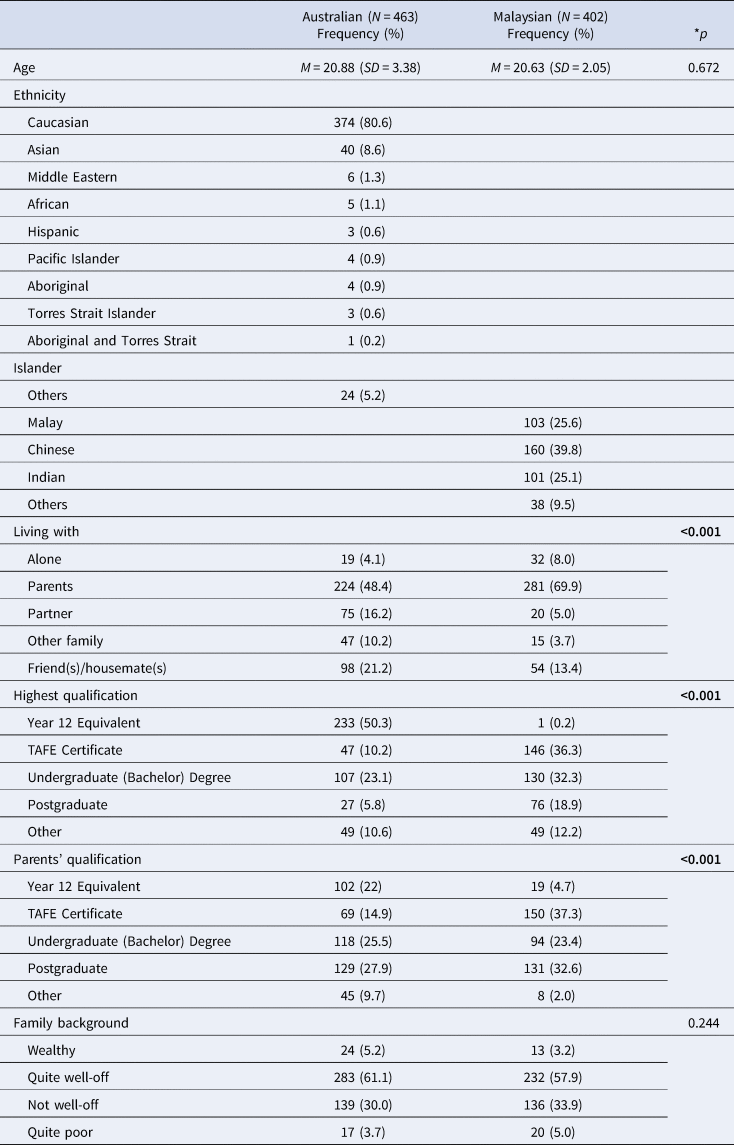
Participants for this cross-sectional study were 830 females aged 18–25 years from Australia (n = 428) and Malaysia (n = 402). The demographic information of the Australian and Malaysian participants is outlined in Table 1. Australian participants were, on average, 20.88 years old (SD = 3.38), whereas Malaysian participants were, on average, 20.63 years old (SD = 2.05). Malaysian participants were approached face-to-face and recruited online, while Australian participants were recruited online using social media advertisement (Facebook advertisement).
Demographic Variables for Australian and Malaysian Participants

Significance of bold values = *p < .001, *p < 0.05.
Measures
The measures used in this study are outlined below. The questionnaires were made available in English for Australian participants and in dual language for the Malaysian participants (English with translation in the Malay language). The first author, who is bilingual, carried out the translation. In order to validate the translation, all items were independently translated back into English by a translator to ensure both versions of the questionnaires have the same meaning for participants in both countries.
Demographic Information
Participants were asked questions pertaining to their age, ethnicity, living arrangements, highest education qualifications, qualification of parents, and family background. Table 1 presents the mean age of Australian and Malaysian participants as well as the demographic variables such as living arrangements, qualification, parents’ qualification, and family background.
Sociocultural Influences (Peer, Family, and Media Influences)
The Pressures Peer, Pressures Family, and Pressures Media subscales of the Sociocultural Attitudes Towards Appearance Questionnaire 4 (SATAQ-4; Schaefer et al., Reference Schaefer, Burke, Thompson, Dedrick, Heinberg, Calogero and Swami2015) were used to measure peer, family, and media influences, respectively. Each subscale is made up of four items, to which participants respond by rating the degree to which they agree or disagree with each item on a scale that ranges from 1 (definitely disagree) to 5 (definitely agree). Responses across the four items of each subscale were then summed to provide a total score for each subscale ranging from 4 to 20 with higher scores indicating higher levels of perceived influence. The SATAQ-4 has excellent internal consistency with a Cronbach's alphas ranging from .92 to .94 (Schaefer et al., Reference Schaefer, Burke, Thompson, Dedrick, Heinberg, Calogero and Swami2015; see also Bell, Donovan, & Ramme, Reference Bell, Donovan and Ramme2016; Ramme, Donovan, & Bell, Reference Ramme, Donovan and Bell2016). Cronbach's alphas of .89, .89, and .95 were found in the current study for the Peer, Family, and Media subscales, respectively, for the Australian sample, while Cronbach's alphas of .89, .88, and .93 were found for Peer, Family, and Media subscales, respectively, for the Malaysian sample.
Thin Ideal Internalisation
The Internalization-Thinness (IT) subscale of the SATAQ-4 (Schaefer et al., Reference Schaefer, Burke, Thompson, Dedrick, Heinberg, Calogero and Swami2015) was used to measure thin ideal internalisation. The 5-item IT subscale requires participants to rate the degree to which they agree or disagree with each item on a scale from 1 (definitely disagree) to 5 (definitely agree). Responses across the five items were summed to provide a total score ranging from 5 to 25, with higher scores indicating higher levels of thin internalisation. The IT scale has been shown to have a Cronbach's alpha above .82, indicating high internal consistency (Schaefer et al., Reference Schaefer, Burke, Thompson, Dedrick, Heinberg, Calogero and Swami2015; see also Bell et al., Reference Bell, Donovan and Ramme2016; Ramme et al., Reference Ramme, Donovan and Bell2016). A Cronbach's alpha of .88 was found for the IT subscale in the current study for the Australian sample, while a Cronbach's alpha of .84 was found for the IT subscale for the Malaysian sample.
Body Dissatisfaction
BD was measured using a modified version of the Body Image Concern (BIC) subscale of the Body Image and Body Change Questionnaire (Ricciardelli & McCabe, Reference Ricciardelli and McCabe2002; see also Bell et al., Reference Bell, Donovan and Ramme2016; Ramme et al., Reference Ramme, Donovan and Bell2016). Consistent with Ramme et al. (Reference Ramme, Donovan and Bell2016) and Bell et al. (Reference Bell, Donovan and Ramme2016), the original 10-item BIC was modified by adding two items (two extra body parts which include satisfaction with their buttocks and back). This was designed to provide a more comprehensive assessment of satisfaction with specific body parts. The resulting BIC subscale consisted of 12 items assessing the extent to which individuals were satisfied with their muscle size, body shape, weight, and each of seven body parts (chest, hips, shoulders, thighs, abdominal region/stomach, legs, arms, back, and buttocks). Respondents were required to rate the degree to which they are satisfied with each body aspect on a 5-point Likert scale from 1 (extremely satisfied) to 5 (extremely dissatisfied). Scores on each item were summed to produce a total score ranging from 12 to 60, with higher scores indicating higher levels of BD. The BIC has demonstrated excellent internal consistency with a Cronbach's alpha of .77, as well as good validity (McCabe & Ricciardelli, Reference McCabe and Ricciardelli2003; see also Bell et al., Reference Bell, Donovan and Ramme2016; Ramme et al., Reference Ramme, Donovan and Bell2016). A Cronbach's alpha of .90 was found for the BIC subscale in the current study for the Australian sample and a Cronbach's alpha of .91 was found for the Malaysian sample.
Restrained Eating
The 10-item Restrained Eating Subscale of the Dutch Eating Behaviour Questionnaire (DEBQ; van Strien, Frijters, Bergers, & Defares, Reference van Strien, Frijters, Bergers and Defares1986; see also Bell et al., Reference Bell, Donovan and Ramme2016) was used to measure restrained eating. Restrained eating refers to an individual's intention to restrict food intake in an effort to lose weight or prevent weight gain (Meule, Reference Meule2016; Tuschl, Reference Tuschl1990). Respondents rated the frequency with which they engaged in each restrained eating behaviour on a 5-point Likert scale that ranges from 1 (never) to 5 (very often). Responses were summed to provide a total score ranging from 10 to 50, with higher scores indicating greater engagement in restrained eating behaviours. The DEBQ has been found to have a Cronbach's alpha of .95, indicating high internal consistency (van Strien et al., Reference van Strien, Frijters, Bergers and Defares1986; see also Bell et al., Reference Bell, Donovan and Ramme2016; Homan, Reference Homan2010). A Cronbach's alpha of .93 was found for the DEBQ in the current study for the Australian sample and a Cronbach's alpha of .93 was found for the DEBQ for the Malaysian sample.
Bulimic Behaviours
Bulimic behaviours were measured using the 6-item Bulimia subscale of the Eating Attitudes Test (EAT-26: Garner, Olmsted, Bohr, & Garfinkel, Reference Garner, Olmsted, Bohr and Garfinkel1982; see also Bell et al., Reference Bell, Donovan and Ramme2016; Webb & Zimmer-Gembeck, Reference Webb and Zimmer-Gembeck2016). Respondents were required to rate the frequency with which they engage in each behaviour on a 6-point Likert scale that ranges from 1 (never) to 6 (once a day/more). Responses were summed to provide a total score that may range between 6 and 36, with higher scores indicating greater bulimic behaviours. The EAT-26 has been shown to have a Cronbach's alpha of .90 (Garner et al., Reference Garner, Olmsted, Bohr and Garfinkel1982; Stice & Shaw, Reference Stice and Shaw1994; see also Webb & Zimmer-Gembeck, Reference Webb and Zimmer-Gembeck2016). A Cronbach's alpha of .65 was found for the Bulimia subscale of the Eating Attitudes Test in this study for the Australian sample, and a Cronbach's alpha of .73 was found for the Malaysian sample.
Health Behaviours
To assess health behaviours (smoking, alcohol consumption, drug use, physical activity, and sexual behaviours), The Youth Risk Behavior Survey (YRBSS), developed by The Center for Disease Control and Prevention (CDC), was used in this study. YRBSS monitors six types of health-risk behaviours including unhealthy dietary behaviours, tobacco use, alcohol and drug use, behaviours that contribute to unintentional violence and injuries, sexual behaviour related to sexually transmitted diseases and unintended pregnancy, and inadequate physical activity (Centers for Disease Control and Prevention (CDC), 2019; Cotton, Larkin, Hoopes, Cromer, & Rosenthal, Reference Cotton, Larkin, Hoopes, Cromer and Rosenthal2005;). The Lifestyle behaviour subscale used in this study included 21-items that measured smoking habits, alcohol, and drug use and sexual behaviour.
Procedure
Ethical permission to conduct the study was granted from the Human Research Ethics Committee (GU Ref. No.: 2016/844). Several avenues were using in recruiting Malaysian and Australian participants. Malaysian participants were approached face-to-face at restaurants, shopping malls, colleges and universities, and online through social media advertisement (Facebook advertisement). Australian participants were recruited via a University Call for Research Volunteers and social media advertisement (Facebook advertisement). Both Malaysian and Australian participants were provided with a consent form and information sheet (in the paper questionnaire as well as the online questionnaire) that contained details of the study, aims of the research, what their participation entailed expected benefits of the research, voluntary nature of their participation, assurances of confidentiality, and a statement informing them that they could withdraw from the study at any time without penalty. Participants were also provided with the opportunity to enter into a prize draw if they intended. In order to ensure anonymity, their details were kept separate from their questionnaire responses.
Overview of Data Analysis
A multivariate analysis of variance (MANOVA) was conducted to compare Australian and Malaysian women on the continuous variables of BD, thin ideal internalisation, restrained eating, bulimic symptoms, and the three sociocultural influences of family, peer, and media. Chi square tests were conducted to compare Australian and Malaysian women on the discrete variables of alcohol consumption, smoking, drug use, and sexual behaviours. Finally, five logistic regression analyses were conducted (one for each of the health behaviours of smoking, alcohol consumption, marijuana use, other drug use, and sexual behaviours) for both Malaysian and Australian women, resulting in 10 regression analyses overall. For each regression analysis, the health behaviour under consideration was entered as the dependent variable with BD was entered as the independent variable.
Results
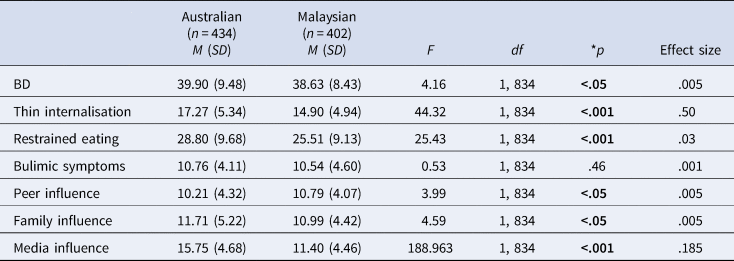
Results of the MANOVA on BD, thin ideal internalisation, restrained eating, bulimic symptoms, and the three sociocultural influences of family, peer, and media are presented in Table 2. As is evident from Table 2, Australian women scored significantly higher than Malaysian women on BD, thin ideal internalisation, restrained eating, media influence, and family influence, while Malaysian women scored significantly higher on peer influence. There were no differences between the cultures in terms of bulimic behaviours.
Mean and SD Scores and MANOVA Results for on Body Dissatisfaction, Thin Ideal Internalisation, Sociocultural Influences, and Problematic Weight-Related Behaviours

Note: Pillai's trace = .29, p < .001, partial η2 = .29. Significance of bold values = *p < .001, *p < 0.05.
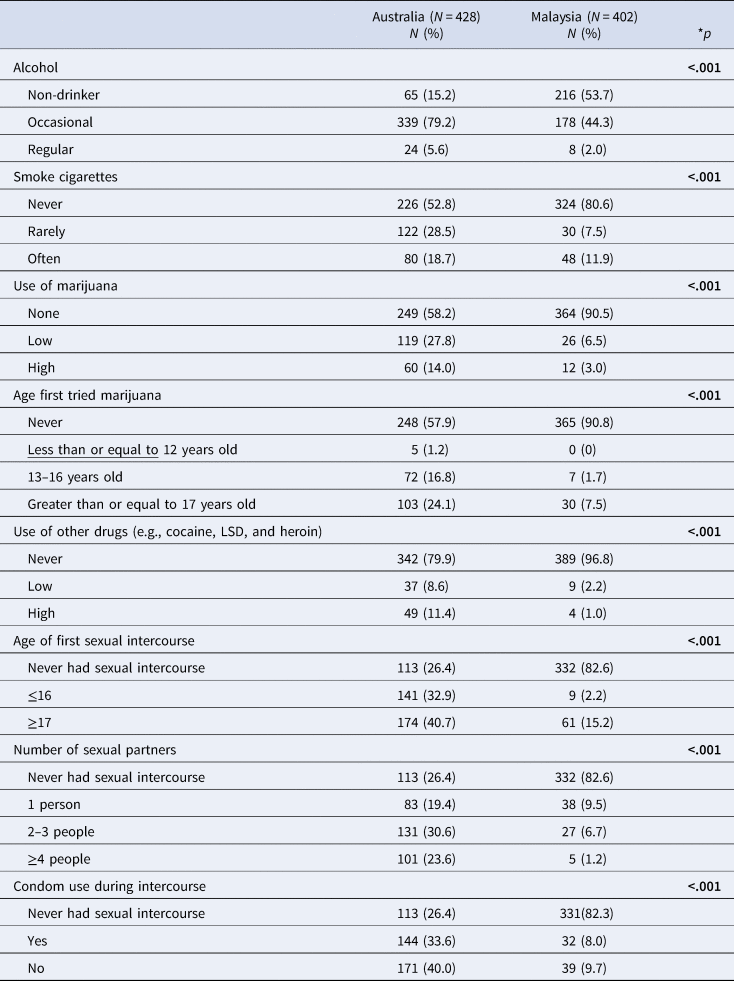
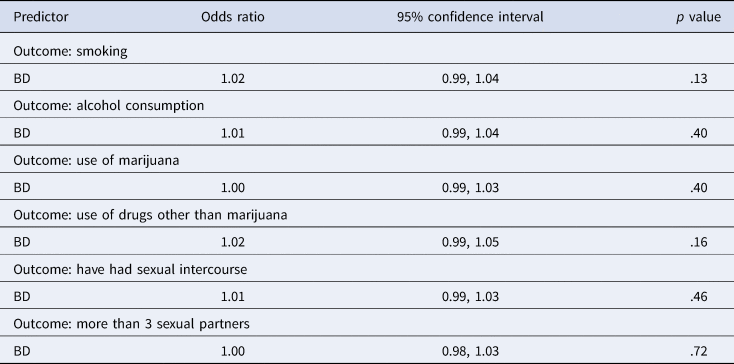
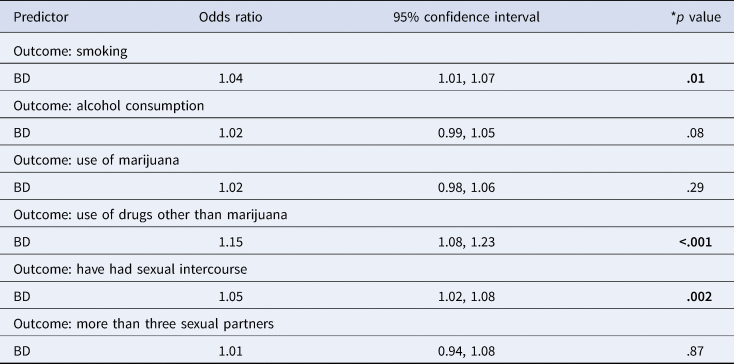
Table 3 presents the results from the Chi square analyses on health behaviours. As is evident from Table 3, Australian women were more likely to: consume alcohol on an occasional (79.2%) and regular basis (5.6%); smoke often (18.7%); report high use of marijuana (14.0%); report high use of other drugs (e.g., cocaine, LSD, and heroin) (11.4%); be 17 years or older when they first tried marijuana (24.1%); to be 17 years old of age when they first had sexual intercourse (40.7%); and have more than four sexual partners (23.6%) compared with Malaysian women. Australian women also reported that they used a condom during intercourse (33.6%) compared with only (8%) of Malaysian women. The results of the logistic regression analyses are shown in Tables 4 and 5. As is evident from Tables 4 and 5, BD was found to have an association with both use of ‘other’ drugs (such as cocaine methamphetamine, ecstasy, LSD, and heroin) ([OR] 1.15, 95% CI 1.01–1.19) and sexual intercourse ([OR] 1.05, 95% CI 0.99–1.06) for Malaysian women. For Australian women, BD did not have an association with any of the health behaviours.
Results of Chi Square Analysis Comparing Across the Australian and Malaysian Samples

Significance of bold values = *p < .001, *p < 0.05.
Results of Logistic Regression with Body Dissatisfaction Predicting Risky Behaviours for Australian Participants

Results of Logistic Regression with BD Predicting Risky Behaviours for Malaysian Participants

Significance of bold values = *p < .001, *p < 0.05.
Discussion
The present study had two aims. The first was to investigate cross-cultural differences between Australian and Malaysian women on sociocultural influences (peer, media, and family), BD, thin ideal internalisation, restrained eating, bulimic behaviours, and health behaviours (smoking, drinking, marijuana use, other drug use, and risky sexual behaviours). The second aim was to compare across cultures, the association between BD and health behaviours. The first hypothesis is BD, sociocultural influences, thin ideal internalisation, problematic weight-related behaviours (restrained eating and bulimic behaviours), and health behaviours will be higher among Australians compared with Malaysians.
Consistent with the first hypothesis, Australian women reported higher family and media influence, greater BD, higher thin ideal internalisation, and more restrained eating behaviours. Although some of these differences are statistically significant, the mean differences/effect sizes are quite small. In contrast, Malaysian women reported more peer influence. This finding is consistent with some previous research but not all. For example, research by Baillie and Copeland (Reference Baillie and Copeland2013), that examined BD and disordered eating behaviours among Chinese, Malaysians, and Caucasian college student in the USA (n = 990), found that Caucasian women reported higher BD and disordered eating behaviours compared with their Chinese counterparts. However, the findings from the present study were contrary with previous research by Mellor et al. (Reference Mellor, Waterhouse, Mamat, Xu, Cochrane, McCabe and Ricciardelli2013). Although the study by Mellor et al. (Reference Mellor, Waterhouse, Mamat, Xu, Cochrane, McCabe and Ricciardelli2013) was with females aged 12–19 years (n = 476), they found that BD was higher among Asians (Malaysian Chinese, Malaysian Malays, and Chinese) compared with Australians and they found that Malaysian Chinese were most dissatisfied with their bodies. A possible explanation for the differences in BD, internalisation of the thin ideal, restrained eating, media, and parent influence among Australian and Malaysian women in this study is that Australian culture, which is primarily a Western culture, would be similar to that of other Western cultures with respect to BD, thin ideal internalisation, sociocultural influence, and disordered eating behaviours. Female beauty ideals in Western cultures are synonymous with the thin ideal and with the constant presentation of thin ideal images in mass media. This has contributed to increased levels of BD and problematic eating behaviours (Sepúlveda & Calado, Reference Sepúlveda and Calado2012). A possible explanation for higher peer influence among Malaysian compared with Australian women is that young individuals from collectivistic cultures may have a tendency to conform to the opinions of peers regarding the thin ideal and BD (Zhang, Qian, & Fu, Reference Zhang, Qian and Fu2018). This may directly and indirectly cause women to feel peer pressure (Javier & Belgrave, Reference Javier and Belgrave2015; Jones, Vigfusdottir, & Lee, Reference Jones, Vigfusdottir and Lee2004).
It was hypothesised based on previous research that Australian women, similar to women in other Western cultures, would have higher bulimic behaviours compared with Malaysian women. This hypothesis was based on extensive research which suggested that bulimic symptoms were high among young Australian women ( Koupil, Tooth, Heshmati & Mishra, Reference Koupil, Tooth, Heshmati and Mishra2016). Previous study by Koupil, Tooth, Heshmati & Mishra, (2016) found that bulimic symptoms were common in Australian women aged 18–23 years (n = 12,599). However, research that has emerged over the last 10 years has suggested that Western and non-Western women are less likely to differ in relation to eating disorders and the findings from this study are consistent with this more recent research. For example, Mond, Chen, and Kumar (Reference Mond, Chen and Kumar2010) investigated eating disorders among Australian and Singaporean young women aged 18–20 years (n = 503) and found no difference between the two groups of women with respect to eating disorders. Similarly, a study by Rasman, Rahid Kay, Ahmed, and Ahmed (Reference Rasman, Rahid Kay, Ahmed and Ahmed2018), that assessed eating disorders among 18–26-year-old medical students in Malaysia (n = 279), found that there was a high prevalence of eating disorders among medical students and a majority of them were females and of Indian ethnicity (see also, Lai et al., Reference Lai, Mak, Pang, Fong, Ho and Guldan2013; Pike & Dunne, Reference Pike and Dunne2015; Soh et al., Reference Soh, Touyz and Surgenor2006). A significant change in gender roles in Asian societies often takes place when there is an increase in urbanisation, industrialisation, and Westernisation. These changes often bring about a development in consumer culture (media influence and globalised fashion and beauty industries). These new aesthetic beauty ideals often glorify thinness (Pike & Dunne, Reference Pike and Dunne2015). Similarly, there has been a significant increase over the past three decades in economic development in Malaysia, industrialisation, Westernisation, Western body ideals, and modernisation. The pressure to attain the thin ideal, consistently promoted through media images, may cause young Malaysian women to engage in extreme behaviours of weight control, such as bulimic behaviours to embrace these unrealistic appearance standards. This may have been the reason for the similarity in bulimic behaviours in Malaysian and Australian women.
Consistent with the first hypothesis, Australians scored higher on negative health behaviours including alcohol consumption, smoking, use of marijuana, using other drugs (cocaine, methamphetamine, ecstasy, LSD, and heroin), sexual behaviours, having multiple sex partners, and were more likely to use a condom during sexual intercourse compared with Malaysian women. These results show that Asian culture may be a protective factor for female emerging adults from engaging in negative health behaviours. The results of this study are consistent with previous studies. For example, higher negative health behaviours among Australian women are consistent with a study by Chen and Jacobson (Reference Chen and Jacobson2012) that examined developmental trajectories of alcohol use, smoking, heavy drinking, and marijuana use among adolescents and young adults of different ethnicities (n = 20,160). The study found that Asian adolescents reported significantly lower levels of heavy drinking and alcohol use compared with their Caucasian counterparts. The results were also consistent with findings from a study by Razali and Kliewer (Reference Razali and Kliewer2015) that investigated the risk factors for drug use among Malaysian adolescents and young adults aged 13–25 years old (n = 859). The study found that religious practices, belief in a moral order, and reward for prosocial family involvement were protective factors against hard drug use. Despite increases in Westernisation, modernisation, and industrialisation in Asian countries over the past few decades, negative health behaviours remain low compared with Western countries. A possible explanation for this is that in Western countries, alcohol consumption is socially accepted and seen as a positive and integral component of the culture (Lee, Sulaiman-Hill, & Thompson, Reference Lee, Sulaiman-Hill and Thompson2014). The results of this study for Malaysian females are similar to the cultural practices in other Asian countries where alcohol consumption is lower among females (Bui et al., Reference Bui, Blizzard, Luong, Truong, Tran, Otahal, Srikanth, Nelson, Au, Ha, Phung, Tran, Callisaya and Gall2016; WHO, 2014). The individualistic culture in Western societies may also contribute to feelings of alienation, less connectedness, and the lack of shared values which may potentially contribute towards negative health behaviours such as drug use at a higher rate compared with a more collectivist culture (Eckersly et al., 2009). Although, religious and cultural imperatives may influence alcohol consumption and drug use in Malaysia resulting in female emerging adults’ low levels of alcohol and drug use compared with Australians, increased modernization together with the transitional phase of emerging adulthood may promote experimentation with alcohol and other substances.
With respect to smoking behaviours, individualistic and collectivistic cultures may also influence rates of smoking, with higher rates of female smokers in Australian compared with Malaysians. According to a previous study by Hosking et al. (Reference Hosking, Borland, Yong, Fong, Zanna, Laux and Omar2009), Malaysian smokers placed importance on the perception of significant others and their beliefs about appropriate public behaviours, such as smoking, rather than their personal beliefs. Females in Malaysia are expected to adhere to prescribed beliefs, values, and behaviours (Hirschman, Reference Hirschman2016).
Malaysian women were less likely to engage in sexual behaviours. They had fewer sexual partners and were less likely to use a condom during intercourse. There is extensive evidence that knowledge regarding condom use is low in some parts of Asia with a disparity in condom knowledge between the sexes (Lucea, Hindin, Gultiano, Kub, & Rose, Reference Lucea, Hindin, Gultiano, Kub and Rose2013; Moore, Beksinska, Rumphs, Festin, & Gollub, Reference Moore, Beksinska, Rumphs, Festin and Gollub2015; Tangmunkongvorakul et al., Reference Tangmunkongvorakul, Musumari, Srithanaviboonchai, Manoyos, Techasrivichien, Suguimoto and Chariyalertsak2017), and this study is consistent with these findings. A report by UNESCO on the sexual and reproductive health of young people in Asia and the Pacific found that less than half of young females (15–24 years old) in eight countries (Papua New Guinea, Nauru, Afghanistan, Bangladesh, India, Pakistan, Indonesia, and Timor-Leste) knew about the use of condoms for preventing HIV (Central Statistics Organisation (CSO) & UNICEF, 2012; UNFPA, UNESCO, & WHO, 2015). Further, social disapproval regarding premarital sex, along with difficulties in obtaining condoms and embarrassment, may contribute to the low rate of condom use among Malaysians. Previous studies from Malaysia, Vietnam, and Thailand indicate that in those countries, the use of condoms implies unfaithfulness and promiscuity which is said to violate notions of love and trust. This is also consistent with previous research by Ahrold and Meston (Reference Ahrold and Meston2010) that examined sexual attitudes among Asian, Euro-American, and Hispanic students and found Asian cohorts to be more conservative. Thus, young people reported that for this reason, they were less likely to use a condom with their sexual partners (Khumsaen & Gary, Reference Khumsaen and Gary2009; Ng & Kamal, Reference Ng and Kamal2006; Teerawichitchainan, Reference Teerawichitchainan2007). Australian culture, on the other hand, is similar to most Western cultures and thus has a more liberal attitude regarding sexual behaviours (Smith, Rissel, Richters, Grulich, & de Visser, Reference Smith, Rissel, Richters, Grulich and de Visser2003).
Meanwhile, the second hypothesis is BD will have an association with health behaviours such as smoking, alcohol consumption, drug use, and sexual behaviours only for Australians and not for Malaysians.
Contrary to the second hypothesis, BD had an association with some health behaviours — in particular, the use of other drugs and sexual behaviours — among Malaysians but not Australians; although the rates of other drug use and sexual behaviours among Malaysians were very low. Further, BD did not have an association with the health behaviours of use of marijuana and alcohol consumption for either Australians or Malaysians. The findings of an association between BD and other drug use and sexual behaviours were not in line with previous research that found an association between BD and unhealthy/risky behaviours among Western cultures. For example, a study by Warren, Lindsay, White, Claudat, and Velasquez (Reference Warren, Lindsay, White, Claudat and Velasquez2013), in the USA among women in substance abuse treatment, found 37% of women reported using drugs with the intent to lose weight. The results of this study were also inconsistent with a previous study by Littleton, Breitkopf, and Berenson (Reference Littleton, Breitkopf and Berenson2005), among women in the USA (n = 1547), which found that negative body image was associated with sexual behaviour, inconsistent use of condoms, as well as having multiple sex partners. A possible explanation for the relationship between BD and use of other drugs and smoking and engaging in sexual intercourse for Malaysians but not Australian could relate to social acceptance and social approval. First, drug use or smoking is not socially accepted for Malaysians, particularly for females given the stigma around it in a collectivistic culture. Females, in particular, are sensitive towards public scrutiny in Malaysia (Hirschman, Reference Hirschman2016). Thus, individuals may tend to use drugs or smoke cigarettes only or even engage in sexual intercourse when they have presenting problems or concerns, such as BD, which encourage them to self-medicate. Second, Australians on the other hand may use drugs or smoke for a multitude of reasons as it is more socially accepted in an individualistic culture (Eckersley, Reference Eckersley2005). From a cultural context, the more conservative attitudes in health behaviours of young Malaysians reflect a collectivistic culture (conforming to social values and norms), while the more liberal attitudes of Australian reflect a more Individualistic culture.
Strengths, Limitations, and Future Directions
This study had a number of strengths. First, to our knowledge, it was the first of its type to cross-culturally compare the role of BD and the association it has with health behaviours between Australia and Malaysia. Second, the scales used to measure BD, thin ideal internalisation, sociocultural influences, restrained eating, and bulimic symptoms were psychometrically sound and widely used in body image research. Third, the large sample size of Malaysian and Australian participants ensured adequate power. Despite the strengths, this study had several limitations. The use of discrete rather than continuous variables to measure the health behaviours limited statistical techniques. Although difficult to make consistent, the difference in sampling used in the two countries is another limitation of this study. The cross-sectional design of this study cannot draw conclusions about the temporal progression of effects nor can it conclude the direction of causality. Thus, more longitudinal studies are needed to ascertain whether BD is associated with those behaviours over time. Furthermore, qualitative studies would be useful to have a more in depth understanding of how BD is associated with those behaviours.
Implications and Conclusion
Findings from this study have implications for the treatment and prevention of BD, thin ideal internalisation, and problematic weight-related behaviours (restrained eating and bulimic symptoms). As higher BD, thin ideal internalisation, family and media influence, and restrained eating were found among Australians and higher peer influence among Malaysians, culturally specific programs and interventions that promote positive body image and healthy eating behaviours to improve the health and wellbeing of emerging adults should be implemented. With respect to prevention efforts, sociocultural influences of parents, peer, and media should be targeted across both cultures. Prevention efforts focusing on the role of media in its portrayal of thin images of women are crucial. Prevention efforts targeting parents and peers should promote awareness on how harmful negative comments and ‘fat talk’ can be for young women. With respect to the similarities in bulimic behaviours across cultures, prevention and treatment efforts need to focus on reducing the pressure to conform to the thin ideal and on evidence-based therapies to treat this disorder. BD is indeed a public health problem that needs to be addressed, particularly in non-Western cultures as it was found to have a strong association with use of other drugs, smoking, and sexual behaviours. The results have clear implications for treatment programs targeting BD, thin ideal internalisation, sociocultural influences, restrained eating and bulimic symptoms, and health behaviours.
Funding
The author(s) received no financial support for the research, authorship, and /or publication of this article.
Declaration of Interests
The author(s) declared no potential conflicts of interest with respect to research, authorship, and/or publication of this article.