A nuclear detonation will cause blast, thermal, and radiation injuries.Reference Hogan and Kellison 1 The latter will be particularly difficult to manage clinically if the radiation doses are sufficient to cause acute radiation syndrome (ARS), which may not be evident for days following the event.
ARS, also known as radiation sickness,Reference Hogan and Kellison 1 is a condition that occurs when the whole body (or a large part of it) is exposed to high doses of penetrating ionizing radiation over a short period of time. The severity of ARS depends on several factors, including the dose, dose rate, type of radiation, duration of exposure, and proportion of the body exposed (whole or partial). ARS manifests clinically, at doses >1 Gy whole body exposure, as 3 overlapping subsyndromes: hematopoietic, gastrointestinal, and neurovascular.Reference Heslet, Bay and Nepper-Christensen 2 It is important to note that the severity and progression of ARS can vary significantly depending on the individual’s radiation exposure, presence of comorbid conditions, presence of combined injuries, and medical care received. Immediate medical attention, supportive care,Reference Weisdorf, Chao and Waselenko 3 and, in some cases, treatment with specific therapies, may improve the prognosis for individuals affected by ARS.Reference Weisdorf, Chao and Waselenko 3
Hematopoietic acute radiation syndrome (H-ARS), a subsyndrome of ARS starting at the lower range of exposure, occurs when the bone marrow, responsible for producing blood cells, is damaged by radiation exposure. The symptoms typically manifest within hours to days after exposure. The prodromal symptoms include nausea, vomiting, fatigue, weakness, and fever, followed by the hallmark decrease in blood cell counts. This reduction in white blood cells, red blood cells, and platelet counts can lead to an increased risk of infection, anemia, bleeding, and death, especially at higher doses of exposure.Reference Dainiak, Goans, Iddins, Todd and JCR 4
The current available treatments for H-ARS include cytokinesReference Dainiak 5 such as granulocyte colony-stimulating factors, granulocyte macrophage colony-stimulating factors, and thrombopoietin receptor agonists. These colony-stimulating factors (CSFs) will stimulate hematopoietic stem cells in the bone marrow, leading to an increased production of granulocytes, macrophages, and megakaryocytes. The increase in the white blood cells will strengthen the immune system through increased cell capacity,Reference Dainiak 5 while an increase in platelet count will decrease the risk of thrombocytopenia-associated bleeding. Initially, these exogenous CSFs were developed to treat neutropenia caused by chemotherapy or radiation used in cancer treatment.Reference Waselenko, MacVittie and Blakely 6 CSFs have been studied for their potential use as medical countermeasures (MCM) following high dose radiation exposure causing bone marrow dysfunction. The US FDA-approved medications for H-ARS included in this systematic review are filgrastim, pegfilgrastim, romiplostim, and sargramostim.
The goal of this systematic review is to characterize the evidence on the efficacy of CSFs to treat ARS during a nuclear and radiological emergency. This will inform and direct future clinical guidance for the administration of these medical countermeasures following a nuclear detonation.
Methods
Systematic review planning began with formulation of the PICO Model (Population, Intervention, Comparison, and Outcomes) (Table 1). The model was then used to develop the research question, “What is the efficacy of CSFs for treating ARS during a nuclear and radiological emergency?” The authors engaged a group of subject matter experts from academic institutions and professional medical organizations, organized by the National Alliance for Radiation Readiness (http://www.radiationready.org), to assist in the refinement of both the question and model.
PICO details

Literature Search and Study Selection
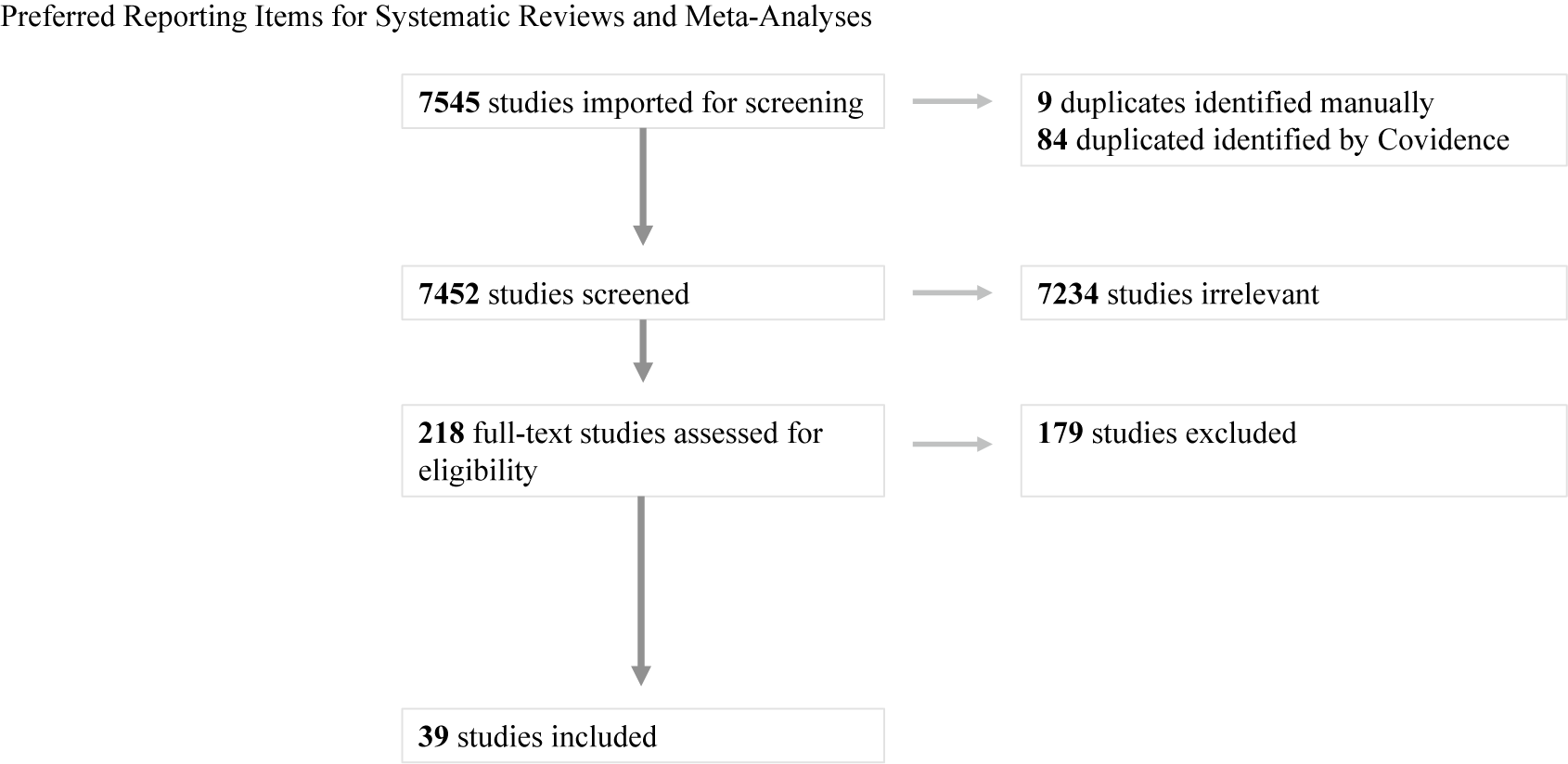
The search strategy was carried out by searching Medline OVID (1996-), Embase OVID (1998-), Cochrane Library, CINAHL EbscoHost, and Scopus for English and non-English language articles through July 2022. The databases and keywords used in this search are shown in Table 2. The review methods followed the Preferred Reporting Items for Systematic Reviews and Meta-Analyses (PRISMA) guidelines (http://www.prisma-statement.org). The initial literature search returned 7545 articles, with 93 duplicates removed for a total of 7452. A first round of abstract review eliminated 7234 studies, as they were not relevant to the research question. The remaining 218 articles were then assessed against the PICO criteria. This step required a full text review of each of the remaining articles resulting in an additional 179 articles which did not meet the stated PICO criteria. A total of 39 studies remained at the end of the process (Figure 1). Articles that met exclusion criteria and were excluded were narrative reviews, editorials, and reports that did not answer our research question. The selected articles were then further reviewed for extraction of the appropriate data needed for the analysis by at least 2 study personnel.
Search strategy

PRISMA (Preferred Reporting Items for Systematic Reviews and Meta-Analyses) chart.

Data Extraction
The authors extracted data from the selected publications using Covidence (https://www.covidence.org/), an online software program for systematic review management. The article and data variables extracted were title, author name, year of publication, study design, subject demographics, inclusion criteria, radiation exposure dose, intervention, time of intervention post-irradiation, survivability, physiological improvement measures, and supportive care. Data extractions were completed by 2 reviewers independently. The data extractions were then compared, and any inconsistencies were resolved and brought to consensus by the 2 reviewers and a third reviewer, if needed.
Articles reported survivability of test subjects in a variety of ways: overall percent survival of an irradiated but untreated control group and an irradiated treated group; overall percent survival of the control and treated groups; and physiological improvements of the treated group over the control group. To facilitate comparisons across studies, all reported survival data were adjusted to overall percent survival of the control and treated groups. For studies that did not report survival of test subjects, description of physiological improvement between the treated and control groups was used for categorization. Other reported outcomes from these studies were considered in the analysis and discussion sections of this review but did not contribute to the counts referenced in relation to survival: intervention dose, length of therapy, and supportive care.
Data Synthesis and Analysis
Due to the heterogeneity in each study’s experimental design using different animal species, interventions, and treatment protocols, vote counting rather than a meta-analytic approach was used. This method of data synthesis categorized all studies into improved or non-improved outcome based on observed direction of effect of outcome data variables.Reference McKenzie, Higgins, Cumpston and Li 7 To place each study in the correct category, the survival percent of the control was compared to the survival percent of the treatment group where this information was available. In studies in which survival outcome data was not available, physiological improvement between the control and treatment groups was used to determine outcome improvement or non-improvement of the intervention used in the study. Physiological improvement is defined as improvements in 1 or multiple of the following: increased leukocyte, neutrophil, platelet counts, recovery from anemia, and/or decrease in the duration of neutropenia. We calculated an estimated proportion of effects (P), where P = u/n; u = studies showing outcome or physiological improvement and n = number of total studies.Reference McKenzie, Higgins, Cumpston and Li 7 The 95% confidence intervals for this single binomial proportion using Wilson confidence intervals with a continuity correction were calculated.Reference Brown, Cai and DasGupta 8 The P value for the proportion of studies showing outcome or physiological improvement in relation to the null hypothesis of 50% showing improvement was calculated.
Quality assessment scoring
The studies selected for analysis were assessed for quality of evidence through use of a modified Newcastle-Ottawa Scale (NOS).Reference Wells, Shea and O’Connell 9 The authors chose 6 characteristics divided into 2 major categories (selection and outcome) to have a standard for comparison between studies and to reduce bias. These criteria included absorbed radiation dose, overall representativeness of acute radiation syndrome (ARS), treatment approach, treatment timing, supportive care, and survival outcome. Multiple reviewers then assigned a numeric score to each study. All studies were ranked as low (1-3), moderate (4-6), or high quality (7-9) using the modified Newcastle-Ottawa ScaleReference Wells, Shea and O’Connell 9 criteria above.
Results
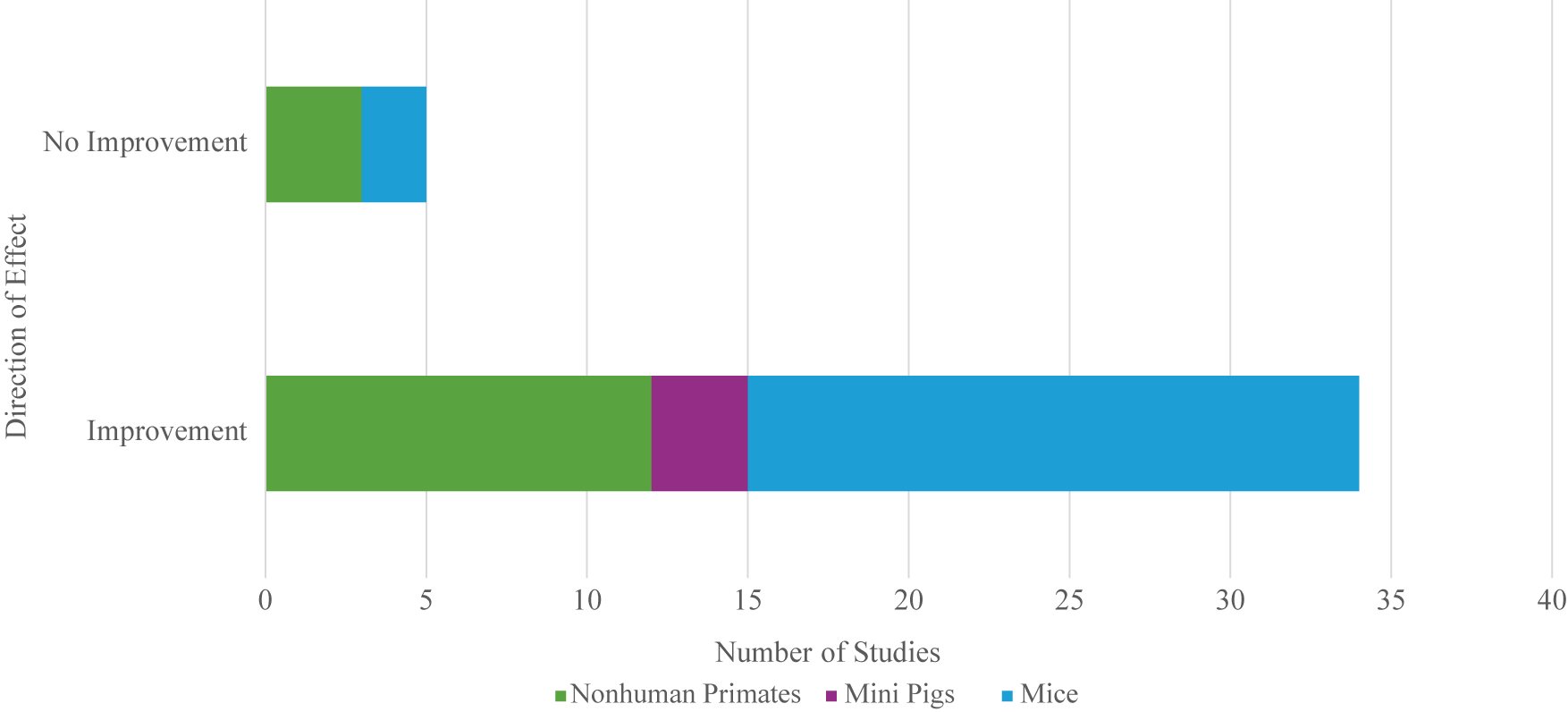
A total of 39 experimental animal studies met PICO inclusion criteria using filgrastim (20), pegfilgrastim (19), romiplostim (8), and sargramostim (3) alone or in combination with other interventions. The species used included laboratory-bred mice (21), rhesus monkeys (15), and mini pigs (3). Seven of the studies reviewed also included stem cell transplantation as an intervention (Table 3). Among the 39 studies included, 34 were categorized as showing improvement and 5 showed no improvement based on an increase in percent survival or observation of physiological improvement in the experimental group when compared to the control (estimated proportion of effects: 87%, 95% CI = 71.77%, 95.18%, P = <0.001) (Figure 2).
Demographics of 39 included articles

* Supportive, or adjunctive, care is any of a collection of secondary therapies that support the cytokine administered in the study. This could include hydration fluids, antibiotics, analgesics, anti-diarrheals, antipyretics, hemapoietic growth factors, GVHD prophylaxis, required isolation techniques, anti-emetics, anti-ulceratives, nutritional support, and blood transfusions.
(Note: Kiang 2017 provides a range rather than an exact number of animals in each experimental group, so the table entries correspond to the percentage numbers and range of test subjects given by Kiang et al.)
Number of systematic review studies and direction of effect of CSF treatment for ARS by study species.

Outcome Grouped by Experimental Treatment
Colony stimulating factors
Filgrastim was the intervention used in 14 of the 29 studies reporting survival. Within these 14 studies, there were 12 in which the CSF was administered as a single therapy (Table 3). Among the studies using filgrastim, the Newcastle-Ottawa ScaleReference Wells, Shea and O’Connell 9 quality assessment ranked all studies as high quality, 7/9 in 4 studies,Reference Sureda, Kadar and Valls 10 –Reference Cary, Ngudiankama and Salber 13 and 9/9 in 6 studies.Reference Farese, Bennett and Gibbs 14 –Reference Ossetrova, Blakely and Nagy 19 Of the studies that used filgrastim as treatment, 3 showed inconsistent outcome measures, and 1 neither improved or worsened physiological effects or survival percentages.
Pegfilgrastim was administered in 9 studies as the sole treatment, and all reported improved survival. These studies were all ranked as high quality, with 2 studies scoring 9/9, 5 studies scoring 8/9, and 2 studies scoring 7/9. Moreover, 1 of these studies utilized the pre-marketing formulation of pegfilgrastim, known as Maxy-G34, instead of the commercially available formulation of pegfilgrastim, which has equivalent efficacy. The Maxy-G34 study used both male and female mice and was ranked with a high-quality score of 8/9, showing improved survival. When given 24 hours after irradiation, the survival of the treated group was 97% compared to 70% for the control group.Reference Chua, Plett and Sampson 20
Sargramostim was studied in nonhuman primates in 2 studies evaluating survival. In 1 study, the treated group survival was 32%, whereas the control group survival rate was 14%.Reference Zhong, Pouliot and Downey 21 In the second study, the treated group showed a survival of 78 percent, and the control group survival rate was 42 percent.Reference Clayton, Khan-Malek and Dangler 22 One of these studies showed improvement using a pegylated form of sargramostim.Reference Clayton, Khan-Malek and Dangler 22 The quality assessments for both studies were ranked as high quality, 9/9.
Six studies used romiplostim as the intervention following irradiation of mice and in all studies, improved survival or physiological improvement was seen. The romiplostim was used in conjunction with other CSFs in 4 of the 6 studies. The other CSFs used in these studies were pegfilgrastimReference Bunin, Bakke and Green 23 , Reference Wong, Chang and Fielden 24 or filgrastim.Reference Yamaguchi, Suzuki and Funaba 11 , Reference Hirouchi, Ito and Nakano 12 Our quality scoring of these experiments ranged from moderate in 1 study to high quality in 5.
Stem cell transplantation
Our review identified 7 studies that included stem cell transplant regimens. All identified studies used mice in stem cell therapy. Each study reported improved survival or physiological improvements, except for 1 study. This study did not show physiological improvements, but both treatment and control groups showed similar outcomes. The quality scoring of these studies was moderate, ranging from 5/9 toReference Yang, Wang and Jia 25 , Reference Li, Wei and Yan 266/9Reference Lange, Brunswig-Spickenheier and Cappallo-Obermann 27 –Reference Kim, Moon and Heo 31, yet all but 1 study showed physiological improvement or improved survival.
Of the 29 studies reporting survival as an outcome, 10 used supportive care in both the control and treated groups in addition to CSF treatment in the treated group. Eight of the 10 studies showed an increase in percent survival between the control and treated groups. The remaining 2 studies showed inconsistent outcomes for CSF treatment on survival percentages and physiological improvement when compared to the control.
Timing of Administration
Initial CSF administration following irradiation took place at 24 hours or less, 30-, 48-, 72-, 96- and 120 hours post irradiation (Table 4). Thirty-four of the 39 studies initiated therapy with at least 1 dose within 24 hours of exposure or less. Of these, 28 used percent survival and 11 used physiological improvement to compare treatment groups to control groups.
Administration times and outcome variables of 39 included articles

(Note: Kiang 2017 provides a range rather than an exact number of animals in each experimental group, so the table entries correspond to the percentage numbers and range of test subjects given by Kiang et al.)
Five studies administered cytokines at 48 hours; of those, 4 showed increases in survival when compared to a control group, while the remaining study did not show a difference between groups.Reference Farese, Brown and Smith 16 , Reference MacVittie, Farese and Parker 17 , Reference Zhong, Pouliot and Downey 21 , Reference Clayton, Khan-Malek and Dangler 22 , Reference Satyamitra, Kumar and Biswas 32 Two of the 5 studies, as well as an additional 5, investigated a first dose of CSF administered after 48 hours.Reference Farese, Bennett and Gibbs 14 , Reference MacVittie, Bennett and Farese 15 , Reference MacVittie, Farese and Parker 17 , Reference Zhong, Pouliot and Downey 21 , Reference Sanzari, Krigsfeld and Shuman 33 , Reference Cohen, Hankey and Farese 34 In a study that administered filgrastim and pegfilgrastim independently, starting at 24 and 72 hours post irradiation, the same survival percentages were seen for both administration schedules.Reference Farese, Bennett and Gibbs 14 One study, utilizing sargramostim, showed increased survival with treatment administration starting at hour 48, 72, 96, and 120, respectively, post exposure to radiation.Reference Zhong, Pouliot and Downey 21 When compared to control groups, 2 nonhuman primate studies showed that treatment with filgrastim at 24, 48, 72, and 120 post irradiation showed improvement in either survival or physiologic parameters (e.g. neutropenia).Reference MacVittie, Bennett and Farese 15 , Reference MacVittie, Farese and Parker 17 All studies with administration of cytokines after 24 hours were ranked as high-quality studies.
For the 7 studies that used stem cell therapies, 6 showed improved survival when the intervention was administered within 24 hours, and 1 of these 6 showed improved survival when treatment was administered at 30 hours post exposure to radiation. The remaining study did not show improvement but did not worsen outcomes compared with the control. These studies were ranked as moderate in the quality scoring range.
Discussion
Overall, the studies in this systematic review, 34/39 studies, showed improvement in survival outcomes or physiological improvement with administration of CSFs following irradiation. This is consistent with a previous systematic reviewReference Dainiak, Gent and Carr 35 from other authors and an expert consensus publication.Reference Waselenko, MacVittie and Blakely 6 Every CSF used in these studies has received FDA approval under their Animal Rule guidelines: filgrastim (approved 3/30/2015), pegfilgrastim (approved 11/13/2015), sargramostim (approved 3/29/2018), and romiplostim (approved 1/28/2021). 36 The Animal Rule guidelines are used when human studies do not meet ethics requirements and field trials are not possible. We found many studies that detailed the proven efficacy of CSFs in cancer treatment and historical use of CSF in human case reports after accidental radiation exposure, but they did not meet our PICO criteria. Head-to-head comparisons of efficacy between different CSFs (e.g., filgrastim vs sargramostim) were not included in any of the studies, and, thus, we could not make any conclusions. Vote counting was chosen for this systematic review based on the lack of consistent methods and effect measures (i.e. radiation dose, animal species, study sizes, and outcome measures) reported across included studies. This heterogeneity precluded the use of meta-analysis.
An important consideration for the administration of CSFs following a mass radiation exposure incident is the timing of first treatment. In other words, how long after radiation exposure can the first dose of the CSF be administered and remain efficacious? Timing of administration will be impacted by many logistical challenges including limited initial availability and timing of procurement or distribution of additional doses from the US Strategic National Stockpile. 37 Most studies included in our review were designed to assess efficacy of treatment with administration at 24 hours. In our analysis, only 7 studies started treatment at 48 hours or later; however, they still showed improved survival compared to their respective control groups and improvement in other outcome measures (e.g. recovery from neutropenia). For example, MacVittie showed that when filgrastim was administered at 72 and 120 hours post irradiation, there was an increase in survival for nonhuman primates receiving treatment compared to those who did not receive treatment. However, the number in each group was very small (n = 8).Reference MacVittie, Bennett and Farese 15 CSF administration was reported to shorten recovery time from neutropenia in most studies.
A previous consensus report indicated that supportive or adjunctive care alone can increase the survival outcome of those suffering from ARS.Reference Waselenko, MacVittie and Blakely 6 In the studies reviewed in this report, the use of supportive care was not consistent across the reviewed studies, and its effectiveness was not directly tested against controls. Approximately 30% of the studies reviewed here used some form of supportive care in addition to CSF treatment.
The experimental radiation exposure protocols and outcome measures used among the studies were not uniform; the standardization of these exposures and outcome measures would benefit future research. Protocols in these studies included different sources and types of radiation (e.g., gamma, neutron, proton, accelerator-produced, x-ray), different magnitude of dose, dose rate, total or partial body irradiation, and total duration of irradiation of the animals. Some studies used species-specific lethal doses, while others used sub-lethal doses.
The test subjects varied by animal species – mice, rhesus monkeys, and mini pigs – as well as by sex and age. The interventions differed not only in type of CSF, but also in the dose(s) administered and the additional therapeutics used concurrently. Additionally, there was a lack of conformity in the timing of the first administration of CSFs following irradiation and duration of treatment. Lastly, studies that used stem cell transplantation as treatment also showed benefit; however, they scored lower in our quality assessment scale because of lack of supportive care descriptions and/or measurement of percent survival as a study outcome.
For those unfamiliar with radiation research, the reliance on animal models and exclusion of human subjects in randomized controlled trials might be considered limiting. Due to the inherent challenges and ethical considerations associated with these types of studies, there are no controlled studies of ARS performed on humans. Human descriptive studies were found but they were limited to historical case reports from occupational accidents that resulted in high doses of radiation and subsequent treatment with CSFs or other agents. Therefore, these did not meet the PICO criteria and were not included in the systematic review.
Another limitation was using a modified NOS for quality of evidence assessment over other tools, such as the more widely used GRADE (Grading of Recommendations, Assessment, Development, and Evaluations).Reference Guyatt, Oxman and Vist 38 This was chosen because our studies in the analysis were all performed on experimental laboratory animals rather than human subjects (a negative characteristic in GRADE). A previous report used expert consensus with quality assessment of human data from case reports found in the literature and found similar conclusions as those found in this study.
Conclusion
The studies we identified support the use of CSFs to treat H-ARS caused by acute exposure to high doses of radiation by improving survival or physiological parameters (high quality of evidence). There was evidence that CSF interventions had an effect on survival outcome or physiological improvement, with 34 of 39 studies favoring the intervention (87% [95% CI: 71.77%, 95.18%], P = <0.0001) for treating ARS during a nuclear and radiological emergency.
While studies looking at efficacy of CSF given after 24 hours were very limited, the few studies included in our review showed that delayed treatment up to 120 hours may still be beneficial in terms of survival or physiological recovery (low quality of evidence). We did not find any studies that included head-to-head comparisons between CSFs in our review; however, all FDA approved CSFs showed overall benefit for the treatment of H-ARS. Stem cell transplantation studies also showed benefit, although there were fewer studies compared to CSF administration alone (moderate quality of evidence). One challenge that we identified is the lack of standardization in study design and methodologies which makes direct comparison of results between studies very difficult.
The findings and conclusions in this report are those of the authors and do not necessarily represent the official position of the Centers for Disease Control and Prevention.
Competing interests
None.