I. Introduction
According to the Kretika of the Hellenistic historian Dosiadas (BNJ 458 F2), one of the functions of the mess groups at Lyktos was the socialization of citizen boys through the inculcation of martial values. After an elaborate description of how the common meals functioned, including the allocation of choice portions to men who were considered outstanding in war or sagacity, Dosiadas writes:
After the meal it is their custom first of all to deliberate about public matters; then, after that, they recall the deeds of war, and praise those who showed themselves to be courageous men, exhorting the young men towards bravery.
Dosiadas’ remarks align with those of various writers who claim that the Cretans brought up their boys to be brave.Footnote 1 A very different view of Cretan bravery, though, is offered by another Hellenistic historian, Polybios (4.8.10–11):
Θϵτταλῶν γοῦν ἱππϵῖς κατ ̓ ἴλην μϵ̀ν καὶ φαλαγγηδὸν ἀνυπόστατοι, χωρὶς δϵ̀ παρατάξ;ϵως πρὸς καιρὸν καὶ τόπον κατ ̓ ἄνδρα κινδυνϵῦσαι δύσχρηστοι καὶ βραδϵῖς: Aἰτωλοὶ δϵ̀ τούτων τἀναντία. Kρῆτϵς δϵ̀ καὶ κατὰ γῆν καὶ κατὰ θάλατταν πρὸς μϵ̀ν ϵ̓νϵ́δρας καὶ λῃστϵίας καὶ κλοπὰς πολϵμίων καὶ νυκτϵρινὰς ϵ̓πιθϵ́σϵις καὶ πάσας τὰς μϵτὰ δόλου καὶ κατὰ μϵ́ρος χρϵίας ἀνυπόστατοι, πρὸς δϵ̀ τὴν ϵ̓ξ ὁμολόγου καὶ κατὰ πρόσωπον φαλαγγηδὸν ἔφοδον ἀγϵννϵῖς καὶ πλάγιοι ταῖς ψυχαῖς: Ἀχαιοὶ δϵ̀ καὶ Mακϵδόνϵς τἀναντία τούτων.
The cavalry of the Thessalians, for instance, is irresistible in troop and column; but when their formation is dispersed and each man has to run risks according to timing and location, they are unmanageable and slow; the Aitolians are the opposite in this regard. And the Cretans both by land and sea, when it comes to ambushes, raids, stealing the advantage, night attacks and everything involving tricks and separate action, are irresistible; but when it comes to an open and front-facing phalanx assault they prove ill-bred and irresolute; and again the Achaians and Macedonians are the opposite in this regard.Footnote 2
The irresolute, wavering mind of the Cretan (the Cretans are πλάγιοι ταῖς ψυχαῖς) is contrasted with the faculty of the Achaian to remain steadfast and resolute in a phalanx clash. And Polybios has plenty of other criticisms of Cretan conduct: they are liars, they are cruel, they are addicted to plunder.Footnote 3 In Polybios’ eyes, as Paula Perlman puts it, ‘the kind of warfare for which the Cretans were suited was devious and underhanded, not even fit for the light of day. The Cretans themselves were morally ill-equipped to fight as hoplites because they lacked the civic virtues of bravery and stout-heartedness’.Footnote 4
These differing appraisals of Cretan bravery (and conduct in war more generally) could be explained in several different ways. One would be to impugn Dosiadas’ testimony by arguing that such literary sources on Cretan society are unreliable and merely a philosophical confection.Footnote 5 However, Link’s recent re-evaluation of the reliability of the literary sources for Crete and their compatibility with Cretan epigraphy, convincing in my opinion, makes this an unattractive option.Footnote 6 Another approach would be to impugn Polybios’ testimony, or that of his sources, as hopelessly biased, and claim that he misrepresented the realities of Cretan behaviour in war. Yet although a distinct hostility towards Cretans on Polybios’ part is undeniable, his remarks about Cretan tactics align well with what we know from a wide range of sources (see further infra). There is a third, more satisfactory explanation; and that is what this article aims to articulate: a contrasting set of cultural evaluations related to particular tactics in war. The Cretans, I will argue, never underwent the historical processes that led their mainland peers to fight in phalanxes, and the Cretan practice of running away rather than standing their ground, as well as ambushes and the tactical use of deceit, can be paralleled abundantly from archaic poetry. Dosiadas’ view reflects this tradition. Polybios’ stance, on the other hand, reflects a set of values that emerged in close relation to phalanx warfare. My argument falls in three parts. Section II will sketch the style of fighting pursued by the Cretans on land and sea. Section III shows that this is distinctly similar to the style of fighting on land and sea in archaic texts, and suggests that Cretan tactics evolved along a very different trajectory to that followed in much of the Greek mainland. Section IV turns to ethics, and argues that although Polybios and Dosiadas were referring to the same forms of behaviour, their standards of evaluation differed markedly: tactics that counted as ignoble in Polybios’ eyes were fair game, indeed admirable, in the eyes of the Cretans. Picaresque tales of such actions probably constituted much of what Lyktian men told their sons after dinner.
II. Cretan tactics
The Cretan interlocutor in Plato’s Laws (625c–626a) connects the fighting style of Cretans to the nature of the terrain: whereas Thessaly is dominated by level plains and suited to breeding horses and fighting from horseback, Crete is predominantly rough, mountainous country, and is therefore a land of mobile, light-armed archers. The Cretans are runners.Footnote 7 Plato’s geographical determinism in explaining the origins of Cretan tactics may seem a little overwrought today, but his description of those tactics does at least dovetail with what we know from other sources.Footnote 8 Ephoros (BNJ 70 F149, apud Strabo 10.4.16–22), writing in the generation after Plato, provides a comparable but more detailed picture. Cretan boys were raised to fight from an early age: younger boys attended their fathers’ mess hall (andreion), sitting at their feet, and would fight with each other and with boys from other messes. Older boys joined a band (agelē, lit. ‘herd’; or agelā, to give the local Doric);Footnote 9 members of an agelā would hunt and run races together; and agelai would engage in mock battles. These involved not just punch-ups, but the use of blunt (?) iron weapons too (§20).Footnote 10 In general, Cretan education involved training from boyhood in archery, war dances, the endurance of blows within and outwith the gymnasium, forced marches over rough ground and uphill, as well as learning military music, songs and basic literacy (§16).Footnote 11 Ephoros, then, repeats Plato’s emphasis on archery, fleetness of foot and the ability to fight in rough terrain, but adds further important details.Footnote 12 An excerpt of Herakleides Lembos’ epitome of the contemporary Aristotelian Constitution of the Cretans (fr. 15 Dilts = [Arist.] fr. 611.15 Rose) corroborates Ephoros on several points, adding that the mock battles involve boxing and stick-fighting, and are fought to the music of the aulos and kithara. Footnote 13
One might wish to pass off such passages as part of an idealized imaginary constructed by outsiders; but there are good reasons to take them seriously.Footnote 14 Xenophon served in a mercenary army that included Cretan archers; he noted how, under the command of a man named Stratokles, they proved particularly valuable when the Ten Thousand were being harassed by barbarian bowmen during a march through rough country: a situation that called for the Cretan contingent’s expertise in skirmishing amid mountainous terrain and skill at chasing down the enemy (Anab. 4.2.27–28).Footnote 15 Philip V of Macedon used Cretan archers specifically for skirmishing actions, and Livy (deriving his account at this point from Polybios) claimed that they were so swift of foot that they could even keep up with the cavalry (31.35.3, 31.36.8–9, 31.39.12–13). References abound in our historiographical sources to contingents of Cretan mercenary archers serving as light troops in Greek armies of the Classical and especially the Hellenistic period, displaying exactly the kind of skill set that the system of training Ephoros described might be expected to instil.Footnote 16 At the end of an exhaustive review of the sources for Cretan mercenaries of the Hellenistic era, Marcel Launey concluded thus: ‘Incorporated into a foreign army, the Cretans were not merged into the robust mass of the army – the heavy infantry, the phalanx, the cavalry. From the accounts of campaigns given by historians, it appears that a Cretan unit was a light unit – mobile, perfect for reconnaissance, surprise, harrying, ambushes, night operations’.Footnote 17
The Cretan style of warfare spawned a well-worn stereotype. ‘Bow-carrying’ (τοξοφόροι) Cretans appear in passing already in Pindar’s Pythian 5 (39–42) as dedicants of a wooden statue at Delphi. Mnesimachos, a poet of Middle Comedy, refers offhandedly to Cretan arrows as a typical feature of the mayhem of war (fr. 7 KA). Kallimachos (Hymn 3.81–3) refers to Kydonian bows after the Cretan city of that name, and at Anth. Pal. 13.7 (= Callim. Epigr. 37 Pf.) presents Menitas of Lyktos’ dedication of a bow and an empty quiver to Sarapis with a wry quip: ‘the men of Hesperis have the arrows’ (τοὺς δ ̓ ὀϊστοὺς ἔχουσιν ‛Eσπϵρῖται).Footnote 18 In another Hellenistic epigram, Antipater of Sidon uses the simile of a Cretan archer shooting straight at his target to characterize a direct and decisive solution to a puzzle (Anth. Pal. 7.427). Diodoros (5.74.5) refers to the bow as a characteristically Cretan weapon, and to a tradition that Apollo taught the Cretans its use.Footnote 19 At 37.18 he presents one of the most well-crafted vignettes of a Cretan archer in ancient literature; the context is a meeting with L. Julius Caesar, consul of 90 BC:
A Cretan, coming to the consul Julius with an offer of betrayal, said, ‘If through my help you should overcome your enemies, what reward will you give for this service?’ The general said, ‘I will make you a Roman citizen, and you will be honoured in my house’. But the Cretan cracked up in laughter at this remark, and said, ‘Citizenship, among the Cretans, is just a fine-sounding gimmick. For we shoot our bows for profit, and as we range over every land and sea, every arrow of ours is shot for the sake of money. And I have come now for the sake of money, so confer the honours of citizenship upon those who are currently quarrelling over it, and who are buying with bloodshed this squabbled-over gimmick’. The consul laughed and said, ‘When this enterprise comes to pass, I will give you a thousand drachmas’.
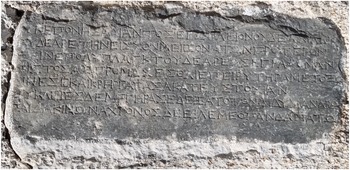
As we have seen, this stereotype draws on a real Cretan specialism in archery. But it was not simply a stereotype imposed on Cretans by outsiders. Bow imagery is unusually common on Cretan coins, showing that prowess with the weapon was part of a projected emic Cretan identity, not just an ascribed, etic one.Footnote 20 Grave stelae provide further evidence of this, a number of which depict Cretan men as archers.Footnote 21 But the best evidence for Cretans emphasizing their shooting skills comes from inscriptions. One example is a Cretan mercenary’s epitaph from the third century BC (fig. 1), currently ensconced in a wall of the Church of the Holy Apostles on the island of Tilos (IG XII.3 47 = GVI 1811):

Cretan sepulchral epigram from Tilos, in the wall of the Church of the Holy Apostles (IG XII.3 47 = GVI 1811). Photo courtesy of Ian Hogg.

I did not suffer more than Ajax or Achilles, Stranger; nor did I have greater virtue than men of former times. But I enlisted under wide-wandering Ares, ever dependable to fight in the forefront of battle, since as a drawer of bows all Crete praised me for accuracy. And honourable old age welcomed me, Kimon, the son of Didymandros. But Time the all-subduer took me.Footnote 22
Another example is this epigram from the sanctuary of Isis and Sarapis at Gortyn recording a dedication of weaponry (which addresses the viewer), from the second century BC (IC IV 243 = Martínez Fernández (Reference Martínez Fernández2006) no. 6):

The Cretan Pyroos invented me, and having grasped his bow with a double quiver for both shoulders he cleaved to the battle din of Ares. And then he devised a shield of skin and an arrow-case, he the daring one, the bravest of the Ertaians in the forefront of battle; since then the whole swift-running youth of neoi fears me. And as a gift to you, Sarapis and Isis, Pyrōs [sic] put me under the porch, this memorial to you of victory, since often he carried off glory from wars.Footnote 23
Reality, of course, was more complex than the stereotype allows: Cretans made use of other missile weapons than the bow: Amanda Kelly’s excellent recent study of Classical and Hellenistic Cretan sling bullets illustrates yet another missile weapon in the Cretan warrior’s kit.Footnote 24 Furthermore, Plato’s claim (Leg. 625c–d) that Crete was no place for cavalry is belied by a range of sources. Horses and horsemen are a common feature of archaic Cretan art, and provision of cavalry is also mentioned in a Hellenistic treaty between Eumenes II and several Cretan poleis (IC IV 179).Footnote 25 Cretan horsemanship is captured far more vividly, though, in an epitaph from Knossos (IC I viii 33 = Martínez Fernández (Reference Martínez Fernández2006) no. 4, second or first century BC):

Tharsymachos son of Leontios. You did not lose your virtuous name when you died, but the reputation that does you honour raises you up out of the House of Hades, Tharsymachos; and someone of those as yet unborn will sing clearly, recalling that furious cavalry troop when you alone of the Ertaians on windy Elaios broke the troop of the cavalry cry, devising deeds worthy of your father Leontios and worthy of your noble, much-praised forebears. And for that reason, among the assembly of the perished, glorious Hades has enthroned you alongside Idomeneus, protector of the city.Footnote 26
Equally at odds with Plato’s stereotype is the plentiful evidence that some Cretans, at least, fought hand to hand.Footnote 27 For instance, in 272 BC King Pyrrhos of Epeiros had his horse shot from under him by a Cretan archer (Plut. Pyrrh. 29.4), and lost his son Ptolemaios to a Cretan, Oryssos of Aptera. This man, described by Plutarch as ἀνὴρ πλήκτης καὶ δραμϵῖν ὀξύς, ‘a swift-footed bruiser of a man’, closed with the prince amid the chaos of battle and killed him, presumably with a hand weapon (Plut. Pyrrh. 30.4). Interestingly, Plutarch says that he struck ϵ̓κ πλαγίου παραδραμών: that Oryssos, rather than attacking the prince head-on, blindsided him at a run, sprinting in obliquely and catching his victim unawares.Footnote 28 A similar case concerns the Argive tyrant Aristippos: when his forces were routed at Kleonai in 235 BC, he fled as far as Mykenai before being run to ground by a Cretan named Tragiskos (‘Little Goat’), who slit the tyrant’s throat (Deinias of Argos, BNJ 306 F5).Footnote 29
Earlier and later evidence fleshes out the picture over the long term. An inscription from Axos, ca. 500, recently joined by Perlman from two previously known but hitherto unassociated fragments, mentions dedications of spearheads as spoils of war.Footnote 30 Archaic iconography from Praisos, Prinias and Palaikastro shows various examples of Cretans armed with spears, and finds of armour show that light-armed archers represent only part of the picture.Footnote 31 In the ‘Song of Hybrias’ (PMG 909) the eponymous Cretan warrior boasts that it is his sword, spear and shield that guarantee his privileges and dominion over his slaves.Footnote 32 Several centuries later, an epitaph from Gaza, written in elegiac couplets for a Cretan mercenary named Charmadas, boasts of how he had raised up his home city of Anopolis when it was subdued by the enemy spear (SEG 8.269, lines 11–12).Footnote 33
Some Cretans, then, fought with heavy arms; but did they fight in phalanxes? James Whitley has recently drawn attention to the lack of shields in the archaeological record as an indication that they did not.Footnote 34 Shields do appear in the literary record, however: witness Hybrias (supra); and Xenophon (Anab. 5.2.29) mentions Cretan archers who fought among the Ten Thousand carrying bronze-covered shields. Significantly, though, Xenophon uses the term peltē, implying a light buckler rather than the larger and heavier hoplite aspis; and Hybrias uses the rare term λαισήϊον, a hide-covered shield, which he describes as a πρόβλημα χρωτός, a shield of skin, the same words that Pyroos later used of his shield (πρόβλημα χροός).Footnote 35 It is unsurprising that such objects have not survived in the archaeological record. The examples of Pyroos and the Cretans among the Ten Thousand show that Cretan warriors might go into battle armed with both bow and shield.Footnote 36 Nicholas Sekunda puts it thus: ‘Cretan archers, unlike other Greek archers, were trained to use the shield alongside the bow, which offered them some protection from enemy missiles, and which allowed them to skirmish as well as to shoot’.Footnote 37 As noted above, some Cretans like Hybrias or the warriors depicted in archaic Cretan plaques will have fought differently, favouring shield and spear; however, one ought not to suppose that such shields were necessarily bronze-covered, or that the presence of hoplites ipso facto implies phalanxes, rather than heavy-armed warriors fighting as soloists in the archaic manner (on which see infra).Footnote 38 There is therefore sufficient evidence to show that the Cretans, through particularly noted for their skill with the bow, were all-rounders in the arts of war; but there are good reasons to suppose that the open-order skirmishing tactics which we find Cretan mercenaries using in our historiographical sources represent the standard Cretan way of war.Footnote 39
Another well-known stereotype of Cretans is that they were liars and tricksters, and writers from Kallimachos to the pseudo-Pauline author of the Epistle to Titus and beyond repeated the accusation.Footnote 40 Some writers relate specific instances of Cretan duplicity in war. Diodoros (31.45) recounts a Cretan raid on Siphnos where they gained entry to the city by deception, and having pledged to do no wrong, reneged and plundered the city and its temples. During the Lyktian War in the late third century, the Knossians waited until the Lyktians had sent out a force of a thousand men against enemy territory, using the opportunity of their absence to sack Lyktos and enslave its women and children (Polyb. 4.54). In the following century, the Kydonians treacherously seized Apollonia even though it was an allied city, and having killed its men, enslaved the women and children (Polyb. 28.14.5). Livy (42.15; cf. Plut. Mor. 489d–e) writes of a Cretan mercenary hired by Perseus of Macedon to assassinate his rival Eumenes II; this Cretan sprang an ambush in a narrow defile at Delphi by rolling boulders onto the king’s party below, badly wounding Eumenes. But there is no better example of the Cretan facility for double-dealing and springing traps than Bolis, the mercenary captain who captured the renegade general Achaios and delivered him to Antiochos III (Polyb. 8.15–20). Bolis contrived an elaborate plan, ostensibly to help Achaios escape to safety on a moonless night; Achaios, weighing up his options, decided that Bolis was playing it straight and went along with the rescue. But he was duped, ambushed by Bolis’ men and delivered to his enemy in return for a hefty reward; as Polybios (8.19) put it, in thinking he was in control of the situation, Achaios was πρὸς Kρῆτα κρητίζων.Footnote 41 Whilst deceit was hardly unusual in Greek warfare, Cretans, such as the archer who approached the consul Julius, seem to have been regarded as particularly expert at it.Footnote 42
Siege warfare was also utilized on Crete, and here local practices aligned with mainland ones. Most Cretan cities were walled by the Classical period; some cities also had forts and watchtowers within their territories, with a particular concentration in the east of the island around the Gulf of Mirabello.Footnote 43 Literary sources attest to sieges and the use of siege machinery in Hellenistic times.Footnote 44 Archaeological remains complement the picture. Kelly, for instance, notes large numbers of projectile finds discovered along stretches of the wall of Aptera; these probably attest to barrages of missiles used to clear the walls and provide cover for engines and scaling ladders, surely surmounted by more heavily armed warriors of the sort noted above.Footnote 45 Even when betraying their own city, Cretans could display characteristic ingenuity: in 67 BC, during the Roman conquest of Crete by Metellus, insiders in Eleutherna betrayed the city by saturating a strongly built brick tower with vinegar during the night, rendering this key strategic point vulnerable to the Roman engines (Cass. Dio 36.18).
What of violence at sea? ‘The Cretan doesn’t know the sea’, says Ephoros, is a proverb about those who pretend to be ignorant about that which they know thoroughly; and the Cretans did not earn this reputation as peaceful merchants.Footnote 46 Ephoros goes on to say that the Cretans in his day had no fleet, true enough if we take this as referring to a publicly owned fleet of large warships. Like those of archaic elites, Cretan warships were small, light, fast and (very probably) privately owned.Footnote 47 Diodoros (31.38) describes how in one encounter, small Cretan galleys called μύδια (‘mice’) and τραγώδια (‘goats’) ran rings around the larger Rhodian vessels sent after them. Ranging by sea in such vessels allowed Cretan pirates, who, as Strabo (10.4.10) noted, were drawn from the same social background as Cretan mercenaries, to strike at settlements across the Aegean, plundering and kidnapping at will.Footnote 48 Accordingly, some cities contracted asulia agreements with Cretan cities, thereby making their territories ‘no-go’ zones for Cretan citizens abroad on the waves in search of plunder.Footnote 49 Miletos even contracted agreements with various Cretan cities that guaranteed that they would not buy or sell Milesians as slaves (IC I viii 6, xxiii 1; IV 161).Footnote 50 Like Cretan archers, Cretan pirates became a literary trope; and eliminating piracy was a key justification for the Roman conquest of the island.Footnote 51
The stereotypes of Cretans as fast-pacing archers and sea-raiders contain a good deal of truth, then, though like many stereotypes they tend to overemphasize certain traits and omit all nuance.Footnote 52 They probably reflect the style of warfare that Cretans specialized in abroad: foreign paymasters could source heavy infantry and cavalry from various places, but expert archers and skirmishers were less common, and it was for this niche specialism that Cretans were typically hired. However complex war on Crete was, then, when Cretans went abroad, most fought as archers: it was in this guise that Cretan warriors were encountered by the non-Cretans who perpetuated the stereotype. At any rate, a few closing remarks will round off this section of the discussion. One important point to emphasize in relation to recent debates is the level of military expertise among Cretan citizen-soldiers. In most of the Greek world, citizen militias of the Classical era were composed predominantly of amateurs. Plato’s vignette (Resp. 556c–e) of a wiry, working-class Athenian standing in the formation beside an overweight rich man provides some sense of the varying quality among Athenian hoplites; but as the vignette indicates, the tougher soldiers were those who were used to hard physical labour. Athens had no formal military instruction for its citizens until the introduction of the ephēbeia in the later fourth century, and even that only involved a couple of years’ training.Footnote 53 As for Sparta, Roel Konijnendijk has underscored the implications of Xenophon’s remark (Lac. 11.6–10) that the formation manoeuvres which the Spartan army was able to execute in the field were rudimentary and easily learned: the main advantage that Spartan armies enjoyed in the Classical period was that they practised such manoeuvres whereas their adversaries did not practise formation drill at all (cf. Arist. Pol. 1338b25–30).Footnote 54 Other than that, Spartan training was of a general, not specialized, sort. An emphasis on enduring hunger and exhaustion and the tactical use of deceit were key parts of the paideia, and adults kept fit in the gymnasium and by hunting (Xen. Lac. 5.8, 6.4); but there is no explicit mention of weapons drill in Sparta.Footnote 55 Stephen Hodkinson has, furthermore, pointed out that the Spartan habit of hunting with dogs may have kept citizens fit, but was not a particularly specialized method of training for phalanx warfare.Footnote 56
Crete, however, followed a different pattern. Cretan education as described by Ephoros did involve practical military education: forced marches, mock battles and weapons drill, including archery practice, since the bow is only effective if handled by an expert and takes years to master.Footnote 57 Moreover, the relation between hunting and warfare on Crete must be viewed differently, too: here we have an exact instance of ‘transferable skills’, since Cretan hunts typically involved venturing on foot into the mountains and bringing down wild goats with the bow, an ideal apprenticeship in the shooting and ambush skills for which Cretan warriors were famed.Footnote 58 Indeed, hunting with the bow is mentioned prominently in an epitaph from late Hellenistic Itanos (IC III iv 39 = Martínez Fernández (Reference Martínez Fernández2006) no. 45, first century BC). The first part of the inscription identifies the dead man as Leon son of Thennas and proclaims that ‘the Water Nymphs and their companion in the mountains, Echo, seek out your shout and the barking of your hounds, archer’ (Νύμφαι δ’ ϒ̔δριάδϵς καὶ ὁμέστιος οὔρϵσιν Ἀχώ, τοξότα δίζηνται σὰν σκυλάκων τϵ βοάν). Leon then replies (B.1–6):

Bloodstained Ares did not kill me with the spear: (I was not) laid low in the battle rout while coming to strife with enemies. Rather, mighty Fate toppled me, having given me over to a disease; I leave the chambers of my parents orphaned, and no longer will I cry aloud, taking pleasure in shooting my bow whilst ranging among the bare rocks, exulting in the pleasure of dogs …Footnote 59
In sum, Cretan citizen boys were trained more thoroughly in the techniques of warfare, at least, their particular style of warfare, than those of any other Greek region, though the widespread introduction of ephebic training from the fourth century onwards somewhat addressed the disparity.Footnote 60
A second point is the frequency and intensity of warfare on Crete. As Konijnendijk has shown, mainland Greek citizen militias of the Classical period saw battle very infrequently; but when pitched battle occurred, losses could be horrific.Footnote 61 Warfare on Crete, though, was proverbially frequent, endemic, even.Footnote 62 But absent the massed phalanx, casualties were probably rather lower per encounter. In other words, Cretan citizens probably engaged in (and survived) more violent encounters on average than the hoplites of Athens, Thebes or even Sparta.Footnote 63 Thirdly, unlike most Classical armies, where a fairly clear distinction between amateur hoplite militias and professional mercenary forces can be maintained, the number of Cretans who served as mercenaries in foreign wars during the Classical and Hellenistic periods was unusually large.Footnote 64 A band of Cretan citizen soldiers taking the field, then, probably included an unusually large number of seasoned fighters. It is no wonder that, seeking to broaden his experience in the art of war, the Achaian stratēgos Philopoimen headed to Crete, ‘perhaps the hardest and toughest school of rough-and-ready fighting that the ancient world could afford’,Footnote 65 and fought for Gortyn in its local wars, adopting Cretan tactics (Plut. Phil. 7.1–2; especially 13.6) which he later put to good use against Nabis (Plut. Phil. 14.6).Footnote 66 Hunting and endemic petite guerre in Crete therefore fostered among citizen soldiers a level of expertise in warfare that exceeded by some margin even that of their Spartan counterparts; ‘since to prefer this weaponry’, as Launey remarked, and ‘this style of combat to that of the other Greeks, and above all to succeed, it was vital to have been born and raised on the great island, to have hunted wild goats in its mountains, to have led a simple, rough life, and fought against other Cretans in the wars of one town against another, ever being reignited’.Footnote 67
III. The historical evolution of Cretan tactics
Why did the Cretans of the Classical and Hellenistic periods fight in a manner so different to that of the mainland Greeks? Much work by military historians has considered the evolution of tactics over the long term, and in particular the timing and causes of the emergence of the hoplite phalanx. Hans van Wees’ discussion of the ‘Homeric way of war’ provides, in my opinion, a robust starting point for understanding the style of warfare practised ca. 700 BC, and from which further developments (including but not limited to the phalanx) can be traced.Footnote 68 Despite glamorization of the equipment of the Homeric heroes, exaggeration of their strength and prowess, and focus on their deeds vis-à-vis their Trojan opposite numbers (to the detriment of a broader view of the course of battles and the role of non-elite warriors), some clear patterns of practice emerge from the Iliad. Homeric warriors fight on foot (though they may have a chariot to bring them to the field, and to help them escape posthaste). Numerous war bands, each constituted by a basileus and his hetairoi, range at will across the battlefield, the more eager (promachoi) vigorously engaging the enemy at the forefront of the battle, the less eager holding back; but it is normal for the Homeric hero to retreat if outnumbered, dashing away to preserve his own life. Heavily armed warriors operate alongside lighter-armed archers; and many heavily armed warriors carry javelins which they cast at their enemies before closing in to fight with them at close quarters. Indeed, there are no distinct divisions specializing in particular forms of fighting, such as the units of heavy and light infantry, archers and cavalry of classical battles. This is the style of fighting described by Archilochos and Kallinos.Footnote 69 Looking beyond the battle itself, Homeric warriors engage in a wide range of violent activities: they capture and pillage towns; they engage in night attacks and subterfuge; and when no war is going on, basilēes take their hetairoi on plundering voyages aboard low, sleek galleys. Van Wees has made a strong case that these texts reflect forms of violence typical of the Archaic era.
What bearing has this on Cretan warfare? Thucydides makes a fundamental point, and one that underscores the importance of taking regionalism seriously both from a synchronic perspective (Greek societies of the late fifth century were a very mixed bag) and a diachronic one (some of these societies had changed a good deal more than others from the kind of society depicted in Homer). He describes war and raiding in early Greek society thus:
Falling upon unwalled poleis that were just clusters of villages, they plundered them, and from this they made the bulk of their livelihood, as at that time this practice did not have any shameful connotations but instead conveyed some honourable reputation; and some of the mainlanders illustrate this even today, among whom it is thoroughly creditable to do such a thing, and the old poets likewise ask tidings of voyagers, inquiring if they are pirates, as though they would not ask this question of those who would deny it, and that the questioner would not reproach them for it. They also used to raid one another on the mainland. And right up to the present, many parts of Greece follow the old ways, such as the Ozolian Lokrians, the Aitolians, the Akarnanians and this region of the mainland. These mainlanders continue to carry arms, after the old raider fashion. (Thuc. 1.5)
Certain archaic practices and attitudes therefore lingered on in parts of Greece long after the more ‘advanced’ regions had given them up. Indeed, to describe ‘mainland’ Greek warfare as predominantly a matter of hoplite phalanxes (as I have done above) is rather too selective. The Aitolians also practised the old open-order skirmishing right down to Thucydides’ day, and to great effect too, as the Athenian general Demosthenes’ invasion of Aitolia in 426 shows (Thuc. 3.97–98). The Ozolian Lokrians were armed and fought in the same manner (Thuc. 3.95.3), whilst the Akarnanians excelled at bombarding their enemies with sling-stones (Thuc. 2.81.8). As for raiding and kidnapping, the same ‘raid mentality’, as Vincent Gabrielsen puts it, still existed in Aitolia two centuries after Thucydides’ day, and drove much predatory activity by members of the Aitolian League.Footnote 70 Gabrielsen has shown that by the Classical period, two kinds of state had developed in Greece:
In certain states, organized violence had become the absolute monopoly of the central political authority, which accordingly had taken all such activity under its purview, legally restricted its usage to the pursuit of ‘national’ objectives, and claimed for itself the exclusive rights to any material proceeds (laphyron, leia) that might accrue therefrom … By contrast, the central political authority of the Illyrians, the Aitolians, the Cretan city-states and other communities was willing to share the right to exercise violence with the private entrepreneur.Footnote 71
The core regions of southern Greece that occupy centre stage in our historiographical sources had, by Thucydides’ day, undergone a long process of state formation and de-escalation of private organized violence, and are typical of Gabrielsen’s first sort of state; in such states citizens typically did not carry weapons in daily life.Footnote 72 Phalanx warfare emerged as part of the long-term shift that produced this sort of state. As Konijnendijk has cogently shown, phalanxes were a practical solution to the problem of deploying a state’s available military-age manpower in war when the vast majority of citizens had little or no experience of armed combat.Footnote 73 Far from representing the pinnacle of Greek achievement in the art of killing, phalanxes were a response to the growing unfamiliarity of most southern Greeks with warfare: by bunching together to present a wall of shields and spears, they could mount a formidable challenge to enemies whilst nullifying the problem of individual inexperience. In the phalanx, what counted was collective morale, co-operation and the ability to hold one’s station. Of course, even those states that fielded citizen hoplite militias as their main force also made some use of cavalry, archers and skirmishers; but the key point is that the tactics of the citizen militia in most mainland Greek cities became oriented chiefly towards phalanx fighting.Footnote 74
The Cretan way of war is perhaps best understood as the product of a very different trajectory of historical development. Crete did not undergo the de-escalation in private organized violence characteristic of mainland city states, and is instead a good example of Gabrielsen’s second kind of state. Like the Aitolians, bearing arms remained a Cretan custom.Footnote 75 In many respects Cretan warfare in the Classical and Hellenistic periods resembles the forms of warfare and violence typical of the Archaic age.Footnote 76 Like the Homeric war band of a basileus and his hetairoi, the citizenry of Cretan poleis was arranged in hetaireiai, bands of hetairoi. These hetaireiai were formed in part during the public upbringing, by the gathering of poorer citizen boys in an agelā led by a wealthier boy. Ephoros (BNJ 70 F149 §21) states that after a kidnapping ritual this leading boy was given special clothing by his older lover, was known as kleinos (‘renowned’) and continued to wear this costume into adulthood, distinguishing him from his companions, all of whom ‘graduated’ together and apparently joined the older man’s hetaireia.Footnote 77 These hetairoi dined together in an andreion, and the meal had certain features in common with the Homeric feast, such as sitting rather than reclining, and boys serving the men (however, the special restrictions on portions of food and drink represent a modification of earlier practices).Footnote 78 As we have seen, Cretan war bands fought in the old open-order manner and with a mixture of troop types. Their special relationship with archery is probably also an archaic holdover, for skill with the bow was quite common across Greece in the Archaic era but declined during the Classical period. It may be this that explains why archery, though found to a limited degree right across the Classical Greek world, became associated so strongly with Crete: here the old ways not only persisted, but were actually institutionalized as a mandatory aspect of the citizen upbringing, whilst the local habit of goat-hunting in the mountains provided extra practice in hitting a living target.Footnote 79 (The story is not one of straightforward continuity, though, for Cretans innovated by developing shields for archers to use in battle; in Homer, archers do not carry shields but may share the shield cover provided by a heavily armed companion (e.g. Il. 8.269–72).) Finally, Cretan piracy (in essence, raids led by elite galley owners along with their hetairoi) was another holdover from the Archaic age, when such activities were widespread in Greece, though they increasingly disappeared from the more ‘advanced’ states after the late sixth century. It is this strong continuity with the Archaic era, out of kilter with changes in core regions of the Greek mainland, that justifies Gunnar Seelentag’s periodization of a ‘long Archaic period’ on the island, overlapping with the Late Archaic, Classical and Hellenistic eras of the rest of Greece.Footnote 80 That is not to say that Cretan society remained fossilized: the Gortynian laws, particularly the Great Code, show an ongoing process of legislative tinkering, not a one-off enactment followed by cultural homeostasis; and during subsequent centuries the island underwent changes in terms of dialect, epigraphic habit, dress, religion, art and interstate relations both at home (for example, the establishment of a Cretan koinon and new interstate judicial arrangements) and abroad. All the same, certain structural features of sociopolitical organization and their attendant values persisted in Crete when they were abandoned elsewhere.Footnote 81
IV. Violence and values
This brings us full circle to our initial discussion of Dosiadas and Polybios and the subject of values. I have argued so far that, although Polybios’ judgement of Cretan conduct in war (and peace for that matter) is largely negative, his description of Cretan tactics is accurate and is corroborated by many other sources, not least the Cretans themselves in inscriptions, coins and funerary reliefs. Were the Lyktians, then, simply deluding themselves in thinking that this sort of conduct was courageous?
Let us consider some unwarranted aspects of Polybios’ critique. First, it is selective. As noted above, it is simply not the case that warfare on the Greek mainland only meant phalanx warfare in pitched battle: even states like Athens used archers, skirmishers and cavalry; warfare involved much more than pitched battle; and as Peter Krentz has shown, no Greek state was above the use of dirty tricks in war.Footnote 82 What set the Cretans apart was that they never (as far as we know) fought as hoplites in massed phalanxes, but in the open order of the archaic battle, and they were particularly accomplished as archers, at deception, night attacks and ambuscades. Yet Polybios’ Achaians had only adopted Macedonian-style phalanx tactics in the days of Philopoimen (Plut. Phil. 9); and as Frank Walbank pointed out, the ‘Cretan’ tactics and qualities that Polybios so disparaged could equally be applied to Polybios’ hero Aratos.Footnote 83 Besides, Polybios’ own sense of the ‘good old days’ of pre-arranged, gentlemanly phalanx warfare (13.3.2–6) does not correspond to any real, documented phase of Greek warfare, and his point that such good manners linger on among Roman commanders may in part be a way of flattering his Roman friends.Footnote 84
What is really at play here, though, is the ethical correlate of those diverging regional trajectories of historical development noted earlier. Classical Athens is a case in point. Since the phalanx’s effectiveness depended on hoplites holding their place in the line, the faculty of so doing became a moral virtue. Athenian ephebes swore in their oath to hold their station in the phalanx: ‘I will not disgrace the sacred weapons, nor will I leave the man beside me, wherever I am stationed in the line’ (RO 88, lines 6–8: οὐκ αἰσχυνῶ τὰ ἱϵρὰ ὅπλα οὐδϵ̀ λϵίψω τὸν παραστάτην ὅπου ἂν στϵιχήσω). To do so counted as lipotaxion (‘deserting the formation’), and was liable to prosecution under the graphē deilias: those found guilty suffered total loss of citizen rights and were debarred from the sacred area of the agora and from participating in public rituals.Footnote 85 Looking back at archaic poetry with this classical Athenian outlook could pose problems: one of the criticisms that Kritias levelled at Archilochos was that he had, by his own admission, thrown away his shield, but Kritias failed to recognize that in an era of open-order skirmishing, Archilochos had committed no great fault (88B44 DK; Archilochos frr. 5 and 98 West).Footnote 86 Likewise, Plato (Leg. 4.706b–c) could make sniffy comments about the courage of Athenian epibatai (naval hoplites) who fought as soloists and utilized hasty tactical retreats, though perhaps this relates to Plato’s general discomfiture with anything to do with the proletarian Athenian navy.Footnote 87 In sum, states that practised phalanx fighting, even as just part of a more complex military that involved skirmishers, archers, cavalry, raids and deception, could always congratulate themselves for the moral virtue of holding the formation alongside their citizen comrades, and reproach those who fought differently (Pl. Lach. 190e; cf. Arist. Eth. Nic. 1115b–1117b).Footnote 88
Like Kritias looking askance at Archilochos, viewing Cretan tactics from a Polybian perspective only shows us an etic, outsider’s view, and not the emic value system of the Cretans themselves. For such a viewpoint, we might consider the possibility that Cretan martial values, like their tactics, had not changed much from those of the Archaic age; and indeed the evidence dovetails neatly at all points in support of this hypothesis. The brave warrior in Homer is not one who holds the line alongside his comrades in a phalanx formation, but the promachos: the man who stays at the forefront of the open-order fray, risking his neck to do the utmost damage to the enemy. This is exactly what the archer Kimon claims to have done in his epitaph from Tilos (IG XII.3 47 line 4: προμάχϵσθαι), and exactly what Pyroos claims to have done in his dedication from Gortyn (IC IV 243 line 4: ϵ̓ν προμάχοις). Presumably the latter’s double quiver enabled him to spend twice as long at the forefront, inflicting twice as much damage before he had to retreat and ‘reload’.Footnote 89 Likewise, Oryssos of Aptera (Plut. Pyrrh. 30.4) and Tragiskos (BNJ 306 F5) are excellent examples of promachoi, running great risks in chasing down and killing enemy leaders in the midst of their own troops. Even to envisage carrying out such feats required remarkable confidence and audacity, founded on experience and formidable athletic prowess. These men evidently were not πλάγιοι ταῖς ψυχαῖς, but cast in the mould of the Homeric warrior Meriones, a Cretan who fights at the forefront and is prodigiously skilled with the bow and spear (Il. 5.65–67; 13.567–75, 650–55; 23.850–83).Footnote 90
There are many other direct correspondences. In Homer (Il. 12.310–21) and Archilochos (fr. 2 West), warriors justify their social pre-eminence by their prowess with arms. So does Hybrias in his skolion. The various Cretan behaviours which Polybios reproaches (running away in the face of a phalanx charge, the predilection for ambushes, night actions and trickery) likewise, from an archaic viewpoint, create no contradiction with Cretan assertions of courage. The Cretans behaved thus against a phalanx charge not because they had wavering, irresolute souls, but because they had always fought in open order: to stand one’s ground singly against a massed charge would have been perfectly idiotic, and as open-order fighters the Cretans never developed the idea of holding one’s position in a phalanx as a moral virtue in the first place. Ambushes, far from being a coward’s tactic, are regarded in Homer as particularly dangerous: when springing an ambush, it was seen as a mark of extreme bravery to be the first to fall upon the enemy (Il. 13.276–87; Od. 11.523–30). Successful ambushes were a thing to brag about (Od. 13.256–71; 14.217–21, 459–502), and night actions were dangerous, too, requiring skill to pull off successfully (Il. 10.295–579, 21.35–40).Footnote 91
As for tricks (doloi), Odysseus often openly boasts of his pre-eminence as a trickster (Od. 3.118–23, 4.19–20, 11.405): it is his ruse that breached the walls of Troy after ten years of inconclusive fighting (Od. 8.493–95), and even before that he had penetrated Troy disguised as a badly beaten slave (Od. 4.240–64). He plays a similar trick on Polyphemos (Od. 9.316–470), and his eventual triumph over the suitors is brought about through trickery (Od. 21.228–380). And no wonder, since he was the grandson of Autolykos, who ‘surpassed all men at thievery and oaths’ (Od. 19.396).Footnote 92 Homeric ethics place high value on intelligence and ingenuity. The Cretan reputation for lying and deceit can therefore be explained in terms of archaic cultural continuities and need not be explained away as some rhetorical fantasy or ethnic prejudice with no basis in reality. One of Odysseus’ most remarkable traits is his ability to extemporise stories as and when needed, all the while maintaining his poker face and suppressing any emotions that could give the game away (Od. 13.254–55, 19.203; cf. 4.265–89).Footnote 93 The Cretan mercenary Bolis exercised the same talent for deception in arranging the capture and betrayal of Achaios whilst stringing him along with the story that he was really arranging his escape. Note again that the men who were honoured in the messes of Lyktos were those accomplished either in war or sagacity (BNJ 458 F3, §6: κατὰ πόλϵμον ἢ κατὰ σύνϵσιν), whilst in Plato’s day the Cretans had a reputation for thoughtfulness (πολύνοια: Pl. Leg. 641e). And various Cretan epitaphs stress virtues of the mind.Footnote 94 Again, the point is not that Cretans played tricks in war and mainlanders did not; tricks occurred in Greek warfare more generally. The point is that the Cretans made more frequent and ingenious use of this kind of warfare than others, and openly admired such tactics.
What of the alleged Cretan obsession with acquisition and plunder? It is worth pointing out that this stereotype is not groundless ethnic prejudice either, but is confirmed by the Cretans’ own words; for in a number of Cretan interstate treaties where joint military ventures are envisaged, the correct division of booty appears as a leitmotif. The earliest example of this is the fifth-century treaty between Knossos and Tylissos (IC I viii 4 = ML 42B); but the issue remained a preoccupation throughout the Hellenistic period.Footnote 95 One Cretan term for slave, klārōtās (‘allotted person’), was derived from the practice of allotting captives as war booty.Footnote 96 To understand the Cretan concern with booty, we need to place it first in its proper diachronic context, and secondly in its local Cretan context.
Regarding the former point: archaic elite society across Greece, as represented not just by Homer and Hesiod but by a wide array of lyric poetry, was in general highly acquisitive; if Cretan culture during the Classical and Hellenistic periods displayed strong continuities in values with the Archaic period, then obsession with material gain ought not to come as a surprise. Alain Duplouy has shown how elite status required the continual investment of resources and energy in various competitive contexts: prowess in war, of course, but also in athletics, display via dress, votives, symposia, showy sacrifices, weddings and funerals, as well as gift-giving to secure choice marriages and the best xenia ties.Footnote 97 This constant demand for resources meant that status competition drove acquisitive behaviour; but this could rebound upon the dēmos of one’s own community if leading men were tempted to steal, intimidate, take bribes in legal processes or raid a neighbouring community whose reprisals might fall on the dēmos rather than on the perpetrator.Footnote 98 The dēmos in turn might riot or lynch bad actors among the elite, whose proper role was to lead and protect the community, not exploit or endanger it.Footnote 99 The result was a highly unstable mix, always vulnerable to entropy and stasis. The way this problem was surmounted across the Greek world varied.Footnote 100 At Athens, Solon aimed to achieve the archaic ideal of symbiotic yet unequal relations between the dēmos and the elite through processes of institutionalization that limited social mobility whilst placing the economic and political rights of the dēmos on a much firmer footing than it had previously enjoyed; this later evolved into the democratic system of the Classical era.Footnote 101 Despite some setbacks, Athens’ system proved remarkably stable.Footnote 102 In Sparta, the various forms of elite display that had so destabilized archaic society were restricted or taken over by the state: funerary ostentation was banned, dress became uniform and commensality was regulated through the mess system.Footnote 103 Sparta, though, did little to interfere with the underlying economic structures of society, and therefore behind the uniform, austere veneer lurked many of the old problems of mushrooming inequality and acquisitiveness, exacerbated by a rule that removed the citizenship of anyone who failed to maintain their mess payments (Arist. Pol. 1271a26–37). ‘Love of wealth, and it alone’, so the saying went, ‘will be the downfall of Sparta’ (Diod. Sic. 7.12.5). Prescient words: Sparta’s system proved less durable, and its nosedive into decline, already well underway long before Leuctra in 371, proved irreversible.Footnote 104
Cretan cities achieved stability over the long term with greater success than the Spartans, and without losing their thoroughly elitist government. We owe much to German historical sociology, especially the work of Stefan Link, Hans-Joachim Gehrke and Seelentag, for clarifying the inner workings of the classical Cretan poleis.Footnote 105 Like Sparta, the Cretans gave up the antisocial practices of conspicuous consumption; indeed, the Cretans were quite possibly decades ahead of the Spartans in initiating austerity.Footnote 106 Sympotic pottery and fine votives disappear from the Cretan archaeological record at the end of the seventh century, to be replaced with plain wares; messes come in, and with them serious restrictions on drinking and feasting, a public paideia and so forth. Unlike the Spartans, whose elite continued to foster private xenia ties abroad, Cretan elites accepted the usurpation of this by the state: xenoi were hosted at public expense, and private entertainment of foreigners was banned.Footnote 107 Sparta made few redistributive demands on its elite’s wealth, letting it hoard lucre in peace while inequality mushroomed and the citizenry dwindled in number. In Crete, the elite sacrificed this privilege and allowed a system of redistribution where citizens typically paid a tithe of their harvest, the elite’s large surpluses therefore being placed at the service of the dāmos, whose leisure was thus funded.Footnote 108 This ‘aristocratization of the dāmos’, as Seelentag puts it, fostered social cohesion among citizens whilst legitimizing elite dominance in politics.Footnote 109 Where, then, in Crete was there an outlet for status competition among citizen males? This drive was never nullified: rather, it was channelled into personal prowess at the racetrack, at feats of arms and those feats of intelligence that enabled warriors to succeed against a wily enemy.Footnote 110
This also explains the predilection for booty and material wealth: in a society where the chief arena for status competition is war, and where booty is shared out proportionally among combatants, plunder is a proxy for bravery, skill and intelligence. It is the material correlate of the values inculcated into Cretan citizens from boyhood. And it is not dissimilar to what we find in the Iliad, where the row over booty that sets the plot in motion is about far more than mere material goods, but what they say about a leader’s worth, merits, deserts and rank relative to others.Footnote 111 Furthermore, in a society such as that of the Cretan poleis, where elite wealth was placed at the service of the dāmos, acquisitiveness allowed one to accumulate monetary capital that could be translated into political capital. In this respect, Crete was similar to Athens, where ambitious men typically virtue-signalled about how many liturgies they had undertaken on behalf of the people in order to stake a claim to political power.Footnote 112 But there was a major difference: in Athens and Sparta the state absorbed all war booty into the public coffers; the same was true of the Achaian League.Footnote 113 Not so in Crete, where booty appears to have been shared out among combatants in the old archaic manner.Footnote 114 Such structural differences from the ‘advanced’ kind of Greek state were reflected in values and behaviours, and drew the ire of writers like Polybios.Footnote 115
This helps to explain the prominence of Cretans in foreign mercenary service in the Classical and especially the Hellenistic period: however much poverty or overpopulation may have pushed Cretans into mercenary service, the prospect of material gain and the status this could translate into at home pulled them into it, too.Footnote 116 And it helps to explain the higher levels of violence in Crete. In a world where the avenues for status competition were heavily restricted, violence, whether directed at foes at home or the enemies of foreign paymasters, enabled Cretan men to jostle for status in the honour arena of their choosing, whether that was their natal polis or indeed the whole island.Footnote 117 This fractiousness could of course rebound on Cretan poleis to their own disadvantage: not only did they face the threat of annihilation by or subordination to rival poleis in the rough-and-tumble neighbourhood of their own island; Cretan towns might also be ruptured by stasis caused by inter-tribal rivalry, but also by age-group rivalry, such as the Gortynian stasis of the late third century, where the citizenry split between the neōteroi (who favoured alliance with Lyktos) and the presbuteroi who held political power (and favoured alliance with Knossos), an episode that ended in a bloodbath (Polyb. 4.53).Footnote 118 The issue of age is particularly germane, because with the older citizens dominating politics, the range of ways in which younger men could gain status was even more restricted.Footnote 119
We may conclude with some observations on courage, the problem with which we began. On one recent view, ancient Greek courage was only possible in a democratic context; in oligarchies like Sparta and the Cretan cities, but also in ‘Homeric’ society, behaviour was fuelled by irrationality and the primitive impulses of traditional Mediterranean masculinity enforced by shame.Footnote 120 As Douglas Cairns and Mirko Canevaro have shown, though, such societies were far more sophisticated than that: the individual’s duty to himself was always in tension with his duty to the community; values of honour and shame were fully internalized; and correct action was the subject of rational deliberation and reflection, both internally and in dialogue with others.Footnote 121 The Spartans, Cretans and Athenians all implicitly agreed on what courage was: acting for the good of the community in the face of personal danger, experiencing fear and proceeding in full knowledge of this after due consideration.Footnote 122 What differed cross-culturally between these different Greek societies was the value system that set the goals towards which the faculty of courage was applied. The Athenian value system viewed bravery in terms of phalanx warfare among citizen militias fighting for their homeland. But the way of war in Crete was different, and Cretans granted status and fame for actions that were no longer seen as decent in the more ‘advanced’ parts of Greece. Status warriors of the archaic stamp, then, remained at large in the eastern Mediterranean right down to the days of the Roman conquest.
Supplementary Materials
To view supplementary material for this article, please visit https://doi.org/10.1017/S0075426923000654
Acknowledgements
I owe the impetus to pursue this line of research to Mirko Canevaro and Stephen Hodkinson, more specifically Canevaro (Reference Canevaro, Giangiulio, Franchi and Proietti2019) 194 and Hodkinson (Reference Hodkinson, Stewart, Harris and Lewis2020a) 355, of which this article can be taken as an elaboration. Several colleagues read and critiqued or otherwise assisted me with aspects of this essay: Richard Rawles, Mirko Canevaro, Yannis Tzifopoulos, Edward Harris, Matteo Zaccarini, Jakub Filonik, Andrew Erskine, Theodora Hadjimichael, Fernando Echeverría, Gunnar Seelentag, Christian Thomsen, Benedikt Eckhardt, Douglas Cairns and Stephen Hodkinson. Special thanks are due to Nicholas Sekunda, who generously scanned and sent me his unpublished PhD thesis of 1981 during the 2020 lockdown. I would also like to thank the anonymous reviewers, particularly Reviewer II, for incisive comments and criticisms, many of which have enriched this essay. Naturally, the above are not responsible for this essay’s shortcomings. After this essay was accepted at JHS, Obert’s 2023 thesis became available, but I was unable at that late juncture to engage with it.
 Arrowheads