Introduction
Following a mild traumatic brain injury (mTBI) children are likely to experience a range of acute post-concussion symptoms (PCS), such as headache, concentration difficulties and irritability (Iverson, Brooks, Collins, & Lovell, Reference Iverson, Brooks, Collins and Lovell2006; Ponsford et al., Reference Ponsford, Willmott, Rothwell, Cameron, Ayton, Nelms and Ng1999). For a significant proportion of individuals, PCS will persist beyond the acute post-injury period and are likely to be associated with increased anxiety, depression and poorer health-related quality of life (HRQOL) and daily functioning (Kashluba, Paniak, & Casey, Reference Kashluba, Paniak and Casey2008; Yeates et al., Reference Yeates, Luria, Bartkowski, Rusin, Martin and Bigler1999). Fortunately, research has identified empirical and theoretical risk and maintaining factors for persistent PCS (Carroll et al., Reference Carroll, Cassidy, Peloso, Borg, von Holst and Holm2004; Fay et al., Reference Fay, Yeates, Taylor, Bangert, Dietrich, Nuss and Wright2010; Wood, Reference Wood2004; Yeates & Taylor, Reference Yeates and Taylor2005). These include both neurological (e.g., cognitive impairments) and psychosocial (e.g., pre- and post-injury distress) factors that could be the focus of neuropsychological intervention (Kirkwood et al., Reference Kirkwood, Yeates, Taylor, Randolph, McCrea and Anderson2008).
The provision of information is often cited by families as a key need following a TBI (Murray, Maslany, & Jeffery, Reference Murray, Maslany and Jeffery2006). The information and support needs of families are consistent with practice recommendations (Kirkwood et al., Reference Kirkwood, Yeates, Taylor, Randolph, McCrea and Anderson2008) and also theoretical models of PCS (Mittenberg, Di Guilo, Perrin, & Bass, Reference Mittenberg, Di Guilo, Perrin and Bass1992; Wood, Reference Wood2004; Yeates & Taylor, Reference Yeates and Taylor2005). However, research has shown that a significant proportion of families do not receive appropriate information during their child's hospital visit. Specifically, while 83% of parents who received standard emergency department information on mTBI stated they understood the information, only 69% of parents agreed that the information met their needs (Falk, von Wendt, & Söderkvist, Reference Falk, von Wendt and Söderkvist2009). Furthermore, only 58% of parents reported receiving age-appropriate information about their child's mTBI, despite research indicating that families of older and younger children have different information needs (Gagnon, Swaine, Champagne, & Lefebvre, Reference Gagnon, Swaine, Champagne and Lefebvre2008; Swaine et al., Reference Swaine, Gagnon, Champagne, Lefebvre, Friedman, Atkinson and Feldman2008). When parents and adolescents do not receive adequate information from health professionals, they report seeking information on mTBI and PCS from less reliable sources (e.g., the internet, friends) (Gagnon et al., Reference Gagnon, Swaine, Champagne and Lefebvre2008). This provision of unreliable or incorrect information may lead to increased psychological distress, misattribution of symptoms and poorer expectations of recovery, all of which are theoretically linked to persistent PCS (Mittenberg et al., Reference Mittenberg, Di Guilo, Perrin and Bass1992; Wood, Reference Wood2004; Yeates & Taylor, Reference Yeates and Taylor2005).
Parents and children clearly have education and support needs following paediatric mTBI, and these needs are not always met by health professionals. Therefore, it is important to develop and evaluate the effectiveness of psychoeducation resources for paediatric mTBI.
Psychoeducation has been found to be effective at reducing PCS, particularly among those individuals at risk for PCS (Bell et al., Reference Bell, Hoffman, Temkin, Powell, Fraser, Esselman and Dikmen2008; Paniak, Toller-Lobe, Durand, & Nagy, Reference Paniak, Toller-Lobe, Durand and Nagy1998; Paniak, Toller-Lobe, Reynolds, Melnyk, & Nagy, Reference Paniak, Toller-Lobe, Reynolds, Melnyk and Nagy2000; Ponsford et al., Reference Ponsford, Willmott, Rothwell, Cameron, Ayton, Nelms and Ng2001, Reference Ponsford, Willmott, Rothwell, Cameron, Kelly, Nelms and Curran2002; D.T. Wade, King, Wenden, Crawford, & Caldwell, Reference Wade, King, Wenden, Crawford and Caldwell1998). Active coping strategies may also be effective at addressing pre- and post-injury risk factors for persistent PCS, including psychological distress and poor adjustment to PCS (In-Albon & Schneider, Reference In-Albon and Schneider2007; Ishikawa, Okajima, Matsuoka, & Sakano, Reference Ishikawa, Okajima, Matsuoka and Sakano2007; Mittenberg, Tremont, Zielinski, Fichera, & Rayls, Reference Mittenberg, Tremont, Zielinski, Fichera and Rayls1996). There is much less research available assessing the effectiveness of interventions for paediatric PCS. The one study (Ponsford et al., Reference Ponsford, Willmott, Rothwell, Cameron, Ayton, Nelms and Ng2001) that assessed the efficacy of an information intervention following paediatric mTBI, failed to address and assess parent functioning prior to and following the intervention. As such, further research is needed to adequately assess the effectiveness of parent and child psychoeducation resources for paediatric PCS.
Information-focused websites have also been shown to be effective at reducing paediatric psychological distress following stressful events. For example, Cox, Kenardy and Hendrikz (Reference Cox, Kenardy and Hendrikz2010) showed that a parent education booklet and companion child education website which discussed common trauma reactions and resiliency-based strategies to aid in managing distress (e.g., relaxation, coping statements), were associated with a reduction in post-injury psychological distress.
The internet has also been shown to be an effective treatment modality for children with moderate to severe TBI and their families. For instance, a self-directed family problem-solving intervention including therapeutic video conferences, has been found to lead to a reduction in children's antisocial behaviour and overall conflict with parents (S.L. Wade, Wolfe, Brown, & Pestian, Reference Wade, Wolfe, Brown and Pestian2005). Further, a similar online problem-solving intervention targeted at adolescents was effective at reducing adolescents’ internalising symptoms and depression, parental depression and parent–adolescent conflict relative to pre-treatment ratings (S.L. Wade, Walz, Carey, & Williams, Reference Wade, Walz, Carey and Williams2008). These findings suggest that children with TBI can access and use the internet, and that both parents and children can benefit from internet-delivered interventions.
The literature indicates that effective interventions for paediatric PCS will target theoretically and empirically identified risk factors for persistent PCS. These risk factors include higher parent and child distress, poorer coping strategies and difficulties managing acute PCS (Carroll et al., Reference Carroll, Cassidy, Peloso, Borg, von Holst and Holm2004; Kashluba et al., Reference Kashluba, Paniak and Casey2008; Ponsford et al., Reference Ponsford, Willmott, Rothwell, Cameron, Ayton, Nelms and Ng1999; Wood, Reference Wood2004; Yeates & Taylor, Reference Yeates and Taylor2005). Fortunately, a number of studies have shown that these risk factors can be managed effectively via psychoeducation and supportive interventions such as cognitive behaviour therapy (Bell et al., Reference Bell, Hoffman, Temkin, Powell, Fraser, Esselman and Dikmen2008; Ghaffar, McCullagh, Ouchterlony, & Feinstein, Reference Ghaffar, McCullagh, Ouchterlony and Feinstein2006; Mittenberg et al., Reference Mittenberg, Tremont, Zielinski, Fichera and Rayls1996; Paniak et al., Reference Paniak, Toller-Lobe, Durand and Nagy1998, Reference Paniak, Toller-Lobe, Reynolds, Melnyk and Nagy2000; Ponsford et al., Reference Ponsford, Willmott, Rothwell, Cameron, Ayton, Nelms and Ng2001, Reference Ponsford, Willmott, Rothwell, Cameron, Kelly, Nelms and Curran2002). However, current paper-based psychoeducation or in-person therapy sessions are limited in the ability to reach the large numbers of individuals with mTBI in a cost-effective manner. These difficulties may be overcome by using the internet as a mode of treatment delivery. Internet-based psychoeducation resources may also address parents’ unmet information needs following paediatric mTBI. Given the findings of the above review, this pilot study will test the effectiveness of a child-focused PCS information website and a parent information booklet for paediatric PCS, in comparison to usual care.
Methods
Sample and Participant Selection
Participants were consecutive presentations of children with uncomplicated mTBI at the Department of Emergency Medicine at the Royal Children's Hospital in Brisbane, Australia. Potentially eligible children were identified by nurse researchers via daily reviews of hospital admission lists. Children who did not meet the eligibility criteria (described below), or had not provided consent to be contacted by the hospital for research, were excluded from the study. The families of eligible children were approached and asked to provide consent to be contacted about the study. Attempts were made to contact families until the time frame for the first assessment session had elapsed. Families who had provided consent to be contacted were phoned by research staff, who explained the purpose of the study, responded to any questions or concerns and, for consenting families, scheduled the first assessment session for the study.
Children and their families were eligible to participate in the study if they met all of the following inclusion criteria: (a) aged 6–16 years at the time of accident; (b) lowest Glasgow Coma Score (GCS) between 13 and 15; (c) total duration of post-traumatic amnesia less than 24 hours; (d) parent and child had adequate English abilities to complete the measures; and (e) the child had access to the internet. Consistent with the definition of a mTBI by the American Congress of Rehabilitation Medicine (1993), children were also required to meet at least one of the following criteria: (a) a period of loss of consciousness lasting less than 30 minutes; (b) any period of post-traumatic amnesia lasting less than 24 hours; (c) any alteration in mental status (e.g., disorientation, confusion); or (d) any focal neurological deficits (e.g., ataxia, slurred speech). Children with non-depressed skull fractures were included. Children and their families were excluded if they met any of the following criteria: (a) neurological changes evident on neuro-imaging when conducted as part of medical care (either computed tomography or magnetic resonance imaging); (b) hospitalisation for more than 3 days; (c) poorly controlled or uncontrolled additional co-morbidities (e.g., epilepsy); (d) injury due to suspected child abuse; or (e) the child was in the care of the Department of Family Services (due to practical difficulties obtaining informed consent in this population).
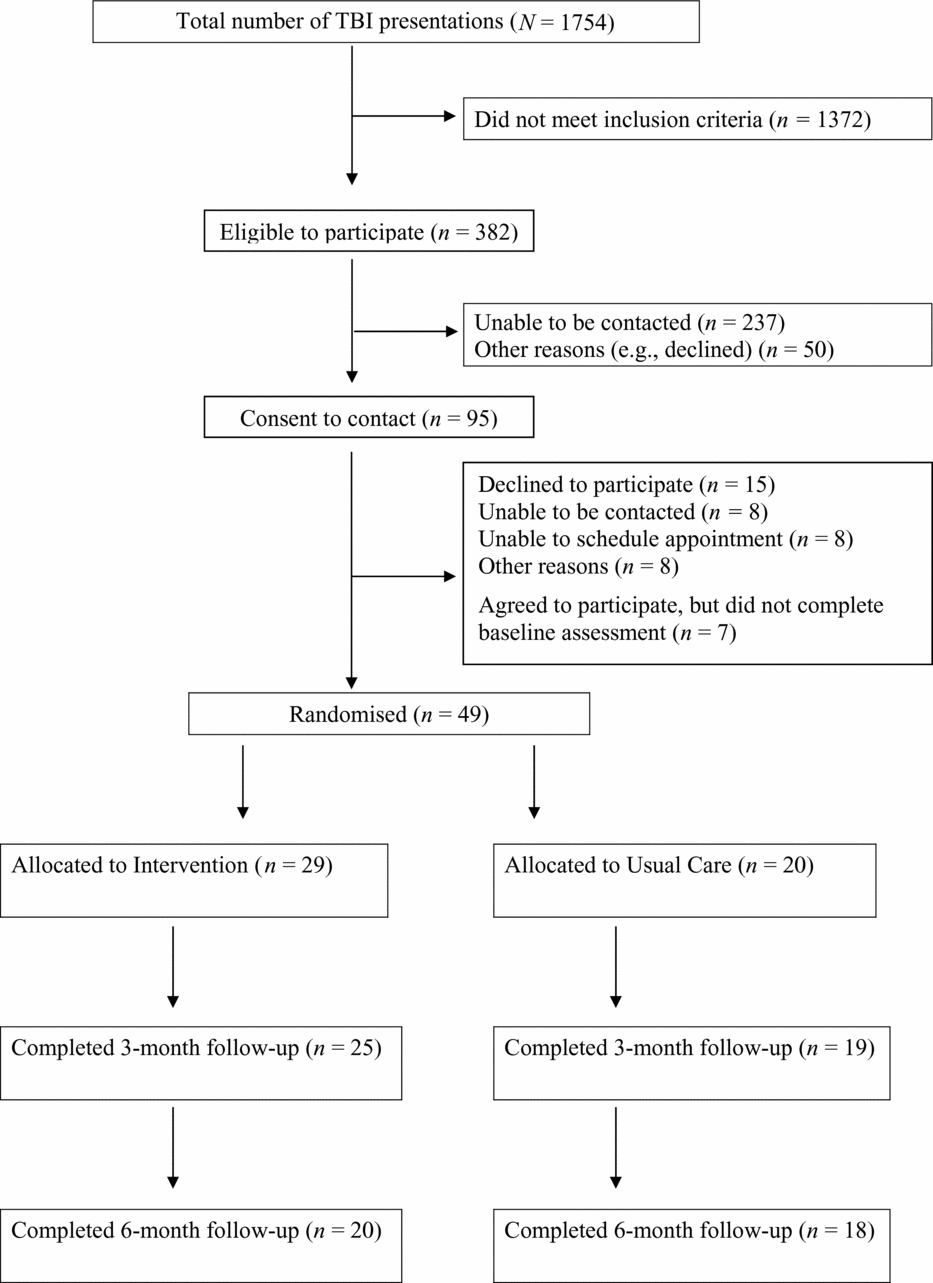
A total of 1754 children with a TBI presented to the Royal Children's Hospital's Department of Emergency Medicine during the period of recruitment. As seen in Figure 1, the majority of children presenting with a TBI did not meet inclusion criteria (n = 1372; 78.22%). This was primarily because these children were aged less than 6 years (n = 1261; 91.91%). The number of children eligible to participate in the study was 382 (21.78%), and 95 families (24.87%) provided consent to be contacted with information about the research. From those who provided consent to contact, 56 families (58.95%) agreed to participate in the study. However, seven families failed to complete the baseline assessment (described below) and were subsequently excluded from the study prior to randomisation. Therefore, 49 families (2.79%) completed the baseline assessment and were randomly assigned, by computer-derived randomisation, to either the Intervention or Usual Care conditions. Five families (10.20%) were lost to follow-up at the 3-month assessment, and a further six (12.24%) were lost to follow-up at the 6-month assessment.
Flow diagram of participants in the Intervention and Usual Care conditions.

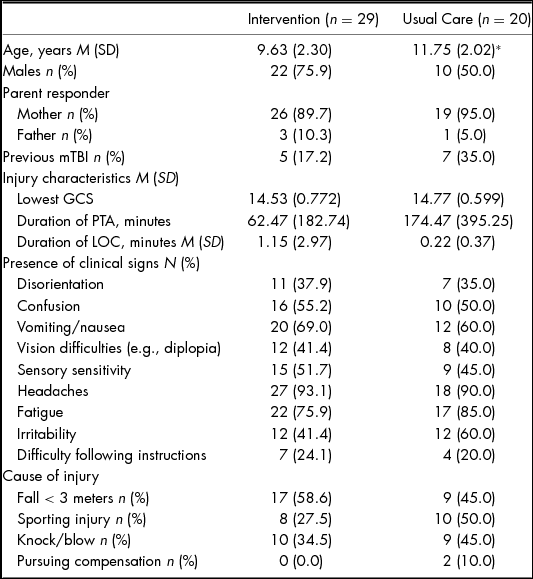
Demographic and injury-related information for children in the Intervention and Usual Care conditions are described in Table 1. Analyses indicated that children in the Intervention compared to Usual Care conditions did not differ on most variables. However, significant differences were observed between the two groups with regard to age at injury (t(47) = 3.33, p < .001), with the children in the Usual Care condition being older on average. Due to privacy regulations, the demographic and injury characteristics of children who did not participate in the study could not be obtained and analysed.
Demographic and Injury Characteristics of Children with mTBI Randomised to the Intervention and Usual Care Conditions
* p < .001
GCS, Glasgow Coma Score; PTA, post-traumatic amnesia; LOC, loss of consciousness.
Intervention: Psychoeducation Website and Information Booklet for PCS
Families in the Intervention group were mailed both a parent information booklet called Mild traumatic brain injury: Information for parents and a flyer detailing access to a child education website named So you have had a mild head injury (https://experiment.psy.uq.edu.au/mtbi/; please note that an online copy of the parent information booklet is also available on the website), which provided information on mTBI and PCS. The parent information booklet and child website drew information from several existing sources, including the Information about mild head injury for kids information booklet (Ponsford et al., Reference Ponsford, Willmott, Rothwell, Cameron, Ayton, Nelms and Ng2001), the So you’ve been in an accident website (Cox et al., Reference Cox, Kenardy and Hendrikz2010) and current information brochures on TBI developed by the Queensland Paediatric Rehabilitation Service (QPRS). The content of the above sources was reviewed to ensure both accuracy and relevancy. Content was supplemented with additional information from the mTBI literature to ensure that theoretically and empirically identified risk and maintaining factors of PCS, as well as the information needs of both parents and adolescents (Falk, von Wendt, & Klang, Reference Falk, von Wendt and Klang2008; Gagnon et al., Reference Gagnon, Swaine, Champagne and Lefebvre2008), were adequately addressed. Senior clinical staff from QPRS, who are experienced in working with children and their families following acquired brain injuries, reviewed and approved the content.
To assist the development of the resources, four children with uncomplicated mTBI aged 6–16 years (M = 10.6 years; SD = 1.17 years) and their parents, who were not involved in the study, provided an evaluation the effectiveness of the psychoeducation resources, including providing feedback on both the parent booklet and child website. Ethical approval to gain this feedback was provided by the Human Research Ethics Committees of the Royal Children's Hospital and The University of Queensland. All parents provided informed consent to participate in the feedback study.
The final versions of both the parent booklet and the child website provided developmentally appropriate information on the following: (a) what is a mTBI; (b) common sequelae of mTBI and approximate duration of PCS; (c) expected recovery; (d) likely long-term impact of mTBI; (e) strategies and guidelines for returning to school and sport; (f) information on when to return to hospital; (g) QPRS services, neuropsychological assessments (e.g., purpose of assessment, what skills might be assessed) and hospital contact details. In addition, both interventions described and provided examples of problem solving, coping statements, relaxing activities and telephone support lines (e.g., Kids Help Line, Life Line) to aid parents and children to manage any post-injury psychological distress.
The parent booklet was an 18-page, A3 size, colour-printed information booklet providing additional information on common emotional reactions of parents following their child's injury and the theoretical rationale for providing education-based resources. The child website included links to information for children aged 6–10 years and for adolescents aged 11–16 years. The information on each site was the same; however, developmentally appropriate modifications to the wording of information and website graphics were made for each age group.
Usual Care
Families in the Usual Care condition received treatment as usual from the Royal Children's Hospital. The standard treatment included routine provision of information on mild head injuries and recovery to families during the initial visit to the hospital. Depending on the child's injury and symptoms, families may also have been referred to either their family doctor or to QPRS for ongoing support and management of symptoms. Families were free to seek additional support and assistance in managing symptoms as needed. Families in the Intervention condition also received this care.
Measures
Child Measures – Psychosocial
Child Behavior Checklist (CBCL; Achenbach & Rescorla, Reference Achenbach and Rescorla2001)
Children's post-injury behavioural functioning was assessed via parent report on the CBCL. The CBCL is a 118-item measure of internalising and externalising symptoms for children aged 6–18 years. The CBCL has acceptable construct, convergent and discriminant validity (Achenbach & Rescorla, Reference Achenbach and Rescorla2001; Petty et al., Reference Petty, Rosenbaum, Hirshfeld-Becker, Henin, Hubley, LaCasse and Biederman2008) and has been used previously as a measure of pre- and post-injury behavioural functioning among children with mTBI (Ponsford et al., Reference Ponsford, Willmott, Rothwell, Cameron, Ayton, Nelms and Ng1999; Yeates et al., Reference Yeates, Luria, Bartkowski, Rusin, Martin and Bigler1999).
Child Depression Inventory – Short Form (CDI-SF; Kovacs, Reference Kovacs1992)
The 10-item CDI-S was used to assess children's post-injury depressive thoughts and feelings. It has normative data for children from 7 to 17 years of age.
Child PTSD Symptom Scale (CPSS; Foa, Johnson, Feeny, & Treadwell, Reference Foa, Johnson, Feeny and Treadwell2001)
Children's post-injury post-traumatic stress symptoms (PTSS) were assessed with the 17-item self-report CPSS. The CPSS is sensitive and specific to PTSS (Foa et al., Reference Foa, Johnson, Feeny and Treadwell2001), and has been used to assess PTSS in children following motor vehicle accidents and accidental injury (Hardy & Stallard, Reference Hardy and Stallard2008; Kassam-Adams, Marsac, & Cirilli, Reference Kassam-Adams, Marsac and Cirilli2010).
Spence Child Anxiety Scale (SCAS; Spence, Reference Spence1998)
Children's general post-injury anxiety was assessed with the 44-item self-report SCAS. Thirty-eight items assess DSM-IV (American Psychiatric Association, 2000) symptoms of Social Phobia, Separation Anxiety Disorder, Panic Attack/Agoraphobia, Obsessive Compulsive Disorder, General Anxiety Disorder (excluding somatic items) and fear of physical injury. There are an additional six positive filler items. Children respond on a four-point Likert scale from 0 (never) to 3 (always). Children's ratings are summed to form a total score which is converted into a T-score (mean of 50 and standard deviation of 10).
Pediatric Quality of Life Inventory 4.0 (Peds QL 4.0; Varni, Seid, & Rode, Reference Varni, Seid and Rode1999)
The Peds QL 4.0 Generic Core Scales, a 23-item parent and child report of children's physical, emotional, social and school functioning, was used as a measure of children's post-injury HRQOL.
Child Measures – Cognitive
Symbol–Digits Modalities Test (SDMT; Smith, Reference Smith1982)
The written SDMT is a standardised measure of psychomotor processing speed for persons aged 8–91 years. Previous research has used the SDMT as a measure of processing speed among individuals with mTBI (Meares et al., Reference Meares, Shores, Batchelor, Baguley, Chapman, Gurka and Marosszeky2006).
Child Measures – Injury Related
Health & Behavior Inventory (HBI; Ayr, Yeates, Taylor, & Browne, Reference Ayr, Yeates, Taylor and Browne2009)
The 20-item HBI was used as a measure of children's self-report and parent's proxy-report of children's cognitive and somatic PCS following TBI. Both parents and children rate the frequency of common PCS experienced over the past week on a four-point Likert scale ranging from 0 (never) to 3 (often). The HBI has been used previously to assess children's PCS following mTBI (Fay et al., Reference Fay, Yeates, Taylor, Bangert, Dietrich, Nuss and Wright2010; Taylor et al., Reference Taylor, Dietrich, Nuss, Wright, Rusin, Bangert and Yeates2010).
Acute injury data
Information on the presence and duration of children's loss of consciousness (LOC), post-traumatic amnesia (PTA), alterations in mental state, focal neurological signs and lowest GCS were obtained from children's medical records. As children's duration of PTA and LOC were not always indicated in the medical chart, both parents and children reported on observed (either by parent or other witness) LOC and PTA. PTA was assessed by asking children to describe their last memory before the accident and first memory following the accident. When children were unable to reliably report on their PTA, collateral information was sought from their parents. This method of establishing the presence and duration of PTA is consistent with previous research and recommendations (Paniak et al., Reference Paniak, Toller-Lobe, Durand and Nagy1998; Ruff et al., Reference Ruff, Iverson, Barth, Bush and Broshek2009).
Parent Measures
Short-Form 12-Item Health Survey (SF-12; Ware, Kosinski, & Keller, Reference Ware, Kosinski and Keller1996)
The SF-12 was used as a 12-item measure of parent's self-reported physical and mental health following their child's mTBI. Responses for the physical and mental health scales, as well as the total score, are summed and converted to a 0–100 scale (mean of 50 and standard deviation of 10). Higher scores reflect greater self-reported quality of life.
Intervention Measures
mTBI knowledge
The mTBI knowledge questionnaire was developed for the current study to assess changes in children's and parent's mTBI knowledge after exposure to the intervention. The mTBI knowledge questionnaire is a 10-item true–false measure of children's and parent's general knowledge about mild head injuries. The questionnaire was designed to assess key concepts discussed in the child and parent interventions (e.g., return to sport, common emotional reactions of parents). The total number of correct responses is summed to form a total knowledge score.
Procedure
Children and their parents completed the baseline assessment within 3 weeks of the injury. During this assessment parents and children reported on their post-injury psychosocial functioning and the child's post-injury PCS. The children also completed a brief neuropsychological assessment. Baseline measures of parents’ and children's knowledge of mTBI were also obtained.
Within 1 week of the pre-treatment assessment, children and their parents were randomly assigned via a Microsoft Excel random number generator to either the Intervention or Usual Care. On enrolment in the study, participants were allocated to an ID number in sequential order and, following the first assessment session, assessors opened an Excel file and noted which condition that ID was allocated to. Assessors were blind to allocation at each time point. Due to the nature of the intervention, parents and children (who self-reported the majority of outcomes) were not blind to their allocation. The intervention materials were immediately mailed via regular post to families in the Intervention group. Each family completed post-treatment assessments at 3 and 6 months post-injury, consisting of the same measures as the pre-treatment assessment, with the addition of the intervention questionnaire for families in the Intervention condition at 3 months post-injury.
Statistical Analyses
Where a participant was missing data for <20% of items on an outcome measure, mean substitution was used to impute their scores. A mixed models analysis was conducted in SPSS 20.0, which allowed for inclusion of participants with missing data at different time points (in line with an intent-to-treat approach). For the two treatment conditions (Intervention versus Usual Care) pre-treatment measures were compared to 3 months and 6 months post-treatment. Only variables of interest were included in the models: Time, Intervention, the Time by Intervention interaction and the outcome variable. Restricted maximum likelihood criteria were used. Denominator degrees of freedom were based on the Sattherthwaite approximation. Time points (nested within individuals) were classified as level 1 units of analysis, and participants were classified as level 2 units of analysis.
Each outcome measure was analysed separately, and the effects from pre-treatment to 3 months post-treatment and pre-treatment to 6 months post-treatment were analysed separately. An uncorrelated diagonal covariance structure was used for analyses looking at 3 month outcomes for parent knowledge and the CPSS, and at 6 month outcomes for parent knowledge, CPSS, child PEDSQL psychosocial and physical scores, and neuropsychological task. The remaining analyses used a compound symmetry covariance structure.
Results
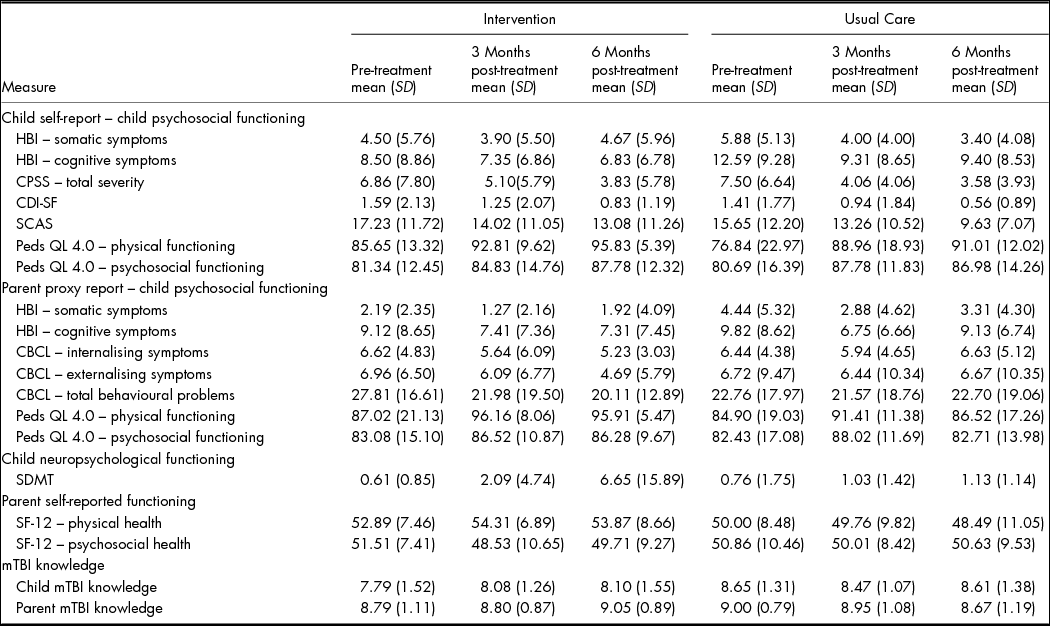
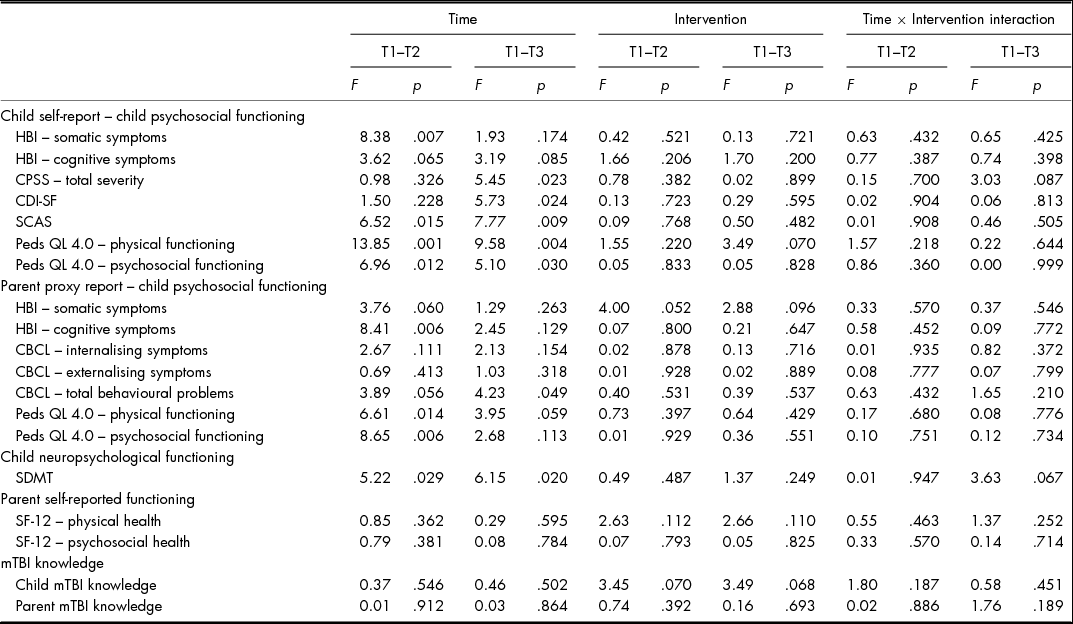
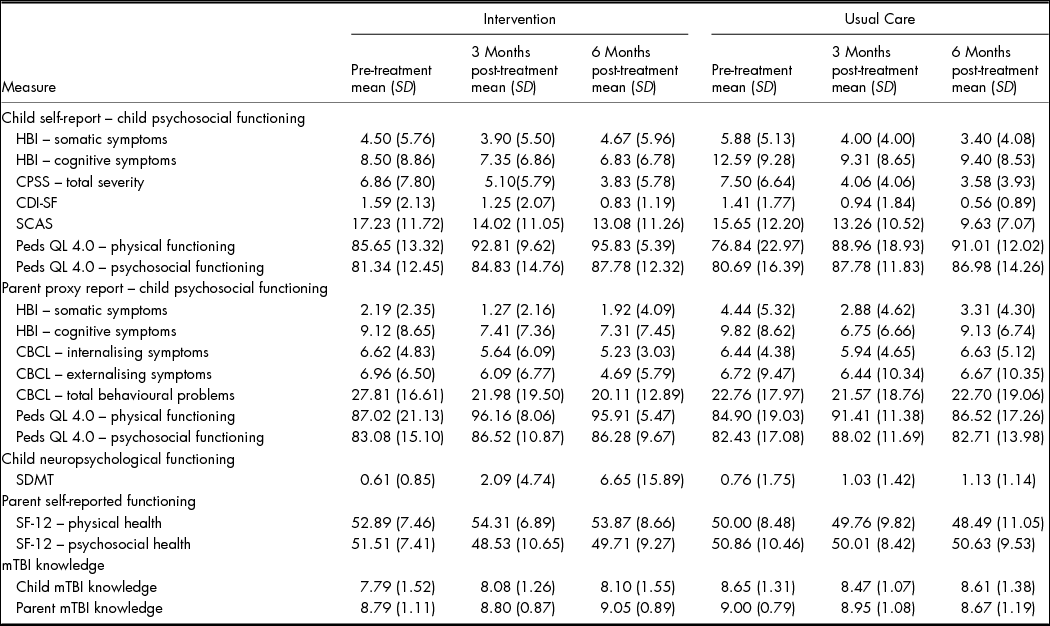
The obtained means and standard deviations can be found in Table 2. Baseline scores were compared using between-group contrasts in the mixed-model analysis. Groups did not significantly differ on any measure of child or parent symptoms; however, the Usual Care group had a significantly higher score on child knowledge of mTBI (p = .042). Due to the relatively small sample size, this difference was not accounted for statistically, but was taken into account when interpreting results. Contrary to predictions, the Time by Intervention interaction variable had no significant effects on any outcome variables over 3 and 6 months. However, as expected, a significant main effect of time was found on some outcomes, as reported below. All significance tests are detailed in Table 3.
Actual Means at Each Time-point, by Intervention or Usual Care Condition
Type III Estimates of Effects for Time, Intervention and the Time by Intervention Interaction
Child Self-reported Outcomes
Child-reported somatic PCS scores on the HBI (F(1, 33.64) = 8.38, p = .007) and anxiety symptoms on the SCAS (F(1, 33.80) = 6.52, p = .015) significantly decreased (improved) over the initial 3 months. Child reports of Peds QL physical functioning (F(1, 34.88) = 13.85, p = .001) and Peds QL psychosocial functioning (F(1, 34.92) = 6.96, p = .012) both significantly increased (improved) at 3 months. Over 6 months, scores on the CPSS total severity (F(1, 59.52) = 5.45, p = .023), CDI (F(1, 27.30) = 5.73, p = .024) and SCAS (F(1, 30.97) = 7.77, p = .009) significantly decreased (improved) with time. Child report of Peds QL physical functioning (F(1, 38.54) = 9.58, p = .004) and psychosocial functioning (F(1, 34.92) = 5.10, p = .030) significantly increased with time. Child speed of information processing also significantly improved at 3 months (F(1,31.29) = 5.22, p = .029) and 6 months (F(1, 27.20) = 6.15, p = .020).
Parent's Report of Child Psychosocial Variables
Over 3 months, significant improvements were also found on parent-reported cognitive PCS symptoms on the HBI (F(1, 36.18) = 8.41, p = .006), Peds QL physical functioning (F(1, 41.16) = 6.61, p = .014) and Peds QL psychosocial functioning (F(1, 37.60) = 8.65, p = .006). However, over 6 months, only CBCL total behavioural problems significantly reduced (F(1, 27.70) = 4.23, p = .049).
Discussion
The main aim of this study was to assess whether the psychoeducation resources would be associated with improvements in children's post-concussion symptoms, psychological distress, behavioural symptoms, health-related quality of life and cognitive processing speed, as well as parents’ psychological distress. There was no support for differential improvement associated with the intervention compared to usual care in any of these outcomes. The secondary aim of this study was to determine whether the psychoeducation resources would improve parents’ and children's knowledge of mTBI. The parents and children in the Intervention condition did not demonstrate improvements in their mTBI knowledge relative to the knowledge of participants in the Usual Care group. Despite beginning with a lower level of knowledge than those in the Usual Care, the children in the Intervention group did not show a significantly greater increase in knowledge over time.
The current findings are not inconsistent with previous research (Paniak et al., Reference Paniak, Toller-Lobe, Durand and Nagy1998; Ponsford et al., Reference Ponsford, Willmott, Rothwell, Cameron, Ayton, Nelms and Ng2001, Reference Ponsford, Willmott, Rothwell, Cameron, Kelly, Nelms and Curran2002), which suggests that parents and children benefit from PCS- and mTBI-specific psychoeducation, in that improvements were found overall across the assessment times on measures of psychological and behavioural symptoms, HRQOL and PCS. However, given the lack of change in mTBI knowledge, and the lack of differential change between Intervention and Usual Care groups, it is difficult to attribute these changes to the intervention. Furthermore, the findings do not provide clear support for practice recommendations that reassurance and recovery-focused psychoeducation during the acute post-injury period are likely to improve the post-mTBI functioning of parents and children (Kirkwood et al., Reference Kirkwood, Yeates, Taylor, Randolph, McCrea and Anderson2008).
Research has shown relationships between psychoeducation and improved psychosocial outcomes (e.g., distress, HRQOL) and fewer PCS (Bell et al., Reference Bell, Hoffman, Temkin, Powell, Fraser, Esselman and Dikmen2008; Paniak et al., Reference Paniak, Toller-Lobe, Durand and Nagy1998; Ponsford et al., Reference Ponsford, Willmott, Rothwell, Cameron, Ayton, Nelms and Ng2001, Reference Ponsford, Willmott, Rothwell, Cameron, Kelly, Nelms and Curran2002; D. T. Wade et al., Reference Wade, King, Wenden, Crawford and Caldwell1998). Theoretical models of PCS also argue for a relationship between improved psychosocial functioning and a reduction in PCS (Wood, Reference Wood2004; Yeates & Taylor, Reference Yeates and Taylor2005).
In the present case, where information was delivered within 4 weeks of mTBI, no significant improvements were found on PCS or other outcomes with treatment compared to usual care. Looking at PCS specifically, the treatment effect size in this study was small (d < .20), and therefore a statistically significant result would only be likely with a very large sample (n >1300 for this effect size) and this effect is unlikely to confer clinically meaningful benefits.
Improvements were found with time for some variables, potentially indicating natural recovery. It is plausible that most children in both groups may have been recovering well and therefore did not require access to psychoeducation to improve their recovery from mTBI. In support of this, the sample in this study did not appear to demonstrate high distress at baseline (e.g., the means for each group at baseline were both below the clinical cut-off of 11 for the CPSS, and 8 for the CDI). Given the small proportion of children (less than 20%) at risk of poorer outcomes following mTBI (Iverson et al., Reference Iverson, Brooks, Collins and Lovell2006; McClincy, Lovell, Pardini, Collins, & Spore, Reference McClincy, Lovell, Pardini, Collins and Spore2006; Ponsford et al., Reference Ponsford, Willmott, Rothwell, Cameron, Ayton, Nelms and Ng1999; Satz, Zaucha, McCleary, & Light, Reference Satz, Zaucha, McCleary and Light1997; Yeates et al., Reference Yeates, Taylor, Rusin, Bangert, Dietrich, Nuss and Jones2009), it is possible that the universal provision of additional resources in addition to routine clinical care did not confer benefits in our data study, as the individuals who were naturally recovering well would have obscured the potential benefits that psychoeducation has for individuals at risk. Sub-group analyses were not possible with this sample size, but it would be useful to consider whether the intervention conferred benefits for high-risk families. Further, as the Usual Care participants were on average older, it may be that these older children improved without intervention due to either less persistent difficulties than younger children, more developed coping skills or potentially greater ability to access information themselves. Future research should consider whether the intervention prevents ongoing distress in younger children specifically.
Similarly, it may be that many parents and children had adequate knowledge of mTBI at pre-treatment, and therefore, as a group, the treatment group did not obtain additional benefits from the psychoeducational intervention. Despite a significant difference between groups for child knowledge at baseline, both groups were still demonstrating high levels of knowledge. Importantly, most parents scored close to 100% on the knowledge measure at pre-treatment. Such high knowledge at pre-treatment was unexpected, but may reflect either the knowledge measure being too easy, or that parents received information on mTBI while the child was in the hospital, as part of their usual care. As such, the absence of an effect of the psychoeducation resources on mTBI knowledge may be due to pre- and post-treatment ceiling effects on the knowledge measure. Future research would likely benefit from developing, pilot testing and evaluating the sensitivity of a mTBI knowledge measure prior to utilising such a measure in research studies. Additionally, it may be important for future research to consider the provision of additional support only when knowledge is assessed as low, to reduce unnecessary use of resources.
An alternative explanation for the lack of treatment effect is the potential for a lack of differential access to psychoeducational materials in the two groups in this study. Any group effect of psychoeducation on child and parent outcomes would likely have been reduced by the proportion of participants who did not look at the website or booklet, as previous research had demonstrated that psychoeducation plus support had no effect on PCS when few individuals utilised the intervention (Elgmark-Andersson, Emanuelson, Björklund, & Stålhammar, Reference Elgmark-Andersson, Emanuelson, Björklund and Stålhammar2007). When asked whether they accessed the information, 18 out of 25 (72%) parents and children who completed the post-intervention assessment at 3 months said they had. The 18% of participants who did not access the information may therefore have influenced the group effect. Unfortunately, as we did not limit access through a ‘log in’ system, we do not have information available on actual access to confirm usage, and we have no information on actual use of the parent booklet. We decided not to apply a ‘log in’ in order to encourage easy use of the website by injured children in the intervention. Furthermore, the extent to which those participants in the Usual Care condition were provided with information that allowed website access is unknown, and the extent to which the Usual Care participants sought additional services is also unknown. This is acknowledged as a limitation of the methodology of this study, and future research should measure usage of materials and additional services, as well as conducting separate analyses for those who reported using the materials and services versus those who did not.
Given the high level of knowledge in both groups at baseline, it may be that by 3 weeks post-injury, adequate knowledge has been gained through Usual Care services, and/or a parent's own research. It may be that, in recent years, the accessibility of high-quality information online has improved, or parents have become more resourceful at accessing information. In addition, it may be that clinical teams are responding to empirical findings of the importance of information provision and are providing more adequate resources as part of routine practice. Quantifying in some way the amount of information received by parents and children as part of clinical care, as well as that sourced independently, would assist in clarifying these explanations. It would be helpful to collect data on information received prior to the intervention, as well as during the intervention period.
While other psychoeducational interventions have been delivered closer to the injury itself (e.g., Ponsford et al., Reference Ponsford, Willmott, Rothwell, Cameron, Ayton, Nelms and Ng2001), we acknowledge that significant natural recovery is likely to occur over the acute phase and hence chose to intervene several weeks later to provide support for residual symptoms. There are sound theoretical reasons for this timing. Early problematic processes following mTBI are likely to be neurological in nature, whereas later processes are likely to be more related to somatic over-focus and psychological factors (Iverson, Reference Iverson, Vasterling, Bryant and Keane2012), and therefore may be more amenable to a psychoeducational intervention. Indeed, if parents and children have adequate knowledge of mTBI at 3 weeks post-injury, and improvement in symptoms is likely over time with or without additional intervention, the necessity of additional psychoeducational interventions over-and-above what is currently accessible to parents and children is questionable and requires further clarification.
Taken together, the above findings indicate that the routine provision of additional supportive psychoeducation resources at 4 weeks post-mTBI was not associated with further improvements in children's PCS, psychological distress, HRQOL and parents’ psychological distress, over usual care practices. Before firm conclusions can be made about the benefits of universal provision of formal psychoeducational resources, future research should be conducted to further identify and understand the effects of supportive psychoeducation on parents’ and children's post-mTBI functioning through tracking of individuals’ usage of online and other resources, and access to clinical services. Moderator analyses on larger samples should also be conducted to identify appropriate clinical indicators of the necessity of psychoeducation (e.g., baseline knowledge, baseline distress, child age and premorbid difficulties), to allow for targeted treatment when needed.