Cardiac re-synchronisation therapy is the choice of treatment for severe cardiac failure due to dyssynchrony. Cardiac re-synchronisation therapy has had a strong impact on the treatment of many patients with heart failure and an abnormal QRS duration.Reference Prinzen, Vernooy and Auricchio 1 Furthermore, in patients with congenital heart disease, the effectiveness of cardiac re-synchronisation therapy pacing for electrical dyssynchrony has already been reported.Reference Sakaguchi, Miyazaki and Yamada 2 In this study, we report the simultaneous use of cardiac re-synchronisation therapy and total cavopulmonary connection in a patient with dyssynchrony, wide QRS, and cardiac failure. To our knowledge, the simultaneous use of cardiac re-synchronisation therapy and total cavopulmonary connection in such a patient has not been reported previously.
Case report
The patient was a 2-year-old boy who was born with a double-outlet right ventricle, severe pulmonary valve stenosis, and a narrow, remote restrictive bulboventricular foramen (11 mm). At 7 months of age, the bidirectional Glenn procedure and ventricular septal defect enlargement were performed. There were no additional procedures. The preoperative QRS duration was 84 ms. The left ventricular ejection fraction was 53%. After these operations, he experienced progressive cardiac failure due to complete right bundle branch block and dyssynchrony. The left ventricular ejection fraction before cardiac re-synchronisation therapy was 35.5%.
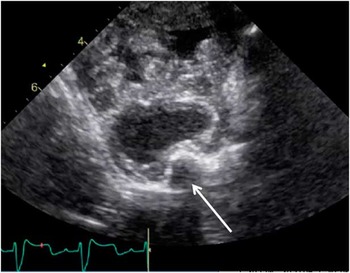
CRT was performed with two ventricular epicardial leads through two surgical approaches. Implantation of the left ventricular pacing lead at the posterior wall of the apex was performed through left lateral thoracotomy, because computed tomography revealed difficulty approaching from a front median incision. The optimal pacing site was decided before the operation by performing catheter biventricular cardiac re-synchronisation therapy examination. In the examination, cardiac ejection fraction, left ventricular outflow tract velocity time integral, and ventricular septal motion were examined in different pacing site positions. The posterior point of the left ventricular apex was identified on catheter examination. Although the endocardial and epicardial pacing sites were different and there was no evidence or clinical experience, we selected the same position as that identified in the preoperative examination. In the operating room, the optimal pacing site of the left ventricle was eventually decided using an epicardial echocardiogram. The surgeon pushed the site that was considered to be the optimal site using a small gauze ball (Fig 1).
Echocardiogram revealed the push point with a small gauze ball (solid arrow).

Next, median full sternotomy was performed for implantation of the right ventricular pacing lead, and the adhesions around the heart were dissected. Preoperative catheter examination indicated that the optimal pacing site of the right ventricle was the right ventricular outflow tract. In the operative period, the right ventricular pacing site was decided by using test pacing. We moved the pacing clip around the right ventricular outflow tract, and used an epicardial echocardiogram to check the movement and synchronisation of both ventricles. The optimal pacing site was fixed as the site where minimal movement of septal flash motion was observed in the echocardiogram. The ventricular bipolar lead was CapSure Epi 4968 (Medtronic Inc., Minneapolis, Minnesota, United States of America). The atrial pacing site was identified as the lateral part of the right atrial wall. After placing all the pacing leads, cardiac re-synchronisation therapy was started. In addition, total cavopulmonary connection using an extracardiac conduit was performed with on-pump beating that used the cardiac re-synchronisation therapy pacing. Finally, a generator for cardiac re-synchronisation therapy was implanted just above the rectus abdominis muscle.
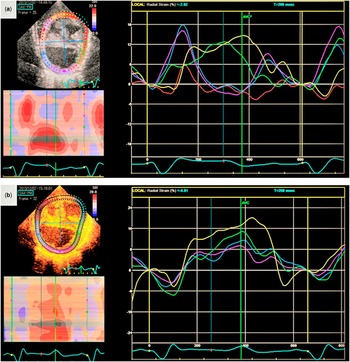
The patient was discharged from the intensive care unit on postoperative day 1; however, he experienced right thoracic empyema 7 days later, and he was treated with thoracic drainage and antibiotics. He was discharged from the hospital on postoperative day 54. On follow-up, performed 10 months after the operation, we noted that the QRS width improved from 140 to 84 ms, and the brain natriuretic peptide level improved from 194 to 16.2 pg/ml (normal range at our institution, 0.0–18.4 pg/ml). His postoperative left ventricular ejection fraction was 50%. In addition, speckle tracking examined with an echocardiogram revealed improved synchronisation of ventricular wall motion (Fig 2).
Preoperative speckle tracking analysis using the short-axis view of the mid-ventricle demonstrating the presence of mechanical dyssynchrony ( a ) and a postoperative echocardiogram revealed an improved strain pattern, which shows synchronisation of ventricular wall motion ( b ).

Discussion
Selecting the most optimal pacing site is an important step in cardiac re-synchronisation therapy. The optimal pacing site varies in children. The left ventricular pacing site is primarily associated with the haemodynamic state.Reference Derval, Bordachar and Lim 3 Intraoperative transoesophageal echocardiography can calculate the beat-to-beat stroke volume, cardiac output, and it can help in selecting the optimal site for placement of the epicardial pacing lead.Reference Arya, Sood, Ralhan and Wander 4 In this operation, a good indication of the optimal pacing site was determined by measuring cardiac function via intraoperative epicardial echocardiography. In paediatric heart disease patients, involving different body sizes and a variety of congenital heart structures, epicardial echocardiography is very useful because it can be easily performed.
Concerns exist about the timing of cardiac re-synchronisation therapy in patients with the Fontan circulation. Considering the increased infection risk owing to cardiopulmonary bypass and prolonged operation time, it is believed that the operation should be performed at another time. In the present case, considering the number of procedures and the risk of lead injury during re-sternotomy, we performed cardiac re-synchronisation therapy and total cavopulmonary connection simultaneously. Cardiac re-synchronisation therapy helped improve circulation dynamics after total cavopulmonary connection; however, the timing of cardiac re-synchronisation therapy should be investigated further.
Rickard et alReference Rickard, Bassiouny and Tedford 5 reported that the 5-year survival rate without a left ventricular assist device or heart transplantation in patients with ambulatory NYHA class III and IV heart failure undergoing cardiac re-synchronisation therapy was 63.2 and 40.2%, respectively, and cardiac re-synchronisation therapy was not a panacea for cardiac failure patients. Careful long-term follow-up is necessary to assess echocardiac function; however, among the 44 cases that have occurred within the last 10 years in our institution, only this case showed that cardiac re-synchronisation therapy has the potential to bring about improvements in Fontan patients with dyssynchrony cardiac failure. In the future, we plan to adapt this operation for patients who are no longer Fontan candidates because of dyssynchrony cardiac failure.
In conclusion, we report the simultaneous use of cardiac re-synchronisation therapy and total cavopulmonary connection in a patient with dyssynchrony, wide QRS, and cardiac failure. We believe that cardiac re-synchronisation therapy is an effective treatment option for patients with a functional single ventricle who have dyssynchrony with heart failure and that the indication for Fontan operation may be extended to patients with heart failure.
Acknowledgements
None.
Financial Support
This research received no specific grant from any funding agency or from commercial or not-for-profit sectors.
Conflicts of Interest
None.