In 2009, during the current excavations by M. Fulford and A. Clarke in Insula IX at Silchester for the University of Reading (1997– ),Footnote 1 a single foot from a metal vessel of some kind was found in a Neronian or early Flavian levelling deposit (10389) for a gravel lane. This 8 m by 3 m spread of material was well-sorted hardcore composed of about 39 kg of broken tile mixed with crushed stone (the local plateau gravel) and some soil, together with a small quantity of pottery (<1 kg), and much smaller quantities of nails, animal bone and charcoal. The foot was the only part of the vessel recovered from this layer and was also the only object within it that could be conventionally defined as a small find. Although there is thus nothing tangible to suggest that the foot might have had a secondary use as a devotional object before being buried as an ex voto, an argument could be made that as a solitary, and therefore anomalous, piece of high quality figurative metalwork within the levelling deposit, it may have been incorporated as a foundation offering in advance of the construction of the gravel lane. Whether or not it was a votive, the foot had been part of a vessel made in the Tiberian-Claudian period (with an early date preferred in view of its repair) that was transported to Silchester as part of the movement of people and material culture triggered by the establishment of the new province.
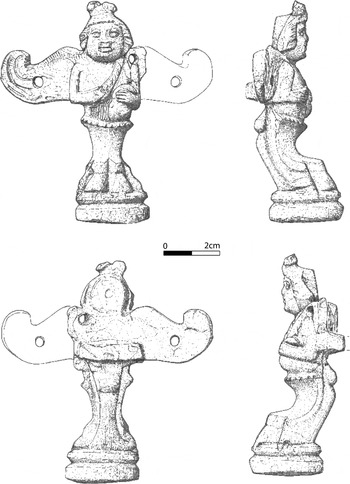
The foot (SF 5626) is cast from leaded bronze and stands 78 mm high.Footnote 2 The lower part comprises a well-formed lion or panther's paw, topped by a rudimentary calyx from which rises the upper body of a winged Harpocrates (fig. 1). There is part of a broken bar or tenon at the rear of the torso, which probably helped support the weight of the vessel. The wings extend backwards slightly and are detailed with mouldings and short shallow grooves along the raised areas. There is a rivet hole in the centre of the right wing, while a second passes through the stump of the missing left wing. There are no traces of brazing or soldering on the back of the figure, suggesting that the primary means of attachment to the base of the vessel was a rivet in the centre of each wing (as shown in fig. 1), with the rivet in the stump of the left wing representing a repair consistent with this technique. An alternative interpretation is that the foot was indeed brazed or soldered to the vessel, all traces of this having now completely decayed, and that both the existing rivet holes relate to a repair, a possibility supported by their both being very neatly formed and of the same diameter. Even if both rivet holes represent secondary working, there is no reason to suppose that they necessarily represent secondary usage.
Vessel foot from Silchester, in the form of Harpocrates above a feline paw. Scale 1:1. (Drawn by Brian Williams. © University of Reading)

The foot is probably the earliest representation in Britain of the Romanised Egyptian Harpocrates, who is Horus, son of Isis and Osiris, as a child. He is often shown with his finger raised towards or on his lips, a gesture that in Egypt represented the hieroglyph for his name but was misinterpreted by the Greeks and Romans, resulting in his adoption as the god of silence and secrecy.Footnote 3 On the Silchester vessel foot he is shown naked, with a chubby face framed by thick shoulder-length hair. On top of his head is a rather obscure feature, perhaps in a Roman milieu meant only to be a top-knot, but probably ultimately derived from the double crown of Egypt (pschent) worn by Horus and Harpocrates.Footnote 4 His right arm is folded over his chest, but instead of raising his finger to his lips he holds the end of a long plait of hair that falls forwards over his left shoulder to end in a loose tassel at his waist. The tassel is rudimentarily shown by slight grooves that were cut into the metal after the figure was removed from the mould. The plait is the juvenile sidelock of pre-pubescent Egyptian boys, who were otherwise shaven-headed, and it marks him out as a child.Footnote 5 The sidelock is often absent, or obscured, on Roman representations of Harpocrates, but can be seen clearly on an early second-century a.d. marble figure of the god in the Borghese Gallery in Rome.Footnote 6 The chief animal companion of Harpocrates is a bird of some kind, and on the Silchester vessel foot he holds what is probably a goose tucked beneath his left arm, its head turned into the crook of his elbow — a position that calms the bird and is still recommended today by professional goose breeders. He may also be shown with a wide variety of other animals.Footnote 7 A silver figurine from London, fitted with a gold body-chain, is accompanied by a dog, a tortoise and a hawk, while another from Bavay in northern France has a goose, a hare and a hawk.Footnote 8 The hawks in these groups refer to Harpocrates as the infant aspect of the falcon-headed Horus.
The few Harpocrates figurines from Britain have a mainly southern and eastern distribution: one comes from Brandon, one from Verulamium, one from Colchester and four from London; the only northern piece came from the amphitheatre at Chester.Footnote 9 The Colchester Harpocrates was found in 2007 not far from both a temple-mausoleum and a burial containing falcon bones that may be associated with the cult of Isis.Footnote 10 A more ambiguous representation of the head of Harpocrates from Richborough may have formed the upper terminal of a ritual staff or it may simply have been a furniture fitting, which would ally it to the Silchester vessel foot.Footnote 11 Several of the British figurines are winged, as is that from Bavay, evidence that in the Graeco-Roman world Harpocrates took on some of the characteristics of Eros/Cupid.Footnote 12
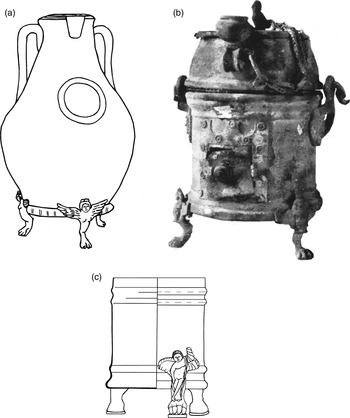
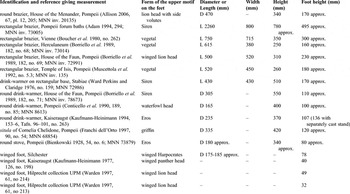
Round feline paws serve as a decorative yet suitably solid base for the lower part of both round and rectangular vessel or furniture feet, sometimes cast in one with the main piece or as part of composite objects cast separately and attached by various means. These feet usually have volutes, small wings or vegetal ornament flanking the upper part where it joins onto the main body of the object. More elaborate pawed feet, always cast separately, are topped by winged figures, which not only lend themselves as ornaments to the upper part of the foot but also provide a sufficient surface of metal to offer a firm join. At Pompeii and other towns in Campania winged feet of this type were chiefly used on drink-warmers (authepsae) — which worked in a similar way to samovars — braziers or small braziers used as portable altars, and stoves. They can take the forms of griffins, winged lion heads, birds, Sirens and Erotes, and leaves or vine scrolls may also be used, their shape sometimes remarkably similar to wings (Table 1).Footnote 13 Figures of Sirens were used on a large rectangular brazier from the forum baths at Pompeii, a round drink-warmer from Pompeii (fig. 2a), and also on the rectangular base of a very elaborately constructed drink-warmer found in a villa near Stabiae.Footnote 14 Other drink-warmers from Pompeii have feet topped by waterfowl with outstretched wings or by vegetal motifs, while the feet of rectangular braziers from Pompeii, Herculaneum and Vienne (Isère) have either winged lion heads or wing-like vegetal motifs.Footnote 15 At Pompeii Erotes topped the feet of an elaborately decorated stove (fig. 2b) and griffins were used on the feet of a large silver-decorated bronze situla, while lion heads flanked by openwork volutes on a round brazier from the House of the Menander displayed a rather more delicate style.Footnote 16 It is apparent from these examples that most feet of this kind were used on objects that became hot and so were potentially damaging to wooden or other delicate surfaces, but there are also smaller versions such as a winged panther-headed foot from Switzerland and two winged lion-headed feet that were probably found in Asia Minor.Footnote 17 All belong to the broader tradition of using animal feet, usually feline paws but sometimes cloven or horse's hooves, on furniture and figurine stands.Footnote 18
(a) Round drink-warmer from the House of the Faun, Pompeii (after Borriello et al. Reference Borriello, Lista, Pappalardo, Sampaolo and Ziviello1989, 182, no. 71); (b) stove from Pompeii (after Bienkowski Reference Bienkowski1928, fig. 93); (c) cista from Tarquinia (after Bini et al. Reference Bini, Caramella and Buccioli1995, tav. 139, 1). Not to scale.

Dimensions of Braziers, Drink-Warmers and Other Vessels with Feline-Pawed Feet Topped by Winged Motifs
MNN: Museo Archeologico Nazionale di Napoli; UPM: University of Pennsylvania Museum. For rectangular braziers, width is assumed to refer to the sides with handles, hence the width of the House of the Faun brazier is slightly greater than its length. Where wings are a normal physical characteristic of a figure (Siren, Eros, waterfowl, griffin), their presence is omitted from the description of the foot.

The motifs on the Campanian winged feet belong to a repertoire of designs common to the bronzesmiths of the region in the early to mid-first century a.d., in many cases developed from much earlier Etruscan or Hellenic metalwork. The date of the context in which the Silchester winged foot was found makes its period of manufacture contemporary with the Campanian items and its general form suggests that it is probably a product of that area. The figure of Harpocrates is unusual within that repertory, but can nevertheless be set in the context of a number of other feline feet topped by the figures of boys or youths. The earliest is a naked and winged young boy, possibly Ganymede, on an Etruscan funerary cista from a burial dating to the end of the fourth or the first half of the third century b.c. at Tarquinia in northern Lazio (fig. 2c).Footnote 19 Probably contemporary with the Silchester foot are the Erotes on the three feet of a drink-warmer, almost certainly of Campanian origin, found at Kaiseraugst, Switzerland, as well as the Eros on a furniture foot from Oberwinterthur, also Switzerland, all of whom have a topknot like that on the Harpocrates.Footnote 20 The wings of the Eros on the furniture foot are not spread wide but are held behind his back to form a socket for attachment. These pieces all provide a general figurative tradition against which to view the Silchester foot, while the Erotes on the feet of the round stove from Pompeii have wings of such similar shape to the Harpocrates that it can confidently be attributed to the same Campanian workshop (fig. 2b).
The angle and curvature of the wings on the Silchester Harpocrates point to the foot also having been attached to a round vessel. Its diameter cannot be precisely estimated because of the missing wing, which was pushed in slightly when the secondary rivet was inserted, but would be about 230 mm. On braziers, both round and rectangular, the feet usually splay outwards from the body to provide greater stability, with the result that the paw does not lie directly below the decorative element of the head, but well beyond it.Footnote 21 In contrast, the feet on stoves and drink-warmers are upright, whether they are topped by winged figures or by some other design, as are also the winged feet on the large brazier from Pompeii's forum baths and on the griffin-footed situla from the town, which was clearly a vessel meant to be displayed rather than used on a daily basis.Footnote 22 All the latter objects are large and heavy and all, apart from the brazier from the baths, are upright vessels, the downward force of their weight providing considerable stability. The upright Silchester Harpocrates can probably be attributed to a similarly heavy and upright vessel, yet the examples in Table 1 show that it is quite short compared with the feet of the drink-warmers. It is of similar height to the feet of Etruscan cistae, but clearly belongs to an entirely different and later tradition.Footnote 23 Given the similarity of its wings to those of the Erotes on the stove from Pompeii, it may be from a similarly complex vessel.
It seems reasonably certain that the image of Harpocrates on the Silchester foot cannot be claimed unequivocally as evidence for the early introduction of the cult of Isis to the town. Only a limited repertoire of motifs was used for the feet of metal vessels,Footnote 24 and, although there are hints, there is no substantive evidence to suggest that the motifs are direct expressions of the social or religious context in which individual pieces were used. The large brazier from Pompeii's forum baths has a cow in low relief on the long side, a visual reference to its having been donated, along with some cow-footed and inscribed bronze benches, by M. Nigidius Vaccula, whose cognomen means heifer — an unusually clear and pertinent statement.Footnote 25 The use of Sirens and waterfowl on drink-warmers may refer to the hot water used to heat liquids in these vessels, or perhaps (as far as Sirens are concerned) to the lure of over-indulgence in wine, but this is far less convincing an association than the Bacchic imagery that sometimes adorned saucepans used to heat wine.Footnote 26 Similarly, the Erotes on the Kaiseraugst drink-warmer and the stove from Pompeii might be taken as general expressions of a convivial social atmosphere that could lead later to amorous exchanges, but putti were so frequently used in figurative art that familiarity must have almost eroded their iconographic value. A brazier from the Temple of Isis at Pompeii might be expected to bear images referring to the cult, but instead its feet have three wing-like leaves above a feline paw, and on its long sides it has high-relief appliqués in the form of theatrical masks and also low reliefs of a lion attacking a bull set at the centre of each long side.Footnote 27 The temple lies adjacent to Pompeii's theatre and odeon, arguably providing a context for a deliberate selection of the masks, but the animal relief is more appropriately linked to wild beast fights in the amphitheatre. Moreover, exactly the same motifs were used on a brazier from Herculaneum, providing more compelling evidence for standardised workshop production than for special commissions with pertinent imagery.Footnote 28 The Vienne brazier has heads of Dionysus and maenads on all four sides, but there is nothing to corroborate the idea that it may have been used in Dionysiac rituals.Footnote 29 Seen in the context of these generally ambiguous images, it seems that the image of Harpocrates on the foot from Silchester need reflect nothing more than the popularity of the cult of Isis at Pompeii having found an outlet in the artistic designs of the region's metalworkers.Footnote 30
Although the type of vessel to which the Harpocrates foot was attached cannot be positively identified, it undoubtedly came from a piece of Campanian metalwork that represents the new forms of material culture introduced into Britain in the mid-first century a.d. Within post-conquest Silchester a wider context for such a rare and possibly valuable piece may be provided by some good quality early stonework found in Insula IX, that had been reused in Flavian and later phases but appears to have come originally from a high-status Claudian-Neronian building in the vicinity.Footnote 31 Adding to this the evidence that an area of Insula IX currently being excavated was used for metal-working in the Claudian-Neronian period, it seems probable that the Harpocrates foot is all that remains of an object used or on display in this high-status building that was somehow damaged beyond repair and then melted down by the bronzesmiths of early Silchester.