

Introduction
In recent years, the digital economy has emerged as a transformative force in addressing poverty and promoting economic development worldwide. In China, the rapid advancement of digital technologies has significantly contributed to poverty alleviation, particularly in rural areas (Deng, Guo, & Liu, Reference Deng, Guo and Liu2023; Qin, Wang, & Xu, Reference Qin, Wang and Xu2022). Digital platforms, such as e-commerce and financial technology, have enabled rural communities to access broader markets, improve productivity, and create new sources of income (Zhang & Han, Reference Zhang and Han2017; Zhao, Zhang, & Liang, Reference Zhao, Zhang and Liang2020). For instance, e-commerce platforms like Taobao have empowered rural entrepreneurs to sell agricultural products and handicrafts directly to urban consumers, bypassing traditional intermediaries and boosting their earnings (Zeng, Cai, & Guo, Reference Zeng, Cai and Guo2020). These innovations have expanded economic opportunities and played a critical role in China’s broader poverty reduction efforts, which have lifted millions of people out of absolute poverty in recent decades (World Bank, 2022).
As a transformative economic paradigm following the agricultural and industrial economies, the digital economy has attracted widespread academic attention. Researchers have examined its impacts from diverse angles, including corporate innovation (Li, Rao, & Wan, Reference Li, Rao and Wan2022), entrepreneurship (Zhao et al., Reference Zhao, Zhang and Liang2020), production efficiency (Zhang, Shi, Shi, & Chen, Reference Zhang, Shi, Shi and Chen2022), industrial upgrading (Liu & Chen, Reference Liu and Chen2021), energy consumption (Xue, Tang, Wu, Liu, & Hao, Reference Xue, Tang, Wu, Liu and Hao2022), corruption (Gouvea, Li, & Montoya, Reference Gouvea, Li and Montoya2022), and sustainable development (Luo, Yimamu, Li, Wu, Irfan, & Hao, Reference Luo, Yimamu, Li, Wu, Irfan and Hao2023). However, what is the relationship between the digital economy and income inequality? Through which specific mechanisms does the digital economy influence income inequality? Furthermore, how can targeted strategies be designed to harness the potential of the digital economy while fostering common prosperity? Although some studies have examined the link between the digital economy and income distribution (Deng et al., Reference Deng, Guo and Liu2023; Yang & Li, Reference Yang and Li2023; Zhang & Han, Reference Zhang and Han2017), the findings remain inconclusive. In particular, there is insufficient systematic and in-depth research on the mechanisms involved and their corresponding policy implications.
Despite its potential to reduce poverty and bridge regional divides, the digital economy presents a paradox: while it fosters rural development, it has also exacerbated income inequality between urban and rural areas. Urban residents, with better access to digital infrastructure, higher levels of digital literacy, and stronger integration into advanced economic activities, are often better positioned to benefit from digitalization (Guo, Wang, Zhang, Liang, Feng, & Hu, Reference Guo, Wang, Zhang, Liang, Feng and Hu2023). This paradox is particularly evident in China, where the digital economy has become a cornerstone of national economic strategy. This article investigates the dual effects of digital economy development on poverty reduction and income inequality in China, exploring whether it exacerbates disparities or contributes to the integrated development of urban and rural areas. Aligned with the goal of achieving ‘common prosperity’ and addressing urban–rural imbalances, this study examines the role of digital economy development within the broader framework of integrated urban–rural development and the ‘Digital China’ strategy. Zhejiang Province, as China’s first demonstration zone for common prosperity, has positioned digital economy development as a cornerstone of its ‘Eight–Eight Strategy’ – a comprehensive provincial policy framework introduced in 2003 aimed at leveraging eight comparative advantages and implementing eight strategic measures to promote high-quality and coordinated development. Since the implementation of this strategy, Zhejiang has been at the forefront nationally in promoting coordinated development between urban and rural areas (Li, Chen, Zhang, Xu, & Chen, Reference Li, Chen, Zhang, Xu and Chen2024). The province emphasizes rural digital transformation, innovation, and entrepreneurship as key drivers of equitable growth. Therefore, analyzing the effects of digital economy development in Zhejiang’s counties on the urban–rural income gap holds significant policy relevance.
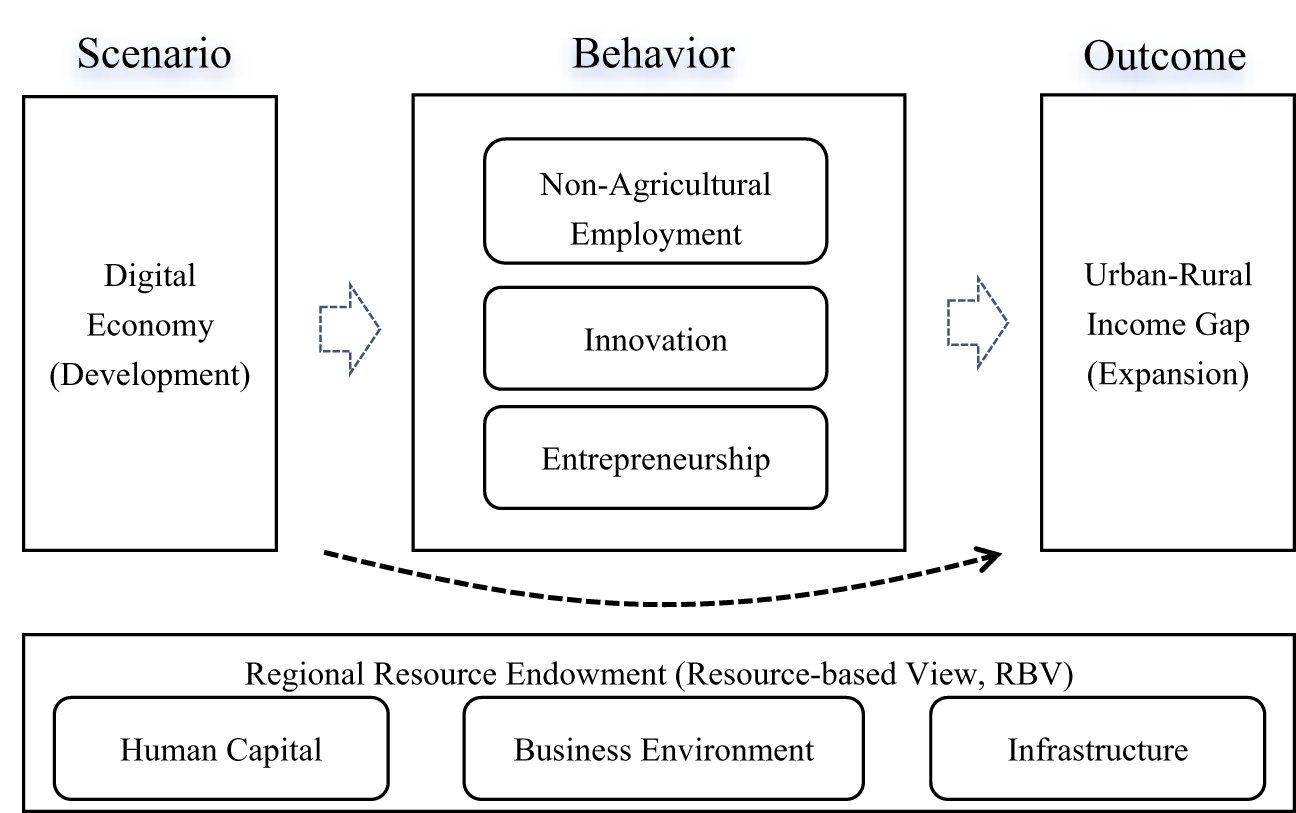
Using panel data from 57 counties in Zhejiang Province from 2015 to 2019, this study offers a county-level perspective on how digital economy development influences urban–rural income disparities. We adopt a scenario–behavior–outcome (SBO) framework as the conceptual scaffold for both the empirical setting and the proposed mechanism, expressed as ‘Digital Economy Development (Scenario)→Nonagricultural Employment/Innovation/Entrepreneurship (Behavior)→Urban–rural Income Gap (Outcome)’. Here, our mechanism analysis refers to a broader approach for identifying the causal pathways through which digital economy development influences urban–rural income disparities, focusing on the intermediate processes linking the initial scenario to the observed outcomes. To operationalize this, the study employs mediation analysis as a specific method to examine the causal relationships and intermediary variables that connect digital economy development with urban–rural income disparities (Baron & Kenny, Reference Baron and Kenny1986; Imai, Keele, & Tingley, Reference Imai, Keele and Tingley2010). By uncovering key mechanisms and pathways, while highlighting the regional heterogeneity of their effects, the study provides actionable insights for fostering inclusive growth and achieving balanced regional development.
Overall, this study deepens the understanding of county-level impacts of digital economy development, aligning with China’s broader development strategies for rural revitalization, innovation-driven growth, and common prosperity. It makes three contributions. First, it enriches the literature on the complex relationship between digital economic growth and income inequality (He & Xu, Reference He and Xu2019; Yang & Li, Reference Yang and Li2023; Zhang & Han, Reference Zhang and Han2017) by offering a comprehensive perspective on the dual effects of digital economy development – highlighting its capacity to both increase household incomes and exacerbate the urban–rural income gap. Second, it identifies and empirically tests three mediating mechanisms – NAE, innovation, and entrepreneurial activity (ENT) – through which digital economy development influences income disparities, thereby revealing how the digital economy reshapes labor markets and economic structures in both urban and rural areas. Finally, it underscores the importance of targeted investments in digital infrastructure, education, and skill training, and proposes region-specific strategies to promote inclusive and equitable growth, thereby contributing to China’s long-term objectives of digital transformation and sustainable development.
Theoretical Background and Hypotheses Development
The Impact of Digital Economy on Urban–Rural Income Gap
Currently, scholars present varied perspectives regarding the relationship between the digital economy and the urban–rural income gap, exploring this issue through diverse lenses such as digital infrastructure, internet access, and e-commerce. Some researchers argue that the digital economy exacerbates the urban–rural income disparity. For instance, Zhang and Han (Reference Zhang and Han2017) find that while e-commerce in China significantly boosts income levels for both urban and rural residents, its beneficial effect is disproportionately greater for urban residents, thus widening the urban–rural income gap – a conclusion consistent with findings by Deng et al. (Reference Deng, Guo and Liu2023). Similarly, He and Xu (Reference He and Xu2019) highlight that, despite expanding internet coverage, considerable disparities remain between urban and rural residents in accessing employment opportunities via online platforms, further exacerbating income inequalities. Conversely, other scholars posit that the digital economy could contribute to narrowing the urban–rural income gap. For example, Yang and Li (Reference Yang and Li2023) identify significant spatial spillover effects of digital economy development, noting that rural digital economic advancements in surrounding regions effectively reduce urban–rural income disparities, a process accelerated by infrastructure development.
Digital economy development has been shown to enhance overall productivity and household incomes by improving efficiency, enabling innovation, and lowering transaction costs (Ward & Zheng, Reference Ward and Zheng2016; Zhao et al., Reference Zhao, Zhang and Liang2020). Hence, it is expected to lift both urban and rural incomes. However, the Digital Divide Theory (Dijk, Reference Dijk2005) emphasizes that disparities in access to and use of digital technologies create unequal opportunities for economic development, making the income effects of digitalization systematically heterogeneous across urban and rural China. Urban areas typically exhibit superior connectivity and device penetration, higher digital literacy, and routinized adoption by firms and households (Yin, Jiang, & Yan, Reference Yin, Jiang and Yan2021), whereas many rural areas continue to face gaps in reliable access and effective use (Xia & Lu, Reference Xia and Lu2008). Consistent with this, urban residents, with better access to digital tools, education, and infrastructure, often experience greater income gains than rural residents (Zhang & Han, Reference Zhang and Han2017). Moreover, even when rural areas acquire similar tools, their absorptive capacity and complementary resources frequently remain below urban thresholds, implying slower learning curves and smaller payoffs. Consequently, while digitalization tends to raise incomes on average, its marginal returns are typically higher in urban settings. Based on this, we propose Hypothesis 1.
Hypothesis 1 (H1): Digital economy development promotes overall income growth, but urban residents are likely to experience greater income growth than rural residents.
Mechanisms of Income Disparity
The development of the digital economy has far-reaching implications for the urban–rural income gap, as it transforms economic structures, redistributes resources, and creates new growth opportunities. The New Economic Geography (Krugman, Reference Krugman1991) highlights how spatial agglomeration effects – such as the concentration of industries, infrastructure, and talent – offer significant economic advantages to urban areas. These effects enable cities to attract greater resources and achieve higher productivity, often leaving rural areas at a comparative disadvantage. Similarly, the Resource-Based View (RBV) (Barney, Reference Barney1991) underscores the critical role of resource endowments, such as HC, technological capabilities, and financial resources, in driving economic performance (Meyer, Estrin, Bhaumik, & Peng, Reference Meyer, Estrin, Bhaumik and Peng2009). Together, these theories suggest that regions with stronger resource endowments and agglomeration dynamics are better positioned to capitalize on the opportunities presented by digital technologies, potentially widening the urban–rural divide. But what are the key mechanisms and pathways through which these disparities are exacerbated?
Nonagricultural employment
The development of the digital economy has significantly facilitated the creation of high-value, nonagricultural jobs by driving demand for high-skilled, knowledge-intensive labor. Research by Zhou and Shi (Reference Zhou and Shi2025) highlights how technological advancements, particularly digital technologies, have reshaped labor markets by increasing opportunities for skilled workers. Similarly, studies by Wang, Yi, and Yang (Reference Wang, Yi and Yang2024) and Sun and Li (Reference Sun and Li2025) emphasize the critical role of digital literacy and infrastructure in enabling access to nonfarm employment, particularly for rural laborers and women. These findings underscore the transformative potential of the digital economy in expanding employment opportunities and fostering economic growth.
However, the benefits of the digital economy are disproportionately concentrated in urban areas, where access to skilled labor, advanced infrastructure, and robust economic ecosystems creates favorable conditions for the growth of high-tech and knowledge-intensive industries. Urban regions also enjoy significant advantages in educational resources, digital infrastructure, and institutional support, which further enhance their capacity to attract and retain high-value jobs. In contrast, rural areas often lack these critical enablers, limiting their ability to participate in the digital economy. This disparity not only widens the urban–rural income gap, as urban residents capture higher wages and career advancement opportunities, but also weakens rural economies through the migration of workers to cities in search of better employment prospects.
Innovation
Innovation constitutes a cornerstone of digital economy development and serves as a critical driver of income growth and economic transformation. However, innovative activities predominantly originate and cluster within urban areas due to richer knowledge spillovers, greater investments in research and development (R&D), and stronger collaboration networks. According to Romer’s endogenous growth theory (Romer, Reference Romer1990), innovation thrives particularly in environments abundant in HC and resources – conditions typically more prevalent in urban settings. Similarly, Holl, Martínez, and Casado (Reference Holl, Martínez and Casado2024) highlight that urban areas, leveraging the network effects of knowledge spillovers, interdisciplinary collaborative ecosystems, and the concentration of venture capital alongside specialized professional services, drive the agglomeration of innovative activities within urban cores.
Urban areas generally possess superior capacities to adopt, adapt, and leverage digital technologies, thus securing early and substantial advantages. These innovation-driven benefits can gradually diffuse into rural regions via technological spillovers, rural-urban linkages, and enhanced market integration. Yet, rural areas typically experience delayed or weaker access to such innovation-driven advantages, constrained by limited resources, inadequate infrastructure, and institutional barriers. Consequently, urban areas tend to disproportionately capture the immediate economic gains generated by digital economy innovations, reinforcing rather than mitigating urban–rural income inequalities.
Entrepreneurship
Entrepreneurship serves as a crucial driver of economic development, significantly shaping income distribution. Huang (Reference Huang2008) highlighted the flourishing of China’s private economy and underscored the pivotal role of the private sector in driving economic growth and development, while emphasizing the dual role of institutions and policies in shaping these outcomes. Building on this perspective, urban areas provide more favorable conditions for entrepreneurship, including a robust BE, access to financing, and a larger pool of skilled labor (Ye, Li, & Zhu, Reference Ye, Li and Zhu2018). However, the digital economy’s promotion of entrepreneurship in rural contexts is selective. Specifically, while digital economy development encourages the agglomeration of real entrepreneurial activities, it can diminish the entrepreneurial drive in smaller, geographically remote communities (Cumming & Johan, Reference Cumming and Johan2010). Glaeser, Kerr, and Ponzetto (Reference Glaeser, Kerr and Ponzetto2010) highlight the importance of cities as incubators of entrepreneurship, where dense markets, supportive institutions, and collaboration opportunities foster business creation and growth. Moreover, the digital economy has created new opportunities for entrepreneurship, particularly in sectors such as e-commerce, digital finance, and platform-based services. However, rural entrepreneurs face significant barriers to entry in these markets, including poor digital infrastructure, limited access to capital, and high transportation and logistics costs. As Nambisan (Reference Nambisan2017) points out, the success of digital entrepreneurship often depends on access to advanced technologies and network effects, which are largely unavailable in rural regions. Consequently, urban entrepreneurs are better positioned to leverage digital tools and platforms to generate income and wealth, while rural areas lag behind, further broadening the urban–rural income gap.
Building on the above discussion, we propose Hypothesis 2 (H2) and further break it down into three subhypotheses:
Hypothesis 2a (H2a): The digital economy amplifies urban–rural income disparities by fostering NAE that disproportionately affects urban and rural economic development.
Hypothesis 2b (H2b): The digital economy amplifies urban–rural income disparities by fostering innovation that disproportionately affects urban and rural economic development.
Hypothesis 2c (H2c): The development of the digital economy disproportionately fosters entrepreneurship, thereby widening the urban–rural income gap.
Moderating Role of Regional Resource Endowments
The impact of digital economy development on the urban–rural income gap is significantly influenced by regional resource endowments. Drawing on the RBV and the Factor Mobility and Division of Labor Theory, key regional resource endowments – such as HC, BE, and infrastructure – moderate how effectively digital technologies are adopted and utilized in different regions. These factors determine the extent to which digital economy development benefits urban and rural areas, thereby shaping the urban–rural income gap.
HC plays a critical role in moderating the effects of digital economy development. Urban areas typically possess higher levels of education and digital skills, enabling residents to effectively adopt digital tools and access high-paying jobs in technology-driven industries. In contrast, rural areas often struggle with significant skill gaps, which limit their ability to leverage digital opportunities. Research has consistently shown that regions with more skilled labor are better positioned to benefit from technological advancements (Acemoglu & Restrepo, Reference Acemoglu and Restrepo2020). As a result, disparities in HC between urban and rural areas exacerbate the income gap as the digital economy expands.
The BE serves as another critical moderator. Urban areas generally have more favorable BEs, characterized by robust regulatory frameworks, easier access to financing, and well-established innovation ecosystems. These advantages enable urban businesses to grow and innovate more effectively within the digital economy. Conversely, rural areas often lack these supports, with weaker institutional frameworks and limited access to credit and networks. Studies on entrepreneurship and innovation suggest that regions with favorable business conditions are more likely to attract investment and foster ENT (Nambisan, Wright, & Feldman, Reference Nambisan, Wright and Feldman2019). This disparity amplifies the urban–rural divide as urban businesses benefit disproportionately from digital economy development.
Infrastructure – both digital and physical – is one of the critical drivers influencing the trajectory of economic development and plays a pivotal role in shaping the urban–rural income gap in the context of the digital economy. Urban areas typically enjoy superior digital infrastructure, such as faster and more reliable internet, as well as better physical infrastructure, including transportation and logistics networks. These advantages enable urban regions to integrate more effectively into the digital economy and participate in global value chains (Deng et al., Reference Deng, Guo and Liu2023; Li & Ke, Reference Li and Ke2021). In contrast, rural areas often face inadequate connectivity and underdeveloped infrastructure, limiting their ability to access and benefit from digital technologies. Persistent infrastructure disparities further widen the urban–rural income gap.
Based on the above discussion, we propose Hypothesis 3 (H3) and further break it down into three subhypotheses:
Hypothesis 3a (H3a): HC moderates the relationship between digital economy development and the urban–rural income gap, with urban areas benefiting more due to higher levels of education and digital skills.
Hypothesis 3b (H3b): The BE moderates the relationship between digital economy development and the urban–rural income gap, with urban areas benefiting more due to more favorable regulatory frameworks, access to financing, and innovation ecosystems.
Hypothesis 3c (H3c): Infrastructure moderates the relationship between digital economy development and the urban–rural income gap, with urban areas benefiting more due to superior digital and physical infrastructure.
Collectively, Figure 1 summarizes the overall conceptual framework, in which digital economy development affects the urban–rural income gap through non-agricultural employment, innovation, and entrepreneurship, and these relationships are further conditioned by regional resource endowments.
Framework of the impact of digital economy on the urban–rural income gap

Methods
Empirical Model
To empirically investigate the impact of the digital economy on the urban–rural income gap, we build upon the studies by Ward and Zheng (Reference Ward and Zheng2016) and Zhao et al. (Reference Zhao, Zhang and Liang2020) and establish the following basic model:
 \begin{equation}{{\text{y}}_{{\text{it}}}} = {\beta _0} + {{{\beta }}_1}Digi{t_{it}} + {X_{it}}{{\beta }} + {{{\mu }}_i} + {{{\lambda }}_t} + {{{\varepsilon }}_{it}}\end{equation}
The dependent variable  ${y_{it}}$ measures the urban–rural income gap in region i in year t (URIG). The variable
 $Digi{t_{it}}$ represents the Digital Economy Development Index for region i in year t. To comprehensively evaluate the determinants of the income gap, we incorporate demographic, economic, and policy-related factors into our regression model. This approach isolates the specific impact of the digital economy on the income gap while accounting for other concurrent factors within the studied time frame and region. Our control variables
 ${X_{it}}$ include economic development, urbanization, foreign trade, fiscal decentralization, and financial development. To address potential unobservable heterogeneity at the regional level, we incorporate individual fixed effects
 ${\mu _i}$, thereby capturing time-invariant regional characteristics. Additionally, we control for time fixed effects
 ${\lambda _t}$ to account for time-specific factors affecting the income gap. The error term is denoted by
 ${\varepsilon _{it}}$.
Building on the previously discussed theoretical framework, we anticipate that NAE, innovation, and entrepreneurship serve as key intermediary factors influencing the impact of digital economy development on the urban–rural income gap. To examine these mechanisms, we employ the identification frameworks established by Jiang (Reference Jiang2022) and Huang and Gao (Reference Huang and Gao2023) to construct the following model based on Model (1):
 \begin{equation}Mediator_{it}=\alpha_0+\alpha_1Digit_{it}+X_{it}\alpha+\mu_i+\lambda_t+\varepsilon_{it}\end{equation}
The impact of the digital economy on the urban–rural income gap is contingent upon regional resource endowments. Unveiling these impacts under varying conditions is fundamental to the moderating effect model. We select HC, BE, and infrastructure development as moderating variables for our analysis. To ensure the robustness of our results, we categorize the moderating variables based on their medians and establish grouping variables. If a moderating variable exceeds the mean (median), it is classified into the high group and coded as 1; otherwise, it is classified into the low group and coded as 0 (Jiang, Reference Jiang2022). The model is specified as follows:
 \begin{equation}{y_{it}} = {{{\gamma }}_0} + {{{\gamma }}_1}Digi{t_{it}} + {{{\gamma }}_2}{M_{it}} + {{{\gamma }}_3}Digi{t_{it}} \times {{{M}}_{{{it}}}} + {X_{it}}{{\gamma }} + {{{\mu }}_{{i}}} + {{{\lambda }}_t} + {\text{ }}{{{\varepsilon }}_{{{it}}}}\end{equation}
In this model,  ${M_{it}}{\text{ }}$represents the grouping variable for the moderating variable, and the coefficient of the interaction term
 $Digi{t_{it}} \times {M_{it}}{\text{ }}$reflects the heterogeneity in the digital economy’s impact on the urban–rural income gap across different groups.
Data Source
We select counties within Zhejiang Province as our sample because Zhejiang has long been a pioneer in digital economy development in China. Examining the internal interaction mechanisms between the digital economy and urban–rural income in Zhejiang thus provides a useful case for other regions. Moreover, compared with provincial-level data (He & Xu, Reference He and Xu2019; Ward & Zheng, Reference Ward and Zheng2016; Wei & Chen, Reference Wei and Chen2020) or city-level data (Guo et al., Reference Guo, Wang, Zhang, Liang, Feng and Hu2023; Zhao et al., Reference Zhao, Zhang and Liang2020), county-level data mitigate the generalizations and limitations inherent in higher administrative levels, thus offering a more precise reflection of the interplay between the digital economy and urban–rural income dynamics.
We define our sample period as spanning from 2015 to 2019. This choice is primarily motivated by the availability of detailed county-level online retail sales data, which have been published annually by the Zhejiang Provincial Department of Commerce since 2015. These data allow us to comprehensively construct county-level digital economy indicators. Moreover, considering that the emergence of the COVID-19 pandemic significantly altered the interaction between the digital economy and overall economic development, we restrict our analysis window to the prepandemic period (2015–2019) to maintain consistency and comparability throughout our study.
Our primary data sources include the ‘Zhejiang Statistical Yearbook’ and the statistical yearbooks of various prefecture-level cities. Specifically, online retail sales data, utilized to construct the digital economy indicators, are sourced from the Zhejiang Provincial Department of Commerce, whereas the Digital Financial Inclusion Index (DFII) is drawn from the Peking University DFII of China (2011–2020), released by the Institute of Digital Finance, Peking University (Guo et al., Reference Guo, Wang, Wang, Cheng, Kong and Zhang2020).
Main Variables
Urban–rural income gap
We measure the income gap between urban and rural residents using the urban–rural relative income gap, denoted URIG, defined as the ratio of urban to rural per capita disposable income. The relative income gap is widely employed and recognized as a representative measure in existing literature (Yuan et al., Reference Yuan, Wang, Zhu, Huang and Xiong2020). Specifically, we select urban per capita disposable income (UrbanInc) and rural per capita disposable income (RuralInc) separately as dependent variables to evaluate the differentiated impacts of the digital economy on urban versus rural incomes. For robustness checks, we further adopt the absolute income gap (Gap), calculated as the difference between urban and rural per capita disposable incomes, as an alternative proxy for the urban–rural income gap.
Digital economy development index
Following Liu, Yang, and Zhang (Reference Liu, Yang and Zhang2020) and Zhao et al. (Reference Zhao, Zhang and Liang2020), we construct the Digital Economy Development Index from the dimensions of internet development and digital financial inclusion. Based on the availability of county-level data for Zhejiang Province, we measure internet development through three specific aspects: internet-related employment, internet-related output, and mobile phone penetration. Specifically, internet-related employment is represented by the proportion of digital technology workers relative to total urban employees (Employ); internet-related output is captured by per capita telecom service revenue (TeleRev) and per capita online retail sales (Online); and mobile phone penetration is measured by per capita mobile phone ownership (Mobile). Digital financial development is closely intertwined with economic growth (Cumming, Glatzer, & Guedhami, Reference Cumming, Glatzer and Guedhami2023). Accordingly, we employ the DFII to measure digital financial inclusion. Table 1 summarizes the indicators, their attributes, and the detailed construction procedure for the comprehensive county-level Digital Economy Development Index in Zhejiang Province.
Indicator system for measuring county-level digital economy development in Zhejiang Province

Table 1 Long description
The table defines an indicator system for assessing county-level digital economy development using a primary index and supporting measures. Under informationization, it includes internet-related employment measured by the share of employment in digital technology. Internet-related output is represented by per capita telecom service revenue and per capita online retail sales. Mobile phone penetration is measured by per capita mobile phone ownership. Digital finance inclusion is captured by a digital financial inclusion index. All indicators are marked as positive direction, meaning higher values indicate stronger digital economy development. The table lists indicator names and hierarchy only and does not provide numeric values or weights, so it cannot be used to compare counties without additional data.
We employ principal component analysis (PCA) to construct the Digital Economy Development Index (Digit), reducing dimensionality after standardizing the five indicators described above. To ensure the robustness and reliability of our results, we also adopt the widely used entropy weight method (EWM) as an alternative approach to calculating the Digital Economy Development Index.
Mediating variables
In this study, we select NAE, innovation, and entrepreneurship as key mediating variables. Specifically, following Wang and Zhang (Reference Wang and Zhang2023), NAE is calculated as the ratio of the combined secondary and tertiary employment to primary employment. Additionally, the level of innovation (INN) is assessed by the number of authorized patents. Lastly, ENT is quantified using the methodologies proposed by Ye et al. (Reference Ye, Li and Zhu2018) and Zhao et al. (Reference Zhao, Zhang and Liang2020), and is measured by the logarithm of the number of legal entities within each county.
Moderating variables
We select three indicators – HC, BE, and infrastructure – as moderating variables. HC is measured by per capita education expenditure. Based on the work of Yu, Wang, Liu, Xie, and Zhang (Reference Yu, Wang, Liu, Xie and Zhang2024), the BE of a region is measured by the tax burden pressure on local businesses. Since tax burden pressure is a negative indicator, its reciprocal is used as a proxy for the BE. During the sample period, the Zhejiang Statistical Yearbook only published tax data for 2019. Therefore, we use the 2019 tax profit data of each county in Zhejiang Province as the basis for calculating the BE indicator, thereby constructing a cross-sectional BE variable. Infrastructure encompasses both digital and physical dimensions. For the digital dimension, we select Mobile as the indicator. For the physical dimension, we choose road traffic density (Road) as the proxy variable, which measures the number of passenger trips per kilometer of road.
Control variables
In terms of control variables, we incorporate several factors following existing literature (Guo et al., Reference Guo, Wang, Zhang, Liang, Feng and Hu2023; Yuan et al., Reference Yuan, Wang, Zhu, Huang and Xiong2020; Zhao et al., Reference Zhao, Zhang and Liang2020). First, we control for regional economic development (lnGDPP), measured by the logarithm of GDP per capita, to capture regional economic disparities (Ji, Wang, Xu, & Li, Reference Ji, Wang, Xu and Li2021). Second, we account for the urbanization rate (Urban), defined as the proportion of urban population relative to total population (Zhong, Wang, Zhu, Chen, & Huang, Reference Zhong, Wang, Zhu, Chen and Huang2022). Third, regarding foreign trade, we adopt two control variables following Li et al. (Reference Li, Chen, Zhang, Xu and Chen2024): foreign direct investment (FDI) and trade openness (Trade). Specifically, FDI is defined as the logarithm of the ratio of actual utilized foreign investment to regional GDP in each respective year, whereas Trade is measured by the logarithm of the ratio of total imports and exports to GDP. Fourth, fiscal decentralization (Finadp) is controlled using the ratio of fiscal revenue to fiscal expenditure within the regional budget (Zhao et al., Reference Zhao, Zhang and Liang2020). Finally, financial development (Finance) is included as the ratio of the total year-end loans of financial institutions to regional GDP (Tang, Gong, Ma, & Rahut, Reference Tang, Gong, Ma and Rahut2022).
We construct a county-level panel dataset for Zhejiang Province covering the period 2015–2019. To ensure the validity and robustness of the empirical results, we exclude observations that contain missing values in the independent variable (the Digital Economy Development Index) or any of the control variables. Accordingly, the sample consists of Zhejiang counties with complete information on digital economy indicators, income variables, and control variables over 2015–2019. After these exclusions, the final dataset comprises 57 counties, which are used for all baseline estimations. Table 2 presents descriptive statistics for the primary variables analyzed in this study.
Descriptive statistics

Table 2 Long description
The table reports descriptive statistics (mean, standard deviation, minimum, maximum) for measures of the urban–rural income gap, digital economy indicators, mechanism variables, and controls. Urban per capita disposable income averages 46,039.73, while rural income averages 24,457.19, yielding an average income gap of 21,582.55 and an average urban–rural income ratio of 1.92. The income ratio ranges from 1.48 to 2.39, and the income gap ranges from 12,793 to 37,621, indicating substantial variation across observations. Digital economy indices are bounded between 0 and 1, with means of 0.25 for the PCA-based measure and 0.22 for the EWM-based measure. Among mechanism variables, nonagricultural employment shows wide dispersion (mean 5.28, maximum 28.59), and innovation varies greatly (mean 2,328.39, maximum 10,558). Several controls include negative values for foreign investment and trade, so these measures likely reflect transformed or logged quantities rather than raw levels. These statistics summarize distributions only and do not indicate causal relationships.
Correlation analysis of variables
To assess the reliability of our data and empirical findings, we perform both Pearson’s and Spearman’s correlation tests. Table 3 presents the results of these correlation tests, indicating a high level of consistency between the two tests. The correlations between the digital economy and the urban–rural income gap are statistically significant. However, as pairwise correlations do not robustly validate hypotheses in the absence of controls for other influencing factors, we subsequently employ fixed-effects models to further examine the primary effect of digital economy development on the urban–rural income gap.
Correlation of primary variables

Table 3 Long description
The table reports pairwise correlations among 15 variables, using one correlation method in the lower-left half and a rank-based method in the upper-right half. The strongest positive relationship is between ENT and Mobile, which is near perfect and statistically reliable. Digit is strongly and positively related to ENT, Mobile, INN, NAE, and Finadp, indicating these development and technology measures tend to move together. NAE and Finadp are also strongly positively related, and Finadp is strongly positive with INN and ENT. URIG shows broad negative relationships with most development indicators, including very strong negatives with lnGDPP and NAE, and a strong negative with Finadp. lnGDPP is strongly positive with Trade, Finadp, Urban, and NAE, but strongly negative with URIG. Road has generally weak to moderate links, including a moderate positive with ENT and a moderate negative with HC and FDI. BE has mostly weak correlations, with small negatives with Road and Trade and small positives with FDI and NAE. Correlations indicate association rather than causation, and the two halves may differ slightly because they use different correlation approaches.
Notes: * , **, and *** denote statistical significance at the 10%, 5%, and 1% levels, respectively. The lower-left triangle presents Pearson correlation coefficients, while the upper-right triangle presents Spearman correlation coefficients
Results
Table 4 reports the linear estimation results derived from a standard fixed-effects model assessing the impact of digital economy development on the urban–rural income gap. Column (1) presents baseline model results without the inclusion of control variables. The estimates demonstrate that, after controlling for county-level and year fixed effects, digital economy development significantly exacerbates the urban–rural income disparity. To further isolate the effect from potential confounders, we introduce additional control variables into the baseline model shown in Column (1); these results are displayed in Column (2). The findings from Columns (1) and (2) are both intuitive and economically significant, suggesting that a one-unit increase in the digital economy index is associated with an approximate 4% increase in the urban–rural income ratio.
Effect of digital economy development on urban–rural income gap

Table 4 Long description
The table reports regression results relating a digital economy development index to the urban–rural income gap and to urban and rural per capita disposable income. In two models where the outcome is the income gap, the digital index has positive coefficients of 0.05 and 0.04, indicating a larger gap as digital development rises, with the second model adding controls. In the income models, the digital index is associated with higher urban income by about 4,867.57 and higher rural income by about 3,246.81, suggesting larger gains for urban residents than rural residents. All models include county and year fixed effects, and controls are included in every model except the first. Model fit is high, with R-squared values of 0.83 for the gap models, 0.99 for urban income, and 0.97 for rural income. The sample size is 259 observations in the first model and 236 in the remaining models. Statistical significance markers indicate the reported associations are unlikely to be due to chance, but the results should be interpreted as associations within the specified model rather than definitive causation.
Notes: * , **, and *** denote statistical significance at the 10%, 5%, and 1% levels, respectively. The values in parentheses represent the corresponding t-values. Digit represents the digital economy development index, while URIG indicates the urban–rural income gap (the ratio of per capita disposable income of urban residents to that of rural residents). The same notation applies to the subsequent tables
The widening urban–rural income gap implies differentiated impacts of digital economy development on urban and rural per capita incomes. To empirically test this, we separately replace the urban–rural income gap with urban per capita income and rural per capita income as dependent variables. The results, presented in Columns (3) and (4), demonstrate that digital economy development significantly enhances both urban and rural per capita incomes. However, in terms of coefficient magnitudes, the increase in urban residents’ income is approximately 1.5 times larger than that of rural residents. In summary, our findings suggest that the development of the digital economy significantly improves urban and rural per capita incomes, indicating a positive effect on digital poverty alleviation. However, this urban income-enhancing effect significantly surpasses that observed for rural areas, thereby further exacerbating the urban–rural income gap. These empirical results support H1.
H2 posits that the digital economy expands the urban–rural income gap by promoting NAE, innovation, and entrepreneurship. Following the aforementioned specification in Model (2), Table 5 presents the regression results of our mediation analysis.
The mediation effects of NAE, INN, and ENT

Table 5 Long description
The table reports three regression models with outcomes for nonagricultural employment, innovation, and entrepreneurship. The Digit variable has positive coefficients in all three models: 5.58 for nonagricultural employment, 2,830.57 for innovation, and 0.40 for entrepreneurship, each marked as statistically significant. The estimated association is largest in magnitude for innovation compared with the other outcomes. The constant term is positive and statistically significant for nonagricultural employment and entrepreneurship, while the innovation constant is not marked significant. All models include control variables plus county and year fixed effects. Model fit differs across outcomes, with R-squared values of 0.24 for nonagricultural employment, 0.23 for innovation, and 0.53 for entrepreneurship. Each model uses 236 observations. Coefficients should be interpreted as associations within the specified controls and fixed effects, and the table does not by itself establish causality.
Notes: NAE represents nonagricultural employment. INN signifies innovation. ENT denotes entrepreneurship
First, Column (1) of Table 5 indicates that the digital economy has a significant and positive effect on NAE. This suggests that the expansion of the digital economy primarily drives the increase in high-value, nonagricultural jobs in urban areas. The unequal distribution of NAE opportunities between urban and rural areas enables urban residents to attain higher incomes and better career development opportunities, thereby widening the urban–rural income gap. This finding supports H2a.
Second, the digital economy significantly enhances innovation activities in urban areas, as shown in Column (2) of Table 5. Urban areas concentrate abundant HC and resources, creating environments conducive to research and development (R&D) and innovation. Digital technologies further bolster urban areas’ advantages in the application of innovation and the adoption of new technologies. Conversely, rural areas, due to insufficient resources and institutional support, struggle to engage in high-level innovation activities. Consequently, the benefits of innovation are primarily concentrated in urban regions, thereby intensifying the income disparity between urban and rural areas. This outcome supports H2b.
Finally, the digital economy significantly promotes entrepreneurial activities. As shown in Column (3) of Table 5, a 1% increase in the digital economy index leads to a 0.4% increase in the level of ENT. Urban areas benefit from more developed BEs, financing channels, and human resources, allowing urban entrepreneurs to better utilize digital tools and platforms to generate income and wealth. In contrast, rural areas lag behind, further widening the urban–rural income gap. This result supports H2c.
H3 proposes that the H1 relationship is influenced by regional resource endowments, including HC, the BE, and infrastructure. We test the hypothesis using Model (3), as reported in Table 6. Table 6 displays the outcomes of the heterogeneity analysis using a median-based grouping method.
The heterogeneity impact of digital economy on urban–rural income gap

Table 6 Long description
Four regression models estimate how the digital economy relates to the urban–rural income gap, with separate models using human capital, business environment, roads, and mobile infrastructure as moderators. The digital economy coefficient is positive and statistically significant in the roads model (0.05) and the mobile model (0.10), but small and not statistically significant in the human capital model (0.03) and business environment model (minus 0.01). The interaction with human capital is positive and statistically significant (0.02), indicating a stronger digital economy association with the gap where human capital is higher. The interaction with the business environment is also positive and statistically significant (0.08), suggesting the same pattern for better business environments. In contrast, the interaction with roads is negative and statistically significant (minus 0.04), and the interaction with mobile infrastructure is negative and statistically significant (minus 0.11), indicating the digital economy association with the gap is weaker where infrastructure is stronger. All models include controls plus county and year fixed effects, use 236 observations, and have high fit (R-squared about 0.84 to 0.85). Statistical significance is indicated by stars, and results reflect associations rather than definitive causation.
Notes: Columns (1)–(4) utilize a median-based grouping approach, with coefficients for the grouping variables omitted for brevity. HC in Column (1) represents human capital, and BE in Column (2) denotes the business environment. Due to data availability, only the 2019 business environment index was calculated. Road in Column (3) signifies physical infrastructure, while Mobile in Column (4) represents digital infrastructure.  $Digit \times HC$,
 $Digit \times BE$,
 $Digit \times Road$, and
 $Digit \times Mobile$ correspond to the interaction terms between the digital economy and human capital, business environment, physical infrastructure, and digital infrastructure, respectively.
The regression results presented in Table 6 indicate significant intergroup differences in the impact of digital economy development on the urban–rural income gap. Specifically, the interaction terms between the digital economy and HC, as well as between the digital economy and BE, are significantly positive, as shown in Columns (1) and (2) of Table 6. This implies that, compared to rural areas, urban areas typically have better educational training systems and BEs. The results are consistent with Huang and Qian (Reference Huang and Qian2017), who found that households with greater resources benefited more under market mechanisms in the 1980s, while inefficient government intervention hindered market efficiency. Similarly, our findings suggest that urban areas, with stronger institutions and resources, are better equipped to capitalize on digital economy development. The disparity in residents’ digital literacy and the BE further amplifies the widening effect of digital economy development on the urban–rural income gap, thus supporting H3a and H3b.
However, in both the digital and physical dimensions, the interaction term between the digital economy and infrastructure development is significantly negative, as shown in Columns (3)–(4) of Table 6. Contrary to H3c, infrastructure development strengthens the connections between urban and rural areas, reduces barriers to the flow of factors between them, lessens resistance to information flow, and mitigates the further widening of the income gap (Yang & Li, Reference Yang and Li2023).
Robustness Checks
To verify the robustness of our results, we primarily perform three types of robustness checks: employing alternative model estimation methods, varying approaches in handling sample data, and altering the measurement of key variables.
First, we adopt alternative estimation methods to assess robustness. Considering the potential presence of autocorrelation in disturbances for the same county across different years, we cluster standard errors at the county level. The results, displayed in Column (1) of Table 7, confirm that the coefficient of the digital economy remains positive and statistically significant. Additionally, given that our dataset may be subject to issues such as cross-sectional dependence, heteroscedasticity, and autocorrelation, we further employ Driscoll–Kraay standard errors. Column (2) of Table 7 demonstrates that under the Driscoll–Kraay standard error adjustment, the digital economy’s coefficient remains consistently positive and significant, aligning with the initial fixed-effects model results. Thus, our chosen estimation methodology proves robust and reliable.
Robustness checks

Table 7 Long description
The table reports six regression specifications testing whether Digit is associated with the urban–rural income gap, using alternative methods and one alternative gap measure. In columns 1 through 4 and 6, the dependent variable is the income gap expressed as a ratio; Digit is positive and statistically significant in each, with coefficients around 0.03 to 0.04 and t statistics from about 1.94 to 3.00. Column 5 switches the dependent variable to an income gap measured as a difference, and Digit remains positive and statistically significant, with a coefficient of 1,620.76 and a t statistic of 2.01. All models include controls plus county and year fixed effects, and the constant term is positive and statistically significant in every column. Model fit is high, with R-squared about 0.82 to 0.83 in most columns and 0.98 in the difference-based specification. Observations are 236 in all columns except the balanced panel model, which uses 220. Because the dependent variable and estimation approach vary across columns, coefficient sizes are not directly comparable across the ratio-based and difference-based specifications, but the direction and significance of Digit are consistent.
Notes: With the exception of Column (5), the dependent variable in all other columns is the urban–rural income gap (URIG), measured as the ratio of urban residents’ per capita disposable income to that of rural residents. Column (1) clusters the regression model at the county level. Column (2) estimates the model using Driscoll–Kraay standard errors. Column (3) truncates the sample data between the 1st and 99th percentiles. Column (4) employs a balanced panel regression. Gap represents the urban–rural income gap, measured as the difference between the per capita income of urban residents and that of rural residents. EWM indicates that the digital economy development index is recalculated using the entropy weight method.
Second, acknowledging that extreme sample values may influence our results, we truncate all continuous explanatory variables at the 1st and 99th percentiles to enhance robustness. As illustrated in Column (3) of Table 7, the results after truncation remain consistent with our baseline regression findings, although with slightly reduced coefficient magnitudes. Furthermore, administrative boundary adjustments – such as county renaming, county consolidation, or district establishment – occurred in some counties or districts during our study period, leading to incomplete datasets. To mitigate potential biases arising from such administrative changes, we construct a balanced panel dataset covering the period 2015–2019. The results presented in Column (4) of Table 7 confirm that our core conclusions remain robust under this balanced-panel approach.
Furthermore, we perform robustness checks by adopting alternative measures for key variables. On one hand, we use the absolute difference between urban and rural per capita incomes (Gap) as an alternative proxy for the urban–rural income gap in our regressions. On the other hand, following the methodology proposed by Yu et al. (Reference Yu, Wang, Liu, Xie and Zhang2024), we employ the EWM to reconstruct the digital economy development index and subsequently repeat our regression analysis. As shown in Columns (5) and (6) of Table 7, the core findings of our research remain robust to these alternative variable measurements.
Discussion
Contributions
This study makes a significant theoretical contribution by refining the understanding of how the digital economy impacts regional income distribution, particularly in the context of urban–rural disparities. First, it extends digital divide theory (Dijk, Reference Dijk2005) by demonstrating the dual effect of digital economy development: while it raises household incomes across regions, it simultaneously exacerbates the urban–rural income gap. This finding advances the current literature on digital economy and inequality (Liu, Wang, Wang, & Cheng, Reference Liu, Wang, Wang and Cheng2024) by offering a more nuanced perspective on how digital transformations produce heterogeneous outcomes, shaped by regional and structural disparities. Second, drawing on the New Economic Geography (Krugman, Reference Krugman1991) and the resource-based view (Barney, Reference Barney1991), the study theorizes how digital inclusion and economic integration reshape regionally embedded resource endowments and opportunity structures (Li et al., Reference Li, Rao and Wan2022; Qin et al., Reference Qin, Wang and Xu2022). It provides new insights into how digital innovation transforms regional labor markets, fosters entrepreneurship, and drives structural economic shifts. These processes disproportionately benefit urban areas, thereby contributing to the widening income gap between urban and rural regions. Third, this study refines existing theoretical models that treat digital development as a uniform growth driver (Zhao et al., Reference Zhao, Zhang and Liang2020) by highlighting the moderating role of localized resource endowments, including HC, BE, and infrastructure. It shows that the effectiveness and inclusiveness of digitalization are highly dependent on the absorptive capacity of specific regions, offering a more conditional and context-sensitive framework for understanding the spatial consequences of digital transformation.
Empirically, this study advances the understanding of the digital economy’s impact on urban–rural dynamics by using a unique county-level panel dataset covering 57 counties in Zhejiang Province from 2015 to 2019. First, the study fills a critical gap in existing literature, which has predominantly relied on provincial or city-level data (Guo et al., Reference Guo, Wang, Zhang, Liang, Feng and Hu2023; Wei & Chen, Reference Wei and Chen2020). By utilizing county-level data, this study provides finer spatial granularity, enabling a more accurate assessment of the heterogeneous effects of digital economy development across local contexts. Second, following the approach of Liu et al. (Reference Liu, Yang and Zhang2020), this study constructs a comprehensive Digital Economy Development Index at the county level using PCA. This multidimensional approach allows for a more nuanced understanding of how various aspects of digitalization contribute to urban–rural income disparities. By integrating these different dimensions, this study offers a broader and more detailed perspective on digital economy development than traditional single-indicator models. Third, this study employs mediation analysis (Baron & Kenny, Reference Baron and Kenny1986; Imai et al., Reference Imai, Keele and Tingley2010) to systematically investigate the causal pathways linking digital economy development to urban–rural income gaps. The methodological approach adds rigor to research on digital inequality and regional development (Ho & Tseng, Reference Ho and Tseng2006; Zhao et al., Reference Zhao, Zhang and Liang2020), offering a replicable empirical framework for investigating the socioeconomic outcomes of digitalization in spatially diverse contexts. Together, these findings enrich the empirical literature on regional digital transformation (Luo et al., Reference Luo, Yimamu, Li, Wu, Irfan and Hao2023) by offering new micro-level evidence on the regionally heterogeneous effects of digitalization and underscoring the importance of examining localized mechanisms and contextual factors in understanding the socioeconomic consequences of digitalization.
Policy Implications
This study offers valuable policy insights for addressing the urban–rural digital divide and promoting a more equitable distribution of digital economy benefits. It shows that the outcomes of digitalization are shaped by local conditions – particularly the quality of digital infrastructure, digital finance, regional BEs, and HC. To mitigate these disparities, the study advocates tailored, region-specific policy interventions that enhance digital skills, expand technology access, and promote entrepreneurship in rural regions, offering actionable guidance for inclusive digital transformation (Guo et al., Reference Guo, Wang, Zhang, Liang, Feng and Hu2023). The following policy recommendations are proposed to address the structural drivers of inequality and foster a more balanced and inclusive digital economy.
First, equal access to digital economy benefits should be promoted by bridging structural gaps. The study identifies NAE, innovation, and entrepreneurship as key mechanisms through which the digital economy widens the urban–rural income gap. Policies should focus on extending these opportunities to rural areas. Governments can promote industrial diversification in rural regions by incentivizing nonagricultural industries, supporting rural entrepreneurship, and creating innovation ecosystems tailored to rural contexts. For example, targeted subsidies for rural entrepreneurs and training programs for small businesses can help rural residents engage in high-value-added activities, reducing urban–rural disparities.
Second, HC development in rural areas should be strengthened to address structural inequalities. Disparities in HC were found to exacerbate the widening urban–rural income gap. Policymakers must prioritize investments in rural education and vocational training programs, particularly those focused on digital literacy, technical skills, and entrepreneurship. Partnerships with private companies can provide rural workers with targeted upskilling initiatives for emerging industries. Additionally, promoting lifelong learning systems in rural areas can help close the skill gap, enabling rural residents to compete for higher-paying jobs and entrepreneurial opportunities in the digital economy.
Third, improving the rural BE is essential to fostering local growth. The study highlights the role of BE disparities in exacerbating the income gap. Improving the rural BE is essential for fostering equitable growth. Simplifying administrative processes, offering tax incentives, increasing access to financing, and enhancing institutional support for rural enterprises are critical steps to reduce the resource imbalance between urban and rural areas. Establishing rural business incubators and innovation hubs can also provide rural entrepreneurs with the tools and networks needed to succeed in the digital economy.
Finally, leveraging infrastructure development is a critical strategy for mitigating regional disparities. Improved infrastructure was shown to mitigate the income gap by reducing barriers to resource flow. Policymakers should prioritize investments in both physical and digital infrastructure in rural areas, such as high-speed internet, logistics networks, and transportation systems, to enhance connectivity and access to markets. These investments can integrate rural economies into broader supply chains, enabling rural residents to benefit more evenly from digital economy development.
Limitations and Future Research Directions
This study, while offering valuable insights, is not without limitations. First, the analysis is based on data from Zhejiang Province, an economically developed region in China. Although the findings provide theoretical implications, Zhejiang’s advanced digital infrastructure and entrepreneurial environment may limit the applicability of the conclusions to less developed regions. Future research could expand to other provinces or regions with varying levels of economic development to validate the findings and explore additional mechanisms for rural income growth. Second, the data used in this study only cover the period up to 2019, which does not account for the significant developments in digitalization and rural economic transformation that occurred after the COVID-19 pandemic. Future studies could incorporate recent data and adopt longitudinal research designs to examine the evolving impacts of digitalization on rural income over time. Lastly, this study considers rural entrepreneurship as a whole, without distinguishing between different types of entrepreneurial activities, such as agriculture-based, service-based, or digital economy-based ventures. The heterogeneous impacts of these entrepreneurial models on income growth remain unexplored. Future research could classify and analyze these distinct entrepreneurial types to provide more targeted and actionable insights for policy design and rural development practices. Addressing these limitations will enhance understanding of the role of digitalization and entrepreneurship in fostering inclusive and sustainable rural development.
Conclusion
This study examines the paradoxical effects of digital economy development in China, using county-level data from Zhejiang Province between 2015 and 2019. The findings show that digital economy development significantly increases household income in both urban and rural areas, thereby contributing to poverty alleviation. However, the income gains are uneven, with rural areas benefiting less, leading to an expansion of the urban–rural income gap. NAE, innovation, and entrepreneurship are key mediating mechanisms, with their effects further amplified by disparities in HC and the BE. However, improvements in digital infrastructure help mitigate these inequalities by lowering barriers to resource flow. In conclusion, if this article could contain only one message, we would like it to be that digital economy development contributes to poverty alleviation by increasing household incomes in both urban and rural areas, yet simultaneously widens the urban–rural income gap through unequal access to employment, innovation, and entrepreneurial opportunities – an effect that can be alleviated through targeted interventions to reduce resource flow constraints in rural regions.
Data availability statement
The data that support the findings of this study are available in the Open Science Framework (OSF) at https://osf.io/wp63t/?view_only=c2ba467eaef34e68a3c8155efcbcffe5
Acknowledgements
We extend our heartfelt gratitude to our editors, Xiao-Ping Chen and Steven Si, as well as the anonymous reviewers, for their constructive feedback and dedicated efforts in helping us refine and shape this paper.
Funding statement
This research was supported by the Project of the National Social Science Foundation of China (Grant No.22BGL021), the Research Project of Zhejiang Federation of Humanities and Social Sciences (Grant No.2026B082), the Research and Interpretation of the Spirit of the Third Plenary Session of the 20th CPC Central Committee and the Fifth Plenary Session of the 15th Zhejiang Provincial Party Committee (Special Project Result of the Zhejiang Provincial Social Science Planning Project).
Xu Ding (ding_xu@zju.edu.cn) is a PhD student at the School of Economics, Zhejiang University. His current research interests include the digital economy, regional development, law and economics, and institutional economics.
Weizhen Yu (yuweizhen@hzcu.edu.cn) holds a PhD in management and is a professor at Hangzhou City University, serving as a master’s supervisor and postdoctoral cosupervisor. He is a West Lake Scholar in Hangzhou and has over 20 years of experience in business management and consulting. He is a recipient of the Special Allowance from the Hangzhou Municipal Government. His main research interests include innovation and entrepreneurship management, digital transformation and enterprise growth, rural revitalization, and common prosperity.
Jinchuan Shi (shijinchuan01@163.com) is a distinguished professor of the School of Economics, Zhejiang University. He received his PhD in economics from Fudan University. He has served as a visiting professor at the University of Chicago, Columbia University, and the London School of Economics and Political Science. His research interests include macroeconomics, law and economics, and China’s regional economic development.
Xiufen Liu (lxf10@zafu.edu.cn) is a lecturer at the School of Economics and Management and an associate research fellow at the Institute of Ecological Civilization, Zhejiang A&F University. She holds a PhD in economics from Zhejiang University and was recognized as an Outstanding Doctoral Graduate. Her research focuses on fiscal policy, the digital economy, and public finance.