Introduction
Two major malaria vector species, Anopheles funestus Giles and An. arabiensis Patton, account for the bulk of malaria transmission in the southern African region. Although they are often found in sympatry, An. funestus plays a dominant role in malaria transmission in the more humid, tropical regions, whilst An. arabiensis is the dominant vector in drier, more arid regions. Anopheles funestus breeds in permanent water bodies and transmits malaria throughout the year, whilst An. arabiensis breeds in temporary pools and is responsible for seasonal transmission based on rainfall patterns (Gillies & De Meillon, Reference Gillies and De Meillon1968; Gillies & Coetzee, Reference Gillies and Coetzee1987).
During the period 1996–2000, South Africa experienced an escalating malaria epidemic primarily in the northeastern border regions, despite continuing vector control efforts. The beginning of the epidemic was coincident with a change in insecticide usage policy, which saw malaria control authorities discontinue DDT in favour of the more environmentally-friendly pyrethroid class of insecticides (Coetzee, Reference Coetzee, Knols and Louis2006). The epidemic was brought under control by the re-introduction of DDT for indoor residual spraying from 2001 onwards. The decision to revert to DDT was based on the identification of monooxygenase-mediated pyrethroid resistance in An. funestus populations in Kwazulu/Natal and southern Mozambique (Hargreaves et al., Reference Hargreaves, Koekemoer, Brooke, Hunt, Mthembu and Coetzee2000; Brooke et al., Reference Brooke, Kloke, Hunt, Koekemoer, Temu and Taylor2001). Although DDT has retained its effectiveness against An. funestus, sociological considerations and the development of DDT resistance in An. arabiensis in Kwazulu/Natal (Hargreaves et al., Reference Hargreaves, Hunt, Brooke, Mthembu, Weeto, Awolola and Coetzee2003) have indicated that alternatives to DDT will need to be identified. An alternative strategy will need to incorporate the concept of insecticide resistance management.
Resistance management strategies often rely on the assumption of reduced fitness in vector populations associated with resistance genes (Bonning & Hemingway, Reference Bonning and Hemingway1991; Raymond et al., Reference Raymond, Berticat, Weill, Pasteur and Chevillon2001). They are based on the principle that resistance genes will tend to drift out of vector populations in the absence of insecticide selection pressure. Many mosquito studies have shown that there are fitness costs associated with insecticide resistance (Ferrari & Georghiou, Reference Ferrari and Georghiou1981; Amin & White, Reference Amin and White1984; Rowland, Reference Rowland1991). However, other insect species, including boll weevils, houseflies and cockroaches, do not show differences in fitness between resistant and susceptible strains in the absence of insecticide treatment (Varzandeh et al., Reference Varzandeh, Bruce and Decker1954; Perkins & Grayson, Reference Perkins and Grayson1961; Thomas & Brazzel, Reference Thomas and Brazzel1961; Roush & Hoy, Reference Roush and Hoy1981). Where resistance associated alleles do confer a significant reproductive disadvantage, natural selection against the resistant alleles in the absence of pesticide treatment would assist in limiting the rate of development of resistance in pest populations. It is, however, difficult to associate fitness disadvantages specifically with resistance in field populations (Roush & Croft, Reference Roush and Croft1986; Roush & McKenzie, Reference Roush and McKenzie1987). Resistance and fitness may evolve independently (Heather, Reference Heather1982), and the immigration of susceptible individuals into the resistant populations under field conditions may cause a decline in resistance gene frequencies (ffrench-Constant & Roush, Reference ffrench-Constant, Roush, Roush and Tabashnik1990). Estimates of relative reproductive and survival rates of resistant and susceptible genotypes obtained from laboratory studies are useful when considering the influence of resistance alone on biological fitness.
The aim of this study was to determine whether pyrethroid resistance in southern African An. funestus affects certain fitness components when compared to their fully susceptible counterparts. Understanding these aspects is essential for improving resistance monitoring, detection and management in vector control programs in South Africa.
Materials and methods
Laboratory strains of An. funestus
FUMOZ-R: A pyrethroid (permethrin) resistance-selected strain originating from southern Mozambique (FUMOZ) (Hunt et al., Reference Hunt, Brooke, Pillay, Koekemoer and Coetzee2005) and kept in colony since July 2001. This strain currently shows 0–1% mortality when exposed to 1% permethrin for 1 h.
FANG: A strain originating from southern Angola and kept in colony since January 2003. It is fully susceptible to insecticides. Specifically, adult males and females exposed to 0.75% permethrin for 1 h consistently show 100% mortality 24 h post exposure (unpublished data).
All life stages were reared in standard insectary conditions of 25±3°C, 80±10% RH, with a 12 h day/night cycle and 30 min dusk/dawn transition period. All adults were fed on a 10% sugar solution, and larvae were fed on a mixture of finely ground dog biscuits and brewer's yeast (Hunt et al., Reference Hunt, Brooke, Pillay, Koekemoer and Coetzee2005). Mated adult females were blood-fed three times per week.
Life table experiments
Comparative fitness was assessed using the following parameters: fecundity, fertility, egg production, rate of larval development and survival, adult survival and sex ratios of adults. These parameters were recorded every 24 hours.
Fecundity and fertility
Newly emerged males and females from the susceptible and resistant strains were placed in cages and left to mate for ten days. Samples of females from each strain were offered blood meals after the tenth day and then placed individually in glass vials lined with damp filter paper to enable them to lay eggs. Non-egg-laying females were discarded and replaced until 30 egg-laying females had been procured from each strain. All eggs laid were counted daily and placed in rearing bowls containing approximately 200 ml of distilled water for hatching. The rate of egg hatch was recorded as a measure of fertility and fecundity. Time to first egg production, number of eggs laid per female for each strain, number of eggs that hatched and time from egg laying to hatching were recorded in numbers of days.
Development time, survivorship and sex ratios
All larvae produced by each of the 30 females from the susceptible and resistant strains were reared in bowls (one bowl per family) containing approximately 200 ml of distilled water. The water level was kept constant by adding water when necessary. Larval bowls were large enough to allow for a sufficient surface area (34×27 cm=918 cm2) to prevent overcrowding and competition for food. The number of larvae varied between families. Larvae were fed twice a day with the amount provided dependent on how much of the previous meal had been consumed. Larval bowls were checked daily and pupae were transferred to plastic cups, which were then placed in cages for adult emergence. Pupae were monitored daily and the number and sex of emerging adults was recorded. All larvae were reared through to adults in the same insectary under the same conditions in order to minimise environmental variation. The mean proportion of larvae surviving to the pupal stage, day of first pupation, mean proportion of pupae surviving to adult stage, the mean length of time from egg hatch to adult emergence for each sex, as well as the ratio of male to female emergences, was recorded for each strain (n=30 families per strain).
Egg production
In order to determine the proportion of females that mate and produce eggs, additional samples of 30 randomly selected females were isolated from each of the resistant and susceptible strains after an initial ten-day mating period in cages of mixed males and females. These were not the same samples as those described in the Fecundity and fertility and Development time, survivorship and sex ratios sections. The selected females were individually placed in glass vials lined with filter paper and offered regular blood-meals until they eventually died. The number of females that laid eggs out of the 30 randomly-selected females, as well as the number of families that hatched, was recorded daily to determine the mating success rate of each strain.
Adult longevity
Cohorts of 0–1-day-old males and females (50 of each sex) from the susceptible and resistant strains were set up in cages and provided with a 10% glucose solution. Dead adults were removed daily. Females were offered blood meals after four days, and were re-fed at two-day intervals. The number of deaths and sex of dead adults was recorded daily. There were five replicates for each experiment. The spermathaecae of dead females were dissected for the presence of sperm as an indication of mating success.
Data analysis
Statistical software used in the analysis of data was Stata 8® (Statacorp, College Station, Texas) and Statistix 7®. The results were interpreted at 95% confidence (two-sided).
Tukey's multiple comparisons tests and Pearson's chi-square were performed in order to compare differences in the chosen parameters between the resistant and susceptible strains. A log rank test was employed in order to assess a comparison of survivorship between the two strains. Survivorship curves for both strains were produced using Kaplan-Meier estimators of the survivorship function (Stata 8®).
Results
Reproductive characteristics
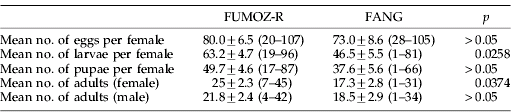
In absolute numbers, the FUMOZ-R strain produced slightly, but not significantly, higher numbers of eggs (p=0.5152) and pupae (p=0.1012) than the FANG strain. The mean number of eggs laid per female for FUMOZ-R was 80.0 with a clutch size ranging from 20 to 107, while FANG laid a mean number of 73.0 eggs per female with a clutch size ranging from 28 to 105. The mean number of larvae produced by the FUMOZ-R strain was significantly higher than that of the FANG strain (p=0.026). FUMOZ-R produced a significantly higher mean number of females than FANG, with 54.9% (n=25) and 49% (n=17), respectively (p=0.037). The mean number of adult males produced by each female did not differ significantly between the two strains (table 1).
Reproductive characteristics for the An. funestus pyrethroid resistant (FUMOZ-R) and susceptible (FANG) strains. Ranges (min–max) are given in parentheses; p-values were determined by t-tests using the mean and SE values.

No. of blood meals required to produce eggs
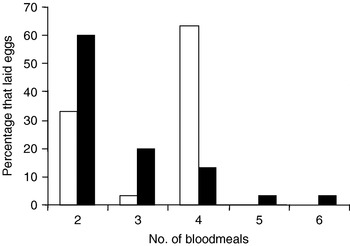
FUMOZ-R females required a significantly higher number of blood meals to lay eggs than FANG females (p=0.0244) (table 2); 63.3% (n=19) FUMOZ-R females laid their first egg batch after four blood meals, while 33.3% (n=10) and 3.3% (n=1) laid eggs after two and three blood meals, respectively. Of FANG females, 60% (n=18) laid their first egg batch after two blood meals, and 20% (n=6), 13.3% (n=4), 3.3% (n=1) and 3.3% (n=1) laid eggs after three, four, five and six blood meals, respectively (fig. 1).
Frequency distribution of the percentage of females of pyrethroid susceptible (FANG) and resistant (FUMOZ-R) An. funestus strains that laid eggs after taking successive blood meals (□, FUMOZ-R; ■, FANG).

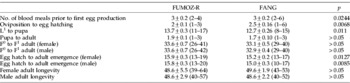
Mean (±SE) developmental time (days) of An. funestus pyrethroid resistant (FUMOZ-R) and susceptible (FANG) strains. Ranges (min–max) are given in parentheses; p-values were determined by t-tests using the mean and SE values.

Egg fertilization and viability
The dissection of spermathaecae revealed that 52.6% (n=156) of FANG females were fertilized compared to 56.8% (n=162) of FUMOZ-R females. There was no statistical difference between them (χ2=0.57, p=0.32). The proportion of females that successfully produced eggs was significantly higher in the FUMOZ-R strain (χ2=9.05, p=0.0026). Forty-three percent (n=30) and 23.3% (n=30) of females from FUMOZ-R and FANG produced eggs, respectively. Complete failure to hatch was recorded in 28.6% (n=7) of FANG families and 7.7% (n=13) of FUMOZ-R families, showing a significant difference (χ2=14.62, p=0.0001).
Developmental time
Egg-laying occurred at 15.8 days and 15.7 days (following a ten-day mating period), on average, following adult emergence for the FANG and FUMOZ-R strains, respectively. Time from oviposition to egg hatching was significantly longer in the FANG strain than in the FUMOZ-R strain (p=0.0068) (table 2), with a range of 1–3 days for FUMOZ-R and 1–6 days for FANG. Ninety percent (n=27) of eggs from FUMOZ-R families hatched two days following oviposition, while the other 6.7% (n=2) and 3.3% (n=1) hatched after one day and three days, respectively. Results for the FANG strain showed that 60% (n=18) and 30% (n=9) hatched after two days and three days, respectively, while 3.3% (n=1) hatched after one day, 3.3% (n=1) after four days and 3.3% (n=1) after six days.
Developmental time from first instar larva to pupa was significantly longer in FUMOZ-R than in FANG (p=0.011). The majority (80%) of larvae from FUMOZ-R families pupated between the 12th and 15th day following oviposition, while the majority of larvae from FANG families (93.4%) pupated between the 11th and 14th day following oviposition. No significant difference was recorded in developmental time from pupa to adult between strains. The generation time for males and females from both strains did not differ significantly (table 2). However, FUMOZ-R females took a significantly longer time from egg hatch to adult emergence (p=0.0127), ranging from 13 to 19 days for FUMOZ-R and 13 to 17 days for FANG. FUMOZ-R males also took a significantly longer time from egg hatch to adult emergence (p=0.0085) than FANG, ranging from 13 to 20 days in FUMOZ-R and 10 to 17 days in FANG.
Pre-adult survivorship
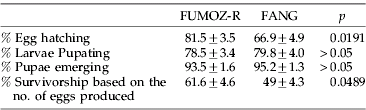
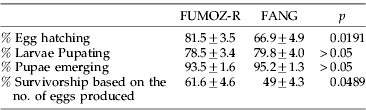
The proportion of eggs that hatched was significantly higher in FUMOZ-R than in FANG (p=0.0191). No significant difference was recorded between the proportions of larvae pupating and pupae emerging as adults between the two strains (table 3). However, the percentage of egg-to-adult survivorship was greater in FUMOZ-R than in FANG (p=0.0489). In FUMOZ-R, mortality was greatest during the larval stages; whilst, in FANG, mortality was greatest during the egg stage.
Mean (±SE) survival through each life-stage of An. funestus pyrethroid-resistant (FUMOZ-R) and -susceptible (FANG) strains; p-values were determined by t-tests using the mean and SE values.
Adult survivorship
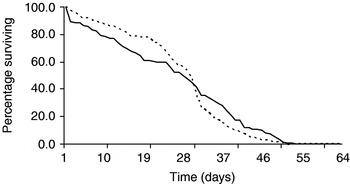
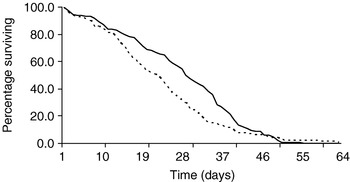
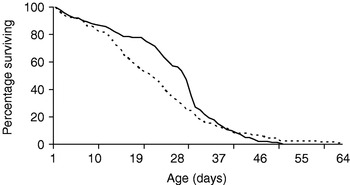
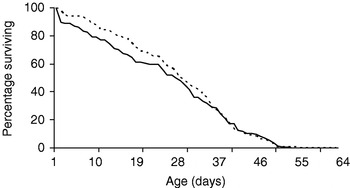
There was no overall statistical difference in the adult longevity (table 2), as well as the adult survivorship, between the males and females of each strain. However, females of the FANG strain showed a higher rate of survival than the corresponding male cohort during the first 31 days (fig. 2). Males of the FUMOZ-R strain survived slightly longer than the corresponding female cohort during the period of day 3 to day 47. However, a few females survived to day 64, while all the males had died by day 55 (fig. 3). There was no statistical difference in the length of adult survivorship between females from the two strains (p=0.2487) (fig. 4). However, during the period between day 7 and day 37, females of the FANG strain showed a significantly higher rate of survival than those of the FUMOZ-R strain (p=0.001). A comparison between the two male cohorts (fig. 5), showed a significantly higher rate of survival in FUMOZ-R (p=0.0316).
Adult male and female survivorship curves for the pyrethroid susceptible strain (FANG) of An. funestus (— male; - - - - female).

Adult male and female survivorship curves for the pyrethroid resistant strain (FUMOZ-R) of An. funestus (— male; - - - - female).

Adult female survivorship curves for the pyrethroid susceptible (FANG) and resistant (FUMOZ-R) strains of An. funestus (— FANG; - - - - FUMOZ-R).

Adult male survivorship curves for the pyrethroid susceptible (FANG) and resistant (FUMOZ-R) strains of An. funestus (— FANG; - - - - FUMOZ-R).

Discussion
Few differences in biological fitness were recorded between the pyrethroid resistant and susceptible strains of An. funestus. In absolute numbers, the resistant strain produced higher, but not always significant, numbers of eggs, larvae, pupae and adults compared with the susceptible strain. The proportion of females that laid eggs and the proportion of viable eggs produced were higher in the resistant strain than in the susceptible strain. The resistant strain showed a slightly longer developmental time compared to the susceptible strain. However, it produced a higher yield of eggs and showed greater female fertility. The life span of some females of the resistant strain was longer than that of the susceptible strain. The number of blood meals required in order to produce eggs was generally higher in the resistant strain. There was no uniform negative effect on all fitness parameters associated with one strain compared to the other. Additionally, negative performance in one parameter can conceivably be balanced by positive performance in another. These results suggest that the factors controlling pyrethroid resistance in southern African An. funestus cause no reduction in fitness, but do not necessarily suggest that the resistant strain shows greater fitness than the susceptible strain.
Various environmental factors affect developmental rates and survivorship of mosquito immatures (Rodcharoen & Mulla, Reference Rodcharoen and Mulla1997). Some important factors include temperature, nutrition and larval density (Reisen et al., Reference Reisen, Milby and Bock1984; Clements, Reference Clements1992). In this study, temperature was controlled (25±3°C), but nutrition (amount of food per larva) and larval density were not. Larvae that developed from each family were kept in approximately the same volume of water with a constant surface area large enough to avoid the issue of intense competition for food. The amount of food supplied per larval bowl depended on larval density. Larvae were checked constantly and re-fed once the food on the water surface had been consumed. In this way, food provision was ample and unlikely to have been a limiting factor for larval survival and growth.
Inbreeding depression can reduce mosquito fitness (Munstermann, Reference Munstermann1994; Armbruster et al., Reference Armbruster, Hutchinson and Linvell2000). This effect can occur in laboratory colonies after a few generations in an insectary environment depending on the size and variance of the gene pool of the founding wild-caught material. Furthermore, loss of fitness should be enhanced by additional selective pressures such as selection for insecticide resistance. The strains used in this study were colonized in 2001 (FUMOZ-R) and 2003 (FANG). Our results tend to negate these concerns in this instance because colonisation followed by intense selection for pyrethroid resistance in FUMOZ-R does not appear to have compromised the overall physiological and reproductive fitness of FUMOZ-R compared to FANG.
The fact that the pyrethroid resistant strain (FUMOZ-R originating from southern Mozambique) and insecticide susceptible strain (FANG originating from southern Angola) do not share the same genetic background also requires careful consideration. Analyses of Msp I digests of a 400 bp domain 3 (D3) fragment of An. funestus from samples collected in West, central, East and southern Africa show clear evidence of population structuring (Garros et al., Reference Garros, Koekemoer, Kamau, Awolola, Van Bortel, Coetzee, Coosemans and Manguin2004; Koekemoer et al., Reference Koekemoer, Kamau, Garros, Manguin, Hunt and Coetzee2006). However, samples from southern Angola, the FUMOZ laboratory colony, southern Mozambique and South Africa clustered together as the MW type, suggesting that they are genetically similar. These results are re-enforced by cross-mating experiments between the FUMOZ and FANG strains, which showed that hybrid F1 progeny of both sexes are fertile and viable (Ntomwa, Reference Ntomwa2004).
The assessment of biological characteristics of populations resistant to insecticides can be very important in the management of resistance (Campanhola et al., Reference Campanhola, McCutchen, Baehrecke and Plapp1991). The potential fitness cost associated with resistance can affect the spread of resistance genes because of the impact on the relative fitness of resistance gene carriers (Crow, Reference Crow1957; May & Dobson, Reference May and Dobson1986). Resistance management tactics may rely on the reduced fitness of resistant genotypes relative to susceptible genotypes with the aim of preserving susceptible homozygotes and eliminating heterozygotes and resistant homozygotes (Leeper et al., Reference Leeper, Roush and Reynolds1986). This can be achieved by various methods, including sequential rotation of insecticides, avoiding the use of a particular type of insecticide for one or more generations per season, using appropriate insecticide rates, extending intervals between treatments, using short residual insecticides or by using alternative insecticides (Georghiou, Reference Georghiou, Georghiou and Saito1983). In cases where resistance has developed, the use of pesticides impervious to the mechanisms producing the resistance phenotype will halt or even reverse the development of resistance (Wood & Bishop, Reference Wood, Bishop, Bishop and Cook1981; Roush, Reference Roush1989).
Pyrethroid resistance in An. funestus originating from southern Mozambique and Kwazulu/Natal, South Africa has been shown to be metabolic, essentially based on the overproduction of monooxygenases (Brooke et al., Reference Brooke, Kloke, Hunt, Koekemoer, Temu and Taylor2001; Amenya et al., Reference Amenya, Koekemoer, Vaughan, Morgan, Brooke, Hunt, Ranson, Hemingway and Coetzee2005). Our results suggest that monooxygenase overproduction does not compromise the overall fitness of individuals carrying the resistance phenotype. The implications for insecticide resistance management in affected regions are quite clear – one cannot assume that relaxation of pyrethroid selection pressure will translate into a significant decrease in the frequency of resistance alleles in affected An. funestus populations. Evidence of cross-resistance to carbamate insecticides (Brooke et al., Reference Brooke, Kloke, Hunt, Koekemoer, Temu and Taylor2001) complicates the situation further, leaving organochlorine and organophosphate insecticides as the best available options. This information requires careful consideration in terms of designing an effective resistance management strategy to combat insecticide resistant An. funestus populations in southern Africa.
Acknowledgements
This project was funded by the Medical Research Council of South Africa and the National Health Laboratory Service Research Foundation. Mr M. Letsoalo of the Biostatistics & Epidemiology Unit, NICD, is thanked for help with the statistical analysis.