


Introduction
The cognitive model of Obsessive-Compulsive Disorder (OCD), presented by Salkovskis (Reference Salkovskis1985, Reference Salkovskis1989, Reference Salkovskis1999), covers both the development and the maintenance of the disorder, in which an inflated sense of responsibility plays an important role as a cognitive mediator. According to this model, dysfunctional responsibility schemata lead to the misinterpretation of the intrusive thoughts that occurs with the focus on the fear of causing harm to self/others and inflated personal responsibility. Interest in this cognitive mediator has increased over the past two decades as findings from surveys, experimental and treatment efficacy studies have supported the model (e.g. Foa, Sacks, Tolin, Preworski and Amir, Reference Foa, Sacks, Tolin, Preworski and Amir2002; Lopatka and Rachman, Reference Lopatka and Rachman1995; Shafran, Reference Shafran1997; Van Oppen and Arntz, Reference Van Oppen and Arntz1994). Several studies also assigned an important role for exaggerated or inflated responsibility for the events beyond the control of the individual among the prominent faulty belief domains in OCD (Obsessive-Compulsive Cognitions Working Group [OCCWG], 1997; Steketee, Frost and Cohen, Reference Stekeete, Frost and Cohen1998). In addition, responsibility appraisals oriented to harm are supposed to be specific to OCD (Salkovskis, Reference Salkovskis1989, Reference Salkovskis1999), which differ from depression with ruminations about future catastrophic events, and from other anxiety disorders (Van Oppen and Arntz, Reference Van Oppen and Arntz1994).
On the other hand, there are some studies that note either weak or no association between responsibility and OCD (e.g. Emmelkamp and Aaardema, Reference Emmelkamp and Aaardema1999; Frost, Steketee, Cohn and Griess, Reference Frost, Steketee, Cohn and Griess1994; Freeston, Ladouceur, Thibodeau and Gagnon, Reference Freeston, Ladouceur, Thibodeau and Gagnon1992; Rachman, Thodarson, Shafran and Woody, Reference Rachman, Thordarson, Shafran and Woody1995); thus, the discrepancy between the findings was assumed to be due to the differences in the definition of responsibility and/or in the measurement methods (Mancini, D'Olimpio and D'Ercole, Reference Mancini, D'Olimpio and D'Ercole2001). Rachman et al. (Reference Rachman, Thordarson, Shafran and Woody1995) suggested that the manifestation of responsibility in OCD might be situation-specific, and the situation specificity of responsibility is activated more when the person views himself as mainly responsible for the hazardous/harmful event. They also suggested that the measurement of this construct requires multi-factorial assessment rather than the use of an unitary structure.
Salkovskis et al. (Reference Salkovskis, Wroe, Gledhill, Morrison, Forrester, Richards, Reynolds and Thorpe2000) emphasized the role of inflated sense of responsibility, defining it as the belief that one has a pivotal role for causing or preventing subjectively crucial negative outcomes, which might have results in real world and/or at moral level. This definition points to two primarily cognitive distortions, which are pivotal influence and the potential negative influences. Among these distortions, the pivotal influence (i.e. the main responsible agent for the harmful event) was found to be a better predictor of perceived responsibility than potential negative influences (i.e. probability and severity of the event) (Ladouceur, Rheaume and Aublet, Reference Ladouceur, Rheaume and Aublet1997; Rheaume, Ladouceur, Freeston and Letarte, Reference Rheaume, Ladouceur, Freeston and Letarte1995). The latter distortion was assumed to be under the general anxious threat schema, which was a necessary but not a sufficient condition for OCD (Rheaume et al., Reference Rheaume, Ladouceur, Freeston and Letarte1995). Along with the operational definition of responsibility, Salkovskis et al. (Reference Salkovskis, Wroe, Gledhill, Morrison, Forrester, Richards, Reynolds and Thorpe2000) designed the Responsibility Attitude Scale (RAS) to assess attitudes, beliefs and vulnerability characteristics of the present belief domain and harm concerns in OCD, and found that the patients with OCD had significantly higher scores in RAS than anxious and non-clinical controls.
Despite being accepted as a unitary diagnostic category (DSM-IV; APA, 1994), OCD also includes diversity, with subgroups having different symptom clusters such as checking and cleaning (McKay et al., Reference McKay, Abramowitz, Calamari, Kyrios, Radomsky, Sookman, Taylor and Wilhelm2004). This subgroup differentiation may be linked to the inflated sense of responsibility as a cognitive mediator. For instance, Rachman (Reference Rachman2002) stated that even though personal responsibility plays an important role for both subgroups, the focus of responsibility for the protection of others from harm is mainly focused in checking, whereas self-focused responsibility is more pronounced in cleaning. Empirical findings suggest that inflated responsibility has a more influential and prominent role in checking than cleaning (e.g. Foa et al., Reference Foa, Sacks, Tolin, Preworski and Amir2002; Lopatka and Rachman, Reference Lopatka and Rachman1995; Rachman, Reference Rachman1998; Rheaume, et al., Reference Rheaume, Ladouceur, Freeston and Letarte1995; Yorulmaz, Karancı and Tekok-Kılıç, Reference Yorulmaz, Karancı and Tekok-Kılıç2006). Similarly, the dimensionality of responsibility also appears to operate differently in symptom subgroups such as checking and cleaning. In addition to identifying the salient role of responsibility in checking, Mancini et al. (Reference Mancini, D'Olimpio and D'Ercole2001) found that responsibility focusing on the belief of possessing harmful power (i.e. self-granted power for harm) is associated more with checking symptoms, but prevention-based responsibility (i.e. prevention) is more pronounced for cleaning symptoms. On the other hand, Smari, Glyfadottir and Halldorsdottir (Reference Smari, Glyfadottir and Halldorsdottir2003) reported a stronger association between responsibility attitudes and obsessional thoughts about harm than for checking.
In line with the a continuum between normal intrusive thoughts and clinical obsessions as suggested by cognitive explanations (e.g. Clark and Purdon, Reference Clark and Purdon1995; Rachman, Reference Rachman1997, Reference Rachman1998; Salkovskis, Reference Salkovskis1999), the inclusion of non-clinical samples (i.e. university students, community groups) as well as clinical groups (i.e. patients with OCD) in the relevant studies seems acceptable in the current literature (Burns, Formea, Keortge and Sternberger, Reference Burns, Formea, Keortge and Sternberger1995). The studies that examined the role of responsibility in OCD in nonclinical subjects seem to use in the main undergraduate university students from Western cultures.
OCD and OC phenomena could also be seen in adolescence (Rasmussen and Tsuang, Reference Rasmussen and Tsuang1986; Mancini, Gragnani, Orazi and Pietrangeli, Reference Mancini, Gragnani, Orazi and Pietrangeli1999). OC phenomena in adolescence is fairly similar in prevalence and symptomatology to the adult version (e.g. Flament et al., Reference Flament, Whitaker, Rapoport, Davies, Berg, Kalikow, Sceery and Schaffer1988; Libby, Reynolds, Derisley and Clark, Reference Libby, Reynolds, Derisley and Clark2004; Rasmussen and Eisen, Reference Rasmussen and Eisen1990). Retrospective studies with adult OCD patients also showed that 30–50% reported the onset of their disorder during adolescence (Mancini et al., Reference Mancini, Gragnani, Orazi and Pietrangeli1999; Rasmussen and Eisen, Reference Rasmussen and Eisen1990). However, this age group is generally underrepresented in the evaluation of current cognitive theories of OCD.
The investigation of prevalence of OCD in childhood and adolescence (e.g. Flament et al., Reference Flament, Whitaker, Rapoport, Davies, Berg, Kalikow, Sceery and Schaffer1988; Libby et al., Reference Libby, Reynolds, Derisley and Clark2004) led some researchers to question whether the current cognitive models of OCD, which were originally developed to explain the development, maintenance and therapy of the disorder in adults (e.g., Salkovskis, Reference Salkovskis1999), is also valid for explaining the development and persistence of OCD amongst adolescents. However, only a few studies reported partially theoretical (Barrett and Healy, Reference Barrett and Healy2003; Libby et al., Reference Libby, Reynolds, Derisley and Clark2004; Mather and Cartwright-Hatton, Reference Mather and Cartwright-Hatton2004; Matthews, Reynolds and Derisley, Reference Matthews, Reynolds and Dersley2007; Turner, Reference Turner2006) and therapeutic (Shafran and Somers, Reference Shafran and Somers1998) consistencies for adolescents, mainly from Western countries.
Despite some epidemiological and phenomenological similarities in OCD in different cultures (Weismann et al., Reference Weismann, Bland, Canino, Greenwald, Hwu, Lee, Newman, Oakley-Browne, Rubio-Stipec and Wickramaratne1994), the impact of sociocultural factors in the clinical manifestation of OCD is still under investigation (e.g. Fontenelle, Mendlowicz, Marques and Versiani, Reference Fontenelle, Mendlowicz, Marques and Versiani2004; Sica, Novara and Sanavio, Reference Sica, Novara and Sanavio2002). For instance, Ghassemzadeh, Bolhari, Birashk and Salavati (Reference Ghassemzadeh, Bolhari, Birashk and Salavati2005) supported the role of responsibility in OCD in a non-Western country. Nevertheless, situated between Europe and Asia, Turkey is a developing secular-Islamic country and thus might have a different and unique pattern of socio-cultural factors. More research is needed in order to get a better view of the role of the responsibility concept in this type of context. The findings of such research will provide support for the international applicability and generalizability of the cognitive model. Furthermore, the inclusion of an adolescent sample in examining the association of responsibility with OC phenomena as well as university students will contribute to the exploration of the impact of responsibility in a sample not previously examined. Consequently, the present paper firstly aims to examine further the nature of responsibility attitudes and psychometric properties of RAS (Salkovskis et al., Reference Salkovskis, Wroe, Gledhill, Morrison, Forrester, Richards, Reynolds and Thorpe2000) in Turkish samples. Second, it aims to investigate the relationship between different domains of responsibility and OC symptom subgroups, and to explore the specific roles of responsibility dimensions in different symptom clusters of OCD in adolescents and young adults in Turkey.
Method
Samples
The present study had two separate age samples. The sample of young adults was composed of 378 undergraduate university students (230 females and 148 males with a mean age of 20.3 years; SD = 1.66; range: 18–29) from various departments of Uludağ University, located in Bursa. The adolescent sample consisted of 380 senior high school students from a high school, located in Ankara (230 females and 150 males with a mean age of 17.23 years; SD = 0.68; range 16–20).
Instruments
Responsibility Attitudes Scale (RAS). RAS is a 26-item, 7-point Likert-type scale (ranging from totally agree to totally disagree) designed by Salkovskis and his colleagues (Reference Salkovskis, Wroe, Gledhill, Morrison, Forrester, Richards, Reynolds and Thorpe2000) to assess attitudes and beliefs about responsibility and harm concerns in OCD. The original scale had satisfactory reliability and validity. The Turkish version of the RAS also had satisfactory reliability and validity for a sample of non-clinical adolescents (Altın, Yorulmaz and Karancı, Reference Altın, Yorulmaz and Karancı2004) and university students (Yorulmaz, Karancı and Tekkok-Kılıç, Reference Yorulmaz, Karancı and Tekok-Kılıç2002; Yorulmaz et al., Reference Yorulmaz, Karancı and Tekok-Kılıç2006).With regard to factor structure, Mancini et al. (Reference Mancini, D'Olimpio and D'Ercole2001) found that RAS (α = 0.90) had a 4-factor structure composed of prevention (α = 0.87), feeling dangerous (α = 0.71), self-granted power (α = 0.69) and though-action fusion (α = 0.76).
Maudsley Obsessive-Compulsive Inventory (MOCI). MOCI (Rachman and Hodgson, Reference Rachman and Hodgson1980) is a self-report measure of obsessive-compulsive symptoms. The scale consists of 30 true-false items about various obsessive-compulsive symptoms including checking, cleaning, slowness, and doubting. The total score can range from 0 to 30, with higher scores indicating higher levels of obsessive-compulsive symptoms. The Turkish adaptation of the MOCI (Erol and Savaşır, Reference Erol and Savaşır1988) revealed a 3-subscale structure: cleanliness/meticulousness, checking/slowness and obsessive thinking with good reliability. Several studies have confirmed the psychometric properties of the Turkish version (e.g. Yorulmaz, Yılmaz and Gençöz, Reference Yorulmaz, Yılmaz and Gençöz2004; Yorulmaz et al., Reference Yorulmaz, Karancı and Tekok-Kılıç2006). In the present study, this factor structure of the MOCI was again confirmed (α = 0.67, α = 0.74 and α = 0.73 respectively) and used in further analyses.
Beck Depression Inventory (BDI). Developed in 1961 and revised in 1978 by Beck, Steer and Garbin (Reference Beck, Steer and Garbin1988), BDI is a well known and widely used 21-item self-report measure assessing emotional, somatic, cognitive and motivational symptoms of depression, as well as pointing to the level or severity of depression. The Turkish adaptation of BDI (Hisli, Reference Hisli1989) has satisfactory reliability and validity.
State-Trait Anxiety Inventory (STAI). STAI is a 4-point Likert-type self-report scale of anxiety designed to evaluate the level of state and trait anxiety. Each part consists of 20 items (Spielberger, Gorsuch and Lushene, Reference Spielberger, Gorsuch and Lushene1970). Like the original STAI, the Turkish adaptation of the scale has satisfactory reliability and validity (Öner and Le Compte, Reference Öner and Le Comte1985). In the present study, the effect of trait anxiety was considered to be more relevant for responsibility because of its pervasive nature and the nature of the current study (i.e. survey); accordingly, in order to control for the effect of anxiety, only the trait anxiety inventory was administered.
Procedure
A questionnaire booklet including all the instruments was administered to the participants during class hours; participation was voluntary, and informed consent was signed by the subjects. Among the instruments, randomization was performed to eliminate any possible order effects.
Results
Factor structure and stability
In the present study, the Cronbach alpha coefficients of the original RAS factor structure (Mancini et al., Reference Mancini, D'Olimpio and D'Ercole2001) were lower (i.e. ranging from 0.85 to 0.56), and the study aimed to examine the factor structure of the RAS in Turkey, which has a different pattern of socio-cultural values from Italy, where the factor structure was previously examined (Mancini et al., Reference Mancini, D'Olimpio and D'Ercole2001). A new explanatory factor analysis was executed with Principle Component Analysis (PCA) as the extraction method and Varimax rotation for separate samples. In contrast to Mancini et al. (Reference Mancini, D'Olimpio and D'Ercole2001), examination of the scree plot of data from the two samples yielded a two-factor solution, and this solution accounted for 37% of the variance for the university sample and 29 % of the variance for the adolescent sample. The first factor was labelled as responsibility based on danger prevention and explained 24% of the variance (α = 0.88) for university sample and 18% of the variance (α = 0.82) for the adolescent sample. Items constituting danger prevention (e.g. even if harm is not a likely possibility, I should always try to prevent it at any cost; if I can have a slight influence on things going wrong, then I must act to prevent it; for me even slight carelessness is inexcusable when it might affect other people) tap personal responsibility driven by the notion of prevention of possible dangerous outcomes in general, regardless of time domain. Based on the work of Mancini et al. (Reference Mancini, D'Olimpio and D'Ercole2001), the second factor was labelled as self-dangerousness, with 11% of the variance for the adolescent sample (α = 0.67) and 13% of the variance for the university sample (α = 0.74). Items under this factor (e.g. I am often close to causing harm; everything I do can cause serious problems; I'm too sensitive to be self responsible for things going wrong) points to the individual dangerousness potential. Therefore, item distributions under these two factors seem to have similar patterns in the two samples. Even though explained variance of these two factors seems to be relatively lower for the adolescent sample, item loadings and item distributions in respective factors, and the reliability values led us to continue with this bifactorial structure in the present analyses.
Factorial congruence between two different samples on the RAS was further examined through the target rotation method with proportionality agreement coefficient (Tucker phi). Van de Vijver and Leung (Reference Van de Vijver and Leung1997) suggested using this method to assess factorial stability among different samples, with a cut-off score of .90. The analysis of target rotation revealed that the factor structure in the two samples were highly overlapping (Tucker phi = 0.97 and 0.93 respectively), which provides further support for the factorial stability of the RAS.
Responsibility factors in adolescents and young adults
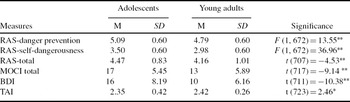
T-test analysis of the sample differences indicated that the adolescent/high school sample scored higher on the total RAS, MOCI and BDI than the university sample; but the reverse was seen for trait anxiety. One-way multivariate analysis of variance (MANOVA) with sample groups (adolescents vs. young adults) as a between-group factor was performed on responsibility based on prevention and self-dangerousness. The analysis revealed group differences (Wilks λ = 0.95, F (2, 669) = 19.43, p < .001, ή2 = 0.06). Follow up F-tests revealed significant sample differences on prevention (F (1, 672) = 13.55, p < .001, ή2 = 0.02) and self-dangerousness responsibility (F (1, 672) = 36.96, p < .001, ή2 = 0.05). Pair wise comparisons executed with LSD showed that adolescents expressed more responsibility based on prevention and self-dangerousness than university students. Table 1 presents group differences in the main measures.
Mean scores and standard deviations of different groups for main measures

*p < .05, **p < .001.
RAS = Responsibility Attitudes Scale; MOCI = Maudsley Obsessive-Compulsive Inventory; BDI =Beck Depression Inventory; TAI = Trait Anxiety Inventory.
Responsibility in different symptom subgroups
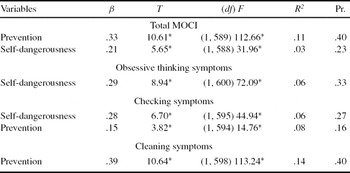
Separate multiple regression analyses were performed in order to examine the impact of factors of responsibility on the OC phenomena in general, and on each of OC symptom clusters with the stepwise equation. In all of these regression analyses, two samples were pooled and group membership was entered as a dummy variable to indicate high school vs. university samples. It was included among the control variables together with gender, the scores of depression and trait anxiety. The results of the regression analyses are given in Table 2. In predicting total MOCI scores, all the control variables, except gender, were found to be significantly and positively associated with OC phenomena. In other words, high school students tended to be more obsessional; similarly, trait anxiety and depression were found to be positively associated with the total MOCI scores. Moreover, the responsibility based on both danger prevention and self-dangerousness was a moderate significant predictor of the OC phenomena in general. For obsessive thinking, the significant relationship patterns of the control variables were the same as with the total MOCI. More importantly, responsibility based on self-dangerousness was the only factor found to be associated with obsessive thinking. On the other hand, both responsibility factors significantly contributed to the prediction of checking symptoms. A similar pattern for the control variables of anxiety and depression was observed for checking symptoms; but it was also found that males tend to exhibit more checking. However, it was only responsibility focusing on the prevention of danger that was seen as a significant predictor of cleaning symptoms. Moreover, among the control variables, just being at high school, being female and high trait anxiety were significant in relation to cleaning symptoms.
The results of multiple regression analyses1

*p < .001. MOCI= Maudsley Obsessive-Compulsive Inventory.
Discussion
The main aim of the study was to examine the function of responsibility in OC phenomena and its symptom clusters in different age samples in a developing country, by using an attitude scale assessing responsibility beliefs. The overall findings of the study provided further evidence for Salkovskis’ cognitive model (Reference Salkovskis1989, Reference Salkovskis1999), which stresses the core role of responsibility in OC symptomatology.
Taking the operational definition of responsibility as the belief of possessing a pivotal role to bring about or prevent a possible harmful outcome, Salkovskis et al. (Reference Salkovskis, Wroe, Gledhill, Morrison, Forrester, Richards, Reynolds and Thorpe2000) developed the RAS to assess attitudes of responsibility and harm concerns in OCD. In order to evaluate this instrument in a different culture, the factorial structure of the RAS was examined. Contrary to the findings of Mancini et al. (Reference Mancini, D'Olimpio and D'Ercole2001), our results indicated that this scale had two factors, namely responsibility based on danger prevention and responsibility based on the self-dangerousness. Furthermore, it was also observed that this factor structure was consistent across two different age samples from Turkey. The danger prevention factor focuses on the importance and necessity of prevention of any harmful outcome and, thus, the relief from personal responsibility if appropriate actions are taken. By contrast, the self-dangerousness factor consists of attitudes oriented to the belief of possessing potential power for causing harm and of self-blame for the person's role in such harm. It seems that there is a strong emphasis on the pivotal role (Ladouceur et al., Reference Ladouceur, Rheaume and Aublet1997; Rheaume et al., Reference Rheaume, Ladouceur, Freeston and Letarte1995) in both factors, and the difference between them lies in the relative impact of this role on the outcomes. Responsibility based on danger prevention focuses on preventing an undesirable outcome, whereas self-dangerousness is more associated with fears about bringing about this outcome. In addition to the group comparison that revealed significant differences in responsibility and its factors, these findings also contribute to the validity base of the RAS (Salkovskis et al., Reference Salkovskis, Wroe, Gledhill, Morrison, Forrester, Richards, Reynolds and Thorpe2000).
Senior high school students reported more OC symptoms, and they feel more self-dangerous and express more responsibility in prevention of danger than university students. When their scores for responsibility attitudes in total are taken into account (Table 3), it is seen that they are different and higher from non-clinical young adults from both host and other countries (i.e. Iceland; Smari et al., Reference Smari, Glyfadottir and Halldorsdottir2003, and UK; Libby et al., Reference Libby, Reynolds, Derisley and Clark2004; Mather and Cartwright-Hatton, Reference Mather and Cartwright-Hatton2004; Matthews et al., Reference Matthews, Reynolds and Dersley2007; Salkovskis et al., Reference Salkovskis, Wroe, Gledhill, Morrison, Forrester, Richards, Reynolds and Thorpe2000). This situation might have resulted from the period of transition from high school to university, which also coincides with late adolescence to early adulthood, and it has been found to be associated with psychological and emotional problems as well as behavioural ones (Compas, Howell, Phares, Williams and Guinta, Reference Compas, Howell, Phares, Williams and Guinta1989). There is another critical factor accounting for such a difference. In Turkey, senior high school students confront a major stressful life event/challenge, which is the university entrance exam (Koçkar and Gençöz, Reference Koçkar and Gençöz2004). They prepare for this exam, which is held nationwide once a year, and in which there are many applicants for a very limited quota; thus, by studying for this challenging exam, they experience a very stressful year. In order to alleviate this stress, the Turkish government recently changed the educational system and begun in 2005 to administer a 4-year high school education program throughout the country. Stressful life events have already been found to play a role in the activation of dysfunctional responsibility schema in the cognitive model (Salkovskis, Reference Salkovskis1989, Reference Salkovskis1999). Similarly, it was reported that initial symptoms were often triggered by stressful life events that more probably result in a substantial increase in responsibility, such as the birth of a child, promotion to a new job, significant losses such as death of family members and loss of a job (McKeon, Roa and Mann, Reference McKeon, Roa and Mann1984; Neziroglu, Anemone and Yaryura-Tobias, Reference Neziroglu, Anemone and Yaryura-Tobias1992; Rasmussen and Eisen, Reference Rasmussen and Eisen1990; Rasmussen and Tsuang, Reference Rasmussen and Tsuang1986). The findings of the present study are also consistent with the knowledge of the influence of stress in increasing the incidence of unwanted thoughts (Albert, Maina and Bogetto, Reference Albert, Maina and Bogetto2000; Maina, Albert, Bogetto, Vashetto and Ravizza, Reference Maina, Albert, Bogetto, Vashetto and Ravizza1999; Rachman, Reference Rachman1997; Rasmussen and Tsuang, Reference Rasmussen and Tsuang1986, McKeon et al., Reference McKeon, Roa and Mann1984). The stressful life event might also account for the differences between the two groups in depression and anxiety scores. The university entrance exam might also be a factor that increases depressive feelings in adolescents, as well as state anxiety levels (Koçkar and Gençöz, Reference Koçkar and Gençöz2004). On the other hand, trait anxiety might be more salient after such stressful life events and during young adulthood.
Means and standard deviations of Responsibility Attitudes Scale (RAS) from selected studies

The present study also suggests OC symptom differentiation by assigning different roles for different types of responsibility in checking, cleaning and obsessive thinking. It was found that both responsibility factors were influential in checking; in other words, it seems that people who had high scores in checking emphasize both types of responsibility that may be caused by themselves (i.e. self-dangerousness) and by the power for danger prevention. This information supports the importance of the role of responsibility in checking (e.g. Foa et al., Reference Foa, Sacks, Tolin, Preworski and Amir2002; Rachman, Reference Rachman2002). On the other hand, responsibility was found also to be important in cleaning symptoms (Cougle, Lee and Salkovskis, Reference Cougle, Lee and Salkovskis2007), but only in the form of danger prevention. Instead of self-dangerous responsibility, people might view danger from outside and try to prevent harm and thus control this undesirable outcome in cleaning. As for obsessive thinking, it was found that responsibility based on self-dangerousness had a more salient role. Accordingly, the inflated sense of responsibility, whether driven by danger prevention concern and/or self-focused prevention, is influential in all symptom clusters. However, responsibility seems to function differently for different subtypes (Cougle et al., Reference Cougle, Lee and Salkovskis2007; Rachman, Reference Rachman2002; Mancini et al., Reference Mancini, D'Olimpio and D'Ercole2001).
In summary, the findings suggest that there seems to be consistency in responsibility concerns among different cultures (Ghassamzadeh et al., 2005; Libby et al., Reference Libby, Reynolds, Derisley and Clark2004; Mather and Cartwright-Hatton, Reference Mather and Cartwright-Hatton2004; Matthews et al., Reference Matthews, Reynolds and Dersley2007; Salkovskis et al., Reference Salkovskis, Wroe, Gledhill, Morrison, Forrester, Richards, Reynolds and Thorpe2000; Smari et al., Reference Smari, Glyfadottir and Halldorsdottir2003), as responsibility attitudes of young adults from a non-Western country, Turkey, appear similar in range to the young adult samples from elsewhere (Table 3). In supporting factorial congruence and stability of the RAS, the current study highlights the role of responsibility in OC phenomena, and presents further evidence for the impact of this construct in adolescents and young adults. Furthermore, these findings contribute to the knowledge on the OC symptom cluster differentiation from a non-Western country; thus, this elicits theoretical consistency in OC symptomatology in the international context by means of such an important cognitive mediator. A limitation of the study is the participation of non-clinical samples that do not match/have a psychiatric diagnosis, although OC symptom scores on MOCI of the adolescent samples seem to be within the clinical range (>14) (Rachman et al., Reference Rachman, Thordarson, Shafran and Woody1995), and their scores of responsibility attitudes are as high as the adolescents with OCD in UK (Libby et al., Reference Libby, Reynolds, Derisley and Clark2004). Nevertheless, the replication of the present study with clinically diagnosed OCD patients is strongly encouraged.




Comments
No Comments have been published for this article.