Introduction
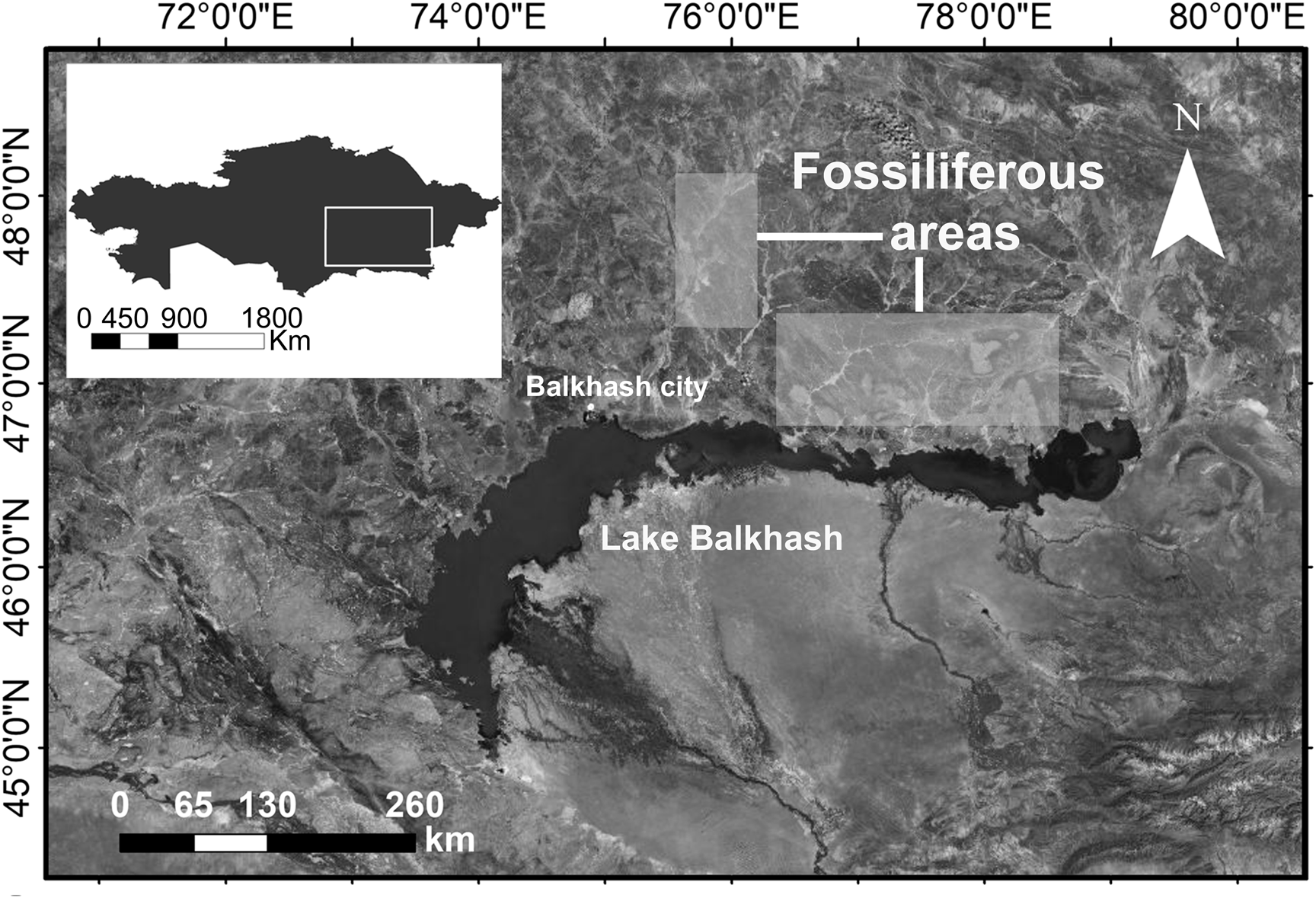
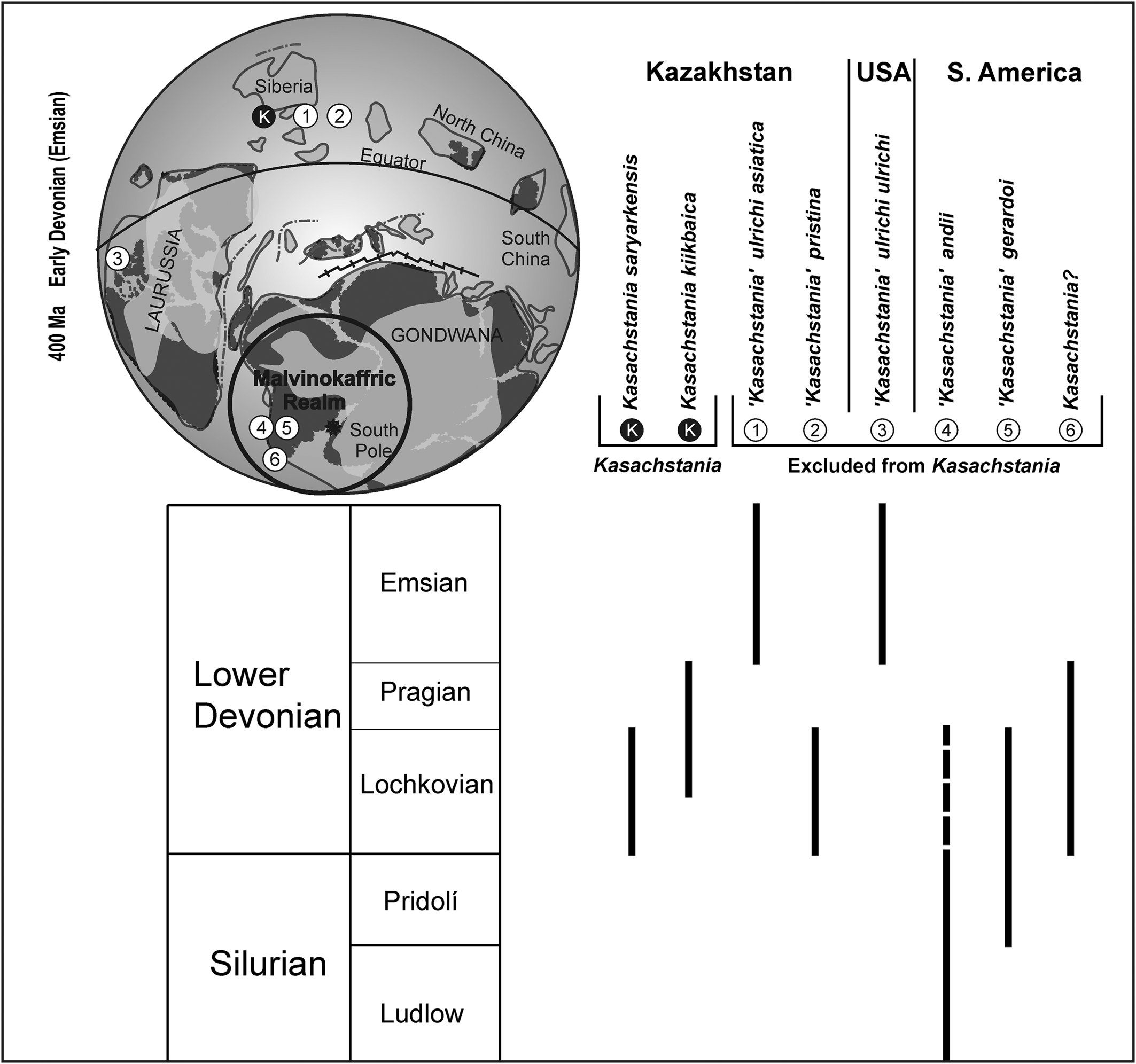
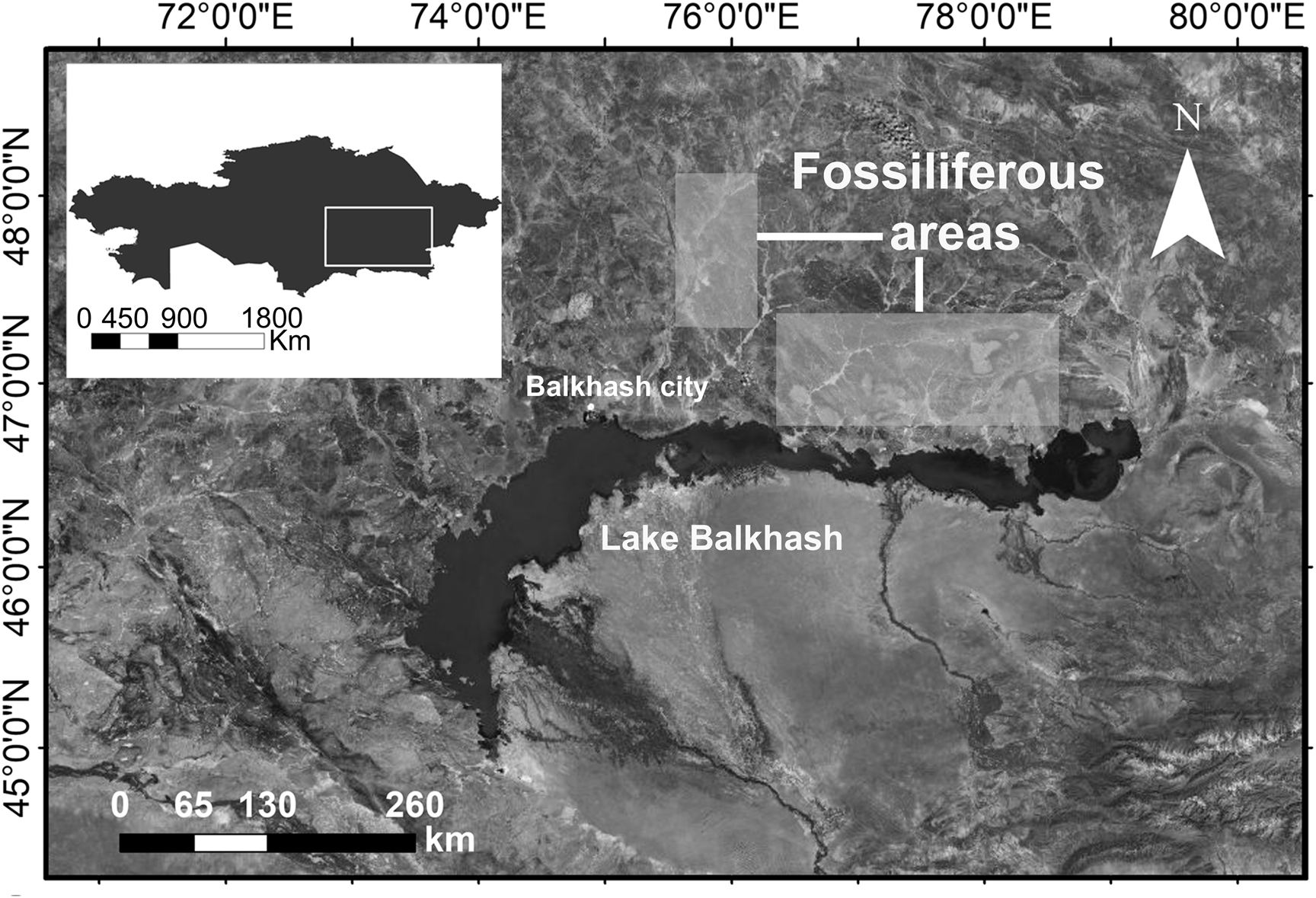
The dalmanitid trilobite Kasachstania Maksimova, Reference Maksimova1972 was originally recognized from the Lower Devonian of Kazakhstan (Fig. 1) and coeval strata in the Great Basin from Nevada, USA. Later, this genus was reported from the Silurian and Lower Devonian of southern South America (Pek and Vaněk, Reference Pek and Vaněk1991; Edgecombe and Ramsköld, Reference Edgecombe and Ramsköld1994) and thus considered of nearly cosmopolitan distribution (Fig. 2).
Map of the Devonian fossiliferous area of Balkhash, in central Kazakhstan, showing areas recording Kasachstania Maksimova, Reference Maksimova1972 and related taxa (based on Maksimova, Reference Maksimova1968, Reference Maksimova and Rzhonsnitskay1978b).
Occurrence of the taxa assigned to Kasachstania Maksimova, Reference Maksimova1972. Temporal distributions in doubt are shown with dashed lines.

In South America, the genus was recognized in the Andean region through two endemic species. The first, Kasachstania andii (Kozłowski, Reference Kozłowski1923) was reported from the upper Silurian and Lower Devonian of Bolivia (Swartz, Reference Swartz1925; Braniša, Reference Braniša1965; Wolfart, Reference Wolfart1968; Pek and Vaněk, Reference Pek and Vaněk1991; Edgecombe and Ramsköld, Reference Edgecombe and Ramsköld1994). The second, Kasachstania gerardoi Edgecombe and Ramsköld, Reference Edgecombe and Ramsköld1994 was recognized from the upper Silurian of Argentina to the lowermost Devonian of Bolivia (Waisfeld et al., Reference Waisfeld, Toro and Brussa1988; Edgecombe and Ramsköld, Reference Edgecombe and Ramsköld1994).
The very wide geographic distribution of Kasachstania contrasts with the mostly endemic trilobite faunas known from the Early Devonian of Southwestern Gondwana (faunas of the Malvinokaffric Realm), where entire families, such as the calmoniids, were restricted and diversified (Eldredge and Braniša, Reference Eldredge and Braniša1980; Boucot and Racheboeuf, Reference Boucot and Racheboeuf1993; Abe and Lieberman, Reference Abe and Lieberman2009, Reference Abe and Lieberman2012; Carbonaro et al., Reference Carbonaro, Langer, Nihei, de Souza Ferreira and Ghilardi2018). In fact, the diversification of Southwestern Gondwana dalmanitids was identified with a minor intensity relative to calmoniids, rapidly radiating during the Devonian in the Malvinokaffric basins from previous cosmopolitan Silurian stocks (Eldredge and Ormiston, Reference Eldredge, Ormiston, Gray and Boucot1979). Kasachstania, widely distributed since the late Silurian, initially supported this hypothesis.
As a result of preliminary revisions of this genus from the Lower Devonian of Argentina (Rustán, Reference Rustán2011, Reference Rustán2016), we revisit and test this proposal, focusing on Malvinokaffric records. Hence, a profound revision of some poorly defined taxa appeared necessary to better understand biostratigraphic, phylogenetic, and paleobiogeographic patterns of dalmanitids in the middle Paleozoic of Southwestern Gondwana and particularly from South America.
Here we provide a taxonomic reappraisal of Kasachstania. Some concerns regarding the original material of Maksimova from the type area of the Lower Devonian of central Kazakhstan are addressed. Nomenclatural issues that involve the correct spelling of the genus are also dealt with. Species previously included in Kasachstania are revised, focusing on new illustrations, the original material, and new taxonomic criteria to improve the accuracy of its diagnosis and to recognize biostratigraphic and biogeographic implications of reassignments.
In addition, some insights on the largely overlooked valid dalmanitid genus Saryarkella Maksimova, 1978, described from the same type locality and age of Kasachstania, are provided. This genus drew our attention during the revision as it was never mentioned after the original publication and has a particular distribution of marginal spines that is uncommon for dalmanitids.
Geological settings
The area where Kasachstania was defined corresponds to the Lower Devonian marine deposits from northern Balkhash in central Kazakhstan (Fig. 1). The stratigraphy and age of this region are mainly based on the paleontological reports of Bublichenko (Reference Bublichenko1945) and Maksimova (Reference Maksimova1968, Reference Maksimova and Rzhonsnitskay1978a). Sedimentary successions consist mainly of siltstones and sandstones, with subordinate interlayers and lenses of limestones.
The stratigraphic scheme of the Lower Devonian of central Kazakhstan has been classically described through several informal divisions that include, from base to top, the Aynasu, Kockbaital, Pribalkhash, and Sardzhal horizons, which would span from the Silurian–Devonian boundary through the Emsian (Kaplun and Senkevich, Reference Kaplun, Senkevich and Rzhonsnitskay1978). However, more precise works are necessary to resolve the complex stratigraphy of central Kazakhstan. Indeed, the Aynasu and Kockbaital horizons are considered a single cycle of deposition (the Karazhirik horizon according to Kaplun and Senkevich, Reference Kaplun, Senkevich and Rzhonsnitskay1978), making the correlation between different layers difficult. The presence of the graptolite Monograptus uniformis angustidens Přibyl, Reference Přibyl1940, at the base of the Aynasu horizon, indicates the lowermost Lochkovian (Maksimova, Reference Maksimova and Rzhonsnitskay1978a). However, no other index fossil was identified in the Kockbaital horizon, and late Silurian ages should not be rejected in some localities (see Budil et al., Reference Budil, Fatka, Rak and Hörbinger2014).
The Karazhirik horizon is represented by green-colored various-grained sandstones, siltstones, argillites, shales, bluish-gray ashy tuffs, and lens-like layers of light reef-related limestones of very uneven thickness. The total thickness of the Karazhirik horizon ranges from 500 to 2,400 m.
The Karazhirik horizon bears several dalmanitids type species such as Kasachstania saryarkensis (Maksimova, Reference Maksimova1960), K. kasachstanica (Balashova in Maksimova, Reference Maksimova1968), and ‘Odontochile’ pristina Maksimova, Reference Maksimova1968. Species restricted to the Aynasu horizon include Kasachstania septicostata (Maksimova, Reference Maksimova1968) and several species of the subgenus Odontochile (Pacifina) Maksimova, Reference Maksimova and Rzhonsnitskay1978b (see Kaplun and Senkevich, Reference Johnson1978).
Kasachstania kiikbaica (Maksimova, Reference Maksimova1968) occurs in the Kockbaital horizon, and in the lower levels of the overlying Pribalkhash horizon. This horizon is represented by different-grained sandstones, tuff sandstones, siltstones, and ash tuffs of greenish and brownish color with thin layers of limestone. The thickness reaches 280–600 m. It is widely distributed in central Kazakhstan and abundantly fossiliferous. It is considered to be upper Lochkovian to Pragian in age (Kaplun and Senkevich, Reference Kaplun, Senkevich and Rzhonsnitskay1978).
The Sardzhal horizon is regarded as lower Emsian (Kaplun and Senkevich, Reference Kaplun, Senkevich and Rzhonsnitskay1978) and sharply differs from the underlying Pribalkhash horizon on the basis of the trilobite content. Dalmanitids recorded include ‘Odontochile’ asiatica Maksimova, Reference Maksimova1968, ‘О.’ (Рacifina) arcuata Maksimova, Reference Maksimova1968, ‘О.’ (Р.) carinata Maksimova, Reference Maksimova1968, and Saryarkella radiata Maksimova, Reference Maksimova and Rzhonsnitskay1978b.
The determination of the precise paleogeographic position and environmental settings of this basin in central Kazakhstan is hindered by the complex geological history of the different tectonic terranes involved (Li et al., Reference Li, Sun, Rosenbaum, Yuan, Safonova, Cai and Zhang2018) and contrasting models of reconstruction (Wang et al., Reference Wang, Zhao, Li and Zong2013; Dowding and Ebach, Reference Dowding and Ebach2018). Bazhenov et al. (Reference Bazhenov, Levashova, Degtyarev, Van der Voo, Abrajevitch and McCausland2012), focusing on western Kazakhstan, proposed that Kazachstania and other terranes were involved in a huge subductive margin, located approximately at 30°N during the Early Devonian. These terranes, in temperate water settings, rotated, bent, and moved from north to south and were linked to the Siberian plate (Fig. 2). The subduction of the Junggar plate is associated with the development of a Devonian Volcanic Belt, representing an Andean-type volcanic arc at the margins of Kazachstania (Li et al., Reference Li, Sun, Rosenbaum, Yuan, Safonova, Cai and Zhang2018).
In North America, by contrast, the only Kasachstania species recognized by Maksimova (Reference Maksimova1972) is ‘Odontochile’ ulrichi Delo, Reference Delo1940, described from the ‘Devonian of Eureka District, Nevada, USA’ (p. 63) without any additional information. The specimens were found specifically near Combs Peak and Brush Peak in central Nevada (M. Florence, personal communication, 2017). This Emsian area corresponds with the McColley Canyon Formation (Johnson, Reference Johnson1962). This unit is divided into three members (Yigit and Hofstra, Reference Yigit and Hofstra2003); the only one bearing trilobites is the Bartine Member (Schalla, Reference Schalla1978). Hence, ‘Odontochile’ ulrichi probably occurs in this member.
In South America, Kasachstania was recorded from the Silurian and Lower Devonian of Bolivia and Argentina. In Bolivia, it was reported from the Cordillera Real and Catavi formations of the Central Andean region (Steinmann and Hoek, Reference Steinmann and Hoek1912; Kozłowski, Reference Kozłowski1923; Braniša, Reference Braniša1965; Edgecombe and Ramsköld, Reference Edgecombe and Ramsköld1994). The Cordillera Real Formation refers to a fossiliferous succession containing ‘Dalmanites’ andii (Suárez–Soruco, Reference Suárez Soruco, Gutiérrez-Marco, Saavedra and snd Rábano1992), considered to be of Silurian age (Braniša, Reference Braniša1969). Nevertheless, an Early Devonian age for some of the fossiliferous deposits has been suggested (Suárez–Soruco, Reference Suárez Soruco, Gutiérrez-Marco, Saavedra and snd Rábano1992; Edgecombe and Ramsköld, Reference Edgecombe and Ramsköld1994). The siliciclastic Catavi Formation, where ‘D.’ andii was also reported (Braniša et al., Reference Braniša, Chamot, Berry, Boucot, Berry and Boucot1972), starts with an important sandstone bank deposited during the upper Silurian (Pridoli). This formation is topped by a pelitic horizon called Ventilla, where ‘Kasachstania’ gerardoi was identified (Edgecombe and Ramsköld, Reference Edgecombe and Ramsköld1994), which is referred to the base of the Devonian (Suárez–Soruco, Reference Suárez Soruco2000).
In Argentina, scarce dalmanitids provisionally identified as Kasachstania? sp. (Rustán Reference Rustán2011, Reference Rustán2016) were recorded from siliciclastic outcrops of the Lower Devonian Talacasto Formation in the central Precordillera Basin. Fossils come from Lochkovian to Pragian lower muddy intervals (see García Muro et al., Reference García Muro, Rubinstein, Rustán and Steemans2018), preserved in nodules.
Hence, considering the three major marine paleobiogeographic realms recognized for the Early Devonian (see an update in Dowding and Ebach, Reference Dowding and Ebach2018), Kasachstania was considered present in two of them: the Balkhash–Mongolo–Okhotsk Province and the Nevada Province of the Old World Realm (in temperate–warm carbonatic settings) and in the Malvinokaffric Realm (in cold-water siliciclastic settings).
Materials and methods
Repositories and institutional abbreviations.—Figured and cited specimens are housed in the Alexander Petrovich Karpinsky Russian Geological Research Institute in St. Petersburg, Russia (VSEGEI), the Smithsonian National Museum of National History in Washington, DC, USA (UNSM), the Muséum national d'Histoire naturelle in Paris, France (MNHN.F.B), and the Národní Muzeum in Prague, Czech Republic (NM–S).
In addition to other published illustrations, we particularly consulted specimens published by Waisfeld et al. (Reference Waisfeld, Toro and Brussa1988) and Edgecombe and Ramsköld (Reference Edgecombe and Ramsköld1994) assigned to Kasachstania gerardoi from the Silurian of the Los Espejos Formation of Argentina, housed in the paleontological repository of the Centro de Investigaciones Paleobiológicas (CIPAL) at the CICTERRA (Centro de Investigaciones en Ciencias de la Tierra: CONICET–University of Córdoba), numbered with the prefix CEGH–UNC (Cátedra de estratigrafía y Geología Histórica–Universidad Nacional de Córdoba) and in the collection of the Museo de Paleontología of the University of Córdoba numbered with the prefix CORD–PZ (Córdoba– Paleozoología).
Systematic paleontology
Terminology.—Technical terms are abbreviated as traditionally in trilobite descriptions: transversal/transversely (tr.), sagittal/sagittally (sag.), exsagittal/exsagittally (exsag.). In the description of the pygidial terminal piece, we counted any furrow that indicates segmentation, including those barely impressed (see discussions in Campbell, Reference Campbell1977). Open nomenclature follows criteria by Bengtson (Reference Bengtson1988). Morphological structure denomination follows Whittington and Kelly (Reference Whittington, Kelly and Kaesler1997).
Family Dalmanitidae Vogdes, Reference Vogdes1890
Subfamily Dalmanitinae Vogdes, Reference Vogdes1890
Remarks
The recognition and definition of subfamilies within Dalmanitidae have been long discussed, and currently several genera particularly challenge the valid concept of Dalmanitinae (see Carvalho and Fonseca, Reference Carvalho and Fonseca2007; Holloway and Carvalho, Reference Holloway and Carvalho2009). Since we cannot broach further discussions herein, we provisionally follow taxonomic proposals given by Campbell (Reference Campbell1977) and Holloway (Reference Holloway1981), together with additional taxonomic criteria drawn by Holloway and Carvalho (Reference Holloway and Carvalho2009) to retain Kasachstania as a member of Dalmanitinae.
Genus Kasachstania Maksimova, Reference Maksimova1972
Type species
Dalmanites saryarkensis Maksimova, Reference Maksimova1960 from the Lochkovian (Kockbaital horizon) of Kotanbulac mountains, Northeast Balkhash, central Kazakhstan by original designation. Holotype: isolated pygidium VSEGEI 9112 No. 18, figured by Maksimova (Reference Maksimova1960), table 55, fig. 9.
Other species
Kasachstania kiikbaica (Maksimova, Reference Maksimova1968).
Emended diagnosis
Cephalic margin approximately parabolic without processes or crenulations, barely less convex anteriorly to axial furrows in dorsal view. Short preglabellar area (sag.), no more than 10% of the cephalon total length (sag.). Glabellar frontal lobe with an evenly curved anterior side (in dorsal view), slightly flattened dorsally toward its central and anterior region, with an elongated (sag.) posteromedial and two rounded anterolateral shallow depressions. Anterior branch of facial suture running closely to the frontal lobe. S3 oriented at 50°–65° from sagittal line, widening (exsag.) and shallowing near junction with axial furrow. S2 and S1 approximately parallel and oriented slightly backward, both short (tr.), bearing apodemal pits adaxially, and nearly effaced in contact with axial furrows. Large eyes, length (exsag.) equal to 50% of cephalic total length (sag.). Lateral and posterior border furrows separated by a posterolaterally directed ridge in the genal area. Pygidium heart–shaped to widely subtriangular (length-to-width index approximately 0.61–0.8), with rounded anterior sides of the pleural fields, widely rounded anterolateral corners, evenly convex lateral margin that becomes barely concave posterolaterally before a wide-based (tr.) and short (sag.) terminal spine. Pygidial axis narrow, 0.21 of maximum pygidial width (tr.), with 11–15 rings, fading posteriorly at level of the interior margin of pygidial doublure. Pygidium with 8–11 pleurae, concave adaxially and then progressively more convex, posteriorly deflecting abruptly close to the margin (pleural bands not reaching the pygidial margin); anterior pleural bands convex dorsally (in lateral view), narrower (exsag.) adaxially, then widening near the margin; posterior pleural bands wider (exsag.), slightly concave dorsally (in lateral view); pleural furrows deep and wide (exsag., tr.), interpleural furrows incised. Wide (exsag., tr.) and stout doublure, up to 15% of total pygidial width (tr.).
Occurrence
Lower Devonian (Lochkovian to Pragian), Northeast Balkhash, central Kazakhstan.
Nomenclatural note
Regarding the use of the nominal taxon, Pek and Vaněk (Reference Pek and Vaněk1991, p. 84), Edgecombe and Ramsköld (Reference Edgecombe and Ramsköld1994, p. 397, 398, 401, 403, 405, 407, 409), and Rustán (Reference Rustán2016, p. 5, fig. 6) cited the genus as Kazachstania. Nevertheless, the original spelling is Kasachstania as defined by Maksimova (Reference Maksimova1972), and it is used here as such.
In 1967, Maksimova (Reference Maksimova and Oswald1967) named several new dalmanitids entirely on the basis of illustrations and provided the descriptions afterward (Maksimova, Reference Maksimova1968). They were later assigned to Kasachstania (Maksimova, Reference Maksimova1972; Edgecombe and Ramsköld, Reference Edgecombe and Ramsköld1994). According to the International Code of Zoological Nomenclature (1999, art. 13), all these species should be interpreted as formally erected in 1968, when illustrations together with descriptions were provided. These taxa, revised herein, include Dalmanites kasachstanicus Balashova in Maksimova, Reference Maksimova1968, Dalmanites septicostatus Maksimova, Reference Maksimova1968, Odontochile kiikbaica Maksimova, Reference Maksimova1968, and Odontochile ulrichi asiatica Maksimova, Reference Maksimova1968.
Moreover, Dalmanites kasachstanicus has been also cited as Dalmanites kazachstanicus in the text of the original publication (Balashova in Maksimova, Reference Maksimova1968) and posterior works (e.g., Lespérance, Reference Lespérance1975). The correct spelling is Dalmanites kasachstanicus in accordance with the first mention of this species, posteriorly to the original publication, by Maksimova in 1972.
Remarks
Kasachstania was originally erected as a subgenus of Odontochile Hawle and Corda, Reference Hawle and Corda1847, also including several species assigned to Dalmanites Barrande, Reference Barrande1852. Kasachstania was defined mainly on the basis of pygidial characters, particularly a broader doublure, rounded anterior pleural sides, and less-developed segmentation compared to Odontochile. In the original work (Maksimova, Reference Maksimova1972), most species referred to Kasachstania occurred in the Lower Devonian of northern Balkhash in central Kazakhstan: Odontochile ulrichi asiatica Maksimova, Reference Maksimova1968, Dalmanites saryarkensis Maksimova, Reference Maksimova1960, Dalmanites septicostatus Maksimova, Reference Maksimova1968, and Dalmanites kasachstanicus Balashova in Maksimova, Reference Maksimova1968. Odontochile ulrichi ulrichi Delo, Reference Delo1940 from the Lower Devonian of Nevada, USA, was also included. Meanwhile, some other species from the United States were assigned with doubts: Dalmanites lingulifer Delo, Reference Delo1940 from the Devonian of Oklahoma, Dalmanites illinoisensis Weller, Reference Weller1907 from the Silurian of Illinois, and Dalmanites rutellum Campbell, Reference Campbell1967 from the Silurian of Oklahoma. Subsequently, Odontochile pristina, from the Lower Devonian of Balkhash, was also included in Kasachstania (Maksimova, Reference Maksimova and Rzhonsnitskay1978b).
Dalmanites andii Kozłowski, Reference Kozłowski1923 from the Silurian of Bolivia was assigned to Kasachstania by Pek and Vaněk (Reference Pek and Vaněk1991). In that work, Kasachstania was interpreted as a subgenus of Dalmanites without further justifications. Then, Edgecombe and Ramsköld (Reference Edgecombe and Ramsköld1994) interpreted Kasachstania as a distinct genus for the first time. They described the new species Kasachstania gerardoi from the lowermost Devonian of Bolivia and upper Silurian of Argentina (Waisfeld et al., Reference Waisfeld, Toro and Brussa1988). Moreover, they reassigned Odontochile kiikbaica Maksimova, Reference Maksimova1968 from the Devonian of northern Balkhash to Kasachstania.
Some of these assignments lacked a solid taxonomic justification due to the relatively vague terms of the original diagnosis of Kasachstania and the poorly preserved and scarce type material (Maksimova, Reference Maksimova1972). In addition, Campbell (Reference Campbell1977) questioned particularly the doublure and number of pygidial rings as main diagnostic characters of Kasachstania. He attributed these characters to sexual dimorphism and advised using them carefully in systematics. Despite this assumption, we considered such characters as taxonomically meaningful, supported by the fact that sexual dimorphism in trilobites is still a somewhat controversial issue even in cases of well-preserved assemblages apparently including supposedly mating pairs (Hughes and Fortey, Reference Hughes and Fortey1995).
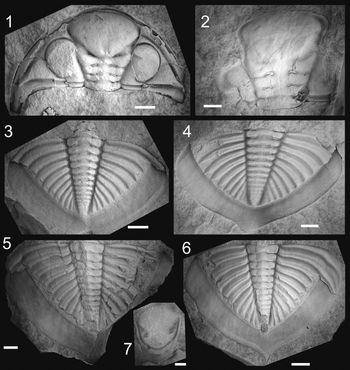
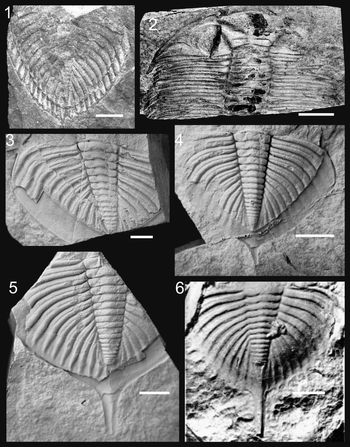
Taking all this into account, we included additional characters to clarify the diagnosis of Kasachstania. Hence, Kasachstania is distinguished from Odontochile, following Budil et al. (Reference Budil, Hörbinger and Mencl2009), on the basis of the anterior branch of the facial suture running next to the frontal lobe instead of anterior to the preglabellar furrow (Fig. 3.1) and the presence of a short preglabellar area that is absent in many species of Odontochile (Figs. 3.1, 4.1, 4.2). In addition, the pygidium of Kasachstania is heart-shaped while in Odontochile it is more elongated (sag.) and with a higher number of axial rings (16–20) and pleurae (13–14).
Kasachstania Maksimova, Reference Maksimova1972 from the Lochkovian of Balkhash, central Kazakhstan. All from the Kockbaital horizon except (6), from the Pribalkhash horizon. (1, 3, 4, 7) The type species Kasachstania saryarkensis (Maksimova, Reference Maksimova1960): (1) internal mold of cephalon, VSEGEI 8597/144, near Sary–Oba mountains; (3) internal mold of pygidium, VSEGEI 8597/145, Kotanbulac Mountains; (4) internal mold of pygidium, VSEGEI 8597/147, Kotanbulac Mountains; (7) internal mold of hypostome, from the same sample of the pygidium in (4). (2, 5, 6) Kasachstania kiikbaica (Maksimova, Reference Maksimova1968): (2) internal mold of cephalon, VSEGEI 8597/177, Kiikbai mountains; (5) internal mold of pygidium, VSEGEI 8597/175, Kiikbai mountains; (6) lectotype, internal mold of pygidium, VSEGEI 8597/173, Kiikbai mountains. Scale bars = 5 mm.

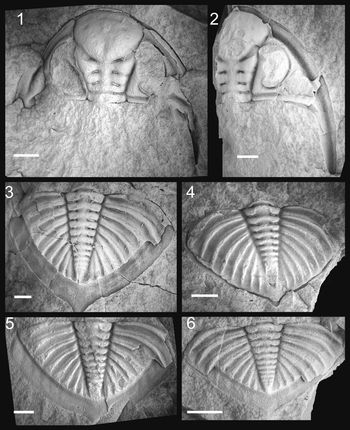
Some specimens of taxa synonymized with Kasachstania saryarkensis (Maksimova, Reference Maksimova1960), from the Lochkovian of the Kockbaital horizon, Balkhash, central Kazakhstan. (1–3) Specimens originally considered K. kasachstanica (Balashova in Maksimova, Reference Maksimova1968): (1) internal mold of cephalon, VSEGEI 8597/156, near Sary–Oba mountains; (2) internal mold of incomplete cephalon, VSEGEI 8597/157, near Sary–Oba mountains; (3) internal mold of pygidium, VSEGEI 8597/158, Kotanbulac mountains. (4–6) Specimens originally considered K. septicostata (Maksimova, Reference Maksimova1968): (4) internal mold of pygidium, VSEGEI 8597/149, Kiikbai mountains; (5) internal mold of pygidium, VSEGEI 8597/150, Kotanbulac mountains; (6) internal mold of pygidium, VSEGEI 8597/153, Kiikbai mountains. Scale bars = 5 mm.

Kasachstania has also been considered close to Dalmanites (Pek and Vanêk, Reference Pek and Vaněk1991). According to the diagnosis of Dalmanites (Richter and Struve in Harrington et al., Reference Harrington and Moore1959), Kasachstania differs in having a very short preglabellar area, a very wide hearth-shaped pygidium, and a higher number of pleural segments, about 8–11 in Kasachstania versus 6–7 in Dalmanites (Figs. 3.3–3.6, 4.3–4.6). Nevertheless, a clear separation is not possible since the diagnosis of Dalmanites has been heavily questioned (Ramsköld, Reference Ramsköld1985), and its revision is beyond of the scope of this work. Campbell (Reference Campbell1977) stated that Odontochile and Dalmanites deserve further taxonomic work, focusing especially on the number of pygidial axial rings, location of facial suture, and doublure width. Until such revision, the relation between Dalmanites and Kasachstania remains unclear.
Recently, Pour et al. (Reference Pour, Popov, Owens, Vinogradova and Klishevich2019) considered Zlichovaspis Přibyl and Vaněk, Reference Přibyl and Vaněk1971 related to Kasachstania. Zlichovaspis could be clearly distinguished by a subtriangular instead of parabolic cephalon, the presence of a short precranial median process, a more subtriangular pygidium with a higher number of axial rings (16–20) and pleurae (12–17), and sculpture of fine to large granules and spines. With these important differences, there is no reason to establish Kasachstania as more similar to Zlichovaspis than any other dalmanitid.
The morphologically closest genus to Kasachstania is probably Reussiana Šnajdr, Reference Šnajdr1987a, originally defined as Reussia Maksimova, Reference Maksimova1972 and later replaced due to a secondary homonymy with Reussia M'Coy, Reference M'Coy1854, a Cretaceous crustacean from England (Šnajdr, Reference Šnajdr1987a). Original diagnostic characters for Reussiana were similar to Kasachstania, including rounded anterior sides and wide doublure of the pygidium. An emended diagnosis was provided by Šnajdr (Reference Šnajdr1987b); accordingly, Reussiana can be distinguished from Kasachstania on the basis of pygidial characters, including more than 15 axial rings strongly elevated medially, a keel-like postaxial ridge, a dorsally concave pygidial border developed after a steep distal inclination of the dorsal convexity toward the border, and more than 11 pleurae that are less curved. Reussiana reussi (Barrande, Reference Barrande1846), the type species and the only species of the genus known from a complete cephalon, shows a rounded and deep posteromedial depression of the frontal lobe and a long (sag.) preglabellar area that clearly differs from Kasachstania.
According to our diagnosis, a number of species previously assigned to Kasachstania should be excluded from this genus.
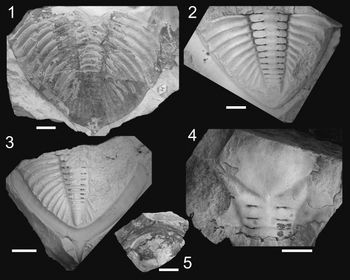
Kozłowski (Reference Kozłowski1923) erected Dalmanites andii on the basis of material originally assigned to Dalmanites maecurua Clarke, Reference Clarke1890 by Steinmann and Hoek (Reference Steinmann and Hoek1912). The illustrations of this material consisted of drawings of a complete specimen and a pygidium. Kozłowski (Reference Kozłowski1923) interpreted the complete specimen as extremely deformed and therefore based the description of D. andii on pygidial characters, including illustrations of two additional pygidia. The illustrated pygidia in these publications present several differences in shape (tr.), curvature and width (exsag.) of pleural bands and furrows, and curvature of the posterior margin, which may indicate tectonic or taphonomic deformation or interspecific variability. The first description of cephalic characters was provided by Swartz (Reference Swartz1925), who assigned an isolated cephalon found among several pygidia apparently similar to those described by Kozłowski. However, Swartz did not provide illustrations of the pygidia, making it impossible to validate the supposed association between cephalon and pygidia. In addition, no repository number was included in any of these publications, and the cephalon was illustrated through a drawing. After that, an isolated cephalon housed at the Smithsonian National Museum of Natural History in Washington, DC, USA (Fig. 5.1, 5.2), was illustrated by Braniša (Reference Braniša1965, plate 9, figs. 1, 2). Pek and Vaněk (Reference Pek and Vaněk1991) determined two new cephala and one pygidium but illustrated only one isolated cephalon (NM–S2111). The Národní Museum of Prague, Czech Republic, provided pictures of a nearly complete unpublished specimen (NM–S4688). The poor preservation does not allow a formal taxonomic identification; moreover, we are not aware that it was revised by Pek and Vaněk (Reference Pek and Vaněk1991). Hence, the only complete specimen of D. andii available is the original drawing of Steinmann and Hoek (Reference Steinmann and Hoek1912). Unfortunately, it is extremely deformed. However, it highlights an ovoid glabellar frontal lobe different from any other cephala assigned. As a result, it is not possible to link the described pygidia of D. andii to any other cephala.
(1–5) Taxa excluded from Kasachstania: (1, 2) Dalmanites andii (Kozłowski, Reference Kozłowski1923) from the upper Silurian of Viloco, schistes de la Cordillera Royale, Bolivia: (1) internal mold of a slightly flattened pygidium, USNM PAL 373947; (2) internal mold of a cephalon and seven thoracic segments, USNM PAL 373946. (3–5) Odontochile pristina Maksimova, Reference Maksimova1968 from the Lochkovian of the Kockbaital horizon, Balkhash, Kazakhstan: (3) internal mold of incomplete pygidium, VSEGEI 8597/159, northwest of the Kiikbai mountains; (4) internal mold of pygidium, VSEGEI 8597/160, near mount Sary–Oba; (5) internal mold of incomplete pygidium, VSEGEI 8597/161, near mount Sary–Oba. (6) Saryarkella radiata Maksimova, 1978: latex of external mold of pygidium, VSEGEI 11091/3, Emsian of the Sardzhal horizon, Sayak mine area, Kazakhstan. Scale bars = 1 cm.

Without the holotype defined, Wolfart (Reference Wolfart1968) selected as lectotype the pygidium of Kozłowski (Reference Kozłowski1923, plate 2, fig. 3); unfortunately, he did not specify repository number.
To shed light on this problem, we looked for the type specimens of Kozłowski in main institutions that might house material of D. andii in their catalogs. The Museo Nacional de Historia Natural de Bolivia in La Paz, Bolivia; the Sorbonne Université in Paris, France; the Université de Rennes 1 in Rennes, France; the Národní Museum in Prague, Czech Republic; the Geozentrum Hannover in Hanover, Germany; the Instytut Paleobiologii Polska Akademia Nauk in Warsaw, Poland; the Smithsonian National Museum of Natural History in Washington, DC, USA; and the American Museum of Natural History in New York City, USA, confirmed that they do not house the type material. An incomplete pygidium (MNHN.F.B05830) housed at the Muséum national d'Histoire naturelle in Paris, France, is cataloged as a paralectotype of this species. However, this pygidium was not mentioned or illustrated in any publication. Because of these statements, the original type material of Kozłowski (Reference Kozłowski1923) is herein considered probably lost.
Hence, the assignment of D. andii to Kasachstania by Pek and Vaněk (Reference Pek and Vaněk1991) is poorly supported, being based only on the ‘similar structure of its exoskeleton’ and a comparison between D. andii and K. saryarkensis. Besides the issues hindering the definition of D. andii, all assigned specimens differ from Kasachstania in having a pointed glabellar frontal lobe (described as ‘subpentagonal’ by Swartz, Reference Swartz1925); an S1 particularly deep, close to the axial furrow (Fig. 5.2); a subtriangular pygidium instead of a heart-shaped outline; 18–19 pygidial axial rings (versus 11–15); 13–14 pleural segments (versus 11–12); pleural bands nearly straight; and a moderately wide doublure, as was pointed out by Edgecombe and Ramsköld (Reference Edgecombe and Ramsköld1994) and inferred by Braniša (Reference Braniša1965; Fig. 5.1). We therefore exclude D. andii from Kasachstania. A revision of Bolivian collections and new material would be necessary to definitely solve the taxonomy of D. andii. Presently, the original drawings (probably idealized in part) and a poorly preserved cephalon that cannot be reliably linked to a pygidium do not allow such study.
The assignment of ‘Kasachstania’ gerardoi from the lowermost Devonian of the Catavi Formation of Bolivia and the upper Silurian of Argentina, by Edgecombe and Ramsköld (Reference Edgecombe and Ramsköld1994), was based on pygidial similarities with Kasachstania kiikbaica and cephalic similarities with D. andii. However, ‘Kasachstania’ gerardoi, in contrast with D. andii, is based on well-preserved original material. ‘Kasachstania’ gerardoi differs from Kasachstania by a pointed anterior cephalic margin; a subrhombic glabellar frontal lobe; a depressed area of the pygidium approximately coincident with the interior margin of the doublure; pleural bands becoming progressively less expressed distally, defining a wider pygidial border; and narrower pygidial doublure (tr.). In addition, the shape of the pygidium is more elongated (sag.) and without a clear heart-like shape. This species is therefore also excluded from Kasachstania.
Dalmanites andii and ‘K.’ gerardoi, in turn, were considered similar, with their main differences at the pygidium (Edgecombe and Ramsköld, Reference Edgecombe and Ramsköld1994). They consist of fewer pygidial rings and pleurae, more sinuous pleural bands, and wider doublure in ‘K.’ gerardoi.
These similarities suggest that ‘K.’ gerardoi and at least some specimens assigned to D. andii might belong to the same (and undescribed) genus, closely related to Kasachstania. However, D. andii is extremely difficult to define, as stated previously, and its eventual inclusion in a new genus depends on a complete revision of the assigned specimens.
Odontochile ulrichi and Odontochile asiatica do not conform to the proposed diagnosis of Kasachstania in having a proportionally longer pygidium, subtriangular instead of heart-shaped in outline; pleurae that tend to be evenly curved instead of having a sinuous shape; anterior pleural bands nearly reaching the pygidial margin showing a gentle sinuosity; and more than 15 axial rings (Fig. 6.1–6.3). In particular, O. asiatica has nearly no pygidial interpleural furrows expressed and exhibits a much longer (sag.) terminal spine than Kasachstania (Fig. 6.2, 6.3), while O. ulrichi has more than 11 pygidial pleurae and a much longer (sag., exsag.) preglabellar area (Fig. 6.1, 6.5). As a result, these taxa are excluded from Kasachstania. Both subspecies were grouped solely on the basis of a similar pygidial axis width (tr.) and pygidial pleural shape. Differences between O. ulrichi and O. asiatica previously reported include the near absence of interpleural furrows and a distinct number of pygidial pleurae in O. asiatica (Maksimova, Reference Maksimova1968). In addition, we observed that the pygidium of O. asiatica is proportionally longer, with deeper and wider intrapleural furrows and a delicate ridge-like dorsal surface on the anterior margins of the anterior pleural bands, which is completely absent in O. ulrichi. Thus, O. asiatica and O. ulrichi are interpreted here as two different species. Furthermore, they might belong to distinct genera. O. ulrichi would conform to the taxonomic concept of Odontochile (Fig. 6.1, 6.5). However, O. asiatica most closely resembles the subgenus Odontochile (Pacifina), registered in the same stratigraphic interval and area. In particular, Odontochile (Pacifina) arcuata Maksimova, Reference Maksimova1968 is the most similar species of this subgenus according to the pygidial shape, pleural bands, and furrow curvature, the number of axial rings, and the strongly straight S1 (Fig. 6.4). However, despite these similarities, O. asiatica does not match all the requirements of the subgeneric diagnosis of Odontochile (Pacifina), as defined by Maksimova (Reference Maksimova and Rzhonsnitskay1978b), in having a terminal spine and fewer axial rings (Fig. 6.2, 6.3). Furthermore, there appears to be a problem with the definition of O. (Pacifina) since at least two other species of this subgenus, O. (Pacifina) carinata and O. (Pacifina) pratteni (Roy, Reference Roy1933), clearly show a caudal spine. Hence, a revision and emended diagnosis of O. (Pacifina) is necessary to reassess its subgeneric status and resolve its taxonomic relationship with O. asiatica.
Taxa excluded from Kasachstania: (1, 5) Odontochile ulrichi Delo, Reference Delo1940 from south slope of Brush Peak, Eureka District, Nevada, USA, USNM PAL 13996, Emsian: (1) internal mold of pygidium; (5) internal mold of frontal lobe and margin; (2–4) Odontochile asiatica Maksimova, Reference Maksimova1968, from Sardzhal horizon, Balkhash, Kazakhstan, Emsian: (2) internal mold of a damaged pygidium, VSEGEI 8597/182, near the Akkuduk well; (3) internal mold of pygidium, VSEGEI 8597/180, the area of the Bala well; (4) internal mold of incomplete cephalon, VSEGEI 8597/181, Sayak mine area. Scale bars = 1 cm.

Odontochile pristina is distinguished from Kasachstania by the presence of a large caudal spine, higher number of pygidial rings (18 versus 11–15), a proportionally elongated (sag.) pygidium (not heart-shaped) with abrupt changes of curvature in the anterolateral sides (not rounded), a wider (tr.) axis, and pleurae strongly curved posteriorly (Fig. 5.3–5.5). Consequently, O. pristina is excluded from Kasachstania. Despite differences in size and scarcity of material, we believe that it might belong to Odontochile. Recently, Pour et al. (Reference Pour, Popov, Owens, Vinogradova and Klishevich2019) considered material of O. pristina insufficient to justify a formal generic assignation.
Some specimens from the Lower Devonian of Argentina were reported as Kasachstania? sp. by Rustán (Reference Rustán2011, 2016, p. 5, fig. 6). A preliminary revision of this material suggests clear differences from Kasachstania, and therefore they are excluded from this genus. The taxonomic study of such specimens is in progress to be reported in a forthcoming work.
Dalmanites lingulifer was revised in detail by Campbell (Reference Campbell1977) and reassigned to Huntonia Campbell, Reference Campbell1977, an endemic genus of North America. Later, this genus was found to be a junior homonym of the isopod Huntonia Vandel, Reference Vandel1973 and was replaced with Huntoniatonia Jell and Adrain, Reference Jell and Adrain2003. On the basis of new material, Campbell (Reference Campbell1977) rejected any relationship with Kasachstania, as was suggested before by Maksimova (Reference Maksimova1972), due to the long, simple anterior cephalic process, which Campbell considered as a diagnostic character of Huntoniatonia. Additional differences with Kasachstania involve the presence in Huntoniatonia of a subrhombic glabellar frontal lobe, deeper S1 and S2 at the contact with the axial furrow, a more elongated (sag.) pygidium, a wider (tr.) pygidial axis, and a long (sag.) terminal spine, twice as long as the pygidium. On the basis of these features, we agree with Campbell that H. lingulifer is excluded from Kasachstania.
Dalmanites illinoisensis is known only from its pygidium. Characters distinguishing it from Kasachstania include a tendency to be subtriangular, proportionally smaller and rounded anterolateral sides, a wide (tr.) and well-defined pygidial border, and a longer (sag.) caudal spine with a dorsal postaxial ridge. We agree with Delo (Reference Delo1940), who stated that the generic assignment of D. illinoisensis needed further study because its wide (tr.) border, elongated (sag.) spine, and larger size differentiate it from all other North American dalmanitids.
Dalmanites rutellum can be distinguished from Kasachstania on the basis of an extended preglabellar area, an anterior cephalic margin interrupted by a slight, well-rounded anterior protuberance, S1 in clear contact with the axial furrow where it is deeper, an elongated (sag.) pygidium, and pygidial pleurae strongly curved posteriorly.
Recently, Pour et al. (Reference Pour, Popov, Owens, Vinogradova and Klishevich2019) erected Kasachstania alperovichi from the Early Devonian of west Balkhash, Kazakhstan. This species does not conform to the proposed diagnosis of Kasachstania in having a subpentagonal glabellar frontal lobe, a distinct and longer (exsag.) postocular area, a more subtriangular pygidium, and fewer axial rings and pleurae. They made a comparison with Odontochile pristina, and ‘K.’ alperovichi differs in having a more subtriangular outline, narrower pygidial pleurae, faint interpleural furrows, and longer caudal spine with a robust base. ‘Kasachstania’ alperovichi most closely resembles Dalmanites as it shares the facial suture running very close to the frontal lobe of the glabella.
Kasachstania saryarkensis (Maksimova, Reference Maksimova1960)
Figures 3.1, 3.3, 3.4, 3.7, 4.1–4.6
1960 Dalmanites saryarkensis Maksimova, p. 272, 376, pl. 55, figs. 8, 9.
1968 Dalmanites kasachstanicus; Balashova in Maksimova, p. 90, pl. 9, fig. 2, pl. 22, figs. 6–8, pl. 27, figs. 5, 6.
1968 Dalmanites kazachstanicus; Balashova in Maksimova, p. 89 [Lapsus calami]
1968 Dalmanites septicostatus; Maksimova, p. 88, pl. 22, figs. 1–5.
1972 Odontochile (Kasachstania) saryarkensis; Maksimova, p. 81.
1972 Odontochile (Kasachstania) kasachstanica; Maksimova, p. 81.
1972 Odontochile (Kasachstania) septicostata; Maksimova, p. 81.
1975 Odontochile (Kasachstania) kazachstanica; Lespérance, p. 100. [Lapsus calami]
1975 Odontochile (Kasachstania) septicostata; Lespérance, p. 99.
1991 Dalmanites (Kasachstania) saryarkensis, Pek and Vaněk, p. 85.
1994 Kasachstania saryarkensis; Edgecombe and Ramsköld, p. 403.
Holotype
An incomplete pygidium, VSEGEI 9112, No. 18. Figured by Maksimova (Reference Maksimova1960, table 55, fig.9).
Diagnosis
Kasachstania with 11–12 pygidial axial rings and 8–9 pleural furrows; pleural sinuosity barely expressed, pleurae tending to be evenly curved. Pygidial inter-ring furrows wide (sag., exsag.) with deep adaxial apodemal pits. Interpleural furrows slightly impressed.
Occurrence
Lochkovian, Northeast of Balkhash city, Karazhirik horizon, Kotanbulac mountains, area of the Bala Well and Kiikbai mountains, central Kazakhstan.
Remarks
Only one hypostome (Fig. 3.7) is considered to possibly belong to K. saryarkensis (Maksimova, Reference Maksimova1968) although without attachment to any cephalon. Therefore, its characters are not included in the diagnosis. This hypostome is elongated (length-to-width index approximately 1.36), tending to be sub-oval. The anterior part is incompletely known, so the wings could not be described. The middle furrow is deep anterolaterally up to a strong posteromedial macula. The lateral margin is slightly concave anteriorly, converging gently backward up to a distinct lateral projection near the macula, then again concave up to the other lateral projection in the posterior part of the lateral border, and finally converging gently toward the spiny posterolateral junction with the posterior margin. The outline of the posterior margin is convex, and a conspicuous median spine is directed backward. The posterior border furrow is convex with a slightly pointed middle part. The posterior border has a medial convex depression. Five denticles in the posterior part are mentioned in the original description (Maksimova, Reference Maksimova1968), but only one can be observed and two might be inferred.
Several described species are herein considered synonyms of Kasachstania saryarkensis. The differences mentioned by Maksimova (Reference Maksimova1968) between K. saryarkensis and K. kasachstanica are related mainly to the pygidium. Kasachstania kasachstanica has a wider axis (approximately 0.25 times the maximum pygidial width versus 0.23–0.24 in K. saryarkensis) and a shorter pygidium (length-to-width index approximately 0.63 versus 0.68) with fewer axial rings (11 versus 12) and pleurae (8 versus 9). Maksimova (Reference Maksimova1968) stated her concerns about these differences, which might be intraspecific. We also consider them too subtle to support a specific distinction. In addition, one pygidium assigned to K. kasachstanica (VSEGEI 8597 No. 158; Fig. 4.3) has a length-to-width index of approximately 0.8 compared to the 0.63 index of the type material, supporting an intraspecific variation. Additional differences mentioned by Maksimova (Reference Maksimova1968) include the maximum width (tr.) of the pygidial doublure in K. kasachstanica (which should occur at the level of the seventh–eighth ring, while at the fifth–sixth in K. saryarkensis), a transition between posterior border and genal spines more angulated than in K. saryarkensis, and S1 and S2 in contact with axial furrows. In our opinion, these additional differences might be explained by taphonomy since the maximum width of pygidial doublure (as specified by Maksimova, Reference Maksimova1968) might depend on preservation, and the illustrated cephalon of K. saryarkensis (Fig. 3.1) is probably deformed, modifying the proportions of the glabella and making it look wider. In addition, no significant differences are recognizable in S1 and S2. Considering that all specimens come from the same locality and layers, we consider K. kasachstanica a junior synonym of K. saryarkensis.
Kasachstania septicostata is known from 24 pygidia (five illustrated). It is also very similar to K. saryarkensis but with narrower (exsag.) pleurae and wider and deeper pleural furrows (Fig. 4.4–4.6). However, all specimens assigned to K. septicostata are small-sized and share locality and bearing layers with K. saryarkensis. Hence, we interpret them as probable juveniles of this species, differences being ontogeny-based. Preliminarily, we report the specimens formerly assigned to K. septicostata as K. saryarkensis?. Such specimens might eventually shed light on the ontogeny of these dalmanitids, an aspect greatly overlooked.
Kasachstania kiikbaica (Maksimova, Reference Maksimova1968)
Figure 3.2, 3.5, 3.6
1968 Odontochile kiikbaica Maksimova, p. 97, pl. 24, figs. 1–5.
1972 Odontochile (Reussia) kiikbaica; Maksimova, p. 82.
1975 Odontochile (Reussia) kiikbaica; Lespérance, p. 100.
1994 Kasachstania kiikbaica; Edgecombe and Ramsköld, p. 403, 405, 407.
Holotype
An incomplete pygidium, VSEGEI 8597, No. 173, figured by Maksimova (Reference Maksimova1968, table 24, fig. 1) and herein (Fig. 3.6).
Diagnosis
Kasachstania with 15 pygidial axial rings tending to be inflated medially and 10 pleural furrows; pleural sinuosity well expressed. Pygidial inter-ring furrows narrow (sag., exsag.) with shallow adaxial apodemal pits. Interpleural furrows well expressed. Anterior pleural bands inflated at level of inner margin of doublure.
Occurrence
Lochkovian–Pragian, Northeast of Balkhash city, Kockbaital and Pribalkhash horizons, Kiikbai and Kockbaital mountains, and the area of the Bala Well, central Kazakhstan.
Remarks
A diagnosis is provided for this species for the first time. Kasachstania kiikbaica was originally assigned to Reussiana by Maksimova (Reference Maksimova1972). However, in the revision of this genus, Šnajdr (Reference Šnajdr1987b) did not discuss K. kiikbaica. Later, Edgecombe and Ramsköld (Reference Edgecombe and Ramsköld1994) assigned K. kiikbaica to Kasachstania based mainly on similarities with ‘Kasachstania’ gerardoi. Here the taxonomic assignment to Kasachstania is supported but on the basis of the emended diagnosis and comparisons with the type species.
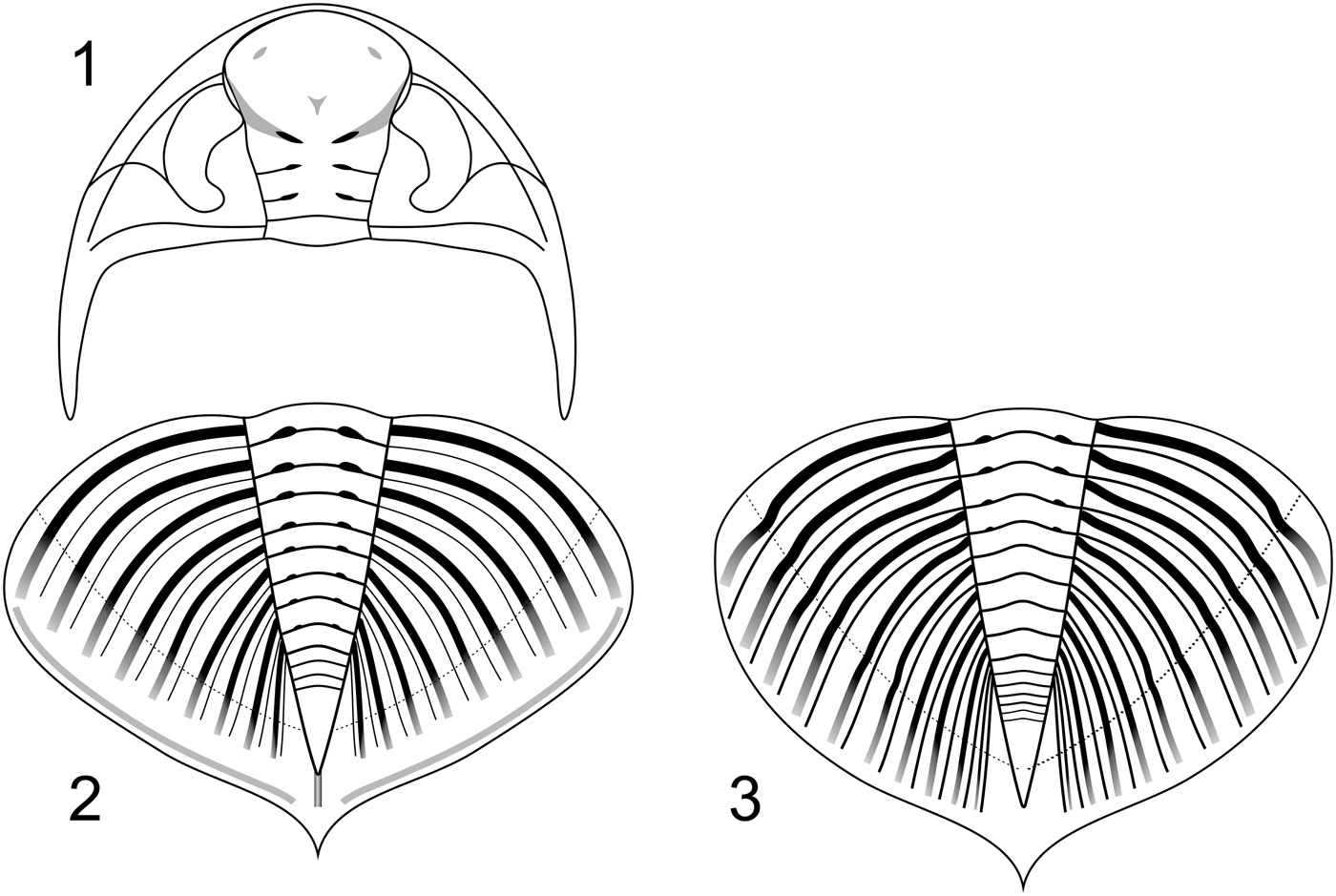
Kasachstania kiikbaica is distinguished from K. saryarkensis by the presence of 15 axial rings (versus 11–12), 10 pleurae (versus 8–9), more sinuous pleurae, narrower inter-ring furrows (sag.) with shallower apodemal pits, deeper interpleural furrows, axial rings that tend to be inflated, and anterior pleural bands with a distal inflation (Figs. 3.5, 3.6, 7). Kasachstania kiikbaica appears to have a narrower pygidial axis, but scarce and poorly preserved material hinders further precisions.
Schematic drawings of the two species of Kasachstania Maksimova, Reference Maksimova1972 based mainly on their type specimens: (1, 2) Kasachstania saryarkensis (Maksimova, Reference Maksimova1960): (1) cephalon after VSEGEI 8597/144; (2) pygidium after VSEGEI 9112/18. (3) Kasachstania kiikbaica (Maksimova, Reference Maksimova1968): pygidium after VSEGEI 8597/173. Terminal part of pygidial axis idealized because of incomplete specimens. Dashed line indicates inner margin of pygidial doublure. Slight differences in shape of pygidia might reflect different orientation of specimens in the original photographs.

Genus Saryarkella Maksimova, Reference Maksimova and Rzhonsnitskay1978b
Figure 5.6
Type species
Saryarkella radiata Maksimova, Reference Maksimova and Rzhonsnitskay1978b, from the Lower Devonian, Emsian, Sardzhal horizon of Northeast Balkhash city, Sayak mine area, central Kazakhstan.
Diagnosis
Translated and adopted from Maksimova (Reference Maksimova and Rzhonsnitskay1978b): pygidium flat, almost semicircular. Axis rapidly narrowed back, with 16 rings, behind which an undifferentiated tail passes into a rounded keel, ending with a long spine. Pleurae with 10 pairs of posteriorly directed ribs; the first pairs bear weak traces of pleural furrows; their posterior pleural bands vanish near the pygidial margin. The narrow pygidial margin has flat, posteriorly directed spines, corresponding to the width of the pleurae.
Remarks
The monospecific genus Saryarkella was not mentioned in any publication after its original erection. It is known only from one pygidium (VSEGEI 11091, No. 3; Fig. 5.6), which shows a robust caudal spine and conspicuous marginal spines, a combination that differentiates it from any other mature dalmanitid holaspid. Marginal pygidial spines are rare among dalmanitids. They are present in Coronura Hall and Clarke, Reference Hall and Clarke1888 and Chacomurus Braniša and Vaněk, Reference Braniša and Vaněk1973, but these closely related taxa are characterized by a median embayment in the posterior margin of the pygidium (without a caudal spine), developed between two lateral spines. Saryarkella, by contrast, is unique in having a typical dalmanitid pygidial shape with well-developed lateral and caudal spines located at the same (dorsoventral) level of the pygidial margin. Equivalent marginal spines were found in some meraspids and early holaspids of different dalmanitids such as Odontochile, Dalmanites, Zlichovaspis, and Songxites Lin, Reference Lin1981 (Whittington and Campbell, Reference Whittington and Campbell1967; Vaněk, Reference Vaněk1996; Budil et al., Reference Budil, Hörbinger and Mencl2009). Erbenochile Alberti, Reference Alberti1981, a genus considered related to Dalmanitids (Bignon and Crônier, Reference Bignon and Crônier2014), has marginal spines that continued from the posterior pygidial pleural bands. This kind of marginal spine is not found in any dalmanitids, being larger and more robust than Saryarkella, Coronura, and Chacomurus. The evolutionary context, morphofunctional, and ecological implications of spinosity in dalmanitids remain unclear. It might be assumed that this spinosity is driven by heterochrony, and it probably plays a defensive role, particularly in early ontogenetic stages. The striking pygidial spines of Saryarkella would suggest a defensive function also in mature holaspids.
Discussion
The Devonian trilobites from central Kazakhstan appeared to be cosmopolitan, according to the first-reported taxonomic lists, since the bulk of them (reported mainly by Maksimova) were included in classic genera reported virtually worldwide (Dalmanites, Odontochile, Phacops Emmrich, Reference Emmrich1839, and so on). However, after a number of taxonomic reappraisals, these classic genera were separated into several new taxa with a more restricted distribution. Similarly, all species from Kazakhstan previously assigned to Reussiana and the phacopid Paciphacops Maksimova, Reference Maksimova1972 were questioned in their generic assignment because of the poor original material and absence of diagnostic characters. As a result, the presence of these two widely distributed genera is currently putative in Kazakhstan (Šnajdr, Reference Šnajdr1987b; Ramsköld and Werdelin, Reference Ramsköld and Werdelin1991; Budil et al., Reference Budil, Hörbinger and Mencl2009). In the case of Kasachstania, the material was considered enough to support the genus, conformed with two endemic species.
Hence, these new insights suggest that trilobites from the Devonian of Kazakhstan support a more endemic signature than previously thought. This pattern coincides with the clearly endemic Early Devonian brachiopod fauna from Balkhash, which share only a few genera with the Siberian plate, the main paleogeographic neighbor with similar climatic settings (Wang et al., Reference Wang, Zhao, Li and Zong2013). Nevertheless, recently Pour et al. (Reference Pour, Popov, Owens, Vinogradova and Klishevich2019) commented on the presence of shared homalonotid trilobites between west Balkhash and Australia. They related the two faunas with Kasachstania in Balkhash and Zlichovaspis in Australia, considered by them as related dalmanitids. This similarity is discussed before in this current work and is not considered well supported. In addition, they remark on a relation of the brachiopods of west Balkhash with the Rhenish–Bohemian Province. Dowding and Ebach (Reference Dowding and Ebach2019), however, commented that a faunal relation between the Ural region as a whole and the Gondwana basins was a novelty of Middle–Late Devonian.
It is worth mentioning that the complex paleogeographic history of the basins in the Early Devonian paleogeographic evolution of the tectonic terranes involved in the present central Kazakhstan, as commented on previously, could certainly have favored isolation and speciation, promoting rising biogeographic barriers and vicariance.
Acknowledgments
We thank the Alexander Petrovich Karpinsky Russian Geological Research Institute (St. Petersburg, Russia), the Smithsonian National Museum of National History (Washington, DC, USA), and the Národní Muzeum (Prague, Czech Republic) for allowing us to use photographs of material and for valuable help with information about the different species revised. J.L. Ortiz and R. Andrade (Museo Nacional de Historia Natural de Bolivia) helped with information about the material studied. I. Gogin (Alexander Petrovich Karpinsky Russian Geological Research Institute) and B. Young (Smithsonian National Museum of National History) contributed by taking photographs included in this work. P. Budil (Czech Geological Survey) provided additional pictures of specimens. N. Madelon translated publications in Russian. M. Rogov provided contacts with Russian museums. P. Yaciuk edited the map for Figure 1. S. Druetta offered technical support in handling pictures. The Consejo Nacional de Investigaciones Científicas y Técnicas (CONICET) and the Universidad Nacional de Córdoba provided support and facilities used in this investigation. This is a contribution to PUE 2016–CONICET–CICTERRA. Financial support was provided by University of La Rioja (projects PIC) and the Agencia Nacional de Promoción Científica y Tecnológica (ANPyT–FONCYT) project BID PICT–2017–3095 granted to J.J. Rustán.