

1. INTRODUCTION
Real wages are one of the most versatile instruments in the economic historian’s toolkit. Although they have limitations, ratios of nominal wages to the cost of a basket of goods provide a transparent way to gauge standards of living and how they vary across time and space. By using a clear theoretical framework, they allow us to make sense of the sometimes-scant data available to study the human past, hence providing — as the well-known Spanish saying states — «una de cal y otra de arena» (one [measure] of quicklime and another of sand): a solid foundation resulting from the combination of two very different, weaker elements on their own.
2. REAL WAGES IN THE GREAT DIVERGENCE DEBATE
There is an enduring interest among historians and economists as to why some countries are rich and others poor. This interest has manifested in different ways over the years. Within economic history, research of a half a century ago typically framed the question in terms of specific case studies, such as why England had an Industrial Revolution instead of France (e.g. Hartwell Reference Hartwell1967), or what explains the long-term decline of Imperial Spain (e.g. Elliott Reference Elliot1963). In the last few decades, however, this enquiry has taken on a global dimension, and increasingly poses the question of why Europe pulled ahead of the rest of the world (e.g. North and Thomas Reference North and Thomas1973; Jones Reference Jones1981; Bairoch Reference Bairoch1988; Diamond Reference Diamond1998; Landes Reference Landes1998; Allen Reference Allen2009). The Great Divergence debate (Pomeranz Reference Pomeranz2000), trying to explain how and why Western Europe escaped from centuries of stagnation leaving other parts of the world behind, is undoubtedly one of the liveliest in the discipline these days.
A crucial upshot of this debate has been a renewed interest in assessing exactly how well different regions performed in terms of income in the long run. Because the most natural measure to use, the gross domestic product (GDP), faces serious limitations for historical studies due to the heavy demand on very detailed data, and work on other types of information such as anthropometric measures is still evolving (Salvatore et al. Reference Salvatore, Coatsworth and Challú2010; Dobado González and García Montero Reference Dobado González and García Montero2014), various scholars advocate the construction and use of real wages indexes (e.g. van Zanden Reference Van Zanden1999; Allen Reference Allen2001).
Real wages are particularly appealing for the study of income in the past in at least three senses. First, they provide an intuitive way of looking at standards of living, very much related to the now widely known concept of the poverty line (Allen Reference Allen2013), as used in the World Bank’s «wretched dollar» now familiar in the development literature (e.g. Deaton Reference Deaton2006). The fundamental idea is that a person who earns a living spends his/her salary on a certain number of basic goods such as food, clothing or fuel, and his/her welfare depends on how many of those goods he/she can purchase. If one has information on wages and the prices of a basket of goods typically available in that place, one can get an idea of whether that income is enough for basic subsistence by calculating the ratio between the wage and the cost of that hypothetical basket. Second, given that the main inputs to estimate this ratio are nominal wages and prices, data availability is less of a problem than with the GDP. Prices of goods and labour appearing in the accounting books of long-lasting institutions like hospitals, churches or universities are arguably the oldest continuous objective economic data in existence, and because little could be gained from the destruction of such documents, many survived wars and political upheavals (Hamilton Reference Hamilton1944). Lastly, the construction of real wage estimates can incorporate many local subtleties. The definition of the basket, for instance, can integrate information on eating habits, caloric needs associated with typical work performed in the region, or clothing and housing needs or customs. In this way real wages end up being a truly comparative quantitative measure that incorporates qualitative information.
The Great Divergence debate has profited from this approach by showing how the standard of living diverged within Europe (van Zanden Reference Van Zanden1999; Allen Reference Allen2001), Northern Europe — especially London — pulling ahead somewhere in the 18th century, and how the rest of the world seems to have followed a similar pattern of the worst performers in Europe, contributing to the discussion of why those patterns came to be (e.g. Clark Reference Clark2008, Allen Reference Allen2009; van Zanden Reference Van Zanden2009; Parthasarathi Reference Parthasarathi2011). Although this research on standards of living has indeed been framed as global in emphasis and scope, most work focuses on selected Eurasian cities (e.g. Broadberry and Gupta Reference Broadberry and Gupta2006; Pamuk, Reference Pamuk2007; Allen et al. Reference Allen, Bassino, Ma, Moll‐Murata and Van Zanden2011a). The most prominent omission in this literature was certainly that of the New World. It is clear now that by the late 19th century the North American economy had overtaken Europe in income and productivity (Broadberry Reference Broadberry1997), and that Latin America was already lagging behind both of them (Edwards et al. Reference Edwards, Esquivel and Marquez2007), yet we know little about when, how, and why this happened. The contrasting experiences of North and South America, for example, have been particularly puzzling. Both regions had many commonalities, including an abundance of land and natural resources, and openness to immigration and capital imports. Yet they still had very different trajectories of development (Engerman and Sokoloff Reference Engerman and Sokoloff1997, Reference Engerman and Sokoloff2002), which we could understand better if we knew when and how incomes diverged between the north and the south and between the Americas and Europe (Prados de la Escosura Reference Prados De La Escosura2007). Also, many participants in the Great Divergence debate believe that the creation of the Atlantic economy and the establishment of European colonies in the Americas in the seventeenth and eighteenth centuries played an important role in explaining the success of Great Britain (e.g. Pomeranz Reference Pomeranz2000; Acemoglu et al. Reference Acemoglu, Johnson and Robinson2005). However, Spain and Portugal also had American colonial empires and yet fell dramatically behind.
It is this omission that our recent paper in the Journal of Economic History (Allen et al. Reference Allen, Murphy and Schneider2012) tried to fill. There we provide one of the first systematic approaches to study the standards of living in the Americas as measured using the now familiar «welfare ratios»Footnote 1 . Welfare ratios are real wage estimates built using a basic subsistence (barebones) basket for a small family; hence, a value of one indicates that such a family achieves just subsistence (equivalent to the World Bank poverty line of one dollar per day) and values higher than that allow either sustaining a larger family or consuming more (or better) goods. We then collected information from various secondary sources on prices and nominal wages since colonisation for six cities/regions in the continent (Boston, Philadelphia, the Maryland area, Mexico, Bogota and Potosi) and with these data we constructed welfare ratio series for unskilled free workers for each place. Our results suggested that standards of living diverged in the Americas quite early following European colonisation, the Northern colonies achieving levels comparable to (and even surpassing) those of the top performers in Europe. Spanish America, on the other hand, fared not too different from other parts of the world and, in particular, the evidence available on Spain. These findings led us to hypothesise that there was probably some level of integration between the European powers and their colonies.
3. NOT POOR, NOR SHORT
Dobado is an optimist, and thinks that those results are seriously misleadingFootnote 2 . According to him, the inhabitants of colonial Spanish Latin America did very well, as living standards were not far behind the rest of the world. His reading of the evidence on wages and prices is that workers in Mexico, Bolivia and Argentina were as well off as (or even better than) those in leading European countries in the seventeenth and eighteenth centuries. This seems to be reinforced by information on heights, as the data he surveys suggest that Spanish American were taller than many Europeans. This interpretation leads Dobado to cast doubts on «pessimistic» narratives (Engerman and Sokoloff Reference Engerman and Sokoloff1997, Reference Engerman and Sokoloff2002; Acemoglu et al. Reference Acemoglu, Johnson and Robinson2001, Reference Acemoglu, Johnson and Robinson2002) that emphasise the negative impact of the colonial status on the region. At the core of Dobado’s argument is the idea that reconstructing price baskets for historical periods is a deeply flawed methodology, so we can better compare international performances combining information from wages based on one commodity (silver, grain, meat and sugar wages) and anthropometric information, what Dobado refers to as the Dobado-García approach (Dobado González and García Montero Reference Dobado González and García Montero2014)Footnote 3 .
4. SEARCHING FOR THE BEST REAL WAGE COMPARISON
Much of Dobado’s argument circles around the idea that estimating welfare ratios has too many flaws and we are better off sticking to single goods ratios or, to follow the quicklime and sand analogy used earlier, we are better of going back to mud. We do not share this view. Some issues are contentious, but we believe many of the points he raises are indeed valid and need to be discussed extensively if we want to construct measures that allow us to improve our understanding of how standards of living evolved in a global perspective. But, in any case, we certainly fail to see how most of those criticisms can imply the so-called Dobado-García approach provides a better alternative.
Although it has been done elsewhere, it is probably useful at this stage to make clear and explicit what the methodology we are using does. Comparisons of cost of living have been taking place always (van Zanden Reference Van Zanden1999), but the publication of the paper by Allen (Reference Allen2001) marks the time in which the discussion took a new direction. The proposal there was to present the information in terms of welfare ratios that have a very specific meaning. The basic idea is incorporated in this relationship:
 $${\rm Real}\,{\rm wage}={{w_{t} {\times}d_{t} } \over {b_{t} {\times}h_{t} {\plus}r_{t} }}$$
Here w t is the daily wage and d t the amount of days worked in a year, so the numerator indicates the total nominal yearly income of the labourer. The denominator is of course supposed to reflect somehow the purchasing power of that income, so it incorporates the cost of a basic basket of goods (b t ) scaled by the household size (h t ) and the cost of lodging (r t ). The cost of the basket is determined by the product of two vectors, one of prices and one of quantities:
 $$b_{t} ={\bf p'}_{t} {\times}{\bf q}_{t} $$
Where each vector is composed of a series of elements, typically corresponding to food and non-food products:
 $${\bf p}_{t} =\left( {\matrix{ {{\bf p}_{t}^{{{\rm nf}}} } \cr {{\bf p}_{t}^{{{\rm nf}}} } \cr } } \right)\quad {\bf q}_{t} =\left( {\matrix{ {{\bf q}_{t}^{{{\rm nf}}} } \cr {{\bf q}_{t}^{{{\rm nf}}} } \cr } } \right)$$
It follows directly from this brief description that each individual element is crucial to interpret the welfare ratio (1), and even if reliable sources existed for all of them, the researcher will always have to exercise a certain level of discretion. This is particularly the case for the vector q t . Which basket should we select? The one typically purchased by the worker being paid w t ? «Typical» as in mean or in mode? But perhaps the typical is not as informative as the cheapest, as the latter will really give us a sense of the limitations of the salary. If this is the case, the cheapest basket will probably still require certain minimum amounts of some goods. How to define those? Similar problems are faced with the other components of the relationship, and this is important because — by construction — the choice of w t , d t , r t , h t , p t , or q t will determine the ranking among ratios corresponding to different periods or places. Dearth of data only makes the exercise more complicated, forcing the researcher to make different assumptions along the way, so those real wages are comparable across time and space. It is important to note that any choice will lead to some sort bias, yet estimations can be more or less comprehensive, more or less transparent, and hence, more or less comparable.
With this basic framework in mind, one can see clearly the main critiques to our approach suggested by Dobado-González (Reference Dobado-González2015):
-
i. The vector q t is unsuitable because
-
a. It is fixed across space: «Allen et al. (Reference Allen, Murphy and Schneider2012) rely on an arguable premise: the identity of consumption pattern across the world» (p. 37).
-
b. It is incomplete, as it does not include all the relevant elements, such as those coming from the Columbian exchange (pp. 38-39).
-
c. It is fixed across time: «the very notion of an immutable consumption basket during the whole viceregal period conflicts with substantial evidence» (p. 40).
-
-
ii. All the other numbers in the relationship are also problematic because they are fixed across time and space:
-
a. The working days, d t : «A universal estimate of yearly working days is not consistent with the variety of labor practices existing in different economic sectors (…) and their likely long-term change» (p. 40).
-
b. The household size, h t : «It seems reasonable to expect that the number of family members changed in response to economic conditions and evolved over its life cycle» (p. 41).
-
c. The cost of rent, r t : «The across the board 5-per cent allowance for rent might also be misleading, since, presumably, it penalizes rural living standard and less dynamic towns over the Early Modern Era» (p. 42).
-
-
iii. It is very hard to get a series of vectors p t : «Far from minor is the problem that Allen’s methodology is very data demanding» (p. 43).
Having accepted these criticisms, Dobado argues that we should revert to the earlier method of calculating wages relative to the prices of specific goods. We find this argument to be seriously flawed for a number of reasons, especially because the empirical strategy he proposes entirely ignores his own criticisms (i) and (ii), and only really deals with (or dodges) problem (iii) above. But rather than providing a litany of counterpoints to Dobado’s critique above, we would like to focus our discussion on the benefits of constructing baskets of prices when comparing wages across countries.
Until relatively recently, basically because many scholars agreed with criticism (iii) above, most of the comparisons in terms of standards of living were done using single product comparisons, typically expressing the amount of wheat or other grains that could be purchased with an annual salary (van Zanden Reference Van Zanden1999). Scholars constructed grain wages because grain prices were readily available and represented one of the most uniform products that could be compared. However, several steps of scholars have moved away from this methodology. First, Phelps-Brown and Hopkins (Reference Phelps-Brown and Hopkins1981) calculated multi-product cost of living indices to measure real wage trends in various European cities over time. Later, Allen (Reference Allen2001) proposed a standardised basket and calculated real wages that were comparable across space as well as over time. In this way, real wages provided a more realistic and meaningful measure of living standards and economic performance than the earlier grain wages. In addition, Allen’s methodology had a clear and explicit set of assumptions, which allowed for the creation of internationally comparable measures.
Of the many theoretical baskets available, the literature has slowly converged to using a «barebones» or subsistence basket (Allen et al. Reference Allen, Bassino, Ma, Moll‐Murata and Van Zanden2011a). This is the «cost of basic subsistence», the minimum resources needed for survival in terms of caloric and protein intake. Barebones baskets include a limited variety of goods, typically a cheap source of calories (normally carbohydrates in the form of grains), some source of protein (legumes and meat), and oil or butter, plus some basic goods for heating (fuel), lighting (candles and lamp oil), clothing (linen or cotton) and hygiene (soap). This basket does not represent what the typical worker consumed (in Europe or otherwise) but instead an essential set of goods from which he or she could survive. It is then a theoretical basket, anchored in empirical evidence, yet based upon basic biological needs. Since it is not strict on the actual goods, but on what those goods provide (e.g. calories and proteins for food products), the basket is geographically flexible (e.g. grain can be wheat in Europe, while being rice in Asia, and corn in some parts of America). Because the basket is set at the minimum level for subsistence, the level of the real wage or welfare ratio estimated has an intuitive meaning: values above one indicate that wages provide the minimum for subsistence.
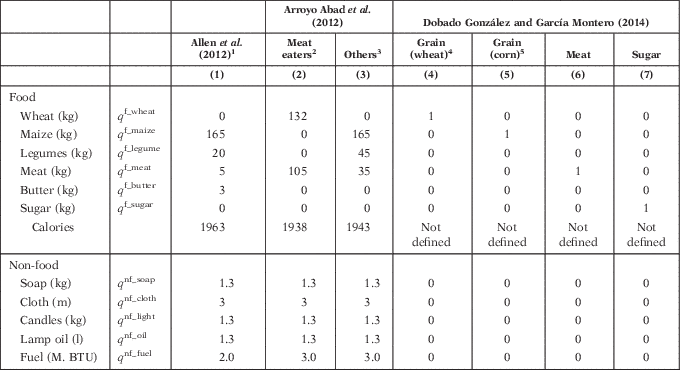
Of course, there is not only one such basket, and sometimes price data are not available, which has led different researchers to set up alternative versions of them. In the case of Spanish America, for example, we used a comparable basket to Arroyo Abad et al. (Reference Arroyo Abad, Davies and Van Zanden2012): the quantities of most non-food items were identical (though they included 50 per cent more fuel) and food items did not include oil or butter, compensating the caloric intake with more meat and legumes (see Table 1, columns 1 and 3). It is debatable whether one choice is better than other, but both are indeed comparable in the sense that they both provide the same «product» (caloric and protein intake)Footnote 4 . Challú and Gomez-Galviarrato (Reference Challú and Gomez-Galviarrato2015) use the same basket we use, yet with different (and more detailed) prices and the results they obtain are comparable to oursFootnote 5 .
CONSUMER BASKETS FOR SPANISH AMERICA

Notes:
1 Bogota, Mexico and Potosi.
2 Argentina and Chile.
3 Bolivia, Colombia, Mexico, Peru.
4 Buenos Aires.
5 Bogota, Guadalajara, Mexico, Potosi.
Using a basket of goods does increase the complexity of the calculations as Dobado has argued, but this does not mean that we should completely abandon this method. In fact, research looking more closely into the assumptions of the welfare ratio methodology generally finds that these are not terribly important. Schneider (Reference Schneider2013) showed that changes in mortality and fertility in early modern England had only a small influence on family size and thus the welfare ratio of the average family at the average point in their life cycle. High infant and child mortality and wide spacing of children kept the average number of children being supported by a household at any given time low. Extending this analysis to Latin America, family sizes were likely larger in Spain and Latin America than in England and British North America, amplifying the wage gap. In addition, when studying the diets of the poorest workers in societies around the world, the similarities in diet are much more striking than the differences. Most poor workers in the early modern world survived on a primarily vegetarian diet with smaller amounts of meat, beans and fat. It is true that Argentina may not have fit this general mould, but that does not mean that the other comparisons made are unreasonable or flawed. We agree that when meat is the cheapest source of calories, the baskets should be adjusted accordingly. However, this was not the case in any of the cities we studied.
We also do not deny that some assumptions were required to overcome limited historical evidence and to maintain the comparability of the real wages. A typical example is that of r t , which due to lack of data is normally approximated with a fixed percentage of around 5 per cent. This is indeed probably wrong, and recent research has allowed us to know that that number should be pushed upwards for Spain (Drelichman and González Agudo Reference Drelichman and Gonzalez Agudo2014) and perhaps as well for Mexico (Calderón Fernández Reference Calderón Fernández2009), but until those uncertainties are resolved, we think being explicit about a reasonable lower bound makes more sense than ignoring the issue altogether (as the Dobado-García approach does). We tried to be very clear about the interpolations that we made to deal with shortfalls in historical evidence in our 30-page data appendix to the final published paper. All of our assumptions are clearly laid out for scrutiny and further analysis. We also acknowledge that household consumption has changed over time as relative prices have shifted and new products have been introduced, but allowing each individual basket to change over time makes it much more difficult to create comparable price baskets across countriesFootnote 6 . We do not deny that new commodities like sugar were important for workers’ lives, but the new commodities are less relevant when creating a subsistence basket of goods representing the cheapest way to reach a survival level of calories and proteins.
5. LIMITATIONS OF USING SINGLE PRODUCT RATIOS
In the face of the strength and analytical clarity of the welfare ratio methodology, Dobado and García’s method of comparing commodity wages is interpretively unsatisfying and does not fit economic historian’s understanding of economic development in the past. Dobado’s table 5 shows that the ordinal ranking of commodity wages varies dramatically across the four commodities measured (Dobado-González Reference Dobado-González2015). This is not surprising given how sensitive the welfare ratio (1) is to changes in the vector q t and that the implicit choice in the Dobado-García approach is so extreme (see last four columns of our Table 1). Thus, Dobado is essentially arguing that because the relative cost of various goods was different around the world, all countries had the same relative living standards. This is not historically relevant because there are many reasons that a particular city might get a cheap price for a certain commodity that would be unrelated to the overall cost of living. For instance, Potosi had very high silver wages because it had one of the largest silver mines in the world in the colonial period. However, the cost of other goods was also quite high in Potosi bringing the overall welfare ratio down. In addition, meat might have been very cheap in Buenos Aires, but other goods were much more expensive (e.g. legumes). This method also gives us no way of creating a meaningful ranking among countries of how much wealthier people in one city were relative to another. For instance, Amsterdam’s sugar wages were approximately the same as Calcutta’s, but its silver wage was over eight times higher. Were people in Amsterdam better off or worse off than people in Calcutta? Dobado and García’s method cannot answer this question. Thus, the fact that certain cities in Latin America end up ahead of some European cities for certain commodities does not provide economically meaningful information.
In addition, Dobado and García’s method does not actually overcome the assumptions in our work that they seem to criticise. By comparing the amount of grain that could be purchased by a male day wage, they implicitly assume that men in all countries worked the same number of days and that their family sizes were equalFootnote 7 . Otherwise their comparisons are meaningless as a proxy for living standards. They indirectly assume that the value of meat and grain is measured by the kilogram when meat from different animals, different cuts of meat and different types of grain have very different caloric values. Clearly, their methodology is not assumption free either.
Given the strengths of the welfare ratio methodology, which has become widely accepted internationally by economic historians, and the weaknesses of Dobado and García’s commodity wage comparisons, we feel Dobado’s reflections do not really affect the crucial results we obtained in our paper that there was a substantial gap between British North American and Spanish American real wages in the colonial period. The divergence in the Americas was the product of forces at play from the early colonial era and cannot solely be explained by a reversal of fortune in the late eighteenth and early nineteenth centuries. Thus, the real puzzle is why did this gap exist. The explanation we put forward in our paper suggests that trade and migration patterns created two separate, integrated labour markets across the Atlantic and along with the Malthusian population dynamics of indigenous Americans maintained the wage gap between British North America and Latin America.