



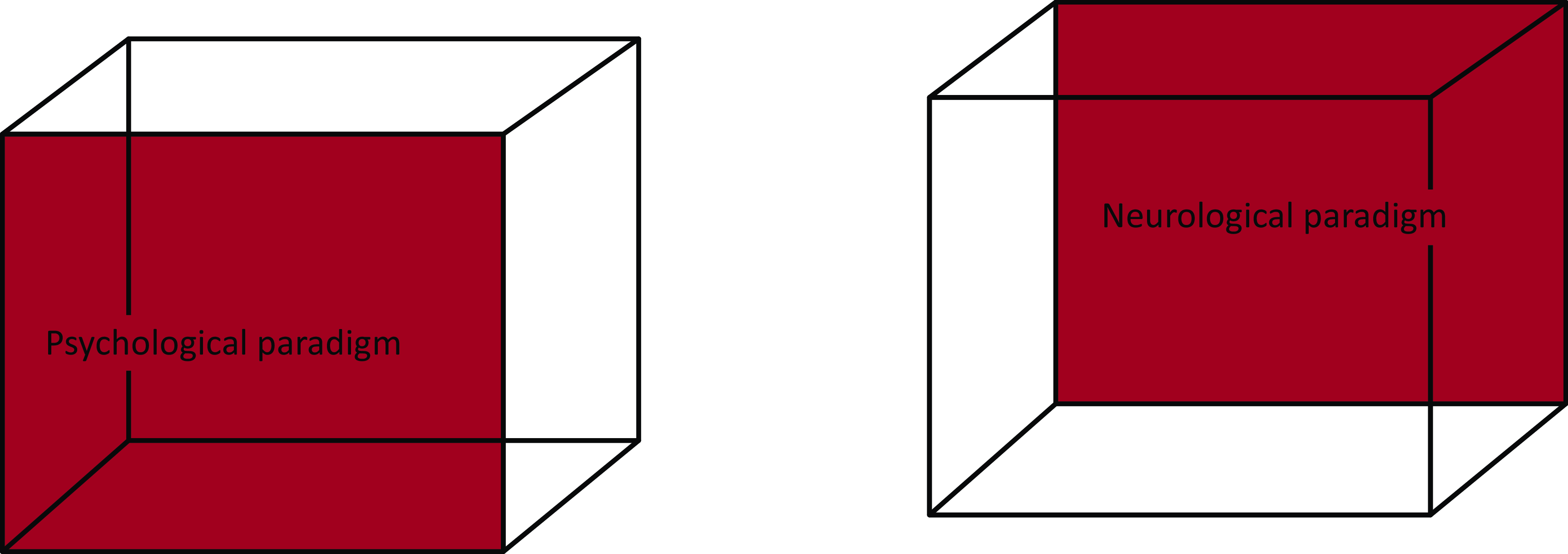
A captivating encounter with an unorthodox psychiatrist, Dr Richard Hunter, in a north London hospital gave Daniel Rogers inspiration for his book Motor Disorder in Psychiatry (Reference Rogers1992: p. xii). In it, Rogers utilises the Necker cube phenomenon to illustrate the rival psychological and neurological paradigms in the approach to the same psychiatric phenomena (Fig. 1). Rogers eloquently applies this concept to multiple clinical examples, such as the similarity in presentation reported between encephalitis lethargica and dementia praecox/schizophrenia, when these conditions were first described.
An adaptation of Rogers’ illustration of the Necker cube phenomenon demonstrating the conflicting paradigm views on how motor disorders in psychiatric disorders could be approached.

Quoting the literature and his own clinical observations, Rogers promotes the validity of a neurological approach in both academic and clinical spheres to encourage advancement of our understanding in this persistently elusive field.
Rogers begins by highlighting the views proposed by eminent 19th-century psychiatrists such as Henry Maudsley and Wilhelm Griesinger, who originally endorsed psychiatric disease as a disorder of brain. He then describes how the 19th-century neurology-dominant views of psychiatry changed over the course of the 20th century, i.e. that the approach to psychiatric disorders shifted towards the investigation of abnormal mental state rather than cerebral dysfunction. In doing so, Rogers provides a historical background to these opposing views, encapsulated beautifully by Oliver Sacks as soulless neurology versus bodiless psychology. Rogers offers a chronological account of the constant back and forth between these two paradigms by methodically dissecting the published literature on movement disorders reported in psychiatric patients over the preceding two centuries. He elaborates on how scientists using a psychoanalytical framework suggested new ways of analysing movement disorders by attributing psychological meaning. Examples of these now outdated and unhelpful interpretations include the interpretation of flexed posture as repressed sadism, of drooling as ‘displaced’ seminal emission (p. 2), protrusion of the lips (schnautzkrampf) in catatonia as the expression of contempt (p. 11), blepharospasm as an inability to face reality and torticollis as an inability to face the future (p. 18).
The philosophical basis of psychiatry has always been debated. Although no longer as widely accepted, Descartes’ proposal of mind–body dualism (Robinson Reference Robinson and Zalta2020) in the early 17th century played a vital role in our early understanding of the relationship between mind and body, influencing theoretical models which later contributed to development of two major treatment approaches in psychiatry – the biological and the psychological. Freud’s psychoanalysis had a profound impact on the practice of psychiatry in the late 19th and early 20th centuries, shifting the focus of psychiatry away from a more brain-based/biological understanding to one related to psychological conflicts and further contributing to the divide between neurology and psychiatry. However, this gap was later bridged with the invention of electroencephalography (EEG) by Hans Berger in 1924, which allowed objective assessment of brain activity, including emotional state, attention and memory, in real time, further broadening understanding and insight into neuropsychiatric disorders (Haas Reference Haas2003).
Although psychological approaches started to lay the foundation of contemporary psychiatry from the early decades of 20th century, the study of pathophysiology underlying mental disorders was also considered fruitful by those who attempted to bridge these two fundamentally opposing views. Accordingly, Rogers addresses the paradoxical organic versus functional dichotomy, arguing that a dichotomous distinction without any connection between the two radically opposing poles is logically flawed. Rogers demonstrates the development of the conflicting rival paradigms of the Necker cube over time, whereby different methods are utilised, including the development of distinct terminologies by neurologists and psychiatrists, in an attempt to understand a shared observation.
Rogers focuses on catatonia, dystonia and extrapyramidal symptoms, exploring different theories from the likes of Kraepelin (Reference Kraepelin, Barclay and Robertson1919) and Kleist (Reference Kleist1960). Aetiological factors reviewed range from purely psychological to iatrogenic and brain pathologies. Other topics discussed vary from the evolution of the historical concept of institutional neurosis and the significance of the basal ganglia in movement disorders through to the post-antipsychotic (post-neuroleptic) era of the 1950s and the neurotransmitter revolution in the 1960s. Rogers critically appraises the evidence that compares motor disorders observed in psychiatric patients taking antipsychotics with such disorders in those who were antipsychotic-naive, elucidating the considerable overlap between the two. He concludes that the contribution of antipsychotic medication to the development of motor symptoms cannot be considered in isolation from the motor disorders observed in psychiatric patients.
Rogers goes on to provide an in-depth evidence-based analysis of movement disorders in the context of obsessive–compulsive disorder, hysteria, neurodevelopmental conditions and antipsychotic-induced movement disorders. He also presents the findings of his own impressive research projects, providing insight into the variety of movement disorders identified in 100 in-patients with schizophrenia, as well as in a cohort of 236 with intellectual disabilities. Rogers subsequently discusses his own findings and those of others to address the abnormalities observed in tone, posture, speech and motor activities (such as akinetic mutism) in psychiatric patients.
Take-home message
Modern medicine has become somewhat fragmented in its structure; the arbitrary divide between specialties appears to be growing wider despite inherent overlap, such as is seen between psychiatry and neurology.
Our understanding of the brain has also further evolved over the years, initially from a macroanatomical perspective with Gall’s theory of phrenology (Britannica 2024) in the early 19th century, followed by the work of Broca and Wernicke on brain mapping and localisation. The involvement of cerebral regions in emotion regulation and behaviour later became well established, but it was only relatively recently that we gained greater appreciation of the role of the cerebellum in higher cognitive functions, through Schmahmann’s work in the 1990s (Schmahmann Reference Schmahmann2019). Other studies have provided insight into the interaction between behavioural experience/cognitive processes and their underlying neurological bases during brain development. One interesting study found that source memory improvement during childhood was closely associated with hippocampal maturation, which shows bidirectional processes whereby experience shapes future changes in the brain and the brain shapes future changes in behaviour (Geng Reference Geng, Botdorf and Riggins2021).
With the advancement of technologies, we have also been able to deepen our understanding of the importance of the microscopic structures of the brain. Although primarily known for their function in immune response, research suggests that microglia may also play a role in both brain development and the development of neuropsychiatric disorders (Liu Reference Liu, Du, Chen and Cheng2022). The recent discovery of microbiomes and their influence on brain health has offered an exciting insight further supporting a more biological and neurological basis for psychiatric conditions (Dicks Reference Dicks, Hurn and Hermanus2021). On the other hand, the appropriate treatment of the classic examples of neuropsychiatric conditions such as movement disorders and epilepsy is not solely pharmacologically/neurosurgically oriented (i.e. using biological methods) but always requires a multidisciplinary/multiagency framework (a holistic approach including psychosocial interventions) to address the complex presentation in various neurological/motor, psychiatric and cognitive domains. Otherwise, no real improvement in the patients’ quality of life could be expected.
Rogers beautifully highlights this point in one of his concluding paragraphs:
‘There is not a “psychiatric brain” and a “neurological brain”. There is only one brain […] Simply bringing together research efforts in neurology and psychiatry could achieve a quantum leap of understanding of psychiatric disorder and cerebral function’ (Rogers Reference Geng, Botdorf and Riggins1992: p. 114).
Rogers highlights his Friern hospital study, wherein a significant proportion of the patients who had never received antipsychotic medications also presented with motor features. Similar studies would be helpful in gaining a greater understanding of motor disorders in psychiatric patients.
The above quotation still holds true after over three decades and is strikingly relevant to today’s prevailing opinion: current clinical practice predominantly reflects a neuropsychiatric approach in order to make sense of a particular motor disorder and treat accordingly. This is clearly a strong take-home message for the contemporary clinician.
Data availability
Data availability is not applicable to this article as no new data were created or analysed in this study.
Acknowledgements
We are grateful to the anonymous reviewer for their invaluable and insightful comments in improving our manuscript.
Author contributions
All three authors contributed to the overall idea and writing the first draft. Z.M. and R.K worked on the initial draft and on the revised version of the manuscript. G.T. edited the draft, proofread it and worked on the structure and presentation of the manuscript and Fig. 1.
Funding
This research received no specific grant from any funding agency, commercial or not-for-profit sectors.
Declaration of interest
None.



eLetters
No eLetters have been published for this article.