Introduction
Stored-product pests not only cause losses in quality and quantity of stored products but they also cause contamination with potential adverse effects to human health (Stejskal & Hubert, Reference Stejskal and Hubert2008). There are at least 15 species of the genus Cryptolestes Ganglbauer, 1899 (Coleoptera, Laemophloeidae) which are regarded as secondary storage pests of economic importance and cause losses in temperate and tropical regions around the world (Freeman, Reference Freeman1952; Sinha, Reference Sinha1975; Banks, Reference Banks1979; Thomas, Reference Thomas1988; Stejskal et al., Reference Stejskal, Hubert, Kučerová, Munzbergová, Lukáš and Žďárková2003; Hagstrum & Subramanyam, Reference Hagstrum and Subramanyam2009). Five of these species, namely Cryptolestes ferrugineus (Stephens, 1831), Cryptolestes pusillus (Schönherr, 1817), Cryptolestes turcicus (Grouvelle, 1876), Cryptolestes pusilloides (Steel & Howe, 1952) and Cryptolestes capensis (Waltl, 1834), represent the most common Cryptolestes beetles found in stored products, where they cause serious damage (Halstead, Reference Halstead1993; Rees, Reference Rees2004). Both adults and larvae feed on cereal, legume and oil seeds as well as their processed products (e.g., Throne et al., Reference Throne, Doehlert and McMullen2003; Hagstrum & Subramanyam, Reference Hagstrum and Subramanyam2009).
Being small and flattened, adults and larvae of Cryptolestes can easily enter imperfections in packaged goods (Rees, Reference Rees2004). World trade of cereal products causes the dispersal of pest from different geographic areas (Freeman, Reference Freeman1967). Consequently, the selective life histories, genetic background and insecticide resistance status of the stored-product pests are different (Arnaud et al., Reference Arnaud, Brostaux, Assié, Gaspar and Haubruge2002). Therefore, more attention needs to be paid to the identification of pest species of Cryptolestes where they occur, including at ports as part of quarantine inspection in order to prevent their spread to non-infested areas. Because of the economic importance of insect pests infesting stored products, it is necessary to apply species-specific control measures, which often require a rapid and accurate identification of Cryptolestes species.
Identification of Cryptolestes species is traditionally based on morphological characters of adults (Lefkovitch, Reference Lefkovitch1958; Halstead, Reference Halstead1993). The species are small (c. 2 mm), similar in appearance, and difficult to identify on the basis of external morphological characters alone. The characters are variable and differences among species are not obvious (Arbogast, Reference Arbogast1991). It is generally agreed (e.g., Howe & Lefkovitch, Reference Howe and Lefkovitch1957) that identification requires examination of male or female genitalia (Banks, Reference Banks1979). Only experts can identify species of the genus Cryptolestes accurately. Moreover, what is frequently found in stored products are Cryptolestes fragments (e.g., leg, elytron and wing) (i.e., Trematerra et al., Reference Trematerra, Stejskal and Hubert2011), which lack specific features for species identification. There are also no morphological characteristics to discriminate eggs or pupae on species level (Hossain et al., Reference Hossain, Verner and Rezaur1986). Identification of the egg stage is only possible on generic level. Consequently, species identification of the preimaginal stages in the family Laemophloeidae requires development of molecular methods (Kučerová & Stejskal, Reference Kučerová and Stejskal2002).
Identification of Cryptolestes species based on DNA barcoding is an appropriate alternative to the conventional taxonomy based on morphological characters. Therefore, DNA barcoding is proposed as a tool for species identification in view of the premise that a short standardized sequence can distinguish individuals of a species due to the fact that genetic differentiation between species exceeds genetic differentiation within species (see e.g., Hebert et al., Reference Hebert, Cywinska, Ball and DeWaard2003a ). Compared with other molecular identification methods, this approach can be both fast and cost effective, and data can be easily standardized and compared across taxa (Xiao et al., Reference Xiao, Wang, Li, Murphy, Wan, Niu, Hu, Fu and Huang2010). Species barcoding was first promoted for animal DNA by Hebert et al. (Reference Hebert, Ratnasingham and deWaard2003b ). The proposed standard barcode sequence is a 658-bp (base pairs) fragment of the mitochondrial gene cytochrome c oxidase I (COI) for animal (Hebert et al., Reference Hebert, Cywinska, Ball and DeWaard2003a ; Hajibabaei et al., Reference Hajibabaei, Singer, Hebert and Hickey2007). The use of COI in species identification has been documented as accurate and reliable for many insect groups, such as the stored-product Psocodea (Yang et al., Reference Yang, Kučerová, Li, Kalinović, Stejskal, Opit and Cao2012, Reference Yang, Zhao, Kučerová, Stejskal, Opit, Qin, Cao, Li and Li2013), Lepidoptera (Hebert et al., Reference Hebert, DeWaard and Landry2010), Coleoptera (Caterino & Tishechkin, Reference Caterino and Tishechkin2006; Antonini et al., Reference Antonini, Coletti, Serrani, Tronci, Cristofaro and Smith2009), Hemiptera (Foottit et al., Reference Foottit, Maw, Dohlen and Hebert2008) and many others. However, there are currently no published studies on molecular identification of Cryptolestes species including DNA barcoding. Most of the difficulties related to morphological identification of species in the genus Cryptolestes could be solved by utilizing molecular characteristics to complement morphological identification.
The present study focuses on the five most common Cryptolestes species in stored products (Rees, Reference Rees2004). The aim of the study was to develop the accurate, rapid and practical identification of Cryptolestes species using DNA barcodes.
Materials and methods
Cryptolestes specimens
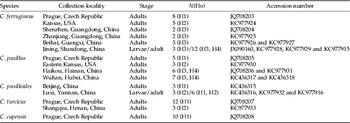
Cultures of five Cryptolestes species used in this study, including 93 specimens of adults and larvae, were obtained from the Crop Research Institute (Prague, Czech Republic), Kansas State University (Kansas, USA), Academy of State Administration of Grain (Beijing, China) and China Agricultural University (Beijing, China). Their original collection localities are listed in table 1. These laboratory strains were reared in darkness at 27 °C and 75% relative humidity, and on a diet of powdered wheat germ, yeast and oat flakes (Kučerová & Stejskal, Reference Kučerová and Stejskal2002). Voucher specimens, including adults and larvae, were kept in 95% ethanol and stored at −80 °C. Detailed specimens’ information is shown in table 1. Prior to DNA extraction, all specimens were identified following Lefkovitch (Reference Lefkovitch1962) and Halstead (Reference Halstead1993), which is based on external morphology as well as genitalia characters. The nomenclature follows Löbl & Smetana (Reference Löbl and Smetana2007).
Specimens of Cryptolestes used in the study.

N: the number of individuals used in the study.
Hn: the serial number of haplotype contained in each Cryptolestes population.
DNA extraction, PCR and sequencing
Total genomic DNA was isolated from adult individuals without abdomens or whole larval bodies of Cryptolestes samples using the commercial TIANamp Genomic DNA Kit (TIANGEN, China) and following the manufacturer's protocol. Polymerase chain reaction (PCR) was completed in a final volume of 50 μl containing 25 μl MasterMix without dye, 20 μl sterilized distilled water, 3 μl DNA extraction (about 60 ng μl−1) as a template, 1 μl forward and reverse primer (10 μM), respectively. The PCR profile included an initial denaturing step at 94 °C for 3 min, followed by 35 cycles of 94 °C for 1 min, 50 °C for 1 min and 72 °C for 1 min with the final extension at 72 °C for 10 min. The reaction was performed on Veriti TM 96-well Thermal Cycler (ABI, USA). PCR was performed with a pair of universal COI gene primers, forward primer-LCO1490 and reverse primer-HCO2198, which were designed for diverse metazoans (Folmer et al., Reference Folmer, Black, Hoeh, Lutz and Vrijenhoek1994). The amplified DNA fragments of about 650 bp were separated on 1.0% (w/v) agarose gel (1×Tris Acetate-EDTA buffer), stained with ethidium bromide and visualized under UV light. DNA purification and bidirectional sequencing using the same amplification primers were conducted commercially through Beijing Aoke Biotechnology Co., Ltd.
Data analysis
After assembly and multiple sequences alignment of sequences using DNAMAN v.6.0.3.99, the ambiguous base pairs and primer sequences were deleted, getting the final COI gene partial sequence for each specimen. All sequences obtained in this study have been submitted to GenBank. Pairwise genetic distances for COI gene were computed by Kimura 2-parameter method (K2P) and involved all nucleotide sequences of Cryptolestes using the software MEGA v.5.2 (Tamura et al., Reference Tamura, Peterson, Peterson, Stecher, Nei and Kumar2011). The online version of automatic barcode gap discovery (ABGD) (Puillandre et al., Reference Puillandre, Lambert, Brouillet and Achaz2012) was applied to generate distance histograms and to partition the DNA sequence dataset of Cryptolestes into groups according to a range of potential barcode gap threshold. Haplotypes were identified using software DnaSP v.5.1 (Librado & Rozas, Reference Librado and Rozas2009). A phylogenetic tree of individual haplotypes based on COI region was constructed with the PhyML v.3.0 (Guindon et al., Reference Guindon, Dufayard, Lefort, Anisimova, Hordijk and Gascuel2010) using the maximum likelihood (ML) approach. The best-fit substitution model for tree construction was chosen using jModelTest v.2.1.4 (Darriba et al., Reference Darriba, Taboada, Doallo and Posada2012). The general time reversible model incorporating invariant sites and a gamma distribution (GTR+I+G) was selected according to the corrected Akaike information criterion. Branch supports were estimated using 500 bootstrap replicates. Sequences of Tribolium confusum (accession number KC407742) and T. destructor (accession number FJ743723.1) were used as outgroups. Parsimony networks of the haplotypes were constructed using the program TCS v.1.21 (Clement et al., Reference Clement, Posada and Crandall2000). The resulting networks identify both the relationship between the different haplotypes as well as the significant number of substitutions connecting haplotypes (Templeton et al., Reference Templeton, Crandall and Sing1992). The default connection limit of 95% was applied to all analyses.
Results
We obtained 93 new COI gene sequences of five species of the genus Cryptolestes with a length of 658 bp. The absence of insertions and deletions allowed the sequences to be aligned unambiguously. There are four different haplotypes identified for C. ferrugineus and C. pusillus, two for C. pusilloides and C. turcicus and just one for C. capensis. All sequences were deposited in GenBank; accession numbers are listed in table 1.
Genetic divergence within and between species
The inter-specific K2P divergence of the five Cryptolestes species averaged 17.9%, ranging from 16.1 to 19.9%, whereas the intra-specific K2P divergence ranged from 0 to 8.94%, with an average of 3.12% (table 2). Thus, the inter-specific average divergence between five closely related species was almost sixfold higher than their average intra-specific divergence. It should be noted that intra-specific divergences ranged up to 8.94% for the analysed C. ferrugineus specimens. Additionally, specimens of C. pusillus were characterized by K2P divergence ranging up to 8.88%. Geographically distant populations of both species showed the distinct deep intra-specific genetic divergences. For other Cryptolestes species, intra-specific K2P divergences were all less than 0.7%. Nonetheless, overall inter-specific divergence values were greater than intra-specific values without overlap.
The averages and ranges of intra- and inter-specific Kimura 2-parameter divergence values (%) of the five Cryptolestes species.

N: the number of sequences analysed.
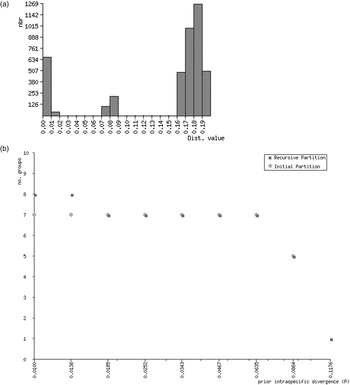
The separation between the maximum intra-specific and minimum inter-specific divergences is known as barcoding gap (Meyer & Paulay, Reference Meyer and Paulay2005; Barr et al., Reference Barr, Islam, De Meyer and McPheron2012). The result of applying the ABGD algorithm to the COI data set of five analysed Cryptolestes species is presented in fig. 1. Distance values show a gap between the intra-specific and the inter-specific distances (fig. 1a). The data set was partitioned into five groups when the prior assumption of maximum intra-specific divergence ranged as high as 8% (fig. 1b). Sequences related to C. ferrugineus and C. pusillus were further divided into two groups, namely, a total of seven groups, by ABDG analyses when the prior threshold across 2–6%.
Histogram of pairwise distance divergence for five Cryptolestes species (a) and automatic partition of the COI data set of five Cryptolestes species (b) as generated by automatic barcode gap discovery. The low distance values (<0.09) represent intra-specific divergences, whereas higher distance values (>0.16) represent inter-specific divergences.

Phylogenetic analysis
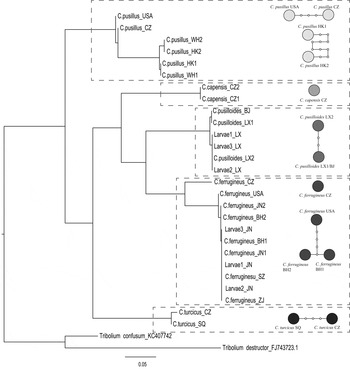
A ML tree grouped the five morphologically identified species of Cryptolestes, along with the outgroup species, into six clades (fig. 2). All sequences of C. turcicus were closely related and presented limited genetic variation, the same result can be observed in C. pusilloides and C. capensis. However, we found two peculiar clades with high support. There were specimens morphologically identified as C. ferrugineus from six different geographical sites that formed a clade, but clustered into two groups which are clearly split and genetically relatively distant from each other. Sequences of C. pusillus isolated from Czech Republic and the USA also formed a sister cluster relative to other conspecific sequences. Larvae and adults of C. ferrugineus collected from Jining (Shandong, China) were grouped within the same cluster. As expected, larvae and adults of C. pusilloides from Luxi (Yunnan, China) were also clustered together.
Phylogenetic tree (maximum likelihood) and haplotype networks of individual haplotypes belonged to the five Cryptolestes species of stored products. The small circles indicate the hypothetical haplotypes while the connections are based on 95% parsimony limit. The name of each branch and haplotype consists of species name and collection localities’ abbreviation (BH: Beihai, Guangxi, China; BJ: Beijing, China; CZ: Prague, Czech Republic; JN: Jining, Shandong, China; HK: Haikou, Hainan, China; LX: Luxi, Yunnan, China; SZ: Shenzhen, Guangdong, China; SQ: Shangqiu, Henan, China; USA: Kansas, USA; WH: Wuhan, Hubei, China; ZJ: Zhanjiang, Guangdong, China). The circles in different colours indicate those haplotypes belonging to five Cryptolestes species of this study.

Results from parsimony network analyses support the pairwise genetic divergences and shed light on phylogenetic relationship among them (fig. 2). The haplotypes of species with low intra-specific divergences (C. turcicus and C. pusilloides) generated species-specific haplotype networks, whereas the haplotypes of species that revealed high levels of intra-specific divergences (C. ferruginus and C. pusillus) separated into two networks, corresponding with the relatively long branches separating the two conspecific sub-clades. C. capensis with only one haplotype did not form the network.
Discussion
In the present study, the five pre-identified Cryptolestes species were successfully diagnosed to species level by use of DNA barcoding. Also the larvae were successfully identified. The abdomens removed from adults in order to avoid their negative influence on sequencing (gut content) could also be used as voucher material, because the genitalia inside abdomens are decisive diagnostic characteristics for Cryptolestes sp. (Bank, 1979).
The genetic distance between sequences provides an approach for ‘DNA barcode’ evaluation (Meiklejohn et al., Reference Meiklejohn, Wallman and Dowton2011). A favourable DNA barcode should have a higher divergence among species than within species. In the case of COI, the suggested standard divergence threshold value is ten times (10×) the mean intra-specific variation (Hebert et al., Reference Hebert, Stoeckle, Zemlak and Francis2004). In this study, the ratio between species to within species variation (6×) was lower than the proposed threshold (10×) as a potential species’ boundary. However, the intra- versus inter-specific divergences of COI exhibited distinct gaps (fig. 1a). Additionally, the ‘tenfold rule’ has been questioned in many studies because it lacks strong biological background and due to the difficulty of it being confirmed by all taxa (Lefébure et al., Reference Lefébure, Douady, Gouy and Gibert2006; Pamilo et al., Reference Pamilo, Viljakainen and Vihavainen2007; Frézal & Leblois, Reference Frézal and Leblois2008; Song et al., Reference Song, Bhay, Whiting and Crandall2008; Raupach et al., Reference Raupach, Astrin, Hannig, Peters, Stoeckle and Wägele2010). Therefore, the COI gene provides a robust DNA barcode for identifying the five species of stored-product Cryptolestes because it shows separate and non-overlapping genetic distances between intra- and inter-specific samples (fig. 1a).
The haplotype networks provide an alternative approach in species assignment based on DNA barcode data (Hart & Sunday, Reference Hart and Sunday2007). In the present study, the species with high intra-specific divergence (C. ferrugines and C. pusillus) and geographically distant populations (the Czech Republic, USA and China) were divided into two networks. Even if the TCS method strongly suggests new species from these two Cryptolestes species, they need to be tested by adding geographical, ecological and phylogenetic analyses, considering our uneven sampling and the 95% connection limit of statistical parsimony networks also functions as a threshold and cannot be applied generally to all species (Wong et al., Reference Wong, Shivji and Hanner2009).
The ML tree diagnosed all five species determined by morphology by forming robust clades. Therefore, our limited data suggest that COI sequences will be useful for barcoding the five Cryptolestes species of stored products, although examination of specimens from more localities would reveal the genetic variability of these five species more in detail.
The unambiguous assignment of specimens to an exact taxonomic group in our study supports the efficiency of DNA barcoding as molecular marker for a valid identification of the five analysed species of the genus Cryptolestes. Compared with the restriction fragment length polymorphism method, DNA barcoding based on the Folmer fragment of COI (Folmer et al., Reference Folmer, Black, Hoeh, Lutz and Vrijenhoek1994) provides a greater level of quantitative information and a data set that can be easily shared and accessed by the greater research community (Barr et al., Reference Barr, Islam, De Meyer and McPheron2012) and proved to be more accurate and more robust (Armstrong & Ball, Reference Armstrong and Ball2005; Darling & Blum, Reference Darling and Blum2007). For researchers or practitioners, with access to DNA sequencing facilities, our data make it possible to rapidly identify the five species of Cryptolestes based on simple DNA sequence comparisons and will facilitate the identification in quarantine inspection and other pest control efforts (Yang et al., Reference Yang, Kučerová, Li, Kalinović, Stejskal, Opit and Cao2012). The present study also provides a large set of sequences to design species-specific PCR primers annealing to regions displaying variation among species but not among populations or individuals of the same species, which makes it possible to design rapid identification kits (Beltrà et al., Reference Beltrà, Soto and Malausa2012).
The present study has established a reliable DNA barcode library for five infamous pest species of Cryptolestes. Our data also revealed relatively high intra-specific divergences within two species (C. ferrugineus and C. pusillus). The possible reasons for the high level of mitochondrial genetic variability may be that (1) the specimens in this study were obtained from three different continents (North America, Asia and Europe). Gene flow is limited in distant populations or interrupted in allopatric populations (Wiemers & Fiedler, Reference Wiemers and Fiedler2007); (2) the number of analysed specimens is limited to some extent; and (3) introgressive hybridization events with other closely related Cryptolestes species or incomplete lineage sorting represent the most plausible explanation. A sub-species of C. pusillus (Schönherr, 1817) has been described, which can hybridize with the typical form (Lefkovitch & Currie, Reference Lefkovitch and Currie1967). A linkage disequilibrium caused by maternally inherited endosymbionts such as Wolbachia for terrestrial arthropods (Shoemaker et al., Reference Shoemaker, Dyer, Ahrens, McAbee and Jaenike2004), as well as heteroplasmy cannot be excluded (Raupach et al., Reference Raupach, Astrin, Hannig, Peters, Stoeckle and Wägele2010) at present for the Cryptolestes species. Further work based on larger samples sizes, a higher taxonomic diversity, more geographic populations and additional molecular markers (e.g., 16S rDNA and Cytb), will improve the DNA-based identification system for Cryptolestes.
Acknowledgements
We thank Dr Chunqi Bai, from Henan University of Technology, China, for providing us with the China population of C. turcicus. We would also like to thank Qianqian Yang, Bingyi Cui, Tao Zhang from China Agricultural University, China, for their help with software analysis. Financial support for this research was provided by the International Science and Technology Cooperation Program of China (2013DFG32350) and the National Quality Supervision, Inspection and Quarantine Public Welfare Industry Research Project of China (201310075). The Czech side was supported by the project KONTAKT – LH12160.