Introduction
In the present era, the surgical trainee has to acquire surgical skills in the face of reduced training hours and in a culture that favours the efficiency of operating theatre time. Patient advocates encourage trainees to practise using simulated surgery if possible, before they are trained on live patients. As a result of these pressures, many surgical specialties are increasingly turning to model and simulation-based training.Reference Atesok, Mabrey, Jazrawi and Egol1–Reference Bath and Lawrence4 This can provide trainees with safe, low-pressure training opportunities prior to and alongside opportunities in the operating theatre.
The field of otolaryngology has long been at the forefront of simulation in surgery, with temporal bone dissection and similar cadaver models of surgery. Advances are being made with virtual-reality temporal bone and sinus surgery simulators.Reference Ruthenbeck, Tan, Carney, Hobson and Reynolds5 However, these are not universally available at present and have not yet been validated. Dummy models are used for anaesthetic training, and can even be used to simulate airways that require emergency care and mimic shock caused by bleeding, in a real-time and realistic fashion. They are currently used on courses, but are expensive and require a high level of technical skill to operate them.
There is a need for simple dummy models to enable the practice of common ENT operations such as tonsillectomy. It is reassuring for the trainer to have seen the trainee practise the difficult skill of tying the tonsil bed on the model in the face of bleeding before the trainee operates on a real patient. Likewise, the trainee feels better prepared for doing this. We have devised a simple, relatively inexpensive tonsillectomy model to enable the practice of tonsil removal and the ligation of bleeding vessels.
Materials and methods
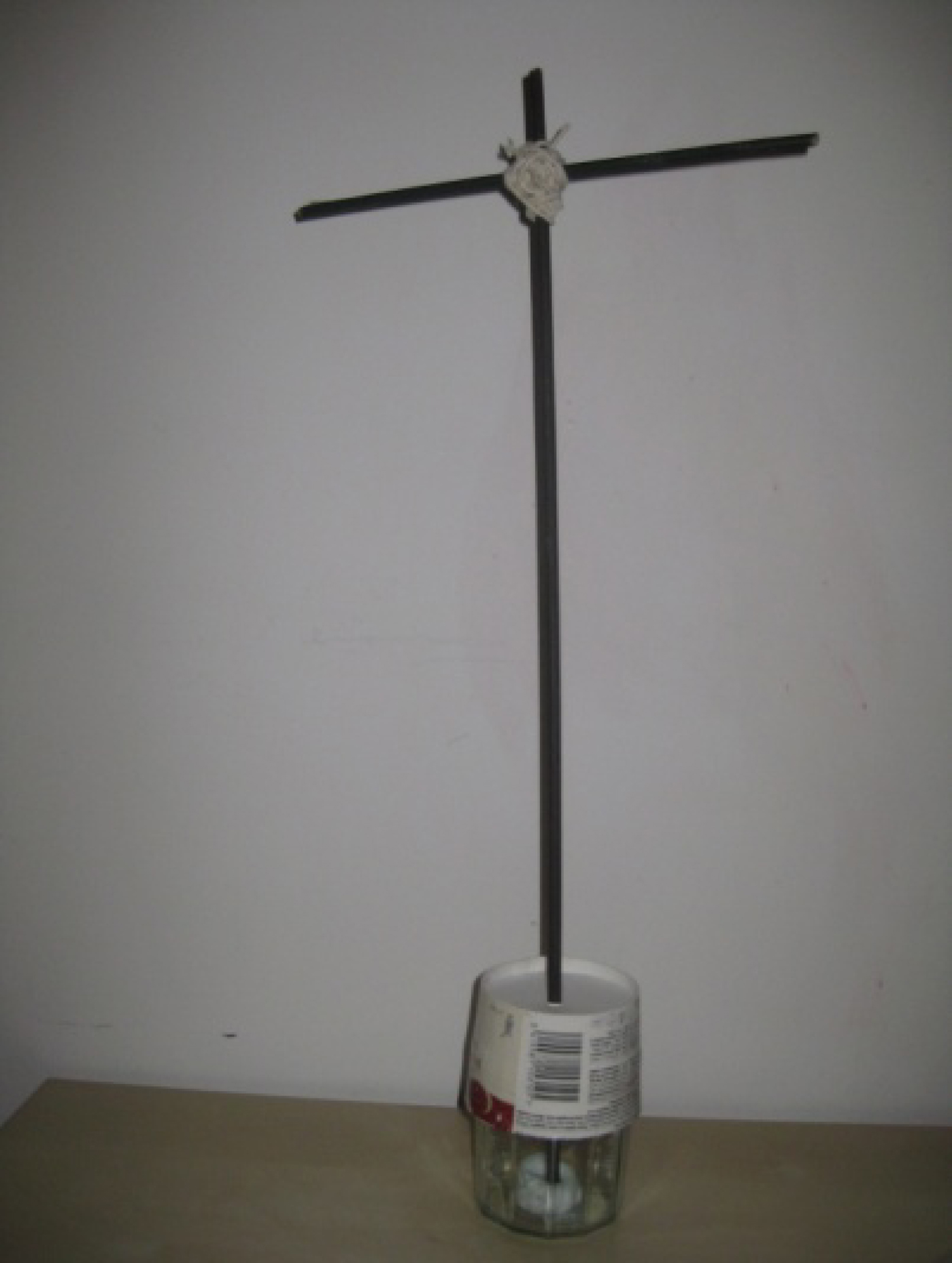
Firstly, two 100 ml 0.9 per cent saline bags are suspended from an old drip stand or, if this is not available (if the trainee is at home, for instance), a stand can be made by crossing two wooden sticks and binding them with twine at the top. This stand is then supported by adhesive putty at the base of a glass jar with a cardboard lid (Figure 1).
A makeshift stand (for the suspension of two saline bags).

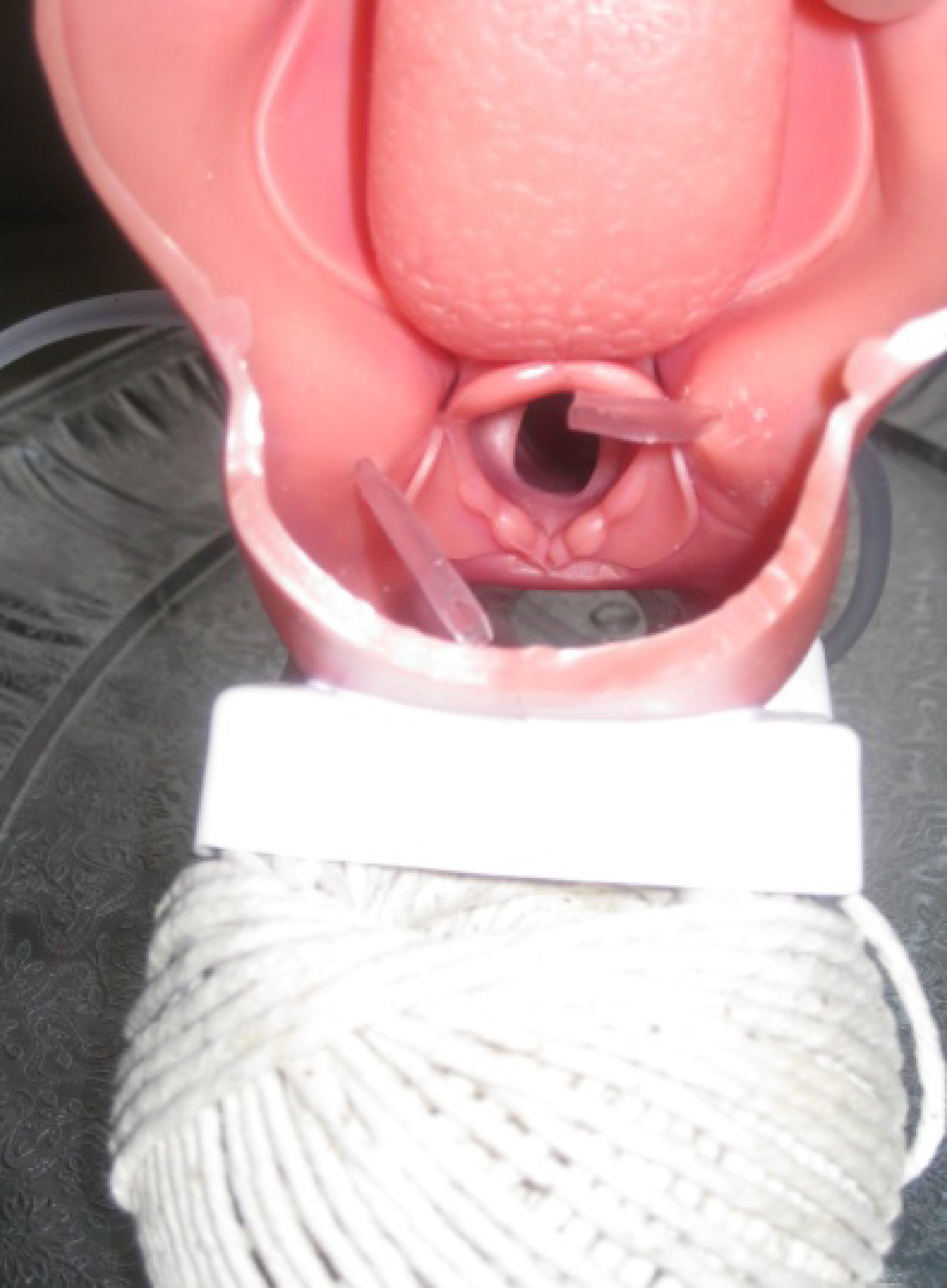
Red food dye is then injected into the saline bags to create the supply of ‘blood’ to the tonsillar fossae. The giving set from each bag of saline is passed through the base of a pseudo mouth mounted on a ball of twine (Figure 2). The pseudo mouth model is designed to assist in the teaching of intubation and is called an ‘airway demonstration model’. (It is available from Laerdal Medical (Orpington, UK; order code: 252500) and costs £187.00 plus value-added tax).
Red dye injected into saline bags to create the supply of ‘blood’; the fluid passes through a pseudo mouth mounted on a ball of twine.

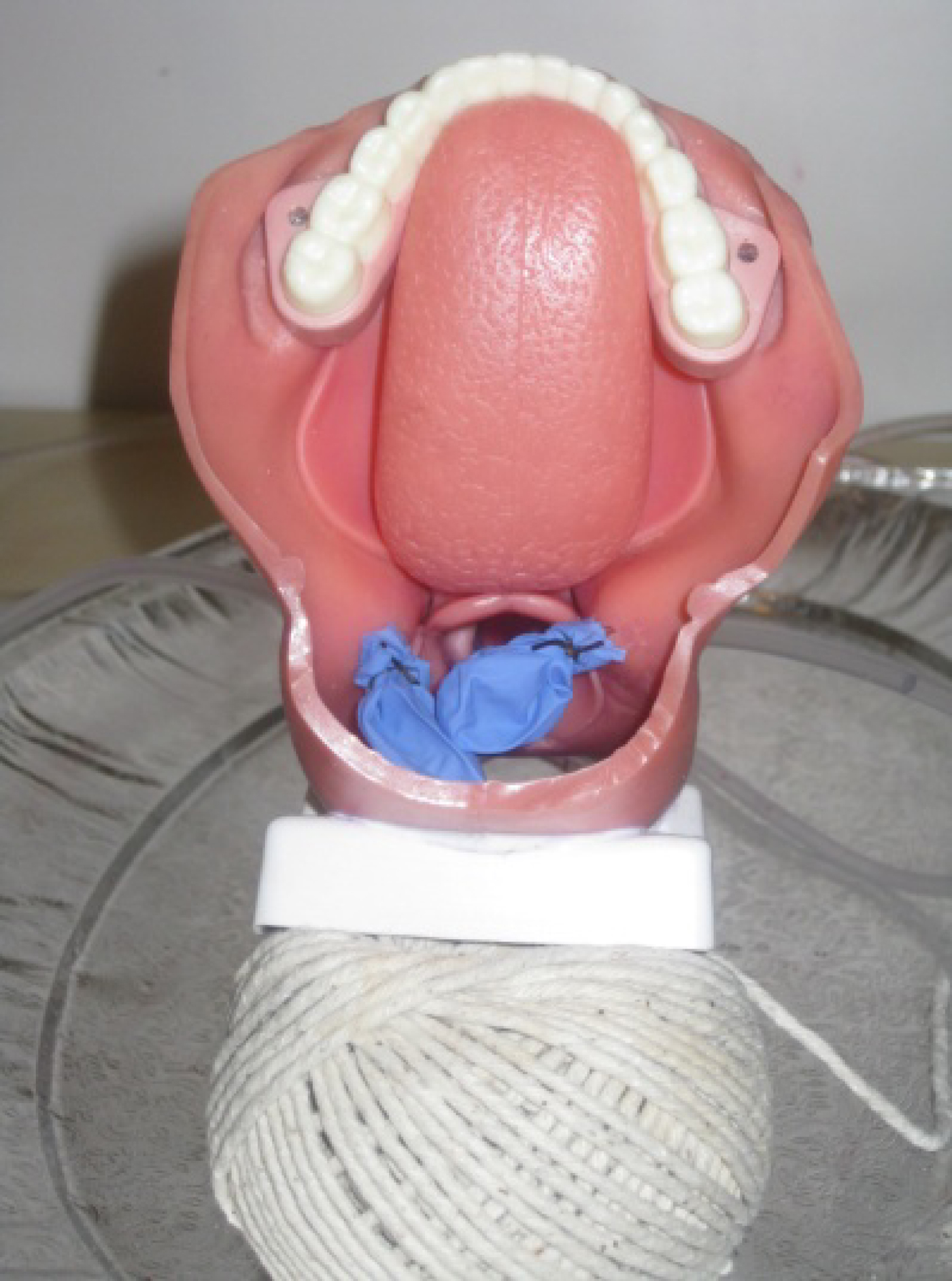
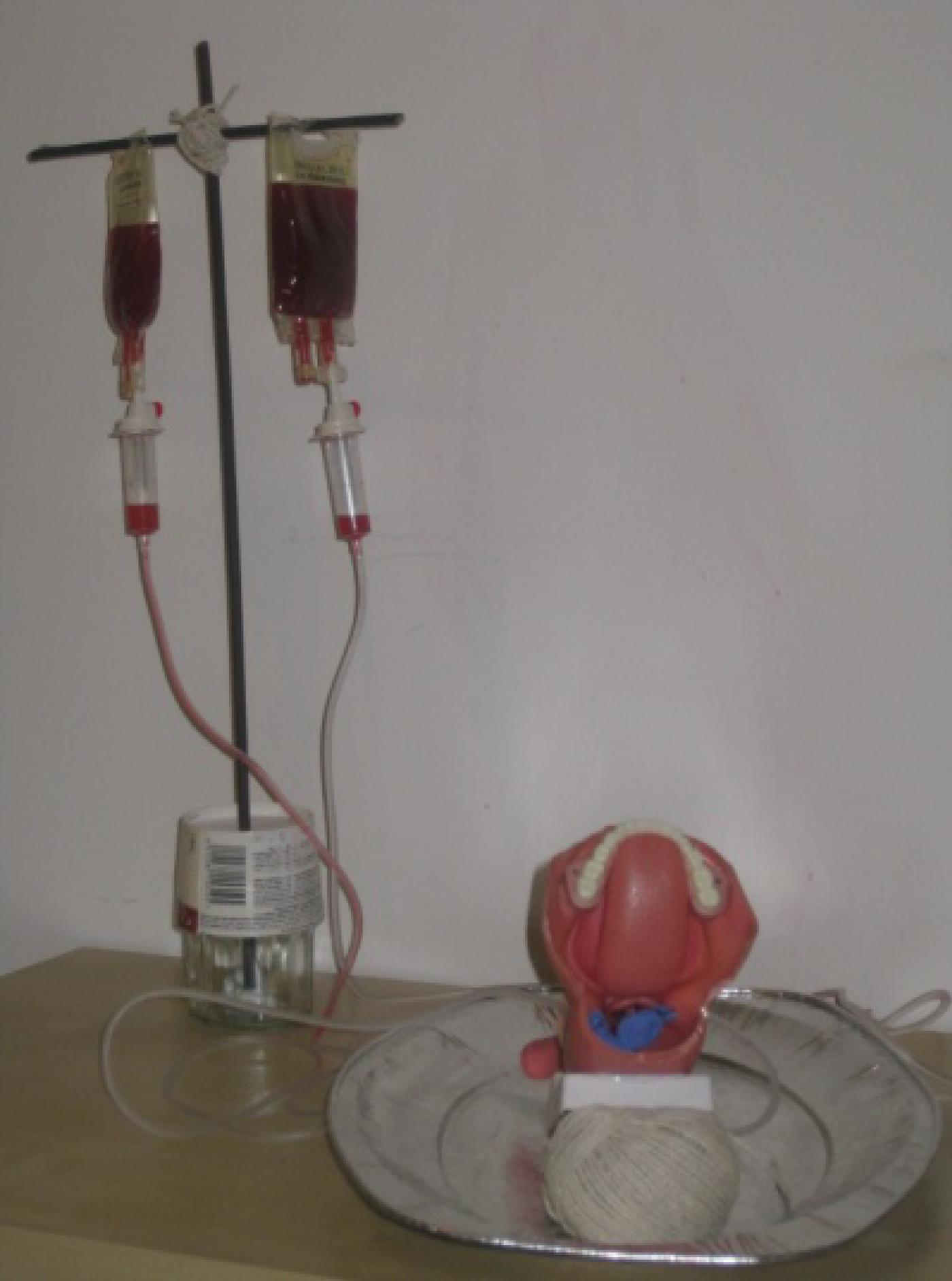
A finger, cut from disposable latex gloves, is tied to the end of each giving set to represent the tonsils (Figure 3). The model is then ready for use (Figure 4).
Fingers cut from a latex glove to represent the tonsils.

Model ready for use.

Once the giving set has been opened, the trainee can apply the curved Negus forceps to the base of the tonsil. The trainee can then remove the tonsil and perform a tonsil tie to ligate the vessels. The effectiveness of the tie is tested by the fact that the blood may escape from the tonsillar bed if the tie is not firmly and properly placed. The glove can be perforated or slashed to simulate bleeding during the procedure. If the 100 ml of simulated blood runs out before the tie is firmly in place, then the trainee needs to try again. It is also worth tugging on the tie to simulate the anaesthetists' sucker at the end of a real tonsillectomy.
Discussion
The model described above is easily and inexpensively constructed, and can be used in the work place or at home. It allows for repeated practice; the trainee simply has to replace the ‘tonsils’ each time it is used and proceed until only half of the giving set remains. Only the giving set will need to be replaced at this point; there will be no need to reconstruct the whole model.
Practice on the model leaves the trainee better prepared for the operating theatre experience. It allows them to acquire and refine the technical skill of ligating tonsillar vessels in a low-pressure environment, with no risk to patient safety. The feedback provided by the tonsillar fossa bleeding, which occurs if the tie is not adequately placed, gives the trainee an awareness of their ability to effectively perform the tonsil tie.
Practice on the model allows the trainee to progress through the three stages of motor skill acquisition as described by Fitts–Posner, cited by Reznick and MacRae.Reference Reznick and MacRae6 This practice eventually enables the trainee to perform a tonsil tie in an automatic manner, thereby allowing the trainee to learn and focus on other skills, as they will no longer be thinking about how to execute a tonsil tie.
A literature search on teaching aids for tonsillectomy yielded a small number of papers that varied in content. One paper described a simple tonsillectomy cup constructed from a wooden block, a plastic cup and a length of gauze.Reference Pearson and Wallace7 Another paper utilised two plastic cups and a nasal pack.Reference Almeyda, Chau and Wood8 Others have described the use of a child's size 2 trainer,Reference Street, Beech and Jennings9 crisp cans,Reference Ross, Jaiswal and Jones10 a square tissue box and paper clips,Reference Wasson, De Zoysa and Stephens11 and a skull model.Reference Raja, Haneefa and Chidambaram12 The most technical of these involved the use of a virtual-reality subtotal tonsillectomy simulator.Reference Ruthenbeck, Tan, Carney, Hobson and Reynolds5
We offer this tonsil tie simulator as a feasible, safe training opportunity to aid current surgical training and the evaluation of that training.
Acknowledgement
The authors wish to thank the resuscitation officers at the Queen Elizabeth Hospital (Birmingham, UK) for the loan of the airway demonstration model.