Introduction
Obstructive sleep apnoea (OSA) has emerged as a significant public health problem in recent years.Reference Young, Peppard and Gottlieb 1 There is an increased recognition of the health and social implications of OSA, which is reflected in the burgeoning research efforts in the field, as well as an increased number of surgical procedures performed over the last two decades.Reference Ishman, Ishii and Gourin 2
From a surgical viewpoint, upper airway obstructions can be single- or multi-level. Common levels of obstruction include nasal, retropalatal, retrolingual, lateral pharyngeal wall and tonsillar obstruction. The management and responses to treatment for these different levels of obstruction can differ. A common single-level surgical procedure for OSA, uvulopalatopharyngoplasty (UPPP), has met with limited success.Reference Caples, Rowley, Prinsell, Pallanch, Elamin and Katz 3 In a paper by Fujita, published in 1984, most non-responders to UPPP were reported to have multi-level obstruction.Reference Fujita 4 Hence, it is no surprise that over the last two decades, surgery for OSA has moved towards multi-level surgery. Current data have shown that multi-level surgery is associated with improved outcomes.Reference Lin, Friedman, Chang and Gurpinar 5 – Reference Verse, Baisch, Maurer, Stuck and Hormann 7
However, data on the prevalence of single- versus multi-level obstruction in OSA patients are lacking. In addition, little is known about how OSA severity (assessed in terms of the apnoea/hypopnoea index) correlates with single- or multi-level obstruction. The convenient assumption is that mild OSA is associated with single or fewer levels of obstruction. However, this is not necessarily true, and patients may consequently receive suboptimal treatment.
We aimed to identify the relationships between single- and multi-level obstructions and OSA severity, to help us target and prioritise our management of OSA patients. The primary aim of this study was to characterise multi-level obstruction in terms of prevalence, OSA severity and clinical factors that predict multi-level obstruction. The secondary objective was to collect epidemiological data on upper airway morphology in our existing OSA population.
Materials and methods
This study received ethical approval from the Domain Specific Review Boards of the National Healthcare Group, Singapore.
The list of participants was generated from a database of patients who underwent polysomnography from 2012 to 2015. Adult patients with an apnoea/hypopnoea index of more than 5 events per hour were included in the study.
A retrospective review of patients’ medical records was performed, charting the following details: gender, age, body mass index (BMI), Epworth Sleepiness Score, apnoea/hypopnoea index and physical examination findings (modified Mallampati score, tonsil size and sites of upper airway obstruction evaluated using Müller's manoeuvre).
Obstruction evaluation criteria
In our study, sites of obstruction were divided into nasal, palatal, tongue, lateral pharyngeal wall and tonsillar obstructions, as these categories form the basis for adult OSA surgical intervention. We hypothesised that obstruction at these different anatomical levels has a different impact on OSA severity.
In this study, nasal obstruction reflects our clinical assessment of the presence of various underlying nasal obstruction pathologies, including turbinate hypertrophy, septal deviation, nasal polyposis and chronic rhinosinusitis.
Palatal, tongue and lateral pharyngeal wall obstructions were determined via a clinical assessment of the pharyngeal airway space at these different levels using Müller's manoeuvre. Hence, obstructions reflect both soft tissue hypertrophy and/or skeletal framework deformities.
We consider grade 3 and 4 tonsillar hypertrophy to be obstructive, taking reference from the Friedman staging system.Reference Friedman, Ibrahim and Bass 8 In this staging system, tonsil sizes are essentially separated into two categories – tonsil sizes 3 and 4, and sizes 0, 1 and 2. Friedman stage I, whereby patients have tonsil sizes of grade 3 and 4, correlates with better surgical success.Reference Friedman, Ibrahim and Joseph 9
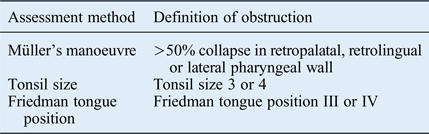
Multi-level obstruction is defined as more than one site of obstruction. In our study, this was determined based on Müller's manoeuvre, tonsil size and Friedman tongue position. Definitions of obstruction are detailed in Table I. The only overlap in these evaluation methods occurs if the patient has retrolingual obstruction on Müller's manoeuvre and Friedman tongue position III or IV. In this instance, the patient is considered to have one level of obstruction, at the level of the tongue.
Definitions of obstruction for different upper airway evaluation methods

Statistical analysis
Statistical evaluation was performed using IBM SPSS Statistics® software (version 21) and Stata 13 software (StataCorp, College Station, Texas, USA). Chi-square tests were used to evaluate the relationship of two categorical variables. Pearson correlations were conducted to determine the relationship among two continuous variables. Multivariate logistic regression tests were employed to evaluate the association between the types of obstruction with risk factors. Tests are two-sided, and p < 0.05 was considered statistically significant.
Results
Demographics
The medical records of 294 patients who underwent polysomnography from 2012 to 2015 were reviewed. Thirty patients did not have OSA, and the medical records of 14 other patients had missing information. These patients were excluded from the study. Hence, the total number of patients included in this study was 250. The sample consisted of 46 females and 204 males, with a mean age of 41.1 years (range, 19–68 years). In terms of ethnicity, 184 of the patients were Chinese (73.6 per cent), 32 were Malay (12.8 per cent), 25 were Indian (10.0 per cent) and 9 were of another race (3.6 per cent).
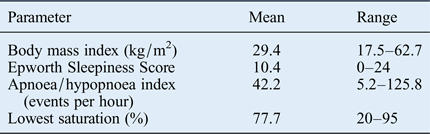
The clinical and polysomnography findings of the patients are shown in Table II.
Clinical and polysomnography findings of study population

Epidemiology
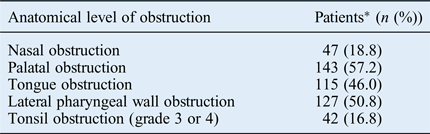
In our study population of OSA patients, 171 (68.4 per cent) had multi-level obstruction, 49 (19.6 per cent) had single-level obstruction and 30 (12 per cent) showed no obstruction on clinical examination. Fifty-three patients (21.2 per cent) had mild OSA, 60 (24.0 per cent) had moderate OSA and 137 (54.8 per cent) had severe OSA. Multi-level obstruction was more prevalent within each category of OSA severity (Table III). The frequencies of obstruction at various anatomical levels in our study population are shown in Table IV.
Frequency of types of obstruction according to OSA severity

Data represent numbers (and percentages) of patients. *Total n = 250. OSA = obstructive sleep apnoea
Frequency of obstruction at different anatomical levels

*Total n = 250
Obstructive sleep apnoea severity and upper airway morphology
Multi-level obstruction was associated with severe OSA (apnoea/hypopnoea index of more than 30 events per hour) (p = 0.001). The severity of OSA increased with the number of obstruction sites (r = 0.303, p < 0.001). Compared to single- or multi-level obstruction, the absence of obvious obstructions on clinical examination (30 patients) was associated with mild and moderate OSA (apnoea/hypopnoea index of less than 30 events per hour) (p = 0.003).
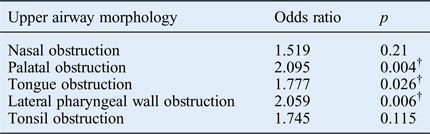
Regarding obstruction at different anatomical levels, palatal (p = 0.004), tongue (p = 0.026) and lateral pharyngeal wall obstructions (p = 0.006) were associated with severe OSA (Table V).
Association between upper airway morphology and severe OSA*

* Defined as an apnoea/hypopnoea index of more than 30 events per hour. †Indicates statistical significance. OSA = obstructive sleep apnoea
Upper airway morphology and obesity
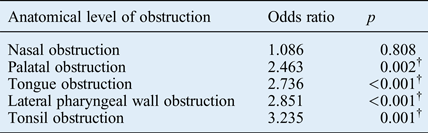
Patients with high BMI (more than 30 kg/m2) were more likely to have obstructions at the level of palate, tongue, lateral pharyngeal wall and tonsils, as shown in Table VI.
Association between obesity and upper airway morphology*

* Body mass index of more than 30 kg/m2. †Indicates statistical significance
Predictors of multi-level obstruction
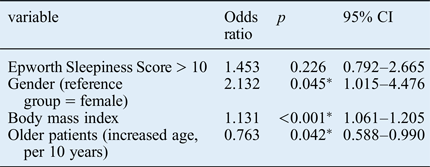
Multi-level obstruction was more likely in younger (p = 0.042), male (p = 0.045) patients, with higher BMI (more than 30 kg/m2) (p < 0.001) (Table VII). On further analysis, younger patients in our study population were found to have a higher BMI (r = −0.149, p = 0.02).
Logistic regression analysis on multi- versus single- or no obstruction

*Indicates statistical significance. CI = confidence interval
Discussion
Conventional OSA surgery has focused predominantly on single-level treatment. Commonly used surgical methods include tracheostomy and UPPP. Tracheostomy, whilst effective, is associated with morbidity and is met with low acceptance. As a single-level surgery, UPPP has shown limited effectiveness in the treatment of OSA. In a meta-analysis by Caples et al., following UPPP, the post-operative apnoea/hypopnoea index remained elevated, at 29.8 events per hour.Reference Caples, Rowley, Prinsell, Pallanch, Elamin and Katz 3 It was such suboptimal surgical responses which revealed that most patients non-responsive to UPPP had multi-level obstruction.Reference Fujita 4
This highlighted the need to conceptually clarify, and to establish the prevalence of, single- and multi-level obstruction in patients with OSA. Our data show that the majority of our OSA population (79.3 per cent) had multi-level obstruction. This is similar to findings of other studies, wherein multi-level obstruction was reported in 87–93.3 per cent of OSA patients.Reference Riley, Powell and Guilleminault 6 , Reference Abdullah, van Hasselt, Terris and Goode 10 Ishman et al. noted that currently multi-level surgery is favoured for OSA.Reference Ishman, Ishii and Gourin 2 Given that multi-level obstruction was more ubiquitous in our OSA patients, and that multi-level obstruction is associated with more severe OSA, this current trend of multi-level surgery is likely to yield more promising results.
-
• Upper airway obstruction in obstructive sleep apnoea (OSA) can be single- or multi-level
-
• Multi-level upper airway obstruction is more prevalent in the OSA population and is associated with more severe OSA
-
• Certain anatomical levels of obstruction contribute more significantly towards OSA severity
-
• Surgical management of OSA patients should focus on localising obstruction levels, tailoring surgical intervention accordingly
In addition, our study demonstrated that an increased number of obstructions on clinical examination is related to increased OSA severity, and this potentially affects the clinical management of these patients. If a patient exhibits more levels of obstructions on clinical examination, they may warrant prioritisation in terms of the sleep study appointment, for early diagnosis and management.
Our study also showed that multi-level obstruction was more prevalent compared to single-level obstruction across all categories of OSA severity. Multi-level obstruction was more prevalent, regardless of whether patients had mild, moderate or severe OSA. This has relevance in the application of multi-level treatment for OSA patients. When Friedman et al. presented their surgical results on minimally invasive, single-stage, multi-level treatment for patients with mild to moderate OSA, the treatment principle was founded upon the hypothesis that multi-level obstruction is the common denominator in all patients, regardless of whether they have mild, moderate or severe OSA.Reference Friedman, Lin, Gurpinar and Joseph 11 Our study confirms this hypothesis. This therefore rationalises the application of multi-level treatment when surgical intervention is considered for patients with mild to moderate OSA, if they have multi-level obstruction.
Our study also demonstrated that male patients, those with a BMI of more than 30 kg/m2 and patients of a younger age are more likely to have multi-level obstruction. Coupled with the fact that patients with multi-level obstruction are more likely to have severe OSA (p = 0.001), these clinical predicting factors can be used to identify patients who might need more urgent investigation and management.
In previous studies, increased age was associated with increased upper airway obstruction and an increased incidence of OSA.Reference Tishler, Larkin, Schluchter and Redline 12 , Reference Bixler, Vgontzas, Ten Have, Tyson and Kales 13 This is because of reduced muscle tone of the upper airway and a reduction in pharyngeal sensory discrimination, associated with advancements in age, which lead to increased upper airway collapsibility. However, our unusual finding that younger patients are more likely to have multi-level obstruction can be explained by the fact that, in our study population, younger patients had higher BMI.
The associations between multi-level obstruction and obesity and OSA severity, as shown in our study, are not entirely surprising. Obesity is known to predispose to OSA development and contribute to its progression.Reference Romero-Caorral, Caples, Lopez-Jimenez and Somers 14 Epidemiological studies have shown that there is a higher prevalence of OSA in obese adults and children.Reference Rudnick, Walsh, Hampton and Mitchell 15 Obesity causes fat deposition at the upper airway, leading to narrower lumen and increased airway collapsibility. Studies have demonstrated deposition of fat at multiple sites of the upper airway. Using T1-weighted magnetic resonance imaging of the upper airway, Shelton et al. demonstrated deposition of adipose tissue adjacent to the upper airway, between the medial pterygoid muscle and carotid artery.Reference Shelton, Woodson, Gay and Suratt 16 Kim et al. demonstrated increased fat deposition in the base of the tongue in obese OSA patients.Reference Kim, Kennan, Jackson, Chan, Staley and Poptani 17 Shelton et al. also demonstrated a statistically significant correlation between adipose tissue volume and OSA severity (r = 0.59, p < 0.001).Reference Shelton, Woodson, Gay and Suratt 16 This presents a role for bariatric surgery in the treatment of obese patients with severe OSA and multi-level obstruction. Some early studies have shown that bariatric surgery is effective in improving OSA symptoms and reducing the apnoea/hypopnoea index.Reference Fritscher, Mottin, Canani and Chatkin 18 In addition, prevention strategies for OSA should include control of the obesity epidemic.
Examination of the upper airway morphology of our OSA patients revealed that a high number of them had palatal (57.2 per cent), tongue base (46.0 per cent) and lateral pharyngeal wall (50.8 per cent) obstructions. These levels of obstruction were associated with more severe OSA, as shown in Table V. These findings are similar to those of Pang et al.Reference Pang, Terris and Podolsky 19 The presence of obstruction at these upper airway anatomical sites can be suggestive of severe OSA, and this can aid decisions to expedite care and intervention. If surgery is considered, these anatomical areas should be targeted during treatment planning.
Twelve per cent (30 out of 250) of our OSA patients showed no clinical obstruction, even though their polysomnography demonstrated varying degrees of OSA, from mild to severe. This could be attributed to limitations in the assessment methods used in our study. Müller's manoeuvre is effort-dependent,Reference Ritter, Trudo, Goldenberg, Welch, Maislin and Schwab 20 and there can be variation in observer estimations.Reference Faber, Grymer, Norregaard and Hilberg 21 Furthermore, epiglottis collapse, the prevalence of which may be higher than previously described,Reference Torre, Camacho, Liu, Huon and Capasso 22 can only be detected with drug-induced sleep endoscopy. Whilst our evaluation methods are suboptimal compared to the ‘gold standard’ of drug-induced sleep endoscopy, these methods and results still have clinical applicability, as they have greater availability in most ENT clinics compared to drug-induced sleep endoscopy. In addition, dynamic pharyngoscopy is time- and cost-effective, and is able to predict surgical success to a certain degree.Reference Aboussouan, Golish, Wood, Mehta, Wood and Dinner 23
In current literature, the exact criteria of ‘multi-level’ obstructions are not clearly defined, and vary between authors. For instance, Riley et al. classifies patients into three categories: type one – oropharyngeal obstruction only; type two – oropharyngeal and hypopharyngeal obstruction; and type three – hypopharyngeal obstruction only.Reference Riley, Powell and Guilleminault 6 Type two patients were considered to have multi-level obstruction, and 93.3 per cent (223 out of 239) of their study population had multi-level obstruction.Reference Riley, Powell and Guilleminault 6 This definition does not count nasal obstruction as part of its levels, which may lead to an underestimation of patients with multi-level obstruction.
The definition of single- or multi-level obstruction has two main broad classifications. It can be divided based on regions such as the oropharynx and hypopharynx. It can also be divided based on organs, as described in our paper. There is a broad range of descriptive terminologies used for sites of obstruction, and overlap is common. For instance, retropalatal, velopharynx, retrolingual and mesopharynx all represent parts in the oropharynx. Confusion can also arise where some authors classify tongue obstruction as oropharyngeal obstruction,Reference Rama, Tekwani and Kushida 24 and some consider it as a hypopharyngeal obstruction.Reference Kezirian and Goldberg 25 Hence, in our study, we utilised an ‘organ’ based approach to classify sites of obstruction. We categorised the levels of obstruction into nasal, palatal, tongue, lateral pharyngeal wall and tonsillar obstructions, as these sites are easy to pinpoint on clinical examination, they avoid confusion, and they form the basis for surgical intervention.
Conclusion
Multi-level upper airway obstruction is more prevalent in the OSA population, and is associated with more severe OSA. Surgical management of these patients should be focused on localising the levels of obstruction and tailoring surgical intervention accordingly. In our study, obstruction at certain anatomical levels contributed more towards OSA severity. The management of affected OSA patients should be prioritised to achieve optimal results.