INTRODUCTION
The nematode Anguillicola crassus Kuwahara, Niimi & Itagaki, 1974 (Nematoda, Dracunculoidea) is a parasite that has received much attention in the last 2 decades, because of its recent introduction by the Japanese eel (Anguilla japonica) into European and American eel (A. anguilla and A. rostrata) populations (reviewed by Kirk, Reference Kirk2003; Kennedy, Reference Kennedy2007). Anguillicola crassus infrapopulations, which are in the swim-bladder, are larger in European eels than in Japanese eels (Knopf and Manhke, Reference Knopf and Manhke2004; Knopf, Reference Knopf2006; Münderle et al. Reference Münderle, Taraschewski, Klar, Chang, Shiao, Shen, He, Lin and Tzeng2006). The immune response against the nematode is known to be sufficient to regulate infrapopulations in the native host (Nielsen, Reference Nielsen1999; Nielsen and Esteve-Gassent, Reference Nielsen and Esteve-Gassent2006), but not in the novel host (Knopf, Reference Knopf2006). However, A. crassus infrapopulations should also be regulated in their European host, because in wild populations, parasites rarely ‘over-exploit’ their host population (Anderson, Reference Anderson1991). Because an endangered host and an introduced parasite species (EIFAC/ICES, 2007) are involved, it is of particular importance to investigate and understand the processes that may regulate the nematode infrapopulations.
In this host–parasite system, the characteristics of the parasite's life cycle are likely to produce strong intra-specific competition. The life cycle includes 2 obligatory hosts, eels as definitive hosts and small crustaceans as intermediate hosts (De Charleroy et al. Reference De Charleroy, Grisez, Thomas, Belpaire and Ollevier1990b). Moreover, various small fish species and invertebrates are known to act as facultative paratenic hosts (Thomas and Ollevier, Reference Thomas and Ollevier1992a). Male and female adults reproduce in the swim-bladder of the eel. Females produce thousands of eggs (Thomas and Ollevier, Reference Thomas and Ollevier1993), some of which hatch in the swim-bladder of the eel into second-stage larvae (L2s) (first-stage larvae (L1s) moult to L2s in the uterus of the fecund female). Eggs and L2s leave the swim-bladder via the pneumatic duct, pass through the digestive tract and reach the water, in which the remaining eggs hatch. L2s are ingested by small crustaceans, reach the haemocoel and subsequently, moult to L3s. Infected intermediate hosts can be eaten either by eels or small fishes. If eaten by eels, infective L3s pass through intestine and swim-bladder walls and establish in their niche, the swim-bladder lumen. They moult to L4s, which begin to feed on the blood of eels. These larvae then moult to immature adults that will acquire sexual maturity. If infected intermediate hosts are eaten by small fishes, the development of the parasite ceases until the fishes are eaten by eels. Under laboratory conditions, the complete life cycle takes 2 to 5 months, most of which is spent in the eel swim-bladder (Haenen et al. Reference Haenen, Grisez, De Charleroy, Belpaire and Ollevier1989; De Charleroy et al. Reference De Charleroy, Grisez, Thomas, Belpaire and Ollevier1990b; Moravec et al. Reference Moravec, Di Cave, Orecchia and Paggi1994). Therefore, intra-specific competition should arise from the fact that (i) the swim-bladder is a habitat limited in resources and space and (ii) the regular consumption of infected prey by eels, as well as the high developmental plasticity of the nematode leads to the coexistence of multiple stages (i.e. L3s, L4s, highly dimorphic male and female adults and newborn L2s) in a single swim-bladder. The use of resources by individuals may decrease their availability for others (competition by exploitation) and/or one individual may have a direct negative effect on another (competition by interference). Both of these processes, which are difficult to distinguish between, are known to be density-dependent (Poulin, Reference Poulin1998; Combes, Reference Combes2001) and may indirectly or directly mediate the inter-individual interactions within a specific stage (L3s, L4s, adults or L2s) or sex (males or females) and also between different stages or sexes.
The regulation of A. crassus infrapopulations has been investigated previously in naturally infected eels. Adult parasites were found to inhibit the moult of larvae to the adult stage and to constrain the number of females reaching sexual maturity, in a density-dependent manner (Ashworth and Kennedy, Reference Ashworth and Kennedy1999). These findings supported the hypothesis of an intra-specific competition among parasites, both between developmental stages and between sexes. However, there is a paucity of knowledge on the regulation of A. crassus infrapopulations, particularly regarding the effects of the size of the niche, the possible existence of other inter-individual interactions and the potential variability of these relationships during the course of infection.
In the present study, under experimental conditions, we investigated the regulation of A. crassus infrapopulations within their European host via intra-specific competition within and between the different stages and sexes. The approach was to test: (i) the influence of the size of the niche on the number of parasites of each stage and sex, and the influence of the size of the niche on the biomass of adults; (ii) the influence of the number of parasites of a particular stage on the number of parasites of all other coexisting stages (and of the other sex, when adults), and on adult biomass. The experimental protocol included artificial infections to obtain various densities of parasites and the monitoring of the infrapopulations at 4 essential steps in the life cycle of A. crassus, namely the establishment of L3s in the swim-bladder, the moult to L4s, the moult to adults and the attainment of sexual maturity.
MATERIALS AND METHODS
Cultivation of third-stage larvae of Anguillicola crassus
L3s of A. crassus were cultivated following a modified version of the procedure described by De Charleroy et al. (Reference De Charleroy, Cannaerts, Augustijhn, Grisez, Boon and Ollevier1990a) and Haenen et al. (Reference Haenen, Van Wijngaarden and Borgsteede1994). L2s and eggs containing L2s of A. crassus were isolated from naturally infected yellow eels caught in Mediterranean lagoons. L2s and eggs were suspended into freshwater and incubated for 2 or 3 days at 20°C until hatching. Copepods, which were collected at the Villeneuve-de-la-Raho Lake (42·63°N 2·90°E, Pyrénées-Orientales, France), were fed with L2s (~10 L2s per copepod). Subsequently, infected copepods were maintained at 24°C in oxygenated water and fed once a day with paramaecia. The L3s were identified under a photonic microscope by the presence of a brace-shaped sclerified structure at the anterior end of the larvae, called ‘buccal ornamentation’ (Blanc et al. Reference Blanc, Bonneau, Bagianti and Petter1992). At this point, L3s were harvested from the copepods with a potter in physiological serum (8·5‰) and counted under a binocular microscope.
Collection and husbandry of eels
One thousand A. anguilla L. from a single cohort were caught in January 2004 at Salses-Leucate Lagoon (42°50'N 03°00'E, Pyrénées-Orientales, France). They were transported to the laboratory in oxygenated lagoon water and transferred into ten 100 l tanks filled with artificial, 23 g/l salt water. A subset of individuals (n=53) were randomly selected and examined for macro-parasites (helminths); no parasites were found in the swim-bladder, the gills or the digestive tract. The remaining eels were allowed to acclimatize and develop in aquaria from January 2004 to May 2005. The photo-period was 12 h, the temperature was between 20 and 25°C and eels were fed ad libitum with commercial pelleted food (Trouvit, Hendrix S.p.A., Varese, Italy). During the first 2 months of the experiment, the water salinity was reduced by 2–3 g/l weekly until it reached 3 g/l and then maintained at this level until the end of the experiment.
Infection protocol
The experimental infections of A. anguilla L. were performed between December 2004 and February 2005. Eels were anesthetized in 0·1 ml/l Eugenol (Merck Schuchardt OHG, Hohenbrunn, Germany). Twenty-five, 50, 75, or 100 L3s were deposited in the stomach of eels, using syringes with a blunt cannula filled with physiological serum. These doses were chosen based on the mean parasite recovery (15%) obtained by Haenen et al. (Reference Haenen, van Wijngaarden, van der Heijden, Hoglund, Cornellissen, van Leengoed, Borgsteede and van Muiswinkel1996) following artificial infection of eels using a similar protocol. We expected a broad range in infrapopulation size, which would be consistent with that found in the wild (mean of 4 and 15 parasites per eel). Eels were maintained in aquaria for 2, 8, 12 and 20 weeks. These durations of infection were chosen according to the life cycle and developmental times of A. crassus. Taking into account the rearing temperature (20–25°C), most parasites were expected to establish in the swim-bladder 2 weeks post-infection (p.i.). At 8 weeks p.i., the majority of the parasites was expected to have moulted to the L4 stage. At 12 weeks p.i., most parasites were expected to have moulted to the immature adult stage. At 20 weeks p.i., most parasites were expected to reach sexual maturity and commence reproduction (Haenen et al. Reference Haenen, Grisez, De Charleroy, Belpaire and Ollevier1989; De Charleroy et al. Reference De Charleroy, Grisez, Thomas, Belpaire and Ollevier1990b; Moravec et al. Reference Moravec, Di Cave, Orecchia and Paggi1994).
Parasite infrapopulation recovery
Prior to their dissection, eels were anesthetized and measured (total length in mm) to assess the potential volume that was available for parasite establishment and development in the swim-bladder (Thomas and Ollevier, Reference Thomas and Ollevier1992b). The eels were then beheaded. Swim-bladders (wall and lumen) were examined under a binocular microscope for the recovery of parasites. The parasite infrapopulation was characterized by the number of the different stages: L3s, L4s, male adults and female adults, by the biomass of each sex and by the presence of L2s and eggs in the lumen of the swim-bladder. The developmental stage (L3, L4 and adult) and the sex (for adults only) and the presence of L2s and eggs were determined by eye under a binocular microscope. Both male and female adults of each infrapopulation were weighed (mg). The percentage recovery was calculated as the number of recovered parasites (total number of L3s, L4s and adults) divided by the number of infective L3s originally administered.
Statistical analyses
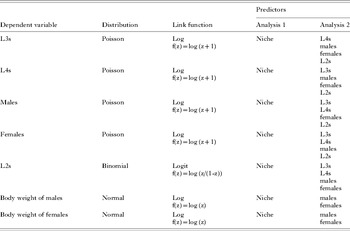
The regulation of A. crassus infrapopulations was studied using generalized linear models, which test the effect of explanatory variables or predictors on one dependent variable. Generalized linear models were used because both linear and non-linear effects for any number and type of predictors on a discrete or continuous variable can be analysed (Wilson and Grenfell, Reference Wilson and Grenfell1997). The dependent variables, their distribution (Kolmogorov-Smirnov test), the link function used for the model structure and the tested predictors are given in Table 1. The effect of the size of the niche on the number or biomass of parasites of each stage or sex, and the effect of the number of parasites of a given stage on the number or biomass of parasites of all other coexisting stages or sex, were considered in separate analyses (see Table 1). To test the potential variability in the effect of predictors during the course of the infection, each of the 4 durations of infection (i.e. 2, 8, 12 and 20 weeks p.i.) was independently considered. As the males and females of each infrapopulation were each found to be homogeneous in size, we decided to extrapolate 2 dependent variables from the experimental data, the ‘body weight of males’ and the ‘body weight of females’. These variables were calculated by dividing the whole male (or female) biomass by the number of recovered males (or females) in each infrapopulation. They were calculated for 2 of the 4 durations of infections, 8 and 12 weeks p.i., because there were no adults and thus too few values available for the infrapopulational biomass at 2 and 20 weeks p.i., respectively. The data for 8 weeks p.i. were log-transformed for normality.
Description of the dependent variables, their distribution, the link function used for the model structure and the tested predictors, for each of the two analyses
(‘niche’ corresponds to total length of eel; third-stage larvae (‘L3s’), fourth-stage larvae (‘L4s’), ‘males’ and ‘females’ correspond to the number of recovered parasites of each of these stages/sexes; second-stage larvae (‘L2s’) corresponds to the presence/absence of these larvae in the swim-bladder.)

The significance of predictors was determined using a forward, stepwise procedure (P-enter value<0·01 and P-remove value<0·05), with significance of a predictor determined using the Wald test (P-value<0·01). This process allowed the construction of minimal models from significant predictors. All statistical analyses were conducted with Statistica 6.0 software (StatSoft, Inc.).
RESULTS
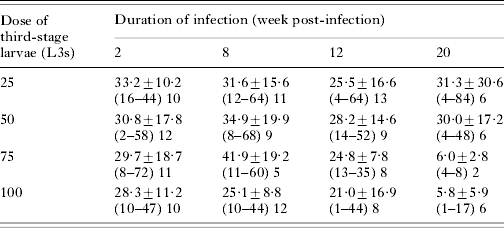
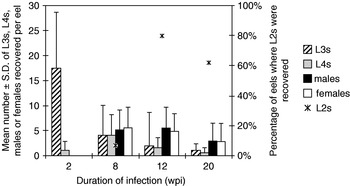
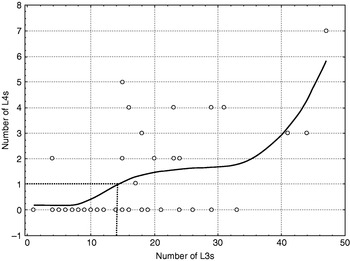
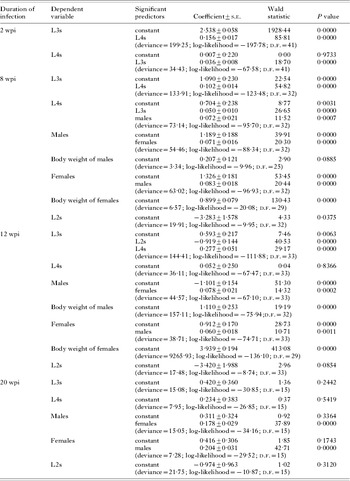
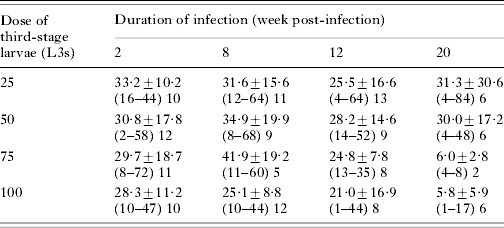
At 2 weeks p.i., L3 stages had established in the swim-bladders and some of them had moulted to the L4 stage (Fig. 1). The mean percentage recovery ranged between 28·3% and 33·2% (Table 2). The number of L3s was positively influenced by the number of L4s (P<0·0001) and, reciprocally, the number of L4s was positively influenced by the number of L3s (P<0·0001) (Table 5). Under the experimental conditions used, the critical value of established L3s necessary to find at least one L4 was inferred to be ~14 (Fig. 2).
Mean percentage recovery of Anguillicola crassus±standard deviation (minimum and maximum percentage recoveries) followed by the number of eels studied
Developmental dynamics of Anguillicola crassus in artificially infected European eels. The figure shows the mean number±standard deviation (s.d.) of recovered parasites with respect to the developmental stage and the sex when adults (third-stage larvae (L3s), fourth-stage larvae (L4s), males, females) and the percentage of eels where at least 1 couple of adults has reproduced (second-stage larvae (L2s)), for each duration of infection. wpi, week post-infection.

Number of recovered Anguillicola crassus fourth-stage larvae (L4s) in relation to the number of recovered third-stage larvae (L3s) in swim-bladders of artificially infected European eels, 2 weeks after infection. Data modelling (fit line: distance weighted least squares) suggests that the critical value of established L3s necessary to find at least 1 L4 would be approximately 14 (dotted line).

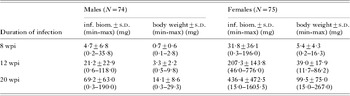
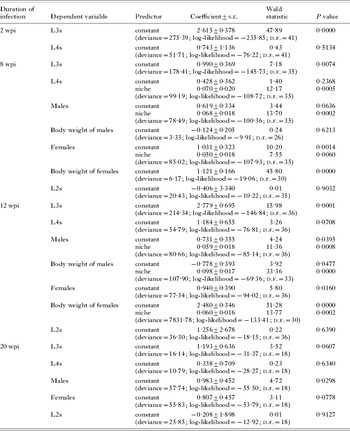
At 8 weeks p.i., infrapopulations were mostly made up of adults, of which few had reproduced; between 2 and 8 weeks p.i., most L3s moulted to L4s and some L4s moulted to adults (Fig. 1). The body weight ranged between 0·1 and 2·8 mg for males and between 0·2 and 16·3 mg for females (Table 3). The mean percentage recovery varied between 25·1% and 41·9% (Table 2). The number of L4s (P<0·001), males (P<0·001) and females (P<0·01) was positively influenced by the size of the niche (Table 4). The number of L3s was positively influenced by the number of L4s (P<0·0001). The number of males and females and the presence/absence of L2s had no effect (P>0·01). The number of L4s was positively influenced by the number of L3s (P<0·0001) and the number of males (P<0·001). The number of females and the presence/absence of L2s had no effect (P>0·01). The number of males was positively influenced by the number of females (P<0·0001) and, reciprocally, the number of females was positively influenced by the number of males (P<0·0001). The number of L3s and L4s and the presence/absence of L2s had no effect on the number of either males or females (P>0·01) (Table 5). No predictor was found to have an effect on the body weight of males and females or on the presence/absence of L2 larvae (P>0·01).
Mean infrapopulational biomass and body weight of male and female Anguillicola crassus per artificially infected eel
(wpi, week post-infection; inf. biom., infrapopulational biomass; s.d., standard deviation; min-max, minimum and maximum recorded values.)

Effect of the size of the niche on Anguillicola crassus infrapopulations
(Generalized linear models were performed independently for each dependent variable, at each of the 4 durations of infection. Models were built assuming (i) a Poisson distribution (link function: log) for the third-stage larvae (‘L3s’), fourth-stage larvae (‘L4s’), ‘males’ and ‘females’ dependent variables, (ii) a Normal distribution (link function: log) for the ‘body weight of males’ and the ‘body weight of females’ dependent variables and (iii) a Binomial distribution (link function: logit) for the second-stage larvae (‘L2s’) dependent variable (response codes: 1=presence of L2s and 0=absence of L2s). Only significant (P<0·01) predictor, except constant, is given. wpi, week post-infection; S.E., standard error; d.f., degree of freedom; ‘niche’ corresponds to total length of eel; ‘L3s’, ‘L4s’, ‘males’ and ‘females’ correspond to the number of recovered parasites of each of these stages/sexes; ‘L2s’ corresponds to the presence/absence of these larvae in the swim-bladder.)

Effect of the number of Anguillicola crassus of a given stage/sex on infrapopulations
(Generalized linear models were performed independently for each dependent variable at each of the 4 durations of infection, using a forward stepwise procedure (P-enter value<0·01 and P-remove value<0·05). Models were built assuming (i) a Poisson distribution (link function: log) for the third-stage larvae (‘L3s’), fourth-stage larvae (‘L4s’), ‘males’ and ‘females’ dependent variables, (ii) a Normal distribution (link function: log) for the ‘body weight of males’ and the ‘body weight of females’ dependent variables and (iii) a Binomial distribution (link function: logit) for the second-stage larvae (‘L2s’) dependent variable (response codes: 1=presence of L2s and 0=absence of L2s). Only significant (P<0·01) predictors, except constant, are given and presented with respect to their importance in the dependent variable explanation (see Wald statistic values). wpi, weak post-infection; s.e., standard error; d.f., degree of freedom; ‘L3s’, ‘L4s’, ‘males’ and ‘females’ correspond to the number of recovered parasites of each of these stages/sexes; ‘L2s’ corresponds to the presence/absence of these larvae in the swim-bladder.)

At 12 weeks p.i., infrapopulations were mostly made up of adults, most of which had reproduced. Between 8 and 12 weeks p.i., some of the remaining L3s moulted to L4s and moulted further to adults (Fig. 1). The body weight varied between 0·5 and 9·8 mg for males and between 11·7 and 86·2 mg for females (Table 3). The mean percentage recovery ranged between 21·0% and 28·2% (Table 2). The number of males (P<0·001) and both the body weight of males (P<0·0001) and females (P<0·001) were positively influenced by the size of the niche (Table 4). The number of L3s was positively influenced by the number of L4s (P<0·0001) and negatively influenced by the presence of L2s (P<0·0001). The number of males and females had no effect (P>0·01). No predictor was found to have an effect on the number of L4s (P>0·01). The number of males was positively influenced by the number of females (P<0·001), and reciprocally, the number of females was positively influenced by the number of males (P<0·01) (Table 5). The number of L3s and L4s and the L2s had no effect on both these variables (P>0·01). No predictor was found to have an effect on the body weight of males and females or on the presence/absence of L2s (P>0·01).
At 20 weeks p.i., infrapopulations were mostly made up of adults, but their number and the proportion which had reproduced were less than at 12 weeks p.i. Between 12 and 20 weeks p.i. some adults died and some of the remaining L3s moulted to L4s and moulted further to adults. The body weight varied between 0·3 and 29·3 mg for males and between 15·0 and 267·0 mg for females (Table 3). The mean percentage recovery ranged between 5·8% and 31·3% (Table 2). No predictor was found to have an effect on the number of L3s or L4s (P>0·01). The numbers of males and females were only positively influenced by the number of adults of the other sex (P<0·0001) (Table 5). Other predictors had no effect (P>0·01). No predictor was found to have an effect on the body weight of males and females or on the presence/absence of L2s (P>0·01).
DISCUSSION
In the present study, we experimentally tested the effects of (i) the resource-limited habitat of the parasite and (ii) the coexistence of several developmental stages in the swim-bladder of A. anguilla L. on the composition of the nematode infrapopulations, at different steps of the life cycle. This investigation was conducted to determine whether intra-specific competition occurred within or between the different stages and sexes of the parasite. Our results revealed that if both of these factors actually regulated A. crassus infrapopulations, their respective effects differed substantially during the course of the infection. These results provide new insights into the regulation of natural A. crassus populations.
The resource-limited habitat of the parasite led to intra-specific competition among 3 stages of A. crassus: L4s, male adults and female adults. We showed that if the size of the niche had no effect on the number of either L3s or L4s at 2 weeks p.i., a positive relationship was found with the number of L4s as well as the number adults at 8 weeks p.i., but not at 12 and 20 weeks p.i. This information suggests that the habitat would regulate the infrapopulation at the time of moult of L4s into immature adults, but not earlier in the establishment of L3s and the moult to L4s. This proposal may be explained by a substantial increase in competition for space and food among individual parasites, when they begin to feed on the blood of eels and grow. The positive relationship between the size of the niche and the body weight of males and females found at 12 weeks p.i. suggests that the habitat would still regulate the infrapopulations, by exerting a constraint on the biomass of sexually mature adults. This result is confirmed by the greater variability in body weight and infrapopulational biomass of males and females at 12 weeks p.i. compared with 8 weeks p.i. (as shown by differences in standard deviation and range of values in Table 3), and is in accordance with the positive relationship between the size of mature adults and the body length of their host, as reported by Moravec et al. (Reference Moravec, Di Cave, Orecchia and Paggi1994). We also found a significant positive relationship between the size of the niche and the number of males at 12 weeks p.i. However, this relationship was not found for females, which is surprising given the sexual dimorphism of adults. The present result may be explained by different reproductive strategies between sexes. We hypothesize that large females would remain stationary, whereas males would move within the swim-bladder to find one or more sexual partners and mate. Therefore, the space-limited habitat may constrain the movement of males within the swim-bladder. Currently, no data are available in the literature to support this hypothesis. Finally, the absence of an effect of the size of the niche at 20 weeks p.i. may be explained by the smaller infrapopulations following the death of some adults.
The coexistence of multiple developmental stages in the swim-bladder also led to intra-specific competition among A. crassus infrapopulations. We found that several types of inter-individual interactions occurred (i) within a developmental stage: between males and females, and among L3s and (ii) between developmental stages: between male adults and L4s, and between L3s and L2s.
First, we showed a positive relationship between the number of male and female adults, for each duration of infection in which adults were present (8, 12 and 20 weeks p.i.). This result illustrates synchronization of moults, and growth and sexual maturation of males and females in order to effectively reproduce. We also showed a positive relationship between the number of L3s and L4s. This result suggests that inter-individual interactions occurred within the L3 stage and then, that moult of L3s into L4s was significantly enhanced by an increasing number of established L3s. Under the present experimental conditions, the number of established L3s necessary at 2 weeks p.i. to promote the moult to L4s was inferred to be approximately 14. Therefore, the early development of L3s could be accelerated when density is high. This result was supported by a previous study (Boon et al. Reference Boon, Augustijhn, Cannaerts, Lokin, Machiels and Ollevier1990) showing that the rate of parasite development increased as the dose of infective L3s increased. In contrast, Haenen et al. (Reference Haenen, van Wijngaarden, van der Heijden, Hoglund, Cornellissen, van Leengoed, Borgsteede and van Muiswinkel1996) showed no relationship between these two parameters. Differences in the percentage recovery may explain the latter finding. Under analogous conditions (single infection, similar temperatures and times) the percentage recoveries were approximately 2-fold higher than those reported by Haenen et al. (Reference Haenen, van Wijngaarden, van der Heijden, Hoglund, Cornellissen, van Leengoed, Borgsteede and van Muiswinkel1996), possibly due to differences in water salinity (not reported by Haenen et al. Reference Haenen, van Wijngaarden, van der Heijden, Hoglund, Cornellissen, van Leengoed, Borgsteede and van Muiswinkel1996), which is known to affect development and survival of the nematode (Kirk et al. Reference Kirk, Lewis and Kennedy2000). At the beginning of A. crassus infection, intra-specific competition between larval stages would thus increase phenotypic variability of the developmental dynamics of the parasite.
Second, we found a positive relationship between the number of male adults and the number of remaining L4s at 8 weeks p.i. This suggests that the moult of late L4s to adults would depend on the density of immature males. Taken together with the above first result (positive relationship between the number of L3s and L4s), these findings would reflect the two opposite forces that drive the development of the L4s. On the one hand, moult of L3s into L4s would be enhanced by an increasing number of L3s, as found at 2 weeks p.i. On the other hand, moult of L4s into adults would be delayed by the presence of male adults. The latter confirms the operation of a density-dependent mechanism that stops the development of A. crassus larval stages (Ashworth and Kennedy, Reference Ashworth and Kennedy1999). In this study, we demonstrated that, at 8 weeks p.i., the density-dependent arrest of A. crassus larval development by adults was exerted by males on L4s and thus could limit male intra-sexual competition for females. We also found a negative relationship between the presence of newborn L2s in the swim-bladder and the number of remaining L3s at 12 weeks p.i. Again, this result could be related to the influence of adults on larval development (Ashworth and Kennedy, Reference Ashworth and Kennedy1999). Recovery of L2s in the swim-bladder indicates that the parasite has completed its life cycle. Moravec et al. (Reference Moravec, Di Cave, Orecchia and Paggi1994) reported that the mean length of the patent period was short (1 month) compared with the pre-patent period (3 months) and that females degenerated soon after oviposition. The present result suggests that once adults have reproduced (particularly females), their constraint on larval stages would decrease and would therefore allow the moult of the remaining L3s to L4s.
Finally, the absence of intra- or inter-stage interactions at 20 weeks p.i. may be explained (as for the absence of effect of the size of the swim-bladder) by smaller infrapopulations following the death of some adults. Also, a lack of energy in the late-stage adults might cause them to focus on reproduction rather than on competition.
We synthesize, as a theoretical model, the pattern of development of A. crassus in a previously uninfected eel that had eaten a small infected fish (paratenic host infected with many L3s) as follows: L3s pass through the intestine and swim-bladder walls. Their establishment in the lumen would not be constrained by the size of the swim-bladder. The moult to the L4 stage would be accelerated as the number of L3s increases. Subsequently, the moult of L4s to adults would be delayed by adult males and would be constrained by the size of the swim-bladder. However, the moult of L4s to adults and their further development would be synchronized with that of the opposite sex. At the time of sexual maturation and mating, the number of males, as well as the body weight of adults would depend on the size of the swim-bladder. Soon after laying eggs, the developmental constraint on late L3s would decrease. When adults die, constraints would cease and the late larval stages would moult to become adults to reproduce.
We thank Michael S. Blouin for his valuable comments on an earlier version of the manuscript and for revising the English. This work was financially supported by the French Ministère de l'écologie et du développement durable, the CNRS and the University of Perpignan. G. F. was financially supported by a grant from the French Ministère de l'enseignement supérieur et de la recherche. Glass-eels were caught with French Affaires Maritimes authorization (order no. 2004/324).