Catheter-associated urinary tract infections (CAUTIs) are a common healthcare-associated infection, accounting for 30% of all healthcare-associated infections. CAUTIs are associated with increased rates of morbidity and mortality, increased healthcare costs, and unnecessary antibiotic use.Reference Hollingsworth, Rogers and Krein 1 , 2 CAUTIs are a preventable complication of hospitalization, and recently intense efforts have focused on healthcare worker education about appropriate catheter use and proper techniques for insertion and maintenance.Reference Buckley, Clements and Hopper 3 These efforts have moderately reduced catheter use and CAUTIs, but new approaches are needed. Recent studies examining barriers to reducing urinary-catheter use highlight the need for discussion of the risks of catheters with patients.Reference Krein, Kowalski, Harrod, Forman and Saint 4 , Reference Purvis, Gion and Kennedy 5 However, patient views on urinary catheter use and education have not been well explored.
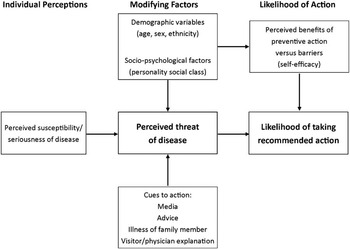
Our group recently published a pilot study examining patient perceptions of urinary indwelling catheters.Reference Safdar, Codispoti, Purvis and Knobloch 6 Here, we expand upon this work in a different patient population using a formal theoretical framework to identify key themes. The Health Belief Model (HBM) framework emphasizes perceptions of susceptibility, benefits and barriers, and “cues to action” (Figure 1), and has been used to study patient compliance and patient decision-making. 7 – Reference Bishop, Baker, Boyle and MacKinnon 9 Using the HBM, we uncovered themes related to urinary catheter use in inpatients, including an overall positive perception of catheters and a paucity in education regarding catheter use and alternative methods.
The Health Belief Model. 7 Originally developed to explain and predict health-related behaviors, the Health Belief Model can be used to understand how perceptions influence patient engagement to promote safer health care.

METHODS
A semistructured questionnaire was developed on the basis of HBM theoretical constructs (Online Supplementary Materials). We interviewed patients in their hospital rooms at our institution. Interviewees were currently using a urethral indwelling urinary catheter or had a urethral indwelling urinary catheter removed no more than 12 hours before the interview. Demographic information was collected during the interview and from electronic medical records. Patients paralyzed, pediatric, highly sedated, in the intensive care unit, or in isolation (other than contact isolation) were excluded. Verbal consent to conduct and audio record was obtained at the time of interview by the assisting nurse. This study was considered quality improvement and deemed exempt by the institutional review board at the University of Wisconsin.
Analysis used a line-by-line coding sequence as well as organizing and mapping of major themes to constructs of the HBM. Quotes were extracted from the interviews to depict major recurring themes and also mapped to the constructs.
RESULTS
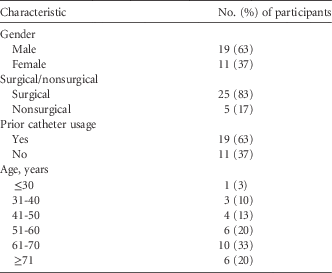
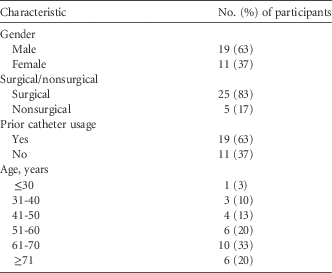
Table 1 summarizes participant characteristics. Analysis of interviews revealed 4 major themes about the use of urinary catheters.
Characteristics of 30 Participants in Study of Inpatient Perceptions of Indwelling Urinary Catheters
Theme 1 was the advantages provided by the catheter for comfort and support. Of the 30 patients, 18 (60%) expressed that the urinary catheter helped them avoid moving from the bed to urinate. Patients indicated difficulty with bathroom use in a hospital setting owing to surgeries, multiple tubes, and need for assistance. One participant noted, “It’s a lot of work to get myself up and out of bed and to the bathroom. So the catheter eliminates all of that.” Others expressed relief from having to urinate and reduced possibility of embarrassment. For example, one participant said, “It provides me security, it provides me safety, it provides me the capability of going to the bathroom when I need to and not have to wait for somebody to get here and then wetting the bed.”
Theme 2 was pain and discomfort associated with surgery and/or urinary catheter. Of 30 patients interviewed, 25 (83%) were surgical patients, 12 of whom (48%) expressed they had pain and/or discomfort from surgery and the catheter provided a method to urinate without moving. All patients spoke similarly about this aspect—one patient stated, “It is hard to get out of bed because of the surgery and it hurts and I’m connected to all of these tubes.” Patients also conveyed the urinary catheter itself would be painful if disturbed or tugged. One particular patient indicated he experienced pain if the catheter tube was disturbed.
Theme 3 was lack of knowledge of urinary catheters and alternative methods. Of 30 patients, 19 (63%) reported they did not receive training or education about urinary catheters. Information such as how to make sure the catheter was placed correctly, what levels to keep the catheter, and basic care were not addressed. Of the 30 patients, 26 (87%) reported that no information on alternative methods to a urinary catheter was provided.
Theme 4 was the ability to function somewhat normally. Of 30 patients, 16 (53%) believed they were able to function normally in the hospital, to some extent, with the urinary catheter. Many mentioned they could still take walks or do what they wanted in their hospital room with the catheter in place. Of 30 patients, 27 (90%) indicated they either would recommend having a urinary catheter or would use a catheter again if needed while hospitalized.
DISCUSSION
By means of the HBM framework, investigation of urinary catheter–related attitudes in inpatients found that many patients find aspects of catheters favorable. In fact, 90% of our cohort indicated they either would recommend having a urinary catheter or would use one again if needed while hospitalized.
These observed positive perceptions are likely related to lack of knowledge of urinary catheters, their risks, and alternative methods. In a recently published study in a separate cohort, our group found that 15 of 20 adult patients with indwelling urinary catheters perceived they had not received adequate education about catheters—all of these patients felt alternative methods of excretion were not discussed and a large proportion (65% [13/20]) felt they had not received sufficient information on urinary catheter risks.Reference Safdar, Codispoti, Purvis and Knobloch 6 The work presented here confirms these results in a different patient population using a theoretical framework, finding most patients reporting little or no education on catheters (63%) or alternative methods (87%). Recommendations on appropriate urinary catheter use are largely aimed at healthcare workers and include little guidance on how to involve patients. 2 Our study emphasizes the lack of urinary catheter education and knowledge in patients.
Our findings highlight the need for explicit discussion of the risks of catheters with patients and suggest a role for empowering patients to be part of decision-making regarding catheters. It is recognized that the perceived positive aspects of catheters (eg, comfort and maintained functionality) may be a complicating factor, especially in high-risk populations such as elderly patients. Future studies to understand the basis of positive perceptions are needed to determine effective patient-centered strategies to reduce urinary catheter use.
Limitations of our study include that it was conducted at a single site and in a small number of patients, most of whom were recovering from surgery. Alternative views may exist in nonsurgical patients and in patients with prior urinary catheter experience. In addition, the HBM does not address social or environmental factors associated with hospital stays. Also, some study participants had visitors present at the time of interview. Only one participant asked for continual input from visitors; all other visitors restricted comments to facts surrounding the care of the patient, such as when the catheter had been inserted or how long the catheter had been in place. Another limitation was that the precise reason for patients’ hospitalization was unknown; this could explain why alternative methods were not discussed with some patients.
In conclusion, we found that inpatients often perceived urinary catheters positively, identifying benefits related to convenience and comfort. Most patients were not aware of the risks of urinary catheters and that alternatives to indwelling catheters exist. These findings suggest opportunities to better educate and empower patients—strategies that could further reduce urinary catheter use and thus CAUTIs.
ACKNOWLEDGMENTS
Financial support. Agency for Healthcare Research and Quality (grant R03HS023791).
Potential conflicts of interest. All authors report no conflicts of interest relevant to this article.
Disclaimer: The contents do not represent the views of the US Department of Veterans Affairs or the United States Government. The content is solely the responsibility of the authors and does not necessarily represent the official views of the Agency for Healthcare Research.
SUPPLEMENTARY MATERIAL
To view supplementary material for this article, please visit http://dx.doi.org/10.1017/ice.2016.120.