Authoritarian governments create space for online political participation when they allow citizens to access new information and communication technologies (ICTs). New ICTs present multiple challenges for such governments because they serve as an “information source,” “a communication medium” and a “virtual public sphere.”Footnote 1 First, they can function as a coordination tool to mobilize and orchestrate collective actions against the government. For example, during the Jasmine Revolution in the Middle East in 2010 and 2011, new ICTs facilitated the protests that led to regimes collapsing.Footnote 2 Second, citizens’ access to new ICTs challenges the government's authority and monopoly over discourse.Footnote 3 And third, when new ICTs become a channel for political participation, the government is then faced with the pressure of responsiveness.
Authoritarian governments commonly adopt censorship to hinder collective actions and to maintain discourse dominance.Footnote 4 Gary King, Jennifer Pan and Margaret Roberts suggest that in China, “the purpose of the censorship program is to reduce the probability of collective action by clipping social ties whenever any collective movements are in evidence or expected.”Footnote 5 The Chinese government also manipulates online content by mobilizing or hiring people to post messages online in defence of the regime. Rongbin Han finds that some internet users defend the government online because they are either paid to do so or are simply pro-government.Footnote 6 King, Pan and Roberts show that state-mobilized internet users post a large number of messages online. These people avoid arguing with regime critics or discussing controversial issues; instead, they aim to distract the public and change the subject at hand.Footnote 7
Nevertheless, censorship and content manipulation do not necessarily alleviate the pressure of responsiveness confronting the government. When many people air their non-regime challenging demands online, the legitimacy of the government is diminished if it responds with censorship and repression; however, the government must pay the cost of verifying and addressing these complaints. It is therefore necessary to balance the cost with the need for responsiveness. In China, the decentralized political system helps the central government to deal with the issue of responsiveness. Addressing daily life grievances is generally the responsibility of local authorities. By shifting such responsibility to local governments and giving prominence to their responsiveness, the central government can protect regime legitimacy while avoiding the direct costs of addressing the complaints.
How do local governments address online complaints? This study finds that the political hierarchy creates a sandwich effect that shapes their response. Local governments cannot control new ICTs or prevent citizens from voicing their dissatisfaction online, but they are held accountable for aired grievances. They differentiate their responses by considering the pressure and costs generated by the complaints. High-profile cases are commonly addressed because of the significant pressure they bring. By contrast, low-profile complaints can be addressed if they lead to severe consequences, involve less cost or are supported by strong evidence. Local governments’ ignorance of low-profile complaints does not always damage regime legitimacy because there is little public knowledge of the issues; however, an accumulation of grievances can result in pent-up resentments in the long run.
Our study contributes to the understanding of government responsiveness. Existing research focuses on whether the government responds,Footnote 8 seeing its response as dichotomous.Footnote 9 As these studies focus less on how the government responds, they fail to measure the quality of response. For example, Zheng Su and Tianguang Meng measure the quality of government responsiveness “with the speed at which local governments respond to online public demands.”Footnote 10 However, this measurement is indirect and can be inaccurate. Our study specifies the multiple modes of response employed by the government, namely, not responding, providing justification for the problem, processing the complaint, promising to resolve the complaint, and resolving the complaint. The quality of response can therefore be directly measured.
Further, our study directly and objectively measures the pressures and costs that local governments are presented with when dealing with online grievances. In their study of Chinese counties, Jidong Chen, Jennifer Pan and Yiqing Xu identify two factors that cause county governments to be highly responsive: “threats of collective action” and “threats of tattling to upper levels of government.”Footnote 11 Their experimental design shows that this treatment does not distinguish between the real threat of collective action and negative publicity surrounding the issue. It is possible that public attention rather than the threat of collective action makes local governments responsive.
Finally, existing studies commonly suggest that authoritarian governments can benefit from the media's exposure of grievances as a source of information.Footnote 12 These studies, however, fail to address a critical issue: as the government cannot address all publicly aired complaints, how does it mitigate the damage to regime legitimacy caused by media exposure? Our study suggests that differentiated response allows both the central and local governments to strike a balance between the cost of resolving a problem and the need for responsiveness. However, the term differentiated response implies a threshold of meaningful response, and thresholded responsiveness can disappoint citizens. The government thus faces difficulties when it tries to shield its legitimacy from media exposure without relying on censorship.
Political Hierarchy and Downward Responsibility of Responsiveness
According to Milan Svolik, authoritarian rulers face two issues: the sharing of power among the ruling elites and maintaining authoritarian control over the masses.Footnote 13 There is also another important dimension of authoritarian rule: the monitoring of lower-level agents in a political hierarchy that contains multiple levels of government. Corrupt or incompetent agents undermine the regime's authority and legitimacy and provoke popular contention. Given the vast numbers of local agents and the difficulties in gathering information, the national government may empower the citizens to keep local agents in check. This is effective when the leverage gained by the citizens is beyond the control of the agents.
By empowering citizens, local agents are constrained both by the central authority and the people. In China, these two constraints shape local agents’ management of information. Technological development can empower the government by providing it with new and effective tools to improve its governance and control.Footnote 14 However, in a political hierarchy that comprises multiple levels of government, the degree of empowerment enjoyed by each level of government varies. Chinese local governments face pressure from upper-level authorities, including the central government, as well as internet users. Unlike the central government, local governments possess limited or little control over new social media, but they are held responsible for local issues that are brought to light. Exposed problems signal failures in governance at the local level.
Selective online censorship
In his study of the former Soviet Union, Seweryn Bialer distinguishes “high politics” from “low politics.”Footnote 15 High politics involves the principal political issues of society, the abstract ideas and language of politics, and the decisions and actions of the political leadership. By contrast, low politics pertains to decisions directly affecting citizens’ daily lives, community affairs and workplace conditions. Bialer suggests that expanded citizen participation in the former Soviet Union went “hand in hand with the retention of one of the most characteristic features of major Soviet social groups – their high level of apolitization.”Footnote 16 A lack of interest and curiosity allowed the Soviet people to remain untouched by high politics, and they mostly participated in low politics.
Similarly, many Chinese citizens with access to new ICTs have little interest in high politics.Footnote 17 For example, a 2014 survey of 1,800 Sina Weibo 微博 users found that nearly 73 per cent of respondents showed no interest in public issues, preferring instead to focus on sharing their individual life experiences, feelings, occupations, life philosophies, travel stories, jokes and health concerns.Footnote 18 Jens Damm claims that “the Chinese Internet is more so a playground for leisure, socializing, and commerce than a hotbed of political activism.”Footnote 19 Yet, similar to their counterparts in the former Soviet Union, Chinese citizens are actively interested in low politics. They commonly take to the internet to voice their demands and grievances as well as criticisms of local governments that have violated or failed to protect their rights.Footnote 20
Posting messages online is convenient and almost cost-free, and thus it is an easy option for those who encounter problems in their daily lives. More importantly, such low-political complaints are often not censored by the government. Instead, governments at various levels have opened online petition systems or online mailboxes to which citizens can submit their demands.Footnote 21 In 2013, the national complaints system began to accept online petitions, a practice which was then adopted nationwide in 2015. From 2013 to 2015, online petitions accounted for 43.6 per cent of all petitions filed in China.Footnote 22 Apart from the online petition system, citizens can also send messages to the email accounts or online mailboxes of government leaders, or post messages on government websites, various online forums or comment sections of influential news portals. For example, people.com.cn has launched an online forum called “Message Board for Local Leaders,” which invites local residents to submit questions to local officials. From January to June in 2017, this board received approximately 22,000 to 35,000 messages a month.Footnote 23
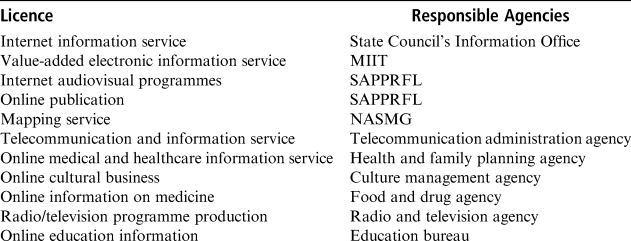
Although local governments continue to block and cover up information that tarnishes their image or that of local leaders, their efforts are not necessarily effective.Footnote 24 Local governments do not have direct control over social media. Influential news portals and new social media are subject to regulation by the central government and, in some cases, the provincial authority. Table 1 lists some of the licences necessary for internet companies to operate. A website may require licences issued by different agencies, depending on the business field within which it operates. Websites providing online information generally require the first five licences listed in the table, all of which are issued by central government agencies. Provincial agencies issue the remaining licences, often on behalf of the national agencies.
Online Business Licences

Source:
Authors' summary. MIIT: Ministry of Industry and Information Technologies; NASMG: National Administration of Surveying, Mapping and Geoinformation; SAPPRFL: State Administration of Press, Publication, Radio, Film and Television.
Local governments have to seek assistance from the provincial or central government or from internet companies when attempting to curb the circulation of information. For example, one official admitted that the prefecture government for which he worked had to approach the Cyberspace Administration of China (wangxin ban 网信办), Sina Weibo and Tencent (the owner of WeChat and QQ) for assistance in regulating local internet companies and users.Footnote 25 Local governments may also hire public relations companies to remove online messages that are critical of local authorities.Footnote 26 These practices reveal the constraints placed on local governments when attempting to manage information.
Pressure from upper-level governments
Online participation differs from traditional modes of citizen participation such as petitions or lawsuits in that it is immediately public and thus has the power to influence. When a complaint against lower-level agents gains publicity online, upper-level authorities can no longer feign ignorance about the problem. As a result, the public expects upper-level authorities to exert pressure on lower-level agents to resolve the issue; failure to do so damages regime legitimacy. Anticipating the possible intervention of upper-level governments, lower-level agents feel pressured into addressing the exposed problems for which they will be held accountable.
The Chinese central government requires local governments to be responsive. In February 2016, the central government issued an important directive that reiterated past rules and introduced new ones for regulating local governments.Footnote 27 One general rule relates to maintaining the dominance of official discourse, requiring the government to use all major media to disseminate information, explain policies and guide public opinion. Accordingly, central and local media as well as managers of news websites must be invited to participate in important functions and understand government decision making. Propaganda departments must maximize their use of news websites, commercial websites, Weibo, WeChat and mobile devices to enhance the effectiveness of their propaganda. Government websites must become authoritative information platforms for promulgating and interpreting policies, guiding public opinion and providing timely responses to the needs of the people.
In August 2016, the central government re-emphasized the importance of paying attention to public opinion. It called for all government levels to create mechanisms for monitoring, assessing and responding to public opinion, while state agencies had to create their own Weibo and WeChat accounts through which to communicate with the public. It also decreed that press conferences be held within 24 hours of important events in order to respond to public opinion, and within 48 hours to address other types of opinion.Footnote 28 In April 2017, the city government of Beijing stipulated that lower-level authorities would be disciplined if they failed to provide timely, active and accurate responses to important incidents. All authorized information on important and sudden incidents should be released within five hours and a news press conference should be held within 24 hours.Footnote 29 These regulations put local officials under direct pressure to manage exposed problems effectively as their reputations and careers may be impacted by any failure to do so. Information management has become a priority for local governments when responding to a crisis.Footnote 30
Local governments also come under pressure to manage information effectively because they are required to report local issues to upper-level authorities. For instance, the government of an inland city submitted 674 reports on local issues to the provincial authority in 2014.Footnote 31 Not all of these reports were critical of the government but some were citizens’ complaints that had been posted online. Although local governments can be selective about what local information they submit to upper-level authorities, this reporting system puts them under added pressure because their reports are no longer the only source of information: upper-level authorities can now access information through alternative channels.
Local Governments and Information Management
Media exposure puts local authorities and officials under significant pressure as those who are deemed responsible for or who mismanage exposed problems risk disciplinary action.Footnote 32 Given the potential consequences, local governments have to be both attentive and responsive to online complaints. Chinese local governments manage information by actively collecting information and then acting upon some of that information. They gather information through many different channels, including third parties, and pay particular attention to the so-called negative reports that may tarnish their image.
The different channels for collecting information
Chinese local governments use a variety of means to collect information pertaining to their localities.Footnote 33 They or their agencies may assign specialized people to address information-related concerns, including information collection. For example, in one district in an eastern city that we visited, each of the street offices and state agencies had a designated person who was responsible for information management. Some of these people were also responsible for collecting information from government and non-government websites as well as for dealing with the media. Local governments also recruit civilians to collect information. In the district we visited, the government had recruited approximately 25 volunteers who searched various sources for news on their locality. Recruited civilians can pass information on to the government via a designated email or new social media accounts, such as QQ or WeChat. As volunteers, they may not be paid, but the government occasionally rewards those who have performed well.
Internet companies or national news agencies are highly important conduits of information. Local governments often outsource information collection to businesses or state-owned news agencies that have the necessary technological skills and networks for collecting information. These internet companies or news agencies charge varying fees, depending on government requirements.
In the aforementioned district, the government hired a news agency, for a large sum, to provide several different services including monitoring public opinion, reporting on various issues or topics, and consultation services. The news agency had three responsibilities when monitoring public opinion for the district government. The first was to follow over a thousand major news media outlets inside and outside of China, including those in Hong Kong, Taiwan and Macau. The agency harvested positive and negative reports of the district by monitoring traditional and new social media, including mainstream internet websites, newspapers and television. It then studied the effects of the coverage of negative news on the regions where the news was disseminated. The agency also had a team to analyse and make judgements about important events that attracted public attention. It was expected to email daily reports to designated local authorities before a specified time.
The second duty was to review and analyse important events that had transpired over the previous month and submit monthly reports to designated parties before a pre-set date. Finally, when important public events did occur, the agency analysed public opinion based on the requirements of the local government. When negative reports were found (apart from email messages), the agency was required to immediately call the local authority. Moreover, when important and emergent events occurred, the agency had to inform the local authority right away via text messages, even during holidays.
In another example, the government of a prefecture in an inland province hired a state news agency to collect information, which it provided in daily and weekly summaries. Between 28 December 2013 and 26 September 2014, this agency gathered 80,254 reports concerning the prefecture from over 300 influential websites and their forums as well as online sources such as Weibo. The prefecture government received an average of 294 reports each day in which negative comments were highlighted.Footnote 34 A total of 710 pieces of negative news were extracted from approximately 240 daily reports in 2014, which is equivalent to approximately three negative news pieces per day.
Rationale of government response
Obtaining timely information is vital to local governments if they are to prevent media exposure from damaging their local image. Chinese local governments have also acted upon collected information. Zheng Su and Tianguang Meng found that of the more than 211,500 messages that were posted on an online political forum being monitored by local leaders from 2008 to early 2015, a significant portion (33 per cent) received a response.Footnote 35 In an experimental study on the response by county-level government to online demands for welfare assistance, Chen, Pan and Xu classify government replies as deferral, referral, or direct information. They found that the threat of collective action and the threat of tattling to upper levels of government increase the responsiveness of county officials.Footnote 36 However, the responsiveness of local governments to citizens’ online queries can be selective, with some groups experiencing discrimination.Footnote 37
Although these studies show that local governments are selective when responding to online complaints, they focus almost exclusively on whether or not these governments respond, as opposed to how they respond. As Su and Meng emphasize, “Online response is the very minimum but necessary form of government responsiveness, and it does not necessarily mean that actual moves are made by the government in the real world.”Footnote 38 Although some studies show how governments respond to highly publicized complaints,Footnote 39 they focus exclusively on a very small number of high-profile cases and fail to address the responses of governments to low-profile complaints.
This study suggests that when sandwiched between the people and higher-level authorities, local governments respond to online complaints according to how much pressure and cost the complaint generates. Such pressure is significantly determined by how much attention that a case draws from the public and from upper-level authorities. High-profile cases that capture nationwide attention exert significant pressure on exposed authorities and consequently tend to be resolved.
We examine the effect of media exposure by analysing the high-profile cases that occurred in China between 2012 and 2014. These cases were collected from the Blue Book of Public Opinion in China (2013–2015).Footnote 40 The yearbooks include information on high-profile events that occurred in each month during a given year. The cases were selected using a five-dimension scheme which measures their publicity.Footnote 41
Among the 1,255 high-profile cases recorded in China from 2012 to 2014, 46.2 per cent were in connection with social events that frequently involved celebrities, disputes between businesses, and the erroneous behaviour of individuals. Approximately 49 per cent were concerning public employees or state agencies, but not all of these cases evolved from citizens’ complaints. A total of 162 cases stemming from citizen complaints required action (Table 2). The majority of the aired complaints (81 per cent) were resolved and 102 individuals (including government officials) were disciplined. Therefore, it appears that those deemed responsible for the problematic issues take the threat of media exposure seriously. However, Table 2 also shows that complaints targeting government agencies are the least likely to be resolved.
Resolution of High-profile Cases

Source:
Authors’ collection.
Note:
Some complaints have more than one target.
Most of the citizen complaints filed online are low profile and attract little public attention. Examining how local governments deal with low-profile complaints reveals the rationale for their responsiveness. In high-profile cases, knowledge of the issue becomes widespread among the public and governments, including upper-level ones. Authorities are thus unable to pretend not to know about the problem and therefore come under pressure to help resolve it. In contrast, low-profile cases draw less public attention and so exert less pressure on local governments. A response from the government can increase citizens’ satisfaction with the regime, but there are political or economic costs to resolving complaints.Footnote 42 Local governments have more discretion when dealing with low-profile complaints and therefore pay more attention to the cost of resolving such cases. The cost of resolution certainly has an influence on their willingness to address citizens’ complaints.Footnote 43 Local governments cannot be certain if some low-profile cases will eventually become high profile and so their response is also affected by the seriousness of the online complaint or its potential consequence.
This study is based on data drawn from 1,159 low-profile cases reported in J City, a prefecture in an inland province. The information was gathered through two sources. The first source is a set of emails that has been publicly released online.Footnote 44 This package contains approximately 1,500 email exchanges between lower-level authorities, such as county governments, township governments, state agencies and public institutions or firms, and the propaganda department of the prefecture in 2014. These reports contain information on the complaints submitted by residents in the prefecture and how the local authorities addressed these complaints. A total of 1,159 cases were selected for the analysis after excluding repeated reports.
Second, by searching various public websites we were able to verify approximately 80 per cent of the complaints and collect additional background information on them.Footnote 45 None of the 1,159 cases was adequately influential to gain national attention and be included in the cases presented in the Blue Book of Public Opinion in China. These cases thus constitute a rarely publicly available dataset that allows for a systematic analysis of how local governments respond to low-profile online complaints in China.
Local Government and Differentiated Response
Our data suggest that local officials respond quickly to online complaints to limit damage from further exposure. Local authorities take approximately five days on average to reply to a complaint. However, most responses are provided within a shorter time span. The median time span between the raising of a complaint and the government's response is only three days. The average number of days is much larger than the median because of several outlier cases. For example, in one case, the local government took 146 days to respond. According to our data, approximately 17 per cent of complaints received a response within a day, 40 per cent within two days, 57 per cent within three days, and nearly 84 per cent within a week. Yet, the speed of response cannot be equated with the quality of response.Footnote 46 We divide the complaints into two categories: resolved and unresolved. Overall, 83 per cent of the resolved cases and 84 per cent of the unresolved cases were responded to within a week.
Modes of government response
For our analysis of low-profile complaints, we divided the subjects of complaints into the following categories: (1) governments or their agencies; (2) officials; (3) law enforcement agents; and (4) non-government actors (for example, public institutions or businesses). Governments or their agencies include those at the township, county and prefecture levels. We separate law enforcement agents from officials because law enforcement agents are not necessarily government officials or formal employees included in the state's personnel quota and may instead be contract employees of state agencies. Nonetheless, these individuals are still state employees and represent the state in law enforcement.
According to our data, the government adopted five modes of response to tackle the low-profile complaints of citizens: (1) no response; (2) justification or explanation of the existing practice; (3) claiming that a case is being processed; (4) promising a resolution; and (5) resolution. As shown in Table 3, only a small portion of these complaints (1.5 per cent) failed to receive a response from the local authorities.
Modes of Response

Source:
Authors’ collection.
Resolving citizen complaints involves costs, paid by the state or non-state agencies deemed responsible, and the costs can be economic or political (for example, the disciplining of state agents). We make two assumptions in our analysis of local governments’ responses. First, it is more costly to address a complaint involving a state agency than one involving individuals. Second, it is more costly to address a complaint involving a state agency than it is to address one involving a non-state agency, such as public institutions or businesses.
The descriptive statistics reveal two significant features of Chinese local government responses to online complaints by citizens. One is the effect of the degree of publicity the issue attracts. The government (especially the local government) comes under pressure when a case receives significant public attention. Therefore, publicity surrounding an issue is a crucial factor in the likelihood of local governments responding to citizens’ complaints. As shown in Table 2, approximately 81 per cent of the high-profile cases were resolved, whereas only 22.4 per cent of the low-profile complaints were resolved (Table 3).
An email from a county authority in J Prefecture reveals the rationale behind the local governments’ differentiated responses. An internet user had posted a claim that local cadres were fabricating their expenditures in order to receive government subsidies for the “construction of a new countryside.” The local authority describes how it was responding to the case:
Our department is watching him [the tip provider]. He has been using the same Weibo. He has been looking for an audience these days, hoping to make the case high profile. For the time being, only about seven or eight people have read or forwarded the case, and it is not influential. If it becomes high profile, our department will present it to pertinent leaders and the local government for investigation. We will also try to find this person and talk to and educate him.Footnote 47
The second feature is that responses are shaped by the subject of the complaint, which affects the cost to the local government of addressing the complaint. In both high- and low-profile cases, complaints about the government or its agencies are the least likely to be addressed. Approximately 60 per cent of such high-profile complaints were resolved, compared to only 9.4 per cent of low-profile complaints. In contrast, complaints involving non-state actors have a high tendency to be addressed. All high-profile cases involving businesses and 32 per cent of low-profile cases involving non-state actors were resolved.
The subjects of complaint in 281 of the 1,159 low-profile complaints (24 per cent) are not clearly specified. Some of these complaints concern government policies, while others pertain to incidents unrelated to the government, such as suicides. Although such cases do not explicitly target the government, the government senses the need to provide a response in order to contain the spread of any damaging publicity.
There are different forms of government response. Local governments provided justifications for 43 per cent of the 1,159 complaints under study, occasionally claiming that the complaints were misleading or unfounded. Determining the authenticity of the complaints or the government justifications is difficult. Many online reports of grassroots cadre corruption were dismissed as false. Local authorities tasked with addressing such allegations sometimes responded with the brief explanation that, “based on the investigation of pertinent agencies, what the message reports is not true,” but offered no explanation as to why they considered the report to be false. Chinese disciplinary agencies depend heavily on tip-offs from citizens to investigate corruption; however, most of these leads are not followed up owing to their lack of clarity or trustworthiness, or the political considerations of the leaders.Footnote 48
Local authorities also downplay the malfeasance of local officials in order to justify their failure to take any disciplinary action. For example, one complaint alleged that a deputy township Party secretary had called upon triad members to intimidate and threaten residents during a programme of housing demolition. The local government explained that the city government ordered the county and township governments to prevent peasants constructing illegal housing in areas of urban renewal. The township government claimed to have hired a demolition company to enforce the policy after “learning from other townships’ successful experiences.” As the township government was able to fulfil its assigned responsibility, there was little motivation for the upper-level authorities to launch any disciplinary action.
In approximately 21 per cent of the cases, the local authorities claimed that the issues raised were being investigated, were beyond their remit, required additional information, or had been submitted to the pertinent state agencies. It is difficult to assess whether such cases are eventually resolved. Local authorities use procrastination in order to protect their agents or to avoid responsibilities and costs. Addressing citizens’ complaints requires a considerable amount of cost and time, and “procrastination can typically reduce the government's total costs of investigation.”Footnote 49 Local governments are aware that public attention to issues is generally short lived,Footnote 50 and procrastination can be an effective way of avoiding having to deal with malfeasant agencies or agents. For example, when a case first catches the public's attention, local authorities may promise to investigate it; however, as public attention wanes, the authorities are able to shelve the case.
Choice of mode of response
Chinese local governments do not always ignore low-profile complaints. In this section, statistical analyses are used to examine the factors that influence their choice of response. The dependent variable is the local governments’ modes of response, which are divided into the aforementioned five categories, ranging from no response to a resolution. An ordered probit model is employed for the analysis.
The above discussion indicates the effect that the subject of a complaint has on the government's choice of response mode. The subject of a complaint may imply a political or economic cost, which shapes the government's response. In our analysis, the subjects of complaints were divided into the following categories: officials; law-enforcement agents; government agencies; non-government actors; and unspecified (i.e. the reference group). Complaints directed at officials, legal agents and state agencies are assumed to be more difficult to resolve than others because disciplining state agencies or state agents can be politically costly. By contrast, complaints directed at non-state agencies, such as public institutions and businesses, are more likely to be addressed than others because the government can place direct or indirect pressure on these agencies without paying a direct cost.Footnote 51
Control Variables
Three sets of control variables were included to examine their effect on local governments’ choice of response. One set of factors measures the pressure arising from publicly aired complaints. Specifically, if the complaint involves casualties or a large number of people, the targeted authority comes under increased pressure. The seriousness of a complaint case is divided into three categories. The degree of seriousness is coded as 0 if nobody is injured (i.e. the reference group); 1 if one or more persons are injured; and 2 if the case involves a death or deaths.
A dummy variable is also included to assess the degree of pressure that arises from the aggrieved individuals. Specifically, if the issue of complaint affects the interests of an individual, the variable is coded 0; if the issue affects the interests of a group of people, it is coded 1. We hypothesize that a case that affects the interests of a group of people tends to be solved, because the threat of action by a group of people is more severe than the threat posed by an individual.
A second set of variables included in the analysis concerns the reliability of complaints. Two dummy variables are created to measure the effect of the authenticity of online complaints. One is the presence (coded 1) or absence (coded 0) of photographic evidence, and the other is the presence (coded 1) or absence (coded 0) of audio- or video-taped evidence. The assumption is that complaints which present photographic, audio or filmed evidence are more likely to be resolved than those without such evidence.
Two variables are included to examine whether media exposure affects the resolution of low-profile complaints. A dummy variable measuring the involvement of traditional media was included. We assume that if a complaint is also reported by traditional media (i.e. newspapers), it tends to be addressed because it may attract extra attention; the opposite is also true. The other variable is the online forum on which a complaint was posted. The online platforms are divided into five categories: county-level, city-level, provincial-level, nationally influential, and unspecified forums (i.e. the reference group). If a complaint is posted on a provincial or national forum, it is more likely to be resolved.
The reports provided by the news agency hired by the prefecture government to collect information indicate that some incidents are treated as “negative cases that should receive primary attention.” Accordingly, we divide cases into the following categories: cases requiring extra attention by local authorities (coded 1), and other cases (coded 0).
Statistical Results
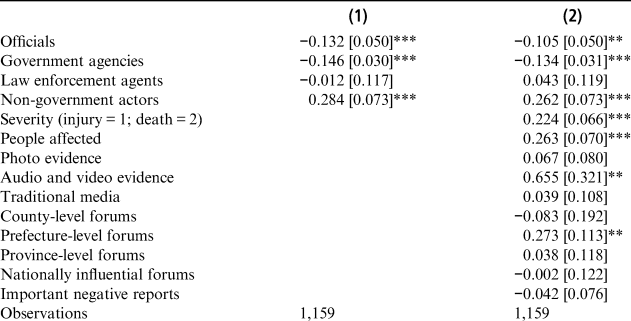
The statistical results are presented in Table 4. As hypothesized, if cadres or state agencies are the subject of the complaint, the issue is less likely to be resolved. On average, 22.4 per cent of complaints were resolved in our sample. If a complaint targets the government, the probability will decrease by approximately 3.9 percentage points or by 17.4 per cent (3.9/22.4) when evaluated at the mean. By contrast, if a complaint targets non-government actors (for example, firms), the probability of the complaint being addressed increases by approximately 7.6 percentage points or 33.9 per cent (7.6/22.4) when evaluated at the mean.
Determinants of the Choice of Mode of Response (Ordered Probit)

Notes:
Robust standard errors in brackets; ***p < 0.01, **p < 0.05, and *p < 0.1.
As expected, complaints involving severe casualties tend to be addressed. Compared with cases not involving any deaths, complaints involving death(s) are much more likely (56.3 per cent) to be addressed. Similarly, complaints affecting the interests of a group of people are more likely to be resolved. If a complaint affects a group of people, then it is 33.9 per cent more likely to be resolved and 9.4 per cent more likely to extract a promise of a resolution, as opposed to a case that only affects an individual. This finding is in line with earlier research that suggests that the fear of collective action drives local governments to respond to citizens’ demands.Footnote 52
The statistical results suggest that complaints submitted with photographic evidence are not more likely to be attended to than those without photographic evidence. However, complaints with audio or video evidence are much more likely (102 per cent more likely) to be addressed than those without such evidence. Even when such cases are not immediately resolved, the authorities are more likely to promise a resolution (12.1 per cent more likely). Video images appear to provide authenticity and arouse emotions. As Anthony Blair states, “a single visual image can probably be more powerful than a single verbal assertion.”Footnote 53 New ICTs can effectively create “image events” that empower the weak.Footnote 54 Hence, similar to high-profile cases, low-profile complaints with audio and video evidence tend to be addressed.
The effect of exposure by traditional media is insignificant. A possible reason is that exposure by newspapers is endogenously decided by the characteristics of a complaint. For example, if a complaint is supported by photographic, audio or video evidence, the government may sense the pressure in advance even before traditional media cover it. Therefore, the significant and positive effect of media is likely captured by these factors.
The online forum where a complaint is posted is significant only when the complaint is posted on a city-level forum. Of the 432 complaints posted on websites run by prefecture authorities, 27.3 per cent were resolved and 15.5 per cent were promised a resolution. By comparison, 21.7 per cent of complaints posted on county-level forums, 21.1 per cent posted on provincial-level forums and 16.5 per cent posted on nationally influential platforms were resolved. The regression results show that if a case is posted on a prefecture-level platform, it is 35.7 per cent more likely to be resolved and 8.9 per cent more likely to be promised a resolution.
This finding suggests that if a case fails to gain a high profile, the likelihood of it being addressed is not increased by being posted on provincial or national forums. Instead, the chance of a case being solved increases if it is directed at the prefecture authority. Most complaints occur at the grassroots level and are about township or county governments. However, county authorities have little incentive to investigate these cases, and provincial and national authorities lack the energy to address low-profile complaints. By contrast, the prefecture government, although not the subject of most of the complaints, is directly responsible for monitoring county authorities and ensuring social stability within the prefecture. Therefore, the prefecture government has more motivation than the upper-level authorities to pressure lower-level authorities to deal with local residents’ complaints.
In addition, we find that cases tagged as requiring “primary attention” by the hired news agency were not necessarily prioritized by the local government. A possible reason is that these cases failed to attract significant public attention and so there was little pressure on the government to address them.
The statistical analyses suggest that local governments’ responses are shaped by their perception of the pressure, the cost and the reliability of the information. When local governments address low-profile complaints, they satisfy the demands of some citizens and stem the spread of damaging information. Although local governments fail to address the majority of low-profile complaints, this failure does not necessarily cause great harm to regime legitimacy because low-profile complaints are generally not public knowledge. As costs vary according to the issue, so too do the responses of local governments to online grievances. Furthermore, government responses to similar issues may also vary across localities. These variations may cause aggrieved citizens to blame local officials instead of the political system if local governments fail to deal with citizens’ complaints satisfactorily.Footnote 55
It is important to note that government-reported data can be selective as some complaints may be omitted. However, this possibility does not affect our main results. First, the complaints under study are mostly aimed at governments at the county, town and village levels, or public institutions such as schools.Footnote 56 These parties have no control over the news media and cannot prevent complaints from being posted online. The prefecture propaganda department does not rely on the lower-level agencies’ reporting of complaints. Instead, it collects data on complaints via multiple channels, including the hired news agency and online forums. Second, there is no incentive for the prefecture government to omit some issues of contention from the email package in our research as the package was not intended for public release or for scrutiny by upper-level authorities. The primary goal of the prefecture government is to have the collected complaints dealt with, especially the serious ones, to avoid the possibility of them gaining media prominence. Even if lower-level agencies do not report complaints about themselves or higher-level authorities, their behaviour only confirms that costly complaints are difficult to resolve. Indeed, a sample with such underreported cases tends to underestimate the effect of explanatory variables.Footnote 57
Conclusion
The internet has increased the channels of political participation in both democratic and non-democratic states. In democracies where political participation (for example, contacting officials or politicians) has been institutionalized, citizens’ access to the internet does not necessarily cause a significant increase in their participation.Footnote 58 However, in authoritarian regimes, citizens’ access to new ICTs is viewed as a significant challenge to the government because it opens up a new political space in a repressive polity. In China, online participation has become an important conduit through which citizens can express their grievances. Although citizens are discouraged or prohibited from criticizing certain high-political issues, their low-political grievances are tolerated. Governments at different levels have created specific online channels for the political participation of citizens.
Citizens’ online complaints create an issue of responsiveness for the government, which “refers to the relationship between policy choices and citizen preferences.”Footnote 59 The current study finds that new ICTs can enhance government accountability because they create a sandwich effect; that is, even though local officials have no control of the media, they are held accountable for the problems that the media expose. Consequently, they must deal with citizens’ online complaints. Chinese local governments differentiate their responses according to the publicity surrounding an issue and the cost of resolving it. High-profile cases are much more likely to be addressed than low-profile ones. A low-profile case can still be resolved if it involves severe casualties or is supported by strong evidence, such as audio or video recordings.
By responding to citizens’ online complaints (especially high-profile ones), the government can limit any damage to its legitimacy and gain popular support among the people.Footnote 60 However, the government's differentiated response does not always counter the challenges to regime legitimacy. First, even some high-profile cases may be ignored because of the political considerations of the state authorities. Hence, the threshold of a meaningful response can be disappointingly high. Second, although low-politics issues affect a limited number of people, they may still damage regime legitimacy if they persist and remain unsolved.
Evgeny Morozov contends that authoritarian governments may feel at ease: “The age of new media, with its characteristic fragmentation of public discourse and decentralization of control, has made the lives of propaganda officials toiling in stuffy offices of authoritarian governments considerably easier.”Footnote 61 People holding this view may be more optimistic than the autocrats themselves: the flow of information can generate significant pressure on both the national and local governments because non-political issues brought to light by the media can be politicized by the public. Local governments feel the pressure of responsiveness when their malfeasance or governance failures are exposed. Furthermore, unresolved grievances cause citizens to link their complaints to the political system or the central government. Thus, citizens’ access to the internet will continue to put pressure on the local government for as long as the national government views regime legitimacy as important.
Acknowledgement
This research is partly funded by the General Research Fund (GRF 16633316) provided by the Hong Kong government.
Biographical notes
Yongshun CAI is chair professor in the Division of Social Science at the Hong Kong University of Science and Technology. He is the author of State and Agents in China: Disciplining Government Officials (2014) and The Occupy Movement in Hong Kong: Sustaining Centralized Protest (2016).
Titi ZHOU is assistant professor in the department of Asian and policy studies at the Education University of Hong Kong. Her research interests include the political economy of development, authoritarian governance and contentious politics.