Introduction
Bipolar disorder (BD) has been conceptualized as a spectrum of inter-related conditions with recurring mood/energy fluctuations,Reference Akiskal and Mallya 1 , Reference Cassano, Dell’Osso and Frank 2 and differential epidemiologic, sociodemographic, and illness characteristics.
For instance, lifetime population prevalence comparison studies have shown a marginally higher rate for BDII vs BDI in the U.S. National Comorbidity Survey replication (1.1% and 1.0%, respectively),Reference Merikangas, Akiskal and Angst 3 but marginally lower in a more recent international community survey (0.40% and 0.46%, respectively).Reference Merikangas, Jin and He 4 However, some authors argue that BDII might be more common than BDI, being likely more frequently underdiagnosed and/or misdiagnosed with major depressive disorder (MDD) and other psychiatric disorders.Reference Benazzi 5 – Reference Parker and Fletcher 7
With respect to gender differences between BDI and BDII patients, some studies have reported a higher prevalence of BDII in female gender,Reference Merikangas, Jin and He 4 although the majority of studies did not find any such difference.Reference Diflorio and Jones 8
In terms of clinical severity, over the last few years, the old belief that BDII represented a milder form of illness than BDI (based upon the definition of hypomania implying, per se, less severe mood elevation compared with mania) has been increasingly questioned. In fact, several studies have found that BDII compared with BDI can in multiple ways be more severe, as evidenced by frequently reported associations between BDII and unfavorable illness characteristics,Reference Dell’Osso, Holtzman and Goffin 9 including more depressiveReference Endicott, Nee, Andreasen, Clayton, Keller and Coryell 10 – Reference Judd, Schettler and Akiskal 12 and overall episodes,Reference Vieta, Gasto, Otero, Nieto and Vallejo 13 , Reference Goodwin and Jamison 14 more frequent anxiety comorbidity,Reference Rihmer, Szádóczky, Füredi, Kiss and Papp 15 , Reference Henry, Van den Bulke, Bellivier, Etain, Rouillon and Leboyer 16 rapid cycling course,Reference Maj, Pirozzi, Formicola and Tortorella 17 – Reference Kupka, Luckenbaugh, Post, Leverich and Nolen 19 predominant depressive polarity,Reference Popovic, Torrent and Goikolea 20 and family history of mood disorders.Reference Endicott, Nee, Andreasen, Clayton, Keller and Coryell 10 , Reference Benazzi 21 Moreover, BDII compared with BDI, on occasion, has been associated with a greater risk of suicide attempt in some,Reference Dunner, Gershon and Goodwin 22 – Reference Baek, Park and Choi 24 but not all, studies.Reference Merikangas, Jin and He 4 , Reference Novick, Swartz and Frank 25 , Reference Valtonen, Suominen, Mantere, Leppämäki, Arvilommi and Isometsä 26 On the other hand, studies have continued to find that BDII compared with BDI can be less severe in a few ways, as evidenced by a lower incidence of lifetime psychosisReference Vieta, Gasto, Otero, Nieto and Vallejo 13 and psychiatric hospitalizations.Reference Vieta, Gasto, Otero, Nieto and Vallejo 13 , Reference Bega, Schaffer, Goldstein and Levitt 27
Additional clinical features that have been reported to differ between BDII and BDI patients (being more frequent in the former), but that require replication, include a lower rate of prescription of psychotropic ingestion,Reference Endicott, Nee, Andreasen, Clayton, Keller and Coryell 10 , Reference Coryell, Endicott, Andreasen and Keller 28 a higher use of benzodiazepines,Reference Popovic, Torrent and Goikolea 20 more alcohol abuse in women,Reference Goodwin and Jamison 14 and more frequent antidepressant use.Reference Lorenzo, Vázquez, Zaratiegui, Tondo and Baldessarini 29 Other parameters that are even less clearly characterized with respect to BDII vs BDI differences include age at onset, overall functioning, neurocognitive status,Reference Solé, Martínez-Arán and Torrent 30 duration of illness, lifetime number of mood elevation episodes, rate of comorbid personality disorders, and recent/current clinical status.
Ultimately, the aforementioned associations of BDII with multiple unfavorable illness characteristics, along with high rates of delayed diagnosis and increased latency to appropriate treatmentReference Altamura, Buoli, Albano and Dell’Osso 31 , Reference Altamura, Dell’Osso, Berlin, Buoli, Bassetti and Mundo 32 with related poor response, significantly contribute to the very substantial disability, personal, and economic costs associated with BDII, which are comparable to those reported for BDI and MDD.Reference Judd, Schettler and Akiskal 12 , Reference Benazzi 33 – Reference Judd, Akiskal and Schettler 35
Given the variability of reported findings, a better characterization of differences between BDII and BDI, particularly in terms of which characteristics contribute to more severe forms of BDII, is of great clinical interest, particularly in light of recent findings reporting different sociodemographics and clinical characteristics in U.S. vs European/South American bipolar patients.Reference Post, Altshuler and Kupka 36 , Reference Holtzman, Lolich, Ketter and Vázquez 37 Such characterization could help inform the treatment of BDII, which is commonly extrapolated from that of BDI and/or MDD, not infrequently yielding suboptimal outcomes. Thus, the present study was aimed to assess sociodemographics and illness characteristics in patients with BDII compared with BDI, who were referred to a Northern Italian BD specialty clinic.
Methods
The sample consisted of 217 bipolar patients, recruited at the University Department of Mental Health of the Fondazione IRCCS Ca’ Granda, Ospedale Maggiore Policlinico in Milan, Italy. In order to better represent the phenomenology of BD in the Northern Italian population, we also included patients referred by community-based psychiatric services, including day hospital, outpatient, and inpatient units. All subjects provided written informed consent prior to participation, for having their clinical records reviewed for research purposes.
Patients underwent clinical assessment with the Structured Clinical Interviews for Diagnostic and Statistical Manual of Mental Disorders, Fourth Edition, Text Revision (DSM-IV-TR) (SCID I and II), 38 – Reference First, Gibbon, Spitzer, Williams and Benjamin 40 administered by expert psychiatrists with specific training, to confirm diagnosis. In order to enhance diagnostic specificity, individuals with BD Not Otherwise Specified were not included in the study sample. Subjects with evidence of organic mental disorder, mental retardation, or mental illness secondary to medical disorders were excluded, as indicated by the SCID. In order to assess potential residual symptoms, patient’s current affective status was assessed through the 21-item Hamilton Depression Rating ScaleReference Hamilton 41 and the Young Mania Rating Scale.Reference Young, Biggs, Ziegler and Meyer 42 Furthermore, the Global Assessment of Functioning (GAF)Reference Hall 43 was administered after the resolution of the most recent syndromal mood episode (in order to avoid potential mood phase-related bias) to evaluate patient’s current level of global functioning.
Both subjects with or without current pharmacological treatment were recruited.
Sociodemographic and clinical data were gathered, including age, gender, education, co-habitation, marital status, employment, lifetime occupational functioning impairment (defined as the inability to hold a stable job or to perform tasks at work/work and earn according to the level of education),Reference Rosa, Bonnín and Vázquez 44 age at onset, duration of illness, duration of untreated illness (DUI), duration of most recent episode, lifetime number of psychiatric hospitalizations, lifetime involuntary commitments and suicide attempts, family history of psychiatric disorders (first- and second-degree relative history of mood disorder), polarity of first and most recent episode, presence of current subthreshold symptoms, history of stressful life events, lifetime psychiatric and medical comorbidity rates, and lifetime history of psychosocial rehabilitation (community-based intervention aimed to reduce functional disability by improving patients’ social and working skills, and by introducing environmental changes meant to improve their quality of lifeReference Barbato 45 ).
Current pharmacological treatment status was collected, focusing in particular on the use of antidepressants, mood stabilizers, and antipsychotics in mono- and polytherapy.
Statistical analyses were performed using Statistical Package for the Social Sciences (SPSS), version 22. Corrected multivariate analysis of covariance (MANCOVA) analyses were used to compare continuous demographic and clinical data across the bipolar subgroups, using DUI as a covariate (to exclude potential influence of this variable while analysing other clinical parameters) and diagnosis as the independent variable, whereas chi-square tests were used to compare categorical features, with Bonferroni post-hoc analysis. The MANCOVA model proved to be valid (Wilk’s test, p<0.001). A two-tailed significance threshold of p<0.05 was used.
Results
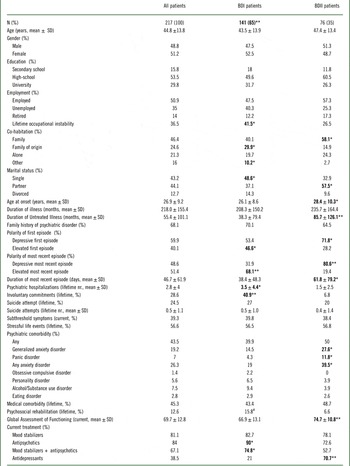
Sociodemographic and clinical data for the entire sample and related subgroups are provided in Table 1.
Socio-demographic and clinical variables of the study sample and related subgroups

Values for categorical and continuous variables are expressed in percentages and mean±SD, respectively. Boldface indicates parameters with significant BDII versus BDI differences. Legend: BDI=bipolar I disorder, BDII=bipolar II disorder. Statistics: *p<0.05; **p≤0.001; #p=0.052.
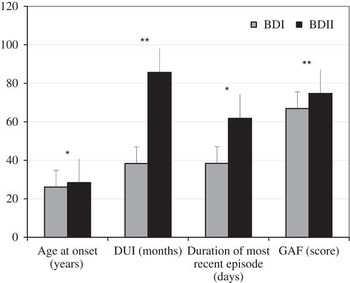
As expected, DUI was longer in bipolar II patients than in bipolar I subjects (85.7±126.1 vs 38.3±79.4 months, F=10.6, p=0.001).
We had significantly more patients with BDI than with BDII (65% vs 35%, binomial test, p<0.001). In relation to sociodemographic data, the two bipolar subgroups did not differ with respect to age (BDI vs BDII 43.5±13.9 vs 47.4±13.4 years, F=0.92, p=0.34), gender (BDI vs BDII 47.5% vs 51.3% male, 52.5% vs 48.7% female, χ2=0.29, df=1, p=0.67), education (χ2=2.92, df=3, p=0.40), and current employment (χ2=4.94, df=2, p=0.09). However, BDI compared with BDII patients had a higher rate of lifetime occupational instability (41.5% vs 26.5%, χ2=4.40, df=1, p=0.04). The two cohorts also differed in terms of cohabitation (χ2=11.82, df=3, p=0.01) and marital status (χ2=8.09, df=2, p=0.02), with BDI subjects being more likely to be currently single than BDII ones (48.6% vs 32.9%), and to live with their family of origin (29.9% vs 14.9%). Conversely, more than half of BDII individuals were living with a partner compared with only one-third of BDI patients (57.5% vs 37.1%).
In terms of clinical differences, patients with BDI had more severe illness, compared with BDII subjects, in light of an earlier age at onset (26.1±8.6 vs 28.4±10.3 years, F=4.96, p=0.03), a higher number of lifetime psychiatric hospitalizations (3.5±4.4 vs 1.5±2.5, F=8.33, p=0.004), a higher rate of lifetime involuntary commitments (40.9% vs 6.8%, χ2=27.06, df=1, p<0.001), a lower GAF score (66.9±13.1 vs 74.7±10.8, F=15.40; p<0.001), and a higher rate of elevated (manic/hypomanic/mixed) first (46.6% vs 28.2%, χ2=6.49, df=1, p=0.02) and most recent episode (68.1% vs 19.4%, χ2=44.87, df=1, p<0.001).
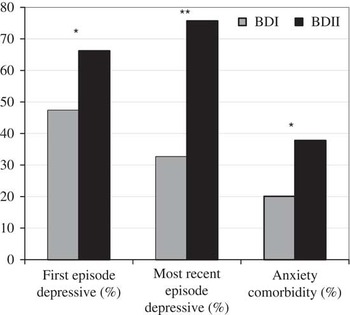
On the other hand, BDII compared with BDI patients had a higher rate of lifetime psychiatric comorbidity with anxiety disorders (39.5% vs 19%, χ2=12.93, df=5, p=0.02), particularly for generalized anxiety disorder (GAD) (27.6% vs 14.5%, χ2=13.44, df=6, p=0.03) and panic disorder (PD) (11.8% vs 4.3%, χ2=13.44, df=6, p=0.03). Furthermore, BDII compared with BDI patients more often had depressive first (71.8% vs 53.4%, χ2=6.49, df=1, p=0.02) and most recent episode (80.6% vs 31.9%, χ2=44.87, df=1, p<0.001). Moreover, the duration of most recent episode, regardless of its polarity, was longer in BDII vs I patients (61.8±79.2 vs 38.4±48.3 days, F=5.29, p=0.02).
Patients with BDI and BDII had similar duration of illness (BDI vs BDII 208.3±150.2 vs 235.7±164.4 months, F=0.06, p=0.80), family history of psychiatric disorders (BDI vs BDII 70.1% vs 64.5%, χ2=0.71, df=1, p=0.44), lifetime number of suicide attempts (BDI vs BDII 0.5±1.0 vs 0.4±1.4, F=0.56, p=0.46), presence of current subthreshold symptoms (BDI vs BDII 39.8% vs 38.4%, χ2=0.04, df=1, p=0.88), history of stressful life events (BDI vs BDII 56.5% vs 56.8%, χ2=0.001, df=1, p=1.00), and medical comorbidity rates (BDI vs BDII 43.4% vs 48.7%, χ2=0.55, df=1, p=0.49).
A trend of significance was found in the rate of lifetime history of psychosocial rehabilitation (BDI vs BDII 15.8% vs 6.6%, χ2=3.83, df=1, p=0.052).
With respect to current pharmacological treatment, BDI compared with BDII patients were more frequently taking antipsychotics (90% vs 72.6%, χ2=10.83, df=1, p=0.002), but less frequently taking antidepressants (21% vs 70.7%, χ2=50.60, df=1, p<0.001), although these subgroups had statistically similar rates of taking mood stabilizers (82.7% vs 78.1%, χ2=0.68, df=1, p=0.46).
Figures 1 and 2 summarize selected statistically significant BDI vs BDII clinical features for continuous and categorical variables, respectively.
Statistically significant differences in continuous clinical variables of BDI vs II patients. BD=bipolar disorder, DUI=duration of untreated illness, GAF=Global Assessment of Functioning. Statistics: *p<0.05; **p≤0.001.

Statistically significant differences in categorical clinical variables of BDI vs II patients. BD=bipolar disorder. *p<0.05; **p≤0.001.

Discussion
To the best of our knowledge, the present study is the first report specifically focused on differentiating BDI and II subtypes in terms of sociodemographic and clinical correlates in an Italian sample, with previous studies focussing on specific treatment issues (eg, lithium response) and clinical differences between BDI and BDII individuals.Reference Tondo, Baldessarini, Hennen and Floris 46 , Reference Baldessarini, Tondo and Visioli 47 The overall picture emerging from our results indicates differential sociodemographic/functional (BDII more favorable than BDI) and clinical (BDI more unfavorable for certain characteristics and BDII for others) distinctions between patients.
Interestingly, BDI compared with BDII patients had a more dysfunctional sociodemographic profile, in relation to occupational instability, cohabitation, and marital status, although not differing in terms of education and current employment. These findings were also paralleled by the result of an overall worse functioning of BDI, compared with BDII subjects, as indicated by a significantly lower GAF score. Our data are consistent with a previous study indicating a higher frequency of married status/stable relationships and employment among BDII patients,Reference Tondo, Baldessarini, Hennen and Floris 46 but seem to differ from other reports showing similar levels of dysfunction in BDI vs BDII patients,Reference Dell’Osso, Holtzman and Goffin 9 , Reference Ruggero, Chelminski, Young and Zimmerman 48 as well as a more frequent impairment in terms of interpersonal relationship stability and social adjustment in BDII compared with BDI patients.Reference Mantere, Melartin and Suominen 49
Similarly, from a clinical point of view, some features, including an earlier age at onset and a greater number of lifetime hospitalizations, a higher rate of lifetime commitments and elevated mood first/most recent episode, along with a lower GAF score after the resolution of the most recent acute episode, suggest more severe illness in BDI vs BDII patients in the present sample.
Our results with respect to earlier age at onset for BDI compared with BDII appear consistent with some reports,Reference Merikangas, Jin and He 4 , Reference Tondo, Baldessarini, Hennen and Floris 46 but differed from that of Dunner,Reference Dunner 50 who found earlier onset in BDII, and from that of Parker et al,Reference Parker, Graham, Hadzi-Pavlovic, McCraw, Hong and Friend 51 who found similar onset age for BDII and BDI. A recent American report by some authors involved in the present study found an earlier age at onset and a higher frequency of childhood onset in individuals with BDII compared with BDI,Reference Dell’Osso, Holtzman and Goffin 9 supporting the hypotheses of geographic differences in this and other clinical variables in American vs European samplesReference Post, Altshuler and Kupka 36 and North vs South American bipolar patients,Reference Holtzman, Lolich, Ketter and Vázquez 37 thus highlighting the need for further international studies in the field.
The higher hospitalization rates found in our BDI sample are consistent with prior studies.Reference Endicott, Nee, Andreasen, Clayton, Keller and Coryell 10 , Reference Young, Biggs, Ziegler and Meyer 42 , Reference Tondo, Baldessarini, Hennen and Floris 46 , Reference Baldessarini, Tondo and Visioli 47 Hospitalization is a predictor of greater severity of illness for the BDI subtype that is also burdened by a higher association with psychotic symptoms.Reference Parker, Fletcher, McCraw, Futeran and Hong 52
To our knowledge, there are no prior studies comparing GAF scores measured after the resolution of the acute episode between BDI and II subjects. Ruggero and colleagues compared GAF scores among depressed bipolar I and II subjects, finding similar scores.Reference Ruggero, Chelminski, Young and Zimmerman 48 However, it is worth noting that assessing overall functional impairment in BD is challenging, considering that this variable is intimately related to illness phase.Reference Vieta 53 Therefore, our data extend prior findings on GAF in BD by measuring it in BDI and BDII patients in the absence of an acute mood episode.
When interpreting other significant findings from the present study, the following features may indicate expression of a greater severity of BDII compared with BDI patients. First, BDII subjects spent much more time before having a first clinical contact, that is, had a longer DUI, compared with individuals with BDI. Such a finding is consistent with previous reports.Reference Coryell, Endicott, Andreasen and Keller 28 , Reference Baldessarini, Tondo and Visioli 47 Second, the comparison of psychiatric lifetime comorbidity rates revealed that BDII subjects more frequently had anxiety disorders, GAD and PD in particular. This appears consistent with most prior reports, which support a strong association between BDII and anxiety spectrum disorders,Reference Dell’Osso, Holtzman and Goffin 9 , Reference Judd, Akiskal and Schettler 11 , Reference Rihmer, Szádóczky, Füredi, Kiss and Papp 15 , Reference Mantere, Melartin and Suominen 49 , Reference Akiskal, Akiskal, Perugi, Toni, Ruffolo and Tusini 54 although discordant results have been reported as well.Reference Merikangas, Jin and He 4
We found BDI and BDII subjects had similar overall lifetime psychiatric comorbidity rates, consistent with the findings of Valtonen et al,Reference Valtonen, Suominen, Mantere, Leppämäki, Arvilommi and Isometsä 26 but discordant with prior reports that found higher overall psychiatric comorbidity rates in individuals with BDII compared with BDI,Reference Mantere, Melartin and Suominen 49 , Reference Vieta, Colom, Martínez-Arán, Benabarre, Reinares and Gastó 55 and more recent reports showing higher overall psychiatric comorbidity rates in BDI.Reference Bega, Schaffer, Goldstein and Levitt 27
Furthermore, in our sample, patients with BDII compared with BDI had longer duration of most recent episode. Even though not directly related to illness severity, the polarity of first and most recent episode differed significantly between BDI and BDII patients, with the latter having a higher rate of depressive polarity both at first and most recent episode, compared with BDI subjects. In contrast, we found BDI compared with BDII patients more frequently had mood elevation at first and most recent episode. Taken together, our findings are consistent with the notion that BDII may have more pervasive depression, when compared with BDI,Reference Judd, Akiskal and Schettler 11 , Reference Judd, Schettler and Akiskal 12 , Reference Kupka, Altshuler and Nolen 56 whereas BDI may have more pervasive mood elevation.Reference Judd, Akiskal and Schettler 11 , Reference Judd, Schettler and Akiskal 12 , Reference Joffe, MacQueen, Marriott and Young 34 A higher frequency of depressive first episode in BDII patients emerged also in previous reports.Reference Tondo, Baldessarini, Hennen and Floris 46 , Reference Baldessarini, Tondo and Visioli 47 Nonetheless, a more recent Finnish study found BDI and BDII patients similarly prone to depressive states,Reference Pallaskorpi, Suominen and Ketokivi 57 and Baek et al Reference Baek, Park and Choi 24 documented similar rates of depressive episodes at onset in Korean patients with BDI and BDII.
Our data are in some ways concordant with prior studies indicating that depression is a more pervasive problem in BDII compared with BDI subjects (i.e., with respect to first and most recent episodes), but otherwise discordant with respect to such studies finding that BDII was associated with worse social and occupational functioning.Reference Judd, Schettler and Akiskal 12 , Reference Kupka, Altshuler and Nolen 56 , Reference Vieta 58 However, it should be taken into account that such studies were not confined to patients who were assessed beyond an acute episode.
In addition, in our study, individuals with BDI compared with BDII merely tended (ie, had a nonsignificant trend toward) to more commonly have had prior psychosocial rehabilitation. It could be the case that our limited sample size contributed to us only observing a trend-level (rather than a statistically significant) difference between BDI and BDII subjects in relation to this variable.
With regard to others clinical variables, the two bipolar subgroups showed statistically similar results, consistent with the possibility of BDII and BDI having similar severity with respect to: duration of illness, psychiatric family history, lifetime suicide attempts, stressful life events, presence of subthreshold symptoms, and lifetime general psychiatric/medical comorbidity rates. However, it needs to be kept in mind that our sample size limited our ability to definitively demonstrate non-inferiority of BDII compared with BDI, with respect to these aspects of illness severity.
Baek et al Reference Baek, Park and Choi 24 found similar results in Korean patients with BDI and BDII in terms of duration of illness, although they reported higher rates of family history of several psychiatric illnesses (including major depressive and substance use disorders) in BDII compared with BDI subjects.
In relation to suicide attempts, our findings are consistent with some prior studies,Reference Merikangas, Jin and He 4 , Reference Dell’Osso, Holtzman and Goffin 9 , Reference Novick, Swartz and Frank 25 , Reference Valtonen, Suominen, Mantere, Leppämäki, Arvilommi and Isometsä 26 , Reference Baldessarini, Tondo and Visioli 47 that have reported comparable rates of suicide attempts in BDI and BDII subjects, and discordant with some other studies that observed an association between BDII and a greater risk of suicide attempts.Reference Dunner, Gershon and Goodwin 22 – Reference Baek, Park and Choi 24 , Reference Holma, Haukka and Suominen 59 Holma et al Reference Holma, Haukka and Suominen 59 reported that suicide attempts were likely associated with earlier onset, greater illness severity, and the presence of a problematic affective temperament. On the other hand, Parker et al Reference Parker, Graham, Hadzi-Pavlovic, McCraw, Hong and Friend 51 found that BDI patients more frequently attempted suicide than BDII and MDD subjects. Moreover, in relation to the presence of prior stressful life events, the authors observed an analogous pattern to our findings, as no differences were documented between the two bipolar subgroups.Reference Parker, Graham, Hadzi-Pavlovic, McCraw, Hong and Friend 51
The following methodological limitations need to be taken into consideration when interpreting the aforementioned results. First of all, information on collected variables was obtained retrospectively and, therefore, is susceptible to recall bias. Another limitation is represented by the cross-sectional analysis of collected data, with longitudinal data being likely more informative. Moreover, similar studies on larger Italian and multicentered samples should be conducted to confirm the present results. In fact, our sample was derived from a university clinic, and this may limit the generalizability of our findings due to a referral bias. Exclusion of patients currently experiencing a syndromal mood episode may represent both a strength and a limitation of our study.
Conclusion
The present study offers a better characterization of the differences between the two main bipolar subgroups currently defined by DSM-5 60 in terms of clinical and sociodemographic features analyzed in an Italian sample. As recent genetic, epigenetic, and imaging studies have already shown specific differences in BDI vs II patients,Reference Huang, Perlis and Lee 61 – Reference Dell’Osso, Cinnante and Di Giorgio 63 our findings provide further clinical support to the notion that BDI and BDII categories may be characterized by distinct profiles, rather than being simply considered two different expressions, in terms of severity, of the same entity. As such a perspective may have relevant repercussions on patients’ prognosis and outcome, a better understanding of the differential characteristics of these phenotypic subtypes (ie, distinct phenotypes may be present within bipolar I and II subtypes and differentiated on the basis of specific features) may contribute to obtain more tailored pharmacological and psychosocial interventions. Our data seem, moreover, to encourage further investigation on specific variables (for instance, age at onset and particular comorbid conditions) that may hierarchically play a major role in conferring higher severity of illness to BD subtypes.
Disclosures
Disclosure information:
Bernardo Dell’Osso has the following disclosures: AstraZeneca, speaker’s bureau, speaker’s fee; Bristol-Myers Squibb, speaker’s bureau, speaker’s fee; Janssen-Cilag, speaker’s bureau, speaker’s fee; Eli Lilly, speaker’s bureau, speaker’s fee; Pfizer, speaker’s bureau, speaker’s fee; GlaxoSmithKline, speaker’s bureau, speaker’s fee; Lundbeck, speaker’s bureau, speaker’s fee; Cyberonics, speaker’s bureau, speaker’s fee; Itacfarmaco, speaker’s bureau, speaker’s fee; Roche, consultant, honoraria; Merck, consultant, honoraria; AstraZeneca, consultant, honoraria; BristolMyers Squibb, consultant, honoraria; Janssen Cilag, consultant, honoraria; Lundbeck, consultant, honoraria; Sanofi, consultant, honoraria; Eli Lilly, consultant, honoraria; Pfizer, consultant, honoraria. Shefali Miller has the following disclosure: AstraZeneca, researcher, editorial support for manuscript preparation. Terence Ketter has the following disclosures: Sunovion Pharmaceuticals, grant recipient for research, grant/research support; Sunovion Pharmaceuticals, consultant/advisory board, consulting fee; Teva Pharmaceuticals, consultant/advisory board, consulting fee; Janssen Pharmaceuticals, consultant/advisory board, consulting fee; Myriad Genetic Laboratories, consultant/advisory board, consulting fee; GlaxoSmithKline, lecturer, lecture honoraria; American Psychiatric Publishing, writer, royalties; Janssen Pharmaceuticals, employee (spouse-Nzeera Ketter, MD), salary, stock. A. Carlo Altamura has the following disclosures: Roche, consultant, consulting fee; Lundbeck, consultant, consulting fee; Merck, consultant, consulting fee; AstraZeneca, consultant, consulting fee; BristolMyers Squibb, consultant, consulting fee; Janssen-Cilag, consultant, consulting fee; Otsuka, consultant, consulting fee; Sanofi, speaker’s bureau, speaker’s fee; Eli Lilly, speaker’s bureau, speaker’s fee; Pfizer, speaker’s bureau, speaker’s fee. Cristina Dobrea, Laura Cremaschi, and Massimiliano Buoli do not have anything to disclose.