A hush falls over the death house. The witnesses assemble in the death chamber. The final curtain in this drama, where human life plays the leading role, is about to rise.Footnote 1
Whitner Cary, The Atlanta Constitution, 1928, 1As convicted murderer Mell Gore's date with Georgia's electric chair approached in 1926, The Atlanta Constitution worked overtime to help readers appreciate, yet also traverse, the cosmic distance between themselves and the soon-to-be dead Gore. In an article previewing Gore's execution, the newspaper's journalists invited readers to imagine the countdown to death as a mental entombment. Under the headline, “Doors of the Death House Shut Behind Mell Gore,” readers learned,
The last watch has begun for Mell Gore. Alone and helpless in the dread silence of the death cell, he awaits the coming of that awful hour which will be his last upon this Earth …The heavy steel door of the cell of the condemned in the Milledgeville penitentiary clanged behind the youth Saturday afternoon, and he was left alone with the horrible realization that he had been brought here to await the hour of death, when the sizzling current charges through his veins and nerves, claiming payment of the debt which society says he must repay with his life.Footnote 2
Gore, the newspaper said in a subsequent piece,Footnote 3 would soon “see the sun light up the skies in the east for the last time and will see that sun cast before his eyes the sickening and sinister shadow of the electric chair in which near the hour of noon he will expiate with his life for his crime against the laws of his fellow men.” The paper's writers melodramatically depicted the slow loss of hope in anticipation of an inexorable, annihilating force: “The implicit trust that ‘Something would turn up,’ has gone,” they wrote. “There is a quake in his high, shrill voice and in his hunted eyes there is the mirrored question ‘Must I go?’”Footnote 4
Casting the 22-year-old white boy-man as prey rather than predator, the paper encouraged empathetic identification with Gore and his family. It described his crime without sensationalism. It omitted mention of the loved ones his victim had left behind. It even praised his appearance: “he is still the same natty, sleek-haired youth when he entered [the victim's] store. His carefully pressed blue trousers, his fancy hose, polished shoes, and general neatness has been kept up. There was nothing of the hang-dog about him… nor was there anything boastful.”Footnote 5 Gore looked, in these accounts, less like a hardened criminal and more like any average, ordinary boy might. Readers, moreover, were invited to experience the anguish that the anticipation of his execution was causing his family. An entire article was dedicated to covering Gore's mother's request to the governor for clemency. “An elderly woman with a pencil in her quivering hands and tears in her eyes,” the paper wrote, Mrs. J.B. Gore sat in the reception room of Fulton tower, “writing the words that she felt were wound around her very heart—pouring out her soul for her doomed son in an appeal for sympathy, prayer, and understanding.” The paper went on to reproduce, word for word, the mother's plea.Footnote 6
While it evoked the harrowing experience of loss that Gore and his family were facing, The Atlanta Constitution also depicted the efforts made by authorities to make the punishment bearable. Gore may have appeared as hunted prey and his mother as powerless supplicant, but the state officials involved in the execution were not cast as predators or unfeeling bureaucrats. They were humane men who were sympathetic to the plight of the condemned, themselves bothered by the inflexible, unfeeling “law” they were enacting. The warden “consented to hold off electrocution until the last possible moment with the view that something may turn up from Atlanta in Gore's favor at a late hour.”Footnote 7 The condemned, meanwhile, spoke fondly of the state officials who were responsible for carrying out the death sentence: “From the sheriff's office to the death cell, I have been treated with the utmost courtesy, kindness and consideration,” he said. “I have particularly kind feelings for Deputy Sheriffs R.T. Tolbert and Charles Griffin, who brought me from Atlanta and who have stood by me like princes since I have been here. They are good scouts. And as for Judge Dunaway, the superintendent, I have words only of the highest praise.” The community had likewise not forsaken Gore. On the eve of his execution, readers learned that Gore had “been the recipient of many gifts since this morning. Friends from Atlanta have sent him special foods as also have a number of people from Milledgeville, including a chicken dinner which was presented him by an employee at the state sanitarium, who was a boyhood friend of the youth's when they both lived in Villa Rica, Ga.” The paper went on to note that “singers and an orchestra sang and played for him for over two hours” in front of his holding cell.Footnote 8 In Gore's case, the rituals that preceded the punishment humanized him.
Kindness surrounded Gore until the end, The Constitution showed its readers, transforming his death from a terrible, jarring movement from existence to nonexistence into an occasion for achieving personal closure. In the paper's telling, the horror of anticipating death gave way to a peaceful submission to its inevitability. The paper noted that Gore watched through the window of his holding cell the arrival of the hearse that was to carry his body to Atlanta. In response, he “shifted his position and said, ‘Well, there it is.’” Every detail was labored over in the account of Gore's final hours, from the sigh he made when the barber's dull clippers began to shave his head to the drone of electricity that “wrote the receipt on Mell Gore's debt to society” and announced that “[t]he account was closed.” The scientific mixed with the spiritual as readers learned that “servants of society had scientifically dispatched that soul on its last, long journey by applying 1,900 volts of harnessed electricity through a creation of science known as the electric chair.” Following his funeral services—and readers were told where and when the funeral would be held—Gore's body was to be buried in “its final resting place in a little churchyard near the village.”Footnote 9 Death was, in the coverage, the price of Gore's readmission into the moral community his crime had sundered. But it was also relief from a profane, modern world, a comforting return to an uncomplicated, pastoral landscape.
A fulsome thirty-two paragraphs long, the journalistic coverage of Mell Gore's death in Georgia's electric chair was not an anomalous piece of execution reporting. It was, rather, an example of an approach to representing executions that journalists, playwrights, and screenwriters sometimes undertook in the period between 1915 and 1940 that I call the “empathy-inviting execution narrative.” The creators of such narratives invited readers to empathize with both the condemned and the men charged with executing them. These stories depicted the fraught relationship in a new age between the individual—sympathetically embodied by condemned men like Mell Gore—and the state—presented as an unfeeling, abstract “law” and the feeling, humane men charged with enacting it.
Empathy-inviting execution narratives revealed anxieties about the new ways in which the state killed capital offenders: professionally, privately, scientifically. Since the Enlightenment, the legitimacy of the death penalty had depended, in many quarters, on an execution's capacity to do justice without dehumanizing the offender. Channeling new sensibilities about human rights that had developed in the eighteenth century, for example, philosopher Immanuel Kant had insisted that executions should “be kept entirely free from any maltreatment that would make an abomination of the humanity residing in the person suffering it.”Footnote 10 In the eighteenth century, it was torture that threatened to make an abomination of the humanity of the condemned; by 1915, however, modern forces, rather than uncivilized barbarism, increasingly challenged the ability of the state to live up to the principle that the condemned should not be degraded. Executions were becoming routine, one-size-fits-all procedures that risked treating the condemned as faceless members of a toxic class of persons rather than redeemable sinners.
These narratives, however, worked not only to reveal anxieties about modernity, but also to contain them. On stage, on screen, and in newspapers, writers maintained a humanistic ethos about the act of state killing after the conditions that had traditionally sustained that ethos disappeared. Americans reading about executions that they were no longer allowed to witness directly, or watching a film or play in which a fictional protagonist faces death at the hands of the state, encountered positive, humanizing, even heroic visions of the condemned. They also found sympathetic portrayals of the governors, wardens, and guards charged with carrying out executions as humane men who worked to mitigate the severity of a distant “law” that commanded death. By humanizing those put to death and those doing the killing, execution narratives worked to assure audiences that the modernization of state killing did not entail the destruction of the dignity of the condemned that had, since the Enlightenment, been integral to the death penalty's legitimacy.
These stories, however, were about more than the punishment of capital crimes. They evoked anxieties about the new social, political, and economic world that Americans had uneasily come to occupy. The modernization of American life in the late nineteenth and early twentieth centuries had dramatically transformed the lives of most Americans in ways that called into question classically liberal visions of individuals as autonomous agents capable of controlling their fate. In response to the challenges created by urbanization and industrialization, state and federal governments expanded their size and scope, regulating areas of life that they had once ignored, and tightening their grip on government's traditional functions. Structurally, government became more bureaucratic.Footnote 11 Bureaucracies introduced standard operating procedures across large swaths of territory in an effort to make the behavior of government officials more efficient, predictable, and effective; less dependent on individual players and more dependent on systemic logics such as the sciences of economics or disease control. The potential casualty of all this was individualism. Focused on managing populations, an administrative state threatened, in some minds, to subordinate individuals to public ends. Bureaucracies depersonalized both state actors and the particular individuals they governed.
Empathy-inviting execution narratives registered anxiety about an administrative state that was increasingly exerting control over the lives of ordinary Americans in noncriminal contexts. In some ways, the death penalty was one of the first state actions—and certainly the most dramatic—to undergo the kinds of changes that would come to characterize this modern approach to government. By the early twentieth century, it had become a dry, professional affair. Once a public event aimed at reaffirming the vitality of a community's collective conscience, an execution had become a sanction performed privately by professionals in prisons far from the place where the crime had occurred.Footnote 12 Changes in the identity of the “killing state” anticipated the broader changes wrought by the widespread bureaucratization of government, in particular the transformation of those operating the levers of government from highly visible individuals to unseen officials working in opaque institutions.Footnote 13 More than simply a window into punishment, the narratives I discuss here seem concerned with the character of state power in nonpunitive contexts. They were not just about the fate of the condemned but about the fate of ordinary American citizens in a world increasingly governed by an inaccessible and impersonal state.
As both commentaries on the humaneness of punishment and allegories about the relationship between the citizen and the state, empathy-inviting execution narratives reflected and reinforced traditional racial hierarchies. As commentaries on punishment, they reveal a dissonance between the legal and cultural meanings of capital punishment. In the aftermath of the Thirteenth Amendment, punishment legally became the degradation of all persons convicted of crimes to the status formerly occupied exclusively by black slaves. The amendment retained slavery as a status that could be imposed on persons “duly convicted” of a crime. “Criminality,” as Colin Dayan has shown, “was racialized.”Footnote 14 In the popular imagination, however, capital punishment was a violence that could reveal and affirm white dignity. Empathy-inviting execution narratives were almost exclusively about young white men. The absence of execution stories about condemned men of color, combined with the circulation of accounts of lynching that called attention to the body-mutilating degradation of African Americans accused of crimes, broadcast a color line in the cultural life of punishment. Execution narratives that portrayed the Kantian ideal—a punishment that respected the dignity of the condemned—were reserved for white men.
As allegories about the relationship between the citizen and the state, moreover, empathy-inviting execution narratives responded to the anxiety of those who imagined themselves as the protagonists of an idealized Jeffersonian past in which men were self-sufficient masters of miniature familial kingdoms rather than subjects of a centralized state. That way of life had disappeared, a casualty of the social, economic, and political changes wrought by modernity.Footnote 15 Execution narratives perversely located in the condemned the endangered autonomy of middle class white men: an autonomy that was threatened not only by industrial capitalism but by the paternalism of the regulatory state.
By reimagining the state at its most fearsome moments in kinder, gentler terms, and the condemned as honorable white men who died courageously on their own terms,Footnote 16 these empathy-inviting execution narratives softened, and thus legitimized, the administrative state. They mapped onto modern state practices the comforting fantasy of an idealized past. These narratives attempted, in other words, to map nostalgic fantasies about governance in the nineteenth century onto the discomfiting realities of the twentieth.
The Rise of the Modern State and Its Discontents
Dramatic transformations of everyday life accompanied the proliferation of empathy-inviting execution narratives in the early twentieth century.Footnote 17 Americans looked with wonder upon the energy of the cities in which they increasingly lived, the new technologies that dramatically expanded human capabilities, and an industrial economy that produced unprecedented wealth, but these changes disoriented as much as they invigorated. Cities also produced a sense of anonymity that left some feeling unmoored as they moved through stranger-filled crowds. New industrial technologies posed threats not only to bodily integrity, but also to a sense of spiritual self-possession, increasingly alienating workers from the products of their labor. The capitalist marketplace threatened to replace traditional forms of authority centered in the family with a decadent cosmopolitanism. The economic insecurity of life as a wage laborer made the future seem more uncertain than ever for those aspiring to a middle-class life. These broader social, spiritual, and economic anxieties would manifest themselves, at times, in execution narratives.
Most obvious in those narratives, however, was anxiety about government that was growing distant and depersonalized. The federal government was at the center of such change. In the late nineteenth century, it began growing in scope and changing in substance. Against the laissez-faire ethos of classical liberalism, a federal, administrative state emerged and became “a new ‘fourth branch’ of government, making and applying public policy in new and seemingly ‘lawless’ ways” and embodying “a new form of governmental knowledge and expertise: not legal but economic and social ‘science’ informed and validated its decisions.”Footnote 18 Dispassionate technocrats, rather than charismatic leaders or formalistic judges, seemed increasingly at the helm of many government functions.
These national developments gradually reshaped the enforcement of the criminal law. Beginning in the late nineteenth century, the federal government's involvement in the prosecution of crime expanded dramatically in response to moral crises.Footnote 19 Setting their sights on improving the reputation of law enforcement officers, leaders in the Hoover and Roosevelt administrations developed a new, more professional vision of law enforcement and prison administration that would serve as a model for states to emulate.Footnote 20 As a result of these efforts, Marie Gottschalk writes, “Federal agents were no longer seen at best as Keystone Kops and at worst as corrupt thugs, but increasingly as competent, efficient, straight-shooting professionals. Likewise, a new image of wardens and superintendents took shape, that of nonpartisan, humane, professional managers rather than political hacks and administrators of torture.”Footnote 21 The professionalization of local police forces varied greatly across regions, but other changes worked in the meantime to modernize law enforcement at the municipal level. The coming of the automobile, for example, expanded the surveillance capacity of local governments.
Modern reforms, as Gottschalk has noted, sought to make the state more effective and humane, but they often had dehumanizing effects.Footnote 22 The growth of social scientific knowledge, by-the-book professionalism, and anticorruption rigidity could dehumanize the administration of justice. Changes in law enforcement increased the social distance between the agents of the state and those they governed. Automobiles may have expanded the reach of local police, but they also imposed literal and emotional barriers between officers and civilians.Footnote 23 The police were becoming an increasingly abstract, thing-like entity.
Capital punishment occupied a unique place within this history. Pressures to streamline executions preceded other efforts by states to modernize the exercise of their police powers. Like their counterparts across the Atlantic,Footnote 24 elites in the United States increasingly sought to privatize executions and standardize execution protocols over the course of the nineteenth century. A fear that public executions had become unwieldy spectacles drove state actors to move these events into jail yards at first, and then, with the advent of new technologies such as the electric chair (1890) and the gas chamber (1924), into the interior of centralized prisons that were often far from the county in which the crime had occurred.Footnote 25 Access to executions was dramatically curtailed; they were limited, in most places, to professionals whose solemnity would reinforce the emerging technocratic character of the state.Footnote 26 In some states, legislatures unsuccessfully banned newspapers from reporting details beyond the fact that the execution had taken place.Footnote 27 The desire to end the execution spectacle was so strong that some legislatures considered abolishing a place for witnesses altogether.Footnote 28 Reformers in Nevada went even further, fantasizing about doing away with the executioner. One proposed innovation was “execution by suicide,” wherein a condemned person would self-administer a deadly poison. Advocates noted that “there will be no morbid crowd in waiting to watch the death agonies of the prisoner, nor will anyone be directly charged with having aided in ending a person's existence.”Footnote 29 That plan never came to pass, but the imperative underlying it—the depersonalization of state power—found expression in the centralized and standardized manner in which states were implementing death sentences.
Technology, too, increased the distance between ordinary Americans and the punishment of death. The development of the electric chair created a new, rarefied way of killing the condemned. Ordinary citizens could understand and perform, if need be, a hanging. Not so with electricity. In the bowels of prisons, the state was now dispatching life using a device that the average person would never see firsthand, and marshalling a force that traditionally had divine associations. The electric chair represented, as Jürgen Martschukat has argued, the latest expansion of the human capacity to understand, subdue, and manipulate apparently supernatural forces. However, given its life-ending function, a transcendent, superhuman sense of the mysterious attached to the technologyFootnote 30 and, by extension, to the state that had the exclusive right to operate it.
The privatization of capital punishment and the development of new punishment technology were, then, harbingers of changes that would transform the relationship between citizens and the state in a variety of domains. The state that Americans encountered in the early twentieth century increasingly presented itself in professional, emotionally distant terms.Footnote 31 How the state killed became the most dramatic emblem of anxieties about the modern state. As Stuart Banner has put it, “[W]ith executions conducted behind closed doors, before a small group of the well connected, out of the public eye, the people were no longer punishing the criminal. Now the government was doing the punishing, and the people were reading about it later.”Footnote 32 It was in this new, technocratic context that the empathy-inviting execution narrative, with its portrayal of the relationship between the individual and the state at its most asymmetrical, flourished.
Empathy-Inviting Execution Narratives
Whether fictional or nonfictional, empathy-inviting execution narratives were melodramas. A fictional nineteenth and twentieth century art form, melodramas reflected anxieties about the modern world.Footnote 33 In classic melodramatic plots, the dangers of the oncoming train or the sheriff approaching with an eviction notice dramatized the precarious environmental and economic conditions wrought by new technology and industrial capitalism. Stories about executions captured a different anxiety. When the danger was the state's noose or its electric chair, an impeding execution dramatized the threat modern forms of governance posed to the survival of a unique and spiritual self. Like other forms of melodrama, these narratives were driven by an unspoken imperative to reassure or console.
Execution melodramas were a staple of early twentieth century stage and screen. In the 1920s, Broadway stages hosted a number of successful productions with plots that centered on the fate of condemned men. Those plays were often produced in other cities, such as Atlanta, Los Angeles, and Chicago. Much more dramatically, the birth of film and its development into a storytelling medium led to the production of nationally circulating stories about capital punishment. Between 1915 and 1940, production companies made films that featured capital punishment as a major plot device at least 133 times.Footnote 34
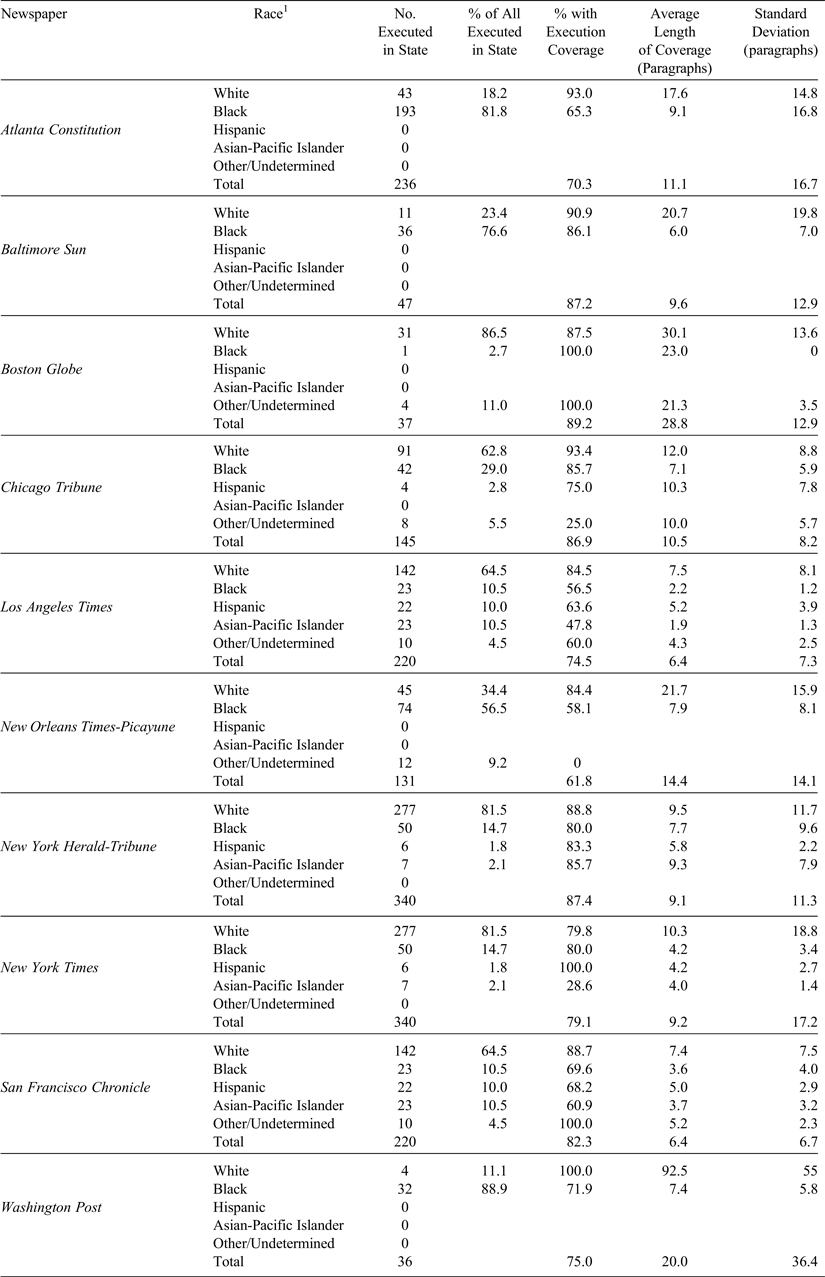
Americans were just as likely to encounter execution melodramas on the pages of their local newspapers. When journalists found a case compelling, as the reporter who covered Mell Gore's execution for The Atlanta Constitution did, they borrowed liberally from the melodramatic plots of stage and screen. There was no shortage of cases to be covered. Nationally, 3,560 people were put to death in the 25 year span between 1915 and 1940. My systematic examination of eight major metropolitan newspapers in California, Georgia, Illinois, Louisiana, Maryland, Massachusetts, New York, and the District of Columbia—jurisdictions responsible for one third of all executions nationally—reveals that 21% of executions received particularly detailed coverage: a story of fifteen or more paragraphs in length.Footnote 35 It was in these stories that readers often encountered empathy-inviting depictions of the condemned and prison personnel.
Big City Newspaper Coverage of Executions, 1915–1940
When they covered executions lavishly, journalists wrote stories that both expressed and aimed to alleviate modern fears. Over and over again, writers would test the theory that an execution was a moment of unraveling, a dissolution of the self and an end to its capacity to exert mind over matter. Across the country, they studied the moods of condemned inmates in the days leading up to their execution to predict whether they would pass the ultimate test and face their moment of death with courage. Covering the retirement of Harry Stanton, who had overseen the operation of the gallows for more than sixty executions at Cook County jail, The Chicago Tribune gave special attention to the question of how people met death. “Discussing the prisoners he had seen hanged, Stanton asserted that Carl Wanderer, who killed his wife and a man he had lured to their home, was the most courageous,” the paper noted. “Wanderer used the last moments of his life to sing a popular song entitled, ‘Old Pal, Why Don't You Answer Me?”Footnote 36 That detail was telling. The song's content allowed readers to imagine vicariously the lonely experience of imminent death, but Wanderer's act of singing about that anxiety was a way of successfully managing it. The mix of courage and vulnerability that Wanderer displayed was a quintessential quality of the protagonists of melodramatic execution narratives. They offered readers a fantasy of spiritual coherence and equanimity at the moment of death. In such accounts, the state's punishment was circumscribed, its terribleness limited by the nobility that journalists projected onto those receiving it.Footnote 37
In similarly admiring coverage of James Satterfield, The Atlanta Constitution wrote in the present tense, taking readers with him on his march to the execution chamber (“eternity's reception hall,” as the paper put it when covering another executionFootnote 38 ). Satterfield moves “like a soldier on parade, chin up, back straight, hands swinging.” On the execution platform, he finds an oppressive atmosphere “surcharged with horror, with nameless terror.” As “[d]eath, the invisible, glides in,” Satterfield's eyes “seek the light of the window below him and he looks beyond the preacher. There is just one ray of sunshine piercing into that gloomy death chamber. Just one tiny ray from that great world bathed in light and freedom and that one ray holds Satterfield spellbound.” Contradictory imaginings of Satterfield as strong and vulnerable mixed indistinguishably in the coverage. He locates, in the light, a freedom that the state could not seal off from the execution chamber, but the light remains cosmically distant. His “mighty frame shakes with a few sobs” as he speaks about his daughter in his very last moments, yet somehow he meets death “unflinchingly without the slightest tremor.” In the end, journalist Pierre van Passen portrayed the crushing reality of state killing only to fantastically deny its power. “Satterfield died not below the scaffold,” Passen concluded. “He died on top there. The law did not kill him. He willed his own death. In that moment when he said ‘I am ready,’ the spirit was already taking flight from his body.”Footnote 39
Tension between resistance to the state and submission to a divine authority suffused these stories. Onto the condemned, whom journalists rendered as sympathetic human beings rather than monstrous others, readers were invited to project their own anxieties about law as a net that could ensnare ordinary people. At the same time, readers could find reassurances about the limits of law's reach. In the literal and metaphorical gaps that journalists highlighted in the state's power, in the spiritual resistance to degradation that the condemned demonstrated, execution scenes showed that it was possible—even in the most extreme circumstances—to escape the disciplinary grip of the modern state.
Satterfield's tears were for his daughter, and journalists frequently made men like him pitiable by introducing readers to their family members and describing the depths of love that they felt for their wives and mothers in their dying hours. Reporters in Maryland and New York eagerly told readers when prison staff discovered, after an execution, that Richard Whittemore and Charles Becker had died with photographs of their sweethearts attached to their undershirts (See Figure 1).Footnote 40 And they often called attention to the feelings of condemned men's mothers or the fate of their soon-to-be fatherless children. The New York Tribune captured the emotional intensity of Howard Baker's final days by describing a visit from his wife and small children. “The patter of children's feet on the cold stone floor of the death house was heard late yesterday afternoon,” the paper reported. Seeing him dressed in the state's standard black execution suit, Baker's wife cried, but his uncomprehending 3½-year-old son “turned to his mother and said: ‘Oh, mamma, hasn't papa got on a funny suit?’”Footnote 41 The child's naiveté called attention to the innocence that would soon be lost. Baker's imminent death was not just an act of retribution, but the loss of a member of the community embedded in a web of relationships.
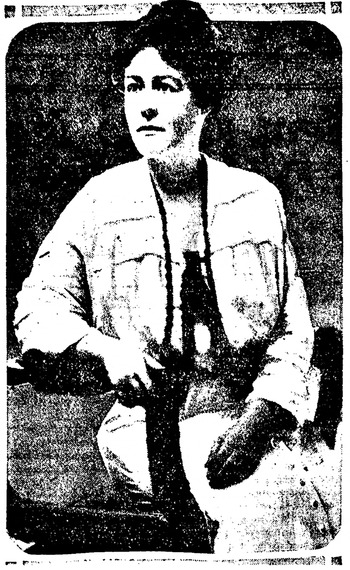
In 1915, The New York Tribune reprinted the photograph of his wife that Charles Becker allegedly wore to his execution, telling readers that it would be buried with him and that it did not “show the lines of care and sorrow which have crept into her face during the last week.”

Execution accounts often followed the narrative structures of what James L. Smith has called the “melodrama of defeat.” Whereas the prototypical melodrama ended with rescue, an important variant of it depicted “a blameless hero” whose fight against external forces is ultimately unsuccessful. He instead “goes under, leaving the audience to pity his distresses or admire the fortitude with which he bears them.”Footnote 42 The “heroes” in execution stories were, of course, convicted felons, but the papers often downplayed the import of the crime that had led them to their fate, usually summarizing it unsentimentally. Journalists usually sketched the lives of the condemned men's victims in minimal detail and omitted the victim's family members’ reaction to the punishment. In some melodramatic newspaper coverage of executions, it was easy to forget that the condemned protagonist had done anything wrong at all. The horror these stories depicted lay not in the crime being punished, but in the punishment being endured.
With the condemned standing in for them, then, readers were invited to manage their own anxieties from a safe distance. Execution narratives captured in an extreme form the more general condition of modern persons as discrete objects buffeted about by forces beyond their control in a world that had been drained of divine enchantment and patriarchal authority.Footnote 43 As melodramas of defeat, however, such stories did not simply acknowledge that anxiety; they affirmed the persistence of the very lifeblood that modernity threatened to drain from the body politic. In a world where God was no longer a given, readers could, as one reporter encouraged them to do, ride like “true allies” with the condemned part of the way “down that misty trail that leads to either oblivion or divine rest and happiness” (Hell, it seems, not being an option). They could watch, “from the brink of the grave,” as those people “met death without fear and with a philosophy of the hereafter that was beautiful to behold.”Footnote 44 When the condemned met their deaths courageously, the melodrama of defeat would become one of triumph.Footnote 45 Displays of dignity in one's final moments—made possible by God's grace or an inner will—announced a last minute spiritual rescue of the self. If the state was the train barreling through the countryside and the condemned the damsel in distress tied to the tracks, courage emerged in the final moments to free the soul of the condemned from destruction.
This kind of spiritual triumph can be seen in those articles that compared the condemned to soldiers being forced to give their lives for the state in war. In its coverage of the double execution of Clifford Thompson and Jim Moss, The Constitution noted, “Not once during that brief space when they sat in the big oak chair on the brink of the grave did they show fear. Nor did either, through all these terrible hours of torture, waver one iota from a profession of innocence of the crime charged. They went to their dooms like soldiers are supposed to meet their maker, but without the satisfaction of a warrior's reward.” Thompson and Moss were celebrated for making their own meaning out of their demise rather than panicking. Without the cause of war to bring meaning to their deaths, they heroically managed to achieve some other unspecified, yet no less transcendent, “satisfaction” in their final moments. Subjected to the cruelty of a modern legal system that arbitrarily spared others but not them, about to be dispatched by a modern, electrical technology of death, Thompson and Moss courageously evinced a warrior's sense of purpose.Footnote 46
In the melodramas of execution played out on newspaper pages, journalists often portrayed the law as an intrinsically menacing force: as a net that ensnared sympathetic souls.Footnote 47 Stories of those meeting their deaths in the nation's execution chambers captured a legal dimension to modern anxiety, one centered on the depersonalization of political power. Law was frequently reified, made into a supra-human “thing,” in newspaper reports of executions. For example, The Los Angeles Times reported that one man's entreaties “fell on deaf ears. The law had entered the toll to be exacted. Nothing could swerve its mandate.”Footnote 48 The New York Tribune reported that when Joseph Mullholland's mother tracked New York Governor Charles Whitman down in the lobby of the Saint Regis Hotel and begged him to spare her son's life, the governor's voice trembled with sorrow as he told her that the “law must take its course,” denying the existence of the very power he had to pardon.Footnote 49 Pardons during the period were common enough that some readers would have seen through Whitman's rhetoric and recognized that law did not exist independent of those who enforced it. Nonetheless, the governor's invocation of law as a transcendent force beyond human control tapped into long-standing conceptions of it as emotionally detached.
If the law could become a fearsome specter of the imagination, newspaper coverage of executions worked to represent those who occupied the roles of warden, sheriff, governor, or executioner as well-meaning people who could soften, but not stop, the law's lethal blows. After telling Mrs. Mulholland that the law had to take its course, Governor Whitman was “eager” to grant her permission, when she asked for it, to visit her son once last time (a request the Sing Sing authorities had denied to her). “He asked her if she had the money at hand for her railroad fare,” the newspaper reporter noted, “and seemed almost disappointed when she produced it,” so anxious was he to do something to ease her pain.Footnote 50
Journalists constructed a similar sort of dynamic in their depictions of the relationships between the condemned and their keepers. At times, the papers showed how prison workers mitigated the mental anguish of condemned. When John McLaughlin, John Devereaux, and Edward Heinlein moved into the death house in Charlestown to await execution, The Boston Globe reported that “[a]s soon as they were lodged in their cells, the warden had coffee and toast sent them, later making them a personal visit and expressing sympathy while telling them that there seemed to be no hope at this time. Their chief concern appeared to be whether their relatives could visit them there and whether they would be allowed to write as many letters as they wished, on both of which points they were reassured.”Footnote 51
Journalists reported the extension of small kindnesses or humane departures from established protocols with relish. In deference to Nathan Desatnick's Orthodox Judaism, readers of the Globe learned, “[f]or the first time in the history of electrocutions at the prison, the condemned was permitted to wear a hat until he reached the death chair.” Witnesses were asked to participate in “the ritual” as well, and “also kept their heads covered until Desatnick was placed in the electric chair.”Footnote 52
Covering Frank Minnick's execution in the electric chair at Sing Sing, both The New York Times and The New York Tribune noted that the warden and his wife were hosting Minnick's wife and children in their home. “As Minnick was led to his death, his two children, Mary, six years old, and John, four, were asleep on the third floor of the home of Warden Lewis E. Lawes,” The New York Tribune reported in a story headlined, “Goes to Chair as Babies Sleep in Warden's Home.”Footnote 53 Their mother, meanwhile, was comforted by the warden's wife, who took her for a car ride during the execution period. Minnick thanked the warden and his wife in his final statement, and Lawes, for his part, took up a collection among witnesses for the financial support of the family. Even the district attorney who was present contributed, The Times noted.Footnote 54 When Charles Becker was electrocuted at Sing Sing several years earlier, The Times wrote that the warden had accorded him a privilege that was seldom granted: he was allowed a contact visit with his wife in the office of the principal keeper on the evening of his execution. “In a cell of the Death House he could have touched his wife's hand, but he could not have embraced her, could not have kissed her,” the paper noted. “This morning he did all these, straining his wife to him as he bade her a last farewell.” And although guards had been told not to take their eyes off of Becker during the meeting, readers learned that, out of respect, they “looked away while the man who is to die embraced the woman.”Footnote 55 Each of these gestures by wardens was “unprecedented,” a violation of protocol that served to rehumanize, temporarily, those facing the “inexorable penalty” of the law.Footnote 56
Sometimes coverage of the days leading up to an execution could suggest an almost familial atmosphere in the death house. On more than one occasion, The Chicago Tribune published photographs of condemned men alongside their jailers that appear, to a modern eye, painfully staged. In one photograph, Deputy Sherriff Paul Disso stands behind two condemned men scheduled to die on the same day, his arms extended outward behind their shoulders. Disso and the two condemned inmates, Thomas McWane and James Gricius, are dressed semiformally, with Disso in a bow tie. None of the trappings of jail appear in the photos. The photograph could almost be mistaken for that of a man with his sons.Footnote 57 (see Figure 2). Not all such photos were so intimate, but they worked to cultivate a sense of the execution as an event in which those who did the killing and those who were killed knew one another. The violence that the captions often announced was softened by the emotional connections the photos suggested.
The Chicago Tribune’s 1926 photograph of Sheriff Paul Disso with two men condemned to die resembled a family portrait.

Even the state's official executioners—the men who physically operated the execution equipment—were humanized. As executions moved into the bowels of prisons, the identities of executioners became privileged information, but newspapers sometimes reversed a tendency toward executioner invisibility. The Boston Globe identified, by name, the agent in charge of actually administering the lethal current to Herbert Gleason noting that “Warden Hendry gave a signal to executioner, Robert Elliott, standing behind a screen.”Footnote 58 The screen, partly designed to de-emphasize the ultimate agent of death, was removed by the newspaper in its own coverage: what masked Elliot from the witnesses who were physically present for the execution was taken down metaphorically for The Globe's readers. By naming the executioner, the paper punctured the mystique of the killing state; it was represented, as the great and powerful Oz would soon be, as a man behind a curtain. In a 1915 execution story, The New York Tribune putatively preserved the anonymity of the executioner by withholding his name, but it included him in its lavish descriptions of the men who participated in Charles Becker's execution. Its reporter took great care in describing the idiosyncratic appearances of the prison's keepers: “McInerney, gray and round as a butter ball,” Johnson, “a stiff new beard on his cheeks [making] him look the more wan,” and “Dorner, a gaunt man, with snow-white hair and a face like a tragedian's.” But it ironically described in the most elaborate detail the one actor it could not know by name, that
mysterious figure, the state executioner. He is a little dried-up man, maybe forty-five years old, with a head that's getting bald, and small hands and feet. For once yesterday he did not wear the grotesque rubber overshoes he usually dons to protect himself against the great electrical current he controls…he had left his diamond horseshoe scarfpin behind. His attitude was purely professional, a sort of detached, ‘it's all in the day's work’ pose. He's the cut-rate executioner who replaced Davis. Davis used to charge $250 for killing a man. What the new man charges is not known, but it's less.
Unlike the other state actors involved in Becker's execution, whose humanity was located in their willingness to deviate occasionally from soulless protocols, Becker's executioner was humanized by the journalist's refusal to let him remain a “mysterious figure.” His “detached” and “purely professional”Footnote 59 demeanor set him apart from the guards who, as The New York Times noted in a different article, “knew Becker well and were fond of him” (including Deputy Warden Johnson who, as Becker's “closest lay friend in Sing Sing,” could not bear to look long at the electric chair that Becker would soon occupy).Footnote 60 But the executioner, readers learned, was just as human as men like Johnson. He was demystified by journalists, his mortality derisively pointed out in details that highlighted his own senescence, and was profaned by making his pecuniary interest in the work the object of speculation. If guards such as Dorner and McInerney were lethal social workers whose compassion seemed consciously arrayed against the law's harshness, the unnamed executioner represented the futility of bureaucratic efforts to depersonalize the enforcement of the law.
The language of theatricality frequently made its way into execution articles, pushing readers to recognize that they were watching a performance of sovereign power, one in which the transcendent nature of the state could not exist without men to operate levers and pulleys behind the scenes. By pointing out the men behind the curtain while simultaneously noting its existence and by depicting state actors deviating from institutional protocols, execution stories humanized a state that had grown depersonalized. Those charged with conducting executions could be pious, operating “solemnly and with scientific precision,”Footnote 61 or they could be profane, “dried up” little men with small hands and feet. But they were ultimately mortal men, and more often than not, they were good men whose small acts of kindness tempered the bureaucratic coldness endemic to the modern execution process.
Theatrical and Cinematic Depictions of the Death Penalty, 1915–1940
When executions loomed in the period's stage and screen productions, they were often part of stories about how the modern world could produce miscarriages of justice. Most death penalty films between 1915 and 1940—83 out of 133 set in the United States—depicted sympathetic white men who were unjustly sent to death row and saved at the last minute, often when a family member or romantic interest would bring to light mitigating facts surrounding their crime or evidence of their innocence.
Misleading circumstantial evidence was at the heart of many death penalty films of the age, a symptom of the anxieties wrought by urban life. By the end of the long nineteenth century, industrialization had concentrated thousands upon thousands of Americans in cities. Exhilarating and liberating though it was, the anonymity of urban life was also a potential liability. A vast population could allow one to disappear from a constraining past, but it could also contain doppelgängers whose lawlessness could be fatal to one's future. Films about wrongful conviction secured on the basis of circumstantial evidence indicted the modern, (Sherlock) Holmesian assumption that the truth of what happened at the scene of a crime could be reliably revealed by inductive reasoning.Footnote 62
Anxieties about circumstantial evidence were compounded by a sense that the professionals tasked with executing the law were rigidly formalistic, attached to the rules even when the rules led them to outcomes that they found unjust. The antidote to corrupt governance was not rigid adherence to the law, but morally pure men who judiciously exercised their discretion in order to ensure just outcomes in particular cases.
The trope was first instantiated in D.W. Griffith's Intolerance (1916).Footnote 63 In one of that film's three story lines, a young man in a big city is the victim of a case of mistaken identity. On the basis of circumstantial evidence, a jury convicts him of a murder he did not commit and his old boss, a crooked machine politician, successfully pressures the judge to sentence the boy to death. The film registered, as Lary May notes, the social and economic anxieties of the age: the working class man had come to the city after a labor strike against an industrial capitalist had ruined him financially. In addition elite progressives wrongly deem his wife an unfit mother and use the bureaucratic apparatus of the state to take the child away from her. In a true melodramatic ending, however, innocence is vindicated. The wife gets a confession from the real murderer, secures a pardon from the governor, dashes to the prison with an army of his friends, and arrives just in time to save her husband from the noose. The state may be subject to overreach or corruption, the film admitted, but hope was not lost. Ultimately, through the governor's pardoning power, “the democratic state serves as [a] just and benevolent ruler…by saving the virtuous individual.”Footnote 64 Even in a world in which government was growing more and more distant from local communities, ordinary citizens could mobilize to prevent the machinery of law from wrongly ensnaring innocent white men. The state would retain its democratic character.
Feminine intuition frequently saved the day in these films. If cases “logically” built on circumstantial evidence got the condemned into trouble, women's moral intuition was usually necessary to get them out of it. Women did what men in the legal system, so often blind to context, could not: exonerate the innocent and procure a pardon just in time. Justice, audiences were reassured, could be effected instantaneously, and larger, humanist values (“the innocent should not be punished”) would take precedence over a slavish adherence to the law.
In true melodramatic form, however, such optimism was often hard won. The Noose was a hit Broadway play, based on a short story by Hubert H. Van Loan, which was made into a film twice in 10 years: first as a silent film with the same name in 1928 and then as a “talkie” called I'd Give My Life in 1936. The plot is preposterous. The film's hero, an orphan named Nickie, one day learns that the gangster he has been working for is his long-lost father, and that his long-lost mother is now the wife of the state's new anticorruption governor.Footnote 65 The gangster-father plans to extort the governor by threatening to reveal the first lady's historical ties to the underworld. On hearing of this plan, Nickie kills his father in order to protect his mother. He is sentenced to death for his crime, partly because he refuses to tell anyone the circumstances surrounding the murder.
Even though she does not recognize Nickie as her son, the governor's wife is inexplicably drawn to the condemned boy, her intuition underlying an unprovable sense that he is morally innocent. She pleads for him on the eve of his execution. Her husband wants to grant clemency; however, he is maddened by Nickie's refusal to provide a motive for the murder. The governor unsuccessfully tries to adopt a paternalistic stance toward the boy. In the 1936 film version, he begs Nickie to give him a reason to stay the execution. “I'm acting on your behalf… more as a father than as governor of this state. Won't you help me?” he pleads. But protecting his mother's reputation, Nickie steadfastly refuses to articulate a motive.Footnote 66 That refusal traps the governor. Although the law of clemency may permit intuition-driven decision making, the governor is an anticorruption progressive who has internalized a respect for the rule of law. He will not stop the execution without a reason. The governor's wife watches in horror as he denies clemency to Nickie. The governor's mother, meanwhile, is disgusted. “The law says that it must happen,” the governor says in his own defense, echoing the statements of actual governors in newspaper reports of the period. “John, if I had you to raise again, I wouldn't let you get within a mile of a law school,” is the mother's frosty rejoinder.Footnote 67 A professionalized legal order, nobly embodied by the governor, was supposed to purge moral and financial corruption from government, but the cure could be as harmful as the disease, the film suggested to its audience as they watched a political order so governed by reason that it lacked the capacity to recognize Nickie's goodness.
Nickie's life is saved, in the end, by an act of feminine subversion. In the two film versions of The Noose, a woman inside the governor's mansion—the governor's wife in one film version, his mother in the other—calls the prison in the middle of the night and grants a reprieve. The reprieve is temporary, but it buys enough time to out the truth by other means, change the governor's mind, and secure a happy ending.
These texts ultimately depicted a process of emotional verification. The law underlying a death sentence is cold, insensitive to context, and incapable of recognizing or protecting moral innocence. Extralegal efforts on the part of private actors force agents of the law to recognize what their commitment to abstract principles kept them from seeing. By depicting a process of the governor's separation from and then reattachment to his role as an agent of the state—from governor to father to governor again—these films tamed the state's excesses of reason.
Such plots ran counter to the larger process of rationalization and bureaucratization that was ongoing in law in the late nineteenth and early twentieth centuries. Elites on some local censorship boards, agencies created in some states and municipalities to vet and license all films shown in their public venues, seemed uncomfortable with the film's representation of the killing state as specific actors inflicting death on specific offenders.Footnote 68 In the 1928 silent version of the film, the New York board objected to the warning a guard gives Nickie when he refuses to name accomplices: “If you are trying to protect someone, you'd better hurry up and speak—that scaffold is being built for you,” the interrogator says (shown to audiences on a title card). The censorship board inserted another line in its place: “If you're protecting someone—you'd better hurry up and talk—before it's too late!”Footnote 69 The Ohio censorship board, notoriously conservative, deleted a different line suggesting the particularity of executions. In the original version of the film, one character says, “It's criminal to hang this boy—no set of men anywhere have any right to penalize murder with murder.” In its place, the board mandated the following subtitle, to be spoken by the governor: “ours is a government of law, and the majesty of the law must be carried out.”Footnote 70 In addition to eliminating criticism of the death penalty, these changes obscured of the role of persons in the practice of punishment, reflecting a tension between censors who required that power be kept anonymous and filmmakers who sought to demystify and thus open to criticism sovereign power, to locate it in particular actors with names, personalities, and agendas.
Aesthetically, The Noose invokes, only to undermine, the specter of the anonymous, unknowable state. Midway through the 1928 version of the film, a judge visible only in silhouette sits on an exaggeratedly high dais and sentences Nickie to death. This image does not last, however. The film quickly personalizes what it initially presents as abstract. The judge's features come into view. He raps his gavel hesitantly after pronouncing the sentence. Death, audiences saw, is an outcome commanded by an uncertain man rather than an impersonal law. A close-up of the rapping gavel then segues into a close-up up of a hammer pounding nails into the scaffold being built at the prison. The visual connection between the judge's sentence and the scaffold's construction furthers the point. In modern states, the violence that underlies law is collectivized. As Robert M. Cover has argued, “in order to do that violence safely and effectively, responsibility for the violence must be shared; law must operate as a system of cues and signals to many actors who would otherwise be unwilling, incapable or irresponsible in their violent acts…[N]o single mind and no single will can generate the violent outcomes that follow from [legal decisions].”Footnote 71 By connecting the gavel to the literal construction of the execution device, the film demystifies the violence of an execution, casting it as an injury perpetuated by particular humans rather than reified law.Footnote 72 Such demystification of law's violence could unsettle, but it also reassured. The judge's human hesitance, like the governor's stubborn fealty to the law, makes the violence of capital punishment all too human. Nonetheless, an equally human, feminine desire to put intuition about justice ahead of legal rules saves Nickie's life in the end.
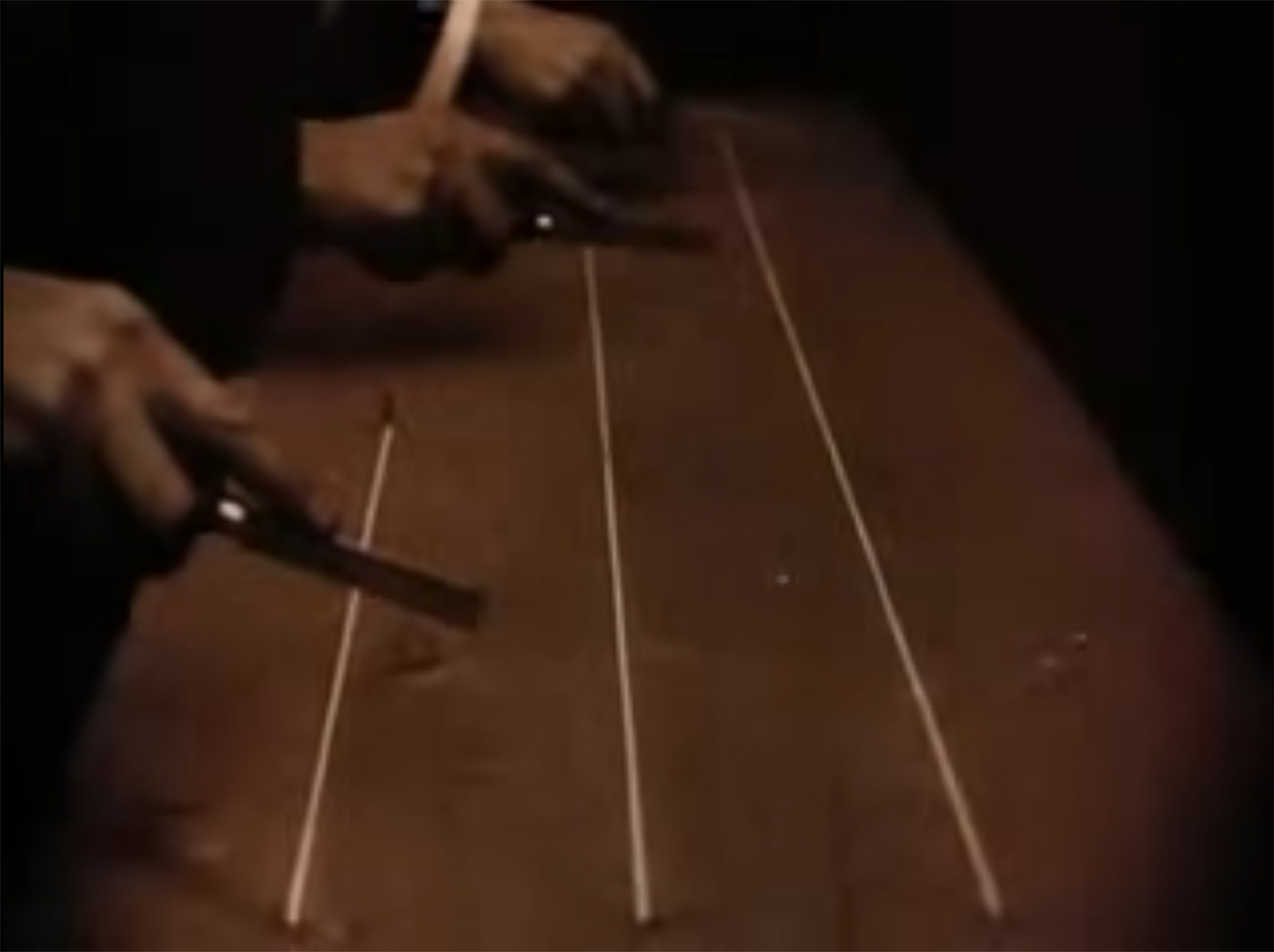
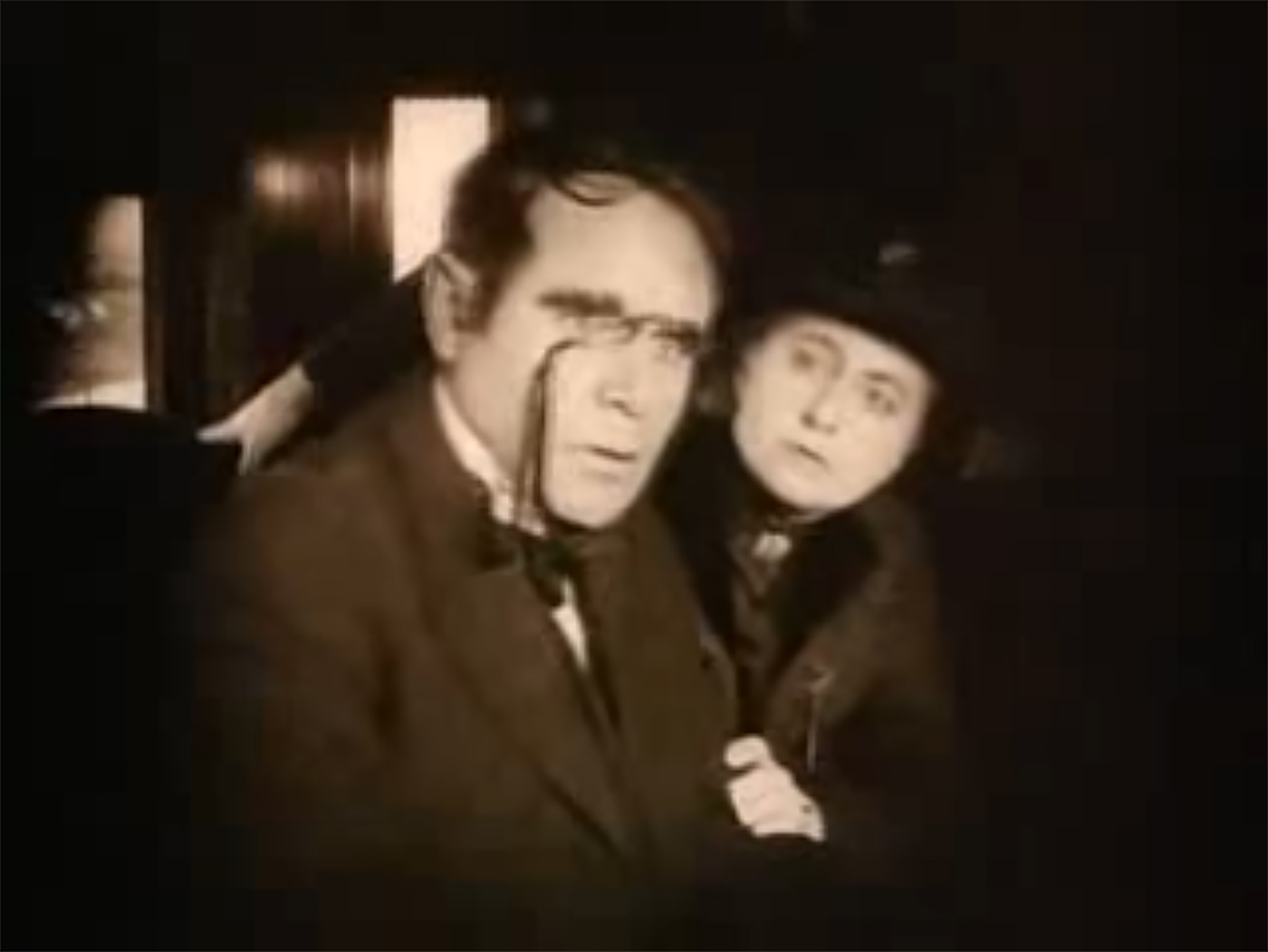
In a similar move a decade earlier, D.W. Griffith's Intolerance (1916) had contrasted the wisdom of the democratically elected governor with fear of the anonymous state. Just before the execution of the film's innocent hero is called off, the frame fills with the image of three disembodied hands hovering with knives over three strings, only one of which will spring the trap door on which the condemned stands (see Figure 3). The obfuscation of individual human responsibility for the killing presents the state as an impersonal agent of death, but a responsible governor, the film showed, has the ultimate power over life and death. With evidence of her husband's innocence, the condemned man's wife chases after and ultimately catches a train carrying the state's governor. With his own wife at his side, grasping him insistently as he hears the evidence of innocence, the governor issues a last-minute pardon (see Figure 4).
Figure 3.
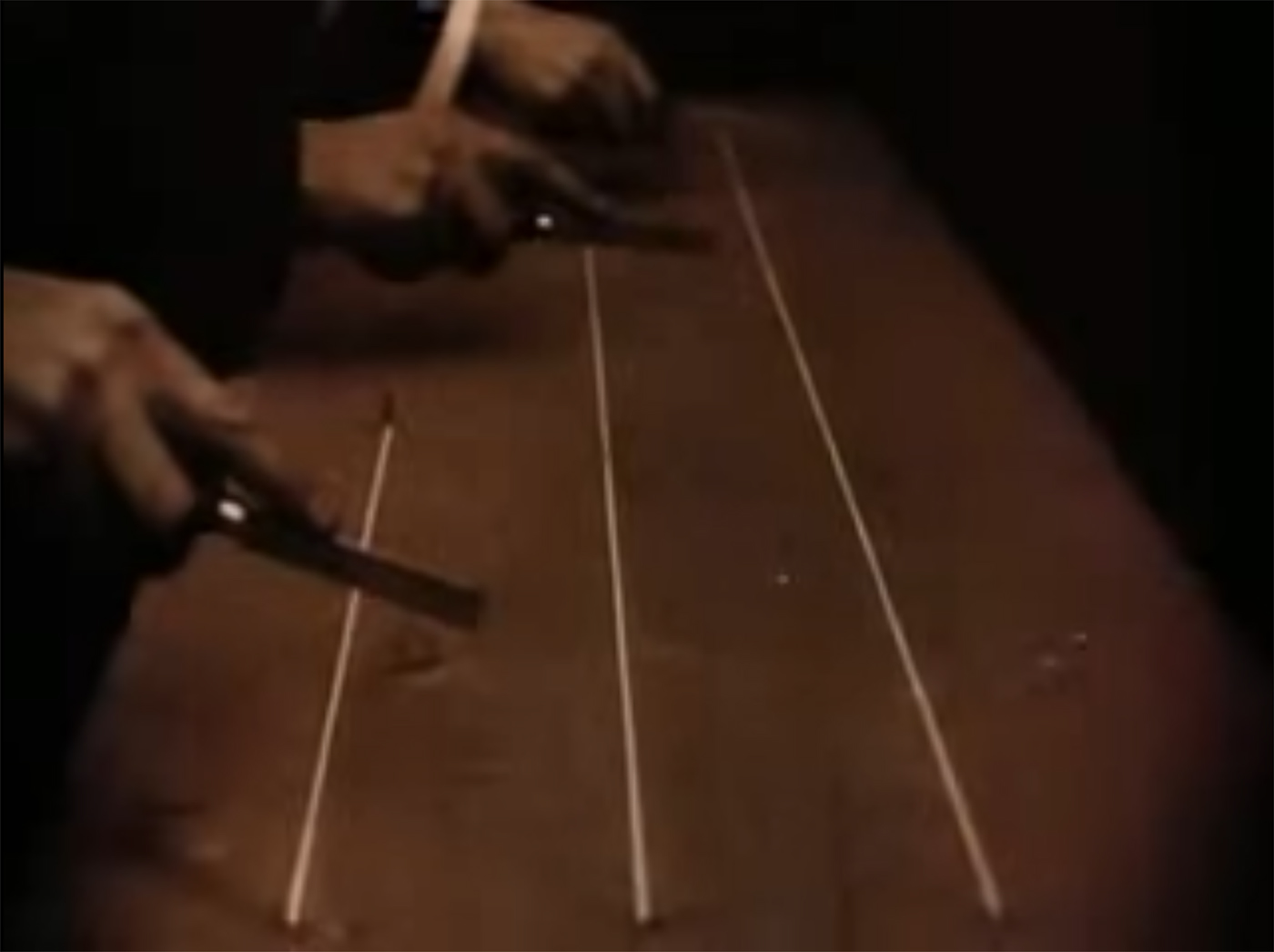
D.W. Griffith’s Intolerance (1916) balanced the specter of the soulless diffusion of sovereignty that was characteristic of the bureaucratic state (top/Figure 3) with the compassionate wisdom of the governor and his capacity to shut down, unilaterally, the machinery of death (bottom/Figure 4).

Sometimes in plays and films, condemned white men did die at the hands of the state, and in such narratives, writers portrayed them as martyrs, a construction that had the potential to unsettle law's legitimacy. The Valiant, a one-act play published in McClure's in 1921 and later made into a film in 1929, is an important example of this subgenre. On the eve of his execution, a mysterious man calling himself James Dyke still will not tell anyone who he is or why he shot a man to death. He merely explains to the warden of the prison, “The man deserved to be killed; he wasn't fit to live. It was my duty to kill him, and I did it…I haven't any excuse—that is, I haven't any excuse that satisfies the law.”Footnote 73 Such an oblique explanation hints that Dyke may have taken the law into his own hands to kill a man who was preying on an innocent person.
As the clock ticks down to execution time, a young woman who has traveled to the urbanized East from bucolic Ohio appears at the gates of the prison to find out if Dyke is her long-lost brother who disappeared 10 years ago. The stage directions describe her as a paragon of innocence: “her manner betrays a certain spiritual aloofness from the ultra-modern world—a certain delicate reticence of the flesh—which immediately separates her from the metropolitan class…Her costume is not quite conservative enough to be literally old-fashioned, but it hints at the taste and repression of an old-fashioned home.”Footnote 74 In a meeting between the girl and Dyke, the audience realizes that he is her brother, even as he successfully convinces her that he is not. He tells her that although he is not her brother, he fought beside him during the war and saw him die a noble death. He also bequeaths to her, on “her brother's” behalf, a significant sum of money. Dyke lies to protect his sister. To confirm his kinship with her would be to push her into the alienating, soulless, “ultra-modern” world from which she has remained “spiritually aloof.”Footnote 75 His valiant act, sacrificing his comfort to preserve her innocence, posits capital punishment as a litmus test for the persistence of honor in a world softened by commercialization, crass materialism, and cosmopolitan decadence. She returns to Ohio, and the play ends with Dyke repeating, as he is marched to the execution chamber, a line from Shakespeare's Julius Caesar, “The valiant never taste of death but once.”Footnote 76
The Valiant, then, showed how executions could become crucibles: tests of a man's willingness to perform his chivalrous duties when doing so had become unfashionable and illegal. The law has forbidden Dyke's vigilante enforcement of a masculine code of honor and then, through its harsh punishment for disobedience, threatens to unman him by damaging his reputation in his sister's eyes. Dyke will not, in the end, let law divert him from his duty, nor will he permit his reputation to be sullied. Dyke's nobility is evident not only in his fidelity to a code of honor, but also in his willingness to endure emotional exile to satisfy its requirements. In his final hours, he foregoes the comfort that only a close family member could provide by keeping his sister in the dark about his true identity. The audience is invited to admire not only his resistance to the modern legal order, but also his performance of a masculine autonomy that cannot be eroded by the state's most terrible punishment.
In its nostalgia for a feudal world, The Valiant, written by a Northerner and set (and initially produced) in a Northern state, oddly adopted the ethos, if not the substance, of the code of honor that ruled the South in the nineteenth century. Under such a code, the law was an estranging, alienating force of modernization; the usurpation of its authority was sometimes a noble way to maintain an endangered, hierarchical past. John Dyke is a martyr to those old world ideals; his courageous endurance of a punishment by a modern legal order only strengthens the premodern values he embodies. His execution symbolized both the law's repression of moral purity and the unequaled opportunity for men to demonstrate the state's failure to extinguish it.
Echoing newspaper accounts of humane state actors, the play presented representatives of the law as simultaneously enamored with Dyke and beholden to the law's soulless demand that he be put to death. Although the warden and the chaplain ultimately do their duty and lead Dyke to his execution, the condemned man's valiance moves them deeply. “A throbbing drama of the law—just, merciless, and cruel,” the film's press sheet read. Nonetheless, one reviewer at the Production Code Administration, Hollywood's internally run censorship program, liked the film precisely because it was different from the routine portrayal, at the time, of sadistic state actors in prison films. In his estimation, the film deserved “salvos of applause:” “It's a real picture and interesting because there is no effort to save the man, no heroics about it, a kind of kindly sternness of the law, carried out by sympathetic, kindly officials,” he wrote to colleagues.Footnote 77 “Kindly sternness” was the very disposition that was often imputed onto prison officials in newspaper accounts of executions. Like those depictions, it seemed to offer a pleasing alternative to the soul-chilling bureaucrat of the modern state. A balanced middle ground, mixing duty and compassion, was fantasized.Footnote 78
Stage and screen productions of the period, then, reinforced capital punishment as an institution that had the potential to become horrifyingly machine-like, but whose annihilating power was ultimately checked by human intuition in stories that ended with a pardon and by courageous nobility in those that ended with an execution. Close-ups of clocks ticking away as an execution approached were likely designed to generate suspense, but those shots also implicitly communicated the fact that an execution was governed by rules that forbade the use of lethal violence before an appointed time. That waiting time became a tool that playwrights and screenwriters used to humanize the administration of the death penalty. In plots that ended in exoneration or commutation, time gave a condemned person's loved ones the opportunity to remedy a potential injustice. Audiences saw that condemned persons would be the beneficiaries of discretion vested in good state actors, who would be responsive to proof of innocence and whose paternalistic goodness was a crucial bulwark against the soullessness of a legal-rational political order. In plots that ended with execution, time gave journalists and fiction writers a way to develop stories of spiritual triumph over a profane world that softened the violence of state killing.Footnote 79 The spiritual resolve with which the condemned met death called attention to the soul that the state's violence could not destroy.
Whitewashing the Death Penalty
Unspoken ideas about race lay at the heart of these narratives. Despite their minority status in the population, African Americans were much more likely to be executed than their white counterparts. Such differences were most stark in the South, where nearly 70% of all executions during this period were of African American men.Footnote 80 Empathy-inviting execution narratives, however, were almost always about white men. Only 3 of 133 films gave significant attention to the experience of condemned African Americans and only 5 depicted condemned women.Footnote 81 The overwhelming majority presented the death penalty as a punishment that targeted white men.Footnote 82 In newspapers, extravagant accounts of executions were rare across all racial groups, but when they did appear, they were almost always about the death of a white man. Although white men were the subject of 60% of articles printed about the execution of just one man, they were the subject of 85% of those articles longer than fifteen paragraphs, and 95% of those articles longer than twenty-five paragraphs (see Appendix Table).Footnote 83 Whereas African Americans were much more likely to be executed, whites were much more likely to inhabit the roles of the condemned in execution narratives.
Such a distortion was important. In modern America, journalistic and artistic representations became Americans’ sole source of knowledge about executions. In those sources, Americans were disproportionately encountering representations of the death penalty as a white man's punishment. Although many continued to think (critically or uncritically) of the death penalty as a tool that disproportionately targeted black men, the plays and movies they saw and many of the newspaper accounts that they read told a different story.Footnote 84
In a less direct, but more powerful way, the rise of lynching in post-Reconstruction America also endowed legal executions with new racial meanings. The whitening of the death penalty in the cultural imagination occurred in an era in which the lynchings of African Americans received widespread attention. Lynchings in the South had peaked in the 1890s, but they occurred regularly well into the twentieth century. When they were public events, lynchings became proclamations of African Americans’ status as subhuman animals. Burning some alive and cutting off others’ tongues and genitals, mobs portrayed African Americans as beings who lacked the self-control, dignity, and rights that white persons alone possessed.Footnote 85 The contrasting treatment of lynching and execution victims solidified, in the dominant cultural imagination, a distinction between extralegal and legal punishment.
So too did the rhetoric of those who defended and those who deplored lynching. Those who defended lynching imagined the punished as instinct-driven animals devoid of the moral faculties associated with autonomous, rights-bearing, responsible citizens. The torture-laden punishment they endured reflected their exclusion from the legal personhood that those who died at the hands of the state were assumed to possess. Out of the discourse generated about America's lynching epidemic came tacit ideas about capital punishment: executions punished persons; lynching punished subpersons. Melodramatic execution narratives amplified this distinction.Footnote 86 These stories regularly imputed to the condemned white men whom they depicted the very humanity and legal personhood that lynching spectacles violently denied to black victims.
Constructions of the punishers in lynching discourse also reinforced the difference between lynching and execution in the popular imagination. In skillful appropriations of white supremacists’ language, antilynching activists cast the white men who joined mobs as animals that lacked moral faculties.Footnote 87 The mob became the frightening incarnation of a would-be state governed by irrational prejudice rather than dispassionate reason. The subtext of such assertions was that those who committed legal homicide did so in a civilized manner because they did not torture or humiliate the condemned. In that context, melodramatic execution narratives amplified the distinction between lynching and execution. The kindly guards of empathy-inviting execution narratives stood in sharp contrast to the bloodthirsty members of lynch mobs, endowing the killing state with humanity and decency.
With lynching as an unspoken, yet readily available foil, journalistic and cinematic depictions of the experiences of sympathetic white men awaiting execution surrounded capital punishment with a humane veneer that it most certainly did not deserve. If lynching photography often depicted the lynched as successfully hunted animals,Footnote 88 posthumously published newspaper photos of the executed depicted them before their deaths, interacting on seemingly equal terms with their keepers. And if those who were lynched died at the hands of white terrorists, those who were executed died at the hands of gentlemen who had forged a relationship with them. Fictional productions brought out other contrasts. If a lynching was a sudden, jarring abduction from a county jail, possibly a sham trial, and a summary death, the imposition of a death sentence was the opening of an often melodramatic journey on the part of the condemned, one that promised the possibility of legal or spiritual vindication. Finally, if vigilante lynching sometimes involved the victim losing his tongue or his genitals, capital punishment sometimes involved the condemned finding his voice or proving his manhood, as John Dyke did when he discovered the meaning of Shakespeare's romantic notion that “the valiant never taste of death but once.”
Resistance to the Killing State
Amid these popular constructions of capital punishment, The Last Mile, John Wexley's 1929 play, stood out as a voice of artistic dissent to the construction of executions as events that respected—or even celebrated—human dignity. An article that condemned inmate Robert Baker had published in H.L. Mencken's magazine, American Mercury, had inspired Wexley to write the play, which became one of the most successful new plays of the 1929–30 Broadway season. The article was a compilation of death row conversations that Baker had overheard on an execution day in Texas. Wexley incorporated much of Baker's dialogue into his play's first act, which dramatizes what happens to a condemned man in his final hours. The second two acts take place several weeks later when the play's protagonist, a white death row inmate named Mears (played on Broadway by a young Spencer Tracy), leads a deadly rebellion against the prison authorities. The play was successful and quickly made into a film.
In contrast to empathy-inviting execution narratives, The Last Mile represented the experience of awaiting and being led to execution as one that was utterly destructive of an inmate's manhood. Audiences watching the 1932 film version were told on a title card at the beginning that they were watching a story of “men in barred cells, crushed physically and spiritually between unrelenting forces of man-made laws and man-fixed death.”Footnote 89 In the play, Wexley openly criticized the way that popular culture had too often imbued the final hours of condemned inmates’ lives with false meaning. “I once saw a moving-picture,” one of Wexley's death row inmates says to his neighbors. “Well, in this picture, this Duke or noble is supposed to go to the guillotine with his wife or sister, or some woman, and it showed how they began dancing and singing what they called the minuet. Now I don't believe that's true. I don't believe that about the dancin’ and the singin’ at all. Do you guys?” In response, one man insists that it is true, pointing to a fellow death row inmate who had joked and sang in the hours before his death. “That's nerve,” the man says. But Mears quickly contradicts him.
Mears. That's crap—that's what that is. That ain't nerve. He was so afraid he had to sing to be able to walk straight. I could hear his knees beatin’ time on each other from over here. Nerve. Huh. Red, didn't you see guys vomit their guts walkin’ to that door?
Kirby. I did see that.
Mears. Why, if they'd examine half the men even before the switch is
pulled for the juice, they'd find they could save current.Footnote 90
Taking on the mythology that journalists and filmmakers had created about men like Carl Wanderer, who sang “Old Pal, Why Don't You Answer Me?” on the Illinois gallows, or James Satterfield, whose equanimity in the face of death made it seem as if he had willed his spirit to take flight before the trap was sprung, Wexley insisted on presenting executions as punishments that destroyed the soul as well as the body. An execution is so spiritually crushing, Mears suggests, that mere proximity to it, in space and time, creates a fear that kills men before the current does.
The play reversed the normal logic of journalistic and cinematic accounts of execution, in which men demonstrated their manliness and achieved a spiritual rebirth by submitting to the execution. Rejecting the mythology of the courageous condemned man who walks to his death with dignity, the play suggested that resistance was the only way to assert one's spirit in the death house. Mears leads a rebellion that quickly proves futile. Massively outnumbered by the prison staff who lie beyond the barricade, the revolting death row prisoners have created between death row and the rest of the prison, Mears soon recognizes that he cannot win. Rather than surrender, he chooses to die fighting. To be condemned, he explains to a fellow inmate, is to join the ranks of “animals, in a jungle. They hunt us down, they kill us. They don't give us a chance.”Footnote 91 When the rebels’ barricade is about to fail, Mears translates this conviction into action. He walks out into the prison courtyard with a gun where he is promptly shot, dying on his own terms as a soldier in a war rather than a hapless animal in a cage. Resistance is re-humanizing.
Wexley's play was in part a critique of Hollywood's tendency to romanticize executions, but even he proved unable to resist the trope. Nearly 10 years after writing The Last Mile, he helped to write the screenplay for another death penalty movie: Angels with Dirty Faces (1938). In that film, James Cagney played Rocky, a reformed gangster on death row who pretends to lose his manhood and “turn yellow” in his final moments in order to disgust the juvenile boys who idolize him, and thereby deter them from following in his footsteps. He goes to his death kicking and screaming, a scared animal rather than a man. But this time dramatic irony subverts Wexley's effort at making the execution chamber a site of emasculation: the fictional boys in the film may have seen Rocky as a coward, but to “the five or ten million real boys and girls” who saw the film, as one angry reformer at the time estimated it, his play-acted “cowardice” only confirmed his courage.Footnote 92 Rocky's awe-inspiring internal strength allows him to sacrifice his public reputation for the greater good. The result was not just the glamorization of Rocky, but the glamorization of capital punishment that Wexley had pointedly avoided, a decade earlier, in The Last Mile. His use of the manhood-through-death trope that he had once critiqued was a testament to just how embedded it remained, in 1938, in American culture.
Conclusion
The last public execution in the United States was held in Kentucky in 1936, capping off a 100 year effort to transform executions into private, bureaucratic acts. By the middle of the twentieth century, the nature of the execution ceremony had so thoroughly changed that death penalty abolitionists could credibly cite its hyper-rationality as evidence of its inhumanity. World War II had revealed the distinctly modern horrors that the mechanization of state killing could produce. Reflecting on his years as San Quentin's death row chaplain in a 1962 memoir, Byron Eshelman adopted that approach, telling readers, “The death penalty is routine, ritualistic, even-tempered, assembly-line annihilation. The state becomes a legal ‘Murder, Inc.’ serving respectable citizens who pay taxes to get the job done.”Footnote 93 Coming fast on the heels of Nazi Adolf Eichmann's conviction in Israel for superintending an institutional machinery of death, Eshelman's words tapped into extreme sorts of anxieties about bureaucracy.
This kind of abolitionist discourse, however, was never quite as central as it might have been in debates over the death penalty, given the horrifying events of World War II. As a new wave of death penalty abolitionism swept the nation in the late 1950s and 1960s, those opposing the death penalty denounced the practice by associating it with antimodern barbarism rather than modern totalitarianism. The resources of the modern state—bureaucratic institutions deploying sophisticated technology to socially engineer the good—were touted as tools of progress rather than instruments of domination. In prominent abolitionist discourse, faith in a rehabilitation-oriented state's capacity to cure offenders of their criminality was the mark of a civilized society; the death penalty was the relic of a primitive past.Footnote 94
The lack of a strong connection between capital punishment and twentieth century totalitarianism in national debates over the death penalty in the 1950s and 1960s has a number of explanations, not least of which is the decentralized manner with which the punishment continued to operate in the United States. Although executions grew centralized within individual states, capital trials and sentencing hearings remained public, local affairs that, one scholar has argued, took the cultural place of executions.Footnote 95 The fact that locally elected district attorneys charged criminal defendants with capital crimes and locally populated juries determined their fate disarmed potential objections to the death penalty as the exercise of a distant and heartless power.
However, popular imaginings of the killing state, forged in journalistic and cinematic representations of capital punishment in the early decades of the twentieth century, also played a role in distancing the American death penalty from broader critiques of modern states as hyper-rational and devoid of respect for the value of individual life. Ordinary Americans, who had lost direct access to executions, now relied exclusively on the newspaper and entertainment industries to witness the state's exercise of its most fearsome power. What they found was reassuring continuity rather than jarring change. As a century-long process of professionalizing and standardizing state killing came to a close between 1915 and 1940, widely circulated renderings of the death penalty portrayed the execution ceremony as a sacred event that still recognized the humanity of the condemned and those charged with putting them to death.
Empathy-inviting execution narratives remind us that the shift from spectacular forms of power to disciplinary ones that Michel Foucault charts in Discipline and Punish was not absolute. Like the faded markings on a palimpsest, older, symbolically rich elements of lethal punishment persisted in the nation's execution chambersFootnote 96 and especially in the representations of what happened in them. Poetic descriptions of humanity worked with, rather than served as obstacles to, the transformation of executions into bureaucratic affairs.Footnote 97 As the state was expanding its reach into new domains, these narratives offered a perverse reassurance that state power remained, in multiple senses of the word, humane. It was humane in the sense that individual, moral actors still seemed to be steering the ship, blunting the impact of homogenizing effects of technocratic policies. And state power was humane in the sense that when it was used to punish people, it seemed to do so with a respect for the dignity that lay within them. In an age of emerging anxiety about the fate of individualism, meanwhile, empathy-inviting execution narratives offered a perverse reassurance that a person could retain psychological coherence under extreme conditions. The soul's survival in the face of the body's physical annihilation was a kind of reassurance of the self's ability to withstand the everyday exercise of disciplinary power that increasingly seemed to shape individual lives.Footnote 98 The modern exercise of power, such representations reassured, could not diminish the vitality of the human soul.
The execution narratives I have studied here push us to recognize how punishment has historically functioned as a signifier of dignity as well as degradation in the United States. Americans’ predilection for harsh punishment does not necessarily indicate, as one scholar has held, the failure of dignity-centered discourse to gain traction in the United States the way it did in Europe.Footnote 99 Commitments to dignity have been incorporated into, rather than simply ignored by, discourse legitimating harsh punishment. When support for the death penalty began rising in the 1970s after decades of decline, one champion of it cast it as a positive good rather than a necessary evil. The anger horrific crime provoked, conservative thinker Walter Berns suggested, expressed “that element of the soul that is connected with the view that there is responsibility in the world; and in holding particular men responsible, it pays them the respect which is due them as men. Anger recognizes that only men have the capacity to be moral beings and, in so doing, acknowledges the dignity of human beings.”Footnote 100
At least one of Berns's critics found this kind of argument laughable. “National leaders keep saying America has lost its moral vision. Now we know where to where to find it,” newspaper columnist Colman McCarthy remarked acerbically—”on death row.”Footnote 101 Berns, however, was putting into words what Americans had long found on the pages of their newspapers and the screens of their movie theaters: a vision of capital punishment as a generative kind of violence. By studying the death penalty as a practice that has long been legitimated by appealing to Americans' positive values as well as their repressive desires, we deepen our understanding of its stubborn persistence in the United States during the western world's late twentieth century “age of abolition.”Footnote 102
Appendix
Methodological Note
In all, thirteen research assistants and I comprehensively searched ten newspapers for execution coverage from 1915 to 1940, inclusive: The Atlanta Constitution, The Baltimore Sun, The Chicago Tribune, The Boston Globe, The New York Tribune/New York Herald-Tribune, The New York Times, The Los Angeles Times, The San Francisco Chronicle, The Washington Post, and The New Orleans Times-Picayune. In states where we searched multiple newspapers (California, New York), we selected for inclusion in national counts the two newspapers with the greatest coverage of executions (omitting, from national figures, The Los Angeles Times and The New York Times). We searched for coverage of all 1,182 executions in the states (or district) that these newspapers served and found coverage of 941 (some executions were covered in multiple, same-day stories; conversely, in states that put multiple men to death on the same day, multiple executions were often covered in one story). For our purposes, an “execution story” was any story published in the days following an execution that announced that the execution had taken place, or that described what happened in the execution chamber. We counted as a discrete paragraph any piece of writing below the headline and sub-headlines that began with an indentation and ended with the last word prior to a new indentation in the text. When newspapers covered multiple executions in one article, we allotted the full length of the story to each person executed no matter how much (or little) of the story was dedicated to recounting that person's particular execution. This makes the findings that I present in the article about the racial disparities we observed conservative. In a significant number of stories in which an African American man was executed alongside a white man, the black man's execution would receive a scant few lines of coverage while the bulk of the lengthy article would be dedicated to studying the executions of the white man.
The newspapers we used were selected because their availability in databases (Proquest Historical Newspapers and America's Historical Newspapers) enabled us to find execution coverage quickly and thus survey a large number of records. Speed and efficiency motivated our decision not to read and analyze systematically coverage of the trial, appeals, and days preceding each execution. The drawback of our approach, which aimed at casting a wide net to gain a larger perspective across a number of regions, is that it did not tell us anything about the coverage of executions in smaller newspapers and tabloids, where coverage may have differed. And it does not take into account those articles that preceded executions and would have, in many cases, allowed us to make a stronger case for the patterns we saw. By focusing solely on representations of the condemned and the state in execution coverage, moreover, we have left for another inquiry the other variables beyond race and gender, particularly the crimes that these people committed and the social status of their victims, which may explain why certain white men received sympathetic coverage by newspapers and others did not. Nonetheless, we think that our finding, that these newspapers showed a consistent bias toward covering executions of white men over their black counterparts and that they often used sentimental and melodramatic narrative frames, benefits from the national perspective that we were able to establish. The database of executed offenders we used to identify the names and races of those executed within the states covered by the newspapers we surveyed is M. Watt Espy and John Ortiz Smykla, Executions in the United States (see Table 1).Footnote 103
Newspaper Coverage of Executions, 1915–40.

To create a list of films in which the death penalty appeared as a major plot device, I compiled the names of all films in the American Film Institute (AFI) Catalog that were tagged with the keywords “capital punishment” or “executions.” This yielded 337 films. Using the summaries of the films, I then excluded from the list films set on the frontier (most often, but not always, westerns), films set in the distant past (i.e., films about the Civil War), and films set outside of the United States. That reduced the list to 131 films. The AFI Catalog is not a perfect source for films that depict capital punishment; for example, Angels With Dirty Faces (1938), which ends with an execution, and D.W. Griffith's Intolerance (1916), which ends with a pardon, were not accompanied by any death penalty-related keywords. I discovered these omissions by comparing the list I had created using the AFI catalogue with information found on The Internet Movie Database (www.imdb.com) and a death penalty filmography from the now defunct web site of the Prison Film Project, formerly at www.theprisonfilmproject.com. My final sample was 133 films.