



Introduction
China is one of the major global centres of early agricultural development (Bellwood Reference Bellwood2005). Rather than a rapid change in subsistence, however, research indicates that the transition to farming was a long and complex process (Smith Reference Smith, Zeder, Bradley, Emshwiller and Smith2006; Fuller Reference Fuller2007; Zhao Reference Zhao2011; Fuller et al. Reference Fuller2014a). To explain this ‘middle ground’ between hunting and gathering and an agricultural way of life, Smith (Reference Smith2001) proposed the concept of ‘low-level food production’, whereby cultures demonstrate a diverse suite of farming strategies (both with and without domesticated crops and animals) but which nonetheless cannot be considered fully agricultural societies. The origins of agriculture in China span several millennia (Zhao Reference Zhao2014), with evidence for cultivation as early as 10 000 years ago (Jiang & Liu Reference Jiang and Liu2006; Liu et al. Reference Liu2011; Yang et al. Reference Yang2012; Zhao et al. Reference Zhao2020) and the establishment of full agricultural societies by 5000 years ago (Zhao Reference Zhao2010, Reference Zhao2017). Advances in archaeobotanical research are beginning to reveal the rich ‘middle ground’ of low-level food production in China.
Early millet farming in northern China is attested by at least five geographically separate but broadly contemporaneous cultural complexes c. 8000 cal BP (Xinglongwa, Cishan, Peiligang, Houli and Laoguantai) (Zhao Reference Zhao2014). The Neolithic Laoguantai Culture (老官台, c. 8000–7000 cal BP), which pre-dates the better-known Yangshao Culture (仰韶, c. 7000–5000 cal BP) was located in the middle Yellow River, extending along both the northern and southern flanks of its tributary, the Wei River (Zhang Reference Zhang2007) (see also online supplementary material (OSM) Table S1; Figure 1). Also called the Dadiwan or Baijia Culture, the Laoguantai is currently the earliest known archaeological culture in the Weihe Plain.
Early cultures and millet complexes of northern China (c. 8000 cal BP) and the location of the Beiliu site; red triangles represent typical archaeological sites of different cultural zones (map by H. Zhou).

In comparison with the other four early Neolithic culture complexes of northern China, understanding of agricultural production in the Laoguantai Culture is relatively limited (Feng Reference Feng1985; Ren Reference Ren1995; Zhao Reference Zhao2005; Lu et al. Reference Lu2009; Crawford et al. Reference Crawford2013). Sparse evidence of broomcorn millet from the Dadiwan site serves as the only definitive evidence for the cultivation of crops (Zhang & Lang Reference Zhang and Lang1983; Liu et al. Reference Liu, Kong and Lang2004; Liu Reference Liu2006; Barton et al. Reference Barton2009; Zhang et al. Reference Zhang2010). Beiliu (北刘) is an Early Holocene Laoguantai Culture occupation site. Through the systematic floatation and analysis of plant remains from Beiliu, we are gaining greater insights into Laoguantai plant use exploitation. Given its proximity to Banpo (the type site for the earlier stage of the Yangshao culture), Beiliu therefore has the potential to reveal much about both the origins of agriculture in this region and the development of agricultural societies towards later Yangshao Culture. With this article, we therefore contribute to understanding of the development of early agricultural societies in northern China.
The middle-lower Yangzi River is widely considered to be the birthplace of rice agriculture in China and the initial stage of the origin of rice can be traced back to at least 10 000 years ago (Higham & Lu Reference Higham and Lu1998; Crawford Reference Crawford and Stark2006). With Early Holocene climatic change and expansive Neolithic cultures, rice farming gradually extended beyond this centre of domestication, though our understanding of the timing and routes by which it spread north and west remains incomplete. For example, the date at which rice was first cultivated in the dry-farming region of the middle Yellow River and on the Weihe Plain is an open question not least because the recovery of rice grains in this part of north-west China could indicate the presence of wild rice, the importation of rice from more southerly regions, or the adoption and local cultivation of rice.
Here, we document charred plant remains from Beiliu, which include three grains of rice. We evaluate the role of this rice and other plant foods at the Early Neolithic Beiliu. Archaeological plant remains result from a variety of subsistence and taphonomic processes (Fuller et al. Reference Fuller, Stevens, McClatchie, Madella, Lancelotti and Savard2014b); by understanding the formation of the deposits containing these charred plant remains, it is possible to connect these archaeobotanical assemblages with specific human activities. In brief, we address the question: where does the subsistence economy of Beiliu sit within the middle ground of early food production in north-west China?
Beiliu and its archaeological context
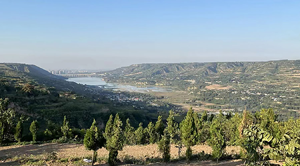
The Beiliu site (34°22′21.8″N, 109°32′37.7″E) is located south-west of Beiliu village in Weinan, Shaanxi province, at the confluence of the Qingshui and Choushui rivers on a secondary terrace (Figures 1 & 2). From 2019 to 2022, the sixth Shaanxi Archaeology Team of the Chinese Academy of Social Sciences and the Shaanxi Academy of Archaeology excavated an area of 500m2 at the site, uncovering ash pits, house structures, hearths, kilns and burials. The main phases of the site relate to an earlier Laoguantai occupation (c. 8000–7000 cal BP) and a later Miaodigou Culture occupation (c. 6000–5500 cal BP). Here, we consider only the earlier of the two phases. The semi-subterranean house structures have square plans with rounded corners (Figure 3). Typical pottery finds include round-bottomed bowls (圜底钵), circle-footed bowls (圈足碗), three-legged bowls (三足钵) and three-legged jars (三足罐) (Figure 4). Tools include bone spades (骨铲) and bone tilling tools (骨耜) for cultivation, stone (石刀) and shell knives (蚌刀) used for harvesting, and grinding stones (石磨棒) for food processing (Xi'an Banpo Museum et al. Reference Xi'an1982, Reference Xi'an1986). Preliminary on-site observations of the zooarchaeological finds indicate a diversity of animal remains including fish, shellfish, reptiles, small and large mammals, and birds.
A) overview of the Beiliu site; B) on-site excavation (photographs by H. Zhou).

The plan, profile and location of house F2 (drawing by H. Zhou).

Laoguantai Culture pottery: a) round-bottomed bowl, huandi bo (圜底钵); b) circle foot bowl, quanzu wan (圈足碗); c, d & f) three-legged bowls, sanzu bo (三足钵); e) three-legged jar, sanzu guan (三足罐) (photographs by X.Q. Wang).

Materials and methods
Plant remains at the Beiliu site were sampled in 2022 using both targeted and grid sampling methods. A total of 81 samples were collected from Laoguantai contexts: 14 from targeted sampling of the ash pits (Figure 5) and 67 from grid sampling of successive layers in house F2 (Figure 6). At least one soil sample of approximately 11 litres in volume was taken from each sampling unit.
A) sample collection; B) sample floatation (photographs by H. Zhou).

Grid plan of house F2 (drawing by H. Zhou).

Bucket floatation was carried out following Pearsall (Reference Pearsall2015) and Zhao (Reference Zhao2004) using a 0.2mm mesh. After drying, flots were sent to the Archaeobotanical Laboratory at Northwestern University, Xi'an, for identification and analysis. Specimens were measured and photographed with a Nikon SMZ25 stereomicroscope. Plant remains are recorded by absolute number, percentage (the proportion of absolute numbers of different species in all samples) and ubiquity (the proportion of samples of a species unearthed in all samples). We follow the guidelines detailed by Pearsall (Reference Pearsall2015). In addition, six samples of charred seeds (Figure S1) were sent to the BETA laboratory for accelerator mass spectrometry (AMS) radiocarbon dating. This material includes five samples of broomcorn millet (each composed of 30 seeds) from house F2 and ash pit H57, and one sample of rice (containing two grains) from ash pit H52. All dates are calibrated by BetaCal4.20, high-probability density method, using the IntCal20 calibration curve (Reimer et al. Reference Reimer2020).
Results
The charred plant remains from Laoguantai contexts at Beiliu comprise three main categories, charcoal, charred seeds/fruit stones and fragments of nuts and acorns; seeds/fruit stones dominate the assemblage (Figure 7).
A selection of seeds, grains and plant remains from Beiliu: a) Setaria italica; b) Panicum miliaceum; c) Oryza sativa; d) Perilla frutescens; e) Ziziphus jujuba var. spinosa; f) Celtis sinensis; g) Glycine soja; h) Vitis vinifera; i) Setaria viridis; j) Poa annua; k) clumps of broomcorn seeds; l) Quercus sp. (photographs by H. Zhou).

Charcoal
Charcoal analysis is an important part of archaeobotany, but in this paper we have only selected charcoal larger than 1 mm for weighing and have not yet done further research.
Nuts and acorns
Fragments of the kernels from nuts and acorns (Quercus sp.) are present in large numbers. There are 44 acorn fragments, with a ubiquity of 28.6 per cent. In addition, there are 203 pieces of varying size that are too fragmented for identification.
Charred seeds/fruit stones
The plant seeds are divided into crop and non-crop categories (Table S2). The former include foxtail millet (Setaria italica, n = 24), broomcorn millet (Panicum miliaceum, n = 1805) and rice (Oryza sativa, n = 3) with a total of 1832 seeds, accounting for 93.3 per cent of the total seed assemblage. The three grains of charred rice (0.2% of the crop seeds, with a ubiquity of 2.5%) were concentrated in ash pit H52. One grain is complete and the other two damaged; measurements are shown in Table 1. Despite their small number, the presence of these grains is potentially significant.
Measurement data of charred rice (mm).

Millets dominate the crop seeds, with broomcorn (98.5% of crops, ubiquity = 86.4%) substantially outnumbering foxtail (1.3% of crops, ubiquity = 21%) (Figure 8, Table S3). Both the foxtail and broomcorn seeds are relatively small; measurements from 40 complete charred broomcorn seeds give an average length, width and thickness of 1.52mm, 1.13mm and 0.99mm, respectively; this equates with an average length/width of 1.36 and an average length/thickness of 1.58 (see Table S4). In addition to the loose grains, 89 variously sized compressed lumps of multiple broomcorn seeds, and 12 lumps of foxtail or broomcorn seeds were found in the soil samples (Figure 6k).
The relative percentage and ubiquity of crop seeds from Laoguantai Culture contexts at Beiliu (figure by H. Zhou).

The non-crop species demonstrate a diverse range of species but the overall number of seeds is low, with 132 specimens, accounting for 6.7 per cent of the total seed assemblage. The non-crops can be divided into three broad categories: edible wild plants, weeds and other plant remains. Most seeds are from the edible wild plants, while weeds and other plant remains are relatively limited. Among the edible wild plants are 56 seeds of perilla (Perilla frutescens, 42.4% of non-crops, ubiquity = 15%), 24 seeds of Chinese date (Ziziphus jujuba var. spinosa, 18.2% of non-crops, ubiquity = 6.2%), 5 seeds of wild soybean (Glycine soja, 3.8% of non-crops, ubiquity = 4.9%), 4 seeds of Chinese hackberry (Celtis sinensis, 3.0% of non-crops, ubiquity = 1.2%) and 2 grape seeds (Vitis vinifera, 1.5% of non-crops, ubiquity = 1.2%). The weed species include hairy crabgrass (Digitaria sanguinalis), green foxtail (Setaria viridis) and annual meadow grass (Poa annua). Additionally, there are other identifiable plant seeds, such as grass-leaved saltwort (Suaeda glauca), summer cypress (Bassia scoparia), shrubby bushclover (Lespedeza bicolor) and yellow sweet clover (Melilotus officinalis). These seeds are not included in our analysis due to the small numbers of seeds and the wide geographical distribution of the plants that produce them.
Chronology
The AMS dates all calibrate to c. 7500 cal BP, consistent with their archaeological context. The five dates on broomcorn millet are statistically contemporaneous, falling between 7619 and 7427 cal BP (at 95.4% probability). The date of the rice sample, at 7570–7431 cal BP (95.4% probability), is contemporaneous with the millet dates (Table 2).
AMS radiocarbon dates processed on samples from Beiliu.

Discussion
Subsistence strategies at Beiliu
Analysis of the plant remains demonstrates the importance of both cultivated and gathered plants at Beiliu. Acorns, Chinese date, Chinese hackberry, wild soybean and grape are particularly significant as collected wild foods, which provide valuable information for exploring subsistence patterns and agricultural development. Macrobotanical studies have identified Quercus sp. acorns at many sites in China c. 8000 years ago (Zhao & Zhang Reference Zhao and Zhang2009; Deng & Gao Reference Deng and Gao2012; Wang et al. Reference Wang, Zhao, Wang and Liu2018), and starch grain studies also suggest that these were an important dietary staple in the early and mid-Holocene (Liu et al. Reference Liu2010, Reference Liu2011). Acorns of Quercus sp. are often bitter, requiring processing before they can be consumed. As a result, they are generally not consumed in large quantities. With the emergence of farming practices, the role of acorns in subsistence gradually decreased (Zhao & Zhang Reference Zhao and Zhang2009).
One ash pit (H52) contained a large number of perilla seeds and millet grains, suggesting that both plants were probably important dietary resources for the site's inhabitants. Further fruits, including Chinese date (likely of the wild variety), Chinese hackberry and grape, also probably served as essential wild food resources.
The numbers of weed species identified in Laoguantai contexts at Beiliu are much lower than those recorded at sites in the middle Yellow River of the subsequent Yangshao period (c. 7000–5000 cal BP) (Zhao Reference Zhao2017; Zhong et al. Reference Zhong, Li, Wang, Yang and Zhao2020). This potentially reflects the relatively low level of agricultural development at Beiliu at the time. Cultivation appears to have focused on broomcorn millet with some evidence for the cultivation of foxtail millet, consistent with archaeobotanical evidence from other sites of this date (see below). The inhabitants of Beiliu also appear to have collected edible wild plants to supplement cultivated crops. This subsistence strategy reflects a low level of agricultural production that fits within the protracted and complex transition from hunting and gathering to farming (Bestel et al. Reference Bestel, Bao, Zhong, Chen and Liu2018; Stevens et al. Reference Stevens2021). The location of Beiliu, set between mountains and river valleys, provided an amenable environment for the transition from fishing, hunting and gathering to agriculture.
Character and development of Laoguantai agricultural production
Broomcorn and foxtail millets belong to the typical dry-land agricultural tradition associated with historical northern China. A similar dominance of broomcorn millet over foxtail millet is observed at sites contemporaneous with Beiliu elsewhere in northern China during the Peiligang period (c. 9000–7000 cal BP) (Stevens et al. Reference Stevens2021; He et al. Reference He, Lu, Zhang and Wang2022). These include Xinglonggou, in Inner Mongolia, associated with the Xinglongwa Culture (Zhao Reference Zhao2011); Yuezhuang, a Houli Cultural site in Shandong Province (Crawford et al. Reference Crawford2013); Zhuzhai, a Peiligang Culture site in Henan Province (Bestel et al. Reference Bestel, Bao, Zhong, Chen and Liu2018), Dadiwan of the Laoguantai Culture in Gansu Province (Liu et al. Reference Liu, Kong and Lang2004; Barton et al. Reference Barton2009; Bettinger et al. Reference Bettinger, Barton and Morgan2010); and Cishan, associated with the Cishan Culture in Hebei Province (Lu et al. Reference Lu2009). Systematic floatation has been carried out at Xinglonggou, Yuezhuang, Zhuzhai and Dadiwan (Barton Reference Barton2009), as well as at other contemporaneous sites (Shelach-Lavi et al. Reference Shelach-Lavi2019). At Cishan, phytoliths of broomcorn millet are more common in early cultural layers, but no charred grains have yet been found (Lu et al. Reference Lu2009). The number of millet grains recovered from these broadly contemporaneous sites is very low, however, and only Zhuzhai, with 358 grains recovered from across multiple contexts, approaches the size of the archaeobotanical assemblage at Beiliu.
The archaeobotanical assemblage from Beiliu is in keeping with a general trend observed in contemporaneous cultures in northern China: broomcorn millet appears to have been relatively more important than foxtail millet in the early stages of food production between c. 8000 and 7000 years ago. The results from Beiliu fill the gap in our understanding of food production in the Laoguantai Culture of the middle Yellow River and confirm that dry-land agriculture in northern China was characterised by an early predominance of broomcorn millet and a later rise in foxtail millet (He et al. Reference He, Lu, Zhang and Wang2022). Thus, Beiliu demonstrates that the development of agriculture at various sites in northern China c. 8000 years ago was generally synchronous, with distinct early dry farming economies at similar levels of development.
The broomcorn grains found at Beiliu are shorter and narrower than those from later Neolithic sites, and their overall size is generally consistent with that of the Xinglonggou and Yuezhuang samples (Figure 9). This change in the size and shape of broomcorn millet grains through the Neolithic has been noted previously and attributed to developments in domestication and cultivation practices (Bestel et al. Reference Bestel, Bao, Zhong, Chen and Liu2018; Stevens et al. Reference Stevens2021). Direct AMS dating of the seeds shows that the broomcorn millet unearthed at Beiliu are among the oldest dated broomcorn remains in China. Therefore, we suggest that the broomcorn at Beiliu is representative of an early form of cultivated/domesticated broomcorn, with the seeds retaining strong wild ancestral characteristics.
Measurement of broomcorn millet grain size at Xinglonggou, Yuezhuang and Beiliu (mm) (figure by H. Zhou).

Implications of rice finds at Beiliu
Scholarly consensus suggests that domesticated rice originated in the middle and lower Yangzi Valley, but there are still many questions regarding the timing, pathways and modes of its subsequent outward spread (Wu Reference Wu1998; An Reference An1999; Qin Reference Qin2012). The discovery of rice in Early Neolithic contexts at sites in the Yellow River basin and Shandong Province are generally considered to indicate the early dispersal of rice (Zhang Reference Zhang2011; Zhang & Hung Reference Zhang and Hung2013). Rice is present in the Yangshao period in the Yellow River basin but its contribution to subsistence appears relatively minor (Stevens & Fuller Reference Stevens and Fuller2017). In subsequent periods rice continued to play a limited role in this region (Deng et al. Reference Deng2020), although it increased in importance in Central China (Li et al. Reference Li2020).
The presence of rice at Beiliu is therefore significant, particularly as direct radiocarbon dating provides confirmation that these are the earliest charred rice grains yet found in the middle Yellow River Valley. Previous studies have suggested that rice appeared in the Yellow River basin as early as 9000–7000 years ago, with charred rice grains recovered from both Yuezhuang (Crawford et al. Reference Crawford2013) and Xihe (Jin et al. Reference Jin, Wu, Zhang, Wang and Wu2014) in the lower Yellow River Valley, and from Zhuzhai in the middle valley (Bestel et al. Reference Bestel, Bao, Zhong, Chen and Liu2018), though the Zhuzhai date is based on associated charcoal rather than directly on the rice grains. Prior to the evidence from Beiliu presented here, the earliest charred rice found in the Weihe Plain is from Yuhuazhai, c. 7000 to 6000 years ago (Zhao Reference Zhao2017). From the Weihe Plain, rice may have then spread further westward along the Wei River and into the upper Yellow River Valley c. 5500–5000 years ago (Zhang & Wang Reference Zhang and Wang2000; Li et al. Reference Li, Dodson, Zhou, Zhang and Masutomoto2007).
Based on the direct dating of grains, the sites of Yuezhuang and Xihe show that rice dispersed northwards into the lower Yellow River Valley c. 8000–7700 years ago, and Beiliu suggests that it spread to the middle valley c. 7500 years ago. Phytoliths and charred grains from Tanghu provide new evidence of mixed broomcorn and rice cultivation in the middle Yellow River Valley, c. 7800 cal BP (Zhang et al. Reference Zhang2012). Although here, again, dating is based on associated charcoal rather than the charred rice.
The period c. 9000–7000 BP was the first major expansion of rice resources in China, though the nature of this expansion is unclear. It is possible that changing climatic conditions during this period permitted an expansion of the natural distribution range of wild rice (e.g. into Shandong Province, d'Alpoim Guedes et al. Reference d'Alpoim Guedes, Jin and Kylebocinsky2015) or the extended range might be the result of cultural transmission and human migration (Zhang Reference Zhang2011). In either case, this expansion enabled the utilisation of rice resources in the Huang-Huai cultural area (Qin Reference Qin2012). No evidence of wild rice has been found on the Weihe Plain so far. Cultural exchanges are, however, apparent between the Houli Culture in the Haidai area and the Xiaohuangshan-Kuahuqiao Culture in the lower Yangzi Valley, as well as between the Laoguantai and Peiligang cultures in the middle Yellow River Valley, and Pengtoushan-Zaoshi and Chengbeixi cultures in the middle Yangzi Valley in the same period. The appearance of rice on Weihe Plain during this period is therefore more likely to represent its introduction from neighbouring regions than local domestication. It is worth reiterating that the process of domestication takes a long time (Fuller et al. Reference Fuller2014a). So it represents only the introduction of rice rather than the gathering or domestication of local wild varieties. We therefore consider the rice from Beiliu as a product of cultivation (Figure 10).
Early Neolithic cultures in China, 7000–5000BC and the expansion of rice agriculture northwards to the middle and lower Yellow River: 1) Xinglongwa Culture; 2) Cishan Culture; 3) Houli Culture; 4) Peiligang Culture; 5) Laoguantai Culture; 6) Pengtoushan-Zaoshi Culture; 7) Chengbeixi Culture; 8) Xiaohuangshan-Kuahuqiao Culture; 9) Zengpiyan Culture; 10) Dingshishan Culture; after Liu and Chen (Reference Liu and Chen2012, figs. 5.1, 5.2) (map by H. Zhou).

The Beiliu rice grains inform understanding of spatial and temporal patterns in the spread of this species in the Yellow River basin, filling a gap in the route of rice transmission moving north and west across China. The limited presence of rice at Beiliu indicates that it was not the dominant crop in cultivation and consumption in the middle Yellow River c. 9000–7000 BP. Rice is a wetland crop, that can tolerate a relatively broad temperature range but requires an abundant water source. The Yellow River basin is a traditional millet farming area, with reduced water availability compared to southern China. Yet the discovery of rice at Beiliu may indicate that environmental conditions were different during the Early Holocene, including climate, landform, soils and hydrology.
Palaeoenvironmental analyses indicate that the climate of the Weihe River basin was warm and humid during the Laoguantai period, supporting the growth of a temperate, deciduous broad-leaved forest (Lu & Zhang Reference Lu and Zhang2008). The Beiliu site is located on a secondary terrace, where river channels intersect, a place of abundant water and fertile soils ideal for rice cultivation. The alluvial plain may also have afforded higher levels of sedentism, which could have provided an opportunity for farmers to integrate rice cultivation alongside early dry farming. The moist and low-lying microenvironment of the site, and the humid and rainy climate of the Holocene Climate Optimum, provided the conditions necessary for the cultivation of rice by the Laoguantai people. The coincidence of suitable growing conditions raises the strong possibility that rice was cultivated locally at this early date. However, the absence of spikelet bases at Beiliu, which can help distinguish between wild and domesticated rice and which are often discarded during rice processing, means that the exchange of processed grains from cultures further south must also remain a possibility.
Conclusion
Scientific sampling and systematic floatation has resulted in the collection of a relatively rich assemblage of charred plant remains from the early Neolithic site of Beiliu in northern China. Cultivated crops include foxtail and broomcorn millets and rice, while edible wild foods include acorns, Chinese date, Chinese hackberry and grape. The Beiliu dataset provides an insight into the subsistence economy on the Weihe Plain during the ‘middle ground’ of the transition from hunting and gathering to farming. The results presented here add to growing understanding of Early Holocene subsistence regimes in northern China, situating Beiliu well along the continuum of farming. In common with other early Neolithic occupation sites in northern China, broomcorn millet dominates the Beiliu archaeobotanical assemblage, suggesting broad homogeneity in agricultural trajectories at this time. The direct dating of rice grains from Beiliu has provided one of the earliest known dates for charred rice grains in northern China. These findings therefore shed new light on the timing and routes by which rice cultivation spread from southern China and on the integration of this crop into local subsistence strategies in northern China; not later than 7500 years ago, rice was present on the Weihe Plain in the middle Yellow River Valley. The Beiliu site therefore contributes to our growing understanding of the long transition from hunting and gathering to food production in East Asia and beyond.
Acknowledgements
We thank the sixth Shaanxi Archaeology Team of the Chinese Academy of Social Sciences for collecting samples and Mr Jingang Yang for his help with seed identification. We acknowledge Liya Tang, Ruichen Yang, Kai Han, Wenbin Fu, Jiaqi Liu, Qianyi Lin, Anqi Yang and Xu Liu et al. for their help with their suggestions on the drafts. We are also grateful to Xiaowen Chang for assistance in mapping and to Ximan Wang and Jin Su for help in reviewing the details of the article.
Funding statement
This research was funded by the Innovative Project of the Institute of Archaeology, Chinese Academy of Social Sciences Archaeological Research on the Transition from the Paleolithic to the Neolithic Period in the Middle Reach of the Yellow River 2021KGYJ002.
Online supplementary material (OSM)
To view supplementary material for this article, please visit https://doi.org/10.15184/aqy.2024.190 and select the supplementary materials tab.



