Introduction
Echinococcus granulosus (a small taeniid cestode) completes its life cycle by utilizing dogs and other canines (carnivores) as the definitive host, with a variety of ungulates (herbivores) serving as intermediate hosts. The range of intermediate host species depends on local differences in their availability and the infecting strain of E. granulosus (Eckert et al., Reference Eckert, Deplazes, Craig, Gemmell, Gottstin, Health, Jenkins, Kamiya, Lightowelers, Eckert, Gemmell, Meslin and Pawlowski2001). Within intermediate hosts, onchospheres liberated from ingested viable eggs may develop into fluid-filled metacestodes (unilocular hydatid cysts) in any organ (preferred sites are liver and lungs) causing cystic hydatidosis. This is an important zoonotic disease from both medical and veterinarian viewpoints, since the metacestode infection may cause severe illness (Jenkins et al., Reference Jenkins, Roming and Thompson2005) and high economic losses due to condemnation of affected viscera at the slaughterhouses (Irshadullah et al., Reference Irshadullah, Nizami and Macpherson1989; Scala et al., Reference Scala, Garippa, Varcasia, Tranquillo and Genchi2005). Dynamics of the disease are becoming more complicated due to the existence of intraspecific variants (termed as strains) in E. granulosus. To date, several host-adapted strains/genotypes (G1–G10) have been reported that differ in a range of characteristics, including morphology and epidemiology, some of which may warrant species status (Thompson & McManus, Reference Thompson and McManus2002; Thompson et al., Reference Thompson, Boxell, Ralston, Constantine, Hobbs, Shury and Olson2006; Nakao et al., Reference Nakao, McManus, Schantz, Craig and Ito2007; Thompson, Reference Thompson2008; Snabel et al., Reference Snabel, Altintas, Amelio, Nakao, Roming, Yolasigmaz, Gunes, Turk, Busi, Huttner, Secova, Ito, Altintas and Dubinsky2009). Because each strain varies in its infectivity and local pattern of transmission, an informal nomenclature is needed for successful intervention strategies in different endemic regions (Gemmell & Roberts, Reference Gemmell, Roberts, Thompson and Lymbery1995).
Larval hook morphology has been considered and used as a valid criterion for the identification of E. granulosus isolates from different hosts and geographical regions (Kumaratilake & Thompson, Reference Kumaratilake and Thompson1984; Thompson et al., Reference Thompson, Kumaratilake and Eckert1984; Kumaratilake et al., Reference Kumaratilake, Thompson and Eckert1986; Ponce Gordo & Cuesta Bandera, Reference Ponce Gordo and Cuesta Bandera1997; Hosseini & Eslami, Reference Hosseini and Eslami1998; Tashani et al., Reference Tashani, Zhang, Boufana, Jegi and McManus2002; Ahmadi, Reference Ahmadi2004; Almeida et al., Reference Almeida, Silva, Neves, Romanii and Sliva2007). Many workers have used morphological tools to ascertain the applicability of larval hook morphometric data to differentiate E. granulosus strains. Results obtained from such studies were comparable to those from genetic analysis (Ponce Gordo & Cuesta Bandera, Reference Ponce Gordo and Cuesta Bandera1997; Harandi et al., Reference Harandi, Hobbs, Adams, Mobedi, Morgan-Ryan and Thompson2002; Ahmadi, Reference Ahmadi2004; Ahmadi & Dalimi, Reference Ahmadi and Dalimi2006; Thompson et al., Reference Thompson, Boxell, Ralston, Constantine, Hobbs, Shury and Olson2006). Morphological analysis is quicker and more cost effective for workers operating in the field of epidemiology.
Buffalo are considered the most suitable intermediate hosts for larval multiplication and the buffalo/dog cycle operates for perpetuation of the E. granulosus life cycle in India (Irshadullah et al., Reference Irshadullah, Nizami and Macpherson1989; Irshadullah & Nizami, Reference Irshadullah and Nizami1992). Gill & Rao (Reference Gill and Rao1967) investigated the morphology of adult worms from buffalo/dog origin and suggested that isolates from buffalo did not correspond to any described subspecies, and may be considered as mutants. The limited information on the transmission patterns and extent of strain variation in E. granulosus from India clearly indicates that more studies are required to determine the form of E. granulosus adapted to buffaloes (Thompson et al., Reference Thompson, Lymbery and Constantine1995). Therefore, in the present study E. granulosus protoscolices originating from Indian buffalo were characterized by using morphological tools.
Many livestock were found to be infected with cystic hydatidosis in Iran, where two distinct cycles of transmission are thought to occur (Harandi et al., Reference Harandi, Hobbs, Adams, Mobedi, Morgan-Ryan and Thompson2002). Based on morphological and molecular analyses, two distinct strains/genotypes (sheep and camel) have been reported from different parts of Iran (Zhang et al., Reference Zhang, Eslami, Hosseini and McManus1998; Harandi et al., Reference Harandi, Hobbs, Adams, Mobedi, Morgan-Ryan and Thompson2002; Ahmadi, Reference Ahmadi2004; Ahmadi & Dalimi, Reference Ahmadi and Dalimi2006); however, no information is available from Sari, northern Iran. Therefore, the present study was undertaken to ascertain whether a similar picture of strain variation may also exist in this region of the country, and to assess whether the morphometric characteristics of larval hooks could be used to distinguish the strains.
Materials and methods
Collection and examination of hydatid cysts
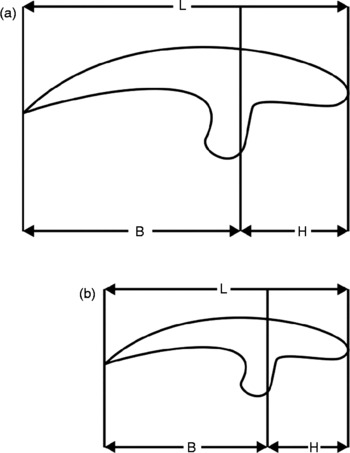
Hydatid cysts were collected from the livers and/or lungs of naturally infected Indian water buffalo (Bubalus bubalis) from Aligarh (northern India) and sheep, cattle and camels from Sari (northern Iran), slaughtered at the local abattoirs. Isolation of protoscolices from hydatid cysts was carried out under sterile conditions as described by Irshadullah & Nizami (Reference Irshadullah and Nizami1992). Protoscolices collected from one or several hydatid cysts from an individual host were considered as a sample/isolate (Hobbs et al., Reference Hobbs, Lymbery and Thompson1990). The viability of all isolates of protoscolices was confirmed by flame cell activity and samples with a mean viability of >96% were used. A total of 37 samples of protoscolices were collected from Indian buffalo, 32 samples from Iranian sheep and 26 samples each from Iranian cattle and camel. The morphometric data were collected from ten protoscolices/sample whereas the data on hook numbers were obtained from 30 protoscolices/sample from each host species (Kumaratilake & Thompson, Reference Kumaratilake and Thompson1984; Kumaratilake et al., Reference Kumaratilake, Thompson and Eckert1986; Ponce Gordo & Cuesta Bandera, Reference Ponce Gordo and Cuesta Bandera1997; Ahmadi, Reference Ahmadi2004). In each rostellum, five large and five small hooks were measured (Sweatman & Williams, Reference Sweatman and Williams1963) and all hooks were counted to avoid subjectivity. Morphological analysis was performed as described by Hobbs et al. (Reference Hobbs, Lymbery and Thompson1990). Fixed (10% neutral buffered formalin) or freshly isolated protoscolices were mounted in polyvinyl lactophenol (R.A. Lamb, Eastbourne, East Sussex, UK) on a glass slide under a cover-slip with sufficient pressure, so that the hooks spread out and lie flat without being damaged. The number, shape and arrangement of rostellar hooks were studied and details of the hook components measured are shown in fig. 1. The total length and blade length of large and small hooks were measured according to Sweatman & Williams (Reference Sweatman and Williams1963). Blade length was also expressed as a percentage of total length of large (LBL/LTL %) and small (SBL/STL %) hooks. All measurements were made on an Olympus microscope by the same individual using a calibrated ocular micrometer under oil immersion.
Length measurements (in μm) of large (a) and small (b) rostellar hooks in the protoscolex of Echinococcus granulosus; L, total length; B, blade; H, handle.

Data analysis
Statistical analysis was based on the total number of samples from each host. Morphometric data were analysed by using SPSS statistical software package version 17 (SPSS Inc., Chicago, Illinois, USA). Student's t-test was employed to detect the level of significance between the parasite materials collected from different host species.
Results
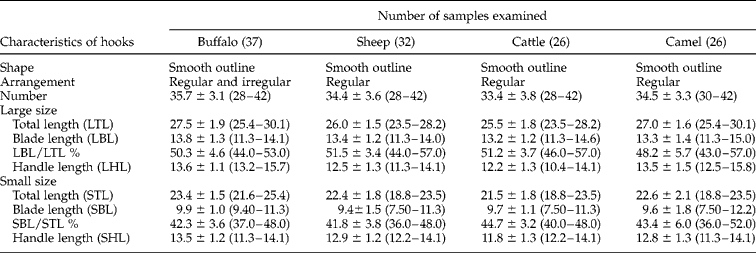
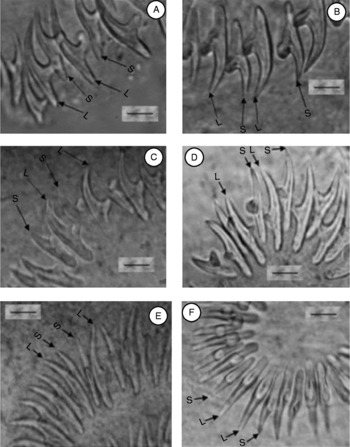
Since fertile cysts were not recovered from sheep and goats, only buffalo material from India was used, whereas sheep, cattle and camel isolates were used from Iran for morphological studies (table 1). The rostella of all protoscolices collected from various livestock had two rows of alternating large and small hooks (fig. 2A–D); but for buffalo about 25% of the samples were found to have either two small hooks in between the large hooks (fig. 2E) or two large hooks in between the small hooks (fig. 2F). In the case of paired large hooks, the space between the two hooks was usually the same as the space normally found between a large and small hook next to each other. However, when small hooks were paired, they were usually closer together than normal. Hooks of all isolates were found to have a smooth outline.
Characteristics of rostellar hooks of protoscolices isolated from hydatid cysts of buffalo (India), sheep, cattle and camel (Iran) (length measurement mean±SD).
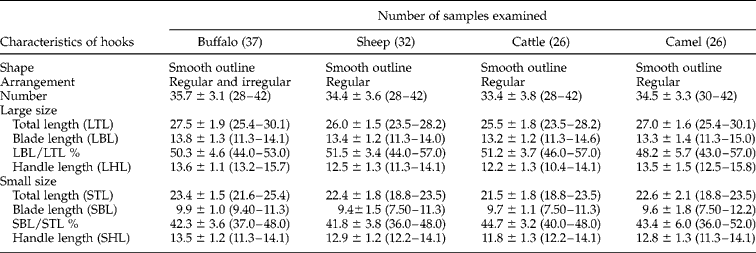
Length in micrometres. Regular, large and small hooks alternate; irregular, paired small hook between two large hooks or paired large hooks between two small hooks.
Alternate (regular) arrangement of large (L) and small (S) hooks in the protoscolex rostellum of sheep (A), cattle (B), camel (C) and buffalo (D) isolates. Some specimens of buffalo isolates have irregular hook arrangement, either two small hooks in between large hooks (E) or two large hooks in between small hooks (F). Scale bar = 10 μm.

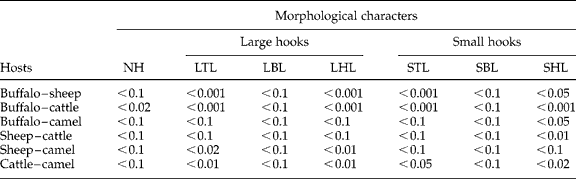
Protoscolices collected from different species of livestock vary from each other in many morphological parameters. All values from the buffalo isolate were found to be higher than other isolates (table 1). The analysis of P value (Student's t-test) revealed significant differences in various morphometric characters (table 2). Total length and handle length of both large and small hooks of buffalo isolates were found to be significantly higher than sheep and cattle isolates. The sheep and cattle isolates from Iran did not differ significantly from each other; however, they did differ significantly from that of the camel isolates in both total length and handle length of large and small hooks. Furthermore, variations were also observed in the curvature of blades. Blades from buffalo isolates were sharp and less curved (fig. 2D) compared to other isolates (fig. 2A–C). The ratio of blade length to total length of large (LBL/LTL %) and small (SBL/STL %) hooks also showed variations among isolates (table 1).
Level of statistical significance (P value) between different isolates of protoscolices isolated from hydatid cysts of buffalo (India), sheep, cattle and camel (Iran).
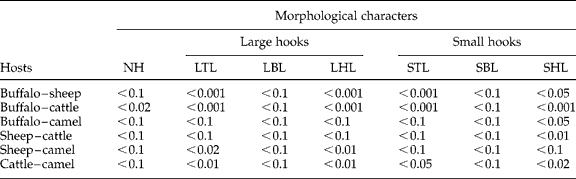
P value up to < 0.05 is considered as significant. NH, total number of hooks; LTL, large hook total length; LBL, large hook blade length; LHL, large hook handle length; STL, small hook total length; SBL, small hook blade length; SHL, small hook handle length.
Discussion
Rostellar hook morphology is still considered to be a valid criterion for differentiating E. granulosus isolates/strains (Ponce Gordo & Cuesta Bandera, Reference Ponce Gordo and Cuesta Bandera1997; Harandi et al., Reference Harandi, Hobbs, Adams, Mobedi, Morgan-Ryan and Thompson2002; Tashani et al., Reference Tashani, Zhang, Boufana, Jegi and McManus2002; Ahmadi, Reference Ahmadi2004; Ahmadi & Dalimi, Reference Ahmadi and Dalimi2006; Thompson et al., Reference Thompson, Boxell, Ralston, Constantine, Hobbs, Shury and Olson2006; Almeida et al., Reference Almeida, Silva, Neves, Romanii and Sliva2007), although its usefulness for this purpose has been questioned (Hobbs et al., Reference Hobbs, Lymbery and Thompson1990). It is a comparatively quick and inexpensive method of strain identification, particularly for epidemiological studies. In this regard, the total numbers, total length and blade length of rostellar hooks have been suggested as important criteria for differentiation of strains (Ponce Gordo & Cuesta Bandera, Reference Ponce Gordo and Cuesta Bandera1997; Lymbery, Reference Lymbery1998). Therefore our finding further supported these previous data that total length and handle length are the most variable characters and therefore could be used more reliably for differentiating E. granulosus strains from different intermediate host species. By considering the fact that the larval hook remains embedded within the adult hook and remains unchanged as it passes through the definitive host (Hobbs et al., Reference Hobbs, Lymbery and Thompson1990), it is possible that larval hook characteristics could be used to infer intermediate host origin of adult worms, and would be helpful for identifying transmission patterns of the different strains (Constantine et al., Reference Constantine, Thompson, Jenkins, Hobbs and Lymbery1993; Lymbery, Reference Lymbery1998; Ahmadi, Reference Ahmadi2004).
While a minimum sample size is required to determine the reliability of the data, this has not always been done in morphological studies (see references in Ponce Gordo & Cuesta Bandera, Reference Ponce Gordo and Cuesta Bandera1997). The first morphological study in which the sample size was estimated on a statistical basis was that of Thompson et al. (Reference Thompson, Kumaratilake and Eckert1984). They used large numbers of samples and specimens from each host species to study the rostellar hook morphology of E. granulosus. Since then, their criteria have been followed by many workers (Kumaratilake & Thompson, Reference Kumaratilake and Thompson1984; Kumaratilake et al., Reference Kumaratilake, Thompson and Eckert1986; Said et al., Reference Said, Abdel-Hafez and Al-Yaman1988; Eckert et al., Reference Eckert, Thompson, Michael, Kumaratilake and El-Sawah1989, 1993; Worbes et al., Reference Worbes, Thompson and Eckert1989; Ponce Gordo & Cuesta Bandera, Reference Ponce Gordo and Cuesta Bandera1997; Harandi et al., Reference Harandi, Hobbs, Adams, Mobedi, Morgan-Ryan and Thompson2002; Tashani et al., Reference Tashani, Zhang, Boufana, Jegi and McManus2002; Ahmadi, Reference Ahmadi2004; Ahmadi & Dalimi, Reference Ahmadi and Dalimi2006). In many of these studies, 30 and 10 protoscolices per sample were used for determining the total number and measurement of hooks, respectively, and usually two large and two small hooks (2+2) per rostellum were measured. Ponce Gordo & Cuesta Bandera (Reference Ponce Gordo and Cuesta Bandera1997) measured 4+4, Hobbs et al. (Reference Hobbs, Lymbery and Thompson1990), Ahmadi (Reference Ahmadi2004), Ahmadi & Dalimi (Reference Ahmadi and Dalimi2006) and Thompson et al. (Reference Thompson, Boxell, Ralston, Constantine, Hobbs, Shury and Olson2006) measured 3+3, while Sweatman & Williams (Reference Sweatman and Williams1963) measured 5+5. In our study, we measured five large and five small hooks per rostellum, which is believed to be a reasonably large enough sample size to reduce the importance of extreme values on the calculated sample mean.
Parasites collected from different host species showed a high degree of phenotypic polymorphism in rostellar hook traits, and all morphometric values of the buffalo isolate were found to be higher compared to values obtained for other isolates. Similarly, phenotypic variations have been reported in E. granulosus collected from different host species as well as from the same host species from different geographical regions (Thompson & Lymbery, Reference Thompson and Lymbery1988; Eckert & Thompson, Reference Eckert and Thompson1997; Ponce Gordo & Cuesta Bandera, Reference Ponce Gordo and Cuesta Bandera1997; Almeida et al., Reference Almeida, Silva, Neves, Romanii and Sliva2007). In addition to this, biochemical, developmental, antigenic and genetic differences have been demonstrated between the protoscolices collected from different cysts of the same host species (Irshadullah & Nizami, Reference Irshadullah and Nizami1992, Reference Irshadullah and Nizami1997; Lymbery & Thompson, Reference Lymbery and Thompson1989; Ahmad et al., Reference Ahmad, Nizami and Saifullah2001; Gholami et al., Reference Gholami, Irshadullah and Khan2009). If the individual cyst in the intermediate host species is from heterogeneous sources, it is possible that the samples used for measurement were genetically different. Thus, it can be suggested that the genetic heterogeneity between the parasite populations may be responsible for morphological variations, as it has been fully accepted that E. granulosus exhibits a high degree of genetic divergence with differences in morphology (Jenkins et al., Reference Jenkins, Roming and Thompson2005, Nakao et al., Reference Nakao, McManus, Schantz, Craig and Ito2007; Thompson, Reference Thompson2008).
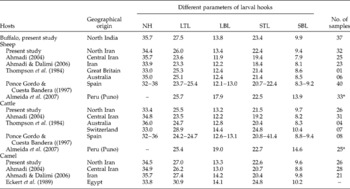
Comparison of the morphometric data obtained in the present study with that from previous reports (table 3) revealed that buffalo isolates are morphologically distinct from that of common sheep and cattle isolates, and may represent a distinct strain. Rostellar hook morphology has not been previously studied in India and this is the first report of its kind. However, previous studies have shown that adult E. granulosus from buffalo origin differ in morphology and developmental patterns from that of sheep (Gill & Rao, Reference Gill and Rao1967). Based on these reports, Thompson & Lymbery (Reference Thompson and Lymbery1988) suggested that buffalo isolates may be similar to cattle strains. Bowles et al. (Reference Bowles, Blair and McManus1992) have shown by molecular studies that Indian buffalo isolates are quite distinct from a Dutch cattle isolate (G5) but only slightly different from the common sheep strain (G1), suggesting that (like Tasmanian sheep isolates) the Indian buffalo isolates are either variants of the common sheep strain or represent a genetically distinct but very closely related group. Bhattacharya et al. (Reference Bhattacharya, Bera, Bera, Maity and Das2007) reported the occurrence of the G2 genotype in Indian buffalo.
A comparison of different parameters of larval rostellar hooks of E. granulosus between present and previous findings.

* Total number of protoscolices. NH, total number of hooks; LTL, large hook total length; LBL, large hook blade length; STL, small hook total length; SBL, small hook blade length.
Cystic echinococcosis is endemic in Iran, where several intermediate host species were found to be commonly infected with E. granulosus. Based on morphological and molecular studies, sheep (G1) and camel (G6) strains/genotypes have been shown to occur in different regions of Iran (south and central) (Zhang et al., Reference Zhang, Eslami, Hosseini and McManus1998; Harandi et al., Reference Harandi, Hobbs, Adams, Mobedi, Morgan-Ryan and Thompson2002; Ahmadi, Reference Ahmadi2004; Ahmadi & Dalimi, Reference Ahmadi and Dalimi2006). The sheep strain was the most common genotype usually affecting sheep, cattle and goats and occasionally camels, whereas the majority of camels were infected with the camel (G6) strain which was also found to cause infection in both sheep and cattle (reviewed by McManus & Thompson, Reference McManus and Thompson2003). Our morphological results agree with previous studies conducted in different regions of Iran (Hosseini & Eslami, Reference Hosseini and Eslami1998; Harandi et al., Reference Harandi, Hobbs, Adams, Mobedi, Morgan-Ryan and Thompson2002; Ahmadi, Reference Ahmadi2004; Ahmadi & Dalimi, Reference Ahmadi and Dalimi2006) and Egypt (Eckert et al., Reference Eckert, Thompson, Michael, Kumaratilake and El-Sawah1989), where camel isolates were found to be morphologically different from the isolates of sheep and cattle. Based on the present results, it can be suggested that sheep and camel strains also exist in Sari, northern Iran and they could be differentiated solely on the basis of hook morphology as suggested previously (Harandi et al., Reference Harandi, Hobbs, Adams, Mobedi, Morgan-Ryan and Thompson2002; Ahmadi, Reference Ahmadi2004). Comparison of the present findings with previous reports (table 3), indicate that the morphometric values obtained from sheep, cattle and camel isolates were slightly higher than those reported from Iran (Ahmadi, Reference Ahmadi2004; Ahmadi & Dalimi, Reference Ahmadi and Dalimi2006), Spain (Ponce Gordo & Cuesta Bandera, Reference Ponce Gordo and Cuesta Bandera1997), Australia and Great Britain (Thompson et al., Reference Thompson, Kumaratilake and Eckert1984), yet less than those reported from Peru (Almeida et al., Reference Almeida, Silva, Neves, Romanii and Sliva2007) and Egypt (Eckert et al., Reference Eckert, Thompson, Michael, Kumaratilake and El-Sawah1989).
Thus, it can be concluded that larval rostellar hook morphology is a valid parameter for identifying E. granulosus isolates, particularly in those areas where different intermediate host species are involved in the transmission of disease, and both total length and handle length of large and small hooks could be used as the most potential characters for quick identification of parasites in epidemiological studies.
Acknowledgements
We are thankful to the Chairman, Department of Zoology Aligarh Muslim University, Aligarh, India, for providing laboratory facilities, and to Prof. D.P. McManus, Department of Molecular Parasitology of Queensland University, Australia, for valuable suggestions and Tracey Laing, for her help with the manuscript. This work is part of the Ph.D. thesis of S.G.