In recent years, with the rapid development of nuclear energy and nuclear technology in China and the promulgation and implementation of the National Action Plan for Energy Development Strategy (2014-2020), by 2020, China’s installed nuclear power capacity reached 58 million kilowatts, and the capacity under construction exceeded 30 million kilowatts. 1 Approximately 100 nuclear power units are currently in operation in China’s neighboring countries and regions. 2 However, nuclear technology is a “double-edged sword.” In its development and application history, it benefits the progress of human science and technology, while serious accidents and the leakage of many radioactive substances still occur, which threaten people’s health and life safety. In addition to direct casualties, it causes psychological panic in society and even affects the social stability and national safety. The 2011 Fukushima nuclear accident in Japan once again sounded the alarm. Reference Anzai, Ban and Ozawa3 Therefore, when a nuclear radiation emergency occurs, it is important to perform emergency responses in a timely and effective manner to minimize the casualties and social impact caused by the accident or incident to protect the physical and mental health of the people and maintain social stability.
Due to the particularity of nuclear radiation incidents, there are few opportunities for practical combat and few experiences in the medical treatment of major nuclear accidents in China, the emergency ability mainly comes from knowledge training and emergency drills. Reference Fu, Yuan and Liu4 Due to the professionalism and particularity of health emergencies in nuclear radiation emergencies, professional technical training and drills are required. The existing training mode has problems, such as unclear division of responsibilities and poor practical operability. Once an unexpected nuclear and radiation accident occurs, it is generally difficult for rescue teams to calmly respond. Nurses participate in almost every aspect of the health system and will be involved in both immediate and long-term care after a radiological or nuclear incident. However, the content is not routinely presented in nursing school curricula, Reference Veenema, Lavin and Schneider-Firestone5 and nurses are not well prepared to respond in this capacity. Reference Veenema, Lavin and Bender6 This apparent knowledge deficit and level of unpracticed skill may have grave implications for patients in a radiological or nuclear incident.
Virtual reality (VR) is an emerging technology generated by computers that can simulate specific scenes. Through the interaction of senses (vision, hearing, and touch), people can have a sense of real presence. Reference El Beheiry, Doutreligne and Caporal7 In recent years, VR technology has entered a period of rapid development and presents great application potential in many fields, including medicine. Reference Izard, Juanes and García Peñalvo8 A recent meta-analysis of the effectiveness of VR in nursing education based on the Cochrane methodology suggested that VR can effectively improve knowledge in nursing education. Reference Chen, Leng and Ge9 However, there have been few reports of VR to train nurses on nuclear radiation emergency medical rescue. In this study, VR was used to training and improve the nuclear radiation emergency medical rescue ability of nurses.
Methods
Study Subjects
Thirty operating room nurses who received traditional nuclear radiation rescue training from May 2020 to October 2020 were selected as the control group, all of whom were female, with an average age of 28.20 ± 0.96 (25-35) y. Thirty operating room nurses who underwent VR nuclear radiation rescue training from November 2020 to April 2021 were selected as the experimental group, all of whom were female, with an average age of 29.57 ± 1.04 (25-35) y. There was no significant difference in sex or age between the 2 groups; P > 0.05.
The methods for training in the control group were nuclear radiation-related theoretical knowledge learning, personal training, scenarios comprehensive drills including (1) proper wearing of personal protective equipment; (2) use of individual exposure dosimeter and measurement equipment; (3) triage of the simulated exposure victims; (4) decontamination of the simulated exposure victims. The method for training in the experimental group were nuclear radiation-related theoretical knowledge learning and application of the VR nuclear radiation emergency medical rescue training system for training. The drill content of VR is the same as the above 4 points in the control group. Nurses get the virtual training scene by wearing helmets, and interact with the system in the virtual scene with 2 handles: the left handle is responsible for movement and the right handle is responsible for operation. The control group and the VR group do not know each other, and all the nurses in both groups were volunteers to receive nuclear radiation rescue training.
Construction of VR Nuclear Radiation Emergency Medical Rescue Training System
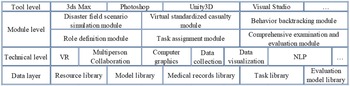
The construction of a VR nuclear radiation emergency medical rescue training system mainly involved the construction of the tool level, module level, technology level, and data level (Figure 1). Radiation source and casualty modeling was mainly constructed based on nuclear explosion sites, nuclear radiation accident sites, and other data. Combined with practical rescue experience in the past, the complex variables of each module were optimized, and the main characteristics of the environment were simplified. With the software of 3dx Max, Photoshop, Unity3D, and Visual Studio, a 3-dimensional simulation environment was formed to build the VR nuclear radiation emergency medical rescue teaching and training system. The system development team modified the modeling content by communicating with the teaching team in real time. This training system enabled trainees to more realistically experience the hazards posed by nuclear radiation, develop a reasonable and effective rescue and treatment plan in conjunction with the on-site situation, and perform rescue and treatment according to the plan.
Construction of a VR-based nuclear radiation rescue training system.

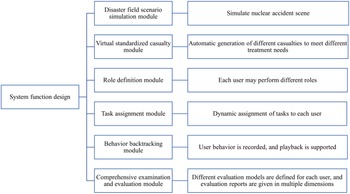
The module level was mainly the system function design, mainly including the disaster field scenario simulation module, virtual standardized casualty module, role definition module, task assignment module, behavior backtracking module, comprehensive examination and evaluation module (Figure 2). The disaster field scenario simulation module provided multiple scenarios to select. Each scenario was created based on real-world real data, and each scenario simulated the entire process of a nuclear accident. The virtual standardized casualty module was configured to generate virtual nuclear radiation casualties through system presets or background customization, while different case characteristics were shown according to different trainee operations. The role definition module enabled multiple trainees to simultaneously enter the system and chose their desired role (doctor or nurse). The behavior backtracking module recorded all behaviors of trainees in real time, recorded them in a third-person perspective, and uploaded them to the background server to facilitate trainees to review at any time. The comprehensive examination and evaluation module was used to determine whether the treatment process of the trainees was standardized, reasonable, and effective according to the roles and identities assumed by the trainees and feedback of the treatment effect of the wounded. The module also evaluated the trainees in a multidimensional manner by combining the mutual evaluation between the leader and the team members, whether the team members obeyed the commanders’ dispatch, and whether the commanders reasonably arranged the tasks. In this study, the VR system could perform the following training scenarios: wearing and taking off personal protective equipment; use of individual exposure dosimeter and measurement equipment; triage of the simulated exposure victims; and decontamination of the simulated exposure victims. Each training scenario contains approximately 30-50 sections.
Functional design of a VR-based nuclear radiation rescue training system.

Observation Parameters
The examination results, scores of the Instructional Materials Motivation Survey (IMMS) learning enthusiasm questionnaire, scores of the self-designed questionnaire, and scores of the satisfaction questionnaire of all trainees in the control group and experimental group after 6 mo of training were observed.
Examination Results
The total score of the examination was 100 points, which was divided into 2 parts: theoretical examination (50 points) and skill operation examination (50 points).
Learning Enthusiasm
The IMMS included 4 dimensions: attention, relevance, confidence, and satisfaction; it consisted of 36 statements with response options ranging from 1 (not true) to 5 (very true) and a total score of 180 points. Reference Cook, Beckman and Thomas10 A higher score indicates better learning enthusiasm.
Self-designed questionnaire on the learning effect: there were 5 questions: whether the training method was conducive to the understanding of the nuclear radiation rescue process, whether it was conducive to improving one’s operational skills, whether it was conducive to improving emergency response capabilities, whether it was conducive to developing teamwork, and whether it was conducive to developing clinical thinking skills.
Training Satisfaction
The satisfaction questionnaire was distributed with a full score of 100 points and scored by the trainees themselves.
Statistical Methods
The SPSS 23.0 software was used for statistical analysis. Measurement data are expressed as x ± s, and 2 independent sample t-tests were used; enumeration data are expressed as percentages, and the chi-square test was used. P < 0.05 was considered statistically significant.
Results
Comparison of Examination Results Between the 2 Groups
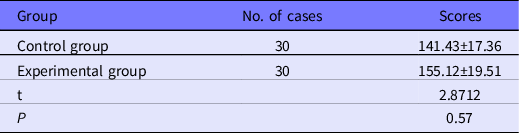
The trainees in the experimental group had significantly higher theoretical examination scores, skill operation examination scores, and total scores than those in the control group (P < 0.05), as shown in Table 1. The results show that the application of VR nuclear radiation emergency medical rescue teaching and training systems can improve the examination scores of trainees.
Comparison of examination and evaluation results of the 2 groups

Comparison of Learning Enthusiasm Between the 2 Groups
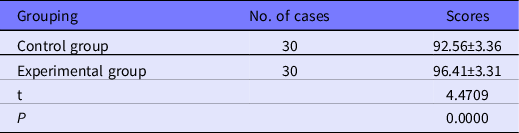
The experimental group had significantly higher total IMMS scores than the control group (P < 0.05), as shown in Table 2. The results show that the application of a VR nuclear radiation emergency medical rescue training system may improve the learning enthusiasm of trainees.
Comparison of IMMS questionnaire scores between the 2 groups

Comparison of the Training Effect Questionnaire Results Between the 2 Groups
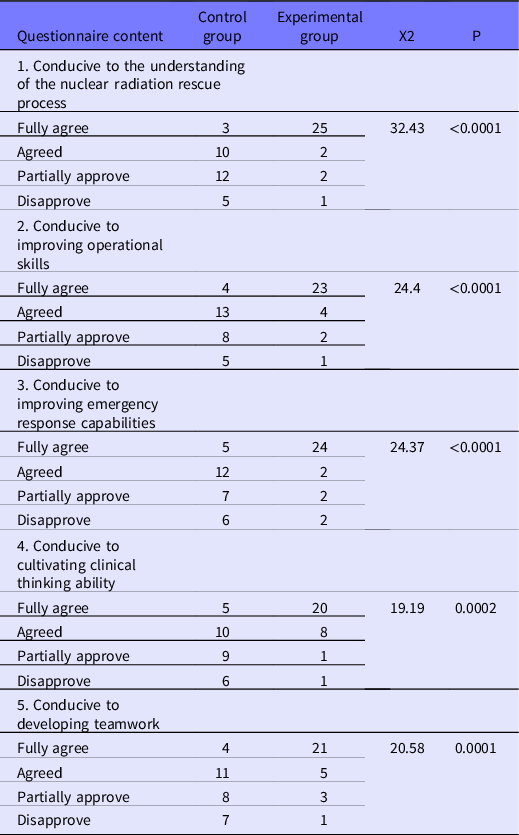
There were significant differences between the experimental group and the control group in 5 aspects: “conducive to the understanding of the nuclear radiation rescue process,” “conducive to improving operational skills,” “conducive to improving emergency response capabilities,” “conducive to cultivating clinical thinking ability,” and “conducive to developing teamwork” (P < 0.05), as shown in Table 3. The results show that the application of VR nuclear radiation emergency medical rescue teaching and training systems can improve the learning effect of trainees.
Comparison of learning effect questionnaire results between the 2 groups

Comparison of Training Satisfaction Between the 2 Groups
The trainees in the experimental group had significantly higher satisfaction scores than those in the control group (P < 0.05), as shown in Table 4. The results show that the application of VR nuclear radiation emergency medical rescue teaching and training systems can improve the training satisfaction of the trainees.
Training satisfaction of the 2 groups

Discussion
When a nuclear and radiation emergency occurs, on-site rescue mainly includes: searching for casualties; preliminary classification (including injury detection and identification); timely rescue of life-threatening casualties; ensuring that patients with overirradiation and/or radionuclide body surface contamination, wound contamination, and internal radionuclide intake receive timely and effective disposal; collecting relevant information to analyze the medical consequences of a nuclear accident; assessing the medical consequences of a nuclear accident and medical disposal capabilities of the site; providing timely recommendations to the site emergency command; reporting to the medical emergency command to reduce the medical consequences of the nuclear accident to a minimum; establishing a temporary rescue and disposal station on site, classifying and transferring the injured; collecting the necessary samples, providing relevant information for subsequent diagnosis and treatment. Reference Fu, Yuan and Liu4,Reference Qin, Li and Tan11–Reference Tsujiguchi, Kitajima and Tomisawa14 The traditional training mode of nuclear and radiation emergency first aid is mainly knowledge training and emergency drill.
However, due to the suddenness, diversity, and complexity of nuclear and radiation emergencies, there are few actual combat opportunities. Despite that most hospitals in Japan have established a radiation training system, it usually focuses on the basic skills related to patient care, especially in middle-sized hospitals, and training on response to radiological events is usually insufficient, Reference Tsujiguchi, Ito and Sato15–Reference Horiuchi, Yamada and Kinoshita17 suggesting the development of new training modes is required. The implementation plan to accelerate the modernization of education (2018-2022) issued by the state council of China noted the need to promote the development of education informatization in China by constructing and developing national virtual simulation experimental teaching projects. Reference Song, Jin and Tang18
Because of its unique interactivity, immersion, and conceptual characteristics, VR technology is increasingly used in medical fields, such as surgical skills training, human anatomy simulation, and telemedicine services. Reference Moro, Stromberga and Raikos19 In VR operation, the trainees interact with virtual objects and virtual characters through the controller to gain the feeling of “immersion,” which is more suitable for the teaching and training of nuclear radiation emergency medical rescue. In VR scenes, the visual scene where the radioactive dust falls to the ground during nuclear explosion and forms a radioactive contamination area can be constructed, or fluorescence can simulate the distribution of radioactive contamination in the body of the wounded under different bunkers and different protective measures, which can guide the rescue team to better master the wounded classification and retrieval method and improve their own protection awareness when performing the rescue task. Reference Guo, Yang and Yu20
The author’s unit is the formation unit of the national emergency medical rescue team and the first batch of nuclear radiation emergency medical rescue bases established by the state. In response to the attack of nuclear terrorism and occurrence of emergencies such as radiation accidents in the application of nuclear technology, the unit must undertake the tasks of emergency treatment and disposal, radiation monitoring and protection, public awareness, technical training, and applied scientific research in health emergencies. In this study, VR technology is introduced to perform training on nuclear radiation-related skills, knowledge, and emergency rescue considering the difficulties in teaching and training nuclear radiation emergencies. The results show that virtual reality technology can improve the performance, learning enthusiasm, teamwork ability, emergency treatment ability, and training satisfaction of trainees, which is consistent with the research results of other scholars. Reference Vidal, Ohaeri and John21–Reference Kalisch, Aebersold and McLaughlin24
VR technology provides various nuclear and radiation emergency training scenarios so that trainees can be completely immersed in 3-dimensional or holographic virtual scenes; experience different nuclear and radiation emergencies; feel the occurrence and distribution characteristics of nuclear radiation casualties to exercise; improve their on-site rescue and mental capacity; learn to observe, analyze, judge, make decisions, and respond in a complex nuclear radiation environment; and improve personal and teamwork and other comprehensive abilities. VR technology has the characteristics of repeatability and standardization. The various equipment of a nuclear radiation emergency platform scene is mainly obtained through computer simulation without consuming real materials, and the resources can be repeatedly used, which satisfies the requirements of repeated operation, and effectively reduces the traditional training cost. Reference Wang, Peng and Dong25 In addition, the virtualization of experimental equipment and experimental phenomena avoids the safety problems caused by improper operation. In VR simulation, teachers can perform differentiated teaching, guide trainees to solve specific problems, provide effective feedback on each interaction or step of trainees, and improve the learning efficiency of trainees. The VR system has very good plasticity, although different scene modeling, wounded modeling, and scenario design, VR modality could be extended to other disaster scenarios, both in the field and in the hospital. This could certainly include explosive, chemical, and active shooter incidents.
There are several limitations in the current study. First, we only involved prehospital nuclear radiation medical rescue training of personal safety, radiation detection, triage and decontamination. However, as such training has just started in our hospital, many items, such as wound management, pollution personnel to promote discharge, and first aid for critical cases, have not been carried out in the VR system, and need to be studied and improved continuously. Second, as the volunteers involve only OR nurses in the training, population bias may exist; a radiation emergency medical rescue team including doctors, nurses, radiologic technologists, and other field staff, would be involved in the training in the future. Third, there may be bias because of the nonrandomized design nature and the small sample size of this study, for example, data collection could not be uniform and could influence the outcomes. A randomized study and an increase in the number of candidates may be further needed to confirm the benefits of the VR training method. In addition, despite that we try to ensure that the instructors are familiar with all the training content before the training and that they maintain high enthusiasm in teaching both groups, instructor-instilled bias may still exist.
Conclusions
With the rapid development of science and technology, VR technology will continue to mature and gradually become popularized in various educational fields. VR technology shows good training results in nuclear radiation emergency medical rescue, which can improve the training performance of trainees and increase learning enthusiasm and satisfaction. Therefore, considering nuclear radiation emergency medical rescue training, it is necessary to broaden the horizon, change the concept, strengthen the attention to VR technology, and construct a brand-new ecological environment for teaching and learning. We believe that, through VR technology, a medical team of emergency rescue who can immediately perform rescue in the face of sudden nuclear radiation accidents, their respective duties, and calmly respond can stand out.
Author Contributions
X.Z. and X.L. were responsible for the conception and design of the study. X.Z. and X.L. prepared the first draft of the manuscript. X.Z. did the analysis of the results. X.Z. and X.L. approved the final manuscript.
Funding statement
This study was financially supported by “Scientific research fund of Education Department of Liaoning Province (FWZR2020008), China”.
Conflicts of interests
The authors declare that they have no conflict of interests.