Introduction
There is much debate in the literature regarding what constitutes “value” in healthcare and how to measure it (Reference Garrison, Pauly, Willke and Neumann1–Reference Carter, Vogan and Haji Ali Afzali6). The value of a medicine or health technology can be described as a multidimensional concept which incorporates utility (the health and well-being benefits to an individual and/or society) as well as the costs (Reference Neumann, Willke and Garrison7). The assessment of value of a healthcare intervention can be impacted by the level of importance placed on particular attributes of the intervention (Reference Garrison, Pauly, Willke and Neumann1;Reference Neumann, Willke and Garrison7).
Health Technology Assessment (HTA) is the systematic process of synthesizing evidence to assess the value of a medicine or health technology (Reference Karnon, Edney and Afzali8). The value assessment includes an evaluation of the safety, efficacy, effectiveness, and cost-effectiveness of a technology as well as wider health system and societal impacts, compared with currently available therapies using a predefined framework to ensure transparency and accountability (9–11). The purpose of HTA is to inform policy and funding decisions in healthcare, including how to best allocate taxpayer funds. From the health economic perspective, value is typically measured using cost-effectiveness analysis (CEA) or cost-utility analysis (CUA) (Reference Garrison, Pauly, Willke and Neumann1). The cost-effectiveness of a new medicine is determined by the incremental cost-effectiveness ratio (ICER), an estimate of the relative benefits and costs of a new medicine over currently available treatment options (Reference Pearson12). In a CUA, benefits are measured from the perspective of the health system using the Quality-Adjusted Life Year (QALY). Frameworks for assessing value using just the QALY have been criticized for not incorporating other aspects of value (Reference Lakdawalla, Doshi, Garrison, Phelps, Basu and Danzon2). Appropriate selection and use of antimicrobial drugs to minimize future resistance has a public health value that is challenging to quantify. While modeling methods generally enable accurate predictions of costs and benefits over a time horizon for most drugs, the utility of models to estimate the impact of a new antibiotic (beyond the resolution of the infection) is low, due to the high degree of uncertainty around future antimicrobial resistance (AMR) and the complexity of modeing required.
With increasing AMR, there is global concern about the lack of new antimicrobials currently in clinical development to meet the increasing needs (13;Reference Schaffer, West, Towse, Henshall, Mestre-Ferrandiz and Masterton14). Nonantimicrobial drugs (e.g., oncology drugs) are much more profitable for manufacturers as they are valued more highly by funders. To incentivize companies to invest in developing new antibiotics, alternative methods of assessing their value have been proposed (Reference Schaffer, West, Towse, Henshall, Mestre-Ferrandiz and Masterton14;Reference Rothery, Woods, Schmitt, Claxton, Palmer and Sculpher15).
Although antimicrobials have attributes that make them unique compared with other classes of medicine, they are currently evaluated using the same methodological framework to assess their cost-effectiveness and value to society. A review of HTA reports for the 10 years to June 2016 in 11 countries (the 10 largest European Union economies plus Norway) found that in some evaluation reports additional values such as “insurance value” were mentioned but not explicitly included in recommendations (Reference Colson16).
Restricting the use of broad-spectrum antimicrobials is an essential strategy of antimicrobial stewardship, so as to limit the spread and rise of AMR (17;Reference Collignon18). Future resistance to antibiotics is unpredictable, and many factors impacting future resistance are not only related to the drug itself but also attributable to other factors such as suboptimal infection control practices. However, there are factors that are intrinsic to the drug, such as the spectrum of activity, which may impact future resistance.
A notable difference between antibiotics and other medicines is that the usage of an antibiotic in one patient potentially has an impact on the future efficacy of that drug in that patient, as well as in other patients to whom resistant bacteria have been transferred. As resistance genes can be transferred between different bacteria the effectiveness, and consequently the cost-effectiveness, of one or more antibiotics can change depending on usage. In addition, any “real-world” factors influencing the usage of a particular drug (e.g., regulatory policy, funding decisions, and shortages of other drugs) can impact future resistance rates, and, as a consequence, therapeutic effectiveness and patient outcomes. Economic evaluation is therefore challenging with antibiotics, as resistance rates (and efficacy of the treatment in future patients) will vary over time for the medicine under evaluation, as well as for the comparator. These “real-world” factors, which impact resistance rates and patient outcomes, should be included in the CEA, but, with wide margins of error, these estimates of future resistance are largely speculative.
In Australia, funding decisions for medicines occur both at the federal and state levels. The Pharmaceutical Benefits Advisory Committee (PBAC) evaluates medicines for federal funding via the Pharmaceutical Benefits Scheme (PBS), whereas decisions regarding the funding of medicines for public hospital inpatients in Australia are largely controlled by state-wide formulary committees or hospital drug and therapeutics committees.
Value-based pricing for antibiotics is being considered in the UK, though regulatory bodies are grappling with how to measure “value” (Reference Verhoef and Morris19). Many factors other than QALYs have been identified as important considerations when assessing value, including the burden of disease and wider social impacts (Reference Paulden20). For any medicine that is publicly funded, there needs to be agreement between governments and manufacturers about how much will be paid for that medicine. While manufacturers require adequate reimbursement for investment into a new medicine, the cost of new medicines must be affordable for governments and patients.
As part of a research project investigating alternative methods for regulating and funding antimicrobial drugs, this qualitative study was designed to elicit and analyze the perspectives of policy-makers and pharmaceutical industry representatives regarding how antimicrobials are assessed for value for the purposes of reimbursement. The study explored stakeholder perceptions of how the framework for HTA in Australia accommodates the unique attributes of antimicrobials in cost-effectiveness analyses.
Methods
Design and Setting
A qualitative approach using in-depth semi-structured interviews was chosen to explore nuances within and between the personal opinions of stakeholder participants (Reference Gibson and Brown21). Interviews followed an interview guide which was based upon a search of published and gray literature. MEDLINE and EconLit databases were searched for published health policy or economic studies investigating alternative business models for antibiotics; HTA agency websites were searched for public summary documents for antimicrobial drugs; and government websites were searched for policies or other documents referring to medicines regulation, reimbursement, and supply chain management. Open-ended questions allowed interviewees to determine the nature of their responses, and the interviewer to probe or seek clarification (Supplementary Material). Interviews were conducted by the first author, either face-to-face, or via phone or video conference.
Recruitment of Participants
Pharmaceutical industry representatives and regulatory or funding decision-makers at a federal or state level were recruited, initially by purposive sampling to select key stakeholders, with additional participants recruited by snowball sampling (Reference Ritchie, Lewis, McNaughton Nicholls and Ormston22;Reference Palinkas, Horwitz, Green, Wisdom, Duan and Hoagwood23). Senior employees working in managerial or policy roles within pharmaceutical industries currently developing or marketing antimicrobials in Australia, as well as medical managers and market-entry specialists, were included. Policy-makers included state government employees involved with formulary funding decisions at a state-wide level, federal government policy-makers, members or ex-members of the national PBAC, or Therapeutic Goods Administration (TGA) advisory committees. Recruitment continued until thematic saturation was achieved; that is, until no new codes or themes pertaining to the study objectives were identified within the final interviews (Reference Mason24;Reference Saunders, Sim, Kingstone, Baker, Waterfield and Bartlam25).
Analysis
Interviews were transcribed verbatim (with speech idiosyncrasies such as “you know” removed for ease of reading), coded, and thematically analyzed using NVivo® software (version 12, QSR International Pty Ltd) in accordance with a qualitative framework method (Reference Saldana26). At the point of transcription, all names were replaced with a study number to de-identify the participant and their workplace or associated role. Transcripts were then read and re-read to allow familiarization with the data and an initial coding framework developed. Data collection and analysis were conducted simultaneously, with deductive (predefined) as well as inductive coding, with new codes introduced when required. Initial codes were merged into more focussed codes on agreement between three authors (NTH, TLM, and JE), which were then refined into emergent themes. Once themes and codes were agreed, all authors were involved in discussion around the data interpretation. Participants were consulted via email to clarify uncertainties in the analysis of individual transcripts.
Ethical Considerations
This study was approved by the University of Adelaide Human Research Ethics Committee (H-2018-136). Written information on the purpose and method of the study was provided to participants prior to the interviews, and informed consent was obtained.
Results
Participants
Eighteen participants (nine pharmaceutical industry representatives and nine policy-makers) were interviewed between July and December 2018. The industry stakeholders were individuals in senior roles, including medical managers/directors (n = 2), chief development/commercial officers (n = 2), manager/director of regulatory policy (n = 2), a CEO, a national sales manager, and a market access analyst. Policy-makers included state government employees (n = 3), federal government employees (n = 2), members or ex-members of the PBAC (n = 3), and a member of a TGA advisory committee. Individuals representing state governments were directly involved with formulary funding decisions at the state-wide level. All other policy-makers were involved in regulatory or funding decisions at a federal level. Interviews lasted between 22 and 60 min.
Themes
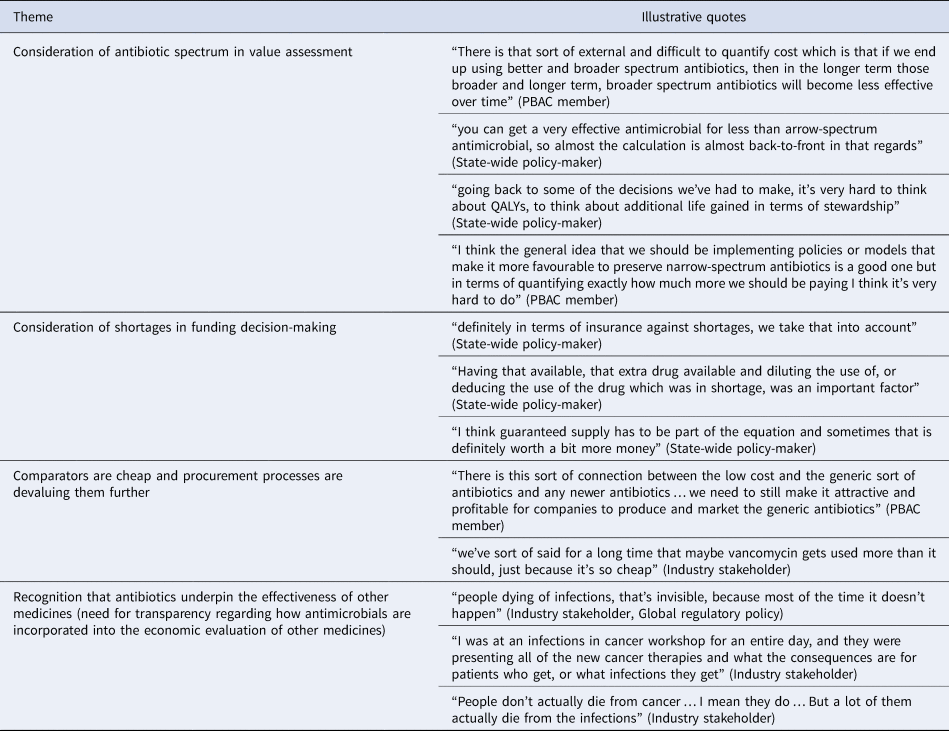
A dominant theme pertained to the method of reimbursement and the feasibility of de-linking payment from sales volumes, and this is discussed elsewhere (Reference Hillock, Merlin, Karnon, Turnidge and Eliott27). Four key themes were derived from the analysis regarding the value assessment or cost-effectiveness evaluation of antimicrobials (see Table 1).
Illustrative quotations for identified themes

Theme 1: Consideration of Antibiotic Spectrum in Value Assessment
Stakeholders agreed that current cost-effectiveness approaches to assessing value of antimicrobials preclude consideration of relevant factors impacting future resistance, in particular, spectrum of activity. Policy-makers in funding decision-making roles were open to the idea of incorporating other stewardship factors into the value assessment of antimicrobials, for example, stating “I would be willing to find a way of incorporating some of these other things into it which may not be captured by cost per QALY.”
To illustrate difficulties in considering comparative spectrum of activity in funding decisions, several stakeholders raised the example of intravenous amoxicillin–clavulanate (IV amoxiclav). IV amoxiclav has been available in many countries since the 1980s, but in Australia, only the oral dosage form was marketed until 2017 when a generic brand was launched. Another broad-spectrum penicillin, piperacillin–tazobactam (piptaz) is the most commonly used IV penicillin/β-lactamase inhibitor in Australian hospitals (28). The antimicrobial spectrum for both drugs is similar, but piptaz is active against additional pathogens, most notably Pseudomonas aeruginosa (29). Global patents on both the drugs have long expired and they are relatively cheap globally; however, IV amoxiclav is significantly more expensive than piptaz in Australia (AUD $28–29/day compared with AUD $12–16 based on usual daily doses in adults).
We were looking at the marginal costs, marginal additional costs of IV Augmentin (amoxiclav) vs IV piptaz, and then the data to show you saved resistant cases is non-existent, so then it becomes a conceptual discussion about is spending $500,000 more or spending a million dollars more to have a narrow-spectrum drug, is that cost effective?
Decision-makers rely on CEA to make decisions about future costs and benefits of funding a new drug, yet because the ICER does not capture the impact of the antibiotic spectrum on future resistance rates, it is difficult to incorporate into funding decisions:
That's where we really got stuck with, with IV Augmentin. We knocked it back a few times and that was just because members couldn't quite understand why we would need to pay so much more for something that we already have an option for. And they understand antimicrobial resistance … you can't say that it's going to give x-patient you know, 3 months more life, and that's how they always think about in terms of cost effectiveness.
Policy-makers expressed difficulty in conceptualizing the opportunity cost of paying more for a narrower spectrum:
When trying to have the members of our various panels think about it, we put it in terms of the cost of an additional, the opportunity cost for an additional ID (Infectious Diseases) Physician, or how much it might cost for a resistant Pseudomonas case but it's all still very guestimate kind of discussions.
Despite general consensus among policy-makers that there is additional “value” in using the narrowest spectrum possible to treat an infection, one policy-maker felt it might be futile to pay extra for narrow spectrum unless other countries do as well:
Global responsibility, even if we pay a premium for narrower spectrum, if other countries don't take steps to limit resistance, the extra money we pay for narrower spectrum is not worth it. So it may be that we pay a higher price for narrow-spectrum antibiotics and we restrict the use of the broader spectrum antibiotics but we still pay the price of worsening antimicrobial resistance.
Without an economic incentive to develop narrow-spectrum antimicrobials, manufacturers may only focus on broad-spectrum agents. Developing broader-spectrum drugs potentially reduces economic risk for companies due to more potential indications for the drug in the future. In contrast, a narrow-spectrum drug may only have a single indication, often with a relatively low incidence. Some policy-makers felt it would be difficult to financially reward companies for developing narrow-spectrum agents, “I think there will be some merit in that perhaps but yeah, it will be a difficult one.” Fidaxomicin was raised as an example of a narrow-spectrum drug with a single indication (treatment of Clostridium difficile) that was considered too expensive compared with currently available broader-spectrum options:
The best example of that is fidaxomicin with C diff? So in theory, the most narrow-spectrum antibiotic ever because it only treats one condition and is a cure but when they brought it in it was $2,000.
Decision-makers found it challenging to consider the impact of the spectrum of activity on future resistance compared with other factors that may impact resistance (Table 1). Participants frequently referred to modeling to estimate future economic burden, but when asked to elaborate, most recognized that the substantial uncertainties associated with future resistance would result in very wide margins of error. One participant involved with hospital formulary funding decisions at a state-wide level expressed the dilemma for decision-makers:
I think some of our decision-makers may be a bit disheartened, if that's the right word, about what impact they can actually make in some of these, their decisions in some of these areas. I think a lot of the time it seems like it's out of their control and even if they do make these small changes, the impact is going to be so small, is it worth considering?
Theme 2: Consideration of Shortages in Funding (Formulary) Decision-Making
Participants agreed that shortages negatively impact clinical and economic outcomes, particularly when there is a need to initiate antimicrobial treatment immediately. Assurance of access was considered valuable, “I think guaranteed supply has to be part of the equation and sometimes that is definitely worth a bit more money.” The risk of shortages was incorporated into funding decision-making at the state level, “definitely in terms of insurance against shortages, we take that into account.”
Industry stakeholders attributed shortages to low prices paid by government:
Shortages occur due to market conditions and policies that deflate the price of generic medicines below reasonable levels. If price falls below the break-even point, the most efficient manufacturer may have to exit the market, leading to a loss in supply.
Shortages can directly impact the clinical outcome of an individual, but can lead to the use of broader-spectrum alternatives, which may impact future resistance rates and future antibiotic effectiveness in other patients: “if we make those antibiotics too cheap … the price we pay is that they are no longer available and people will inevitably get pushed to using broader-spectrum antibiotics, yeah.”
Policy-makers argued that increasing prices paid on the PBS would increase the reliability of supply: “a lot of [antimicrobials] are covered on the PBS anyway, and that's where we may want to be paying a bit more, to make it profitable for companies to continue to produce them.” They recognized, however, that at a hospital level, under the fixed-budget model for procurement, there is little capacity to pay more for antibiotics, and tendering drives antibiotic prices down further, “it's a race to the bottom to win a tender.”
Theme 3: Comparators Are Cheap and Procurement Processes Devalue them Further
Because most currently used antibiotics are cheap, it is impossible for companies to develop new drugs that are cost-effective in comparison, for infections that are not yet resistant to current options. Comparator drugs are, in most cases, generics and often very cheap, so that even if they are the inferior choice of treatment for a patient from a stewardship perspective, they may be used due to tight budget constraints on hospitals: “Ceftriaxone IV costs $1 a vial. So they use ceftriaxone all the time.” This quote illustrates that the comparator drug may be very cheap, and while often equally effective at resolving an infection, may be less appropriate than narrower-spectrum drugs that are more expensive in Australia, such as benzylpenicillin.
Some participants referred to the PBS price-reduction policy to illustrate the declining prices of generic antimicrobials:
So the price crashes down. There is actually no mechanism for the price ever to go up. And the reality of life is all costs go up over time, all costs. Petrol cost, freight costs, in-put costs, raw material costs.
Theme 4: Need for Transparency about How Antimicrobials Are Incorporated into the Economic Evaluation of Other Medicines
Stakeholders agreed that effective antimicrobials are essential in many therapeutic areas where the disease or treatment reduces that patient's natural immune defences. As one participant framed it, “it underpins like some of the more profitable therapeutic areas.”
Multiple participants cited the price of oncology drugs to illustrate the price gap between antibiotics and more lucrative medicines. There was general agreement that governments are willing to pay higher prices for oncology drugs, particularly where there is an unmet need. There was disagreement, however, that companies specializing in oncology or other immunosuppressive drugs should subsidize antibiotic development despite acknowledgement that patients on immunosuppressive drugs were more likely to require antibiotics. One industry participant stated, “I don't really think that would be palatable … I don't think we should be necessarily forcing companies to invest where they don't want to invest.”
A state government participant understood that the PBAC incorporates adverse effects and co-therapy into their economic evaluation of oncology drugs, but was unclear whether concurrent or consequential antimicrobial treatment was similarly accounted for:
I don't think that it's transparent and it's not explicit in what they are taking into consideration. I think it has to be a part of the full conversation about cost-effectiveness and whilst I'm pretty sure that it is, it will be nice to make it more clear, so that the allocation of money or the savings be attributed to where it needs to go.
Discussion
This study provides an insight into the complexities involved with placing a monetary value on antimicrobial drugs. Participants agreed there was a notable disparity between prices paid for new antibiotics compared with other new drugs such as oncology drugs, and acknowledged this is the reason many companies have abandoned research and development of antimicrobials. Most participants, particularly those from pharmaceutical companies, expressed the view that the price should be higher to reflect additional public health benefits, such as in the value ascribed to vaccines. This view is in accordance with other authors who have suggested that current value assessment frameworks utilized by HTA agencies globally “may not capture the broader public health benefits of antibiotics, including the value of tackling AMR” (Reference Schaffer, West, Towse, Henshall, Mestre-Ferrandiz and Masterton14). However, although the unique properties of antimicrobials lend weight to their argument that the HTA methodology for reimbursement should have a specific framework for antimicrobials, the negative impacts of introducing even broader-acting, new antimicrobials into clinical practice have not been addressed (Reference Schaffer, West, Towse, Henshall, Mestre-Ferrandiz and Masterton14).
The spectrum of activity and how to incorporate it in the value assessment of antimicrobials was a dominant theme in this study. Overuse of broad-spectrum drugs can cause harm with regard to the impact on resistance rates in the population, and in general, participants agreed that it is difficult to incorporate stewardship toward narrower-spectrum drugs in funding decisions because the future impact on resistance is difficult to quantify. Ideally, an estimate of the current economic burden of AMR and an extrapolation of the burden in the future would be informative to decision-makers. Understanding the relationship between human, animal, and environmental use of antimicrobials is limited by a lack of available, meaningful data. In addition, the AMR burden of an individual country is not independent of the burden in other countries (and the policies and consumption rate of antimicrobials in those countries).
While broader deliberative processes in HTA frequently consider less-readily quantifiable factors to inform funding decision-making (for example, public health issues), the methods for considering the development of pathogen resistance (to either the new drug, the comparator drug(s), or to multiple drugs in clinical practice) are not explicit (11). The current frameworks for value assessment of new antibacterials do not reward narrow-spectrum agents; rather, there is greater incentive for manufacturers to develop and market broader-spectrum agents with more potential future indications. This is not to argue that broad-spectrum drugs are not valuable per se. The “value” of the antibiotic spectrum for an individual agent is correlated with certainty of the diagnosis; for example, for empirical treatment where the causative organism has not been confirmed, a broader-spectrum drug is more likely to have activity against the pathogen. However, once a pathogen has been identified, a narrower-spectrum agent targeting that pathogen would have less impact on other commensal organisms, carry less risk of AMR, and therefore would have more societal value. Future research into modeling methods to capture the impact of spectrum on resistance could potentially involve the integration of a nonfixed antimicrobial spectrum variable. Nonetheless, public hospitals in Australia operate under a fixed-budget procurement model, and this may constrain their capacity to pay more for narrow-spectrum antibiotics even if the beneficial impact on future resistance could be proven.
Shortages of antimicrobials was another prominent theme in this study with many participants attributing the problem to insufficient reimbursement. Participants representing state-wide decision-makers felt that assurance of supply was “valuable” and suggested a willingness to pay more to avoid shortages (see Table 1). Patient outcomes with antimicrobial treatment are impacted by the expeditiousness of treatment initiation, and delays in accessing the appropriate antimicrobial can be detrimental to the patient or result in substitution with an inappropriate agent. A number of studies have highlighted the clinical and economic impacts of antimicrobial shortages (Reference Phuong, Penm, Chaar, Oldfield and Moles30). Shortages can result in the use of more toxic antimicrobials, broader-spectrum antimicrobials, longer hospitalizations, and long-term morbidity from inadequate treatment of infections, in addition to the opportunity cost of pharmacy clinical services when pharmacists spend significant time procuring alternative, and often less optimal, treatment to replace an antimicrobial that is unavailable (31). How assurance of supply is incorporated into the accepted price hospitals are willing to pay is unclear; however, policy-makers in this study emphasized that shortages contribute to the inappropriate use of broader-spectrum drugs which may adversely affect resistance rates.
Limitations
Our sample of policy-makers included funding decision-makers at Australian federal and state levels; however, only two states were represented. Attempts were made to recruit participants from the other two states that currently have a state-wide formulary process, without success. States that do not have a state-wide drug formulary process were not represented. This study was limited to Australian stakeholders; therefore, only pharmaceutical companies with an interest in the Australian antimicrobial marketplace were included.
Conclusions
These study results illustrate that the current framework for value assessment is considered insufficient to fully inform funding decisions for antimicrobials, as contemporary methods for the analysis of cost-effectiveness fail to explicitly incorporate the attributes of antimicrobials that contribute to future resistance. Future resistance is difficult to predict leading to significant uncertainty in economic evaluations; however, there is a need for a systematic method to illustrate to decision-makers the costs avoided due to good stewardship through the funding of narrow-spectrum antibiotics (and the consequent reduced risk of resistance).
Currently, there is no financial incentive for companies to develop narrow-spectrum drugs that are less likely to drive resistance, so companies are likely to focus on developing broad-spectrum agents with wider potential use, thereby exacerbating the burden of resistance long term. Future research could explore the incorporation of spectrum of activity into cost-effectiveness evaluation, which would provide a weighting in favor of a drug less likely to cause resistance over one that is more likely to do so. Initial steps to establish a “spectrum-index” based on the spectrum of activity against clinically relevant pathogens have been developed (Reference Gerber, Hersh, Kronman, Newland, Ross and Metjian32), but currently there is no internationally agreed “measure of spectrum.”
The “value” of a drug is essentially the amount the market will bear to pay and therefore it is in the interest of industry to advocate for other measures of value in addition to QALYs. Higher prices alone are not a sustainable solution; with the current sales-based model of funding (where the profit for the manufacturer is proportional to sales), higher prices may further incentivize pharmaceutical companies into promoting inappropriate sales. Different mechanisms of reimbursement of antimicrobials are being explored globally such as market-entry lump sum payments delinked from sales (Reference Ardal, Findlay, DSavic, Carmeli, Gyssens and Laxminarayan33–Reference Outterson35). The feasibility of delinking reimbursement from sales in the Australian healthcare system, also part of this research, is discussed elsewhere (Reference Hillock, Merlin, Karnon, Turnidge and Eliott27).
In Australia, the HTA framework for federally funded antimicrobials (via the PBS) explicitly considers AMR; however, it is not clear how the risks or implications of this are considered (11). Most new antibiotics are destined for use in the hospital setting where the processes for medicine evaluation are less rigorous and lack a structured HTA framework. Although many factors limit the ability to accurately predict or model future resistance, methods to include the impact of antimicrobial spectrum of activity into deliberative HTA frameworks should be explored. Finally, HTA frameworks globally should include transparent and explicit guidance on how the risks and treatment of multidrug-resistant infections consequent to immunosuppressive treatments are incorporated into the economic evaluation of those immunosuppressant agents.
Supplementary material
The supplementary material for this article can be found at https://doi.org/10.1017/S0266462320000823.
Acknowledgments
The authors wish to acknowledge and thank all participants who generously gave their time to take part in this research.
Funding
NTH is supported by an Australian Government Research Training Program Scholarship awarded by the University of Adelaide.
Conflict of Interest
TLM performs commissioned assessments of medicines for the Pharmaceutical Benefits Advisory Committee on behalf of the Australian Government Department of Health. JK is a member of the economic subcommittee of the PBAC.