Antibiotic-resistant bacteria are an urgent public health problem today. Inappropriate use of antibiotics is an important modifiable cause for antibiotic resistance, Clostridium difficile infections, and adverse drug events.Reference Llor and Bjerrum 1 While antibiotic stewardship programs (ASPs) largely focus on hospitalized patients, most antibiotics are prescribed in the outpatient setting.Reference Llor and Bjerrum 1
Strategies to improve outpatient antibiotic prescribing are needed to impede antibiotic-resistant bacteria. The Centers for Disease Control and Prevention (CDC) and the Infectious Disease Society of America (IDSA) have set forth treatment guidelines for outpatients. Most inappropriate antibiotic prescribing occurs for acute upper respiratory tract infections (URIs), but drivers of inappropriate antibiotic prescribing are not well documented in the literature.Reference Shapiro, Hicks, Pavia and Hersh 2
We performed a retrospective review of outpatients with 5 common infections. The objective of this study was to describe the frequency of guideline-discordant antibiotic prescribing and to identify risk factors for this prescribing behavior.
METHODS
Study Design
We conducted a single-center retrospective cohort study at the Iowa City VA Health Care System (IC-VAHCS), which includes a tertiary-care medical center (VAMC) and 10 community-based outpatient clinics (CBOCs) in eastern Iowa, northeastern Missouri, and northwestern Illinois. The primary intent of this quality improvement project was to assess the need for ASP services in the outpatient setting across the IC-VAHCS. The University of Iowa Institutional Review Board determined that this project did not constitute human subjects research. Patients with an outpatient medical encounter coded with an International Classification of Diseases, Ninth Revision (ICD-9) code for cystitis, pharyngitis, and sinusitis from July 1, 2014, to June 30, 2015, were eligible for the study. Each patient was included only once per diagnostic cohort. CBOCs, emergency departments (EDs), and VAMC primary care and specialty clinics were included.
Patients were excluded if they received active immunosuppressive therapy (eg, chemotherapy, methotrexate, tacrolimus), were diagnosed with an immunosuppressive condition (eg, HIV/AIDS), presented with a complicated infection (eg, concomitant infection, pyelonephritis), were admitted to an inpatient healthcare facility, had antibiotic treatment initiated by a provider outside of the IC VAHCS, or had insufficient chart documentation.
We aimed to include up to 100 patient cases per diagnostic cohort. Once this goal was met, chart review was discontinued. For cohorts not reaching the goal, all available charts were reviewed. Patient presentation information and laboratory and microbiology data were reviewed by a pharmacist (H.M., PharmD) to determine whether the patient’s presentation reflected the IDSA and CDC diagnostic definitions (see Supplemental Material) and the associated ICD-9 code. Patients identified by the pharmacist to not meet diagnostic criteria were reviewed by the infectious disease physician involved with the project (D.J.L.) and were reclassified to the appropriate diagnosis. Diagnostic cohorts for asymptomatic bacteriuria (ASB) and nonspecific URIs were added based on the reclassification of inaccurate diagnoses. Patients were excluded if they did not match 1 of the 5 diagnostic cohorts listed above.
Guideline concordance was defined as accurate antibiotic selection, dose, and duration based on published guidelines from the IDSA and Get Smart Campaign (see Supplemental Material). Guideline discordance was defined as incorrect antibiotic selection, dose, or duration or as the prescription of an antibiotic when no antibiotic was indicated. All guidelines were easily accessible to healthcare providers during the study period.
Guideline concordance and discordance were verified by a pharmacist using the aforementioned guidelines. In cases in which an antibiotic was indicated according to guidelines, the assessment for guideline concordance initially evaluated the selection of the drug, then the dose, and finally the duration of therapy.
Statistical Analysis
Descriptive statistics were used to characterize the frequency of guideline-concordant antibiotic prescribing in our outpatient diagnostic cohorts. Patient, prescriber, and site factors associated with guideline-concordant antibiotic prescribing were determined by a multivariate logistic regression and were performed using Statistical Analysis System version 9.4 (SAS Institute, Cary, NC). Logistic regression findings were reported using odds ratios (ORs) and 95% confidence intervals (CI). Results with an OR<1 were associated with guideline-discordant therapy. In the multivariate analysis, all comorbidities were considered equivalent due to small sample sizes.
RESULTS
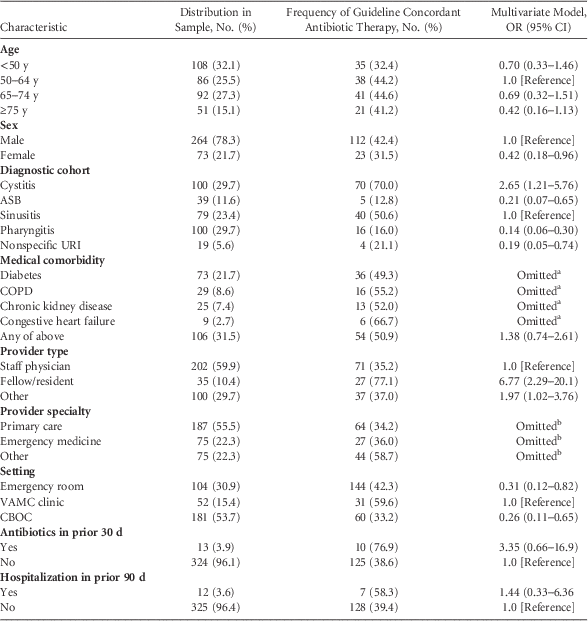
Among 1,039 cases eligible for chart review, 337 patients (32.4%) were included with a confirmed diagnosis for cystitis, ASB, pharyngitis, sinusitis, or nonspecific URI. The median age of included patients was 62 years, and 78.3% were male. The providers evaluating these patients were most commonly staff physicians (59.9%), physician assistants (PA) or nurse practitioners (NP) (29.7%), or physicians in training, residents, or fellows (10.4%). The most common sites of evaluation were CBOCs (53.7%), followed by EDs (30.9%) and VAMC clinics (15.4%) (Table 1).
Patient, Provider, and Facility Characteristics Associated With Guideline-Concordant Antibiotic Prescribing

NOTE. OR, odds ratio; CI, confidence interval; ASB, asymptomatic bacteriuria; URI, acute upper respiratory tract infection; COPD, chronic obstructive pulmonary disease; VAMC, Veterans Affairs Medical Center; CBOC, community-based outpatient clinic.
a Composite indicator used for regression analysis due to similar trends in individual comorbidities and no individual significance due to low power.
b Provider specialty was omitted from the multivariate analysis because it was collinear with both setting and with provider type.
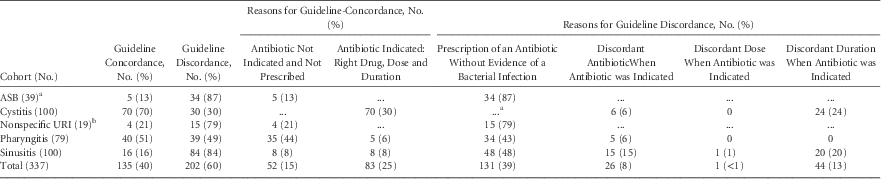
Overall, 202 patients (60%) received guideline-discordant antibiotic therapy. The most common reason for guideline discordance was prescribing an antibiotic when it was not indicated. Of 183 patients without an appropriate indication for an antibiotic, 131 patients (72%) still received treatment with an antibiotic. Of 154 patients with an appropriate indication, 153 (99%) received antibiotic therapy, but the selected therapy was guideline discordant in 71 patients (46%). When an antibiotic was indicated, reasons for guideline discordance included selecting an antibiotic not recommended by guidelines (n=26, 37%), prescribing the wrong antibiotic dose (n=1, 1%), and prescribing a duration of therapy not consistent with guideline recommendations (n=44, 62%). Duration of therapy was guideline discordant in 20 cases of sinusitis; all patients received a course that was too long (mean, 10.4 days). Among patients with cystitis, duration of therapy was guideline discordant in 33 cases. Furthermore, 15 men received courses that were too short (mean, 4.6 days), and 9 women with uncomplicated cystitis received courses that were too long (mean, 7.7 days). Further specifications of reasons for guideline discordance per infection type are presented in Table 2.
Frequency of and Reasons for Guideline-Discordant Antibiotic Prescribing

a All cases of ASB were patients who were incorrectly diagnosed with cystitis.
b All cases of nonspecific URIs were patients who were incorrectly diagnosed with pharyngitis or sinusitis.
The results of the multivariate logistic regression are shown in Table 1. Female gender (OR, 0.42; 95% CI, 0.18–0.96), treatment provided by staff physicians, and patients evaluated at a CBOC (OR, 0.26; 95% CI, 0.11–0.65) or the ED (OR, 0.31; 95% CI, 0.12–0.82) were all associated with higher rates of guideline-discordant treatment.
DISCUSSION
This quality improvement study revealed that guideline-discordant antibiotic prescribing in the outpatient setting was common. The overall rate of guideline discordance was 60%. Largely, guideline-discordant therapy was a result of prescribing antibiotics when an antibiotic was not indicated.
Our results are comparable to other studies evaluating appropriate antibiotic prescribing for URIs.Reference Schroeck, Ruh, Sellick, Ott, Mattappallil and Mergenhagen 3 , Reference Fleming-Dutra, Hersh and Shapiro 4 Schroek et alReference Schroeck, Ruh, Sellick, Ott, Mattappallil and Mergenhagen 3 evaluated antibiotic use for respiratory tract infections within a single VA healthcare system and found that 64.2% of patients received guideline-discordant therapy. In a nationwide CDC-sponsored study, Fleming-Dutra et al estimated half of antibiotic prescriptions for URIs in the outpatient setting from 2010 to 2011 in the United States may have been unnecessary. Sinusitis and pharyngitis are among the 3 most common diagnoses associated with antibiotic prescriptions.Reference Fleming-Dutra, Hersh and Shapiro 4 In contrast to our study, this survey did not validate the accuracy of the physician’s diagnosis and may have underestimated the frequency of overprescribing.
Diagnostic inaccuracy likely contributed to our rates of guideline-discordant therapy. In our study, all cases not meeting diagnostic criteria were reviewed by the infectious disease physician and were reclassified as appropriate. For example, all of the patients in the ASB cohort were identified through an ICD-9 code for cystitis, and all of the patients with nonspecific URIs were identified through an ICD-9 code for pharyngitis or sinusitis.Reference Schroeck, Ruh, Sellick, Ott, Mattappallil and Mergenhagen 3 Distinguishing between bacterial and viral etiologies can be difficult; however, diagnostic guidelines are available to help providers make this distinction.
We observed an association between physicians in training and guideline-concordant antibiotic prescribing. In our study, residents and fellows were approximately twice as likely to prescribe guideline-concordant therapy as staff physicians. A few prior studies have also evaluated the influence of physician-level experience on antibiotic prescribing patterns. Roumie et alReference Roumie, Halasa, Edwards, Zhu, Dittus and Griffin 5 also found that residents in hospital clinics prescribed antibiotics for respiratory diagnoses less often than staff physicians, NPs, and PAs. Likewise, Gonzales et alReference Gonzales, Camargo and MacKenzie 6 found that ED visits associated with physicians in training were less likely to be associated with antibiotic prescriptions. Cadieux et alReference Cadieux, Tamblyn, Dauphinee and Libman 7 concluded that inappropriate antibiotic prescribing increased with time in practice and practice volume. Decreased guideline concordance over time may be associated with a provider’s increasing submission to patient expectations and reduced focus on patient education to ease work load.Reference Butler, Rollnick and Pill 8 Over time, providers may also become less aware of guidelines, which tend to be updated frequently.
Our study revealed that patients presenting to the medical center’s clinic were more likely to receive guideline-concordant therapy compared to patients presenting to the ED, an outlying clinic, or a CBOC. Historically, ED providers have misused antibiotics more frequently than primary-care providers.Reference Gonzales, Camargo and MacKenzie 6 Ong et alReference Ong, Nakase, Moran, Karras, Kuehnert and Talan 9 postulated that ED prescribers may be more likely to overprescribe antibiotics due to the more severe clinical presentations of ED patients, questionable follow-up, and greater patient expectations. Nonetheless, this same study reported that patient satisfaction was related to better knowledge regarding their diagnosis, not receipt of an antibiotic.Reference Ong, Nakase, Moran, Karras, Kuehnert and Talan 9
Several explanations for the CBOCs having more frequent guideline-discordant prescribing are likely. In contrast to the VAMC clinics, the CBOCs did not benefit from close affiliation with the local medical school, the support of physicians-in-training, or the ready availability of diagnostic testing. In addition, providers at CBOCs may have erred on the side of overtreatment because patients who worsened in the absence of antibiotics could have a greater distance to travel for seeking care.
Our results indicate an opportunity to expand our antimicrobial stewardship in the outpatient setting. The greatest area for improvement across the IC-VAHCS is in not prescribing antibiotics when antibiotics are not warranted, and our program is currently exploring strategies for addressing this problem. Audit and feedback, communication training, point-of-care testing, decision support, delayed prescribing, and education for both providers and patients have all been studied as interventions to improve outpatient antibiotic use and have demonstrated varying degrees of success.Reference Drekonja, Filice and Greer 10
The strengths of this study include assessing the accuracy of the ICD-9–coded diagnosis and the guideline concordance of the overall prescription, including antibiotic, dose, and duration. Also, we collected provider and setting data that is not well defined in the literature. Specifically, separating physicians in training from staff physicians and separating locations (ie, VAMC, ED, and CBOC) were all unique features of this study.
This study has several limitations. First, it was completed at a single center with a population of mostly elderly white males. Our results may not be generalizable to other populations. Second, we did not assess additional factors that could have contributed to prescribing decisions, including distance from the nearest hospital and time of day. Third, because this study included a retrospective chart review, providers may have failed to sufficiently document symptoms that would have altered the appropriateness of diagnosis and prescribed antibiotic. Fourth, all departures from guidelines were treated equally. Finally, the rapid antigen detection test for the diagnoses of group A streptococcal pharyngitis was not available at all VA clinics. In the absence of this test, Centor criteria were utilized, which could have led to the overestimation of a bacterial etiology of pharyngitis.
In conclusion, despite national practice guidelines for the treatment of cystitis and URIs, most patients received guideline-discordant therapy. Our identification of provider and setting determinants of guideline-discordant prescribing will inform future outpatient stewardship interventions at our center.
ACKNOWLEDGMENTS
The views expressed in this article are those of the authors and do not necessarily reflect the position or policy of the Department of Veterans Affairs or the United States government.
Financial support: This material is the result of work supported with resources and the use of facilities at the Iowa City VA Health Care System and by the Health Services Research and Development Service, Department of Veterans Affairs (Dr Lund, CDA 10-017). No other financial support was provided relevant to this article.
Potential conflicts of interest: All authors report no conflicts of interest relevant to this article.
SUPPLEMENTARY MATERIALS
To view supplementary material for this article, please visit http://dx.doi.org/10.1017/ice.2017.59