Introduction
Seed dispersal by vertebrates plays a key role in tropical ecosystems (Howe and Smallwood, Reference Howe and Smallwood1982; Levin et al., Reference Levin, Muller-Landau, Nathan and Chave2003; Fleming and Kress, Reference Fleming and Kress2011; Eriksson, Reference Eriksson2016) and strongly determines plant spatial distribution and genetic structure (Levin et al., Reference Levin, Muller-Landau, Nathan and Chave2003). In the Neotropics, birds are the main seed dispersers across different clades and vegetation types (Loiselle and Blake, Reference Loiselle and Blake1999; Fleming and Kress, Reference Fleming and Kress2011; Maruyama et al., Reference Maruyama, Borges, Silva, Burns and Melo2013). Generalist bird-dispersed plants produce a copious amount of fruits with a water- and sugar-rich, but protein- and lipid-poor pulp that encloses several minute seeds (McKey, Reference McKey, Gilbert and Raven1975; Howe, Reference Howe1993). Those species are visited by a taxonomically wide community of opportunistic seed dispersers (McKey, Reference McKey, Gilbert and Raven1975; Howe, Reference Howe1993).
Melastomataceae is a dominant and diversified family in the Neotropics (Goldenberg et al., Reference Goldenberg, Almeda, Meirelles, Caddah, Michelangeli, Martins and Weiss2013; Silveira et al., Reference Silveira, Fernandes and Lemos-Filho2013a) and represents the archetype of the generalist dispersal syndrome (McKey, Reference McKey, Gilbert and Raven1975). Species of Melastomataceae produce large quantities of small, water- and sugar-rich fruits that are consumed by a wide variety of vertebrates and invertebrates (Silveira et al., Reference Silveira, Fernandes and Lemos-Filho2013a). Birds are by far the most important and diversified group consuming their berries (Loiselle and Blake, Reference Loiselle and Blake1999). Miconia, the largest genus of the family (ca 1100 species), is widespread across vegetation types in South America (Goldenberg et al., Reference Goldenberg, Almeda, Meirelles, Caddah, Michelangeli, Martins and Weiss2013) and plays a key ecological role in sustaining frugivores year round (Snow, Reference Snow1965; Levey, Reference Levey1990; Poulin et al., Reference Poulin, Wright, Lefebvre and Calderón1999; Manhães et al., Reference Manhães, Assis and Castro2003; Kessler-Rios and Kattan, Reference Kessler-Rios and Kattan2012; Maruyama et al., Reference Maruyama, Borges, Silva, Burns and Melo2013). Therefore, the Miconia–frugivore system constitutes an excellent model to study seed dispersal effectiveness in generalist seed dispersal systems (Schupp et al., Reference Schupp, Jordano and Gomez2010).
Seed dispersal effectiveness (SDE), i.e. the contribution of individual dispersal agents to plant fitness, can be divided into quantitative and qualitative components (Schupp et al., Reference Schupp, Jordano and Gomez2010). The quantitative component results from the number of visits multiplied by the number of seeds removed during each visit. The qualitative component, in turn, results from the chances that a seed remains viable after being defecated or regurgitated multiplied by the chances of seed deposition into a favourable site (Schupp et al., Reference Schupp, Jordano and Gomez2010). Despite being a useful framework for examining the ecology and evolution of fruit–frugivore interactions, there are few SDE studies available for tropical grasslands (Guerra and Pizo, Reference Guerra and Pizo2014), compared with temperate areas or tropical forests (e.g. Graham et al., Reference Graham, Moermond, Kristensen and Mvukiyumwami1995; Loiselle and Blake, Reference Loiselle and Blake1999; Jordano and Schupp, Reference Jordano and Schupp2000; Jacomassa and Pizo, Reference Jacomassa and Pizo2010; Cestari and Pizo, Reference Cestari and Pizo2013; Saavedra et al., Reference Saavedra, Hensen, Beck, Böhning-Gaese, Lippok, Töpfer and Schleuning2014).
Here, we studied frugivory and seed dispersal in ferruginous campo rupestre, a vegetation that harbours unusually high levels of plant diversity and endemism (Jacobi et al., Reference Jacobi, Carmo, Vincent and Stehmann2007). This environment is extremely endangered by mining activities (Ferreira et al., Reference Ferreira, Aragão, Barlow, Barreto, Berenguer, Bustamante, Gardner, Lees, Lima, Louzada, Pardini, Parry, Peres, Pompeu, Tabarelli and Zuanon2014; Duarte et al., Reference Duarte, Ribeiro and Paglia2016), but we are unaware of any study dealing with seed dispersal in this threatened ecosystem, despite the key role of seed dispersal for ecological restoration (Guidetti et al., Reference Guidetti, Amico, Dardanelli and Rodriguez-Cabral2016). We implemented the theoretical framework of SDE by using two Miconia species as study models for bird-dispersed plants. Specifically, we (1) determined the fruiting period and fruit availability to frugivores, (2) determined quantitative SDE for both species, and (3) examined how gut passage (a subcomponent of qualitative SDE) affects seed germination.
Materials and methods
Study site and species
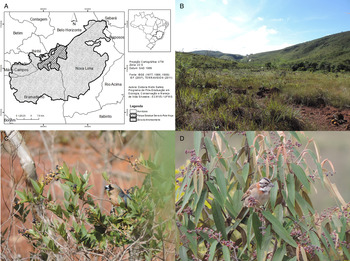
This study was conducted at the Parque Estadual da Serra do Rola Moça, Iron Quadrangle, Minas Gerais, south-eastern Brazil (Fig. 1A). The study site is located nearly 1450 m above sea level (20°00′26′′–20°08′42′′S and 43°96′74′′–44°06′62′′W) in a transitional area between the Cerrado and the Atlantic Forest (Jacobi et al., Reference Jacobi, Carmo and Vincent2008). The climate is tropical sub-humid with a mean annual precipitation of 1500–1900 mm and has marked seasonality with rainy summers (October to March) and dry winters (April to September). We focused on two Miconia species on ferruginous campo rupestre, a megadiverse grassland establishing on nutrient-poor, iron-rich, shallow soils (Fig. 1B).
(A) Geographic location of the Parque Estadual da Serra do Rola Moça; (B) overview of the study site; (C) Schistoclamys ruficapillus eating fruits of Miconia ligustroides; and (D) Zonotrichia capensis mashing a fruit of Miconia pepericarpa.

Miconia ligustroides (DC.) Naudin and Miconia pepericarpa DC. are two shrubby species widely distributed in Brazil (Goldenberg et al., Reference Goldenberg, Almeda, Meirelles, Caddah, Michelangeli, Martins and Weiss2013). They are the two most abundant Miconia species at the study site, but there are 14 species of Miconia at the ferruginous campo rupestre (canga) of the Iron Quadrangle (Jacobi and Carmo, Reference Jacobi and Carmo2012). Unripe fruits of M. ligustroides are green-yellowish and ripe fruits are black (Fig. 1C). Unripe fruits of M. pepericarpa are pinkish and become light purple when ripe (Fig. 1D). Both species produce physiologically dormant seeds (Silveira et al., Reference Silveira, Ribeiro, Soares, Rocha and Moura2013b). Vouchers of both species are deposited at the BHCB herbarium.
Fruit traits and fruit availability
To examine the relationships between fruit traits and the bird assemblages, we measured the largest fruit diameter and fruit fresh mass of 48 fruits of M. ligustroides (n > 10 individuals) and 82 fruits of M. pepericarpa (n > 10 individuals). Fruits were then dried at 70°C for 6 days to obtain fruit dry mass. After drying, we counted the total seed number per fruit and weighted total seed mass per fruit.
To determine fruit availability, we established seven 20 m-long transects at least 10 m apart from each other and randomly tagged 15 individuals of each species. We followed fruit production from February to July 2014, the period corresponding to the beginning and end of the production of ripe fruits. For each individual we counted the total number of ripe fruits at weekly intervals.
Frugivory and quantitative seed dispersal effectiveness
To characterize the assemblage of seed dispersers and their behaviour, we performed ad libitum focal observations during the fruiting period of both species in 2014. All observations were carried out by two or three independent observers with Nikon 10 × 42 binoculars between 6:00 and 18:00 h (Table S1). Sampling effort for each species (129 for M. pepericarpa and 113 for M. ligustroides) was nearly two-fold the minimum effort in the Neotropics (Pizo and Galetti, Reference Pizo, Galetti, Von Matter, Straube, Accordi, Piacentini and Cândido2010) (Table S1).
To avoid interference with bird behaviour, camouflaged observers stayed at a minimum distance of 10 m from the focal plants. We recorded bird species and abundance, time and length of visits, fruit consumption and manipulation mode. When more than one individual simultaneously visited a plant, we followed only the first individual that interacted with a fruit. Bird identification followed Sigrist (Reference Sigrist2009), Gwynne et al. (Reference Gwynne, Ridgely, Tudor and Argel2010), and nomenclature followed CBRO (2014). All records of Elaenia species were merged under Elaenia spp. given the difficulties of species separation under field conditions (Straube, Reference Straube2013).
We calculated the mean visitation rate and mean fruit removal rate for each bird species. Quantitative SDE for each species was determined through the SDE landscape. The SDE landscape is a two-dimensional depiction of the possible combinations of the quantity and the quality of dispersal and with elevational contours representing isoclines of SDE (Schupp et al., Reference Schupp, Jordano and Gomez2010). We quantified the number of visits by each frugivore and the number of seeds removed in each visit, to estimate the quantitative contribution of each bird species to SDE of both Miconia species. The quantitative component (QC) of the SDE landscape was modelled with the codes available at https://github.com/pedroj/effectiveness.
Bird biometry
To explore the relationships between bird traits and fruit consumption, we obtained biometric data from all species consuming fruits of both Miconia species. The specimens examined (n = 106) belonged to the collections of the Federal University of Minas Gerais and the Natural History Museum of the Catholic University. All birds examined were from the Iron Quadrangle or sites >900 m above sea level in the state of Minas Gerais. We obtained data on total length, biomass and measured beak width with a digital calliper (Baldwin et al., Reference Baldwin, Oberholser and Worley1931).
Gut passage effects on seed germination
To determine gut passage effects, ripe fruits were collected from at least 10 individuals per species and offered to captive bird species known to consume fruits of both Miconia species under field conditions. Fruits of M. pepericarpa were offered to four individuals of Schistochlamys ruficapillus (Thraupidae) and six individuals of Zonotrichia capensis (Passerellidae), whereas fruits of M. ligustroides were offered to five individuals of S. ruficapillus and two individuals of Turdus leucomelas (Turdidae). Differences in sample size were due to bird availability at the Centro de Triagem de Animais Silvestres (CETAS), a wildlife rehabilitation centre from the Ministry of Environment of Brazil (Silveira et al., Reference Silveira, Mafia, Lemos-Filho and Fernandes2012). Nevertheless, fruits of M. pepericarpa were not consumed by Z. capensis under captivity.
Birds were placed in individual cages and fruits of each Miconia species were offered one species at a time in the morning. For each individual bird either 40–50 fruits of M. pepericarpa or 22–23 fruits of M. ligustroides were offered on different days. After ingestion of all fruits, seeds were retrieved from the faeces, cleaned in tap water for 5 min and stored until use: 30 days for M. ligustroides and 80 days for M. pepericarpa. The same procedures were done for manually extracted seeds. When setting the germination experiment, seeds from all treatments were immersed for 2 min in sodium hypochlorite 2.5% for disinfection, cleaned in running water for 10 min, and dried.
To examine gut passage effects, three treatments were set (Samuels and Levey, Reference Samuels and Levey2005): (1) manually extracted seeds (six replicates); (2) seeds of M. ligustroides defecated by S. ruficapillus and T. leucomelas (five and two replicates) and seeds of M. pepericarpa defecated by S. ruficapillus (four replicates); and (3) intact fruits (six replicates of five fruits for M. ligustroides and 10 fruits for M. pepericarpa). Each replicate for treatments (1) and (2) consisted of 25 seeds.
To simulate field conditions, seeds and fruits were placed in Petri dishes containing 30 g of soil collected near the parent plants. Soil was sterilized in autoclave for 20 min to kill all seeds and dried for 5 h at 70°C. The Petri dishes were incubated in germination chambers at 25°C with 12 h:12 h light:dark cycles, the optimum conditions for germination of Melastomataceae (Silveira et al., Reference Silveira, Fernandes and Lemos-Filho2013a). The Petri dishes were regularly watered with a 1% Nistatin solution to prevent fungal growth, and germination was monitored daily for 60 consecutive days (Traveset and Verdú, Reference Traveset, Verdú, Levey, Silva and Galetti2002). Radicle emergence was the criterion to determine germination. At the end of the experiment, non-germinated seeds were submitted to the tetrazolium test to examine embryo viability.
We ran a generalized linear model (GLM) followed by Tukey's test to compare the effects of treatments on the proportion of germinated seed differences among treatments (α = 0.05; Sileshi, Reference Sileshi2012). We also ran a survival analysis, a type of non-parametric model, to examine the influence of gut passage on the likelihood of seeds to germinate. We compared how the proportion of germinated seeds varied in time for each treatment by looking at t 50, the time for 50% of the seeds to germinate through a Weibull survival regression analysis. All analyses were performed in R (R Core Team, 2014) in the packages MASS, RT4Bio and survival. For the SDE landscape, we used the packages ggplot2, network, sna, bipartite, igraph, biGraph, vegan and ade4.
Results
Fruit traits and fruit availability
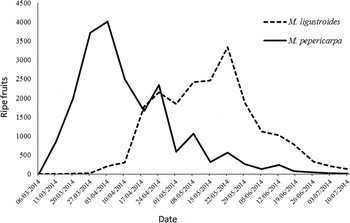
Fruits of M. ligustroides were larger, heavier and contained six times more seeds than fruits of M. pepericarpa (Table 1). Seeds of M. ligustroides averaged 26.6% (4 ± 1 mg, mean ± SD) of fruit dry mass, whereas seeds of M. pepericarpa averaged 16.6% (1 ± 0.8 mg) of fruit dry mass. Fruiting of both species began at the end of the rainy season. Fruit availability peaked between April and May in M. ligustroides and between March and April for M. pepericarpa (Fig. 2). Throughout the sampling period, the average total number of fruits produced by each individual of M. ligustroides was 1332 ± 837, and 1358 ± 1412 for M. pepericarpa.
Average weekly production of ripe fruits of Miconia ligustroides and Miconia pepericarpa in an ironstone outcrop between March and July 2014 at the Parque Estadual da Serra do Rola Moça, southeastern Brazil.

Biometry of fruit and seeds (mean ± SD) of Miconia ligustroides (n = 48) and Miconia pepericarpa (n = 82) at the Parque Estadual da Serra do Rola Moça, southeastern Brazil

*P < 0.001.
Frugivory and quantitative seed dispersal effectiveness
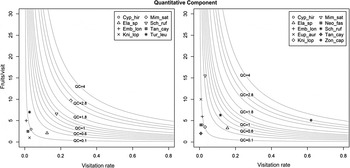
We recorded 93 bird visits in M. ligustroides, in which fruits were consumed on 76 occasions (81.7%) (Fig. 3, Fig. S1). Eight bird species from four families ingested fruits with a dominance of Mimus saturninus, followed by Schistochlamys ruficapillus and Elaenia spp. (Table S2). Embernagra longicauda and Tangara cayana were the least frequent visitors. All eight species behaved as gulpers, ingesting whole fruits. Visitation rate was 0.82 visits per hour, and fruit removal rate was 4.34 fruits per hour.
Seed dispersal effectiveness landscape showing (A) the quantitative component of Miconia ligustroides and its frugivore birds Cypsnagra hirundinacea (Cyp_hir), Elaenia spp. (Ela_sp), Embernagra longicauda (Emb_lon), Knipolegus lophotes (Kni_lop), Mimus saturninus (Mim_sat), Schistochlamys ruficapillus (Sch_ruf), Tangara cayana (Tan_cay) and Turdus leucomelas (Tur_leu); and (B) Miconia pepericarpa and its frugivore birds Cypsnagra hirundinacea (Cyp_hir), Elaenia spp. (Ela_sp), Embernagra longicauda (Emb_lon), Eupsittula aurea (Eup_aur), Knipolegus lophotes (Kni_lop), Mimus saturninus (Mim_sat), Neothraupis fasciata (Neo_fas), Schistochlamys ruficapillus (Sch_ruf), Tangara cayana (Tan_cay) and Zonotrichia capensis (Zon_cap) in a ferruginous campo rupestre at the Parque Estadual da Serra do Rola Moça, southeastern Brazil.

We recorded 173 visits by birds in M. pepericarpa, with 131 (75.7%) with fruit consumption (Fig. 3, Fig. S1). Ten species in five families consumed fruits, with a dominance of Zonotrichia capensis, followed by Elaenia spp. and S. ruficapillus (Table S3). Neothraupis fasciata, Eupsittula aurea and T. cayana, with a single record each, were the least frequent visitors of M. pepericarpa fruits. All species swallowed whole fruits of M. pepericarpa, except Z. capensis which mashed fruits and dropped seeds beneath the parent plant on some occasions. Visitation rate was 1.34 visits per hour, and fruit removal rate was 5.32 fruits per hour.
Turdus leucomelas (Turdidae) only consumed fruits of M. ligustroides, whereas E. aurea, N. fasciata and Z. capensis only consumed fruits of M. pepericarpa. Our sampling effort was sufficient to sample most frugivore species given that the observed number of bird species recorded in both Miconia was close to the estimated richness (see Fig. S2).
Mimus saturninus (QC = 2.5) and S. ruficapillus (QC = 1.17) were the most effective seed dispersers of M. ligustroides, followed by Elaenia spp. (QC = 0.26) and T. leucomelas (QC = 0.18). For M. pepericarpa, Z. capensis (QC = 3.16) and S. ruficapillus (QC = 0.73) were the most effective seed dispersers, followed by Elaenia spp. (QC = 0.50) and M. saturninus (QC = 0.48).
Bird biometry
Mimus saturninus (277 mm; 80.3 g) and T. leucomelas (241.3 mm; 67.3 g) were the largest and heaviest birds that consumed fruits of M. ligustroides, while E. cristata (151.4 mm; 19.4 g), representing Elaenia spp., and T. cayana (148.5 mm; 20.8 ± 2.2 g) were the smallest and lightest birds. Eupsittula aurea (286.4 mm; 87.2 g) and M. saturninus were the largest and heaviest birds that consumed fruits of M. pepericarpa, while the smallest and lightest birds were the same as M. ligustroides plus Z. capensis (147.1 mm; 20.8 g) (Table S4). Zonotrichia capensis also has one of the smallest beak widths (7.8 ± 0.6 mm).
Gut passage effects on seed germination
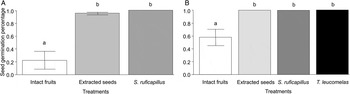
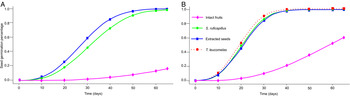
We found significant effects of gut passage treatments on seed germination of M. ligustroides (F = 56.845; P < 0.001) and M. pepericarpa (F = 36.553; P < 0.001). For both species, seeds within intact fruits showed the smallest germination percentage (Fig. 4). Hand-extracted seeds of both Miconia germinated to percentages >95%, with no significant differences from germination of gut-passed seeds (Fig. 4). We found no significant differences in the proportion of non-viable seeds among treatments for M. ligustroides (F = 0.18; P = 0.84) and M. pepericarpa (F = 1.5; P = 0.26).
Mean (±SD) germination percentage of (A) Miconia ligustroides and (B) Miconia pepericarpa exposed to different gut passage treatments. Treatments followed by different lower case letters are statistically different.

Germination time differed significantly among treatments for M. ligustroides (QV = 1554.58; P < 0.001) and M. pepericarpa (QV = 1246.19; P < 0.001), as indicated by survival analysis. For both species, seeds within intact fruits took more time to germinate compared with the other treatments. Germination time of hand-extracted seeds did not differ from gut-passed seeds of M. ligustroides (Fig. 5A), but gut spassage resulted in a minor delay in germination time in M. pepericarpa (Fig. 5B). We could not estimate t 50 for seeds within intact fruits of M. pepericarpa because less than 50% of the seeds germinated across all replicates.
Proportion of germinated seeds of (A) Miconia ligustroides and (B) Miconia pepericarpa in different gut passage treatments.

Discussion
Bird–frugivore interactions have been intensively studied in Neotropical forests where many bird species feed primarily on fruits. In these physiognomies, Miconia is regarded as a keystone resource for frugivorous birds (Snow, Reference Snow1965; Stiles and Rosselli, Reference Stiles and Rosselli1993; Loiselle and Blake, Reference Loiselle and Blake1999; Poulin et al., Reference Poulin, Wright, Lefebvre and Calderón1999). Here, we studied for the first time frugivory and seed dispersal in Miconia species from ferruginous campo rupestre, where strictly frugivore birds are rare (Vasconcelos and Hoffmann, Reference Vasconcelos, Hoffmann, Carmo and Kamino2015), and found that, similarly to Neotropical forests, species of Miconia from campo rupestre are visited by a relatively diverse assemblage of seed dispersers. We also showed that Miconia fruits are produced at the end of the rainy season, when there were few species producing berries (A.M.O. Santos and F.A.O. Silveira, personal observation). A decrease in fruit production at the beginning of the dry season in southeastern Brazil (Maruyama et al., Reference Maruyama, Borges, Silva, Burns and Melo2013 and references therein) suggests that fruits of Miconia produced in the dry season progressively become an important resource sustaining bird populations (Snow, Reference Snow1965), though omnivore species can also forage for insects and track resources in other sites. Finally, we showed that birds strongly differ in quantitative seed dispersal effectiveness but found no interspecific differences in gut passage effects.
Previous studies have found higher diversity of frugivorous birds for Miconia species from forests (Silveira et al., Reference Silveira, Fernandes and Lemos-Filho2013a and references therein) compared with Miconia species from Neotropical savannas (Allenspach and Dias, Reference Allenspach and Dias2012; Allenspach et al., Reference Allenspach, Telles and Dias2012; Maruyama et al., Reference Maruyama, Borges, Silva, Burns and Melo2013). Here, we also observed a relatively small number of frugivorous birds dispersing Miconia fruits, suggesting that open environments support a less diverse assemblage of frugivores. More importantly, we found that only two birds showed high quantitative SDE for each Miconia species. This result has implications for the resilience of seed dispersal because SDE can be highly affected by changes in one or two bird species, compared with a system where multiple effective dispersers generate high functional redundancy (Schupp et al., Reference Schupp, Jordano and Gomez2010).
Zonotrichia capensis was the species with highest quantitative SDE for M. pepericarpa, but we did not observe it feeding on M. ligustroides fruits. Probably its small beak width did not allow it to consume fruits like those of M. ligustroides, though occasional consumption may occur in other physiognomies (Allenspach et al., Reference Allenspach, Telles and Dias2012). In line with this result, M. saturninus, the bird with largest beak width, was the species with highest quantitative SDE for M. ligustroides. These results suggest that both plant and bird morphological traits are important drivers of plant–frugivore efficient interactions (Dehling et al., Reference Dehling, Jordano, Schaefer, Böhning-Gaese and Schleuning2016).
Despite being a masher, Z. capensis is able to disperse seeds of M. pepericarpa. Mashers are recognized as poor seed dispersers because they drop many seeds beneath the canopy of the parent plants (Levey, Reference Levey1987; Stiles and Rosselli, Reference Stiles and Rosselli1993). Nevertheless, recent evidence that mashers often disperse a considerable amount of small seeds (Ruggera et al., Reference Ruggera, Gomez and Blendinger2016; Wischhoff et al., Reference Wischhoff, Marques-Santos and Rodrigues2014) suggests that the role of primarily granivore birds in seed dispersal may have been under-estimated.
Gut passage effects are a key sub-component of seed dispersal quality that affects seedling establishment (Schupp et al., Reference Schupp, Jordano and Gomez2010). Our experimental data indicated a major positive effect of seed cleaning by all bird species, as shown for other Melastomataceae species (Silveira et al., Reference Silveira, Mafia, Lemos-Filho and Fernandes2012). Depulping (deinhibition effect) is an important service delivered by birds (Samuels and Levey, Reference Samuels and Levey2005), since the pulp of the study species contains germination inhibitors (Silveira et al., Reference Silveira, Ribeiro, Soares, Rocha and Moura2013b). Our experimental data also indicated minor scarification effects, with gut-passed seeds showing similar germination percentages and minor changes in germination time compared with hand-extracted seeds. Therefore, our overall results indicate that species-specific differences play a more important role in the quantitative than the qualitative component in SDE in our system, which agrees with theoretical predictions for generalist seed dispersal systems (Stiles and Rosselli, Reference Stiles and Rosselli1993).
Nevertheless, our study presents some limitations. Firstly, our experiments were conducted under laboratory conditions because seeds of the studied species are very small. Because results of germination trials can differ between laboratory and field conditions (Traveset et al., Reference Traveset, Robertson, Rodríguez-Pérez, Dennis, Schupp, Green and Westcott2007), we recommend future studies to address gut passage effects under natural conditions. Secondly, the site of seed deposition strongly affects plant recruitment, but was not addressed here. Therefore, we have not fully examined the qualitative component. Finally, our results should be viewed with caution because of the weak correspondence between birds observed consuming fruits under field conditions and those available for gut passage experiments.
To conclude, we show that Miconia species from ferruginous campo rupestre are visited by a diverse assemblage of generalist birds that differ in quantitative, but not qualitative, seed dispersal effectiveness. Our data have implications for ecological restoration. Ferruginous campo rupestre, particularly the vegetation on ironstone outcrops, is severely threatened by mining activities and in great need for restoration (Jacobi et al., Reference Jacobi, Carmo, Vincent and Stehmann2007). It recently has been shown that artificial perches increase seed arrival and seedling recruitment in degraded areas, thus promoting vegetation restoration (Guidetti et al., Reference Guidetti, Amico, Dardanelli and Rodriguez-Cabral2016). Here, we argue that planting Miconia species in degraded sites can assist restoration by overcoming limited seed supply in these sites. Miconia species are fast growing, produce abundant fruits and can be used as perches by a diverse assemblage of birds (Silveira et al., Reference Silveira, Fernandes and Lemos-Filho2013a), which will eventually drop seeds below parent plants and shape the spatial patterns of regeneration. Therefore, we argue that prioritizing the planting of Miconia species will enhance further initiatives on restoration of ironstone outcrop vegetation following mining activities.
Acknowledgements
We thank D. Vilela for allowing the use of captive birds in Centro de Triagem de Animais Silvestres, Instituto Estadual de Florestas for the permits, people who helped during field and laboratory work, M. Vasconcelos for help in bird biometry, R. Rodrigues, L. E. Macedo and A. Barbosa for help with statistical analyses, and D. M. Salles for Fig. 1. P. Maruyama, C. Schetini, T. Guerra and an anonymous reviewer provided comments that improved early versions of the manuscript.
Financial support
A.M.O.S., C.M.J. and F.A.O.S. received scholarships from Conselho Nacional de Pesquisa e Desenvolvimento. Financial support was provided by Fapemig Fundação de Amparo à Pesquisa de Minas Gerais (APQ0237-14).
Conflicts of interest
None.
Supplementary material
To view supplementary material for this article, please visit https://doi.org/10.1017/S0960258517000071