INTRODUCTION
Parasitism is a common phenomenon among marine animals and a major factor that may affect host population dynamics and community structure in intertidal ecosystems (Sousa, Reference Sousa1991; Fredensborg et al., Reference Fredensborg, Mouritsen and Poulin2005; Mouritsen & Poulin, Reference Mouritsen and Poulin2005). Of the broad range of invertebrates serving as hosts for a great variety of macroparasites, intertidal molluscs play a particularly important role, especially as hosts for digenean trematodes (Mouritsen & Poulin, Reference Mouritsen and Poulin2002). The complex life cycles of these endoparasites usually require two invertebrate intermediate hosts and a vertebrate final host, with gastropods serving primarily as first intermediate host and bivalves mostly being utilized as second intermediate host. Within the first intermediate host, numerous infective stages, the cercariae, develop in either sporocysts or rediae. Cercariae are free-swimming larval stages, which invade the second intermediate host and develop into metacercariae, often enclosed by a protective cyst. Ingestion of the second intermediate host by the final host allows completion of the trematode life cycle.
Parasite invasion does not remain without consequences to the molluscan host. Pathogenic conditions caused by parasitism are widespread in marine molluscs (Lauckner, Reference Lauckner and Kinne1980, Reference Lauckner and Kinne1983; Sindermann, Reference Sindermann1990), and virtually all organs and tissues can be damaged by parasitic infection. A multitude of effects have been described from various host–parasite associations, including host castration, alteration of growth and behaviour (Huxham et al., Reference Huxham, Raffaelli and Pike1993; McCarthy et al., Reference McCarthy, Fitzpatrick and Irwin2000; Thieltges, Reference Thieltges2006a) and adverse effects may be particularly profound when multiple infections occur. Although mass mortalities have been reported (Jonsson & André, Reference Jonsson and André1992; Thieltges, Reference Thieltges2006b), parasite-induced effects are often subtle and only become noticeable under additional environmental stress due to impaired host fitness and lowered ability to adapt to changing environmental conditions (Lafferty & Kuris, Reference Lafferty and Kuris1999). Since consequences of parasitism to individual hosts can have impacts even at the ecosystem level (Thomas et al., Reference Thomas, Renaud and Guégan2005), a detailed knowledge of the macroparasite community composition in molluscs as well as infection levels across a wide range of different coastal habitats is indispensable to our general understanding of the relative importance of parasitism in marine ecosystems. However, this information is still largely missing and comprehensive data are only available from few intertidal habitats (de Montaudouin et al., Reference de Montaudouin, Kisielewski, Bachelet and Desclaux2000; Galaktionov & Skirnisson, Reference Galaktionov and Skirnisson2000; Russell-Pinto et al., Reference Russell-Pinto, Gonçalves and Bowers2006; Thieltges et al., Reference Thieltges, Krakau, Andresen, Fottner and Reise2006). Although gastropods and bivalves constitute a dominant part of the benthos inhabiting the prevailing intertidal hard substrates of Irish coasts, including species of high economic value, only very limited quantitative research has been carried out in Ireland in this respect and exclusively at small spatial scales (Irwin, Reference Irwin1983; Matthews et al., Reference Matthews, Montgomery and Hanna1985; Copeland et al., Reference Copeland, Montgomery and Hanna1987).
In the present study, we describe the macroparasite community in four common mollusc species of rocky shores on a regional scale. We conducted a quantitative parasitological survey on the south coast of Ireland of three intertidal gastropods, Littorina littorea (Linnaeus, 1758), Nucella lapillus (Linnaeus, 1758) and Patella vulgata Linnaeus, 1758, as well as one bivalve (Mytilus edulis/galloprovincialis), which can be found on littoral rocks throughout the coastal areas of Ireland. Since mussels comprise an interbreeding mixture of Mytilus edulis Linnaeus, 1758 and Mytilus galloprovincialis Lamarck, 1819 on the south coast of Ireland (Gosling et al., Reference Gosling, Doherty and Howley2008), and their exact taxonomic status is not clarified yet, they are referred to as Mytilus spp. in the following (see Gosling & McGrath, Reference Gosling and McGrath1990). Besides providing a review of the macroparasite fauna, we were interested to discover whether parasitism occurs frequently in the investigated molluscs or is confined to few or single shore localities.
MATERIALS AND METHODS
Study area
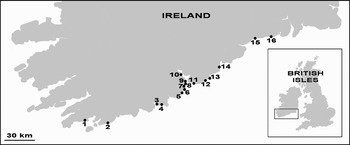
The study area on the south coast of Ireland (Figure 1), from the most easterly sampling site Annestown to Schull in the west, is characterized by wide stretches of rocky shore including bedrock and accumulations of loose rocky material such as boulders and cobbles. It is interrupted by estuaries, creeks and coves, and comprises sheltered to exposed coastal sites. Tides are diurnal, with a tidal range from 3.2 m (MHWS) in Schull to 4.4 m in Monkstown. Mean water temperatures reach from approximately 8°C in winter to 15°C in summer (data obtained from Garrettstown Strand, own recordings from April 2007 to March 2009). For detailed area and habitat information see Fossitt (Reference Fossitt2000) and Nairn (Reference Nairn2005).
Study area on the Irish south coast (large map) and its location on the British Isles (small map). Black dots indicate sampling sites. For detailed information on the sampling effort see Table 1. (1) Schull; (2) Tragumna; (3) Coolmain Bay; (4) Garrettstown; (5) Carrigadda Bay; (6) Robert's Cove; (7) Myrtleville; (8) Poulnacalla Bay; (9) Grab-all Bay; (10) Monkstown; (11) Powerhead Bay; (12) Ballyandreen Bay; (13) Ballycotton; (14) Ring Point; (15) Stradbally; (16) Annestown.

Sampling and parasitological examination
Mollusc samples were taken from sixteen sites along the Irish south coast (Figure 1) between summer 2007 and 2008. Information on the size-range as well as mean size of the molluscan hosts, the sampling effort and the year of sampling are summarized in Table 1. At each site, comparatively large specimens of each species were selected for examination since parasite infections are known to be most common in mature host organisms (e.g. Lauckner, Reference Lauckner and Kinne1980, Reference Lauckner and Kinne1983). Samples were collected haphazardly by hand from littoral rocks at mid-intertidal level within an area of approximately 100 m2.
Sampling effort (sampling sites 1–16 as given in Figure 1), total number of individuals examined, year of sampling, size-range (shell height in Littorina littorea and Nucella lapillus; shell length in Patella vulgata and Mytilus spp.) and mean size ± SD of the mollusc species included in the survey.

In the laboratory, gastropod and mussel shells were measured to the nearest 0.1 mm before dissection. Mussel shells were opened with a scalpel by cutting the adductor muscle. The soft tissue was removed from the valves, carefully dispersed on one side of a compressorium consisting of two thick glass slides, and subsequently squeezed between the two glass slides. Crush preparations were placed under a stereomicroscope with transmitted light and examined for the presence of macroparasites. The intensity of infection (number of individual parasites of a particular species per host; see Bush et al., Reference Bush, Lafferty, Lotz and Shostak1997) was determined. Gastropod tissues were removed from the shell, dissected using pins and screened for parasite infections, also under a stereomicroscope. In addition, all shells were inspected for the presence of shell-boring polychaetes. For Littorina littorea, Nucella lapillus and Patella vulgata only trematode infections with sporocysts or rediae, respectively, were considered. For trematode sporocyst/redial infections and infections with polychaetes only presence/absence was recorded. Parasite species were identified according to Nicoll (Reference Nicoll1907), Rees (Reference Rees1934), Crewe (Reference Crewe1951), Burt (Reference Burt1962), MacKinnon & Burt (Reference MacKinnon and Burt1983), Werding (Reference Werding1969), Matthews (Reference Matthews1973), Lauckner (Reference Lauckner and Kinne1980, Reference Lauckner and Kinne1983) and Kollien (Reference Kollien1996).
Data analysis
The terms prevalence (% of individuals infected with a particular parasite species of the total of hosts examined for that parasite species), intensity (see above) and mean intensity (average intensity of a parasite species among the infected individuals of a particular host species) follow Bush et al. (Reference Bush, Lafferty, Lotz and Shostak1997). To determine the mean prevalence of a parasite species in each mollusc species, prevalences at all sampling sites (calculated from the presence–absence data) were averaged. Mean total prevalence of trematode infections with sporocysts/rediae per host species was calculated by adding up the respective prevalences of each parasite species, with double infections counted as single infection. Mean total prevalence of metacercarial infections in mussels was calculated as described above. To determine the overall mean intensity of parasite infections in mussels, mean intensities at all sampling sites (calculated from the count data) were averaged. Mean total intensity was determined by adding up all trematode metacercariae within single hosts and subsequently calculating the mean for all sites.
RESULTS
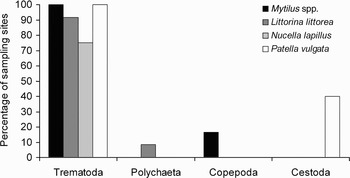
Parasite infections were found at all sampling sites. At the vast majority of sites, molluscs were affected by trematodes, whereas copepods, polychaetes and cestodes occurred infrequently (Figure 2).
Percentage of sampling sites with presence of macroparasites (trematodes, polychaetes, copepods and cestodes) in the respective investigated molluscan host.

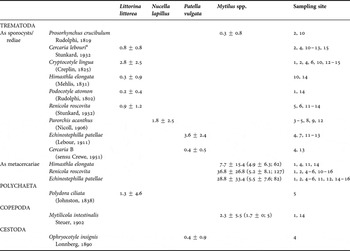
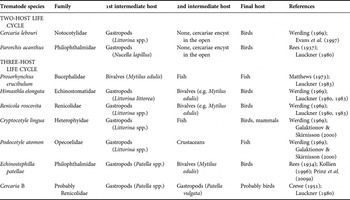
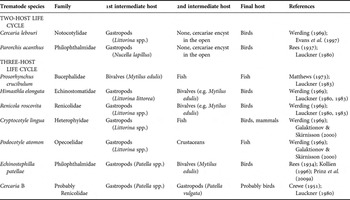
In total, the investigated mollusc species harboured twelve macroparasite taxa, belonging to four major parasite groups (Table 2). The macroparasite community was dominated by digenean trematodes (nine species belonging to seven families), with the majority exhibiting a three-host life cycle (Table 3). Whilst each of the investigated molluscs served as host for at least one trematode, the other macroparasite taxa only occurred in one mollusc species, respectively (Figure 2; Table 2). Amongst the gastropods, trematode species diversity was highest in Littorina littorea, with Cryptocotyle lingua accounting for more than half of the infections. Multiple infections were observed in Mytilus spp. and L. littorea. In mussels, a maximum of four species (Himasthla elongata, Renicola roscovita, Echinostephilla patellae and Mytilicola intestinalis) per host individual was found. In periwinkles, one double infection with the trematodes C. lingua and Podocotyle atomon was observed.
Mean prevalence (%) ± SD, overall mean intensity ± SD and maximum intensity (both given in parentheses) of macroparasites in Littorina littore a, Nucella lapillu s, Patella vulgata and Mytilus spp. as well as sampling sites (1–16 as given in Figure 1) where parasite species was present. For sample sizes (N) see Table 1.
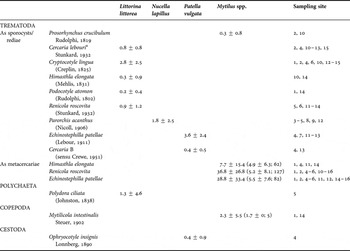
a, Paramonostomum chabaudi van Strydonck, 1965; see Evans et al., Reference Evans, Irwin and Fitzpatrick1997.
Life cycles of the digenean trematodes detected in Littorina littorea, Nucella lapillus, Patella vulgata and Mytilus spp., respectively, sampled from intertidal rocky shore habitats on the south coast of Ireland.
Infections with sporocysts/rediae, which affected the digestive gland and gonad of infected individuals, were found in 3.3% of the investigated gastropods (L. littorea 4.9%, Nucella lapillus 1.8% and Patella vulgata 4.0%). Of the examined Mytilus spp., 0.3% was utilized as first intermediate host by the digenean Prosorhynchus crucibulum, having invaded the digestive gland and gonad of infected mussels. Compared to infections with sporocysts, metacercarial infections with trematodes prevailed in mussels, with a total of 54% of all examined individuals being affected. The mean total intensity of trematode metacercariae in Mytilus spp. was 9.0 ± 14.3 (±SD), with a maximum of 199 metacercariae observed in one host individual. Metacercariae of R. roscovita, which were most common, were located in the palps, mantle margin and digestive gland. Cysts of H. elongata and E. patellae were restricted to the foot tissue of infected mussels.
DISCUSSION
The investigated molluscs harboured a diverse macroparasite community comprising trematodes, polychaetes, copepods and cestodes. Our findings suggest that parasites do not only occur sporadically, but are common in molluscs on the south coast of Ireland. This is largely due to the presence of digenean trematodes, which were found at all sampling sites and in all of the investigated species. The ubiquity of trematodes can probably be explained by a wide distribution of bird final hosts and, in the case of metacercarial infections in mussels, gastropod first intermediate hosts on the south coast of Ireland, which are required for the completion of the life cycle. The fact that some of the parasite species found in this study only occurred infrequently (Figure 2; Table 2), emphasizes the need to examine samples from various shore localities in order to record the parasite fauna present in a region.
Amongst the observed macroparasites, digenean trematodes accounted for the vast majority of the parasitic infections recorded. All other parasite groups exhibited a highly scattered occurrence (present at one or two sampling sites, respectively) with very low infection rates. This is in accordance with findings of macroparasite inventories in molluscs by de Montaudouin et al. (Reference de Montaudouin, Kisielewski, Bachelet and Desclaux2000) and Thieltges et al. (Reference Thieltges, Krakau, Andresen, Fottner and Reise2006), who found digenean trematodes to be the dominant metazoan parasite group in terms of species diversity and prevalence of infection. Whilst the macroparasite fauna harboured by periwinkles, dogwhelks and limpets in our study was largely similar to the macroparasite community in the respective species described from other European shore localities (e.g. Crewe, Reference Crewe1951; Thomas, Reference Thomas1965; James, Reference James1968; Werding, Reference Werding1969; Matthews et al., Reference Matthews, Montgomery and Hanna1985; Copeland et al., Reference Copeland, Montgomery and Hanna1987; Huxham et al., Reference Huxham, Raffaelli and Pike1993; Kollien, Reference Kollien1996; Galaktionov & Skirnisson, Reference Galaktionov and Skirnisson2000; Skirnisson & Galaktionov, Reference Skirnisson and Galaktionov2002; Thieltges et al., Reference Thieltges, Krakau, Andresen, Fottner and Reise2006), which is possibly related to a wide distribution of bird final hosts (see Thieltges et al., Reference Thieltges, Krakau, Andresen, Fottner and Reise2006), the macroparasite community recorded in mussels showed obvious differences when compared to previous findings (Sannia & James, Reference Sannia and James1977; de Montaudouin et al., Reference de Montaudouin, Kisielewski, Bachelet and Desclaux2000; Thieltges et al., Reference Thieltges, Krakau, Andresen, Fottner and Reise2006). However, apart from the study by Sannia & James (Reference Sannia and James1977) from North Iceland, which revealed only one trematode species in Mytilus edulis, these reviews originate from soft sediment habitats. This presumably accounts for the observed variability among regions. Whilst the metacercarial stages of the digeneans Himasthla elongata and Renicola roscovita, which are known to be common parasites in mussels and other bivalves throughout European coastal waters were also present in this investigation, the trematodes Himasthla continua Loos-Frank, Reference Loos-Frank1967, Himasthla interrupta Loos-Frank, Reference Loos-Frank1967 and Psilostomum brevicolle (Creplin, 1829) recorded by de Montaudouin et al. (Reference de Montaudouin, Kisielewski, Bachelet and Desclaux2000) and Thieltges et al. (Reference Thieltges, Krakau, Andresen, Fottner and Reise2006) as well as Gymnophallus gibberosus Loos-Frank, 1971 (Thieltges et al., Reference Thieltges, Krakau, Andresen, Fottner and Reise2006) were missing. The absence of certain trematode species typically being found in mussels from soft sediment shore localities is most likely attributable to the absence of the gastropod and bivalve first intermediate host, respectively, Hydrobia ulvae (Pennant, 1777) and Macoma balthica (Linnaeus, 1758) for these parasites. Apart from these differences, we observed two trematode species that are neither listed by de Montaudouin et al. (Reference de Montaudouin, Kisielewski, Bachelet and Desclaux2000) nor by Thieltges et al. (Reference Thieltges, Krakau, Andresen, Fottner and Reise2006), namely Prosorhynchus crucibulum and Echinostephilla patellae. The latter species has only recently been observed to infect mussels (Prinz et al., Reference Prinz, Kelly, O'Riordan and Culloty2009a), and field data on prevalence and intensity of this trematode in its second intermediate host are presented here for the first time. Our study indicates that mussels from rocky shore habitats might display a distinct trematode community in comparison to the trematode species composition found in mussels from soft sediment shores, featuring typical species like E. patellae, whilst digeneans using soft sediment mollusc species such as H. ulvae as first intermediate host are missing.
Whilst data on infection rates in Nucella lapillus obtained in this study are comparable to values reported by James (Reference James1968), Galaktionov & Skirnisson (Reference Galaktionov and Skirnisson2000), and Skirnisson & Galaktionov (Reference Skirnisson and Galaktionov2002), prevalences of E. patellae in Patella vulgata have been regularly found to be higher (Thomas, Reference Thomas1965; Copeland et al., Reference Copeland, Montgomery and Hanna1987; Kollien, Reference Kollien1996). This is possibly due to concentrations of avian final hosts at the respective study sites, which included harbours and roosting sites where birds congregate. This is also true for the comparatively high prevalences in periwinkles reported from Northern Ireland (Matthews et al., Reference Matthews, Montgomery and Hanna1985) and Scotland (Huxham et al., Reference Huxham, Raffaelli and Pike1993). When compared to data from the Wadden Sea, prevalences and intensities, respectively, in Littorina littorea and Mytilus spp. were found to be low in this study. Thieltges et al. (Reference Thieltges, Krakau, Andresen, Fottner and Reise2006) reported a threefold higher trematode prevalence in periwinkles compared to our findings; the mean total prevalence of metacercarial infections in mussels was twice as high, the mean total intensity of metacercarial infections tenfold higher. The low infection rates and levels detected in the present study compared to data from the tidal flats of the Wadden Sea indicate differences in the abundance of intermediate and final hosts, as well as less suitable conditions for parasite transmission. Seasonally very high abundances of bird final hosts on the tidal flats presumably account for relatively high parasite prevalences in first intermediate hosts in the Wadden Sea (see Hechinger & Lafferty, Reference Hechinger and Lafferty2005; Fredensborg et al., Reference Fredensborg, Mouritsen and Poulin2006), which in turn promote high parasite burdens in second intermediate hosts. Another major factor influencing trematode transmission is water temperature, with infection success being positively correlated with temperature and an optimum temperature for transmission at 20°C or higher as observed in cercariae of R. roscovita and E. patellae, respectively (Thieltges & Rick, Reference Thieltges and Rick2006; Prinz et al., Reference Prinz, Kelly, O'Riordan and Culloty2009a). Since water temperatures during the summer months stay well below this value on the south coast of Ireland, a reduced infection success can be assumed. Besides abiotic factors such as temperature, biotic factors have been shown to influence infection levels in molluscs. Infective stages may be preyed upon by a variety of intertidal benthic invertebrates or their transmission to the next host hindered by marine algae (Hopper et al., Reference Hopper, Poulin and Thieltges2008; Thieltges et al., Reference Thieltges, Bordalo, Caballero Hernández, Prinz and Jensen2008a; Prinz et al., Reference Prinz, Kelly, O'Riordan and Culloty2009b). Thieltges et al. (Reference Thieltges, Jensen and Poulin2008b) suggest that a high ambient diversity in intertidal ecosystems should lead to a low parasite transmission success, as observed similarly in terrestrial systems (Ostfeld & Keesing, Reference Ostfeld and Keesing2000; Keesing et al., Reference Keesing, Holt and Ostfeld2006). Comparatively low infection rates and levels found in this study might thus reflect a strong impact of surrounding species on parasite transmission in rocky shore ecosystems, exhibiting particularly high species diversity and density (Bertness, Reference Bertness1999), which remains to be clarified.
We conclude that, although parasitism is widespread in molluscs on the south coast of Ireland, the impact on individual hosts as well as mollusc populations is likely to be rather marginal, since prevalence and intensity of infections are relatively low. This is of particular importance with regard to periwinkles and mussels, which are commercially exploited in Ireland (Nairn, Reference Nairn2005). Although probably harmless to human consumers (Loos-Frank, Reference Loos-Frank1967), high parasite loads may negatively affect the molluscan host, e.g. by impairing growth (Thieltges, Reference Thieltges2006a), reducing fecundity or enhancing mortality (Huxham et al., Reference Huxham, Raffaelli and Pike1993), which is unfavourable from an economic point of view. However, to evaluate the actual influence of macroparasites on mollusc population dynamics and to assess their relative importance in rocky shore habitats on the south coast of Ireland, further studies are needed.
ACKNOWLEDGEMENT
K. Prinz received funding from the Irish Research Council for Science, Engineering and Technology (IRCSET) under the National Development Plan.