Introduction
Severe and advanced diseases significantly affect patients as well as their family members and caretakers. In patients, the toll taken by physical symptoms, existential suffering, loss of functionality, and impairments in mental health can condition a phenomenon known as wish to hasten death (WTHD) (Balaguer et al. Reference Balaguer, Monforte-Royo and Porta-Sales2016). Among the topics pertaining to palliative care, WTHD has become greatly relevant in the context of severe or incurable diseases. This stems from its highly frequent presentation in this subgroup of patients, as well as due to the spectrum of clinical and policy-driving implications for patients facing their end of life. Currently, this topic remains as one of the lead items in discussions concerning medical ethics, and there is a continued need to understand and address the needs for patients presenting with WTHD (Chao et al. Reference Chao, Boivin and Marcoux2016; Rodriguez-Prat et al. Reference Rodriguez-Prat, van Leeuwen and van Leeuwen2018).
The WTHD represents a construct that underscores a diversity of related phenomena, consequence of a state of suffering due to a life-threatening disorder, for which a patient cannot identify a solution other than to accelerate death (Balaguer et al. Reference Balaguer, Monforte-Royo and Porta-Sales2016; Wilson et al. Reference Wilson, Dalgleish and Chochinov2016). The WTHD frequently presents in patients diagnosed with advanced or life-threatening diseases, such as cancer. Studies conducted in palliative care units have reported that up to 20% and 55% of patients treated in this clinical setting experience a permanent or transitory WTHD, respectively (Wilson et al. Reference Wilson, Dalgleish and Chochinov2016). Further, the frequency of WTHD among patients who are referred for a psychiatry evaluation ranges from 34.6% to 44% (Madeira et al. Reference Madeira, Albuquerque and Santos2011; Rodríguez-Mayoral Reference Rodríguez-Mayoral, Ascencio-Huertas and Verástegui2019a). These differences in reported frequencies likely reflect the studied population and the methodology for assessment.
Factors that have been identified as having an association with the presence of WTHD among patients with cancer include female sex (it is more frequent, but not statistically significant), site of primary tumor (pancreas, liver, lung, head, and neck), uncontrolled physical symptoms (including pain), decreased functional scores, impacts on physical appearance, unstable interpersonal relationships, poor family support, fear of physical and psychological pain (Quill et al. Reference Quill, Back and Block2016), loss of autonomy and perceived dignity, and feelings of being a burden to others (Chochinov Reference Chochinov2016). Mainly though, the presence of psychiatric disorders, including depression and anxiety, has been significantly associated with suicidal ideation (Madeira et al. Reference Madeira, Albuquerque and Santos2011; Mehta and Roth Reference Mehta and Roth2015). Patients with terminal diseases more frequently experience WTHD; nonetheless, this has been proposed as an expression of suffering and not necessarily a genuine wish to die (Wilson et al. Reference Wilson, Dalgleish and Chochinov2016).
Several instruments have been developed to assess the WTHD among patients with advanced diseases; these include the Desire for Death Rating Scale (DDRS) (Chochinov et al. Reference Chochinov, Wilson and Enns1995) and the Schedule of Attitudes Toward Hastened Death (SAHD) (Rosenfeld et al. Reference Rosenfeld, Breitbart and Stein1999). Both instruments aim to detect WTHD among patients considered at risk, as well as to provide a quantitative basis and enable study comparisons between different subgroups (Breitbart et al. Reference Breitbart, Rosenfeld and Pessin2000). When contrasting both tools, the SAHD instrument has been recognized as an adequate assessment instrument with good psychometric properties (Bellido-Perez et al. Reference Bellido-Perez, Crespo and Wilson2018).
The SAHD instrument was originally designed by Rosenfeld et al. for the evaluation of patients with HIV/AIDS (Rosenfeld et al. Reference Rosenfeld, Breitbart and Stein1999); following this initial implementation, the authors validated the scale among patients diagnosed with advanced cancer (Rosenfeld et al. Reference Rosenfeld, Breitbart and Galietta2000). During the initial evaluation, the SAHD displayed high internal consistency (coefficient alpha of 0.89) and adequate concurrent validity with the DDRS instrument (r = 0.69, p < 0.0001) (Rosenfeld et al. Reference Rosenfeld, Breitbart and Stein1999).
The SAHD instrument has been translated into different languages, including Greek, Korean, Spanish (Spain), German, and French. Results from these studies have shown adequate internal consistency scores (coefficient alpha of 0.98, 0.66, 0.92, 0.711, and 0.829, respectively) (Durst et al. Reference Durst, Spencer and Bula2020; Galushko et al. Reference Galushko, Strupp and Walisko-Waniek2015; Mystakidou et al. Reference Mystakidou, Rosenfeld and Parpa2004; Shim and Hahm Reference Shim and Hahm2011; Villavicencio-Chavez et al. Reference Villavicencio-Chavez, Monforte-Royo and Tomas-Sabado2014), indicating that the SAHD represents an instrument with adequate validity and reliability, with adequate psychometric characteristics, which can be used for the assessment of hospitalized and ambulatory patients diagnosed with advanced cancer. Additionally, abbreviated versions of the SAHD have emerged, which attempt to reduce patient burden during the assessment (Kolva et al. Reference Kolva, Rosenfeld and Liu2017; Monforte-Royo et al. Reference Monforte-Royo, Gonzalez-de Paz and Tomas-Sabado2017). This seeks to consider the frail conditions among patients undergoing palliative care (Chochinov et al. Reference Chochinov, Wilson and Enns1997) and facilitate the use of the SAHD for clinical and research purposes (Kolva et al. Reference Kolva, Rosenfeld and Liu2017). Currently, 2 abbreviated tools, a 5-item and a 6-item instruments, are available, both with a cutoff point of 3 positive items for detecting WTHD (Kolva et al. Reference Kolva, Rosenfeld and Liu2017; Monforte-Royo et al. Reference Monforte-Royo, Gonzalez-de Paz and Tomas-Sabado2017).
Although the SAHD has been widely used and implemented in different regional settings, there is currently no version of this relevant instrument for use among patients diagnosed with cancer and undergoing palliative care in Mexico. The objective of this study was to culturally adapt, validate, and reduce the number of items of the SAHD instrument for use among Mexican patients with cancer and receiving palliative care.
Materials and methods
Design
This was a cross-sectional, observational, non-experimental study with convenience sampling. Consecutive patients attending the Palliative Care Service at the Instituto Nacional de Cancerología (INCan) of Mexico from February 2020 to December 2021 were considered for participation. Sample size was calculated based on the number of items on the SAHD instrument (20 items), considering 10 subjects per item, and calculating an additional 20% in sample size to account for estimated losses.
Participants
The referral to palliative care for the patients undergoing oncological treatment within the setting of INCan is based on the following criteria: patients who are diagnosed with an advanced-stage neoplasm and who present uncontrolled pain or symptoms (including dyspnea, seizures, and persistent vomiting); family distress; frequent hospitalizations (over 2 in 1 month); psychological, social, or financial stress (i.e., patients who live far from the hospital center and require physical assistance or have psychological and/or psychiatric symptoms); and hospitalization lasting more than 1 week without significant improvement (Allende-Pérez et al. Reference Allende-Pérez, Verástegui-Avilés and Chavira-Estefan2013). Inclusion criteria for this study among patients referred to the palliative care services were as follows: (a) literate Spanish-speaking subjects who were treated as outpatients, (b) an Eastern Cooperative Oncology Group (ECOG) functional score of 0–3, and (c) informed written consent to participate in the study. Patients were excluded from the trial if they presented with delirium, severe auditory, and/or visual impairments and were eliminated if they failed to provide all the necessary information for this study (including failing to complete all the study instruments, including all questionnaires).
Procedures
Stage 1. Cultural adaptation of the SAHD instrument
The SAHD instrument as published by Villavicencio-Chávez et al. was used for cultural adaptation purposes (Villavicencio-Chavez et al. Reference Villavicencio-Chavez, Monforte-Royo and Tomas-Sabado2014). The decision to use this instrument was based on the fact that it had already undergone a translation and back-translation procedure into Spanish language; however, it was translated to reflect Spain Spanish, which differs from Mexican Spanish in key components, which might hinder patient understanding and usability of the scale to evaluate this population. The published instrument was judged by 7 independent Mexican experts in the fields of health-related psychology, psychiatry, and palliative care, in order to assess the validity of the content, clearness, understandability, and pertinence. Thereafter, a small pilot study was performed, which included 25 participants who provided feedback in terms of their understanding of the items, difficulty answering the instrument, and whether the instructions, items, and possible responses were clear and concise (Hernández Sampieri et al. Reference Hernández Sampieri, Baptista Lucio and Fernández Collado2014). Minor adjustments were made at this point in order to improve understandability of the terminology for Mexican patients (i.e. “put an end to my life” with “end my life,” “my disease progressed rapidly” to “my disease advanced rapidly,” “my disease has no cure” to “my disease cannot be remedied”). After the instrument was compiled, it went through internal review for final adjustments and idiomatic changes; this resulted in the Mexican version of the SAHD instrument (SAHD-Mx).
Stage 2. Application of the SAHD-Mx instrument
Following cultural adaptation, the SAHD-Mx instrument was given to consenting study participants. To evaluate concurrent validity, the Brief Edinburgh Depression Scale (BEDS) was administered at the same time as the SAHD-Mx instrument. The BEDS scale is a self-reported scale, which evaluates 6 items, each with 4 possible answers. Among these, item number 6 explores the presence of suicidal behavior. This scale has been previously validated by Rodríguez-Mayoral et al. for use among Mexican patients with advanced cancer and treated in the palliative care setting. Results from this validation showed a coefficient alpha of 0.71, and using a cutoff score of >5, the sensitivity and specificity were 85.7% and 62.5%, respectively (Rodriguez-Mayoral et al., Reference Rodriguez-Mayoral, Rodriguez-Ortiz and Ascencio-Huertas2019b).
Statistical analysis
Characteristics of the study population are presented with descriptive statistics, including clinical, social, and demographic variables, as means and interquartile ranges, as well as absolute and relative frequencies according to each variable type. A Spearman correlation was performed between the SAHD-Mx and results from the BEDS instrument and ECOG. Internal consistency was assessed using Cronbach’s alpha. An explained variance analysis for the scale was also performed (Batista-Foguet et al. Reference Batista-Foguet, Coenders and Alonso2004). In order to assess long-term reliability, a test–retest was performed via telephone call 24–36 hours following the initial evaluation and assessed using the total score from the scale; this analysis was performed using Pearson’s correlation.
Global adjustment was estimated against a null model using the comparative fit index (CFI) and the Tucker–Lewis index (TLI), which penalizes complexity and considers the adjustment of the model to the data (Batista-Foguet et al. Reference Batista-Foguet, Coenders and Alonso2004). Parsimony and the model equilibrium were estimated through TLI, goodness of fit using the goodness of fit index (GFI), adjusted goodness of fit index (AGFI), and the root mean square error of approximation (RMSEA). Finally, the root means square residual (RMR) was calculated to validate the adjustment (Batista-Foguet et al. Reference Batista-Foguet, Coenders and Alonso2004; Byrne Reference Byrne2016; Hu and Bentler Reference Hu and Bentler1998; Kline Reference Kline2016). The modification of the different models and the removal of items were done considering the explained variance of each item and the standardized residual covariances. The analyses were performed using SPSS version 27 for Windows (IBM Corp., Armonk, NY), AMOS version 24 (IBM Corp., Somers, NY), and Factor Analysis version 12.01 (Universidad Rovira I Virgili Tarragona, Spain).
Results
Patients
A total of 240 outpatients who attended the Palliative Care Service at INCan were invited to participate. Among these, 225 met criteria and agreed to participate in the study. Regarding baseline characteristics of the study population, most were female sex (64.4%; N = 145), and mean age was 56.8 years (standard deviation [SD] = 13.6). Most patients were identified as Catholics/Christians (n = 206; 91.6%). In terms of tumor location, breast was the most frequent site (n = 60; 26.7%), followed by gynecologic and gastroenterology tumors (n = 33; 14.7% and n = 29; 12.9%, respectively). Finally, most patients included had a good (≤2) ECOG performance status (N = 192; 85.3%). Other relevant clinical and sociodemographic characteristics are summarized in Table 1.
Characteristics of the study population (N = 225)

ECOG, Eastern Cooperative Oncology Group; SD, standard deviation.
SAHD-Mx validation
Median positive response was 2 (range 0–18), and median time to complete de SAHD-Mx scale was 5 minutes (range 3–12 minutes). The mean score for the BEDS instrument was 5.67 (SD 4.15). The correlations between the SAHD (20 items) and SAHD-Mx (6 items) was significant for BEDS, item 6 of BEDS (which explores suicidal behavior), and ECOG. A summary is presented in Table 2. Internal consistency analysis yielded a Cronbach’s alpha value of 0.85, and variance analysis identified one factor, which accounted for 79% of total variance. Fifty test–retests were performed and showcased adequate reliability (r = 0.567, p < 0.001).
Pearson coefficients for SAHD (20 items) and SAHD-Mx (6 items) in relation to the measures of BEDS and ECOG

* p = <0.005.
Confirmatory analysis
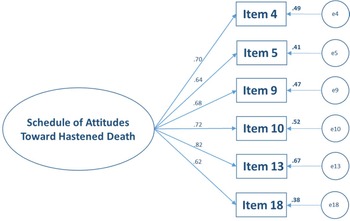
The ratio between χ 2/gl for global adjustment (0.024; p ≤ 0.001) shows practically null errors in the variance and covariance of the population-adjusted model. The main GFI (0.99) and the CFI (0.99) confirm the model as complex and acceptable, meanwhile the SRMR index (0.065) is close to zero, and the RMSEA (0.072; 0.080–0.15) both ratify the model since they penalize complexity, though the values stay close to 0.05 and 0.08, respectively. This indicates that the model is recursive and correctly over-identified. Figure 1 summarizes the model and final factorial structure with one factor, calculated estimates for each factor and correlations, and explained variance for each item. The bottom section of the figure showcases the most relevant indices, including those pertaining to relative comparative adjustment (CFI, TLI, and AGFI), which corroborate an acceptable and parsimonious model compared with the null, as indicated by the literature in terms of ideal (>0.90). The confirmatory factorial analysis model using the Unweighted least squares achieved a factor for the SAHD-Mx among patients with cancer undergoing palliative care. The RMR index is close to zero, which indicates a nearly null difference between the predicted and observed covariance matrix, which allows the assumption that the discrepancy between the proposed model and the real data is practically null (Byrne Reference Byrne2016; Hu and Bentler Reference Hu and Bentler1998; Kline Reference Kline2016). Last, the RMSEA index value is close to zero, representing an average adjustment of the proposed model compared with the null (this entails that a model’s adjustment is evaluated and compared with a higher astringency reference, called a “null model,” where the covariance among all established indicators in the input is set at zero).
Model and final factorial structure with one factor.

The number of items in the scale was reduced to 6 by considering the adjustment with the modification indices, which emerged as the best model with a lower number of items as previously stated in the literature (Escobedo Portillo et al. Reference Escobedo Portillo, Hernández Gómez and Estebané Ortega2016). The abbreviated version of the scale included items 4, 5, 9, 10, 13, and 18 (Supplementary Appendix A).
Discussion
The WTHD is a complex phenomenon, stemming from perceived adversities in several spheres and which frequently presents among patients diagnosed with cancer undergoing palliative care (Bellido-Perez et al. Reference Bellido-Perez, Crespo and Wilson2018). This underscores the need for a validated instrument in order to identify patients who experience this desire. To the best of our knowledge, the present study represents the first validation of the SAHD instrument in the Latin American region. The considerable participation of patients diagnosed with advanced cancer who were attending the Palliative Care Service served as a cornerstone for the elaboration of the SAHD-Mx scale, which was developed through a solid process for cultural adaptation and validation. Results highlight a strong internal consistency, showcased by a higher value for Cronbach’s alpha compared with the original version and most of the validation studies performed to date among other regional settings (Galushko et al. Reference Galushko, Strupp and Walisko-Waniek2015; Mystakidou et al. Reference Mystakidou, Rosenfeld and Parpa2004; Rosenfeld et al. Reference Rosenfeld, Breitbart and Galietta2000, Reference Rosenfeld, Breitbart and Stein1999; Shim and Hahm Reference Shim and Hahm2011; Villavicencio-Chavez et al. Reference Villavicencio-Chavez, Monforte-Royo and Tomas-Sabado2014); the correlation of the original version and the short version of the SAHD was adequate, and similar correlations with the other measures were observed, particularly with item number 6 of the BEDS instrument, which explores the presence of suicidal behavior, and this stresses the close relationship between WTHD and suicidal behavior, though the WTHD is much broader than merely a suicidal behavior. The confirmatory analysis yielded a model with a reduced number of items, resulting in an efficient instrument with adequate psychometric characteristics to identify and evaluate the WTHD in clinical and research settings.
Compared with other abbreviated versions of the SAHD scale previously published, our version includes 6 items, and 3 of these are also included in the other 2 short scales (4: “I am seriously considering asking my doctor for help in ending my life,” 10: “I hope my disease will progress rapidly because I would prefer to die rather than continue living with this illness,” and 13: “Because my illness cannot be cured, I would prefer to die sooner, rather than later”) (Kolva et al. Reference Kolva, Rosenfeld and Liu2017; Monforte-Royo et al. Reference Monforte-Royo, Gonzalez-de Paz and Tomas-Sabado2017). However, the structure of the SAHD-Mx differs from other short versions, likely reflecting the cultural characteristics of the Mexican population, including family relations (familism, including family values and the value of family) (Andrés-Hyman et al. Reference Andrés-Hyman, Ortiz and Añez2006), the construct of death in Mexico, religious observance (Koenig Reference Koenig2012; Kovess-Masfety et al. Reference Kovess-Masfety, Evans-Lacko and Williams2017; Ornelas Reference Ornelas2015), the need to navigate a challenging health system, with difficulties in accessing care and with most patients diagnosed in advanced disease settings (Allende-López and Fajardo-Gutiérrez Reference Allende-López and Fajardo-Gutiérrez2011; Arrieta et al. Reference Arrieta, Zatarain-Barron and Aldaco2019), and poor access to palliative care services (Pastrana et al. Reference Pastrana, De Lima and Sánchez-Cárdenas2021; Soto-Perez-de-Celis et al. Reference Soto-Perez-de-Celis, Chavarri-Guerra and Pastrana2017). In this context, some of the aforementioned may represent risk factors or even in some cases protective factors for the presence of WTHD among Mexican patients.
At this stage, the impact of the construct of death in Mexican culture and how it relates to the WTHD cannot be fully ascertained by the information gathered by this study. However, a qualitative study is currently underway, which will shed light regarding the construct of death in Mexican culture and a WTHD among patients undergoing palliative care.
The previously published abbreviated versions of the SAHD scale had proposed a cutoff point of 3 true items to determine the presence of WTHD, based on the higher sensitivity for detection compared with the 20-item version of the scale (Kolva et al. Reference Kolva, Rosenfeld and Liu2017; Monforte-Royo et al. Reference Monforte-Royo, Gonzalez-de Paz and Tomas-Sabado2017). Currently, the data available from our study was insufficient to propose a cutoff point, though a future study might include the use of the SAHD-Mx scale complimented with the Assessing Frequency & Extension of Desire to Die (AFEDD) interview, which aims to engage patients in a conversation regarding WTHD, thus obtaining valuable information to guide decision-making for the clinical setting. This strategy evaluates the severity and the factors associated with WTHD (Porta-Sales et al. Reference Porta-Sales, Crespo and Monforte-Royo2019).
An important observation stemming from this present study is the association between the presence of WTHD, depressive symptoms, and low functional scores (patients included in this study had ECOG performance scores ranging from 0 to 3). Such associations stress the importance of including quality of life assessments as routine practice to provide a comprehensive and personalized clinical approach to all patients who have expressed a WTHD; these data closely resembles the information presented in other studies (Belar et al. Reference Belar, Martinez and Centeno2021; Porta-Sales et al. Reference Porta-Sales, Crespo and Monforte-Royo2019; Rodríguez-Mayoral Reference Rodríguez-Mayoral, Ascencio-Huertas and Verástegui2019a).
The presence of a WTHD among patients represents a considerable challenge for the palliative care team. This generates the urgent need to provide a comprehensive evaluation spanning diverse areas, while considering the cultural and social context. An exhaustive assessment of physical, existential, and emotional symptoms can aid in developing a transdisciplinary strategy, with the aim of modifying the underlying cause through the exhaustion of available resources (pharmacological, social, and family interventions, psychological therapy, etc.). Resource allocation in these cases must consider that the presence of WTHD may encompass an expression of suffering and not necessarily a genuine desire to die (Guerrero-Torrelles et al. Reference Guerrero-Torrelles, Rodríguez-Prat and Monforte-Royo2018; Kremeike et al. Reference Kremeike, Galushko and Frerich2018; Porta-Sales et al. Reference Porta-Sales, Crespo and Monforte-Royo2019; Wilson et al. Reference Wilson, Dalgleish and Chochinov2016).
The findings of the present study must be viewed in light of its strengths and limitations. Strengths include a homogeneous population, accrued in a single-center, which represents a national referral institution for patients diagnosed with cancer who require palliative care services. The Palliative Care Service at INCan comprises a transdisciplinary team with trained members for the detection and follow-up of WTHD. Limitations include a lack of concurrent validity with other variables, which have been reported as associated with the presence of WTHD in other regional settings, as well as a relatively small sample size compared with other studies (Kolva et al. Reference Kolva, Rosenfeld and Liu2017). Additionally, it is important to stress that this study was conducted amidst the SARS-CoV-2 pandemic, and so results might reflect the influence of the pandemic in addition to the underlying malignancy. Last, a cutoff point could not be calculated from the current data, and so future studies are necessary to identify key factors associated with WTHD among patients with cancer in Latin America and a cutoff value to establish the presence of a WTHD using this abbreviated version of the SAHD-Mx.
Conclusions
The presence of WTHD is frequent among patients diagnosed with cancer who undergo palliative care in Mexico, highlighting the need to generate strategies for the timely identification of this phenomenon. The SAHD-Mx instrument presents adequate psychometric characteristics and represents a useful tool to evaluate and detect WTHD in this population. Future studies should focus on developing individualized strategies for the assessment and follow-up of patients who present with WTHD.
Supplementary material
The supplementary material for this article can be found at https://doi.org/10.1017/S147895152300055X.
Acknowledgments
We would like to thank all the patients who participated in this study and to Javier Márquez-Barrón MD for his valuable collaboration in the development of this paper.
Funding
No funding was received for this project.
Competing interests
Oscar Rodríguez-Mayoral, Oscar Galindo-Vázquez, Silvia Allende-Pérez, and Virginia Pascual-Ramos received partial support from Consejo Nacional de Ciencia y Tecnología (CONACyT) Sistema Nacional de Investigadores and declare no potential conflict of interest. The rest of the authors do not report actual or potential conflicts of interest.
Ethics approval
The study was approved by the local Ethics and Research Review Boards of the Instituto Nacional de Cancerología, Mexico (registration numbers 020/028/CPI and CEI/1423/19, respectively). All subjects signed an informed consent prior to participation.