


Introduction
The prevalence of mental health problems amongst UK Armed Forces (AF) Veterans is equivalent to (Iversen and Greenberg, Reference Iversen and Greenberg2009; NHS England, 2016) or greater (Goodwin et al., Reference Goodwin, Wessely, Hotopf, Jones, Greenberg and Rona2014) than that of the general adult population. The prevalence of depression and anxiety disorders in both populations exceeds that for post-traumatic stress disorder (PTSD) (Hunt et al., Reference Hunt, Wessely, Jones, Rona and Greenberg2014). To deliver the Armed Forces Covenant (Ministry of Defence, 2011) and ensure AF Veterans are not at a disadvantage to accessing evidence-based psychological therapies compared with a general adult population, 12 AF Veteran specific mental health services (Murrison, Reference Murrison2010) alongside six pilot statutory services adopting varied delivery models to accommodate AF Veterans (Dent-Brown et al., Reference Dent-Brown, Ashworth, Barkham, Connell, Gilbody and Hardy2010) were established. Protocols for one pilot service (Clarkson et al., Reference Clarkson, Giebel and Challis2013) were informed by those established for the Improving Access to Psychological Therapies (IAPT) programme (Clark et al., Reference Clark, Layard, Smithies, Richards, Suckling and Wright2009). Despite increased service provision, however, estimates indicate that 82% of AF Veterans with mental health problems still receive no treatment (Woodhead et al., Reference Woodhead, Rona, Iversen, MacManus, Hotopf and Dean2011) compared with 63% of the general adult population (Lubian et al., Reference Lubian, Weich, Stansfeld, Bebbington, Brugha, Spiers, McManus, Bebbington, Jenkins and Brugha2016).
This rate is partly dependent on a significant number of help-seeking barriers faced by the AF population (Coleman et al., Reference Coleman, Stevelink, Hatch, Denny and Greenberg2017). Barriers include external factors related to service delivery such as unclear referral protocols (Dent-Brown et al., Reference Dent-Brown, Ashworth, Barkham, Connell, Gilbody and Hardy2010), alongside internal factors associated with beliefs and attitudes held towards service provision. These factors include beliefs that mental health problems can be handled by oneself (Britt et al., Reference Britt, Bennett, Crabtree, Haugh, Oliver and McFadden2011), NHS mental health service providers being untrustworthy, lack of confidence (Edlund et al., Reference Edlund, Fortney, Reaves, Pyne and Mittal2008) and stigma (Sharp et al., Reference Sharp, Fear, Rona, Wessely, Greenberg and Jones2015). However, the lowest levels of acceptability are associated with not feeling understood by NHS services perceived as having little understanding about the experiences and common difficulties associated with the Armed Forces (Coleman et al., Reference Coleman, Stevelink, Hatch, Denny and Greenberg2017), alongside poor levels of knowledge about AF culture (Clarkson et al., Reference Clarkson, Giebel and Challis2013).
Addressing these barriers has promoted interest in enhancing the cultural competency of professionals working with AF Veterans (Improving Access to Psychological Therapies, 2009; Meyer et al., Reference Meyer, Writer and Brim2016; Royal College of General Practitioners, Royal British Legion and Combat Stress, 2011) with training programmes developed in the UK (Greenberg et al., Reference Greenberg, Lewis, Braidwood and Hunt2018) and USA for health (Nedegaard and Zwilling, Reference Nedegaard and Zwilling2017) and education settings (Cole, Reference Cole2014).
Attention has also focused on ensuring language used to name services and interventions is considered less stigmatizing and more sensitive to an AF context (Zinzow et al., Reference Zinzow, Britt, McFadden, Burnette and Gillispie2012); for example, naming a mental health service for serving personnel the ‘Defenders Edge’ Program (Bryan and Morrow, Reference Bryan and Morrow2011), a CBT psychological therapies service provided by an AF Veterans charity ‘Hidden Wounds’ (Farrand et al., Reference Farrand, Jeffs, Bloomfield, Greenberg, Watkins and Mullan2018) and a brief exposure-based PTSD intervention, ‘Adaptive Disclosure’ (Steenkamp et al., Reference Steenkamp, Litz, Gray, Lebowitz, Nash and Conoscenti2011).
However, little attention has directly focused on culturally adapting psychological therapies and mainstream service delivery for AF Veterans (Farrand et al., Reference Farrand, Jeffs, Bloomfield, Greenberg, Watkins and Mullan2018; Zinzow et al., Reference Zinzow, Britt, McFadden, Burnette and Gillispie2012). This has resulted in the delivery of evidence-based psychological interventions and mainstream services remaining largely the same as those for civilians (Steenkamp et al., Reference Steenkamp, Litz, Gray, Lebowitz, Nash and Conoscenti2011), potentially serving to maintain the AF Veteran mental health treatment gap (Woodhead et al., Reference Woodhead, Rona, Iversen, MacManus, Hotopf and Dean2011). Failing to culturally adapt psychological therapies and enhance the ecological validity of service delivery is surprising given benefits of adapting psychological therapies for specific populations (Hall et al., Reference Hall, Yip and Zárate2016). Although predominantly focused on research into ethnically diverse cultures (Bernal et al., Reference Bernal, Jiménez-Chafey and Domenech Rodríguez2009), culturally adapting psychological therapies has been identified to result in greater engagement with larger effect sizes (Hall et al., Reference Hall, Yip and Zárate2016). Ensuring interventions represent a ‘good fit’ to the specific context may be especially important for AF Veterans given attention to detail (Palmer, Reference Palmer2012) represents a cultural norm.
This qualitative study seeks to understand the main impacts of depression alongside attitudes towards language and imagery to inform the practice of CBT for AF Veterans (Hunt et al., Reference Hunt, Wessely, Jones, Rona and Greenberg2014) and stimulate further research. Enhancing cultural awareness and adapting CBT may help to reduce the current treatment gap faced by AF Veterans (Iversen et al., Reference Iversen, Dyson, Smith, Greenberg, Walwyn and Unwin2005) and improve access to an evidence-based psychological therapy.
Method
Setting
The study was based within ‘Hidden Wounds’, a Step 2 CBT psychological therapies service for the treatment of common mental health difficulties experienced by British AF Veterans, family members and family members of serving personnel (Farrand et al., Reference Farrand, Jeffs, Bloomfield, Greenberg, Watkins and Mullan2018). The service is provided by the UK charity ‘Help for Heroes’, with research undertaken in a recovery centre located in Southern England.
Design
A focus group methodology (Kitzinger, Reference Kitzinger1995) was adopted to gain an appreciation of the main ways that depression has an impact on the lives of AF Veterans, attitudes towards CBT terminology, and satisfaction with visual imagery commonly adopted within CBT self-help interventions (Richards and Farrand, Reference Richards, Farrand, Bennett-Levy, Richards, Farrand, Christensen, Griffiths and Kavanagh2010) or promote mental health services.
Recruitment
Advertisements introducing the study and inclusion/exclusion criteria were placed on a closed Help for Heroes ‘Facebook’ page. AF Veterans willing to consider participation were encouraged to contact a researcher to receive a study information pack detailing ethical rights. To maximize different perspectives, a purposive sample consisting of the first 12 participants drawn from three groups associated with the ‘Hidden Wounds’ service were invited to participate and asked to sign and return a consent form.
Participants
Participants were five male AF Veteran (four Army, one Air Force) service users, three Psychological Wellbeing Practitioners (PWPs) (one male, two female) and four non-clinical welfare staff (one male, three female).
Procedure
Focus group aims and ground rules were discussed prior to participants introducing themselves. A background to CBT was then provided with a topic guide, informed by previous research, examining adaptations to psychological therapies for an AF population (Alvarez et al., Reference Alvarez, McLean, Harris, Rosen, Ruzek and Kimerling2011; Palmer, Reference Palmer2012; Steenkamp et al., Reference Steenkamp, Litz, Gray, Lebowitz, Nash and Conoscenti2011; Zinzow et al., Reference Zinzow, Britt, McFadden, Burnette and Gillispie2012) directing subsequent discussion. Section 1 of the focus group was structured to enable participants to discuss the impact of depression on activities commonly undertaken by AF Veterans and recognize activities felt to be amongst the first to be avoided with depression. Participants were divided into three subgroups consisting of at least one participant from each group in Section 2. A list of commonly adopted terms used within CBT was then presented (Table 3; column 1). Participants were asked to discuss the acceptability of each term and generate alternatives if felt to have greater acceptability. Finally, 22 Help for Heroes stock photographic images focusing on AF Veterans and family members engaging in a number of everyday activities were individually presented. Participants were asked to consider the suitability of using each photographic image within a CBT self-help intervention or to promote mainstream mental health services. Participants rejoined the main focus group at the end of Section 2 where the collated list of acceptable terms and suitable photographic images identified during Section 2 were re-presented. Participants were asked to further discuss their attitudes and highlight reasons behind any disagreement or when consensus could not be reached. The focus group was led by P.F., who is experienced in focus group facilitation, with K.R. and A.E. acting as scribes.
Analysis
Informed by a model of behavioural activation (Richards, Reference Richards, Bennett-Levy, Richards, Farrand, Christensen, Griffiths and Kavanagh2010), activities identified during Phase I of the focus group were separately categorized by two researchers into ‘Routine’ (regular and important life routines making people comfortable in their surroundings), ‘Pleasurable’ (resulting in enjoyment and leading to people feeling positive about themselves) and ‘Necessary’ (important and required to be done to avoid aversive consequences). Analysis of data obtained during Phases II and III was informed by an inductive approach with thematic analysis (Braun and Clarke, Reference Braun and Clarke2006) used to identify emerging themes and sub-themes. Following data familiarization, items were labelled to generate initial codes with rigour (Mays and Pope, Reference Mays and Pope1995) established through two researchers separately aggregating similar coded groupings to derive sub-themes. These were compared, with a final agreed thematic map created following discussion and refinement. To inform final analysis of the data, a title capturing core data features was created for each sub-theme with representative data extracts identified.
Results
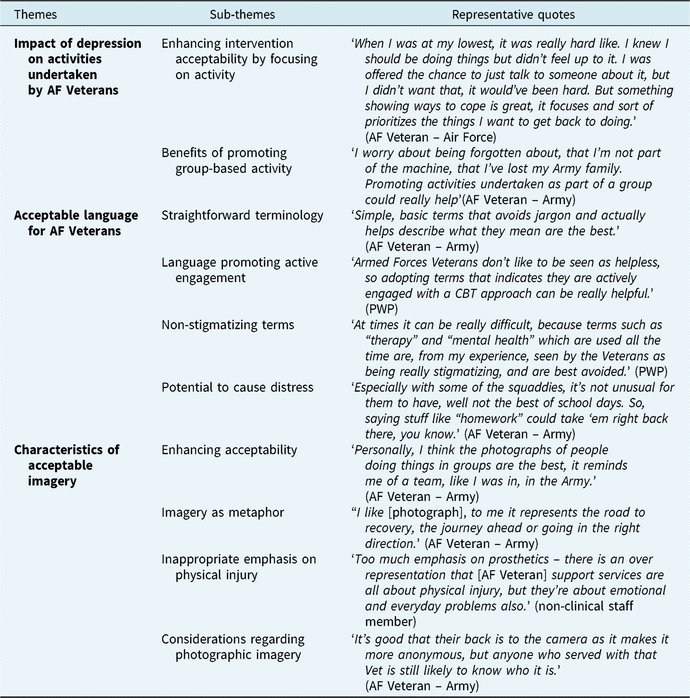
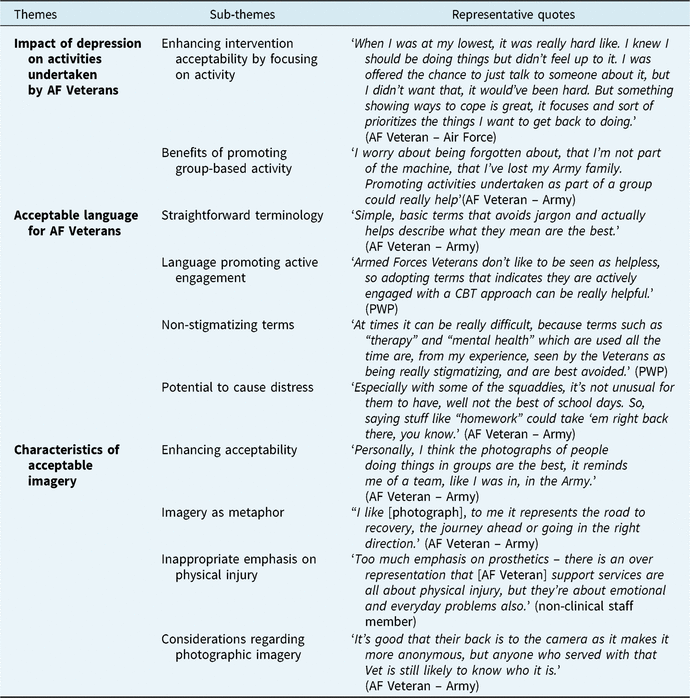
Themes and sub-themes were derived from the three main sections covered by the topic guide (Table 1).
Themes and sub-themes with representative quotes
Theme 1: Impact of Depression on Activities Undertaken by AF Veterans
The main impacts of depression associated with reducing activity and behavioural avoidance are consistent with the phenomenology of depression in the general population. Two sub-themes highlighted how focusing an intervention on increasing activities commonly undertaken by AF Veterans, in particular activity undertaken as part of a wider group, could enhance the acceptability of CBT.
Sub-theme 1: Enhancing intervention acceptability by focusing on activity
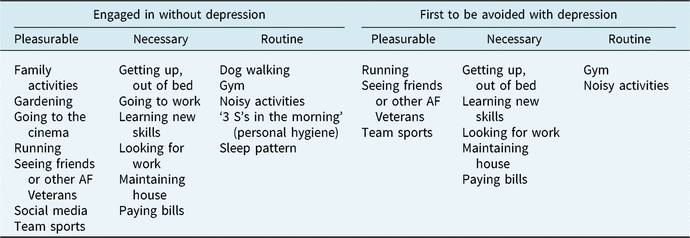
All participants highlighted that no longer engaging in activities was a key symptom of depression experienced by AF Veterans. Given the increased priority placed on activity when serving, engaging in fewer activities with depression was considered to have considerable impact. The acceptability of CBT interventions was felt to be enhanced if they focused on, or made reference to, types of activity AF Veterans commonly engaged in (Table 2). Whilst participants highlighted engaging in all types of activities when not experiencing depression, ‘Necessary’ activities such as going to work, paying bills or looking for work were identified as being among the first to be avoided with depression.
Types of activities associated with AF Veterans

Sub-theme 2: Benefits of promoting group-based activity
To re-establish a sense of belonging and connectedness to others perceived as being lost when leaving the Armed Forces, all participant groups highlighted the value of promoting group-based activities as part of any CBT intervention. Working as part of a team was something identified as being synonymous with Armed Forces life.
Theme 2: Acceptable Language
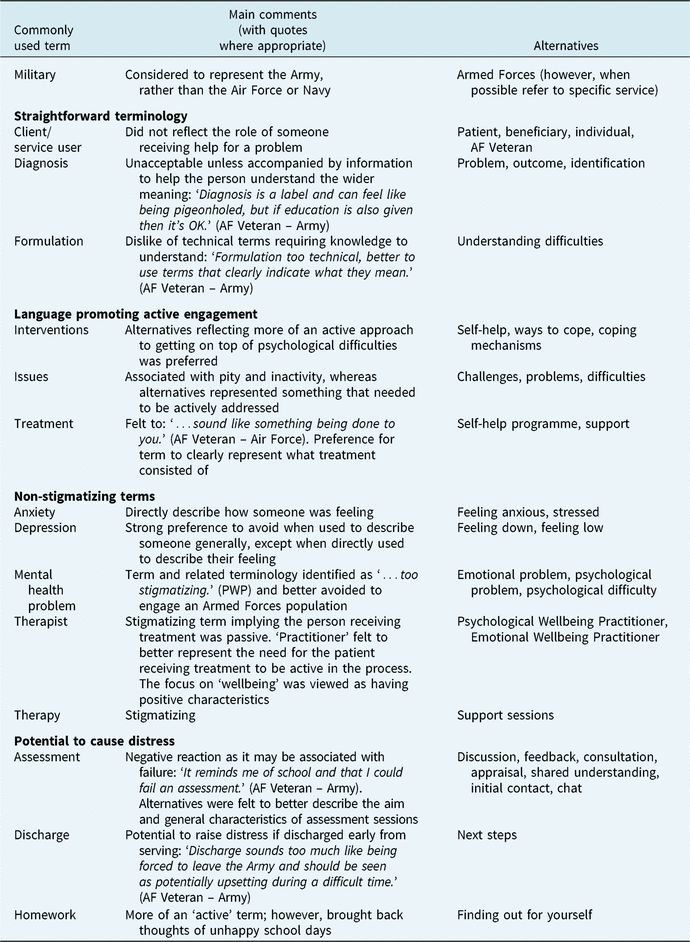
Reported by PWPs, welfare staff alongside two Army and Air Force Veteran service users, a strong association was perceived to exist between the terms ‘Army’ and ‘Military’. This resulted in a preference being expressed for initial use of the collective noun ‘Armed Forces’, until the specific service had been established from which point that should be adopted. Four sub-themes emerged with respect to the acceptability of language adopted within CBT (Table 3).
Acceptability of common CBT terms with alternatives

Sub-theme 1: Straightforward terminology
There was an awareness that at times technical terms could not be avoided. However, participants expressed a preference for terms that better described what they were referring to and helped to promote understanding whenever possible. For example, ‘understanding difficulties’ had much greater acceptability than ‘formulation’ that was identified as ‘technical jargon’ requiring further unnecessary discussion to describe meaning that could provide a source of confusion.
Sub-theme 2: Language promoting active engagement
Participants highlighted preference for terms that reflected active engagement with treatment. Terms associated with ‘self-help’ or promoting ‘ways to cope’ were especially well received.
Sub-theme 3: Non-stigmatizing terms.
Considerable attention was directed towards terms identified as being highly stigmatizing and could prevent help-seeking. On many occasions these were terms such as ‘therapy’, ‘therapist’ and ‘mental health’ commonly associated with psychological therapies and adopted within mental health services.
Sub-theme 4: Potential to cause distress
There was a preference to avoid terms that may be easily related to negative life events. For example, although representing activity, ‘homework’ was felt to have the potential to be associated with unhappy school days with ‘discharge’ associated with having to leave the Armed Forces too early.
Theme 3: Characteristics of Acceptable Visual Imagery
Four sub-themes emerged regarding the acceptability of visual imagery for inclusion in CBT self-help interventions and promote mental health services that accommodated AF Veterans. However, some concerns were also highlighted regarding the use of photographic images.
Sub-theme 1: Images enhancing engagement
Participants from all groups expressed a strong preference towards using visual images representing physical activities, small construction exercises or groups. Such imagery was preferred to that depicting people engaging in passive and solitary activities such as painting, yoga or other forms of relaxation. However, there was a lack of agreement with little consensus regarding the use of photographs representing relationships and family status. In particular, three welfare staff participants felt the use of photographs depicting families may serve to exclude AF Veterans without children, although this was not raised by the Veterans themselves. This issue was further explored with a compromise reached to adopt images representing the wider ‘Armed Forces family’, in addition to those representing traditional families. Additionally, whilst it was recognized that not all members of the Armed Forces had tattoos, they were identified as synonymous with the Armed Forces and may represent a quick way to help engage AF Veterans.
Sub-theme 2: Visual imagery as metaphor
Especially amongst AF Veterans and welfare staff, photographic imagery reflecting outdoor activities and people in natural surroundings was identified as having the highest levels of acceptability. AF Veterans also identified some of these images as having the potential to promote acceptable metaphors. Many images of groups in general were identified as metaphors representing group cohesion and ‘esprit de corps’. For example, a group working together on a construction exercise was felt to represent ‘rebuilding lives’.
Sub-theme 3: Inappropriate emphasis on physical injury
Lower levels of acceptability were associated with an over-emphasis on images used by AF Veteran specific services regarding physically injured Veterans, especially amputees from more recent conflicts. Solely focusing on physical injury was felt to exclude those experiencing mental health difficulties and reduce help-seeking. Adequately representing all AF Veterans in imagery, regardless of the mental or physical difficulty being experienced, age or rank was stressed as important.
Sub-theme 4: Considerations regarding photographic imagery
Two Army AF Veteran service users highlighted the need to consider the nature of the photographic images used with members of the AF community. For example, a photograph of sunlight shining through leaves into an enclosed shaded wooded area was felt to have potential to ‘trigger a flashback’ associated with PTSD (AF Veteran – Army). Additionally, concern across all groups was raised regarding the potential to compromise the confidentiality of Veterans appearing in photographic images. Solutions identified an increased use of illustrations to replace close shots of Veterans, or for scenes that could raise concerns.
Discussion
Results of this focus group are helpful in beginning to identify acceptable characteristics of CBT for depression in AF Veterans, with potential to inform current practice and future research. Appreciating the specific impact of depression on activities representing common features of Armed Forces life appeared to be especially helpful in promoting engagement with CBT. Additionally, adapting CBT practice with consideration to the use of language and imagery emphasizing group-based activities with potential to represent metaphors consistent with features of AF culture is particularly suited to an AF Veteran population.
The acceptability of CBT for treating depression in AF Veterans is enhanced by adopting interventions that place emphasis on overcoming behavioural avoidance. This emphasis could be accommodated by CBT interventions such as behavioural activation (Richards, Reference Richards, Bennett-Levy, Richards, Farrand, Christensen, Griffiths and Kavanagh2010), with certain models also promoting physical activity to improve both mental and physical health outcomes (Farrand et al., Reference Farrand, Pentecost, Greaves, Taylor, Warren and Green2014).
Within a general adult population, depression is commonly recognized as first causing significant disruption to ‘Routine’ activities (Jacobson et al., Reference Jacobson, Martell and Dimidjian2001). However, whilst being aware of limitations associated with classifying activities for others within an idiographic model of behavioural activation (Richards, Reference Richards, Bennett-Levy, Richards, Farrand, Christensen, Griffiths and Kavanagh2010), ‘Necessary’ activities were predominantly identified in this study as being amongst the first to be avoided by AF Veterans. This is of particular concern given that failing to complete these activities can have significant negative impacts and represent an especially important consideration during the transition of AF Veterans into civilian life (Binks and Cambridge, Reference Binks and Cambridge2018). Although most AF Veterans cope well with this transition (Iversen and Greenberg, Reference Iversen and Greenberg2009), there is a significant minority who experience difficulties (Iversen et al., Reference Iversen, Dyson, Smith, Greenberg, Walwyn and Unwin2005). With an emphasis on supporting engagement with ‘Necessary’ in addition to ‘Routine’ and ‘Pleasurable’ activities, behavioural activation may represent a suitable CBT intervention to overcome depression in AF Veterans experiencing difficulties such as finding employment and housing during transition back into civilian life.
Ensuring language is consistent with characteristics of the AF culture was also identified as important to inform the practice of CBT and intervention development. This result suggests that, as far as possible, CBT terminology should be self-explanatory, emphasize active engagement in treatment and ideally be straightforward, thereby avoiding jargon. Additionally, terms such as therapist or therapy have potential to create stigma and making use of alternatives may increase engagement. Reducing stigma is especially important in the AF Veteran population given a significant deleterious impact on help-seeking (Sharp et al., Reference Sharp, Fear, Rona, Wessely, Greenberg and Jones2015). Greater consideration given to language has also been shown to reduce stigma associated with mental health in other settings, for example with respect to the label ‘schizophrenia’ (Lasalvia et al., Reference Lasalvia, Penta, Sartorius and Henderson2015).
Adopting metaphors and analogy commonly used within the Armed Forces (Zinzow et al., Reference Zinzow, Britt, McFadden, Burnette and Gillispie2012) was further recognized as one way to enhance understanding. For example, adopting the phrase ‘test and adjust’, representing controlled breathing and taking aim with a long-barrelled weapon may have utility if adopted as analogous to ‘Recording and Testing Out Automatic Thoughts’ and ‘Constructing Realistic and Balanced Thoughts’. Furthermore, unless known in advance, engagement was felt to be enhanced by initially adopting the term ‘Armed Forces’ at the beginning of assessment but making reference to the specific service during subsequent sessions. This potentially helped to reinforce an Armed Forces norm associated with attention to detail (Hall, Reference Hall2011).
Imagery was also identified as having potential to promote engagement and enhance the delivery of CBT. In particular, several visual images were identified as representing metaphors for features of AF culture associated with group cohesion and ‘esprit de corps’. For example, an image of a group of walkers hiking along a path was identified as representing the ‘road to recovery’. Furthermore, the use of mental imagery to support high-intensity CBT techniques (Hackman et al., Reference Hackman, Bennett-Levy and Holmes2011), such as reliving or re-scripting in the treatment of PTSD (Grey, Reference Grey and L.2009), may highlight imagery as being particularly suitable when working with AF Veterans. However, consideration should also be given to characteristics associated with the visual images adopted. In particular, greater effort should be taken to enhance inclusivity by ensuring images better captured the diverse nature of difficulties and personal characteristics of all AF Veterans. Several visual images presented in our study focused on younger physically injured AF Veterans from recent conflicts who were often amputees. However, focusing on this imagery alone has potential to reinforce beliefs that such difficulties take priority over mental health. This might inadvertently reduce help-seeking for mental health difficulties.
Overall, acknowledging the AF community as representing a specific institutional culture emphasizing trust and loyalty as core values, norms associated with discipline, attention to detail, cohesion, ‘esprit de corps’, professional ethos, alongside placing importance on ceremonial displays (Snider, Reference Snider1999) represents the potential to enhance the acceptability of CBT for AF Veterans. Furthermore, enhancing cultural competence in the CBT workforce at both Steps 2 and 3 within a Stepped Care service delivery model (Bower and Gilbody, Reference Bower and Gilbody2005) may be especially important in achieving service access rates specified by the Armed Forces Covenant (Ministry of Defence, 2011).
Working effectively with AF Veterans, serving personnel or family members (Hall, Reference Hall2011) should therefore inform proposals to direct greater attention within health and social care settings towards distinct features of the Armed Forces (Sharp et al., Reference Sharp, Fear, Rona, Wessely, Greenberg and Jones2015; Zinzow et al., Reference Zinzow, Britt, McFadden, Burnette and Gillispie2012). This is especially important with respect to mental health given that the AF culture may shape attitudes and opinions that serve as a barrier to treatment seeking and engagement (Langston et al., Reference Langston, Gould and Greenberg2007). Furthermore, the Armed Forces having a distinct institutional culture highlights the importance of considering other emergency first responders (for example paramedics, police, firefighters) as also having their own culture (Kleim and Westphal, Reference Kleim and Westphal2011).
This study has several limitations associated with generalizing results from a single focus group, particularly accounting for AF Veterans varying by service, age, rank, discharge type in addition to family members. However, based within the Pre-clinical and Phase I of the MRC framework (Craig et al., Reference Craig, Dieppe, Macintyre, Michie, Nazareth and Petticrew2008), study results have the potential to inform further research to examine necessary adaptations across groups of AF Veterans. Furthermore, as adapted interventions risk losing their link to the evidence base justifying adoption (Castro et al., Reference Castro, Barrera and Martinez2004), there remains a need for ongoing research to examine effectiveness of interventions adapted for groups of AF Veterans. Enhancing the cultural competence of the CBT workforce with respect to the Armed Forces, in addition to culturally adapting the delivery of CBT more generally, may enable statutory mental health services to better accommodate the specific needs of AF Veterans and family members to encourage uptake of mental health services by those who need them.
Acknowledgements
The authors would like to thank the focus group participants and all staff within ‘Help for Heroes’ who helped facilitate the recruitment process.
Conflicts of interest
Paul Farrand, Kat Rayson, Alberta Engelbrecht and Neil Greenberg have no conflicts of interest with respect to this publication. Karen Mead is an employee of Help for Heroes. However, she had no involvement in any aspect of the study associated with data collection, analysis, interpretation, reporting or the decision to submit the article for publication.
Ethical statement
The authors have abided by the Ethical Principles of Psychologists and Code of Conduct as set out by the APA. Following research approval granted by ‘Help for Heroes’, ethical approval was granted by the University of Exeter psychology research ethics committee.
Financial support
The study was funded by ‘Help for Heroes’ as part of a wider research programme.



Comments
No Comments have been published for this article.