Introduction
Damage caused by the gram pod borer, Helicoverpa armigera (Hübner) (Lepidoptera: Noctuidae), is a limiting factor in crop production due to the polyphagous nature of this pest. Helicoverpa armigera causes US $300 million in damage to legumes every year in India, but the total annual damage to crops is estimated to be nearly US $1 billion (Gujar et al., Reference Gujar, Kumari, Kallia and Chandrashekar2000). In the recent past, management tactics for H. armigera damage have included the use of biocontrol agents like Bacillus thuringiensis Berliner (Bt). However, during the past decade, many laboratory studies have documented insect resistance to Bt, and it has been predicted that increasing the usage of conventional Bt sprays or Bt transgenic crops in the field could hasten the development of resistance (Gould et al., Reference Gould, Anderson, Jones, Sumerford, Heckel, Lopez, Micinski, Leonard and Laster1997; Ferre & Van Rie, Reference Ferre and van Rie2002). Management strategies to delay the development of field resistance to Bt deployed as conventional sprays or Bt transgenic plants have been discussed in detail (Tabashnik, Reference Tabashnik1994; Trisyono & Whalon, Reference Trisyono and Whalon1997), and the only strategy that has been used to manage resistance is a high dose/refuge strategy for transgenic crops (Tabashnik et al., Reference Tabashnik, Carriere, Dennehy, Morin, Sisterson, Roush, Shelton and Zhao2003). Similarly, rotations of insecticides with different modes of action and insecticide mixtures combined with crop rotation also have been used as a strategy to avoid resistance development to synthetic sprays (Pimentel & Burgess, Reference Pimentel and Burgess1985; Roush, Reference Roush1989; Tabashnik, Reference Tabashnik1989). The influence of plant allelochemicals on the activity of Bt toxins has been demonstrated as an integrated pest management approach that delays resistance (Sivamani et al., Reference Sivamani, Rajendran, Senrayan, Ananthakrishnan and Kunthala1992; Murray et al., Reference Murray, Alford, Groden, Drummond, Storch, Bentley and Sugathapala1993).
Neem as a whole, or its main active ingredient, azadirachtin, plays a vital role in pest management as an environmentally safe alternative biopesticide, and various studies have suggested that the insecticidal activity of neem extracts is a result of azadirachtin intoxication. Antifeedant effects of azadirachtin, and its insect growth inhibitory and growth regulatory properties, have been extensively studied (Koul & Wahab, Reference Koul and Wahab2004). In fact, the efficacy of neem-based products is determined by the amount of azadirachtin and the type of formulation (Stark & Walter, Reference Stark and Walter1995). Therefore, this compound could be useful in combination with Bt to increase efficacy and host range as well as to reduce the likelihood of resistance development. There are few studies available where the efficacies of Bt and neem have been evaluated (Moar & Trumble, Reference Moar and Trumble1987; Trisyono & Whalon, Reference Trisyono and Whalon1999, Devaki & Krishnayya, Reference Devaki and Krishnayya2004). Studies against Spodoptera exigua (Hübner) (Lepidoptera: Noctuidae) suggested the potentiation of exotoxin (thuringiensin) with Dipel 2X spray formulation but at the same time demonstrated antagonism between Dipel and neem. The development time of Leptinotarsa decimpunctata (Say) (Coleopetra: Chrysomelidae) larvae was significantly reduced after receiving endotoxin following citrus limonoid treatment, suggesting that citrus limonoid antifeedants could be effectively used in conjunction with Bt endotoxin in an integrated approach (Murray et al., Reference Murray, Alford, Groden, Drummond, Storch, Bentley and Sugathapala1993). The toxicity of neem and Bt combinations against second instar Bt-susceptible and -resistant L. decimpunctata larvae also suggested an enhancement in insecticidal activity by the combination. In fact, these studies demonstrated that the combination of neem and Bt resulted in a synergistic effect to larvae of the Bt-resistant strain (Altre et al., 1996; Trisyono & Whalon, Reference Trisyono and Whalon1999).
The present studies were directed towards the efficacy of neem/azadirachtin applied alone or in combination with Bt sprays or individual toxins against H. armigera larvae. Approaches were developed to determine the efficacy of various combinations based on effective (EC), lethal (LC), sub-effective or sub-lethal concentrations to compare the enhancement in efficacy with the exposure time required to induce mortality.
Materials and methods
Chemicals
Test material consisted of neem seed extract with known concentration of azadirachtin (1500 ppm). The azadirachtin (AZA) content of extracts was determined using reverse phase high performance liquid chromatography (HPLC, Shimadzu, Japan) using the procedure of Govindachari et al. (Reference Govindachari, Narasimhan, Suresh, Partho, Gopalakrishnan and Krishnakumari1995), and AZA was detected at 215 nm. AZA (>95% purity) was used as a comparative standard provided by late Professor Govindachari.
Delfin®WG™ (Certis USA, LLC), a biological insecticide based on B. thuringiensis subspecies kurstaki serotype 3a and 3b (concentrate after fermentation), with a potency of 53,000 SU mg−1, was used alone and in combinations with neem materials.
Cry1Ac was isolated by the protocol of Lee et al. (Reference Lee, Milne and Dean1992). Recombinant E. coli (JM 103) expressing the Cry1Ac gene was kindly provided by the Bacillus Genetic Stock Center, The Ohio State University, Columbus, Ohio, USA. Luria agar plates containing 50 μg ml−1 ampicillin were used to grow the Escherichia coli cells for 48 h at 37°C. The cells were harvested by scraping, the content was centrifuged at 5009 g for 10 min, and the pellet was suspended in 50 ml of lysis buffer (50 mm Tris-hydrochloride, 50 mm ethylenediamine tetraacetic acid, 15% sucrose, pH 8.0, 2 mg ml−1 lysozyme) and incubated for 12 h at 37°C. After sonicating the suspension, it was washed with ice cold 0.5 m NaCl containing 2% Triton X-100 followed by 0.5 m NaCl and sterile distilled water. In all steps, the protease inhibitor, phenylmethyl sulphonyl fluoride, was added at 1 mm concentration. The final pellet containing inclusion bodies was solubilized in 50 mm sodium carbonate buffer (pH 10.5, containing 10 mm dithiotheritol) at 37°C for 6 h and subsequently centrifuged at 7826 g for 10 min. The supernatant, containing the solubilized protoxin, was activated by bovine trypsin at 10:1 ratio (toxin:trypsin) for 12 h and then stored at −20°C. Toxin protein was quantified by Bradford dye binding method (Bradford, Reference Bradford1976) and was estimated to be 0.30 mg ml−1.
Insects
Helicoverpa armigera larvae were taken from laboratory cultures maintained on artificial diet prepared in the laboratory (Koul et al., Reference Koul, Shankar, Mehta, Taneja, Tripathi and Dhar1997). The cultures were maintained at 27±1°C at 16:8 L:D photoperiod using our standard procedures (Koul et al., Reference Koul, Shankar, Mehta, Taneja, Tripathi and Dhar1997). First, second, third and fourth instars were used in various experiments (n=60 in each treatment).
Bioassays
Acute toxicity (measured as mortality) and growth inhibition of H. armigera larvae by neem extracts based on the active ingredient azadirachtin (1500 ppm AZA as AI), to be referred as AZA from here onwards, and Bt formulation (Delfin) was determined by feeding neonate, second, third and fourth instars 0.1–40 ppm AZA or 1–300 ppm of Bt. These were individually mixed with the dry portion of the artificial diet at respective concentrations in a carrier. Control diet was treated with carrier alone.
Upon hatching, single 24-h-old neonates or second to fourth instars were placed on 1 g diet in an individual solo cup (1 oz) as previously described (Koul et al., Reference Koul, Smirle and Isman1990). The cups were kept in a plastic tray lined with moistened filter paper to maintain humidity. The experiments were carried out in a growth chamber at 27±2°C at 16:8 L:D photoperiod. Larval growth was assessed as a percentage of the control after 7 days based on larval weight. This was done to determine the effective concentrations (EC) responsible for inducing growth inhibition in various treatments. Larval mortality was recorded every 24 h for each treatment and LC20, LC50, and LC95 values were determined. Sixty larvae were used for each concentration. The concentration inhibiting 20, 50 and 95% growth relative to the control was determined by regression analysis and became the EC20, EC50 and EC95 values, respectively. Experiments were repeated in triplicate.
Sublethal growth and toxicity levels (EC20 and LC20) of both AZA and Bt were determined in order to prepare binary mixtures of neem and Bt based on EC and LC combinations. The combinations were prepared in such a way that each diet had specific amounts of EC or LC concentration in a mixture. However, in case of AZA (based on AZA as AI), which was not toxic at the concentrations used and dosage required to induce mortality was extremely high, only EC levels of treatment were used in various combinations. The treatments of Cry1Ac (0.01–0.5 μg ml−1) to H. armigera larvae (2-day-old) were given in exactly the same way as those of Bt formulation or AZA in order to record the differences, if any, between the combinations of Bt formulation+AZA or Cry1Ac+AZA.
Probit analysis (Finney, Reference Finney1971) was used to determine the LC20, LC50, LC95 and the corresponding 95% confidence intervals. Tukey's test using SYSTAT (Wilkinson, Reference Wilkinson1990) and analysis of variance (ANOVA) with means separated by least significant difference (LSD) multiple range test at P<0.05 were performed on the data to determine significance (SPSS Inc., 1999).
Results
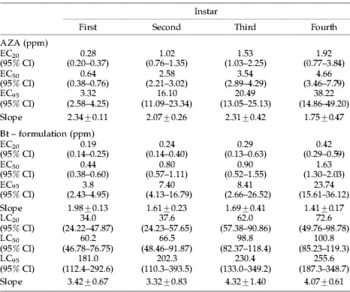
The initial diet bioassay against neonates of H. armigera using AZA and Bt was to assess growth inhibition. The effective concentration of AZA and Bt to inhibit 50% growth (EC50) was 0.64 and 0.44 ppm, respectively. To achieve similar inhibition against second, third and fourth instars, there was a gradual increase in the concentration of each component (table 1). Similar effects were recorded at sub-effective (EC20) and acute (EC95) treatments (table 1).
Effective concentrations (ppm) of AZA and Bt formulation that inhibited growth and induced mortality of Helicoverpa armigera larvae in a dietary assay.

The lethal concentration of Bt to induce 50% (LC50) mortality of neonates within 7 days post-treatment was 60.2 ppm. The sub-lethal concentration to induce 20% mortality (LC20) was similar against first and second instars and was two-fold higher against third and fourth instars (table 1). LC95 values were much higher, ranging between 181 and 255 ppm against various H. armigera instars (table 1). However, as mentioned above, lethality of AZA was not considered, as dosage required to induce mortality was extremely high, and EC levels of treatment were very effective in various combinations.
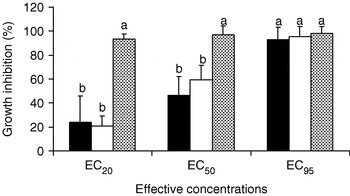
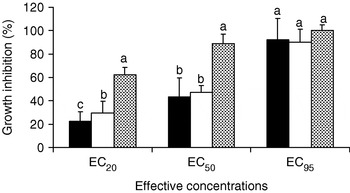
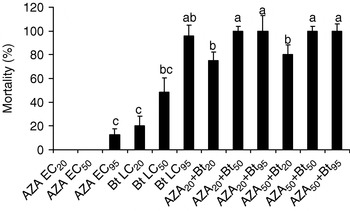
In order to check the efficacy in various combinations of AZA and Bt against neonates, combinations at both EC20 and EC50 levels reduced the growth by 93.5 and 97.3%, respectively, similar to the EC95 level of efficacy (fig. 1). Individually, AZA or Bt treatments did not result in high mortality at these levels (6.25–12.5% only). The combination of AZA and Bt at EC20 and EC50 levels exhibited moderate increase in mortality from 6.25% to 25%; but EC95 levels resulted in 87.5% mortality, which was much higher than the individual treatments. In the treatment of LC (Bt) and EC (AZA) combinations, there was a significant increase in mortality in LC20+EC50 and LC50+EC50 combinations as compared to the mortality induced in individual EC treatments of AZA (3–10%). In fact, 61.5% mortality was obtained in LC20+EC50 combination and 100% mortality in LC50+EC50 and LC50+EC95 combinations in comparison to individual treatments. Similar efficacy was also recorded against second instars. Although the pattern of efficacy was similar in third instar treatments (fig. 2), no mortality was recorded in EC combinations. However, significant increase in growth inhibition was recorded in Bt EC50+AZA EC50 combination (F=63.7, df=3, P<0.001). There was definitely a pattern in inducing toxicity when EC doses for AZA were combined with LC doses for Bt in bioassays of third instars. With the increase in AZA in the combination, there was substantial increase in the larval mortality (fig. 3). AZA at EC20 or EC50 and Bt at LC20 treatments increased the 20% mortality by Bt alone to >70% (fig. 3).
Growth inhibition of Helicoverpa armigera neonates treated with AZA (■), Bt spray formulation (□), or a combination of AZA+Bt ( ) at 20, 50 and 95% effective concentrations (EC). Bars (mean±SE) within a treatment with the same letter do not differ significantly at α=0.05 (ANOVA and LSD).

Growth inhibition of third instar Helicoverpa armigera larvae treated with AZA (■), Bt spray formulation (□) or combination of AZA+Bt () at 20, 50 and 95% effective concentrations (EC). Bars (mean±SE) within a treatment with the same letter do not differ significantly at α=0.05 (ANOVA and LSD).

Mortality of third instar Helicoverpa armigera larvae treated with AZA, Bt spray formulation or combination of AZA+Bt at various lethal and sublethal concentrations of Bt with EC20 and EC50 concentrations of AZA. Bars (mean±SE) between the treatments with the same letter do not differ significantly at α=0.05 (ANOVA and LSD).

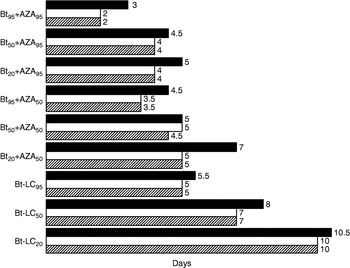
AZA and Bt combinations reduced the days to mortality of H. armigera larvae. Bt only treatments resulted in 50% mortality in 5–5.5 days, whereas the combination of AZA and Bt at the EC95 levels reduced the time to 50% mortality to 2–3 days, depending upon the stage of the larvae (fig. 4).
Time required (days) to induce 50% kill in first (), second (□) and third (■) instars of Helicoverpa armigera treated at various levels of Bt spray formulations, AZA or their combinations.

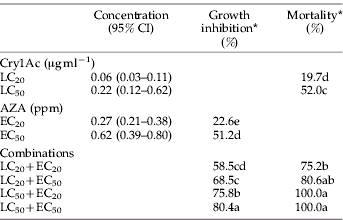
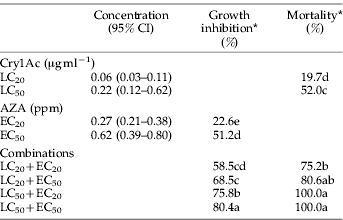
In bioassays of Cry1Ac in artificial diet with H. armigera larvae, the LC20 and LC50 were 0.06 and 0.22 μg ml−1 (table 2). The EC values for AZA in this experiment were 0.27 and 0.62, respectively (table 2). The effects of combinations of AZA and Cry1Ac on H. armigera larvae were similar to the effects obtained with AZA and Bt spray formulation combinations (compare fig. 2 and table 2). The LC50+EC20 and LC50+EC50 combinations (Cry1Ac+AZA) induced 100% mortality of H. armigera larvae 6 days post-treatment. However, the mortality also was significant in LC20+EC20 and LC20+EC50 combinations of Cry1Ac and AZA as well (P<0.05, Tukey test) (table 2).
Effective concentrations (ppm) of AZA that inhibited growth, Cry1Ac toxicity and combination effects in 2-d-old Helicoverpa armigera larvae in a dietary assay after 6 days of treatment.
* Means within a column followed by the same letter are not significantly different according to the Tukey test (P=0.05).
Discussion
Many different plant allelochemicals deter or inhibit feeding by insects (Koul, Reference Koul2005). The antifeedant and growth inhibitory activities of plant limonoids against a number of insects have been demonstrated (Champagne et al., Reference Champagne, Koul, Isman, Scudder and Towers1992); and more specifically, AZA from neem is among the compounds with good insecticidal potential, known to affect more than 400 species of insects (Koul & Wahab, Reference Koul and Wahab2004). Antifeedant and growth inhibitory properties of AZA were demonstrated in the laboratory against H. armigera (Koul et al., Reference Koul and Wahab2004). Furthermore, the allelochemical action of AZA against insects has been predicted by a variety of modes of action, such as acute toxicity, feeding reduction, growth disruption, oviposition suppression and repellence. In addition, allelochemicals may act as stress factors to increase the susceptibility of insects to other toxins (Murray et al., Reference Murray, Alford, Groden, Drummond, Storch, Bentley and Sugathapala1993). Accordingly, allelochemicals may be more effective when used in combination with other pest management tools. Therefore, neem extract enriched in AZA was an obvious choice to evaluate the performance of neem in combination with Bt.
We have tried to standardize the efficacy data based on individual EC and LC levels of AZA and Bt, and then evaluated combinations at both acute and subacute concentrations. The EC50 of AZA in H. armigera increased with the age of the larvae, and increased mortality was correlated to longer exposure to AZA. However, in the present study, the EC values for AZA were determined on the basis of 7-day post-treatment, so that such concentrations could be used in combinations and evaluated for increase in efficacy as well as the reduction in time to mortality. Because AZA is a slow acting compound, and its antifeedant and growth inhibitory effect varies depending on the concentration and the species of the target insect, observation time becomes an important variable in evaluating the toxicity of neem insecticides (Lowery & Isman, Reference Lowery and Isman1994).
In this study, the combination of AZA and a Bt formulation, Delfin, resulted in detrimental effects on larval growth and increased mortality of H. armigera larvae. The results with AZA and Cry1Ac were similar to AZA and Bt toxins Delfin spray formulations. It was evident that even at sublethal combinations of AZA and Bt, growth inhibition was significantly potentiated to almost 100% in the case of neonates and up to 60 to 90% in the case of third instars. Synergistic combinations between Bt and conventional insecticides have been noted against Spodoptera littoralis (Boisduval) (Lepidoptera: Noctuidae) (Salama et al., Reference Salama, Foda, Zaki and Moawad1984). However, results of mixtures of Bt and endosulfan against H. armigera varied depending on the concentrations of the toxins and the bioassay procedures (Pree & Daly, Reference Pree and Daly1996).
It was obvious from the present study that AZA and Bt applied separately or in combinations retarded the growth of H. armigera larvae, and there was enhanced activity even at sublethal levels of Bt when combined with various effective concentrations of AZA. It also was clearly demonstrated that, depending on the concentration combination, there was enhancement of toxicity, and the treatment duration was reduced significantly. It was obvious that at the LC20 to LC95 level of Bt for various instars, the time needed to achieve 50% mortality ranged between 5 to 10 days. However, when the same concentrations were used in a mixture with AZA at EC50 and EC95 levels, the time to induce the same mortality was reduced to about 48 h. Neem alone takes more than 20 days to induce mortality, which occurs due to starvation or growth inhibitory/regulatory effects of AZA. Our earlier studies with H. armigera have shown that in AZA-treated insect gut, the epithelial cells lose the papillae arrangement, and cells were swollen and cuboidal in shape. The apical brush border was less densely packed due to cell swelling and vacuolization. Nidi were in the process of degeneration (O. Koul, unpublished data) which suggests that AZA causes a slow necrosis, resulting in the reduction in regenerative cells of the nidi, and effects the peritrophic membrane, making the gut fragile and vulnerable to other toxins. Earlier studies also determined that AZA affects the activity of gut enzymes like trypsin and elastins (Koul et al., Reference Koul, Shankar and Kapil1996), causing further insult to the gut. Similarly, Bt toxins, under the alkaline conditions of the insect midgut, are proteolytically cleaved, releasing toxic fragments that bind to specific receptors located on the apical brush border membrane of the columnar epithelial cells (Rajyashri & Madan Mohan, Reference Rajyashri, Mohan, Koul and Dhaliwal2004). The toxin molecule inserts irreversibly into the plasma membrane of the cells, thereby forming an ion channel, which allows a rapid flux of ions across the membrane. Ultimately, the sequence of events results in midgut necrosis and death of the insect. Therefore, the mode of action of the two biopesticides suggests a complimentary interaction and suggests that AZA may facilitate the access of Bt toxins to gut receptors, hastening the binding of toxin to receptors and subsequently resulting in an increased efficacy.
There are few studies available where Bt and neem have been simultaneously used to evaluate combined efficacy (Moar & Trumble, Reference Moar and Trumble1987; Trisyono & Whalon, Reference Trisyono and Whalon1999). However, the reports are contradictory, and suggest both enhanced as well as antagonistic effects. It was demonstrated that several formulations of Bt (Dipel) were toxic to beet armyworm, S. exigua, but the action was antagonized after combination with neem extracts (Moar & Trumble, Reference Moar and Trumble1987). On the other hand, enhanced toxicity was observed when neem was used in combination with similar formulations of Dipel against Spodoptera litura (Fabricius) (Lepidoptera: Noctuidae) larvae (Devaki & Krishnayya, Reference Devaki and Krishnayya2004) or when neem or AZA was used with Bt against L. decemlineata (Trisyono & Whalon, Reference Trisyono and Whalon1999). The disparity in data could be due to the lack of standardization of EC and LC values, which makes them more difficult to compare and thereby reduces the usefulness of the results. In the present study, the combinations were used as mixtures, and the efficacy was determined for the mixture that may help in standardizing the application protocols.
AZA and Cry1Ac applied separately or in combination retarded the growth of H. armigera, larvae and these results are in agreement with Murray et al. (Reference Murray, Alford, Groden, Drummond, Storch, Bentley and Sugathapala1993) and Trisyono & Whalon (Reference Trisyono and Whalon1999), where endotoxins were used in combination with allelochemicals against L. decemlineata. However, we believe that the combined action is not synergistic, as reported, but rather complimentary to each other, in that AZA may be facilitating the action of Bt. The combination of AZA with a Bt spray formulation is more economical than combinations with isolated Bt toxins, and the Bt spray formulations are equally effective (Shelton et al., Reference Shelton, Zhao and Roush2002). These combinations may be useful for controlling bollworm populations with resistance to Bt by reducing the endotoxin concentrations in a mixture and thereby reducing the selection pressure of Bt. These types of strategies that incorporate combination applications are important for integrated pest management programmes to manage resistance, in that resistance to Bt toxins in foliar sprays has been detected in field populations of diamondback moth, Plutella xylostella (Linnaeus) (Lepidoptera: Plutellidae), in greenhouse populations of Trichoplusia ni (Hübner) (Lepidoptera: Noctuidae) (Janmaat & Myers, Reference Janmaat and Myers2003; Tabashnik et al., Reference Tabashnik, Carriere, Dennehy, Morin, Sisterson, Roush, Shelton and Zhao2003) and there are also a few cases, which demonstrate resistance development in Bt transgenic crops, apparently of a polygenic nature (Alves et al., Reference Alves, Spencer, Tabashnik and Siegfried2006).
Acknowledgements
The authors thank Brenda Oppert for valuable suggestions and critical review of an earlier draft of this article, and are also thankful to Sarvjeet Kaur for help in the preparation of Cry proteins. GS is grateful to the Indian Council of Agricultural Research for financial support.