The application of neurostimulation techniques such as deep brain stimulation (DBS)—often called a brain pacemaker for neurological conditions like Parkinson's disease (PD)—has generated “currents of hope.” Building on this hope, there is significant interest in applying neurostimulation to psychiatric disorders such as major depression and obsessive-compulsive disorder (OCD).1
Abbott A. Deep in thought. Nature 2005;436(7047):18–9.
The media are, in many respects, at the crossroads of numerous social forces that inform public discourse on science and medical practices. Hence, an examination of the media offers a window into some of the forces that shape public understanding of science and research. This paper reports results of a comparative study of neurostimulation techniques in print media from the United States and the United Kingdom, with a focus on the public understanding of neurostimulation and the coverage of ethical, legal, and social issues.
Methods
We generated a sample of print media using the guided news search function of the LexisNexis Academic database with keyword searches on general sources and newspapers. We ran searches for articles published between 1995 and 2004 in major English-language U.S. and U.K. news sources.2
Keywords searches—performed in headlines, lead paragraphs, and terms to maximize search yields—reflected scientific terminology used to describe the techniques (deep-brain stimulation, neurostimulation, neural stimulation, brain–machine interface, brain–computer interface, neural prosthesis, neural prostheses, transcranial magnetic stimulation, neural implant, cortical implant).
The results on neurostimulation presented here are part of a larger study examining print media coverage of neurotechnology. All articles were systematically coded by two independent coders (S.W. and E.R.) based on the instructions contained in a coding guide. This guide was developed for this specific study based on our research objectives and previous print media studies.3
Mountcastle-Shah E, Tambor E, Bernhardt BA, Geller G, Karaliukas R, Rodgers JE, et al. Assessing mass media reporting of disease-related genetic discoveries. Science Communication 2003;24(4):458–78; Racine E, Bar-Ilan O, Illes J. fMRI in the public eye. Nature Reviews Neuroscience 2005;6(2):159–64; Racine E, Bar-Ilan O, Illes J. Brain imaging: A decade of coverage in the print media. Science Communication 2006;28(1):122–43.
Results
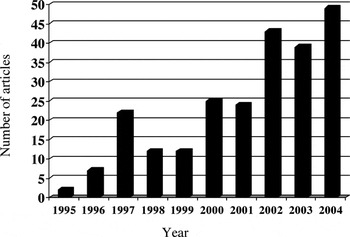
We identified 235 relevant articles4
Deep-brain stimulation (N = 114, 49%), transcranial magnetic stimulation (N = 46, 20%), brain–machine/–computer interfaces (N = 27, 11%), neurostimulation (N = 18, 8%), cortical implants (N = 16, 7%), cortical prostheses (N = 14, 6%).

Print media coverage of neurostimulation techniques (1995–2004).
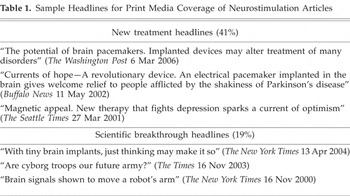
Sample Headlines for Print Media Coverage of Neurostimulation Articles

Following the International Classification of Diseases of the World Health Organization (ICD-10, http://www.who.int/classifications/icd/en/), we found that neurological conditions were featured in 66% (N = 155) of articles with a particular focus on Parkinson's disease (N = 118, 50%), cerebral palsy and other paralytic syndromes (N = 37, 16%), epilepsy (N = 20, 9%), and stroke (N = 19, 8%). Psychiatric conditions were featured in 21% (N = 50) of articles with a focus on mood disorders (N = 42, 18%) and stress-related disorders (N = 14, 6%).
The tone of the articles was mostly optimistic (N = 120, 51%), that is, featuring benefits of research on neurostimulation and its applications. The tone for 31% of articles (N = 72) was balanced (featuring both benefits and risks or issues). The remaining articles were either neutral (N = 33, 14%; no benefits and no risks or issues) or critical (N = 10, 4%; emphasizing risks and issues). Table 2 provides comprehensive data for the presence of benefits and issues. The most frequent clinical benefit was improvement of therapeutic procedures; the key nonclinical benefit was the basic development of devices. Safety and side effects were the most frequently cited scientific and medical issues whereas informed consent and respect for autonomy were the most frequently cited ethical, legal, and social concerns. We note that in this sample we did not find any statements discussing the reliability of neurostimulation techniques, discrimination and stigma, or policy and public involvement.
Benefits and Issues in Print Media Coverage of Neurostimulation Techniques

A considerable proportion of articles did not present any explanation of the scientific principles underlying neurostimulation techniques (N = 93, 40% of articles). Both elaborate explanations (more than three lines; N = 53, 23%) and simple explanations (two or three lines; N = 89, 38%) were also found. We further analyzed reporting practices for the subset of articles with an exclusive focus on research reporting (N = 47, 20%). The investigators (N = 38, 81%), their institution (N = 41, 87%), and the number of patients or subjects involved (N = 28, 60%) were identified in a majority of these articles. The details on funding sources (N = 12, 26%), source of the data, that is, where the study was presented or published (N = 12, 25%), details on conflicts of interest (N = 10, 21%), details on replication of the results (N = 7, 15%), and details on control and comparison groups (N = 5, 11%) were identified in fewer articles. We found a personal interest twist in 29% (N = 67) of articles. This included first person narratives of patients and sometimes of celebrities undergoing neurosurgery with DBS. Some statements resembled “miracle stories” of patients cured of PD, dystonia, and Tourette's Syndrome.
Discussion and Conclusion
Results of this study show that the public discussion on the ethical, legal, and social issues of neurostimulation techniques differs from the extensive coverage of such issues in media reporting of genetics research. Only 14% of the analyzed papers included ethical content whereas this figure is closer to 40% for print media coverage of genetics and genomics research.5
Smart A. Reporting the dawn of the post-genomic era: Who wants to live forever? Sociology of Health & Illness 2003;25(1):24–49; Tambor ES, Bernhardt BA, Rodgers J, Holtzman NA, Geller G. Mapping the human genome: An assessment of media coverage and public reaction. Genetics in Medicine 2002;4(1):31–6; Racine E, Gareau I, Doucet H, Laudy D, Jobin G, Schraedley-Desmond P. Hyped biomedical science or uncritical reporting? Press coverage of genomics (1992–2001) in Québec. Social Science & Medicine 2006;62(5):1278–90.
There are limitations to this study, including sample composition, which is limited to English-language sources of the United States and the United Kingdom. However, the data highlight some of the challenges of medical science reporting. The miracle stories about DBS covered by the media could alone increase existing pressures for expedited technology development and associated professional conflicts.6
Ausman JI. I told you it was going to happen. Surgical Neurology 2004;61(4):313–4; Ausman J. I told you it was going to happen … Part II. Surgical Neurology 2006;65(5):520–1; Ausman J. I told you it was going to happen … Part III. Surgical Neurology 2006;66(2):222–4.