Introduction
The central role that language plays in constituting, circulating, and reproducing the law is well recognized (Mellinkoff Reference Mellinkoff1963; Scheppelle Reference Scheppelle1990; Shuy Reference Shuy1998; Sarat & Kearns Reference Sarat, Kearns, Sarat and Kearns1996; Mertz Reference Mertz, Schieffelin, Woolard and Kroskrity1998, Reference Mertz2007; Tiersma Reference Tiersma1999; Ehrlich Reference Ehrlich2001; Eades Reference Eades2008). Among other things, legal discourse turns events into linguistic accounts, a process that Scheppelle (Reference Scheppelle1990) argues minimizes the actual differences between the two, and Mertz (Reference Mertz, Schieffelin, Woolard and Kroskrity1998) argues “translates” people, things, and events into categories and accounts that are applicable in a legal situation. “Legal institutions use language as an important and integral part of a socially transformative process [that renders] diverse realms of cultural experience in a common language” (Mertz Reference Mertz, Schieffelin, Woolard and Kroskrity1998:149). Similarly, Ehrlich (Reference Ehrlich2001:18–19) argues that law is institutionally coercive, “generat[ing] definitions and categories that discursively regulate and control social life,” by “filter[ing] out” stories, details, and people, deeming them extraneous, inconsequential, untrue, and/or untrustworthy. Whereas Trinch (Reference Trinch2003:1) argues ideas about language in the US civil and criminal justice systems “regarding truth and authorship serve in the construction of authority and credibility for the production of appropriate and meaningful representations of abuse” (emphasis in original). In other words, legal presumptions about language determine which versions of events will count as true and who can author “true” accounts. Legal discourses thus exclude alternative ways of explaining events (Smart Reference Smart1989:162). I suggest that discourses that manage accounts of events also impact discursive agency.
This article considers the discursive structures in the law of evidence that validate some versions of events and invalidate others, which by extension validates some speakers and not others, looking particularly at the role the law of evidence plays in the context of domestic violence crimes. Specifically, I interrogate the hearsay rule and the excited utterance exception to hearsay (US Federal Rules of Evidence (FRE),Footnote 1 1973/2010, Section 8)—rules that determine when certain types of out-of-court utterances can be repeated as proof or evidence in the testimony of a person other than the speaker of the out-of-court utterance. HearsayFootnote 2 is generally barred from in-court testimony, but there are more than twenty-five exceptions to the rule (FRE, 1973/2010, Sections 8.3 and 8.4). Analyzed here is the excited utterance exception, which admits out-of-court utterances that were made by a speaker when under “the stress of excitement caused by a startling event” which “still[s] the reflective faculties” of the speaker (Wigmore 1910, §1230; see also the FRE, 1973/2004). Hearsay is banned, because the Anglo-American law of evidence, with its roots deep in the seventeenth century, prefers “information which the speaker acquired through a direct experience” (Philips Reference Philips, Hill and Irvine1993:251), and is suspicious of second-hand information, such as hearing about an event rather than seeing it. Even though it is hearsay, an excited utterance is admissible because of what Ohio v. Roberts, (1980: 73)Footnote 4 has called its “inherent reliability.”. As admissible hearsay, an excited utterance can then be repeated, for example, in police officer testimony—the legal event in which it is spoken into evidence.
Thus there are two speakers involved with an excited utterance: (i) speaker 1, the person who purportedly made the “original” utterance (“That car hit him!”), and (ii) the witness who repeats the utterance in court (“She was very excited and crying when she told me, ‘That car hit him.’”). This analysis is concerned with the assumptions made in legal rules and precedents about speaker 1, the person to whom the excited utterance is attributed, when the utterance is admitted in the testimony of speaker 2; and with assumptions that allow it to be repeated, even when that speaker 1 is in the courtroom arguing that the excited utterance is untrue. Indeed, I am interested in understanding how this second-hand attribution of utterance to a person who is not giving testimony constrains and alters the discursive agency of speaker 1. This issue is especially important in the context of domestic violence, which often means that speaker 1 is the witness and the victim, and she may be present, trying to explain the original utterance, but ultimately unsuccessful because of the indexical power granted to the excited utterance that she is told she said.
Essentially metadiscursive, the hearsay rule and the excited utterance exception articulate a set of ideas about language that determine when an utterance is so trustworthy that it can be admitted in third-party testimony. As a discourse that operates according to rules that both control and reiterate ideas about language and articulate relationships between language, social values, and speakers, the hearsay rule and the excited utterance exception, and the affiliated precedents, function as a language ideology. A language ideology is a set of ideas about language use that associates particular aspects of language with particular groups of speakers (Silverstein Reference Silverstein, Clyne, Hanks and Hofbauer1979, Reference Silverstein and Lucy1993; Irvine Reference Irvine1989; Woolard & Schieffelin Reference Woolard and Schieffelin1994; Woolard Reference Woolard, Schieffelin, Woolard and Kroskrity1998; Irvine & Gal Reference Irvine, Gal and Kroskrity2000; Kroskrity Reference Kroskrity and Kroskrity2000). According to Irvine & Gal (Reference Irvine, Gal and Kroskrity2000:35), a language ideology is “suffused with the political and moral issues pervading the particular sociolinguistic field and are subject to the interests” of the people who hold the language ideology. That is, ideas about language circulated in discourses, such as the law, embed ideological and social presuppositions in ideas about what language is, how it functions, and how it relates to the world it represents and constitutes, and such presuppositions are then used to make sense of both speech and speakers in interaction. Irvine & Gal (Reference Irvine, Gal and Kroskrity2000) argue that language ideologies function via three processes—iconization, erasure, and fractal recursivity—which work together to laminate ideology onto language. Iconization naturalizes ideological relationships between speech and speakers; erasure explains away or ignores inconsistencies; and fractal recursivity relates a binary opposition that is integral in one part of the ideology to other parts (2000). This study focuses on the process of fractal recursivity to understand the binary construction of the excited utterance exception to hearsay.
Research into legal language ideology investigates the views of language held by judges (Philips Reference Philips1998); the ways in which attorneys use presupposition in direct- and cross-examination to influence and constrain witness answers (Conley, O'Barr, & Lind Reference Conley, O'Barr and Lind1978; Atkinson & Drew Reference Atkinson and Drew1979; Matoesian Reference Matoesian1993; Ehrlich Reference Ehrlich2001; Conley & O'Barr Reference Conley and O'Barr2005; Eades Reference Eades2008); the ways that some witnesses are able to resist the question-asking strategies of attorneys (Ehrlich & Sidnell Reference Ehrlich and Sidnell2006; and the effects of legal discourses and lawerly strategy to co-opt and alter victim accounts of their own experiences (Ehrlich Reference Ehrlich2001; Trinch Reference Trinch2003). Following such research, this article analyzes how the legal language ideology embedded in the FRE creates structures that control courtroom interaction, filtering out accounts and utterances deemed untrue or irrelevant, thus constraining speaker discursive agency, and in some cases, rendering it invisible.
Discursive agency is a linguistic “act with consequences” (Butler Reference Butler1997:7; cf. Medina Reference Medina2006). Following Butler (Reference Butler1997) and Medina (Reference Medina2006), neither the act nor the consequences are related to the intentions of the speaker, but rather, as I argue, they are effects of the language ideology that organizes and constrains the speaker, the utterance, and its institutionally salient effectiveness. Thus, though discursive agency involves linguistic action, it is important to note that it cannot be reduced to speaker intention.Footnote 5 Discursive agency is, in part, an effect of “being recognizable” (Butler Reference Butler1997:5), and is thus the product of prior discourses, social values, and expectations that are used to make sense of any utterance. As such, discursive agency is never wholly in the control of the speaker. According to Butler (Reference Butler1997:10), speech itself “subverts intentionality,” because every utterance holds the potential to “misfire” in some way, to be meaningful beyond or regardless of the explicit intentions of the speaker. Thus, discursive agency isn't something finite and singular that an individual possesses. Medina's (2006:130) model of discursive agency positions intention in relationship to context and situation, where it is essentially unstable “unfinished and open” to new contexts and interpretations (emphasis in original). “Discursive agency involves a process of constant recontextualization” (Medina Reference Medina2006:xiv), and is thus distributed across interactional contexts and discourses. This study combines language ideology with theories of discursive agency to understand the role metadiscourses play in making discursive agency “recognizable,” and the risks to particular speakers associated with that act, ultimately arguing that metadiscourses about language play a key role in the formation of discursive agency.
In what follows, I analyze the trial (2002) and appellate discourses of US v. Hadley (2005, hereafter Hadley), a case involving domestic violence, and a case in which the prosecution's (successful) argument hinges on the use of the excited utterance exception, which is used to admit this statement: “He has a gun. He's going to kill me” (Trial, Officer Williams Testimony, 2002:8).Footnote 6 In this case, police were dispatched to a “domestic disorder with a gun,” which was a “Priority 1” or a call “that needs the fastest and quickest response to the call” (Trial, Officer Jenkins Testimony, 2002:28). The police arrested Mr. Hadley “for the assault that occurred on Mrs. Hadley” (Trial, Officer Williams, 2002:23), and according to the police reports, Mrs. Hadley pressed charges (Trial, Prosecution, March 2003:12). The domestic assault charges were dismissed, however, and replaced with felony possession of a gun (Hadley, 2005:3), a gesture that downplays the domestic quality of the crime and the impact that this particular crime has on the victim. Domestic violence is essentially stripped from a case that has domestic assault at its core, which works to make Mrs. Hadley an instrument, an evidentiary index, for a crime having to do with a gun. Translated, as it is, to gun possession rather than domestic assault, Mrs. Hadley is not called as a witness during the trial; instead, her utterances about a gun, made on scene in an excited state, are admitted as evidence, circumventing her and positioning her as essentially untrustworthy. Mrs. Hadley attends the sentencing of her husband, Mr. Hadley, and insists that she be allowed to give testimony in defense of her husband then. In that testimony, Mrs. Hadley makes utterances that change the account of both the domestic violence and her earlier encounters with police and with the lead attorney for the prosecution. I map the fractally recursive relationships between competing utterances in US v. Hadley (trial 2002, appeal 2005). The oppositional structure of the hearsay rule and excited utterance exception, <true utterance/untrue utterance>, ultimately determines and structures a <discursive agency/no discursive agency> opposition.
The excited utterance exception and domestic violence in US v. Hadley
Since the 1980s and ‘90s, the time period that saw the criminalization of domestic violence across the country, the use of the excited utterance exception has become commonly applied in cases involving domestic violence. Because of the efforts of feminist legal reformFootnote 7 (cf. Smart Reference Smart1989; Schneider Reference Schneider2000), domestic assault was now a crime, but it had to be proved with old laws that were not developed to deal with the domestic sphere or violence between intimates. Because victims of domestic violence sometimes return to their abusive partners, drop charges, miss court dates, and invoke the spousal immunity to avoid giving testimony, one of the old laws used in this relatively new crime is hearsay and its exceptions, which provide a way of importing out-of-court utterances into the trial regardless of the wants of the speaker. The fact that abused women sometimes return to their partners also makes them recalcitrant and untrustworthy in the eyes of legal professionals, police, and juries (Lewis Reference Lewis1993). New policies have been developed that control and/or circumvent the recalcitrant witness. They allow the state to bring charges (Suk Reference Suk2006), do not allow women to drop charges later, and as with the excited utterance exception, they circumvent the need for the victim to give testimony.
Moreover, domestic assault, which has various labels in different police jurisdictions, remains a fairly minor crime in most cities and states, and it is thus commonly replaced with a charge for a more serious crime; in the case discussed here, aggravated domestic assault is replaced with possession of a gun. Domestic assault may be the reason for arrest, but as in the case described here, those charges may be replaced with charges that will garner longer prison time, but which expel the domestic or intimate context from the legal issue. This slows the development of case law that is actually about domestic violence, which would help this issue to pick up legal weight. Further, and more importantly, the dismissal of domestic charges side steps the very real body affected by the crime. This is what happened in the case analyzed here: aggravated domestic assault is replaced with felony possession of a gun. The ill fit between a new, domestic crime (domestic violence) and a traditional law is remedied by making the crime fit the law, and that law has historically been interested in public, male-on-male crimes, in which the parties involved are not intimates. It is also the state that brings charges such as gun possession, not the victim. The result is that the speaker of the excited utterance is reduced to an instrument of law, evidence, at the same time that prior utterances legally associated with abuse against her body are used to impeach her testimony. She is caught between two sets of her own utterances, both of which are made meaningful in relationship to legal discourses. One set of utterances is characterized with the hearsay rule and the excited utterance exception.
With hearsay, the person giving the testimony repeats an account of a crime that he or she only heard about but did not witness him- or herself. According to early English law, one can only give testimony of the things they have seen with their own eyes, not those events that they have only heard about (cf. Gilbert Reference Gilbert1754/1979).Footnote 8 Holding to its historical reasoning, hearsay is barred in our current FRE, because the person who actually witnessed the crime is not on the stand, and thus they cannot be cross-examined in front of the judge and jury. Moreover, the sixth amendment of the United States ConstitutionFootnote 9 ensures that a person accused of a crime has the right to confront those who give testimony against them (cf. Ohio v. Roberts, 1980; Crawford v. Washington, 2004; US v. Hadley, 2005; Giles v. California, 2008).Footnote 10 The excited utterance exception to hearsay admits “a statement relating to a startling event or condition made while the declarant was under the stress of excitement caused by the event or condition” (FRE, 803.2). An excited utterance is evaluated by looking at the physical display of the speaker (is s/he excited), the event (is it exciting or stressful enough to make the speaker excited), and the time between the speaker and the event (cf. Haggins v. Warden, Fort Pillow State Farm, 1983; Crawford v. Washington, 2004). The fact that the utterance was spoken in an excited state, the reasoning goes, ensures that the indexicality of the utterance is not muddied by the communicative goals, needs, and values of the speaker. As the court in White v. Illinois (1992:355–56) put it: “A statement that has been offered in a moment of excitement—without the opportunity to reflect on the consequences of one's exclamation—may justifiably carry more weight with a trier of fact than a similar statement offered in the relative calm of the courtroom.” That is, an excited utterance arguably has more evidentiary “weight” than does anything that could be heard in testimony, precisely because the speaker was excited and thus not reflective when it was uttered. An utterance deemed an excited utterance via trial processes is so trustworthy that cross-examination of the witness would be “superfluous” (Idaho v. Wright, 1990).
The utterance spoken to police the night Mr. Hadley was arrested for assaulting his wife was admitted during the trial as an excited utterance. According to trial transcript (US v. Hadley, 2002, 2003) and the appellate opinion (US v. Hadley, 2005), the events that led to Mr. Hadley's arrest are as follows. In May 2002, the Hadleys were having a party at their house. During the party, Mr. and Mrs. Hadley began to argue. As the argument escalated, they moved into their bedroom, where Mr. Hadley, a two-time convicted felon, removed a gun from a drawer and held it to his wife's head. Though the people at the party could not see the Hadleys, they could hear the fight, leading Mrs. Hadley's friend to call 911 twice. The 911 operator radioed to police that there was a domestic assault with a gun in progress, and in his testimony, Officer Tyrone Williams estimated that he arrived at the Hadley home within two minutes of the first call to 911, followed closely by Officer Alicia Jenkins. According to Officer Williams, when he arrived Mrs. Hadley ran out of the house to the police (without provocation from police) and blurted out “He has a gun. He's going to kill me” (Trial, Officer Williams, 2002:8). After locating the gun, Officer Williams arrested Mr. Hadley on charges of aggravated domestic assault. Those charges were soon replaced with new charges of felony possession of a gun—third strike. Mrs. Hadley gave testimony to the grand jury in the days following Mr. Hadley's arrest—testimony that she later claims she was manipulated into giving. As she put it during the sentencing phase of the trial (March 2003:22): “I did not want to be there. And you told me I had no choice but to be there. That's what you said.”Footnote 11 During the trial, she was not called to testify, but she came to sentencing and demanded that she be allowed to give testimony in defense of her husband. In the trial, the excited utterance—“He has a gun. He's going to kill me”—is introduced in the testimony of Officer Williams, which took place on the first day of the trial in November of 2002.
During sentencing, prosecuting attorneys, the attorney for the defense, and Judge Collier all used and debated the legal discourse of the excited utterance exception in order to determine which of Mrs. Hadley's accounts was true: the excited utterance (which was attributed to her in police testimony during the trial), or the version of events she gives on the stand during sentencing. The defense asserted that because of the inconsistent statements, everything Mrs. Hadley has ever said must be treated as a lie, and so all of her utterances should be discarded. That argument ultimately failed, because the defense does not engage the substance of the excited utterance rule—the circumstances that make the excited utterance inherently truthful. I focus my analysis on the exchange during sentencing between the lead attorney for the prosecution and Mrs. Hadley. The terms of debate set within excited utterance legal discourse position Mrs. Hadley within a binary framework, or what I discuss here as a fractal recursion, in which she can either be giving an excited utterance or making (legally) false statements.
Language ideology and discursive agency
The excited utterance exception to hearsay is a metadiscourse that works by filtering representations through institutional language ideologies, which also works to authorize speakers. Gal (Reference Gal2002:79), among others, equates metadiscourses with ideologies, explaining that “metadiscourses … comment on and regiment other communicative practices.” According to Bauman & Briggs (Reference Bauman, Briggs and Kroskrity2000:142), metadiscourses “both represent and regulate other discourses” and determine “who is authorized to speak or write or to be listened to or read, and in what sorts of social and institutional spaces.” Such regimenting often works normatively to rationalize and simplify sociolinguistic and contextual complexity, which happens, in part, through iconization, erasure and fractal recursivity (Irvine & Gal Reference Irvine, Gal and Kroskrity2000). Iconization is the process of treating “linguistic features that index social groups or activities” as though they are “iconic representations of them, as if a linguistic feature somehow depicted or displayed a social group's inherent nature or essence” (Irvine & Gal Reference Irvine, Gal and Kroskrity2000:37). The machinations that naturalize the feature for the group also tend to laminate onto the speech feature the more ideological aspects that have come to be linked historically or contextually to it. The related semiotic process of erasure “[simplifies] the sociolinguistic field” (Irvine & Gal Reference Irvine, Gal and Kroskrity2000:38). Via erasure, facts seen as inconsistent with the official story are “filtered through cultural and institutional ideologies” (Ehrlich Reference Ehrlich2001:4) and explained away, making “‘victims’ understandings of the events … unrecognizable or imperceptible” (Ehrlich Reference Ehrlich2001:1). Victims’ versions of their own experience are either ignored or transformed to fit the needs of the legal process.
Erasure works in sync with fractal recursivity, which simplifies the sociolinguistic field, by creating oppositions that organize and structure kinds of utterances and by extension speakers. Fractal recursivity does the work of organizing binaries, thereby “categorizing and differentiating cultural ‘objects’” (Gal Reference Gal2002:80). Fractal recursions are always indexical and “relative: dependent for part of their referential meaning on the interactional context in which they are used” (ibid.). The layers of binaries of a fractal recursion can be collapsed, making some of the more ideological aspects of the binary relationships and the events they structure indistinct or invisible. Besnier (Reference Besnier2004:317) explains fractal recursivity as “the mimetic patterning of one opposition … on to another.” In the context of the excited utterance exception, the legal process of determining which utterance is true also determines which utterances are not true.
Legal language ideologies are organized according to fractal recursivity, made all the more stable because the law is explicitly oppositional—the truth of A automatically implies falsity if not A. The binary structure makes the objects it organizes intelligible in relationship to each other oppositionally, organizing them into binaries of <A/not A> , which works to organize utterances into hierarchies. Figure 1 illustrates the basic binary relationship between the excited utterance and other utterances.
Basic binary relationship.

This fractal recursion determines which of the available utterances is admissible, “by virtue of its inherent trustworthiness” (Idaho v. Wright, 1990:657).
As Figure 2 shows, at a basic level, the excited utterance is admissible because it is inherently trustworthy. Thus, any utterance admitted as an excited utterance is inherently trustworthy, which establishes a static baseline standard for evaluating other utterances about the same event. The binary structure of the law simplifies the complexity of sociolinguistic interaction by presupposing that some utterances are inherently trustworthy.Footnote 12 The evaluation process either alters the indexicality of the utterance so that it can be fit into either side of the binary or renders utterances that cannot be forced into either side of the binary unrecognizable. When the binary that structures this rule is operationalized in a trial, any alternative utterances will be explained away as false and/or legally inconsequential.
Inherent trustworthiness.

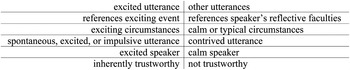
In the excited utterance exception, the most explicit organizing binary is <excited utterance/other (reflective, testimonial, false) utterance>. This binary is established in the definitions of the excited utterance that are used to evaluate and re-establish an excited utterance during trial and appeal. The definition in extract (1) comes from Haggins v. Warden, Fort Pillow State Farm (1983), one of the central precedents used in the US v. Hadley appellate opinion. This definition weaves together discourses from precedent with discourses from various legal treatises. (For the sake of clarity and brevity, I have omitted the paragraphs regarding the issue of time in the evaluation of the excited utterance, as this is not the central issue here.)
(1) Three elements are necessary for the admission of an excited utterance. First, there must be an event startling enough to cause nervous excitement. Second, the statement must be made before there is time to contrive or misrepresent. And, third, the statement must be made while the person is under the stress of the excitement caused by the event.
…
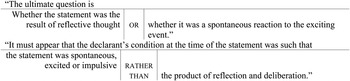
It is important to remember, however, that “the ultimate question is whether the statement was the result of reflective thought or whether it was a spontaneous reaction to the exciting event.” (Id.) Thus, a court must take into account other factors that could affect spontaneity. For example, the declarant's age or physical or mental condition might indicate that a statement is not the result of reflection even if it was made some time after the exciting event.“Testimony that the declarant still appeared ‘nervous’ or ‘distraught’ and that there was a reasonable basis for continuing emotional upset will often suffice” [McCormick's Handbook of the Law of Evidence § 297 at 705–706 (2d ed. 1972)].
In order to find that [Federal Rules of Evidence] 803(2) applies, it must appear that the declarant's condition at the time was such that the statement was spontaneous, excited or impulsive, rather than the product of reflection and deliberation. (Citing cases) (Emphasis added [in Haggins])” (quoting from States v. Iron Shell).
Definitions such as these operate according to and help maintain the language ideology of the hearsay rule that (i) trusts empirical, especially visually based, knowledge; (ii) understands trustworthy language to be independent from contextual and historical information; and (iii) trusts language produced spontaneously and in an excited state (Andrus Reference Andrus2009). In extract (1), we see the positive and negative criteria for an excited utterance, shown as oppositions in Figure 3.
Fractal recursion reiterated in the definition of the excited utterance.

Some version of these criteria is used in most appeals dealing with an excited utterance. In particular, the list of criteria in the first paragraph is used. Individual criteria are also used in trial arguments for or against the use of the excited utterance exception. The reasoning is founded on a seemingly natural assumption that some events are “naturally” more exciting than others, and that utterances made in response to such events will be excited and thus trustworthy. Spontaneity plays a central role in structuring this presumption about exciting events and speakers, and in fact Haggins (1983) expresses this oppositionally (see Figure 4). The explicit binary construction highlights the fundamental tenet of the excited utterance: spontaneous utterances are more trustworthy than rhetorical or subjective ones.
Binary structure of the definition in Haggins.

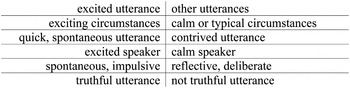
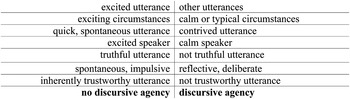
The discourse of the excited utterance exception, thus, filters out alternative explanations of a purported excited utterance. “[Excited utterances] have long been recognizedFootnote 13 as exceptions to the general rule prohibiting hearsay because they contain inherent guarantees of truthfulness” (Haggins, 1983:18, emphasis mine). When the value of “inherent guarantees of truthfulness” is fitted into the basic binary structure of the excited utterance, we get a fractal recursion in which an excited utterance is inherently true, making all other utterances at least potentially false by contrast (see Figure 5). The excited utterance is an unreflective utterance that bears no mark of the speaker's discursive agency. The excited utterance fractal recursion thus presupposes another binary: <no discursive agency/discursive agency> , one that is embedded in the fractal recursion (see Figure 6) but that is not explicit.
Inherently truthful development of definitional opposition.

Discursive agency in the fractal recursion of the excited utterance.

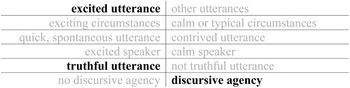
In the precedential fabric of the excited utterance exception, then, speaking on purpose is problematically aligned with false statements, positioning discursive agency as always already unreliable. Discursive agency is the product of the legal discourses in which the excited utterance is debated and established; it is a product of metadiscursive language ideologies with and in which it is recontextualized. When we collapse the structure of the language ideology (Figure 7), the consequences to discursive agency are highlighted: <excited utterance/other utterances> becomes <excited utterance/untruthful speech> , and because truthful speech is only produced when the speaker has no discursive agency the ultimate binary is <trustworthy utterance/no discursive agency>.
Collapsed fractal recursion.

The criteria used to evaluate an utterance offered as an excited utterance also assume and attribute discursive agency. To put it another way, the discourse provided by Anglo-American case law limits the attribution of agency within the institutional context, by creating seemingly neutral indexical links between different but related binaries. This legal discourse sets off a chain reaction that ripples back through time to characterize the utterance said in the “original” speech event. That is, when the speaker of the excited utterance is recontextualized in discourses that presuppose that the impulsive speech of an excited speaker is out of her control, then the process of determining the status of the utterance will also determine the discursive agency of the speaker. The in-court speaker is authorized to speak purposefully, repeating the utterance of someone else, precisely because that “original” utterance is not (anymore) associated with the discursive agency of an individual.
In the sentencing phase of the Hadley trial, the prosecution successfully used the fractal recursion established in excited utterance case law to explain why the excited utterance was the true account of events:
Of course, as an excited utterance, those words were closer in time to the event. She was still under distress by it. The officers testified about what kind of demeanor she had at the time that they arrived, that she was very upset. (Trial, June 2003:51)
Clearly Mrs. Hadley's statements at the scene on that night in May of 2002, before she had any further contact and influence by the defendant, to get her to lie, before she had time for reflection, which was presented in her excited utterance, those statements are certainly more credible than what she has since said then that is contrary to that—to the events of that night. (Trial, June 2003:52)
The excited utterance established during the Hadley trial creates the backdrop against which alternative accounts made by the same speaker can be measured and proven untrue. The very same argument also assumes that Mrs. Hadley is passively parroting her husband, saying what he has told her to say during phone conversations (Trial, prosecuting attorney: 73). Even when she speaks willfully, the discursive agency of the abused woman is attributed elsewhere, typically to her husband. The “truth” is in no way linked to Mrs. Hadley, who was either a victim of her husband and (i) made reflective and false utterances, or (ii) excited out of her reflective faculties and made one, single, inherently trustworthy utterance. Both are the result of the violence performed by the husband. The result of this binary structure in the case at hand is the erasure of Mrs. Hadley as an agent of discourse. As I discuss below, however, she still finds ways of disrupting the structure, albeit briefly.
“But I did have a choice. But you made sure that I didn't know that choice”
The sentencing in US v. Hadley began about nine months after Mr. Hadley was found guilty of felony possession of a gun. The primary evidence against Mr. Hadley was the excited utterance attributed to his wife given (in somewhat different ways) by Officers Williams and Jenkins, who responded to the 911 call. In the following exchanges the prosecution questions Mrs. Hadley, who is intent on providing a corrective for the excited utterance, which had already been admitted as evidence during the trial. In this questioning, the prosecution attributes and disattributes discursive agency to Mrs. Hadley following the structure of the fractal recursion established in the excited utterance exception. The prosecution's case relies on the excited utterance evidence admitted during the trial. In recounting that evidence the prosecuting attorney reiterated the excited utterance embedded in an account of the event that establishes both the speaker as excited and the event as exciting:
the officers testified that when they arrived at the scene after receiving a 911 call which had reported the defendant was beating his wife, they arrived at the scene and the wife ran out of the house screaming “He's got a gun. He's going to kill me.” That was testimony heard in this matter. Also, the 911 tape was played, and we could hear yelling and screaming in the background, definitely an altercation going on. (Trial, March 2003, Prosecution: 11–12)
Such discussion during sentencing reinforces the validity of the excited utterance, working against Mrs. Hadley who is trying to destabilize it.Footnote 14
Mrs. Hadley has appeared in court for sentencing on her own and asked to give testimony. In her testimony, she has an agenda that focuses on three things: (i) she does not remember what she said to police; (ii) she did not run out to the police and make a spontaneous exclamation; and (iii) during cross-examination by the prosecution, she argues that she was not adequately informed of her rights, in particular her right not to testify to the grand jury against her husband. Mrs. Hadley works to establish the new account of events in the first couple of minutes of direct examination done by the attorney for the defense.

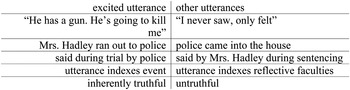
This was the first exchange between Mrs. Hadley and an attorney in the courtroom, and in it, she altered the circumstances in which the utterance was produced, used “I don't know” and “I don't remember” evasively, and distanced herself from the excited utterance by representing the police as actively entering her house and questioning her. Using “I don't know,” she also disclaimed authorship of the version of the event represented in the excited utterance. Figure 8 shows the basic binary structure being circulated in the Hadley trial and sentencing.
Fractal recursion in US v. Hadley.

As we see in the next section, when she was confronted with the excited utterance in this new and institutional context, Mrs. Hadley also represented herself not as the author of the excited utterance, which is used to measure the veracity of all other utterances, but as a person coerced to speak by those with more authority—primarily the police and the prosecution.
When Mrs. Hadley is questioned by the prosecution, the complicated relationship between discursive agency in a private domain and discursive agency in the rigid institutional domain of the courtroom is negotiated. Mrs. Hadley interrupts the prosecuting attorneys, refuses to answer questions, and finally requests an attorney, which requires the Judge to adjourn for the day.
Prosecution's account of agency
The exchange between Mrs. Hadley and the prosecution was a contest over discursive agency—agency that shifts depending on the topic, the speaker, the reference context (original event, grand jury testimony), and the speakers’ discursive goals. The point of contention, at Mrs. Hadley's insistence, was the spousal immunity that she claimed she would have invoked had she known it was an option.Footnote 15 In the prosecution's cross-examination of Mrs. Hadley during the sentencing phase of the trial, the excited utterance provides the backdrop against which other statements can be measured; any detail that diverges from the account hypostatized in the excited utterance during earlier phases of the trial is considered to be untrue. Thus, any new narrative points that Mrs. Hadley introduced, such as the contention that she did not run out to speak with police, are understood to be false when measured against the excited utterance, which was introduced in police testimony. As the prosecution put it, “Forgetting about whatever Mrs. Hadley's problems about truthfulness or untruthfulness are, the excited utterance itself carries the weight of constitutional trustworthiness because of the circumstances in which the statements were given” (Trial, Prosecution, June 2003:72). The prosecution uses the established excited utterance to attribute agency to Mrs. Hadley when she is not being truthful—Mrs. Hadley chooses not to remember and/or not to tell the truth.
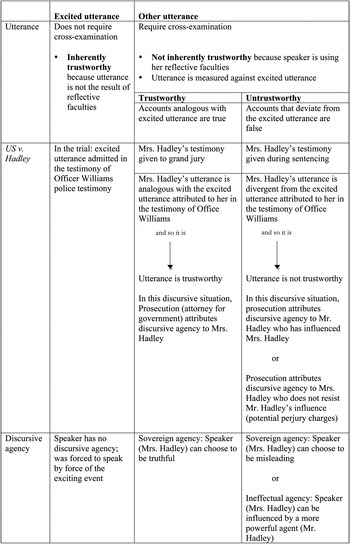
The prosecution evaluated Mrs. Hadley's multiple utterances using the fractal recursion of the excited utterance exception to (dis)attribute the discursive agency required to produce an excited utterance from Mrs. Hadley in order to attribute discursive agency in all other circumstances. Figure 9 illustrates the fractal recursion that organizes the assumptions about agency articulated in the prosecution's response to Mrs. Hadley's shifting account.
Language ideology of the prosecution in US v. Hadley.

In such courtroom encounters, the prosecution operationalizes the language ideology of the excited utterance (Fig. 9). As she uses it, the excited utterance is stable; it requires no testing and therefore, no further binary breakdown. The “other utterance” side of the binary, however, is unstable; these utterances must be proved in cross-examination and measured against the unwavering excited utterance. The stability of the excited utterance makes it usable as the standard against which other utterances can be measured.
Note how the nested binary affects the discursive agency of Mrs. Hadley. The prosecution used this binary, and the excited utterance that organized it, to explain and evaluate the differences between Mrs. Hadley's discursive agency in different circumstances. The prosecution ignored all alternative narratives produced by Mrs. Hadley by using the excited utterance (attributed to Mrs. Hadley) as the true utterance. This allows her to treat Mrs. Hadley as an agented speaker in all other situations. She could choose to tell the truth during sentencing testimony—she has the capacity to be honest—but she does not tell the truth. As the prosecution puts it, “Then how can we believe what you're saying today? You remember, Mrs. Hadley, just what you want to remember” (Trial, Prosecution, March 2003:20). The prosecution turns around Mrs. Hadley's contention that she didn't remember what happened to assert (again) that Mrs. Hadley is untrustworthy. Mrs. Hadley is an agent of discourse only in relationship to potentially false utterances. Utterances that substantially match the excited utterance are understood to be true, but they are not spoken by choice. The standard, the excited utterance, was produced by a speaker with no discursive agency.
The discursive agency involved in lying is then also diverted away from Mrs. Hadley to Mr. Hadley. Elsewhere, the prosecution argues, “Mr. Hadley had begun talking to her at that time, as soon as he was arrested on these federal charges, to begin talking to Mrs. Hadley to get her to change her statement” (Trial, June 2003:73). Even when the prosecuting attorney attributes to Mrs. Hadley the discursive agency to lie, she also disattributes agency by linking her falseness to Mr. Hadley. Thus, Mrs. Hadley is only partially attributed discursive agency, and only in the most negative sense. She can choose to lie, but even that is at least partially a product of coercion.
The discursive agency involved in making true utterances is highly constrained, because the standard of truthful is established outside of the speaker. The standard is “what happened,” the event, which is perfectly indexed by an excited utterance. The prosecution has access to the legal discourse that can be used to align and realign the discursive agency of out-of-control speakers. This access to legally authorized language ideology grants the prosecution a sort of fundamental agency to define Mrs. Hadley's agency: to attribute discursive agency to some of Mrs. Hadley's utterances (different testimonial settings), while disattributing it elsewhere (the excited utterance, abusive husband). This double-bind of attribution constrains Mrs. Hadley's discursive agency in every way. It makes it so that she cannot reclaim authority over the original narrative without looking like she is being purposefully false. The only discursive agency in which she is recognizable is associated with falseness.
Mrs. Hadley's account of events and agency
Mrs. Hadley is also interested in choices—in particular, her choice not to testify against her husband. She assumes (momentary) discursive agency when she argues that the prosecution had kept information regarding those choices from her. During the sentencing phase of the trial, Mrs. Hadley asserted over and over that had she known about all of her choices (had she known exactly how her discursive agency was institutionally constrained), she would not have chosen to testify to the grand jury in the days following her husbands arrest. She attempts to situate events and utterances in interactional contexts—interacting with police, early encounters with the prosecution, and other legal professionals over time. Mrs. Hadley's rearticulation of discursive agency differs from the simple binary structure represented by the prosecution, revealing a complex, goal-oriented and context-specific relationship to the narrative at stake in this legal battle. Mrs. Hadley reframed the original event, and by refusing to stay on the topic introduced by the questioning attorneys (on both sides), she actively reframed the discursive agency attributed to her in that questioning. At the beginning of the cross-examination, while the prosecution was working to establish the focus of their prior interactions and Mrs. Hadley's grand jury testimony, the exchange in extract (3) took place.

The prosecuting attorney's question pattern directs Mrs. Hadley to repeat for the court that Mr. Hadley had held a gun to her head. In answering, Mrs. Hadley represents her earlier testimony to the grand jury as the product of an unfair interaction in which she had not been informed of all of her rights, and had thus been led to do something that she did not realize she could have avoided. She links this legal coercion directly to her inability/refusal to remember what she said or what happened. In this exchange, Mrs. Hadley consistently attempts to reinject her intimate life into the legal context. For example, rather than answering the question asked, she brought up her husband—“Yes, because Jerome is my husband, that is an issue.” When her new, more personal topic is dismissed by the prosecution, she insistently repeats “I don't remember.”
We see Mrs. Hadley's grip on her version of events each time she reintroduces her relationship and each time she comes back to the issue of her spousal immunity: “You did not tell me about my rights, either.” By reintroducing the issue of the spousal immunity that the prosecution is avoiding, Mrs. Hadley works to reclaim ownership over a story that is both deeply personal and has material value in her life, past and present. In questioning details given in police testimony and coming back to the issue of being tricked by the prosecution, she problematizes her link to the excited utterance. She represents herself as having authority to accurately report the “original” event. When she is chastized by the prosecution for not answering the question she was asked—“I'd like for you to just answer my questions”—Mrs. Hadley continues, talking right over the prosecuting attorney: “but was that fair for you to do that to me?” Mrs. Hadley does not respond to the institutional authority of the prosecution, but rather makes a personal plea about the relationship between “you” and “me.” In so doing, she moves to take discursive agency in a setting where it is explicitly constrained by attorney questioning and the rules of the court. She goes on to say:
But I did have a choice. But you made sure that I didn't know that choice. Just like I'm here now, I'm here to support my husband, because I care about him and I love him, but I did not—I do not want to be here testifying against my husband. So, no, I don't know. I don't remember. I don't know. (Trial, Mrs. Hadley, March 2003:23)
In making this accusation, Mrs. Hadley claimed knowledge of being denied a legal right and talked about it with authority even though she was not an authorized agent of/in the legal discourse. She explained that she had not wanted to testify and that she only had because she had not known that she had the right to refuse. She then causally linked her current lapse in memory directly to the fact that she never wanted to testify against her husband using the conjunction “so”: “I do not want to be here testifying against my husband. So, no, I don't know. I don't remember. I don't know.” Not wanting to testify against her husband is the cause of her lapse in memory. In reiterating the denial of her rights, she also established for the Court the context surrounding her grand jury testimony—she had been manipulated into testifying. The interactions with the prosecution leading up to her grand jury testimony had led her to believe that she had no choice. By breaking the rules of the court with a discussion of a choice that had been hidden from her, Mrs. Hadley forces the prosecution to engage the issue of spousal rights that had otherwise been avoided.
In each of these exchanges, Mrs. Hadley is responding to the problematic ways in which she is attributed and disattributed agency by the courtroom and the discourses of excited utterance case law. She takes agency that has not been attributed to her (control over the topic of questioning) and distances herself from agency that has been attributed to her by the prosecution (agency to choose to tell the truth). Through this process, her answers to questions during the sentencing phase of the trial belie a different, more flexible relationship to discursive agency—one that is deeply dependent on context and goals.
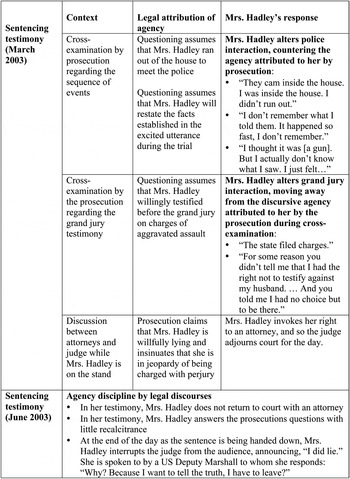
As Figure 10 illustrates, Mrs. Hadley resists attorney-led questioning by raising the topic of her constrained agency and her denied choice. Such a discursive action involves shifting her position within a complex web of agency attribution. By claiming that police came into her house and asked questions, she rearticulates her interaction with police, attributing agency to the police officers. By claiming that she had not been adequately informed of her spousal immunity, she rearticulates her interaction with attorneys and attributes agency to them. In both, she situates herself as the person acted on rather than the actor.
Mrs. Hadley's reaction to and altering of the discursive agency attributed to her.

In actively shifting her own role within the interactional web of agency stretching all the way back to the interaction with police, Mrs. Hadley claims discursive agency within the institutional space of the courtroom. In so doing, she distances herself from an attribution of discursive agency that produces effects she does not agree with. The way the legal discourses oriented her relationship to discursive agency does not match her own view. This is not a small issue. According to the law, the central act of holding a gun to the head of Mrs. Hadley must be associated with the only person who saw the act—Mrs. Hadley. Thus, the court must link that act to Mrs. Hadley by attributing statements to her and making their association seem objective rather than subjective. Such an objective relationship between the utterance and the event contradicts Mrs. Hadley's subjective relationship to her own experience. That is, this is not an objective issue for her, but rather a subjective issue that is about her own lived experience and worldview.
The institutional roles assigned by the metadiscourse to these interlocutors, the prosecution and the witness, Mrs. Hadley, puts them in different relationships to both the discourse in question (the excited utterance) and to discursive agency. The prosecution, who has discursive agency in this setting, is put on guard when Mrs. Hadley, whose discursive agency is constructed in negative terms, claims discursive agency in the space of the courtroom. Even though it is not in front of the jury, these assertions of discursive agency require the court to spend a great deal of time considering her excited utterance and determining how it compared to the alternative accounts given in testimony. The prosecution uses excited utterance legal discourse to make Mrs. Hadley recognizable as a woman whose only true utterance is the excited utterance. Thus the fractal recursion that organizes Mrs. Hadley's utterances also aligns her as a speaker who is fundamentally untruthful—only truthful when her reflective faculties have been stilled.
Conclusions
At all stages of the legal interaction with the excited utterance, the discursive agency of the speaker is truncated: located in the event (in the excited utterance), assumed by the husband (in the moment of violence), or granted to the police, expert witnesses, and legal counsel (during the trial). The sentencing procedures of US v. Hadley are an interaction in which private and public spheres collide. In each sphere, there are different discourses at work that relate the speaker to the event and the utterance, and different discourses that can be used to make sense of the interaction and the people. Such discourses are used to make Mrs. Hadley recognizable, and they alter her access to her own narrative. When the excited utterance exception is invoked during trial and accepted by the trial judge, the statement is thereby deemed inherently trustworthy, breaking any links of discursive agency between the utterance and the speaker. In other words, because the language ideology of the excited utterance assumes that the speaker of the excited utterance has no discursive agency, then if the utterance is entextualized as an excited utterance, the speaker is constructed as a nonagent, in relationship to that utterance. In recognizing an utterance as an excited utterance, giving it that name during trial, and ratifying the naming citationally in the appeal, the boundaries around the event, the utterance and the speaker are set, which also works to reaffirm the normative practices of the discourse itself. Thus, the criteria that are used to establish the boundaries of an excited utterance also give contour to the discursive agency of the person who speaks the excited utterance. The criteria ultimately work to establish the utterance, but not the speaker, as truthful. In this way, the language ideology of the excited utterance creates a situation in which the speaker's own words establish the binary <inherently truthful utterance/untruthful utterance> that will be used to evaluate the utterances in question. The result is that the discursive agency is attributed to her abusive husband (who coerces her to speak his truth) and to the event of abuse at his hands (the circumstances that caused her to speak spontaneously).
The language ideology of the excited utterance metadiscursively forecloses discursive agency with the presupposition that only spontaneous speech is trustworthy. In the very same discourse, however, one particular speaker must be linked to the excited utterance because they have legally recognizable knowledge of original events. Thus, the excited utterance exception constitutes an odd sort of speaker—someone who must speak, but who in the moment of speaking is divided from discursive agency. The domestic violence victim who is the speaker of the excited utterance is forever linked to a representation of a story in which she was the victim, and in which she has no agency, discursive or otherwise. She is doubly reduced as an agent—linked to a story where she is a victim and then forced into a position of spectator rather than actor even in the process of recounting the event.
Appendix: Cases cited
California v. Green (1970). 399 U.S. 149. Supreme Court of the United States. LexisNexis Academic. 27 November 2011. Online: http://web.lexis-nexis.com/universe.
Crawford v. Washington (2004). 541 U.S. 36. Supreme Court of the United States. LexisNexis Academic. 15 August 2006. Online: http://web.lexis-nexis.com/universe.
Davis v. Washington/Hammon v. Indiana (2006). 126 S. Ct. 2266, Nos. 05-5224 and 05-5705 (2006). Supreme Court of the United States. LexisNexis Academic. 15 August 2006. Online: http://web.lexis-nexis.com/universe.
Giles v. California (2008). 128 S. Ct. 2678. Supreme Court of the United States. LexisNexis Academic. 10 August 2008. Online: http://web.lexis-nexis.com/universe.
Haggins v. Warden, Fort Pillow State Farm (1983). 464 U.S. 1071. Court of Appeals for the Sixth Circuit. LexisNexis Academic. 8 February 2007. Online: http://web.lexis-nexis.com/universe.
Idaho v. Wright (1990). 497 U.S. 805. Supreme Court of the United States. LexisNexis Academic. 15 August 2006. Online: http://web.lexis-nexis.com/universe.
Michigan v. Bryant (2011). 131 S.Ct. 1143. Supreme Court of the United States. Google Scholar. 10 May 2011. Online: http://scholar.google.com.
Ohio v. Roberts (1980). 448 U.S. 56. Supreme Court of the United States. LexisNexis Academic. 16 August 2006. Online: http://web.lexis-nexis.com/universe.
United States of America v. Hadley (2005). 431 F.3d 484. United States Court of Appeals for the Sixth Circuit. LexisNexis Academic. 8 February 2007. Online: http://web.lexis-nexis.com/universe.
United States of America v. Hadley (2002-2003). Trial Transcript. United States District Court Eastern District of Tennessee at Chattanooga. Trial: November 12–13, 2002; Sentencing: March 21, 2003 and June 6, 2003.
United States v. Iron Shell (1980). 633 F.2d 77. United States Court of Appeals for the Eighth District. Google Scholar. 4 August 2012. Online: http://scholar.google.com.
White v. Illinois (1992). 502 U.S. 346. Supreme Court of the United States. LexisNexis Academic. 15 August 2006. Online: http://web.lexis-nexis.com/universe.