Picture postcards produced and circulated at the turn of the twentieth century are a multimodal source of historical information about people's multiple identifications within the Habsburg monarchy, as well as their everyday language use and day-to-day activities and concerns. However, they are a source that has not been studied systematically. This article illustrates how this widely available medium can be a valuable source for historical research into the linguistically and ethnically diverse regions of the Habsburg monarchy. This article will present examples of postcards from Carinthia, Carniola, and Lower Styria, which were areas inhabited by German and Slovenian speakers. I argue that postcards are particularly important material for researching history from below, because they tell stories of identification, feelings of belonging, travel and mobility, establishing and stabilizing social relationships, and individuals’ identity choices. Moreover, I will demonstrate that postcards are a valuable source of information not just because of the messages they contain, but also because the language they were written in is representative of language used in the semipublic sphere. Given nationality conflicts in these mixed regions, language use was considered the most important marker of national identity. Moreover, the ordinary, everyday writing practices used in postcards also reveal much about the senders’ and the addressees’ regional, professional, personal, religious, social, and other backgrounds, which express categories of identity and affiliations other than the national. Thus, postcards reveal national indifference and multilayered identifications to a much greater extent than they do clear national affiliations.
“Texting” at the Turn of the Twentieth Century
The history of the postcard is the story of a truly successful mass medium. Correspondence cards were first introduced to the Habsburg monarchy in 1869 and were originally unillustrated. The first illustrated versions came into circulation in 1885, and by the late 1890s the amount in circulation had increased dramatically due to new methods of production (e.g., collotype and halftone printing). They became “the first writing-related technology to be a truly mass vernacular medium.”Footnote 1
Postcards became popular and accessible for several reasons. First, the golden era of the postcard peaked at a time when faster means of transportation, including expanding railways, had already increased people's mobility. Topographic picture postcards, the most common type, played an especially important role in the emerging tourism industry by directing tourists’ attention through displays of what was worth seeing and by staging and presenting a region, city, or territory. Moreover, postcards enabled a means of virtual travel: They were collected as a means of learning about the world by gathering small representations of it.Footnote 2 But the impact of postcards from the 1890s to the 1920s went far beyond this tourist usage. Before the rise of the telephone and due to a well-established postal service, it was also the fastest and cheapest way to deliver short messages. Therefore, it was also a medium of everyday communication and frequently used for delivering messages concerning day-to-day business and events. It was a “fresh” and somehow “young” medium, unencumbered by the overbearing and somewhat stiff conventions that applied to letter writing.Footnote 3 In this sense, comparisons can be drawn between postcard writing at the beginning of the twentieth century and modern-day texting or “today's Twitter enthusiasm.”Footnote 4
Visual and textual information intersect in picture postcards. With the “pictorial turn” in cultural studies and historical research, we have come to perceive pictures in general—and in this case postcards—in a new way. Pictures on postcards are not merely passive representations but a medium that conditions how viewers see things and that shapes their patterns of perception and interpretations of reality. Thus, picture postcards can express ideologies of place and identity. Today we live in a world flooded by visual information, but in the last decades of the Habsburg monarchy, when pictures first reached a larger scale of distribution due to new reproduction methods (e.g., halftone images in illustrated newspapers from the 1880s onward), picture postcards were clearly a powerful way of shaping public discourse.Footnote 5
In addition to visual information, postcards usually contain textual information, which often includes both the producer's inscriptions and the individual sender's handwritten message. Often, the printed inscriptions accompanying the images were the only thing culturally anchoring what was being depicted. In the individual handwritten messages, which were a form of informal, everyday writing, identifications were expressed, and social relationships stabilized, which also makes them a valuable source for sociolinguists. Therefore, the picture postcard should be studied not only in visual terms, but also as a linguistic item due to semantic processes taking place in the interaction between visuality and textuality.Footnote 6 This article therefore applies an interdisciplinary approach—one at the intersection of history, linguistics, and visual culture studies—to several examples of picture postcards to examine how they express a broad range of information about identification and belonging.Footnote 7
Multiple Identities on Picture Postcards from Diverse Areas
The examples of picture postcards presented here from the ethnically diverse regions of the Habsburg monarchy inhabited by Slovenian and German speakers demonstrate how postcards can used as a valuable source of information. They convey a great deal of sociolinguistic information about language contact, everyday language use, code-switching, regional varieties of the Slovenian language, and the standardization processes still in progress at that time.
These postcards can also show to what extent regions like Lower Styria and Carinthia were linguistically mixed and demonstrate patterns of language distribution. They show that German was mainly predominant in the towns, along railway routes, and in tourist resorts, whereas Slovenian prevailed across the more rural countryside. Also, they reflect the long-standing use of German as a lingua franca in the Austrian monarchy. Given the fact that, unlike letters, postcards present language as it was in the semipublic sphere, they demonstrate the presence of these two languages in public and can help portray the linguistic landscape of those regions.Footnote 8 In this respect, topographic postcards, the most common and seemingly apolitical type of picture postcards, must not be underestimated because they served as a stage for a visual and linguistic representation of a certain territory—a stage on which, for example, national claims to this territory, among other issues, could be presented. Thus, they were involved in the processes of identity-building, and national or other collective identities were established or advanced based on them.Footnote 9
Moreover, picture postcards can offer a new and fresh insight into people's (multiple) identifications. Typical historical sources such as newspapers, political pamphlets, flyers, memoirs, monographic publications, and letters from politicians are formats that tend to stress or even overemphasize national issues and concepts of identity, whereas picture postcards are more useful for portraying day-to-day concerns and preoccupations, language used in daily life, multiple feelings of belonging, and often national indifference. They can help tackle questions of identities and identifications from the perspective of relatively unknown local inhabitants. Because of the large quantity of preserved postcards in public institutions and in the collections of private collectors, researchers analyzing them can never claim representativeness; these collections only offer a glimpse into the variety of all the picture postcards in circulation at that time. Using ten picture postcards, this article will tell a story of such multilayered identities at the beginning of the twentieth century in the regions of the Habsburg monarchy inhabited by German and Slovenes.
Postcards and the Growth of National Identifications
In ethnically diverse regions across the monarchy, bilingualism was widespread, and identities were complex, multilayered, and determined by local, social, regional, religious, professional, and other affiliations. In the last decades of the Habsburg monarchy, national group identities became increasingly important and started to overshadow other types of identities.Footnote 10 The peak of these nationality conflicts (or more correctly “nationalist conflicts”) coincided with the golden era of the picture postcard.Footnote 11 Because postcards were a truly mass media close to everyday life from the late 1890s on, they appear to be ideal for answering questions about the diffusion of national identifications.Footnote 12
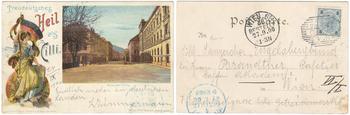
The most obvious signs of national identifications in picture postcards are the typical visual national insignia such as flags; coats of arms; allegories (like Germania); symbolic heroes representing the nation (modern patriots waving the flag, or in German postcards sometimes ancient “Germanic” tribesmen); and symbols such as the blue cornflower, oak or linden leaves, eagles, and falcons. Furthermore, one can find buildings depicted on postcards that were national symbols such as the Deutsches Haus (German House) in Celje/Cilli, which represented the German dominance in Lower Styrian towns, and the Slovenian Narodni dom (People's House) in Maribor/Marburg, which hosted most of the town's national associations. A typical German national postcard from Celje/Cilli would therefore depict Bismarck-Platz (now Krekov trg) in combination with the Deutsches Haus. But national identification was also encoded in the printed text, for example in greetings such as “Treudeutsches Heil aus Cilli” (A loyal German salute from Cilli). Sometimes, the individual sender emphasized the national connotation of a postcard even further with a handwritten message. Figure 1, sent in 1900, depicts such an example: The sender, a man named Zimmermann, who had probably returned from a trip, let the addressee know that he was “Endlich wieder in deutschen Landen” (finally again in German lands).
Figure 1:Picture postcard with German national inscription and individual message. Producer: Fritz Rasch, Celje/Cilli: “Treudeutsches Heil aus Cilli. Bismarckplatz”. [A loyal German salute from Celje. Bismarck square]. Sent in 1900 from Celje/Cilli to Vienna. POLOS_2012, source: private collection Pfandl.
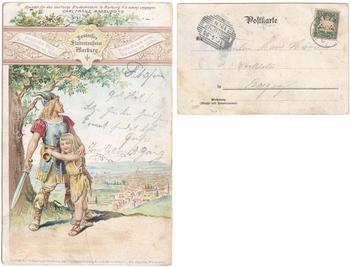
National organizations were key agents in disseminating national group identifications. Groups like Verein Südmark and Deutscher Schulverein, or their Slovenian counterparts, including Dru štvo sv. Cirila in Metoda (Society of St. Cyril and Method), or the gymnastics organizations, such as the Sokol association, were among the main producers of such postcards with clear national frames. Figure 2, sent in 1898, depicts an example published by the local Südmark branch in Maribor/Marburg. It contains what appears to be a Germanic tribesman with long blond hair and a horned helmet. Standing self-confidently under an oak tree, he is protecting a child while glaring fiercely toward the horizon. The town behind them is obviously supposed to be Maribor/Marburg. The purpose of this postcard was to advertise and collect money for the German student dormitory in Maribor/Marburg, and we can assume that buying this postcard was a contribution to this particular cause. A national inscription in rhyme framing the visual components makes the ideological orientation even clearer: “Deutsches Volk, Du herrlichstes von Allen, Deine Eichen stehn, Du wirst nie fallen” (German people, you most glorious of all, your oaks stand tall, you will never fall).
Figure 2:Picture postcard from the Südmark association with German national inscription. Publisher: Verlag der Ortsgruppe Marburg des Vereins Südmark, Maribor/Marburg, produced by Ed. Strache, Varnsdorf/Warnsdorf: “Deutsches Volk, Du herrlichstes von Allen, Deine Eichen stehn, Du wirst nie fallen. Deutsches Studentenheim Marburg.” [German people, you most glorious of all, your oaks stand tall, you will never fall. German Student dormitory, Marburg]. Sent in 1898 from Bavaria to Bregenz. POLOS_2067, source: private collection Pfandl.
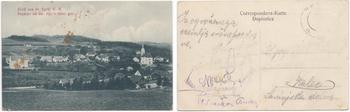
As seen in these first two examples, the national framing of a postcard was not only encoded in the visual components, but also in the textual—and sometimes in the textual component alone. This is illustrated by a postcard produced sometime after 1905 (see Figure 3) from Šentilj/St. Egydi (known then as Sv. Ilj/St. Egydi), a small village on today's Austrian–Slovenian border, then a flashpoint for nationalist conflicts. This village was a focal point for the German national association, Verein Südmark. The association attempted to transform a linguistically mixed region into a primarily German one by resettling German farmers there to establish a German colonial “bridge” between the “threatened” and predominantly German town of Maribor/Marburg and the German-speaking region located north of the imagined “language border.”Footnote 13
Figure 3:Topographic picture postcard sent from Šentilj/St. Egydi with bilingual inscription. Producer unknown: “Gruß aus St. Egidi W. B. Pozdrav od Sv. Ilja v. Slov. gor.” [Greeting from Šentilj in the Slovene Hills]. Produced after 1905 and sent from Šentilj/St. Egydi to Žalec/Sachsenfeld. POLOS_4007, source: private collection Domej.
Judging by the visual components, this postcard is no more than a typical, apolitical, topographic depiction of the village. However, the producer's inscription and the sender's handwritten message framed it in a more nationalist sense. Given the tense situation in Šentilj, it could be argued that the producer's bilingual inscriptions were a claim to this territory being linguistically mixed and are thereby political in nature. Furthermore, the handwritten greeting indicates this card was sent “from the endangered territory” (Iz ogroženega ozemlja srčne pozdrave). So, this specific postcard seems to be evidence of ethnic tensions in the village, while also laying claim to this village being mixed by stressing its bilingual character. As this postcard demonstrates, quite frequently national claims to a specific territory were not necessarily depicted visually, but instead appeared in the accompanying text.
The Struggle for Linguistic Visibility
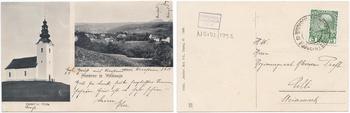
In this regard, it was quite common for people to cross out the topographic inscriptions in one language and write a village's name in the other language instead, and examples of this can be found for both languages. One such example can be seen in Figure 4, a postcard sent in 1911. This postcard's visual elements emphasized the village's Catholic character by prominently displaying the village church, and the sender, Else, praised the sunny day in her handwritten message. Although the rest of her handwritten message and the visual components were completely apolitical, she indirectly staged her personal German national identity in the postcard's semipublic sphere by denying the Slovenian language its place in this bilingual region when she blotted out the Slovenian greetings and topographic descriptions and replaced them with the correspondent German expressions. Her reaction can therefore be interpreted as a sign of intensified language conflict and ethnic tensions, and several such nationally framed postcards in specific villages or landscapes would seem to confirm this interpretation.Footnote 14
Figure 4:Picture postcard with Slovene inscription crossed out by sender. Producer: Anitta, Vienna: “Pozdrav iz Virštanja. Cerkev sv. Filipa. Virštanj” [Greetings from Virštanj. Church of St. Philip. Virštanj]. Sent in 1911 from Virštanj/Wierstein to Celje/Cilli. POLOS_0099, Source: Public library Celje Osrednja knjižnica Celje, Zbirka razglednic, škatla 2; Šmarje pri Jelšah; Rzg KOZJE trg /18.
The struggle for linguistic visibility in postcards’ semipublic sphere took place on both the personal level of the handwritten message and the level of official language use. The latter can also be traced on postcards by the language used in the postmark, which was an official decision. The decision of which language to use to print the inscriptions on postcards, however, was made by the postcard producers and publishers, at least until 1918. Many examples of visually identical postcards with inscriptions in different languages by the same producers seems to indicate that they probably were motivated more by needing to increase sales, rather than wanting to support nationalist causes.Footnote 15
However, after 1918, the situation altered dramatically with the disintegration of the Habsburg monarchy. Styria, for example (where most of these examples are drawn from), was divided between two newly founded states. The predominantly German-speaking areas of Styria were integrated into the Republic of German-Austria, which later became the Republic of Austria, and Lower Styria became part of the newly created State of Slovenes, Croats, and Serbs, which was later known as the Kingdom of Serbs, Croats, and Slovenes/the Kingdom of Yugoslavia. Even though the newly drawn border was disputed, particularly in the case of the city of Maribor/Marburg and the territories north of it, the issue was quickly resolved by Rudolf Maister and his men, when they claimed the territory in question for Yugoslavia. This newly established border essentially followed the already widely recognized concept of the “language border.” Even though many German-speaking inhabitants left the Kingdom of Yugoslavia in the immediate postwar period, a considerable number of them stayed. The Germans were now the new minority, even though they maintained an economically dominant position in some places like Lower Styria. Thus, the balance of power in the public sphere between the language groups had shifted dramatically, as did the languages’ visibility. After the new, short-lived State of Slovenes, Croats, and Serbs was established, Slovenian was declared to be the only official language in November 1918. When the Kingdom of Serbs, Croats, and Slovenes was formed one month later, this order was followed by a directive in June 1919 that all official and private signs placed in public could only be written in the official language known as Serbo-Croatian-Slovenian.Footnote 16
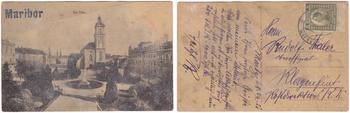
Along with this attempt to Slovenize the public sphere in regions such as Lower Styria, the German language also had to be removed from the half-public sphere of postcards as well. To continue to sell and use postcards that had already been produced and stocked, postcard vendors systematically stamped over or erased the German inscriptions, place names, and greetings and replaced them exclusively with Slovenian topographic names (see Figure 5). As a result, postcards also serve as a valuable source of information for tracking a systematic shift into a new statehood during the years of change between 1918–20. When reconstructing the competition for linguistic visibility and the associated encoded concepts of identity in the semipublic sphere, a differentiation must then be made between private senders and governmental language use. Thus, in 1911, it was Else's individual choice to blot out the Slovenian language on her postcard, but after 1918, erasing Slovene from German printed texts was an official directive.
Figure 5:Picture postcard with the German inscription stamped over and the Slovene topographic name added by the producer or the vendor. Producer: Rudolf Gaisser, Maribor/Marburg: “Marburg a. d. Drau. Der Dom. Maribor.” [Maribor. The cathedral.]. Sent in 1921 from Maribor/Marburg to Klagenfurt/Celovec. POLOS_2105, source: private collection Pfandl.
Diverging Messages
Despite the various ways national identities were expressed both visually and textually by postcard producers and their individual senders, the bulk of picture postcards produced and circulated did not contain several nationalist postcards or expressions of national identities.Footnote 17 Moreover, one can easily find postcards that were not used by their senders in the nationalistic manner the publisher intended.
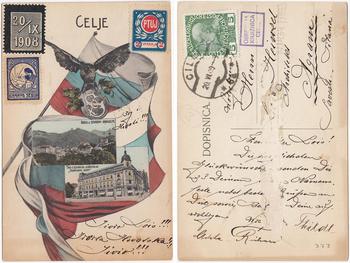
The postcard depicted in Figure 6 is from 1909, and it shows such divergent and even conflicting messages. Judging by the visual components, it is a typical nationalist postcard with Slovenian national insignia: the Slovenian flag, the falcon of the national organization Sokol (falcon), linden leaves as symbols of Slavic identity, and the Narodni dom.Footnote 18 Additionally, the postcard features three solidarity stamps, which indicate that by purchasing them the sender had donated to the association selling them and/or to a nationalist or other cause. A message regarding clear national identity is delivered through these visual elements. However, the accompanying handwritten elements show additional layers of identification including those belonging to social, religious, and professional spheres.
Figure 6:Slovene national picture postcard with three solidarity stamps and Croatian and German handwritten message. Producer unknown: “Celje. Breg z starim gradem. Trg Cesarja Jožefa in ‘Narodni dom’” [Celje. The riverbank with the old castle. Emperor Joseph square and the Narodni dom]. Sent in 1909 from Celje/Cilli to Zagreb/Agram. POLOS_0314, source: Public library Celje Osrednja knijžnica Celje, Zbirka razglednic, škatla 7; Celje 4.
On the picture side, the sender greeted the addressee, Croatia, and the Croats (most likely because the postcard was sent to Zagreb), thereby framing a visually Slovenian national message with a textually Croatian national message. On the other side of the postcard, the sender switched to German and congratulated the addressee on his name day “Die herzlichsten Glückwünsche senden Dir zu Deinem [illegible] Namensfeste…” This indicates that the sender and the addressee were (at least to some superficial extent) Catholic. Furthermore, because addressing the receiver according to their profession was a common convention at that time, we learn from the address text that the addressee, Lois, was an architect. Given the elegant handwriting, it can be assumed the sender was well educated and trained in penmanship.
By examining these details, we can learn from this postcard that explicitly national postcards were not always used by their individual senders in the way the publishers (who most likely had nationalist leanings) intended. Certainly, nationalist messages can be found written on postcards from this period, but far more often they seemed to have been used to congratulate people on their name day, for example, thereby keeping a Christian tradition alive and confirming and stabilizing people's social relationships with the addressees. Nationness was clearly a factor to some extent, but not the primary one. It remains unclear why the sender chose this specific postcard to greet his friend Lois the architect in Zagreb. What can be assumed, however, is that the latter took some pride in his profession—by referring to it, the sender was affirming that both belonged to the educated social class. Moreover, we see that German functioned as a lingua franca, especially among the educated and bourgeois class and between different Crownlands.
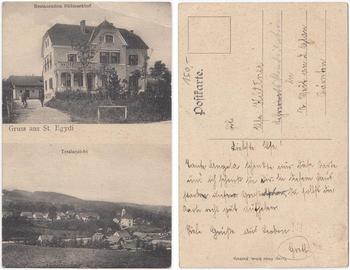
The next example (Figure 7) also demonstrates that identities and allegiances were multiple, and what might seem simple at first glance could in fact be much more complex. Produced after 1905, the item in Figure 7 was probably never sent by post but was instead given by a woman named Gretl from Leoben as a present to a relative (a sister or cousin) named Ilse in Carinthia. The picture side portrays the Südmarkhof, the main building of the Südmark Association in Šentilj/St. Egydi, which served as both an inn and a meeting place, and so the postcard was most likely produced with the intention of promoting the Südmark Association. Gretl, however, had quite different reasons for giving this postcard to Ilse, as she explains in her message: “Aunt Angela gave me this postcard and I'm giving it to you. Our grandparents passed away in this house. You should take good care of this card” (Tante Angela schenkte mir diese Karte und ich schenk sie dir. In diesem Haus starben unsere Großeltern. Du sollst die Karte recht gut aufheben). Although it is unknown why their grandparents died in the Südmark Association's building, one fact is abundantly clear. The sender and addressee were not at all, or at least not primarily, concerned with national affiliations, but instead with the very personal feeling of belonging to the same family and remembering their grandparents. Nationality was not the overarching factor, nor was it relevant in all situations to all the people, as pamphlets from the Südmark Association at the time might have made it seem.
Figure 7:Picture postcard with depiction of the Südmarkhof. Producer: Franz Erben, Maribor/Marburg: “Gruss aus St. Egydi. Restauration Südmarkhof. Totalansicht.” [Greeting from Šentilj. The Inn Südmarkhof. Panorama view.]. Produced after 1905, never sent but probably given from Leoben to St. Veit a. d. Glan. POLOS_4006, source: private collection Domej.
Relevance of Other Concepts of Identities
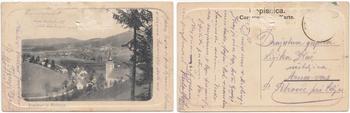
The next example (Figure 8) illustrates that people had very intense feelings of belonging or clear individual affiliations or preferences that had nothing to do whatsoever with national concepts of identity. Sent sometime after 1905, the postcard in Figure 8 contains a man named Václav's description of a trip to the village of Mislinja. In this description, he indicates his regional preferences and what he dreams of every night:
Figure 8:Topographic picture postcard from Mislinja/Missling. Producer: J. Kossär: “Pozdrav iz Mislinja” [Greetings from Mislinja]. Sent after 1905 from Mislinja/Missling to Arja vas / Arndorf near Celje/Cilli. POLOS_4003, source: private collection Domej.
Václav lets the reader know that he really loved the Savinja Valley but disliked the people from the village of Mislinja in the Mislinja Valley. Every night he dreamed about a “beautiful prima missa,” although it is unclear if he is referring to his own prima missa. Moreover, he signed his postcard not only by name, but also added his profession as a “teolog” (theologian). Therefore, it is safe to assume that both his professional identity, which was also religious, was of great importance to him. His written message indicates that the addressee was a young, female teacher. On the picture side, the postcard features additional greetings from a woman who also named her profession as an “učit. kandidatinja” (teacher-in-training) in her signature. A bike trip planned for the following week is mentioned as well. It could thus be inferred that the postcard was sent by some young, educated, active people engaged in some sort of group activity. As for Václav's reasons for disliking Mislinja, there is no indication whatsoever that he disliked it due to reasons related to nationality. Instead, personal reasons appear to be more likely. All in all, the postcard is written in a warm tone, and one can only speculate as to what kind of relationship existed between the sender, the clergyman Václav, and the addressee, “dražestna gospica Lizika Kač, učiteljica” (the delightful lady, Lizika Kač, teacher). It would seem plausible that Václav had personal, regional, or local likes or dislikes; strong professional and religious affiliations; and a warm and friendly relationship with the addressee—all of which were at the time most likely more important to him than a national identity.
The Sociolinguistics of Postcard Writing and Historical Narratives
Much can be learned about people's social and professional background as well as other aspects by looking more closely at the sociolinguistic elements of postcard writing in the mixed Slovenian–German regions, as the following two examples demonstrate. Even though postcard writing was a particularly common activity among the bourgeois classes, those of other classes engaged in it as well. Additional information can be extracted by taking a closer look at their use of vernacular language, including how they identified themselves, their day-to-day concerns, and their specific historical contexts, as is demonstrated by the postcard in Figure 9.
Figure 9:Collage-like lithographic picture postcard with panorama views of Krško/Gurkfeld sent from on clergyman to another. Producer unknown: “Gruss aus Gurkfeld. Gurkfeld. Schiessplatz. Obermaierhof.” [Greetings from Krško. Krško. Shooting range. The hamlet Veliki Marof.]. Sent in 1902 from Krško/Gurkfeld to Knittelfeld. POLOS_2521, source: Admont Abbey postcard collection.
Even at the beginning of the twentieth century, Latin remained a lingua franca of written communication among clergy members.Footnote 20 The postcard in Figure 9 was sent in 1902 from one member of the clergy to another. In the handwritten message, a monk switches between three different languages (i.e., codes) because he used different languages for different kinds of messages. He begins with a Latin salutation, which is nothing more than a set phrase, continues in German with rather formal congratulations to the addressee for his name day, and then immediately after switches to Slovenian for a more informal message:
From his elegant handwriting and language use, he appears to have been fluent in all these languages, easily switched between them, and probably felt comfortable using all of them. The primary, formal reason for sending this postcard was, like in Figure 6, to stabilize a social relationship by congratulating the addressee for his name day. Furthermore, he discusses in Slovenian an obviously shared interest: where and when to buy good wine. He was certainly a member of the educated lower clergy, and it can be inferred that his professional and religious affiliation was one of his primary identifications. For him, language use was not an “emblem of nationness,” but was instead chosen pragmatically according to the needs, rules, and conventions of (written) communication and social context.Footnote 22
The next example (see Figure 10) was produced in 1916 and has a rather interesting history. This particular example illustrates that the modestly literate, who probably rarely wrote letters, occasionally sent postcards. It also illustrates how much can be learned about these senders and their circumstances if the different layers of information contained in a single postcard are properly read and interpreted. The sender, “Ferdinant Wošchitc,” was from Carinthia, was of rural descent, served as a soldier in the Austrian army, had become ill, and was sent to a reserve military hospital in Maribor/Marburg. From there he sent his wife, “Uršchula,” this postcard letting her know that he was alive and well:
Figure 10:Picture postcard sent by a sick soldier in a military hospital to his wife. Producer: Franz Knollmüller, Graz: “Marburg a./Dr. – Franziskanerkirche” [Maribor – Franciscan church]. Produced in 1916 and sent from Maribor/Maribor to Dolnja vas / Niederdörfl, nearby St. Margarethen/Šmarjeta v Rožu in Carinthia. POLOS_4081, source: private collection Domej.
The way he constructed his written message in Slovenian demonstrates the very modest educational effect the schooling system had on the population in rural Lower Carinthia. He appears unfamiliar with the rules of orthography and grammar, and so only wrote phonetically in the manner of his local dialect. For example, he seems unaware of individual words and wrote them together with the words that followed in the way they were colloquially spoken. The same is true for his command of German, which is evident in the written parts where he gives the address of where he is staying: “K. u. k. Rezerve No 3 ob / taielung 2 [illegible] Št / dentn haiem Marburg / Anderdrau” (“K.u.k. Reserve No 3 Abteilung 2 [illegible] Studentenheim Marburg an der Drau”). He had obviously learned some basics of writing, so it can be inferred that he probably attended an utraquist or a German-only primary school but had never received a proper education and probably did not read much either, if at all. Nevertheless, he had achieved a modicum of literacy.
As this postcard demonstrates, advances in increasing literacy had been made in these parts of the Habsburg monarchy, enough so that at the beginning of the twentieth century, a common man from a rural area was sufficiently literate to send such a message and leave behind a written account.Footnote 24 Thus, unlike historians trying to reconstruct history from below about common, illiterate peasants from an earlier period, those studying the last decades of the Habsburg monarchy have some access to the voice of the common people through, for example, picture postcards.
There is, however, more information contained in this postcard. It is clear from the address he wrote to, as well as from the local dialect he wrote in, that he came from Rosental/Rožna Dolina in Lower Carinthia. The postcard also suggests that the sender was old enough to be married—which west of the Hajnal line usually occurred rather late—but also not too old for military service.Footnote 25 Furthermore, it would be reasonable to assume that Ferdinand survived World War I and returned home to his wife. In fact, these suppositions were later confirmed by records kept in his home village, which indicate that he was born in 1872, married Ursula in 1901 at the age of twenty-eight, and died in 1957.Footnote 26 When he wrote this postcard from the military hospital, he was already forty-four years old. Moreover, he obviously survived not only World War I but World War II as well.
Conclusion
This is a small sample of the many postcards sent and received that have survived and can be found in private and official archival collections. While the sample size may be small, it indicates the potential of this medium to enhance research and understanding about this period at the turn of the twentieth century. Although these picture postcards can be read as evidence of language conflict and ethnic tensions in the mixed regions of the Habsburg monarchy, they also portray to a much further extent bilingualism, language contact, social aspects of language use, peaceful everyday coexistence, and the irrelevance of nationness in many everyday situations. Investigating the content of individual messages and applying a sociolinguistic approach reveals even more about the senders and receivers. These postcards, written by common people from the beginning of the twentieth century, convey a broad range of information about different sorts of identifications, multiple identities, social and educational backgrounds, and complex layers of individual feelings of belonging. Moreover, the messages contained in them were multilayered and were conveyed with visual and textual elements, and often both elements were intertwined.
Furthermore, the analyses of these examples demonstrate how postcards can contribute an additional layer to an understanding and reconstruction of historical circumstances, which is particularly relevant to the construction of history “from below.” The 1916 postcard sent from a military hospital (Figure 10) is one of the most salient examples. Not only was it possible to infer a great deal about the sender, but it was also possible to expand on statistical data contained in local records by adding a more human or personal dimension, and by adding the kinds of details that seldom get recorded. In this way, postcards can contribute to constructing an image of civilian life or of soldiers’ experiences during wartime.
Rather than being merely interesting and colorful snapshots of times past, picture postcards can in fact be a useful resource for historians researching many different topics related to this period, including Alltagsgeschichte (the history of everyday life), gender and kin relationships, social and regional history, language history, regional and religious affiliations, World War I, and nationalism. Some of these issues have been touched on here, but due to limited space, only a few examples could be analyzed in detail. Undoubtedly, there is vast untapped potential in these artifacts for researching many different historical facets “from below.”
In conclusion, these ten picture postcards written by common people from the beginning of the twentieth century convey a broad range of information about different sorts of identifications, multiple identities, and complex layers of individual feelings of belonging. However, the postcards from Else, Gretl, Vaclav, Alfonz, Ferdinand, and others permit only a glimpse into specific moments of their lives, and these stories are only a few of many others that could also be told. However, it is obvious that picture postcards can help reach a deeper understanding of identifications among common people and paint a clearer picture of the mixed regions in Habsburg monarchy and the identities that mattered to their inhabitants, which were often not so evidently defined along national lines.





 You have
Access
Picture postcards produced and circulated at the turn of the twentieth century are a multimodal source of historical information about people's multiple identifications within the Habsburg monarchy, as well as their everyday language use and day-to-day activities and concerns. However, they are a source that has not been studied systematically. This article illustrates how this widely available medium can be a valuable source for historical research into the linguistically and ethnically diverse regions of the Habsburg monarchy. This article will present examples of postcards from Carinthia, Carniola, and Lower Styria, which were areas inhabited by German and Slovenian speakers. I argue that postcards are particularly important material for researching history from below, because they tell stories of identification, feelings of belonging, travel and mobility, establishing and stabilizing social relationships, and individuals’ identity choices. Moreover, I will demonstrate that postcards are a valuable source of information not just because of the messages they contain, but also because the language they were written in is representative of language used in the semipublic sphere. Given nationality conflicts in these mixed regions, language use was considered the most important marker of national identity. Moreover, the ordinary, everyday writing practices used in postcards also reveal much about the senders’ and the addressees’ regional, professional, personal, religious, social, and other backgrounds, which express categories of identity and affiliations other than the national. Thus, postcards reveal national indifference and multilayered identifications to a much greater extent than they do clear national affiliations.
“Texting” at the Turn of the Twentieth Century
The history of the postcard is the story of a truly successful mass medium. Correspondence cards were first introduced to the Habsburg monarchy in 1869 and were originally unillustrated. The first illustrated versions came into circulation in 1885, and by the late 1890s the amount in circulation had increased dramatically due to new methods of production (e.g., collotype and halftone printing). They became “the first writing-related technology to be a truly mass vernacular medium.”Footnote 1
Postcards became popular and accessible for several reasons. First, the golden era of the postcard peaked at a time when faster means of transportation, including expanding railways, had already increased people's mobility. Topographic picture postcards, the most common type, played an especially important role in the emerging tourism industry by directing tourists’ attention through displays of what was worth seeing and by staging and presenting a region, city, or territory. Moreover, postcards enabled a means of virtual travel: They were collected as a means of learning about the world by gathering small representations of it.Footnote 2 But the impact of postcards from the 1890s to the 1920s went far beyond this tourist usage. Before the rise of the telephone and due to a well-established postal service, it was also the fastest and cheapest way to deliver short messages. Therefore, it was also a medium of everyday communication and frequently used for delivering messages concerning day-to-day business and events. It was a “fresh” and somehow “young” medium, unencumbered by the overbearing and somewhat stiff conventions that applied to letter writing.Footnote 3 In this sense, comparisons can be drawn between postcard writing at the beginning of the twentieth century and modern-day texting or “today's Twitter enthusiasm.”Footnote 4
Visual and textual information intersect in picture postcards. With the “pictorial turn” in cultural studies and historical research, we have come to perceive pictures in general—and in this case postcards—in a new way. Pictures on postcards are not merely passive representations but a medium that conditions how viewers see things and that shapes their patterns of perception and interpretations of reality. Thus, picture postcards can express ideologies of place and identity. Today we live in a world flooded by visual information, but in the last decades of the Habsburg monarchy, when pictures first reached a larger scale of distribution due to new reproduction methods (e.g., halftone images in illustrated newspapers from the 1880s onward), picture postcards were clearly a powerful way of shaping public discourse.Footnote 5
In addition to visual information, postcards usually contain textual information, which often includes both the producer's inscriptions and the individual sender's handwritten message. Often, the printed inscriptions accompanying the images were the only thing culturally anchoring what was being depicted. In the individual handwritten messages, which were a form of informal, everyday writing, identifications were expressed, and social relationships stabilized, which also makes them a valuable source for sociolinguists. Therefore, the picture postcard should be studied not only in visual terms, but also as a linguistic item due to semantic processes taking place in the interaction between visuality and textuality.Footnote 6 This article therefore applies an interdisciplinary approach—one at the intersection of history, linguistics, and visual culture studies—to several examples of picture postcards to examine how they express a broad range of information about identification and belonging.Footnote 7
Multiple Identities on Picture Postcards from Diverse Areas
The examples of picture postcards presented here from the ethnically diverse regions of the Habsburg monarchy inhabited by Slovenian and German speakers demonstrate how postcards can used as a valuable source of information. They convey a great deal of sociolinguistic information about language contact, everyday language use, code-switching, regional varieties of the Slovenian language, and the standardization processes still in progress at that time.
These postcards can also show to what extent regions like Lower Styria and Carinthia were linguistically mixed and demonstrate patterns of language distribution. They show that German was mainly predominant in the towns, along railway routes, and in tourist resorts, whereas Slovenian prevailed across the more rural countryside. Also, they reflect the long-standing use of German as a lingua franca in the Austrian monarchy. Given the fact that, unlike letters, postcards present language as it was in the semipublic sphere, they demonstrate the presence of these two languages in public and can help portray the linguistic landscape of those regions.Footnote 8 In this respect, topographic postcards, the most common and seemingly apolitical type of picture postcards, must not be underestimated because they served as a stage for a visual and linguistic representation of a certain territory—a stage on which, for example, national claims to this territory, among other issues, could be presented. Thus, they were involved in the processes of identity-building, and national or other collective identities were established or advanced based on them.Footnote 9
Moreover, picture postcards can offer a new and fresh insight into people's (multiple) identifications. Typical historical sources such as newspapers, political pamphlets, flyers, memoirs, monographic publications, and letters from politicians are formats that tend to stress or even overemphasize national issues and concepts of identity, whereas picture postcards are more useful for portraying day-to-day concerns and preoccupations, language used in daily life, multiple feelings of belonging, and often national indifference. They can help tackle questions of identities and identifications from the perspective of relatively unknown local inhabitants. Because of the large quantity of preserved postcards in public institutions and in the collections of private collectors, researchers analyzing them can never claim representativeness; these collections only offer a glimpse into the variety of all the picture postcards in circulation at that time. Using ten picture postcards, this article will tell a story of such multilayered identities at the beginning of the twentieth century in the regions of the Habsburg monarchy inhabited by German and Slovenes.
Postcards and the Growth of National Identifications
In ethnically diverse regions across the monarchy, bilingualism was widespread, and identities were complex, multilayered, and determined by local, social, regional, religious, professional, and other affiliations. In the last decades of the Habsburg monarchy, national group identities became increasingly important and started to overshadow other types of identities.Footnote 10 The peak of these nationality conflicts (or more correctly “nationalist conflicts”) coincided with the golden era of the picture postcard.Footnote 11 Because postcards were a truly mass media close to everyday life from the late 1890s on, they appear to be ideal for answering questions about the diffusion of national identifications.Footnote 12
The most obvious signs of national identifications in picture postcards are the typical visual national insignia such as flags; coats of arms; allegories (like Germania); symbolic heroes representing the nation (modern patriots waving the flag, or in German postcards sometimes ancient “Germanic” tribesmen); and symbols such as the blue cornflower, oak or linden leaves, eagles, and falcons. Furthermore, one can find buildings depicted on postcards that were national symbols such as the Deutsches Haus (German House) in Celje/Cilli, which represented the German dominance in Lower Styrian towns, and the Slovenian Narodni dom (People's House) in Maribor/Marburg, which hosted most of the town's national associations. A typical German national postcard from Celje/Cilli would therefore depict Bismarck-Platz (now Krekov trg) in combination with the Deutsches Haus. But national identification was also encoded in the printed text, for example in greetings such as “Treudeutsches Heil aus Cilli” (A loyal German salute from Cilli). Sometimes, the individual sender emphasized the national connotation of a postcard even further with a handwritten message. Figure 1, sent in 1900, depicts such an example: The sender, a man named Zimmermann, who had probably returned from a trip, let the addressee know that he was “Endlich wieder in deutschen Landen” (finally again in German lands).
Picture postcard with German national inscription and individual message. Producer: Fritz Rasch, Celje/Cilli: “Treudeutsches Heil aus Cilli. Bismarckplatz”. [A loyal German salute from Celje. Bismarck square]. Sent in 1900 from Celje/Cilli to Vienna. POLOS_2012, source: private collection Pfandl.
National organizations were key agents in disseminating national group identifications. Groups like Verein Südmark and Deutscher Schulverein, or their Slovenian counterparts, including Dru štvo sv. Cirila in Metoda (Society of St. Cyril and Method), or the gymnastics organizations, such as the Sokol association, were among the main producers of such postcards with clear national frames. Figure 2, sent in 1898, depicts an example published by the local Südmark branch in Maribor/Marburg. It contains what appears to be a Germanic tribesman with long blond hair and a horned helmet. Standing self-confidently under an oak tree, he is protecting a child while glaring fiercely toward the horizon. The town behind them is obviously supposed to be Maribor/Marburg. The purpose of this postcard was to advertise and collect money for the German student dormitory in Maribor/Marburg, and we can assume that buying this postcard was a contribution to this particular cause. A national inscription in rhyme framing the visual components makes the ideological orientation even clearer: “Deutsches Volk, Du herrlichstes von Allen, Deine Eichen stehn, Du wirst nie fallen” (German people, you most glorious of all, your oaks stand tall, you will never fall).
Picture postcard from the Südmark association with German national inscription. Publisher: Verlag der Ortsgruppe Marburg des Vereins Südmark, Maribor/Marburg, produced by Ed. Strache, Varnsdorf/Warnsdorf: “Deutsches Volk, Du herrlichstes von Allen, Deine Eichen stehn, Du wirst nie fallen. Deutsches Studentenheim Marburg.” [German people, you most glorious of all, your oaks stand tall, you will never fall. German Student dormitory, Marburg]. Sent in 1898 from Bavaria to Bregenz. POLOS_2067, source: private collection Pfandl.
As seen in these first two examples, the national framing of a postcard was not only encoded in the visual components, but also in the textual—and sometimes in the textual component alone. This is illustrated by a postcard produced sometime after 1905 (see Figure 3) from Šentilj/St. Egydi (known then as Sv. Ilj/St. Egydi), a small village on today's Austrian–Slovenian border, then a flashpoint for nationalist conflicts. This village was a focal point for the German national association, Verein Südmark. The association attempted to transform a linguistically mixed region into a primarily German one by resettling German farmers there to establish a German colonial “bridge” between the “threatened” and predominantly German town of Maribor/Marburg and the German-speaking region located north of the imagined “language border.”Footnote 13
Topographic picture postcard sent from Šentilj/St. Egydi with bilingual inscription. Producer unknown: “Gruß aus St. Egidi W. B. Pozdrav od Sv. Ilja v. Slov. gor.” [Greeting from Šentilj in the Slovene Hills]. Produced after 1905 and sent from Šentilj/St. Egydi to Žalec/Sachsenfeld. POLOS_4007, source: private collection Domej.
Judging by the visual components, this postcard is no more than a typical, apolitical, topographic depiction of the village. However, the producer's inscription and the sender's handwritten message framed it in a more nationalist sense. Given the tense situation in Šentilj, it could be argued that the producer's bilingual inscriptions were a claim to this territory being linguistically mixed and are thereby political in nature. Furthermore, the handwritten greeting indicates this card was sent “from the endangered territory” (Iz ogroženega ozemlja srčne pozdrave). So, this specific postcard seems to be evidence of ethnic tensions in the village, while also laying claim to this village being mixed by stressing its bilingual character. As this postcard demonstrates, quite frequently national claims to a specific territory were not necessarily depicted visually, but instead appeared in the accompanying text.
The Struggle for Linguistic Visibility
In this regard, it was quite common for people to cross out the topographic inscriptions in one language and write a village's name in the other language instead, and examples of this can be found for both languages. One such example can be seen in Figure 4, a postcard sent in 1911. This postcard's visual elements emphasized the village's Catholic character by prominently displaying the village church, and the sender, Else, praised the sunny day in her handwritten message. Although the rest of her handwritten message and the visual components were completely apolitical, she indirectly staged her personal German national identity in the postcard's semipublic sphere by denying the Slovenian language its place in this bilingual region when she blotted out the Slovenian greetings and topographic descriptions and replaced them with the correspondent German expressions. Her reaction can therefore be interpreted as a sign of intensified language conflict and ethnic tensions, and several such nationally framed postcards in specific villages or landscapes would seem to confirm this interpretation.Footnote 14
Picture postcard with Slovene inscription crossed out by sender. Producer: Anitta, Vienna: “Pozdrav iz Virštanja. Cerkev sv. Filipa. Virštanj” [Greetings from Virštanj. Church of St. Philip. Virštanj]. Sent in 1911 from Virštanj/Wierstein to Celje/Cilli. POLOS_0099, Source: Public library Celje Osrednja knjižnica Celje, Zbirka razglednic, škatla 2; Šmarje pri Jelšah; Rzg KOZJE trg /18.
The struggle for linguistic visibility in postcards’ semipublic sphere took place on both the personal level of the handwritten message and the level of official language use. The latter can also be traced on postcards by the language used in the postmark, which was an official decision. The decision of which language to use to print the inscriptions on postcards, however, was made by the postcard producers and publishers, at least until 1918. Many examples of visually identical postcards with inscriptions in different languages by the same producers seems to indicate that they probably were motivated more by needing to increase sales, rather than wanting to support nationalist causes.Footnote 15
However, after 1918, the situation altered dramatically with the disintegration of the Habsburg monarchy. Styria, for example (where most of these examples are drawn from), was divided between two newly founded states. The predominantly German-speaking areas of Styria were integrated into the Republic of German-Austria, which later became the Republic of Austria, and Lower Styria became part of the newly created State of Slovenes, Croats, and Serbs, which was later known as the Kingdom of Serbs, Croats, and Slovenes/the Kingdom of Yugoslavia. Even though the newly drawn border was disputed, particularly in the case of the city of Maribor/Marburg and the territories north of it, the issue was quickly resolved by Rudolf Maister and his men, when they claimed the territory in question for Yugoslavia. This newly established border essentially followed the already widely recognized concept of the “language border.” Even though many German-speaking inhabitants left the Kingdom of Yugoslavia in the immediate postwar period, a considerable number of them stayed. The Germans were now the new minority, even though they maintained an economically dominant position in some places like Lower Styria. Thus, the balance of power in the public sphere between the language groups had shifted dramatically, as did the languages’ visibility. After the new, short-lived State of Slovenes, Croats, and Serbs was established, Slovenian was declared to be the only official language in November 1918. When the Kingdom of Serbs, Croats, and Slovenes was formed one month later, this order was followed by a directive in June 1919 that all official and private signs placed in public could only be written in the official language known as Serbo-Croatian-Slovenian.Footnote 16
Along with this attempt to Slovenize the public sphere in regions such as Lower Styria, the German language also had to be removed from the half-public sphere of postcards as well. To continue to sell and use postcards that had already been produced and stocked, postcard vendors systematically stamped over or erased the German inscriptions, place names, and greetings and replaced them exclusively with Slovenian topographic names (see Figure 5). As a result, postcards also serve as a valuable source of information for tracking a systematic shift into a new statehood during the years of change between 1918–20. When reconstructing the competition for linguistic visibility and the associated encoded concepts of identity in the semipublic sphere, a differentiation must then be made between private senders and governmental language use. Thus, in 1911, it was Else's individual choice to blot out the Slovenian language on her postcard, but after 1918, erasing Slovene from German printed texts was an official directive.
Picture postcard with the German inscription stamped over and the Slovene topographic name added by the producer or the vendor. Producer: Rudolf Gaisser, Maribor/Marburg: “Marburg a. d. Drau. Der Dom. Maribor.” [Maribor. The cathedral.]. Sent in 1921 from Maribor/Marburg to Klagenfurt/Celovec. POLOS_2105, source: private collection Pfandl.
Diverging Messages
Despite the various ways national identities were expressed both visually and textually by postcard producers and their individual senders, the bulk of picture postcards produced and circulated did not contain several nationalist postcards or expressions of national identities.Footnote 17 Moreover, one can easily find postcards that were not used by their senders in the nationalistic manner the publisher intended.
The postcard depicted in Figure 6 is from 1909, and it shows such divergent and even conflicting messages. Judging by the visual components, it is a typical nationalist postcard with Slovenian national insignia: the Slovenian flag, the falcon of the national organization Sokol (falcon), linden leaves as symbols of Slavic identity, and the Narodni dom.Footnote 18 Additionally, the postcard features three solidarity stamps, which indicate that by purchasing them the sender had donated to the association selling them and/or to a nationalist or other cause. A message regarding clear national identity is delivered through these visual elements. However, the accompanying handwritten elements show additional layers of identification including those belonging to social, religious, and professional spheres.
Slovene national picture postcard with three solidarity stamps and Croatian and German handwritten message. Producer unknown: “Celje. Breg z starim gradem. Trg Cesarja Jožefa in ‘Narodni dom’” [Celje. The riverbank with the old castle. Emperor Joseph square and the Narodni dom]. Sent in 1909 from Celje/Cilli to Zagreb/Agram. POLOS_0314, source: Public library Celje Osrednja knijžnica Celje, Zbirka razglednic, škatla 7; Celje 4.
On the picture side, the sender greeted the addressee, Croatia, and the Croats (most likely because the postcard was sent to Zagreb), thereby framing a visually Slovenian national message with a textually Croatian national message. On the other side of the postcard, the sender switched to German and congratulated the addressee on his name day “Die herzlichsten Glückwünsche senden Dir zu Deinem [illegible] Namensfeste…” This indicates that the sender and the addressee were (at least to some superficial extent) Catholic. Furthermore, because addressing the receiver according to their profession was a common convention at that time, we learn from the address text that the addressee, Lois, was an architect. Given the elegant handwriting, it can be assumed the sender was well educated and trained in penmanship.
By examining these details, we can learn from this postcard that explicitly national postcards were not always used by their individual senders in the way the publishers (who most likely had nationalist leanings) intended. Certainly, nationalist messages can be found written on postcards from this period, but far more often they seemed to have been used to congratulate people on their name day, for example, thereby keeping a Christian tradition alive and confirming and stabilizing people's social relationships with the addressees. Nationness was clearly a factor to some extent, but not the primary one. It remains unclear why the sender chose this specific postcard to greet his friend Lois the architect in Zagreb. What can be assumed, however, is that the latter took some pride in his profession—by referring to it, the sender was affirming that both belonged to the educated social class. Moreover, we see that German functioned as a lingua franca, especially among the educated and bourgeois class and between different Crownlands.
The next example (Figure 7) also demonstrates that identities and allegiances were multiple, and what might seem simple at first glance could in fact be much more complex. Produced after 1905, the item in Figure 7 was probably never sent by post but was instead given by a woman named Gretl from Leoben as a present to a relative (a sister or cousin) named Ilse in Carinthia. The picture side portrays the Südmarkhof, the main building of the Südmark Association in Šentilj/St. Egydi, which served as both an inn and a meeting place, and so the postcard was most likely produced with the intention of promoting the Südmark Association. Gretl, however, had quite different reasons for giving this postcard to Ilse, as she explains in her message: “Aunt Angela gave me this postcard and I'm giving it to you. Our grandparents passed away in this house. You should take good care of this card” (Tante Angela schenkte mir diese Karte und ich schenk sie dir. In diesem Haus starben unsere Großeltern. Du sollst die Karte recht gut aufheben). Although it is unknown why their grandparents died in the Südmark Association's building, one fact is abundantly clear. The sender and addressee were not at all, or at least not primarily, concerned with national affiliations, but instead with the very personal feeling of belonging to the same family and remembering their grandparents. Nationality was not the overarching factor, nor was it relevant in all situations to all the people, as pamphlets from the Südmark Association at the time might have made it seem.
Picture postcard with depiction of the Südmarkhof. Producer: Franz Erben, Maribor/Marburg: “Gruss aus St. Egydi. Restauration Südmarkhof. Totalansicht.” [Greeting from Šentilj. The Inn Südmarkhof. Panorama view.]. Produced after 1905, never sent but probably given from Leoben to St. Veit a. d. Glan. POLOS_4006, source: private collection Domej.
Relevance of Other Concepts of Identities
The next example (Figure 8) illustrates that people had very intense feelings of belonging or clear individual affiliations or preferences that had nothing to do whatsoever with national concepts of identity. Sent sometime after 1905, the postcard in Figure 8 contains a man named Václav's description of a trip to the village of Mislinja. In this description, he indicates his regional preferences and what he dreams of every night:
Topographic picture postcard from Mislinja/Missling. Producer: J. Kossär: “Pozdrav iz Mislinja” [Greetings from Mislinja]. Sent after 1905 from Mislinja/Missling to Arja vas / Arndorf near Celje/Cilli. POLOS_4003, source: private collection Domej.
Václav lets the reader know that he really loved the Savinja Valley but disliked the people from the village of Mislinja in the Mislinja Valley. Every night he dreamed about a “beautiful prima missa,” although it is unclear if he is referring to his own prima missa. Moreover, he signed his postcard not only by name, but also added his profession as a “teolog” (theologian). Therefore, it is safe to assume that both his professional identity, which was also religious, was of great importance to him. His written message indicates that the addressee was a young, female teacher. On the picture side, the postcard features additional greetings from a woman who also named her profession as an “učit. kandidatinja” (teacher-in-training) in her signature. A bike trip planned for the following week is mentioned as well. It could thus be inferred that the postcard was sent by some young, educated, active people engaged in some sort of group activity. As for Václav's reasons for disliking Mislinja, there is no indication whatsoever that he disliked it due to reasons related to nationality. Instead, personal reasons appear to be more likely. All in all, the postcard is written in a warm tone, and one can only speculate as to what kind of relationship existed between the sender, the clergyman Václav, and the addressee, “dražestna gospica Lizika Kač, učiteljica” (the delightful lady, Lizika Kač, teacher). It would seem plausible that Václav had personal, regional, or local likes or dislikes; strong professional and religious affiliations; and a warm and friendly relationship with the addressee—all of which were at the time most likely more important to him than a national identity.
The Sociolinguistics of Postcard Writing and Historical Narratives
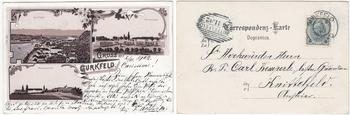
Much can be learned about people's social and professional background as well as other aspects by looking more closely at the sociolinguistic elements of postcard writing in the mixed Slovenian–German regions, as the following two examples demonstrate. Even though postcard writing was a particularly common activity among the bourgeois classes, those of other classes engaged in it as well. Additional information can be extracted by taking a closer look at their use of vernacular language, including how they identified themselves, their day-to-day concerns, and their specific historical contexts, as is demonstrated by the postcard in Figure 9.
Collage-like lithographic picture postcard with panorama views of Krško/Gurkfeld sent from on clergyman to another. Producer unknown: “Gruss aus Gurkfeld. Gurkfeld. Schiessplatz. Obermaierhof.” [Greetings from Krško. Krško. Shooting range. The hamlet Veliki Marof.]. Sent in 1902 from Krško/Gurkfeld to Knittelfeld. POLOS_2521, source: Admont Abbey postcard collection.
Even at the beginning of the twentieth century, Latin remained a lingua franca of written communication among clergy members.Footnote 20 The postcard in Figure 9 was sent in 1902 from one member of the clergy to another. In the handwritten message, a monk switches between three different languages (i.e., codes) because he used different languages for different kinds of messages. He begins with a Latin salutation, which is nothing more than a set phrase, continues in German with rather formal congratulations to the addressee for his name day, and then immediately after switches to Slovenian for a more informal message:
From his elegant handwriting and language use, he appears to have been fluent in all these languages, easily switched between them, and probably felt comfortable using all of them. The primary, formal reason for sending this postcard was, like in Figure 6, to stabilize a social relationship by congratulating the addressee for his name day. Furthermore, he discusses in Slovenian an obviously shared interest: where and when to buy good wine. He was certainly a member of the educated lower clergy, and it can be inferred that his professional and religious affiliation was one of his primary identifications. For him, language use was not an “emblem of nationness,” but was instead chosen pragmatically according to the needs, rules, and conventions of (written) communication and social context.Footnote 22
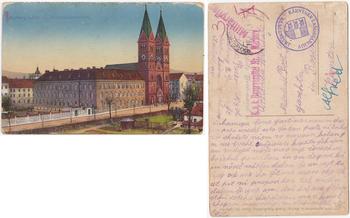
The next example (see Figure 10) was produced in 1916 and has a rather interesting history. This particular example illustrates that the modestly literate, who probably rarely wrote letters, occasionally sent postcards. It also illustrates how much can be learned about these senders and their circumstances if the different layers of information contained in a single postcard are properly read and interpreted. The sender, “Ferdinant Wošchitc,” was from Carinthia, was of rural descent, served as a soldier in the Austrian army, had become ill, and was sent to a reserve military hospital in Maribor/Marburg. From there he sent his wife, “Uršchula,” this postcard letting her know that he was alive and well:
Picture postcard sent by a sick soldier in a military hospital to his wife. Producer: Franz Knollmüller, Graz: “Marburg a./Dr. – Franziskanerkirche” [Maribor – Franciscan church]. Produced in 1916 and sent from Maribor/Maribor to Dolnja vas / Niederdörfl, nearby St. Margarethen/Šmarjeta v Rožu in Carinthia. POLOS_4081, source: private collection Domej.
The way he constructed his written message in Slovenian demonstrates the very modest educational effect the schooling system had on the population in rural Lower Carinthia. He appears unfamiliar with the rules of orthography and grammar, and so only wrote phonetically in the manner of his local dialect. For example, he seems unaware of individual words and wrote them together with the words that followed in the way they were colloquially spoken. The same is true for his command of German, which is evident in the written parts where he gives the address of where he is staying: “K. u. k. Rezerve No 3 ob / taielung 2 [illegible] Št / dentn haiem Marburg / Anderdrau” (“K.u.k. Reserve No 3 Abteilung 2 [illegible] Studentenheim Marburg an der Drau”). He had obviously learned some basics of writing, so it can be inferred that he probably attended an utraquist or a German-only primary school but had never received a proper education and probably did not read much either, if at all. Nevertheless, he had achieved a modicum of literacy.
As this postcard demonstrates, advances in increasing literacy had been made in these parts of the Habsburg monarchy, enough so that at the beginning of the twentieth century, a common man from a rural area was sufficiently literate to send such a message and leave behind a written account.Footnote 24 Thus, unlike historians trying to reconstruct history from below about common, illiterate peasants from an earlier period, those studying the last decades of the Habsburg monarchy have some access to the voice of the common people through, for example, picture postcards.
There is, however, more information contained in this postcard. It is clear from the address he wrote to, as well as from the local dialect he wrote in, that he came from Rosental/Rožna Dolina in Lower Carinthia. The postcard also suggests that the sender was old enough to be married—which west of the Hajnal line usually occurred rather late—but also not too old for military service.Footnote 25 Furthermore, it would be reasonable to assume that Ferdinand survived World War I and returned home to his wife. In fact, these suppositions were later confirmed by records kept in his home village, which indicate that he was born in 1872, married Ursula in 1901 at the age of twenty-eight, and died in 1957.Footnote 26 When he wrote this postcard from the military hospital, he was already forty-four years old. Moreover, he obviously survived not only World War I but World War II as well.
Conclusion
This is a small sample of the many postcards sent and received that have survived and can be found in private and official archival collections. While the sample size may be small, it indicates the potential of this medium to enhance research and understanding about this period at the turn of the twentieth century. Although these picture postcards can be read as evidence of language conflict and ethnic tensions in the mixed regions of the Habsburg monarchy, they also portray to a much further extent bilingualism, language contact, social aspects of language use, peaceful everyday coexistence, and the irrelevance of nationness in many everyday situations. Investigating the content of individual messages and applying a sociolinguistic approach reveals even more about the senders and receivers. These postcards, written by common people from the beginning of the twentieth century, convey a broad range of information about different sorts of identifications, multiple identities, social and educational backgrounds, and complex layers of individual feelings of belonging. Moreover, the messages contained in them were multilayered and were conveyed with visual and textual elements, and often both elements were intertwined.
Furthermore, the analyses of these examples demonstrate how postcards can contribute an additional layer to an understanding and reconstruction of historical circumstances, which is particularly relevant to the construction of history “from below.” The 1916 postcard sent from a military hospital (Figure 10) is one of the most salient examples. Not only was it possible to infer a great deal about the sender, but it was also possible to expand on statistical data contained in local records by adding a more human or personal dimension, and by adding the kinds of details that seldom get recorded. In this way, postcards can contribute to constructing an image of civilian life or of soldiers’ experiences during wartime.
Rather than being merely interesting and colorful snapshots of times past, picture postcards can in fact be a useful resource for historians researching many different topics related to this period, including Alltagsgeschichte (the history of everyday life), gender and kin relationships, social and regional history, language history, regional and religious affiliations, World War I, and nationalism. Some of these issues have been touched on here, but due to limited space, only a few examples could be analyzed in detail. Undoubtedly, there is vast untapped potential in these artifacts for researching many different historical facets “from below.”
In conclusion, these ten picture postcards written by common people from the beginning of the twentieth century convey a broad range of information about different sorts of identifications, multiple identities, and complex layers of individual feelings of belonging. However, the postcards from Else, Gretl, Vaclav, Alfonz, Ferdinand, and others permit only a glimpse into specific moments of their lives, and these stories are only a few of many others that could also be told. However, it is obvious that picture postcards can help reach a deeper understanding of identifications among common people and paint a clearer picture of the mixed regions in Habsburg monarchy and the identities that mattered to their inhabitants, which were often not so evidently defined along national lines.