Introduction
Among the sucking insect pests, cotton mealybug, Phenacoccus solenopsis Tinsley (Homoptera: Pseudococcidae) is an important polyphagous insect pest and causes severe losses to different crops (i.e. 58–73.8%) (Zhang et al., Reference Zhang, Amalin, Shirali, Serrano, Franqui, Oliver, Klun, Aldrich, Meyerdirk and Lapointe2004; Abbas et al., Reference Abbas, Arif and Saeed2005; Zhou et al., Reference Zhou, Lu, Zeng, Xu and Liang2013). Cotton mealybug has been reported as a serious pest of various crops, including vegetables and ornamentals in Australia, USA, Cyprus, Egypt, France, Iran, Israel, Japan, Pakistan, India, China, and Turkey (Hodgson et al., Reference Hodgson, Abbas, Arif, Saeed and Karar2008; Wang et al., Reference Wang, Watson and Zhang2010; Kaydan et al., Reference Kaydan, Çalışkan and Ulusoy2013; Fand and Suroshe, Reference Fand and Suroshe2015). It is an important pest of cotton, Gossypium hirsutum L., Malvaceae and caused 30–60% yield losses during 2005–2009 in Pakistan and India (Fand and Suroshe, Reference Fand and Suroshe2015). The cotton mealybug is also an important pest of ornamental plants, such as Hibiscus rosasinensis L. and Hibiscus syriacus L. belonging to the family Malvaceae, Brugmansia aurea Lagerh and Cestrum nocturnum L. belonging to the family Solanaceae, Lantana camara L. belonging to the family Verbenaceae, and vegetables (such as Solanum esculentum Lam., S. melongena L., and Capsicum annuum L.) belonging to the family Solanaceae (Fand and Suroshe, Reference Fand and Suroshe2015; Çalışkan et al., Reference Çalışkan, Kaydan, Muştu and Ulusoy2016).
Host plants play a significant role in the growth and spread of P. solenopsis and affect the life history parameters (Abbas et al., Reference Abbas, Arif, Ashfaq, Aslam and Saeed2010; Arif et al., Reference Arif, Rafiq, Dildar, Arshad and Aslam2013). Like other arthropod pests, host plant range is an important ecological characteristic of mealybug species. Host plant range defines the resource base of a pest, which helps in determining the population dynamics and the interaction with other insect species, parasites, and predators (Calatayud et al., Reference Calatayud, Polanía, Guillaud, Múnera, Hamon and Bellotti2002; Neuenschwander, Reference Neuenschwander, Neuendschwander, Borgemeister and Langewald2003). Effect of various host plants on the life table and biological parameters of P. solenopsis has been reported by various workers from different parts of the world (Aheer et al., Reference Aheer, Shah and Saeed2009; Mamoon-ur-Rashid et al., Reference Mamoon-ur-Rashid, Khattak and Abdullah2012; Arif et al., Reference Arif, Rafiq, Dildar, Arshad and Aslam2013; Kedar et al., Reference Kedar, Saini and Ram2013; Çalışkan et al., Reference Çalışkan, Kaydan, Muştu and Ulusoy2016). However, no information of complete biological parameters of P. solenopsis on different ornamental and crop plants exists. Therefore, a comparative study on the biological parameters of P. solenopsis reared on various host plants is necessary to develop better control strategies against this pest.
Large-scale adaptation of chemicals for the control of insect pests has led to insecticide resistance in a number of polyphagous insect pests and many other problems, like health hazards, environmental pollution, and secondary pest problems, which have increased (Malik et al., Reference Malik, Javed and Ayyaz2015; Rehman et al., Reference Rehman, Nadeem, Ayyaz and Begum2015). Therefore, the management of insect pests by behavioural manipulation or push–pull strategies can be helpful in integrated pest management programmes (Ravindhran and Xavier, Reference Ravindhran and Xavier1997). Host plants can play a pivotal role not only in population growth but also lead to the outbreak of certain polyphagous insect pests (Abbas et al., Reference Abbas, Arif, Ashfaq, Aslam and Saeed2010). Because of the importance of behavioural manipulation in insect pest management strategies, this phenomenon has gained admiration in the last few years. The main emphasis is to reduce the usage of insecticides to make an eco-friendly agro-ecological climate (Foster and Harris, Reference Foster and Harris1997). The current study was conducted to evaluate the impact of six host plants on the biological parameters of P. solenopsis under laboratory conditions.
Materials and methods
Host plants
Six host plants viz. gul-e-ancha (C. pulcherrima, Sw., Fabaceae), ‘gul-e-cheen’ (P. rubra, Apocynaceae), anthurium (Anthurium spp., Araceae), Arabic jasmine (Jasminum sambac Aiton, Oleaceae), and China rose (Hibiscus rosasinensis L., Malvaceae) were obtained from the Botanical Garden of Bahauddin Zakariya University, Multan, Pakistan. Freshly picked leaves of selected host plants were used throughout the experiment.
Collection and rearing
About 200 adults of P. solenopsis were collected from the cotton fields located in Ali Pur, Pakistan (29.388155 °N, 70.919013 °E) in 2013. The adults were brought to the laboratory and reared in plastic jars (22 × 13 cm) on soft and freshly plucked twigs with leaves from each tested host plant. The older twigs with leaves were changed with fresh ones after 2–3 days. The culture on each host was maintained at 27 ± 2 °C temperature, 65 ± 5% RH, and 10/14 (L/D) photoperiod (Afzal et al., Reference Afzal, Shad, Abbas, Ayyaz and Walker2015).
Biological parameter of P. solenopsis
For testing the effects of host plants on the biological parameters of P. solenopsis, the field population was reared for two generations on each host plant to adapt to the new host plant and eliminate the maternal effects before starting the experiment. A total of 150 newly hatched crawlers were randomly collected from each host population to study biological parameters. Crawlers were weighed with weighing balance and reared in plastic jars (500 mL) containing freshly picked twigs with leaves of selected host plants. The dried leaves were replaced with fresh leaves after 2–3 day intervals. The plastic jars were arranged in three replicates for each host population, and 50 crawlers were used for each replicate. All insects were kept at the laboratory conditions mentioned above. The data were recorded on a daily basis. The survival rate (%), male nymphal duration (crawler to second instar, days), female nymphal duration (crawler to third instar, days), number of pupae, weight of pupae (mg), and pupal period (days) were observed. Moreover, the emergence rate of male (%), fecundity (number of eggs/female), male and female longevity (days), generation time (days), and female adult weight (mg) were also determined.
Statistical analysis
The hatchability (%) was determined according to Abbas et al. (Reference Abbas, Shad and Razaq2012) as follows:
 $$\begin{equation*}
{\rm{Hatchability}} = {\rm{All}}\;{\rm{neonates}}/{\rm{All}}\;{\rm{eggs}}{\rm{.}}
\end{equation*}$$
The net reproductive rate (R 0) was calculated using the following formula as reported by Jia et al. (Reference Jia, Liu, Zhu, Liu, Gao and Shen2009) and Abbas et al. (Reference Abbas, Shad and Razaq2012):
 $$\begin{equation*}
{R_0} = {N_{n + 1}}/{N_n},
\end{equation*}$$
where Nn is the population quantity of the parental generation and Nn +1 is that of the next generation.
Mean relative growth rate (MRGR) of both sexes were determined according to Afzal et al. (Reference Afzal, Shad, Abbas, Ayyaz and Walker2015):
 $$\begin{equation*}
{\rm{MRGR}} = [W1\;{\rm{(mg}}) - W{2_{}}\;({\rm{mg}})]/T,
\end{equation*}$$
where W1 is the initial crawler weight, W2 is the pupae weight for male or third instar weight for female, and T is the developmental time (days) from crawler to pupae for male or crawler to third instar for female.
Biotic potential was determined according to Abbas et al. (Reference Abbas, Shah, Shad, Iqbal and Razaq2016) as follows:
 $$\begin{equation*}
{\rm{Biotic}}\;{\rm{potential}} = {\rm{Log}}\;{\rm{fecundity}}/T.
\end{equation*}$$
Data were analysed by the analysis of variance (ANOVA) using Statistix 8.1v (Anonymous, 2005) and means were compared by Tukey's honestly significant difference (HSD) test (P < 0.05).
Results
Survival rate, nymphal duration, development time, and generation time
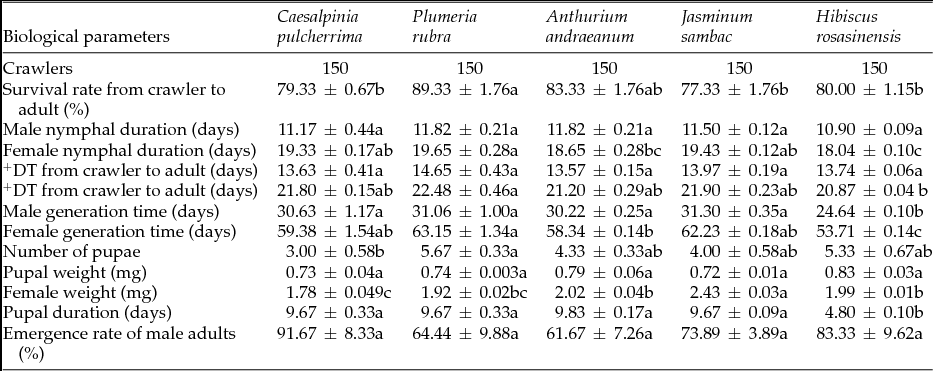
The survival rate from crawler to adult of P. solenopsis was significantly different on the tested five host plants (F = 6.66, df = 4, P < 0.01). The highest survival rate (89.33%) was on P. rubra and lowest survival rate (77.33%) was on J. sambac (Table 1). Male nymphal duration was not significantly different on all the tested host plants (F = 2.65, df = 4, P < 0.09). The female nymphal duration was significantly lower on H. rosasinensis compared to all the other tested hosts (F = 10.70, df = 4, P = 0.001) except A. andraeanum.
The developmental parameters of Phenacoccus solenopsis on different host plants

Means followed by the same letter in rows are non-significantly different (P > 0.05).
+ DT: development time
The development time from crawler to male adult was not significantly different on all the host plants (F = 2.33, df = 4, P = 0.13; Table 1). Similarly, the development time from crawler to female adult on P. rubra was significantly longer compared with the H. rosasinensis (F = 5.22, df = 4, P = 0.02). Male generation time on C. pulcherrima, P. rubra, A. andraeanum, and J. sambac was significantly longer compared to the H. rosasinensis (F = 16.50, df = 4, P < 0.001). Similarly, the female generation time on H. rosasinensis was highly significantly shorter than on the C. pulcherrima, P. rubra, and J. sambac (F = 16.50, df = 4, P < 0.001).
Number of pupae, pupal and female weight, pupal duration, and emergence rate of male
Number of pupae on C. pulcherrima was significantly lower (F = 4.29, df = 4, P = 0.03) than on P. rubra but was not significantly different than on other host plants (Table 1). The pupal weights of P. solenopsis did not differ significantly among all the tested hosts (F = 2.07, df = 4, P = 16). The pupal duration on A. andraeanum, J. sambac, P. rubra, and C. pulcherrima was significantly longer compared to the pupal duration on H. rosasinensis (F = 90, df = 4, P < 0.001). Average female adult weight on C. pulcherrima was significantly lighter as compared to other host plants (F = 54.60, df = 4, P < 0.001) except on P. rubra. Emergence rate of male adults was not significantly different on all tested host plants (F = 2.43, df = 4, P = 0.11).
Adult longevity, fecundity, and hatchability
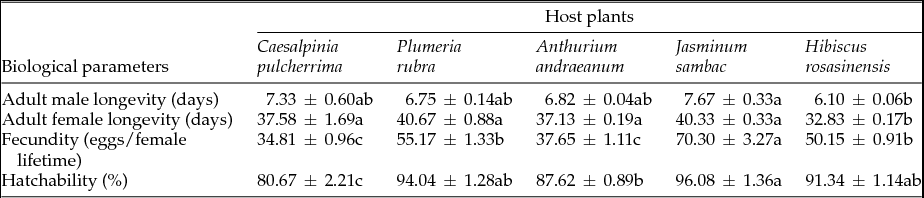
Adult male P. solenopsis longevity on J. sambac was significantly longer than on H. rosasinensis (F = 3.60, df = 4, P = 0.05) (Table 2). Similarly, adult female longevity was shorter on H. rosasinensis compared to all other hosts (F = 13.10, df = 4, P = 0.001). The number of eggs per female produced on J. sambac was significantly higher than on all the other hosts (F = 66.60, df = 4, P < 0.001). The percent hatching of eggs on C. pulcherrima was highly significantly lower compared to other tested hosts (F = 17.60, df = 4, P < 0.001).
Adult longevity, fecundity, and hatchability of Phenacoccus solenopsis on different host plants

Means followed by the same letter in rows are non-significantly different (P > 0.05).
Net reproductive rate, intrinsic rate of natural increase, and biotic potential
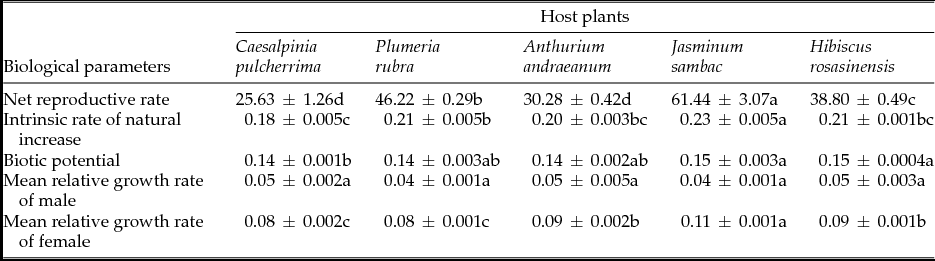
The net reproductive rate on tested hosts was highly significantly different (F = 86.80, df = 4, P < 0.001). The highest net reproductive was observed on J. sambac and lowest on C. pulcherrima (Table 3). Similarly, the intrinsic rate of natural increase (F = 17.90, df = 4, P < 0.001) and biotic potential (F = 7.78, df = 4, P = 0.004) were also highly significantly different on the different hosts.
The growth parameters of Phenacoccus solenopsis on different host plants

Means followed by the same letter in rows are non-significantly different (P > 0.05).
Mean relative growth rate
The mean relative growth rate for male P. solenopsis did not differ significantly among all the tested hosts (F = 1.81, df = 4, P = 0.20), while the mean relative growth rate for female P. solenopsis on J. sambac was significantly higher compared with the other tested host plants (F = 45.80, df = 4, P < 0.001). The MRGR of female was highest on J. sambac and lowest on C. pulcherrima and P. rubra (Table 3).
Discussion
Host plants play an important role in the outbreaks of insect pests (Umbanhowar and Hastings, Reference Umbanhowar and Hastings2002). The biological parameters of a particular insect pest can vary on different hosts, and this factor determines the plant suitability for herbivorous hosts. Rapid development times and greater reproductive rates of insect pests on a particular host indicate the higher suitability of a host (Awmack and Leather, Reference Awmack and Leather2002; Saeed et al., Reference Saeed, Sayyed, Shad and Zaka2010). The developmental and reproductive rates provide important clues about the host's ability to support the whole life cycle of insects. However, these data should be associated to other parameters like mortality before pupation or adult maturation, which ultimately determine host suitability (Saeed et al., Reference Saeed, Sayyed, Shad and Zaka2010). In the present study, developmental time from crawler to male/female adult of P. solenopsis varied on different types of hosts. Shorter developmental time on a specific host could result into a shorter life cycle and rapid population growth (Singh and Parihar, Reference Singh and Parihar1988; Saeed et al., Reference Saeed, Sayyed, Shad and Zaka2010), which might reduce generation time. The variations in developmental rates of insects on various hosts could be due to the differences in nutrient contents and phytochemicals produced as a response to damaged tissue because, as a defence mechanism, plants produce phytochemicals in response to the herbivory damage (Goussain et al., Reference Goussain, Prado and Moraes2005; Saeed et al., Reference Saeed, Sayyed, Shad and Zaka2010; Khan et al., Reference Khan, Shad and Akram2012). More nitrogen contents in host plants increased the survival, longevity, fecundity, and hatchability of sucking insect pests, as well as hatching capacity of their eggs (Kalaiselvi and Kalaivani, Reference Kalaiselvi and Kalaivani2011). However, further studies are required to explore the biochemical reasons for such variations.
In this study, the body weights of P. solenopsis females had a significant association with number of eggs laid. On A. andraeanum, J. sambac, and H. rosasinensis, females were heavier, and laid the maximum number of eggs. Previously, the relationship between body weight and fecundity was observed in other insect pests, such as Spodoptera exigua (Greenberg et al., Reference Greenberg, Sappington, Legaspi, Liu and Setamou2001), Aedes albopictus, Aedes geniculatus (Armbruster and Hutchinson, Reference Armbruster and Hutchinson2002), Plutella xylostella (Saeed et al., Reference Saeed, Sayyed, Shad and Zaka2010), and Musca domestica (Khan et al., Reference Khan, Shad and Akram2012) where fecundity was significantly associated with body weight of the insect. In addition to differences in developmental times and body weights, marked alterations in survival rate from crawler to adults among the different host plants were seen. Nymphs fed on P. rubra and A. andraeanum had considerably higher survival rates compared to the other host plants. Higher survival rate on P. rubra and A. andraeanum might be due to lower early mortality, which could be attributed to the suitability of these host plants. The death of juvenile stages of an insect population, however, is a key factor in assessing the adult population (Saeed et al., Reference Saeed, Sayyed, Shad and Zaka2010). Similarly, the host plants can also have a significant effect on the number of adults and their longevity.
The females developed from the nymphs of P. solenopsis reared on J. sambac laid a higher number of eggs compared with the other hosts. In contrast to this study, previously highest fecundity (nymphs/female) of P. solenopsis on H. rosasinensis was reported (Sana-Ullah et al., Reference Sana-Ullah, Arif, Gogi, Shahid, Adid, Raza and Ali2011; Mamoon-ur-Rashid et al., Reference Mamoon-ur-Rashid, Khattak and Abdullah2012; Arif et al., Reference Arif, Rafiq, Dildar, Arshad and Aslam2013). The suitability of hosts as a nymphal food depends on various factors that might alter the oviposition behaviour of the insect pests consuming such type of food (Khan et al., Reference Khan, Shad and Akram2012). Host plant chemical cues also play a key role in the oviposition behaviour of insect pests (Reddy and Guerrero, Reference Reddy and Guerrero2004). The differences in fecundity on various host plants might demonstrate chemical cues that mediate host plant selection in P. solenopsis (Saeed et al., Reference Saeed, Sayyed, Shad and Zaka2010). However, further studies should explore the role of these chemical cues of host plants in attracting females for oviposition.
The information of differences in host plants could have practical application for the management of P. solenopsis. Phenacoccus solenopsis has the potential to become an important pest in any crop system, due to its broad host range, including field crops, vegetables, ornamentals, and weeds. The present results suggest that the tested host plants can play an important role in the spread and survival of P. solenopsis; therefore, the management of P. solenopsis is necessary on these hosts. The results presented here could be helpful in designing management strategies, including cultural control.