Introduction
Horseweed [Conyza canadensis (L.) Cronquist var. canadensis] has long been a problematic weed in Ohio soybean [Glycine max (L.) Merr.] fields and has the potential to cause substantial yield loss when not adequately controlled (Bruce and Kells Reference Bruce and Kells1990). A survey conducted by the Weed Science Society of America in 2016 ranked C. canadensis as both the number one most common and troublesome weed in Ohio soybean production, and it ranked within the top five most troublesome weeds in U.S. soybean production (Van Wychen Reference Van Wychen2016). Conyza canadensis has the ability to spread over long distances and grow in almost any season. It can flourish as both a winter and summer annual, with 5% to 32% of total germination occurring in the spring (Buhler and Owen Reference Buhler and Owen1997; Loux et al. Reference Loux, Stachler, Johnson, Nice, Davis and Nordby2004). Conyza canadensis has become even more problematic since the evolution of herbicide-resistant biotypes. In the United States, C. canadensis has been reported to have resistance to group 2, 5, 7, 9, and 22 herbicides, and instances of resistance to multiple sites of action have also been reported (Heap Reference Heap2020).
Increased interest in conservation management has led to an increase in the number of acres that farmers are managing with cover crops and without tillage (USDA 2019, 2014; Watts et al. Reference Watts, Myers, Towery, Scott, Dean, Bass, Prokopy, Weber, Tyner, Leirer and Werblow2014). In 2017, roughly 6.2 million hectares of cover crops were planted in the United States (USDA 2019). The area planted with cover crops in Ohio has also been incrementally increasing over the past several years (OSU-ACN 2018). Farmers are adopting cover crops for their multitude of benefits, namely for reduced soil erosion, decreased nutrient loss, building soil organic matter, improved infiltration, and weed suppression (Dabney Reference Dabney1998; Dabney et al. Reference Dabney, Delgado and Reeves2001; Reicosky and Forcella Reference Reicosky and Forcella1998; Teasdale Reference Teasdale1996). Conservation efforts have numerous and wide-reaching benefits. However, the increase in no-till production has exacerbated issues with C. canadensis and other weeds that germinate on the soil surface and thrive in undisturbed soils. In general, tillage renders C. canadensis much less of a problem, as it exhibits poor germination if buried below 0.5 cm (Nandula et al. Reference Nandula, Eubank, Poston, Koger and Reddy2006).
Current C. canadensis management recommendations rely heavily on comprehensive herbicide programs. These programs can be costly and difficult for growers to implement and manage, as they often require fall, spring, and summer herbicide treatments to achieve acceptable control. Applications outside the growing season are often necessary, because there are few POST herbicide options for the late-season control of C. canadensis, especially if the population exhibits resistance to glyphosate (Loux et al. Reference Loux, Doohan, Dobbles, Johnson, Young, Legleiter and Hager2016). Cover crops may be able to provide some weed suppression and could potentially reduce herbicide inputs (Teasdale Reference Teasdale1996). Cereal rye (Secale cereale L.), henceforth referred to as “rye,” is one of the most widely used cover crops in Ohio and the Midwest. Rye is capable of producing the high levels of biomass often cited as necessary to achieve weed suppression and can outcompete winter and summer annual weeds (Cornelius and Bradley Reference Cornelius and Bradley2017). There is a need for the development of a comprehensive rye cover crop management program that integrates with fall- and spring-applied herbicides and for better quantification of the use of rye cover crops with herbicides to control glyphosate-resistant C. canadensis.
The overall goal of these studies was to develop a better understanding of C. canadensis suppression by rye and to develop a complete management program that addresses the use of rye as an alternative or supplemental form of glyphosate-resistant C. canadensis control. The planting date and seeding rate of a rye cover crop can potentially impact C. canadensis population density and control by altering the competition dynamics within the system. Additionally, the role of fall- and spring-applied herbicides in controlling C. canadensis in the presence of rye is unclear. The objectives of this research were to: (1) determine the effect of planting date and seeding rate of a cereal rye cover crop on C. canadensis population density and control in the subsequent soybean crop (Studies I and II), and (2) determine whether the cover crop could replace a fall herbicide treatment (Study II) or allow for a reduction in the use of spring-applied residual herbicides (Study I). The hypothesis was that adding a rye cover crop to a no-till soybean production system would aid in controlling glyphosate-resistant C. canadensis, and possibly even replace some of the conventionally used herbicide inputs, such as fall-applied 2,4-D or spring preplant residuals.
Materials and Methods
Two field studies were conducted simultaneously in the growing seasons from fall of 2016 to 2017 and fall of 2017 to 2018 at the Ohio Agricultural Research and Development Center (OARDC) Western Agricultural Research Station in South Charleston, OH (39.861642°N, 83.667583°W). Each site had a field history of glyphosate-resistant C. canadensis infestations. The fields used for each study had previously been in winter wheat (Triticum aestivum L.) or corn (Zea mays L.) production and were fallow at the start of the project. In the first year of the studies, the soil type in Study I was a Kokomo silty clay loam (fine, mixed, superactive, mesic Typic Argiaquolls) with a soil organic matter content of 2.8% and a pH of 6.4. In Study II, the soil was a Crosby silty clay (fine, mixed, active, mesic Aeric Epiaqualfs) with an organic matter content of 1.6% and a pH of 6.0. In the second year of the studies, the soil type in Study I was a Kokomo silty clay loam with a pH of 6.2 and organic matter of 3.3%. Kokomo silty clay loam was also the soil type in Study II, with a site pH of 6.9 and organic matter of 3.3%. To incorporate all the variables of the three objectives, a randomized complete block design in a split-split-plot randomization restriction with four replications was used. For each study, rye planting date was the main plot factor, rye seeding rate was the subplot factor, and the herbicide treatment was the sub-subplot factor. Individual experimental units (plots) were 3-m wide by 9-m long. Study I consisted of 18 treatments with the following factors: two rye planting dates, three rye seeding rates, and three levels of a spring residual herbicide. Study II consisted of 12 treatments with the following factors: two rye planting dates, three rye seeding rates, and two levels of a fall herbicide.
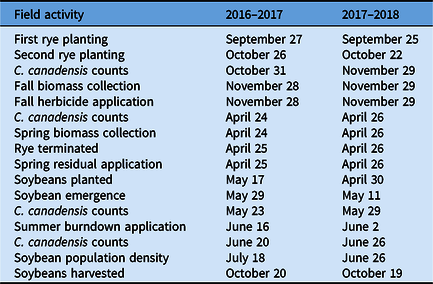
Rye (VNS, Cisco Company; Indianapolis, IN), was disk drilled at a depth of 1.3 cm in rows spaced 19 cm apart. In 2016, the first rye planting date was September 27 and the second planting date was October 26 (Table 1). In 2017, the first planting date was September 25 and the second planting date was October 22. These planting dates were representative of both the beginning and most active times of grain corn harvest, directly after which cover crops can be planted with a subsequent planting of soybeans in a conventional crop rotation (USDA-NASS 2010). These establishment timings are also suitable for fields that were previously in wheat production and harvested midsummer. Rye seeding rates for both studies were 0, 50, and 100 kg ha−1. The 50 and 100 kg ha−1 rates represented the low and high ends of the recommended seeding rate range for rye used as a cover crop (Hayden et al. Reference Hayden, Ngouajio and Brainard2014; Winger et al. Reference Winger, Ogle, St John and Stannard2010). The 100 kg ha−1 seeding rate also represented the recommended seeding rate for rye planted as a grain or forage (Bruening Reference Bruening2015), and the 0 kg ha−1 rate served as the control. Study I received a broadcast application to all plots of 2,4-D at 0.49 kg ae ha−1 on November 28 in 2016 and November 29 in 2017 so that management of the trial was consistent with current recommendations and the spring residual herbicide factor could be isolated for evaluation. In Study I, the three levels of spring preplant residual herbicides were nontreated, flumioxazin at 0.09 kg ai ha−1, and flumioxazin + metribuzin at 0.09 and 0.42 kg ai ha−1, respectively. These herbicides were applied on April 25 in 2017 and on April 26 in 2018, which were 22 or 4 d before soybean planting, respectively. Planting was delayed in 2017 as a result of weather. Spring preplant residual levels were representative of common agronomic practices in Ohio. Many producers use a flumioxazin or sulfentrazone product and add metribuzin for greater control if needed. These treatments were used because many of the C. canadensis populations across Ohio exhibit acetolactate synthase inhibitor resistance (Trainer et al. Reference Trainer, Loux, Harrison and Regnier2005). The two levels of fall herbicide in Study II were nontreated and 2,4-D at 0.49 kg ae ha−1. A fall application of 2,4-D is the first step in recommendations for Ohio producers attempting to control C. canadensis (Loux et al. Reference Loux, Doohan, Dobbles, Johnson, Young, Legleiter and Hager2016). Study II received a broadcast application of flumioxazin at 0.09 kg ai ha−1 to all plots on April 25 in 2017 and April 26 in 2018 to isolate the fall herbicide treatment as a factor. Both studies received a spring broadcast preplant treatment of glyphosate at 0.89 kg ae ha−1 on April 25 in 2017 and April 26 in 2018 to terminate the rye.
Dates of field activities and treatments in Studies I and II, evaluating a rye cover crop for Conyza canadensis suppression in no-till soybeans in South Charleston, OH, from 2016 to 2018.

Soybeans resistant to glyphosate and dicamba (Asgrow®, AG36X6; Bayer Crop Science, St. Louis, MO) were planted on May 17 and April 30 in 2017 and 2018, respectively. Soybeans were planted at a rate of 432,000 and 410,000 seeds ha−1 in 2017 and 2018, respectively, in rows spaced 38 cm apart. Both studies received a POST application of glyphosate at 0.89 kg ae ha−1 on June 16 in 2017 and June 2 in 2018 to remain consistent with current recommendations and common practices and to eliminate the effects of weed pressure from other species. In Study II, 1.1 kg ai ha−1 of acetochlor was included with the POST glyphosate application for residual control of Amaranthus spp. and grass species in year 1, based on the history of the experimental field and presence of these weeds. Herbicide treatments were applied in a volume of 140 L ha−1 using Air Injection Extended Range tips (AIXR, 11002; TeeJet Technologies®, Springfield, IL). Weather data for both growing seasons were collected by an on-site weather station.
Measurements in both studies included C. canadensis population density, aboveground rye biomass, and soybean population density and seed yield. Conyza canadensis density and control were measured at the time of the spring preplant herbicide application, at soybean planting, and at the time of the POST application (Table 1). To evaluate C. canadensis density, two 0.25-m2 quadrats were established in the front and back half of each plot and maintained for the duration of the study. Rye biomass was measured on November 28, 2016, and November 29, 2017. The aboveground rye growth was harvested from a 0.25-m2 quadrat placed at random in the middle of the plot, taking care to include the same number of drilled rows each time. The rye samples were dried at 55 C for 3 d and weighed to quantify biomass based on dry weight. A rising plate meter (Jenquip; Feilding, New Zealand) was used to measure spring rye biomass on April 24, 2017, and April 29, 2018, the day before rye termination (Michell and Large Reference Michell and Large1983). Ten samples outside the treated plot area were measured using the plate meter and then cut, dried, and weighed to obtain the calibration equation used for subsequent nondestructive measurements within plots. The mean of five measurements from each plot was used to derive kilograms per hectare (kg ha−1) of dry matter using the established calibration equation, and these were then averaged per plot and treatment before analysis.
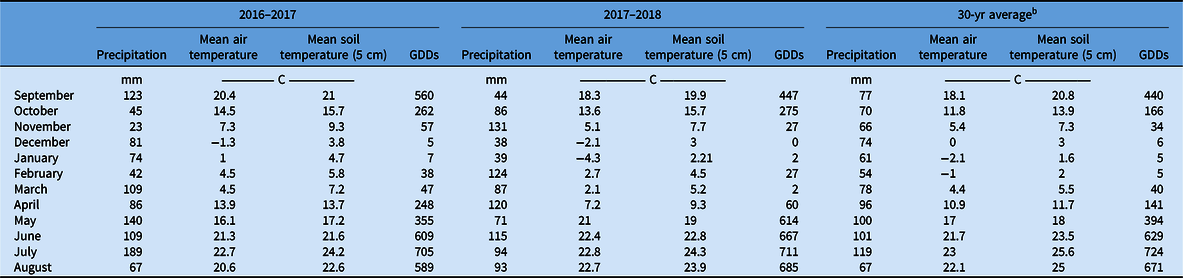
Soybean population density was measured on July 18, 2017, and June 26, 2018, using a method from the University of Kentucky. This required counting the number of soybeans in 3 m per plot, calculating the sum for the total of 12 m per treatment, and averaging to give an estimate of plants per hectare in each treatment (Lee and Herbek Reference Lee and Herbek2005). Soybean seeds were harvested mechanically and measured for weight and harvest moisture, and yields are reported at an adjusted moisture content of 13%. Due to the variability in weather (Table 2) and C. canadensis emergence, data were analyzed separately by year. Data were analyzed as a factorial in a randomized complete block using the PROC GLIMMIX in SAS v. 9.4 (SAS Institute, Cary, NC). Fixed factors were the rye planting date, rye seeding rate, and herbicide level, and their respective interactions. Random factors included replication, planting date by replication (whole-plot error term), and seeding rate by planting date by replication (subplot error). When the global F-test was significant, treatment means were separated using Fisher’s protected LSD (α = 0.05).
Weather conditions at the Western Agricultural Research Station in South Charleston, OH, during the trial period from September 2016 to August 2018.a

a Abbreviation: GDDs, growing degree days.
b From 1988–2018 at the OARDC Western Agricultural Research Station.
Results and Discussion
Weather
The 2017 to 2018 growing season had substantially different weather patterns, and thus growing conditions, compared with the 2016 to 2017 season. This led to changes in the time of emergence, growth, and development of C. canadensis populations as well as management practices. In April, the peak time of spring C. canadensis emergence, the mean air temperature of the second growing season was 7.2 C. This was 3.7 C cooler than the 30-yr average, and 6.7 C cooler than the previous year (Table 2). Germination and development of C. canadensis were likely slow during this time, as C. canadensis does not germinate as well at cooler day and night temperatures (Nandula et al. Reference Nandula, Eubank, Poston, Koger and Reddy2006). This was also reflected by the lower growing degree day (GDDs) accumulated in the spring months of March and April 2018 as compared with both 2017 and the 30-yr average (Table 2). In April 2018, the research station received 34 mm more precipitation than in April 2017 and 24 mm more than the 30-yr average. These cool, wet conditions likely affected the growth and development of C. canadensis. Combined with the fact that there was already a lower population of C. canadensis in each study during the fall of 2017 heading into the second growing season as compared to the first, this led to an overall lower than average population of C. canadensis in early spring. These conditions caused slower germination, and C. canadensis populations were not present until later in the second growing season of the studies. In general, Study II had a higher population of C. canadensis than Study I in both seasons, which was due in part to the fall application of 2,4-D in the latter, in order to isolate the spring preplant residual factor.
Study I. Rye Planting Date, Seeding Rate, and Spring-applied Residual Herbicide
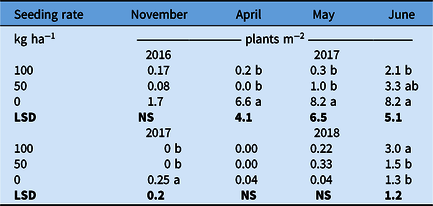
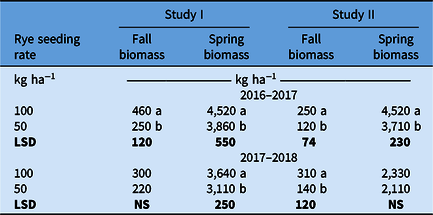
The main effects of rye seeding rate and herbicide level had the most consistent effect on C. canadensis population density each year. In the first year, density at the time of the rye termination in late April and in May at the time of soybean planting was higher in the absence of rye compared with either seeding rate, averaged over other factors (Table 3). Conyza canadensis density in June was lower at the 100 kg ha−1 seeding rate compared with the absence of rye, and the 50 kg ha−1 seeding rate was similar to both. In the second year, C. canadensis density was lower in the presence of rye versus the absence in November. In June, density was higher for the 100 kg ha−1 seeding rate compared with 50 or 0 kg ha−1. Differences in the effect of seeding rate on June density between years may reflect the importance of fall biomass for suppression of C. canadensis into the following spring. The 100 kg ha−1 seeding rate produced nearly twice as much fall biomass as the 50 kg ha−1 seeding rate in the first year, while there was no difference between rates in the second year (Table 4). The higher seeding rate produced only 15% more spring biomass both years compared with the lower rate. Beyond this effect, it is possible that under certain environmental conditions, a rye cover can result in a microenvironment at the soil surface that is conducive for C. canadensis emergence and growth.
Effect of rye seeding rate on Conyza canadensis density in Study I, averaged over rye planting date and spring residual herbicide level.a

a Means within a column followed by the same letter are not significantly different based on LSD at α = 0.05.
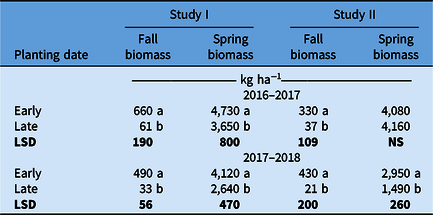
Effect of rye seeding rate on fall and spring rye biomass averaged over planting date and herbicide treatment.a

a Means within a column followed by the same letter are not significantly different based on LSD at α = 0.05.
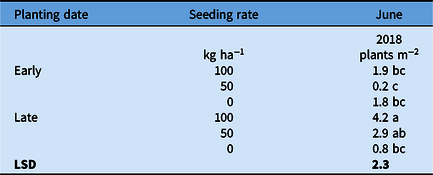
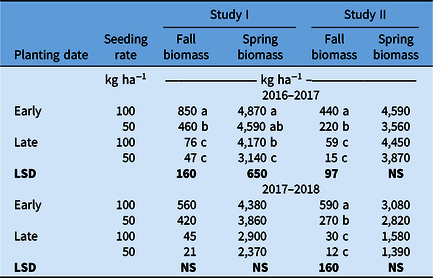
Rye planting date did not affect C. canadensis population density in this study, with the exception of an interaction between planting date and seeding rate in June 2018. This interaction reflected the lower C. canadensis density for the 50 and 100 kg ha−1 seeding rates at the early planting, compared with the same rate planted late (Table 5). Across both years, the earlier planting date resulted in approximately 10 to 15 times more biomass than the later planting in November (Table 6). Spring rye biomass was also higher in the early-planted treatments relative to the late-planted treatments each year, although there was a date by seeding rate interaction in the first year. The early-planted, 100 kg ha−1 seeding rate produced the most fall biomass, with lowest biomass for the late planting regardless of seeding rate (Table 7). The early-planted 100 kg ha−1 seeding rate produced more biomass in the spring than the late-planted 100 kg ha−1 seeding rate, which was higher than the late-planted 50 kg ha−1 seeding rate. These results suggest that an early rye planting date and a high seeding rate is most likely to achieve higher levels of biomass by late fall. However, the overall lack of an effect of planting date on C. canadensis density indicates that lower biomass in the late planting was still sufficient to provide a similar level of weed suppression. Murrell et al. (Reference Murrell, Schipanski, Finney, Hunter, Burgess, LaChance, Baraibar, White, Mortensen and Kaye2017) observed similar spring rye biomass levels when rye was planted after wheat in August and after corn in September and October, and the date of rye planting did not have an effect on the density of broadleaf weeds.
Effect of the interaction between rye planting date and rye seeding rate on Conyza canadensis density in Study I, averaged over spring residual treatments.a

a Means within a column followed by the same letter are not significantly different based on LSD at α = 0.05.
Effect of rye planting date on fall and spring rye biomass averaged over seeding rate and herbicide treatment.a

a Means within a column followed by the same letter are not significantly different based on LSD at α = 0.05.
Effect of the planting date by seeding rate interaction on fall and spring rye biomass averaged over herbicide treatment.a

a Means within a column followed by the same letter are not significantly different based on LSD at α = 0.
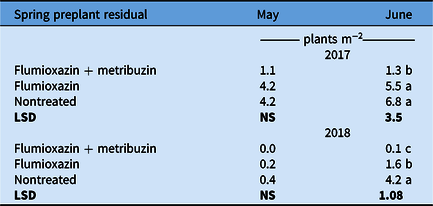
Conyza canadensis density was unaffected by residual herbicide level in May. In June, the flumioxazin plus metribuzin treatments resulted in the lowest C. canadensis density each year, averaged over other factors (Table 8). The flumioxazin reduced C. canadensis density compared with the nontreated only in 2018. There was a three-way interaction in June 2018, wherein C. canadensis density was higher for treatments with rye at either seeding rate and flumioxazin or no residual, compared with those without rye and flumioxazin + metribuzin (data not shown). These results suggest that even in the presence of rye, a more comprehensive spring residual program is necessary to maximize midseason C. canadensis control through the time of POST herbicide application. This is consistent with the findings of Cornelius and Bradley (Reference Cornelius and Bradley2017), which demonstrated the ability of rye to suppress summer annual weeds early in the growing season in comparison with nontreated controls, other cover crop species, and other herbicide programs, but not to the same degree as spring-applied residual herbicides later in the season.
Effect of spring preplant residual herbicide on Conyza canadensis density in Study I, averaged over rye planting date and seeding rate.a

a Means within a column followed by the same letter are not significantly different based on LSD at α = 0.05.
Planting dates and seeding rates that resulted in the highest biomass had the most potential to reduce soybean population density, and also yield in year 2. In the first year, soybean density was higher for late- versus early-planted rye, and also in the absence of rye versus the 100 kg ha−1 rye seeding rate (data not shown). There was also an interaction between seeding rate and herbicide treatment. In the absence of rye, the treatments that included a spring residual at either seeding rate had higher soybean densities compared with the 50 kg ha−1 seeding rate and flumioxazin, or the 100 kg ha−1 rye seeding rate and flumioxazin + metribuzin. In year 2, soybean population density was affected by seeding rate, interactions between planting date and seeding rate, and a three-way interaction. Soybean density was greater in the absence of rye than at the 50 kg ha−1 rye seeding rate, and both treatments resulted in greater soybean density than the 100 kg ha−1 rye seeding rate (data not shown). The early-planted rye at the 100 kg ha−1 seeding rate had the lowest soybean density. In the three-way interaction between planting date, seeding rate, and herbicide, soybean density was highest in the absence of rye with no residual herbicide or flumioxazin, and lowest for early-planted rye at the 100 kg ha−1 seeding rate without residual herbicides.
Most treatments were at or above the critical level of 247,000 soybean plants ha−1 necessary to maximize yield (Robinson and Conley Reference Robinson and Conley2007). Treatments did not have an effect on soybean seed yield in 2017, and yields averaged 4,620 to 5,240 kg ha−1. Differences among yields in the second year generally reflected the effect of rye seeding rate on soybean density. Soybean yield was highest in the absence of rye or herbicides, at 5,280 kg ha−1; this was higher than soybean yields at the 50 kg ha−1 rye seeding rate with flumioxazin or the 100 kg ha−1 rye seeding rate with flumioxazin + metribuzin, which were 4,750 and 4,740 kg ha−1, respectively.
Study II. Rye Planting Date, Seeding Rate, and Fall-applied Herbicide
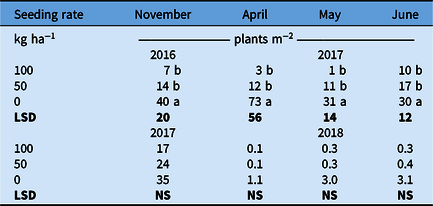
Rye planting date did not affect C. canadensis density in this study. Seeding rate affected C. canadensis density in year 1. At the time of the fall herbicide application in late November of 2016, C. canadensis density in the absence of rye was more than double that of treatments with rye, averaged over other factors (Table 9). This effect continued through the June 2017 measurements, although it was greatest in April before application of preplant residual herbicides, when there were 73 C. canadensis plants m−2 in the absence of rye, and 12 and 3 C. canadensis plants m−2 at the 50 and 100 kg ha−1 seeding rates, respectively.
Effect of rye seeding rate on Conyza canadensis density in Study II, averaged over planting date and fall herbicide treatments.a

a Means within a column followed by the same letter are not significantly different based on LSD at α = 0.05.
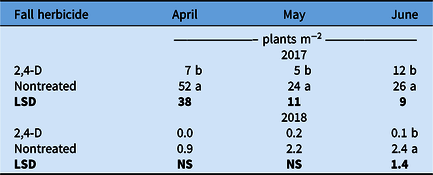
Application of 2,4-D in the fall reduced C. canadensis density in April, May, and June of the first year, compared with the absence of 2,4-D (Table 10). Conyza canadensis density ranged from 5 to 12 plants m−2 where 2,4-D was applied, and 24 to 52 plants m−2 in the absence of 2,4-D. As in Study I, C. canadensis emergence was delayed in the second year of Study II, and treatment effects were not evident until later in the spring. The effect of the fall treatment in the second year was evident in June only, when C. canadensis density was an average of 2.4 plants m−2 in the absence of fall-applied 2,4-D versus 0.13 C. canadensis plants m−2 where 2,4-D was applied (Table 10). These results suggest that a fall herbicide treatment is still important for the control of C. canadensis, even in the presence of a rye cover crop, especially for early-season control. Cornelius and Bradley (Reference Cornelius and Bradley2017) observed that rye generally does not control weeds, especially winter annuals, to the same extent as fall-applied herbicides. The understanding of this effect and that of the spring preplant residual herbicides is important, as C. canadensis can act as both a winter or summer annual, and the management practices must address both types of life cycle. Conyza canadensis plants that emerge in late summer through early fall and overwinter as rosettes are often larger and more competitive with the young soybean crop than those that germinate in the spring. For this reason, a fall herbicide application capable of controlling C. canadensis can be important for minimizing the effects of C. canadensis on soybean growth and limiting subsequent contributions to the seedbank.
Effect of fall herbicide treatment on Conyza canadensis density in Study II, averaged over rye planting date and seeding rate.a

a Means within a column followed by the same letter are not significantly different based on LSD at α = 0.05.
Rye biomass in the fall was affected both years by planting date, seeding rate, and the interaction between these factors. Early-planted rye produced 9 to 20 times more biomass than the later planting (Table 6). The 100 kg ha−1 seeding rate of rye produced twice the biomass of the 50 kg ha−1 rate (Table 4). The interaction reflected early-planted rye at the 100 kg ha−1 seeding rate producing twice as much biomass as the early-planted 50 kg ha−1 seeding rate each fall, and each outproducing the respective late-planted seeding rate by 4% to 50% (Table 7). Rye biomass in spring of 2017 was not affected by planting date, but the early-planted rye produced nearly double the biomass of the late planting in spring of 2018 (Table 6). The 100 kg ha−1 seeding rate produced 810 kg ha−1 more spring biomass compared with the 50 kg ha−1 seeding rate in the first year, but there was no difference between seeding rates in the second year and no interactions between planting date and seeding rate (Table 4).
Based on the biomass results from both studies, rye seeding rate may have more of an effect than planting date on the amount of rye biomass developed by the time of rye termination in spring. This could be due in part to the above-average temperatures from January through April 2017 that allowed the later-planted rye to compensate in growth relative to the early-planted rye and provide similar levels of C. canadensis suppression. These results suggest that in the absence of a fall 2,4-D treatment, a rye cover crop can reduce C. canadensis density. Furthermore, earlier rye planting could lead to greater biomass production. There was no treatment effect on soybean density or seed yield in Study II. Soybean yields ranged from 4,232 to 4,912 kg ha−1 in 2017 and 5,321 to 6,049 kg ha−1 in 2018 (data not shown). Each year, all treatments in both studies produced soybean yields greater than 3,443 kg ha−1, the 5-yr average yield of soybeans in Ohio (Turner and Morris Reference Turner and Morris2018).
The results of these two studies suggest that overall, the inclusion of a rye cover crop in rotation before soybeans can reduce C. canadensis density and that management of the rye can affect the extent of that control. For the suppression of C. canadensis, the planting date of a rye cover crop may not be as important as the rye seeding rate and herbicide program in the eastern Corn Belt. Just before cover crop termination in April and at the time of soybean planting in May, C. canadensis density in the first year of both studies was reduced by the presence of rye regardless of seeding rate. Here, the 50 and 100 kg ha−1 seeding rates provided similar levels of C. canadensis suppression. However, the use of the higher rye seeding rates may help to obtain more effective season-long control, especially of summer annual weeds. Other studies have shown that inclusion of a rye cover crop can reduce weed density (Mischler et al. Reference Mischler, Curran, Duiker and Hyde2010) and that a positive relationship between rye seeding rates and weed suppression exists (Boyd et al. Reference Boyd, Brennan, Smith and Yokota2009; Ryan et al. Reference Ryan, Curran, Grantham, Hunsberger, Mirsky, Mortensen, Nord and Wilson2011).
The planting date and seeding rate of rye both influenced the total amount of biomass rye produced. Earlier-planted rye at higher seeding rates resulted in higher biomass levels, with less biomass produced for lower seeding rates planted later in fall. While not consistent across studies and years, the factors that promoted higher biomass also occasionally resulted in reduced soybean stand and seed yield. Whether this occurs would be dependent upon a number of factors in addition to the rye seeding rate and planting date, such as weather and termination timing relative to crop planting. This research confirms the results of other studies that have shown the ability of rye to reduce weed pressure, but reinforces that herbicides are an essential component of weed management (Ateh and Doll Reference Ateh and Doll1996; Cornelius and Bradley Reference Cornelius and Bradley2017; Reddy Reference Reddy2001).
Conyza canadensis density in June was reduced most effectively with the inclusion of spring-applied flumioxazin + metribuzin, which is among the more comprehensive residual herbicide treatments recommended for management of C. canadensis. The inclusion of fall-applied herbicides resulted in consistently lower C. canadensis densities through the June measurements. Fall herbicide treatments and comprehensive spring residual programs remain important to ensure effective C. canadensis control into the growing season, partly because the effect of rye is inconsistent, as demonstrated by the second year of this research. Incorporating a rye cover crop with a comprehensive herbicide program can be part of the integrated weed management strategy necessary to control glyphosate-resistant C. canadensis in no-till soybean production systems.
Acknowledgments
The authors would like to thank the station personnel at the OARDC Western Agricultural Research Station and the Loux lab members for their assistance and support. We are especially grateful to Bruce Ackley and Bryan Reeb, as well as a number of undergraduate student research associates for technical support and assistance in managing the experimental sites. Salaries and research support provided by state and federal funds appropriated to the OARDC, The Ohio State University. OARDC manuscript HCS 20-02. No conflicts of interest have been declared.