Introduction
Globally, the aging population over the age of 60 years is growing faster than any other age group. In Europe it has been estimated that, by 2050, 35% of the European population will be over the age of 60, compared to the current proportion of 20% (Alliance for Health and Future, 2005), and the biggest growth will be in those aged over 85 (UEMS, 2001). The number of people with dementia in Europe in 2000 was approximately 7.1 million, and by 2050 this figure is likely to have risen to 16.5 million people (Wancata et al., Reference Wancata, Musalek, Alexandronwicz and Krautgartner2003). The financial and emotional pressure placed on the working population will rise markedly. It is estimated that the cost of dementia in Europe is estimated to rise to over 250 billion Euros per year by 2030 (Wimo et al., Reference Wimo and Jonsson2009). The rising aging population combined with increasing numbers of people with dementia therefore poses major challenges for health systems. This means there is a growing need for expansion of specialist older people's mental health services, including memory clinics and community mental health teams. Consequently, there is a pressing need for trained clinicians practicing within specialist disciplines, including old age psychiatry, to meet the health needs and deliver a high standard of care to the aging population across Europe.
In recent years, there has been an increased recognition of the need for training in old age psychiatry, and also the establishment of the discipline as an independent specialty (UEMS, 2001; Camus et al., Reference Camus2003; Andrew and Shea, Reference Andrew and Shea2010). The speciality, however, is not recognized by the European Union (EU), which impedes the development of old age psychiatry across Europe. Old age psychiatry training varies between countries from no training at all to well-established training and education programs. However, the main focus of debate so far has been on an educational curriculum for old age psychiatry rather than a skills- or practice-based training program (Camus et al., Reference Camus2003; Gustafson et al., Reference Gustafson2003). The best-known educational curriculum was developed by the World Health Organization (WHO), World Psychiatric Association (WPA)(WPA/WHO 1998). The educational curriculum would involve the organization of lectures, courses, symposia, and workshops at major international meetings relevant to the discipline, and the dissemination of educational material for practitioners in the field (Camus et al., Reference Camus2003). Such a curriculum and continuing medical education would also require ongoing validation and monitoring (Margariti et al., Reference Margariti, Kontaxakis and Christodoulou2002; Unger, Reference Unger2009). There appears to be substantial agreement between the European Association of Geriatric Psychiatry (EAGP) and World Health Organization (WHO) that a core curriculum should be developed based on knowledge and skills to define the specialty of old age psychiatry (Gustafson et al., Reference Gustafson2003).
There are wide variations in the types of training programs and continual professional development processes for training old age psychiatrists across the EU. There is variability not only in the training processes across countries but also within countries (Margariti et al., Reference Margariti, Kontaxakis and Christodoulou2002). The Bologna Accord, implemented in 2010, highlights the importance of creating a system of comparable and understandable qualifications across the EU as well as promoting student mobility across nations. In 1993, the Council Directive 93/16/EEC was introduced to facilitate the free movement of doctors and mutual recognition of their diplomas, certificates, and other evidence of their formal education. The EU recognizes the importance of standardizing qualifications of medical professionals in order to enable them to work across the EU. To further develop old age psychiatry training in Europe, there needs to be a move toward harmonization between different EU states in developing both a common curriculum and standardized program of training, professional development, and supervision for old age psychiatrists. The aim of this study was to identify the current patterns of training and practice and continuing professional development in old age psychiatry training across Europe, to produce recommendations, and to promote a debate on a process of harmonization.
Methods
Appropriate individuals from every European country were identified and approached and asked to complete the survey by a process of networking, web-based information, and key contacts. These included members of the EAGP Board, members of the World Psychiatric Association, and key old age psychiatrists, or other psychiatrists with a special interest in the area for countries where old age psychiatry was not formally a specialty. In cases where the nominated person did not think that they were suitable to complete the questionnaire (usually they felt that they did not have enough knowledge or insight into the subject matter), they were asked to provide the research team with contact details for the appropriate person. The survey was sent out to one designated individual in each of the 38 countries in Europe between July 2009 and August 2010.
The initial email and survey were sent out in July 2009 and followed up by two reminder emails. In September 2009, representatives from 15 countries had responded; however, there were some representatives from countries, particularly in Eastern Europe, who had not responded, and the deadline for completing the survey was extended. The research team reviewed the contacts for the countries which had not responded, and a revised contacts list was developed and the survey was distributed via email again, with one follow-up reminder about the survey.
The survey was used to gather and collate information on the following areas of old age psychiatry training in European countries: (1) basic medical qualification needed to practice as a physician, (2) mandatory postgraduate psychiatry training and education, (3) specific geriatric psychiatry training and postgraduate qualifications in old age psychiatry, and (4) ongoing training requirements for consultant old age psychiatrists such as continual professional development and peer group supervision.
Results
By November 2010, 30 out of 38 (79%) country representatives had responded to the survey: Austria, Azerbaijan, Bosnia, Belgium, Croatia, Czech Republic, Denmark, Finland, France, Georgia, Germany, Greece, Hungary, Ireland, Italy, Lithuania, Macedonia, Netherlands, Norway, Poland, Portugal, Romania, Serbia, Slovenia, Spain, Sweden, Switzerland, Turkey, Ukraine, and UK. No response was received from representatives in the following countries: Albania, Belarus, Bulgaria, Estonia, Iceland, Latvia, Moldova, and Slovakia.
Undergraduate and postgraduate psychiatry training
All the respondents reported that the basic medical training and qualification in their country ranged between 5 and 7 years, which may also include 1 or 2 years supervised medical practice. All respondents reported that postgraduate psychiatry training up to consultant level ranged between 4 and 6 years. This may include areas of specialization, such as neurology, general/geriatric medicine, pediatrics, child and adolescent psychiatry, gerontology, and geriatric psychiatry.
Geriatric psychiatry training programs
Representatives from 11 countries (37%) – Czech Republic, Denmark, Germany, Greece, Ireland, Italy, Netherlands, Norway, Romania, Switzerland, and UK – reported that they had geriatric psychiatry training programs. The training programs and duration varied between countries, and the time to complete the geriatric psychiatry training component ranged between 6 months and 5 years, but 8 out of the 11 (73%) respondents stated that psychiatrists are required to complete 2 years of training placements within old age psychiatry.
Continuing professional development
Representatives from ten countries (33%) reported that there are specific Continuing Professional Development (CPD) requirements for old age psychiatrists at consultant level. These included credits for attending seminars or courses, peer group assessments, training courses, and the completion of a Masters degree in Geriatric Psychiatry.
Discussion
Since the 2001 UEMS survey, old age psychiatry in Europe has been recognized as a specialist discipline in more countries, but around 60% of the countries contacted did not formally recognize old age psychiatry as a specialty. There was often a lack of national old age psychiatry bodies within individual countries, which impeded data collection. In those countries with formal recognition of old age psychiatry as a specialty, the training to practice in the field was specific to the country and there was very little harmonization across the European countries. One of the key areas for development was the need for national old age psychiatry bodies across Europe to (1) highlight the importance of recognizing old age psychiatry as a discipline, and (2) help harmonize the training and formal recognition of old age psychiatrists across Europe.
Despite the good response rate, there were some limitations to this study. There may be some developments within countries, which have not been captured in the dataset presented in this paper due to the lack of old age psychiatry national bodies. Another approach would have been to approach medical schools directly; however, these are likely to focus on undergraduate education rather than the postgraduate specialties and would not necessarily be able to provide an informative response on the national picture. The lack of responses from Eastern Europe made it more difficult to comment on this area and, consequently, most countries included were from Western Europe. It was often difficult to identify the most appropriate person from each country, and also to obtain up-to-date information about suitable contacts. However, the missing data are also likely to be due to countries not recognizing old age psychiatry as a specialist discipline and a lack of old age psychiatrists working there.
Options for the future
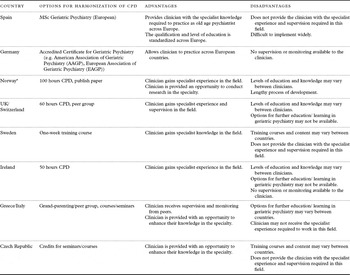
There are a number of possible options for the future. One way of harmonizing the training would be to offer an MSc in Geriatric Psychiatry which is recognized across Europe (Table 1). Although this option would provide the clinician with the necessary knowledge to practice as an old age psychiatrist, the postgraduate qualification would not necessarily equip the practitioner with the specialist experience and supervision that are required. An alternative to this would be to have a common core curriculum based on both knowledge and skills to define the specialty of old age psychiatry (Gustafson et al., Reference Gustafson2003). This has been previously discussed and is an option worth exploring further; if progressed, it should be endorsed by a European Board such as EAGP.
Options for CPD harmonization

* CPD courses are mandatory in Norway.
A further option would be to have peer review panels that would supervise and critically appraise consultant old age psychiatrists and those in training, based on their scientific and technical competencies. Old age consultant psychiatrists could validate training through peer group discussion. This form of peer reviewing, where existing members decide on whom to admit to a specialist discipline, is sometimes known as “Grandparenting.” The peer review panel will very often be selected by way of an election, and panel members may also be able to review co-members within the panel as well. The advantage of this method would be that review and training could become part of an ongoing process as opposed to a time-limited training program. This has the added benefit of learning through mutual exchange of knowledge and expertise.
Conclusions
With the rising number of countries that recognize old age psychiatry as a specialty, there is now a need for the training and development to be harmonized across Europe to allow geriatric psychiatrists to work freely across these countries. Some countries have systems in place for supervised training in the field and/or a requirement for old age psychiatrists to engage in continual professional development. However, the training procedures and processes in place differ between countries and in some cases within countries as well.
To take this forward, support is required from national old age psychiatry bodies across Europe, and an agreement needs to be reached on a training strategy that encompasses supervision, continual professional development, and appraisal of the knowledge and skills required to be a competent old age psychiatrist.
Conflict of interest declaration
Martin Orrell, Joanna Rymaszewska and Ralf Ihl are on the Board of the EAGP.
Descriptions of authors’ roles
S. Toot conducted the study, collected the data, analyzed the data, and wrote the paper. M. Orrell designed the research questions, supervised data collection and analysis, and assisted with writing the paper. J. Rymaszewska assisted with data collection and writing the paper. R. Ihl assisted with study design and provided comments on the research paper.
Acknowledgments
We thank all the respondents who completed the survey for this research study. We also thank Fiona Horton from the Research and Development Office at North East London NHS Foundation Trust for assisting with the distribution of the surveys and collating all responses for the purpose of this study.