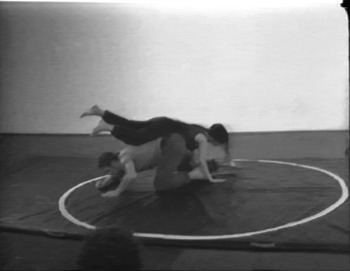
In 1972, Steve Paxton wrote an article in the Drama Review on improvisation within the dance collective Grand Union. In it, he defined the group as an “anarchistic democratic theatre collective” (Reference Paxton1972, 128). The use of the doubled adjectives “anarchistic democratic” points to some hesitancy on Paxton's part about fixing the identity of the collective or perhaps to some ambivalence about its successful embodiment of either of these ideas, particularly in conjunction. For he went on to state that the “attempt to be emancipated without confining or restricting others,” an anarchist tenet, was not easy for all the members because “we are conditioned to voluntary slavery” (131). Paxton ascribed this conditioning to social interactions at various scales, from the national level of American political life to the local level of choreographer-directed dance companies. According to him, in each instance the hierarchical structure of leaders and followers, whether presidents and citizens or choreographers and dancers, results in dictatorships that “demand that others be slaves” (131).
It is tempting to read Paxton's comments as hyperbolic versions of the generalized turn toward greater equality and communality in the dance world in the wake of the sixties counter-culture. Sally Banes describes Grand Union in those terms in her book Terpsichore in Sneakers: Post-Modern Dance (Reference Banes1977, 208–209). Indeed, Paxton's fellow dancer and choreographer Yvonne Rainer has written that Grand Union developed out of her long-term, open-form piece Continuous Project—Altered Daily because she felt “a moral imperative to form a democratic social structure” with her dancers (Rainer Reference Rainer1974, 128). While the dancers in Continuous Project—Altered Daily wielded a significant amount of control over the sequencing of sections as well as the freedom to include “behaviors” like talking while working through a newly learned movement sequence or reciting text at a microphone, Rainer still created the movement vocabulary within the dance sequences and predetermined the types of events that could take place over the course of the performance (128–54). The shift from Continuous Project—Altered Daily to Grand Union happened when Rainer gave up all control over the piece, allowing it to become at once communally determined and truly improvisational. Throughout Grand Union's lifespan “democracy” did not mean consensus, however, but freedom of choice. Performers could simply do their own activities on stage ranging from the dancerly to the pedestrian, from games to singing to monologues, or they could choose to engage with one another interacting confrontationally, playfully, supportively, through imitation, juxtaposition, or cooperation (see Banes Reference Banes1977, 214–18).
In the Drama Review, however, Paxton mentions his interest in an interdependent, evolving practice of communication that resonates with anarchist models circulating at the time (Reference Paxton1972, 132). And while Paxton's article is ostensibly on the Grand Union overall, it focuses largely on this personal contribution to the group's improvisational vocabulary. By the end of 1972, Paxton and a group of students at Oberlin College had already performed Magnesium (Reference Paxton1972), a high-energy piece that Cynthia Novak called Contact Improvisation's “seminal work,” and he had spent two weeks workshopping the new form in New York with another group of students that included Nancy Stark Smith, Curt Siddall, Danny Lepkoff, David Woodberry, and Nita Little who would stay involved with and help develop contact improvisation over the subsequent years (Novack Reference Novack1990, 61, 63–66). By building on existing phenomenological readings of contact improvisation that describe the dynamic between improvisers in purely intersubjective perceptual terms (see, for example, Albright Reference Albright, Brandstetter, Egert and Zubarik2013) and by taking Paxton's invocation of anarchism in 1972 seriously, I move beyond general descriptions of contact improvisation as a form of decentralized freedom of choice and freedom from authority. Instead, I argue that the form emerged as a historically specific theory of group interaction and communication translated into a tactile, physical medium, thereby rooting the anarchist political values of mutual aid and individual freedom in the body.
At the same time, I extend Carrie Lambert-Beatty's analysis of earlier Judson Dance works to include contact improvisation as it developed throughout the 1970s and into the 1980s. Lambert-Beatty argues that “the interest in co-presence and immediacy in 1960s discourse was a case of protesting too much—of registering in negative the encroachments of communications technology and cultures of spectatorship” (Reference Lambert-Beatty2008, 25–26). Contact improvisation's participatory ethos and supposed disregard for performance masks a concern on Paxton's part with the problem of making a tactile form visible. Paxton worked with Nancy Stark Smith and Lisa Nelson as well as the videographer Steve Christiansen to record, edit, and narrate compilations of footage of contact improvisation between the mid-1970s and the late 1980s. These videos are not simply records of improvisations; they represent a paradoxical attempt to overcome the misalignment between the viewer and the dancer in live demonstrations of contact improvisation through the mediation of video.
Communication and Intersubjectivity
From its inception, contact improvisation centered on the relationship between people as a relationship between moving bodies. Magnesium, the high-energy piece Paxton developed at Oberlin, separated out the moments of contact from the moments of focused proprioception. The piece consisted of the students flinging themselves at one another, ricocheting repeatedly off each other's bodies onto wrestling mats as they began to sense how gravity and momentum could affect their postcontact falls. The piece ended with an extended period of standing with eyes closed—the proprioceptive counter to the dancers’ high level of external stimulation during the first portion of the piece (see Paxton [1972] Reference Paxton2006). Although Magnesium's two-part structure emphasized a split between sensations prompted by external stimuli and those coming from the dancers’ interior musculature, the two streams of information would become more and more integrated as the form developed.
As a reader of James J. Gibson's Reference Gibson1966 The Senses Considered as Perceptual Systems, Paxton understood perception as always dependent on the combined effect of sensorial information received from within one's body and sensory input from the body's interaction with other bodies, space, and gravitational forces.Footnote 1 Eventually, contact improvisation became as much about the movement between falls, about supporting and maintaining a point of contact with one's partner for a more extended period of time, as about the falls themselves. As one can see in the later contact improvisation videos like Chute, the improvisers move in relation to one another, constantly shifting the point of contact, as well as each person's center of gravity and orientation to the floor; in this context touch was crucial, allowing the partners to remain grounded through each other's skeletons (see Paxton, Nelson, and Christiansen [1979] Reference Paxton, Nelson and Christiansen2006).
This focus on the real-time sensorial experience of movement makes contact improvisation a ripe site for phenomenological readings as well as for critiques leveled at the supposed neutrality and ahistoricity of the phenomenological body (see Albright Reference Albright2011, Reference Albright, Brandstetter, Egert and Zubarik2013; Overlie Reference Overlie, Jones and Paxton1984; Goldman Reference Goldman2010; Ness Reference Ness2011). While I agree that the implied universality of the body in contact improvisation absolutely resulted from white racial privilege, I argue against collapsing that understanding into the one that emerges in Maurice Merleau-Ponty's philosophy. Merleau-Ponty's concept of intersubjectivity, in which perception opens onto the world, bridging monadic and interactive experiences, is a close but inexact fit with Paxton's understanding of communication (see Merleau-Ponty [1962] Reference Merleau-Ponty and Landes2012, 54). A comparison between the two will help clarify the ways in which contact improvisation presented a model of embodied anarchist philosophy within the movement form itself in the 1970s and early 1980s.Footnote 2
The resonances between Merleau-Ponty's thoughts on spoken dialogue and Paxton's comments on improvisational partnered movement are striking. In Phenomenology of Perception, published in French in 1945 and translated into English in 1962, Merleau-Ponty describes language as a key cultural object for understanding not only one's development as a subject in relation to the world at large, but also one's development in relation to others. His discussion of dialogue and the dynamics of a dialogic interaction, however, extend beyond anything specific to speech. Merleau-Ponty writes:
In the experience of dialogue, a common ground is constituted between me and another; my thought and his form a single fabric, my words and those of my interlocutor are called forth by the state of the discussion and are inserted into a shared operation of which neither of us is the creator. Here there is a being-shared-by-two, and the other person is no longer for me a simple behavior in my transcendental field, nor for that matter am I a simple behavior in his. We are, for each other, collaborators in perfect reciprocity: our perspectives slip into each other, we coexist through a single world. I am freed from myself in the present dialogue, even though the other's thoughts are certainly his own, since I do not form them, I nonetheless grasp them as soon as they are born or I even anticipate them. And even the objection raised by my interlocutor draws from me thoughts I did not know I possessed such that if I lend him thoughts, he makes me think in return. (Merleau-Ponty [1962] Reference Merleau-Ponty and Landes2012, 370)
In a conversation with Rainer, Paxton states:
What is happening when people come together to consensus? They're both offering their center, and then the two centers maneuver with each other. It isn't one attacking the other and whatever happens, happens. But instead there can be flexibility, around which actually a whole new event emerges and which seems to be defined by neither, but by the synergistic effect of both… . Here is a movement form in which, in the essence of contact, touch and the exchange of weight, in the conversation between the masses, a very lively communicative interaction occurs, causing both people to improvise simultaneously to keep up with the other one as in conversation. (Rainer and Paxton Reference Rainer, Paxton and Benoit1997, 19)
For both, subject and object positions dissolve into a collaborative sharing in the creation of thoughts or movement, the two subjectivities improvising together to draw something new out of one another that they did not know they possessed or could not access alone; each feels the distance between themselves and their interlocutor collapse even as they are aware of their own boundaries in the case of individual ideas for Merleau-Ponty and perceptions, proprioception, and kinesthesis for Paxton.
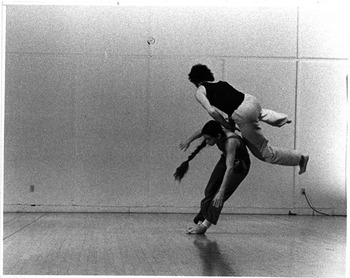
Paxton, however, also emphasizes the possibility of considering a partner's body as a medium for one's own movement, a means to engage gravity and other forces, thereby adding a utilitarian and individualistic layer on top of the dialogue between subjects. “I think that if you touch something you can sense how it is based, you can sense the leverage potential in the thing,” Paxton said to Folkert Bents in Reference Paxton1981 (Paxton Reference Paxton1981–82, 8), referring not only to objects but also to other people. It is that leverage potential, along with gravity and momentum, that contact improvisers have employed since the first decade of the form. In a lift, the top body's weight must be directed down through the lower body's structure, using the grounded dancer's bones as a support. The lifted dancer's ability to use the vertical gravitational force as a place to move from, rather than a place of collapse or resting equilibrium between two bodies, depends on feeling that force as it travels through the other improviser. In Photo 1 Alan Ptashek swings his legs out to the side to balance the diagonal line of force down Nancy Stark Smith's planted legs; this allows him to push harder and better maintain the momentum of his jump, avoiding a freefall. Paxton related this type of grounding-through-another to Gibson's discussion of how “blind people with a cane seem to sense not their hand but the tip of the cane,” (Paxton Reference Paxton1981–82, 8) thus emphasizing, in contrast to Merleau-Ponty, the utilitarian nature of the relationship to other people.
Nancy Stark Smith and Alan Ptashek, Vancouver BC. Photo by Erich Franz.

Furthermore, Merleau-Ponty's philosophy is descriptive, charting what happens in the context of any given dialogic situation, while Paxton encourages communication, seeing it as desirable. As cited earlier, he wrote in Reference Paxton1972 that “the changes of material in performance should be aimed at furthering communication, not hampering it” (Paxton Reference Paxton1972, 132, my emphasis), and he maintained that view nearly a decade later when he said:
You start off wherever you are. You go through different states and you experience them as you do it and what you feel is implicit in the situation. You can affect those states. They are going to be affected by the experience and at the same time, you can work for more and more desirable states. I hope people will. (Paxton Reference Paxton1981–82, 8)
Even as each individual interaction allows for new experiences of support and fall, contact and balance, experienced improvisers can also build on their previous sessions. The possibility of improvement over time comes up later in the same interview with Bents: “You can think of the body as a tunable instrument rather than as an instrument whose tuning is pedestrian or organic or habitual in your life,” Paxton said (Paxton Reference Paxton1981–82,18). It is also central to the 1987 video Fall After Newton. The video documents eleven years of contact improvisation and heavily features Paxton and Smith. Paxton wrote, delivered along with Smith, and eventually published a transcript of the voiceover, in which he comments repeatedly on Smith's physical and technical advances over the years, not through cross-training or study, but through her dedicated practice of the form (see Paxton Reference Paxton and Smith1988). “Communication” thus refers both to an intersubjective meeting and to a mode of mutual assistance within any given moment and over time, fostered through perceptual openness and physical touch. This assistance enables physical and perceptual tuning, making the improvisatory form, free from specific technical norms, as much about the practitioners helping one another develop over time as improvising something new together.
Mutual Aid
Paxton's Grand Union article (Reference Paxton1972) discussed earlier shows him starting to work through questions of communication and mutual growth as they pertain to improvisatory movement forms:
The changes of material in performance should be aimed at furthering communication, not hampering it. Like jigsaw-puzzle pieces, the two persona/activities are put together. But they rarely remain intact; instead, they tend to blend through evolutionary or mutative communication forms into shared material. (132)
This comment about mutually beneficial evolution through the joining of different but complementary actions or persons, relates his thinking about improvisation among dancers to Peter Kropotkin's anarchist theories. Kropotkin developed the idea of “mutual aid” as a factor in biological and social evolution in the late nineteenth century to counter both Thomas Henry Huxley's interpretation of Darwinism as the survival of the fittest and what Kropotkin called the principle of modern society: “Everyone for himself, and the State for all” (Kropotkin Reference Kropotkin1902, xv). Kropotkin, instead, argued that evolution taught that living beings “find in association the best arms for the struggle for life” (293). While Paxton did not cite Kropotkin by name in his early writings on contact improvisation, he did refer to him as a model of cooperation in a recent response to a talk by Christian Felber (Reference Felber2014). Felber was comparing the modes of social engagement within contact improvisation and across its community of participants with those found in capitalism. Paxton ended his written response to the talk quoting Kropotkin's statement describing association as “the best arms for the struggle for life, [with life] understood … not as a struggle for the sheer means of existence, but as a struggle against all natural conditions unfavorable to the species.”Footnote 3 Paxton, building on Kropotkin, thus understood mutual aid as the basis for both personal and social longevity and development within contact improvisation.
Despite not citing him in his earlier writings or interviews, it is likely that Paxton had read Kropotkin before he and his collaborators developed contact improvisation in the 1970s. Kropotkin's model of a mutually beneficial community built out of individual freedom was important for other artists in the late 1960s, including the painter Barnett Newman. The anarchist's collection of essays on aid and evolution was reprinted in English in the United States in 1955 and his memoirs appeared with an introduction by Newman in 1968. Newman argued for the text's relevance at that moment of “revolutionary ferment” and praised Kropotkin's espousal of a “creative way of life that makes all programmatic doctrine impossible” (Newman [1968] Reference Newman and O'Neill1990, 45). There was also a broader blossoming of libertarian thought ranging across the political spectrum in the United States throughout the seventies as people became increasingly disillusioned by the government as the war in Vietnam further unraveled. For some, this meant penning philosophical tracts directly addressing social forms like John Rawls’ A Theory of Justice (Reference Rawls1971) and Robert Nozick's Anarchy, State, and Utopia (Reference Nozick1974), while for others, like the poet Robert Duncan, it meant crafting an artistic practice as an embodiment of the ideals of anarchism.Footnote 4
Eric Keenaghan has argued that Duncan's well-known poetry from the 1960s and 1970s recirculates the anarchist idea (explicitly influenced by Kropotkin in this case) that “creativity might help expose a forgotten groundwork for human collectivity wherein individuals act freely yet, because they cooperatively work together, do not interfere with others’ liberties” (Reference Keenaghan2008, 635).Footnote 5 Furthermore, Keenaghan describes Duncan's belief in art as a way to resist the state, not by trying to win but by trying to live, by turning an inner struggle into a dynamic relationship with poetry beyond the state's control (650). “The crucial battle in which we should exterminate the enemy is the battle against what seem to us established ideas of the poet and his art; but no sooner is he exterminated than, disestablished, he must spring anew to fight now, not for his establishment but for his life,” wrote Duncan in 1969. “The very life of our art is our keeping at work contending forces and convictions” ([1969] Reference Duncan1985, 112). For Duncan, poetry provided a model for the reader and a space for the poet in which one could continuously destabilize oneself to counter the government's crystallization of social structures.
Paxton hoped that contact improvisation would foster a similar, but now literalized and embodied opportunity, for destabilization. In a public conversation with Rainer, he couched the movement form as a kind of competition against oneself, just as Duncan framed his poetry as a mode of self-directed strife:
What is interesting to me, about … contact improvisation relative to social structures, whatever they may be called, is that it's a game in which your opponent is yourself and it takes two people to win. As opposed to your opponent being the other and one person wins … even in democracy somebody always wins and somebody loses. You elect somebody and somebody else goes back to the fields and plows until their nation needs them again. It just seems to me that we set up our models with game structures which lead one to the conclusion that life should be played the same way. Which may be good for the culture but is devastating for fifty percent of the individuals, that is the losers, unless they're strong enough to win the next round. (Rainer and Paxton Reference Rainer, Paxton and Benoit1997, 21–23)
Staging oppositions between social models and life, between what might be good for the culture and what is good for individuals, between competition among people and competition with oneself assisted by others, Paxton frames contact improvisation as a practice of living that contrasts with American democracy. While he made the statement quoted above many years later, it harkens back to his first essay on improvisation within Grand Union. That essay appeared in print just weeks after the 1972 Republican convention at which Richard Nixon was officially renominated as the Republican candidate. Vice President Spiro Agnew gave a speech at the event in which he commended President Nixon for “knowing that our greatest strength is in unity,” amplifying Nixon's appeal a few years earlier to the “silent majority” (Agnew Reference Agnew1972, 47; see Nixon Reference Nixon1969). Contact improvisation would evolve in opposition to this rigidly defined unity.
Contact improvisation itself was not conceived as a stable alternate social structure nor as an attempt at political revolution.Footnote 6 Through its improvisatory intersubjective and yet utilitarian mode of haptic communication and support, it sought to generate a different experience of the self: as both an individual and as part of a social group. The idea was to benefit each dancer without either dancer becoming subsumed by the pairing or fully closed off within the self.
Empathy in Art
While it is tempting to see contact improvisation and its tactile, minutely felt form of anarchist sociability as a complete renunciation of the visual relationship between audience and performers, Paxton in fact remained engaged with the entwined problems of performing and watching movement that interested him during his time as a choreographer in the 1960s.Footnote 7 In an interview in 1975 with Liza Bear, Paxton characterized his work before contact improvisation as focused on performance as a medium. He explained this by quoting his own voiceover from the piece Some Notes on Performance (1967): “Like the famous tree which was unsure whether it would be making noise should it fall to the ground in a forest without people, there is a way of looking at things which renders them performance” (Paxton Reference Paxton1975, 29). For Paxton, there is a quality of attention and focus, a level of engagement on the part of the viewer that turns a mere event into a performance. The dance critic Jill Johnston, while poetically rhapsodizing on Some Notes on Performance as well as Satisfyin’ Lover (Reference Johnston1968) in one of her Village Voice reviews, captured Paxton's interest in the qualities that generate performance qua performance ([1968] 1971, 153–55). She concluded her article with a riff on Paxton's voiceover: “Like the famous ordinary people who are certain they will see and be seen whether they fall down or keep walking in a forest with or without other famous ordinary people there is a way of looking at things which renders them performance. Let us now praise famous ordinary people” (Johnston [1968] Reference Johnston1971, 155). Johnston not only takes up Paxton's invitation to see the ordinary—a chair and a dog in Some Notes on Performance, regular people walking across the stage in Satisfyin’ Lover—as something worth watching, but also recognizes and celebrates his focus on visual attention, the seeing and being seen, itself.
With contact improvisation, the performance problem became how to make visual something that was inherently tactile, interpersonal, and developed over multiple sessions. The first contact improvisation tour of the West Coast was called, “You come. We'll show you what we do” (Novack Reference Novack1990, 72) and in the 1975 Avalanche Magazine interview with Bear, Paxton described contact improvisation as “an on-going phenomenon that is available occasionally for observation. … It is a display but not of virtuosity. Rather it's a showing of how communication changes” (Paxton Reference Paxton1975, 30). The awkwardness of this phrasing, “a showing of how communication changes,” highlights Paxton's shift from exploring the framing that turns a quotidian movement into performance toward the problem of working in the temporal and experiential gap between someone briefly watching improvisation without touching anyone else and the extended temporality, growth, and connection Paxton believed contact improvisation fostered within and among its participants. This is a shift into the demonstrative and pedagogic meaning embedded in the verb “to show.”
In his extended 1981 interview with Folkert Bents, Paxton specifically addressed this disjunction between his own experience as a viewer and as an improviser. He recalled noticing, after watching footage of himself dancing, that there was a change in the “temporal proportions of actions,” and he wondered if this was due to some characteristic of the film itself (Reference Paxton1981–82, 13). Perhaps the speed of the frames passing was distorting the speed of the movement recorded. To test his theory, he videotaped a stopwatch ticking for three minutes and then timed that video with the same stopwatch to determine if filmic time somehow distorted clock time. The filmed stopwatch and the “live” stopwatch matched up perfectly, proving to Paxton that the temporal distortion was in his perception of time while dancing—an experience that could not coincide with the temporal experience of a viewer sitting and watching either a live or a taped performance (14–15). Paxton located this incommensurability in his body, which he saw not merely in structural terms but also hormonally. Whereas he, as the dancer, acted in an adrenalized state that perceptually expanded the duration of lifts and falls, he described himself as the viewer remaining mostly passive, experiencing only minor kinesthetic muscle responses while watching (14).
Although it might seem obvious that a performer and an audience member experience the same movement differently, Paxton's invocation of his kinesthetic response to highlight rather than minimize this disjunction marks a striking contrast to the understanding of kinesthetic empathy at the heart of modern descriptions of the audience-dancer relationship. The concept of empathy originates in the visual relationship between architectural form and bodily experience. (The contemporary association of empathy with emotion came later.)Footnote 8 The German aesthetic philosopher Robert Vischer used empathy (Einfühlung in German) in his treatise On the Optical Sense of Form: A Contribution to Aesthetics in 1873. Vischer believed that a form's interest was directly related to the kinesthetic impulses it produced in the muscles surrounding the eye, secondarily related to the form of the viewer's body more generally, and from there to one's sense of beauty and proportion (Vischer [1873] Reference Vischer1994, 97). Heinrich Wölfflin moved beyond Vischer's narrow focus on the relationship between aesthetic form and the contraction of eye muscles to posit a more generalized kinship between the structure of the body and the structure of buildings, united by the forces that act on both ([1886] Reference Vischer1994, 158). Vision became, with Wölfflin, simply the conduit for this full-bodied recognition of qualities like weight, lift, and balance (158).
By the early twentieth century, the bodily concept of empathy was picked up in other fields, including art and dance criticism (see Worringer [1908] Reference Worringer and Bullock1997; Martin Reference Martin1933). Dance critic John Martin argued that through the empathic link between audience and dancer, “We shall cease to be mere spectators and become participants in the movement that is presented to us…. It is the dancer's whole function to lead us into imitating his actions with our faculty for inner mimicry [empathy] in order that we may experience his feelings” (Martin [1939] Reference Martin1965, 53).Footnote 9
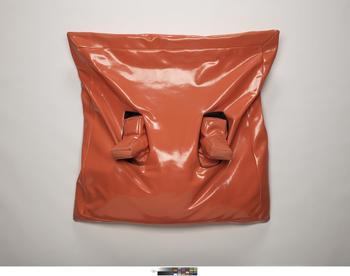
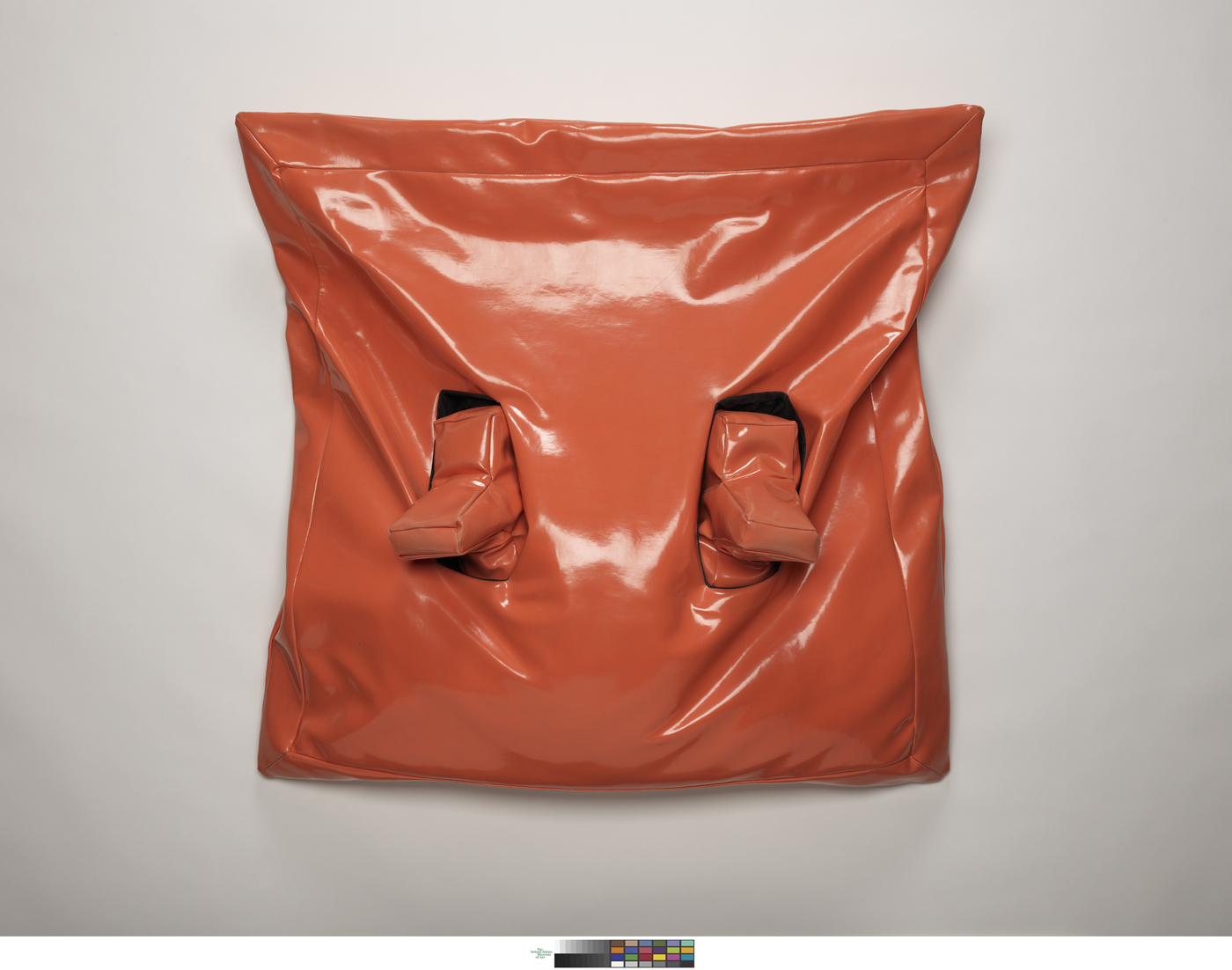
If a bodily, empathic relationship between audience and dancer was assumed throughout the first half of the twentieth century, by the mid-1960s, artists working with objects and in sculpture had begun generating a similar relationship between viewers and their work. Donald Judd, writing in Reference Judd1965 about Claes Oldenburg's soft vinyl sculpture Light Switches (see Photo 2), described Oldenburg as having taken “anthropomorphism to an extreme and made the emotive form, with him basic and biopsychological, the same as the shape of an object” (Judd [1965] Reference Judd1975, 189). From Judd's reading of Oldenburg's sagging, slumping forms as extremely anthropomorphic, we move, a year later, to Lucy Lippard's identification of the body ego in the works of “eccentric abstraction” in her show of the same name ([1966] Reference Lippard and Lippard1971). The body ego provokes a “mindless, near-visceral identification with forms,” she wrote, “[by exciting] that part of the brain which, activated by the eye, experiences the strongest physical sensations” (102). The following year Michael Fried would indict minimalist art for its latent anthropomorphism in “Art and Objecthood.” Fried pointed to size, a sense of interiority, and symmetry as the sources of minimalist art's “disquieting” presence ([1967] Reference Fried and Battcock1968, 128).
Claes Oldenburg, Soft Switches, 1964. Vinyl and Dacron, 47 × 47 × 3 5/8 inches (119.4 × 119.4 × 9.2 cm). Collection of the Nelson Atkins Museum, Kansas City, Missouri. Gift of the Chapin Family in memory of Susan Chapin Buckwalter. Photo Joshua Ferdinard. © 1964 Claes Oldenburg.
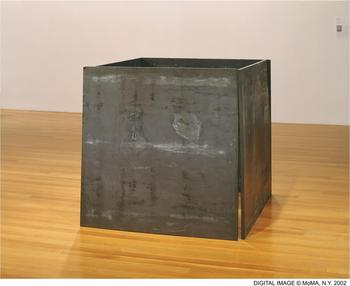
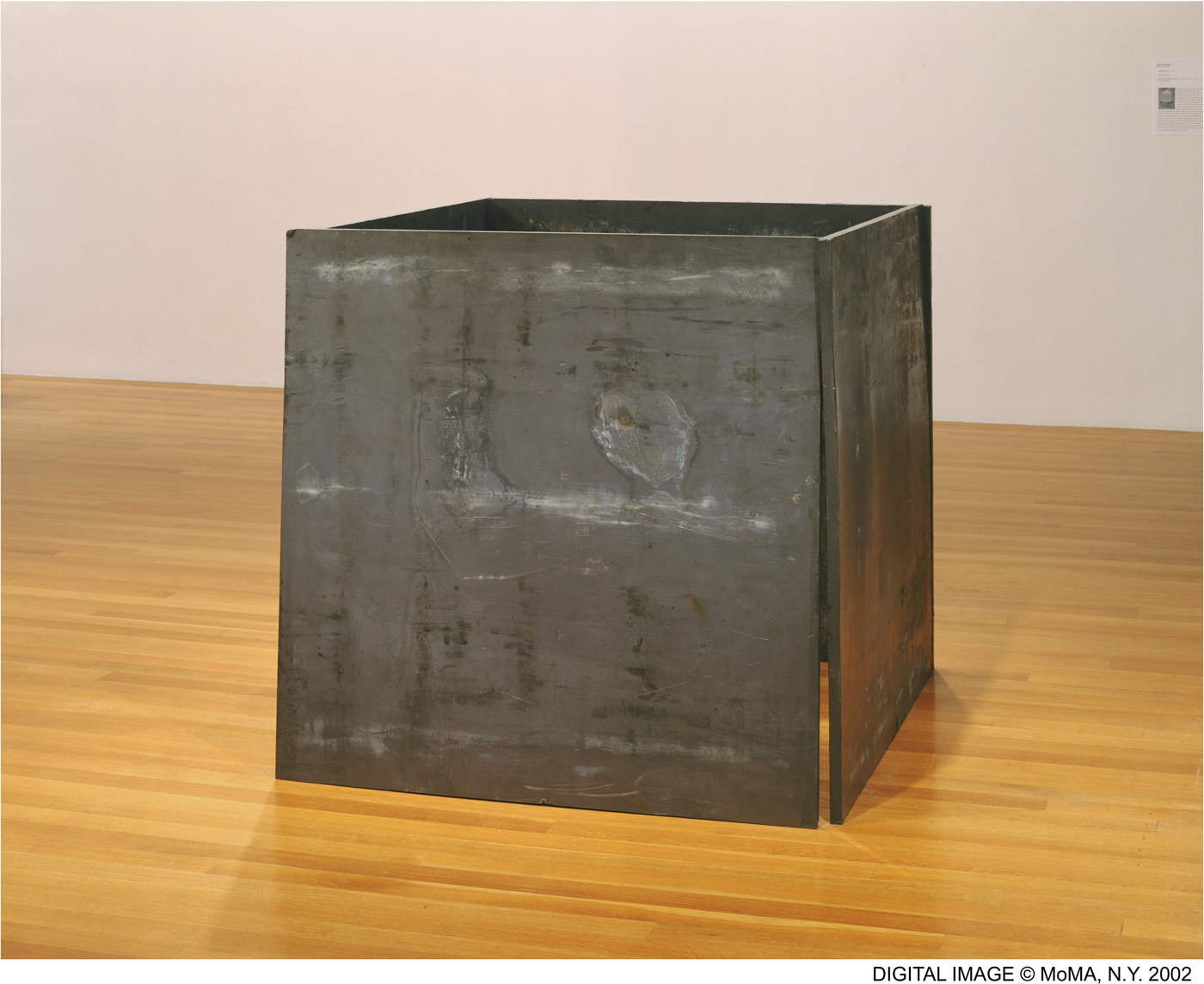
Richard Serra's Prop pieces, which he started making in 1969 from pieces of metal propped or leaning on one another or the wall, supporting each other and themselves, present the period's most abstract and structural occasion for identification between viewer and artwork (see Photo 3).Footnote 10 Rosalind Krauss, drawing on Merleau-Ponty, described these works as exemplary visual metaphors for the “coming into coherence of the body in the guise of a form that was consistently seen in the act of cohering” (Krauss Reference Krauss1973, 6, author's emphasis), never fully whole or present to itself.Footnote 11 More recently, Hal Foster (Reference Foster and Frankel2014) explicitly linked the Prop pieces to the nineteenth-century German theories of aesthetic empathy, convincingly drawing on Wölfflin's ([1886] Reference Wölfflin, Mallgrave and Ikonomou1994) formulation to describe the Props’ precarious engagement with gravity, verticality, and support as empathetic foils for the viewer. We too, as physical beings, feel the forces of gravity, experience the ongoing struggle to maintain verticality, and know what it is to support or be supported. Foster draws on the psychoanalytic concept of “anaclisis,” which describes the dependence of the sexual drives on the survival instincts and literally means “to prop,” to extend this resonance into the psychological and social realms as well (Reference Foster and Frankel2014, 14–15).
Richard Serra, One Ton Prop (House of Cards), 1969, refabricated 1986. Lead antimony, four plates, each plate 48 × 48 × 1 inch (122 × 122 × 2.5 cm). Collection of the Museum of Modern Art, New York. © 2017 Richard Serra / Artists Rights Society (ARS), New York.
Rather than embracing empathy as an artistic strategy, like Oldenburg, the minimalists, and Serra, Yvonne Rainer, with whom Paxton worked closely even before Grand Union, explored the question of kinesthetic empathy in her piece Trio A (1966). Carrie Lambert-Beatty has convincingly argued that the dialectic between live and mediated interactions with other bodies in the 1960s (the rise of performance art at the same time as the rise of tape recording, television news, mass photography) reveals empathy as problematic in the 1960s. Rainer described Trio A, with its continuous, slurred sequence of actions performed at a steady pace and energy level, as having the look but not the feel of the energy one exerts to “get out of a chair, reach for the high shelf, or walk down stairs when one is not in a hurry” (Lambert-Beatty Reference Lambert-Beatty2008, 153; Rainer Reference Rainer1974, 67). This disjunction exemplifies the problem of empathy in performance, for the everydayness was an energetic quality of the movement, allowing for kinesthetic identification between the pedestrian viewer and the perceived ease of the movement. In fact, the dancers had to exert a wide variety of “degrees of effort just in getting from one thing to another” (Rainer Reference Rainer1974, 67). Thus, there was no actual relationship between how the dancer felt performing Trio A and how the audience kinesthetically related to it. Lambert-Beatty connects the problem of kinesthetic empathy in live art to the experience of watching the war in Vietnam on television. She argues that the death and destruction, miniaturized, broken into by commercials, and brought onto a screen in one's living room for the first time made the comparative physical grounding in one's own body that is central to an empathetic reaction, if not impossible, then deeply muted (Reference Lambert-Beatty2008, 151).
Problems with Empathy
In addition to Paxton's concern that his kinesthetic reaction to watching the tape of himself improvising was nothing but an insignificant echo of the actual experience, empathy, as a concept, runs counter to the goals of contact improvisation. Empathy depends on recognition, which in turn presupposes a known experience rather than a new encounter developing in real time. For instance, Foster sees the viewer in front of Serra's House of Cards (1969) (see Photo 3) as correlating their “own tentative free-standing” with the “precarious status” of the form (Foster Reference Foster and Frankel2014, 13). The set of heavy, leaning metal plates relates to one's body in a general, abstracted way. The viewer broadly senses gravity and support whereas leaning, propping, and lifting in contact improvisation exist at the point of contact between two people, moving and shifting moment to moment with the body in space. The philosopher Dan Zahavi, while distinguishing between empathy and of phenomenological intersubjectivity, argues that “empathy understood as a thematic encounter with a concrete other is … taken to be a derived rather than a fundamental form of intersubjectivity … it is taken to disclose rather than establish intersubjectivity” (Zahavi Reference Zahavi2001, 153–54, author's emphasis). This argument extends to the melding of intersubjective communication and mutual assistance manifest in contact improvisation. While falling, pushing, rebounding, and supporting another body, each partner in a Contact pair can come to feel, profoundly, what Wölfflin called the known “basic [and constant] conditions of organic life” in motion—the body's relationship to gravity, its material weight, its physical form, its symmetries and asymmetries ([1886] Reference Wölfflin, Mallgrave and Ikonomou1994, 160). But unlike aesthetic empathy, the perception of these constants is the ground on which the two subjects come into a continuously forming interaction rather than the end goal of that interaction; it is the ground that supports their mutual development. The abstract generalization of recognition does not take into account the moment-to-moment shifts in sensation, perception, and ability. And although this dynamic intersubjective model applies most directly to the improvisers themselves, it is easy to imagine that for Paxton, a generalized empathic reaction fell short as a viewer's experience of contact improvisation as well.
A Different Kind of Spectatorship
Because an empathetic model of vision neither felt able to sufficiently mirror the sensations of the dancers nor adequately capture the dynamism of the developing relationship between them, Paxton and his collaborators Smith and Nelson paradoxically supplemented the live demonstrations and unedited recordings they were using with more mediated videos.Footnote 12 They edited Steve Christiansen's footage and composed scripted voiceovers to introduce nonpractitioners to the analytic mode of spectatorship used by experienced improvisers. Smith described how she and other Contact improvisers would watch early recordings of improvisations and focus on the mechanics of the lifts and falls. “When we'd watch the videotapes and see some outrageous things happen, there was a tremendous appreciation for that. Or we'd see a duet where a very complex thing had gone down, and we could see how they'd worked themselves out of it or into it” (Smith quoted in Novack Reference Novack1990, 78). Already endowed with a sense for the feeling, weight, and trajectory of falling and with a rich groundwork of experiences upon which to draw, Smith could focus her vision on the details of an encounter.
This is precisely the type of vision Paxton asked dancers to let go of during contact improvisation: he urged improvisers “not to get too involved with the visual,” adding that “for many people vision is a kind of a tool which reaches out and grabs things. You grab an image and you strain to see it or reach out and search for details” (Paxton Reference Paxton1981–82, 17). For the dancers while moving, he promoted a receptive, softened gaze prioritizing sensation and peripheral vision. In the voiceover to the video Chute ([1979] 2006), Paxton explicitly discusses the two senses in relation to each other. He begins by describing skin as a “visual surface all over [his] body,” less in an attempt to equate haptic sensation with vision than to emphasize the skin's ability to provide and supplement the information about one's orientation in space gained through visual perception. One's skin, unlike one's eyes, he states, can provide a spherical sense of space because “it works in all directions at once,” and it becomes the main conduit of sensory input during contact improvisation (Paxton Reference Paxton and Smith1982, 16).
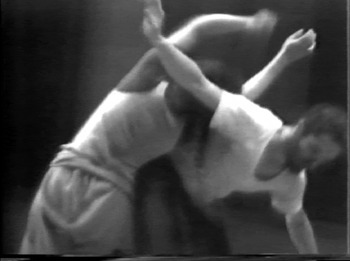
The edited video recordings, Peripheral Vision ([1975] Reference Paxton, Christiansen and Smith2006), Chute, and Fall After Newton ([1987] Reference Paxton and Smith2006), which Paxton made working with Christiansen, Smith, and Nelson, describe this softened gaze while self-reflexively commenting on the viewer's inevitable failure to share the physical experience of contact improvisation and its mode of perception with the performers. In compensation, the videos weave analysis into the footage, using the possibilities of the medium to invite the viewer to see the movement analytically, the way an experienced improviser would see it rather than feel it. A key instance of this compensatory switch from kinesthetic to detail-oriented viewing occurs in Peripheral Vision. Paxton and Smith discuss their own duet, narrating it as they, like us, watch the footage in slow motion before playing it again at speed (see Photo 4). As the real-time footage plays, Paxton says, “Real time, I just don't think that you can see a lot of the detail that you can enjoy in slow motion.” Smith responds, “[In real time] you follow the form rather than the weight … you see the shapes moving but you're not quite sure what's initiating the movement” inviting the viewer to consciously switch from following the form to looking for the point of initiation; yet, as viewers, we can still not be “quite sure what's initiating the movement” (Paxton, Christiansen, and Smith [1975] Reference Paxton, Christiansen and Smith2006). The description of the recording on the video box adds a sense of historical duration to the discussion of the speed of perception. It reads: “Edit of a contact improvisation concert in California in 1974 with Steve Paxton, Nancy Stark Smith and others. With a voiceover by Paxton and Smith, conversing on what is visible and memorable in the dancing from the point of view of one year later” ([1975] Reference Paxton, Christiansen and Smith2006).”
Nancy Stark Smith and Steve Paxton, still from Peripheral Vision, 1975. Camerawork by Steve Christiansen. © Reference Paxton1975, Videoda (Videoda Contact Improvisation Archive: Collected Edition 1972–1983).

Not only are we as viewers physically removed from the performance and simultaneously brought closer to it through the video camera, but we also learn that the narrators are watching this footage at a significant remove as well. Lambert-Beatty (Reference Lambert-Beatty and Perry2006) discusses Rainer's related use of voiceover in her film Lives of Performers (1972). In that film, the audio track consists of the characters narrating what is happening on screen while clearly watching the footage themselves. There is no diegetic sound, instead we and the characters, who sometimes slip out of character and become simply actors, are all spectators, making “connection in alienation” (Lambert-Beatty Reference Lambert-Beatty and Perry2006, 313). Similarly, in Peripheral Vision, we are all viewers together. We all lack access to the moment of contact, but through the mediation of video, its potential for voiceover, for slow motion, and for repetition, the lack of immediacy is acknowledged, and a form of distanced connection is substituted for the feeling of lift and fall.
In the voiceover for Fall After Newton, Paxton says in a deadpan voice, “When an apple fell on his head, Isaac Newton was inspired to describe his three laws of motion. These became the foundation of our ideas about physics. Being essentially objective, Newton ignored what it feels like to be the apple” (Paxton, Christiansen, and Smith [1987] Reference Paxton and Smith2006). Paxton responds to this objectivity in two ways: first, he engages directly with the sensations of “being the apple” through his own somatic play with gravity, and, second, he shows and describes, at a much more local level than the abstraction of physics, how individual “apples” fall. At another moment, in a clip of the first contact improvisation performance at the John Weber Gallery, improvisers shift back and forth on hands and knees, moving over and under each other, cautiously giving and taking weight (see Photo 5). With their centers of gravity so close to the ground, there is little danger in case one or the other fails to correctly sense the direction or force of their partner's momentum. There is also little of visual interest for the audience. Paxton's voiceover acknowledges this, describing the two performers as “getting used to moving by touch” ([1987] Reference Paxton and Smith2006), preempting the viewer's possible lack of interest, inviting them to stay engaged, to not turn off the screen. This is a disembodied, distanced, and intellectual form of connection, which Paxton specifically rejected within the movement practice of contact improvisation but that nonetheless developed in a dialectic relationship with the embodied immediacy of the improvisatory form.
Still from Fall After Newton, 1987. © 1987, Videoda (Videoda Contact Improvisation Archive: Collected Edition 1972–1983).

Anne Wagner has argued that performance art around 1970 was preoccupied with questions about spectatorship, about “how might the artist intersect with a public? What public where? One it chose, or encountered, or conjured into being through its own fantasy?”(Reference Wagner2000, 67). Video art provided one outlet for these questions, she says, because video summons the viewer “into the present moment, as an audience, and sometimes, under select circumstances, to make you all-too-conscious of that fact. By these means the performance becomes double-sided; actor and viewer are locked in a pas-de-deux” (69).Footnote 13 Paxton, Smith, Nelson, and Christiansen did not stage the contact improvisation videos as video art pieces; nonetheless, they partake of this anxiety and mediated solution for addressing the viewer.
In the face of the war in Vietnam and Nixon's election at the national level, and his own feelings of powerlessness, disconnection, and lack of freedom within existing dance structures, Paxton formulated a practice that he felt could allow for personal freedom and mutual development, both within a single instant and over time. Coming from a performance dance background, however, he also remained committed to having the form seen rather than allowing it to develop as a communal somatic practice spread only through workshops, classes, and “dance jams.” His investment in figuring out how and what it meant to make this type of communication visible places it in relation to the dialectics of presence and absence, immediacy and mediation that shadowed live performance and became the content of much video art in the 1970s. In 1997, Paxton described contact improvisation as “a process that I let people see. I hope they like it, but I can't guarantee anything” (57). These concepts together—process, the idea of “letting” people see that process, and a desire for connection he ultimately cannot control—capture the ambivalence at the heart of contact improvisation as it existed in the 1970s and 1980s.