Introduction
Stored cereals and legumes are susceptible to attack by various insect pests, including the coleopterans Callosobruchus maculatus F. (Bruchidae), Rhyzopertha dominica F. (Bostrychidae), Sitophilus oryzae L. (Curculionidae) and Tribolium castaneum Herbst. (Tenebrionidae) (Ngamo et al., Reference Ngamo, Ngassoum, Jirovertz, Ousman, Nukenine and Moukala2001).
Global post-harvest grain losses are estimated at 10–40% (Raja et al., Reference Raja, Albert, Ignacimuthu and Dorn2001), with fumigation being one of the most effective methods for the protection of stored grains from insect infestation. Phosphine and methyl bromide are two widely used fumigants for the control of stored-product insects. However, the use of phosphine could be threatened by the development of resistant strains (Bell and Wilson, Reference Bell and Wilson1995), and methyl bromide has been identified as a contributor to ozone layer depletion and banned in most developed countries (Shaaya and Kostjukovsky, Reference Shaaya and Kostjukovsky2009).
Because of their low mammalian toxicity and high volatility, essential oils are potential alternatives to current stored-grain fumigants (Shaaya et al., Reference Shaaya, Kostjukovsky, Eilberg and Sukprakarn1997). Farmers in India traditionally use spices and other aromatic plant materials to protect grain against insect pest damage in storage. During the last two decades, many studies have been undertaken to develop botanical insecticides for coleopteran pests. Most of these insecticides contain essential oils as their active ingredients (Weaver et al., Reference Weaver, Philipes, Dunkel, Weaver, Grubb and Nance1995; Tripathi et al., Reference Tripathi, Prajapati, Gupta and Kumar1999, Reference Tripathi, Prajapati, Aggarwal, Khanuja and Kumar2000a, Reference Tripathi, Prajapati, Aggarwal and Kumarb).
The family Lamiaceae has about 400 species (Willis, Reference Willis1973), most of them native to tropical America (Hickey and King, Reference Hickey and King1988). These plants are also found in the other parts of the world. The genus Hyptis has been used in traditional medicine and represents an important source of bioactive constituents with various interesting biological properties, such as antimicrobial (Kuhnt et al., Reference Kuhnt, Probstie, Rimpler, Bauer and Heinrich1995), cytotoxic (Porter et al., Reference Porter, Reese, Williams and Williams1995), insecticidal (Novelo et al., Reference Novelo, Cruz, Hernandez, Pereda-Miranda, Chai, Mar and Pezzuto1993), tumorigenic (Saluja and Santini, Reference Saluja and Santini1981), antifertility (Saluja et al., Reference Saluja, Santini and Singh1981), mycotoxic and phytotoxic activities (Porter et al., Reference Porter, Reese, Williams and Williams1995).
Essential oils from other Lamiaceae species have been studied for their insecticidal activity. For instance, Mentha arvensis is a repellent against T. castaneum (TC; Tripathi et al., Reference Tripathi, Prajapati, Aggarwal and Kumar2000b), Mentha spicata against adults of Callosobruchus chinensis (Mishra et al., Reference Mishra, Masih and Gupta1981) and Mentha logifolia against Sitophilus zeamais (Odeyemi et al., Reference Odeyemi, Masika and Afolayan2008). The monoterpenoid constituent l-menthol has been recorded as highly repellent towards adults of C. maculatus (CM), R. dominica (RD), S. oryzae (SO) and TC (Aggarwal et al., Reference Aggarwal, Tripathi, Ahmad, Prajapati, Verma and Kumar2001). Similarly, the essential oil of Ocimum basilicum is a repellent towards mosquitoes (Azhari et al., Reference Azhari, Elhussein, Osman and Abduelrahman2009), tephritid fruit fly (Chang et al., Reference Chang, Cho and Li2009) and SO (Popovic et al., Reference Popovic, Kostic, Popovic and Skoric2006). The fruit essential oil of another species from the same family, Litsea cubeba, strongly repelled adults of S. zeamais and TC (Ko et al., Reference Ko, Juntarajumnong and Chandrapatya2009).
The genus Hyptis (Lamiaceae) has constituents with promising bioactivity against stored-grain insect pests. Hyptis suaveolens, locally known as ‘Chan’, has become an invasive species in India (Yoganarasimhan, Reference Yoganarasimhan, Srinivasan and Kosalram2000). The species is a rigid annual herb commonly found along rail tracks, roadsides and forest clearings (Mudgal et al., Reference Mudgal, Hanna and Hazra1997). Its seeds are highly valued for their resistance to insect and fungal attack, as well as their nutritional and medicinal characteristics (Fatope et al., Reference Fatope, Nuhu, Mann and Takeda1995). H. suaveolens is used in agriculture as an insecticide (Ao Eta et al., Reference Ao Eta, Jean, Schmit, Ramaswamy and Belanger2000). Its further exploitation as a source of essential oil with insecticidal and repellent activity could, in addition, help control the proliferation of this weed.
The chemical composition of the volatile oil of H. suaveolens has been extensively studied. It contains a mixture of mono-, sequi- and diterpenes (Ngassoum et al., Reference Ngassoum, Jirovetz and Buchbauer1999). Seven compounds found in H. suaveolens have been reported, including 1,8-cineole, sabinene, β-caryophyllene, eugenol and menthol (Pant et al., Reference Pant, Singh and Mathela1992; Hac et al., Reference Hac, Khai and Dung1996).
We studied the repellence, contact toxicity, fumigant toxicity and persistence of H. suaveolens leaf essential oil against four stored-product coleopteran pests: CM, RD, SO and TC.
Materials and methods
Insect culture
Adults of four stored-grain insect pests were taken from a mass culture maintained in the laboratory at 28 ± 1 °C and 65 ± 5% relative humidity (RH) in a biological oxygen demand (BOD) incubator without light. RD and SO were reared on wheat grains, TC on rice and CM on chickpea seeds. Adult insects of CM (0–2 days post-eclosion) and RD, SO and TC (5–7 days post-eclosion) from F 1 progenies were used in all the bioassays, conducted under the same conditions as those used for rearing.
Extraction of essential oil
H. suaveolens plants growing in the Kukrail Forest, Lucknow, India were harvested, and their leaves were steam-distilled and extracted with acetone (Donald et al., Reference Donald, Garg and George1982). The solvent was removed using a rotary evaporator at 40 °C under reduced pressure. Analysis of the essential oil by gas chromatography (Varian gas chromatogram CX-3400) was done under the following conditions: carrier gas hydrogen, injector temperatures 220 and 225 °C using a capillary column (Supelcowax − 10, 30 m × 0.32 mm, film thickness 0.20 μm). The oven was programmed from 80 to 150 °C at 5 °C/min and then to 215 °C at 7 °C/min. The area percentage was obtained on a Varian 440 integrator. The identity of each component was assigned by comparing its retention time with those of known samples. The density of the oil (g/ml) was also determined.
Repellency
Repellency was tested using the area preference test described by McDonald et al. (Reference McDonald, Guy and Speirs1970). Test arenas consisted of 8.0 cm-diameter Whatman No.1 filter papers cut in half. Five concentrations (0.05, 0.20, 0.60, 1.0 and 2.0%) of H. suaveolens leaf oil were prepared in acetone. The filter paper halves were treated uniformly with 1.0 ml aliquots of the dilutions using a micropipette so that each half received 0.4, 1.8, 5.5, 9.2 and 18.3 mg/cm2 of the oil at the corresponding concentrations. The same number of filter paper halves was treated with acetone as controls, and all the semi-discs were air-dried. Complete discs were then remade by attaching the treated halves to untreated halves with sticky tape (Cello, India). Each filter paper was placed in a Petri dish and 10 adults of mixed sex of the four beetle species were released separately at the centre of each filter paper disc and then covered with a plastic lid containing small holes for aeration. Each concentration was tested 10 times. Beetles that settled on each half of a filter paper disc were counted after 1 h and then at hourly intervals for 5 h. The average of the counts was converted to percentage repellency (PR) using the formula of Talukder and Howse (Reference Talukder and Howse1993, Reference Talukder and Howse1995), PR = 2(C − 50), where C is the percentage of insects on the untreated half of the disc. Positive values indicated repellent properties and negative values indicated attractant properties.
Fumigant toxicity
The essential oil of H. suaveolens was evaluated for vapour toxicity under two sets of experimental conditions against the four coleopterans. In the first experiment, the oil was evaluated at 1, 5, 10, 15, 25 and 50 μl/l air. Aliquots of 1.0 ml of the dilutions were applied to filter paper strips (6 × 8 cm) with a micropipette so that each filter paper received 0.92, 4.60, 9.21, 13.8, 23.0 and 46.05 mg/l air of the oil at the corresponding concentrations. The filter papers were air-dried and placed separately in empty 1 l plastic jars. Twenty adult beetles of CM of mixed sex were placed with 5 g of chickpea seeds, in a separate glass tube (diameter 2.5 cm, height 5.5 cm). Both ends of this tube were covered with copper wire mesh of 40 micron size. Each vial containing insects and food was suspended at the geometric centre of one of the plastic jars containing treated filter paper strips, and the jars were sealed with an airtight lid.
Such a set (jar containing insect sample and treated filter paper) was considered as one replication. Ten replications were run for each concentration, with acetone (1 ml) serving as a control. For RD and SO, wheat grain was used as food and for TC rice was used. The rest of the procedure was the same as that used for CM.
In a second experiment, higher doses of H. suaveolens oil (25, 50, 70, 90 and 100 μl/l) were evaluated to test the efficacy of the oil admixed with grain. Concentrations were made up with acetone, and 1.0 ml of each concentration was applied to filter paper strips and dried, so that each filter paper received 23.0, 46.0, 64.47, 82.89 and 92.91 mg/l air of the oil at the corresponding concentrations. The treated filter paper strips were placed at the bottom of a 1 l plastic jar and two-thirds of the jar filled with chickpea seeds for CM, wheat grain for RD and SO, and rice for TC.
For the fumigation bioassays, the method was the same as used for the first set of experiments, except that the vials containing insects were hung above the layer of grain.
After 24 h, the insects in both the experiments were transferred to clean vials containing culture media and kept in an incubator. Mortality was observed at 24 h intervals to determine the end-point mortality (when the number of dead insects no longer increased with time), which was reached after 7 days. LC50 values were determined based on end-point mortality and expressed as mg/l air.
Contact toxicity
Contact toxicity was tested by the topical application method. Five concentrations (0.001, 0.005, 0.010, 0.025 and 0.05%) of H. suaveolens oil were prepared in 1 ml of acetone. Aliquots of 1.0 μl of test solution were applied to the dorsal surface of each insect with a Hamilton microsyringe (Burkard, Milwaukee, WI, USA) so that each insect received 0.01, 0.05, 0.20, 0.25 and 0.50 mg of test solution at the corresponding concentrations. One hundred adults in ten replicates of ten insects of each species were treated with each test concentration. The same number of insects was treated with acetone as the control. After treatment, insects were transferred into glass vials (10 insects/vial). Mortality was observed at 24 h intervals until the end-point mortality was reached after 7 days. LD50 values were determined based on end-point mortality and expressed as μg of essential oil per mg weight of insect.
Persistence of H. suaveolens oil admixed with grain
The persistence of H. suaveolens oil in treated food grains was studied in the laboratory at 28 ± 1 °C and 65 ± 5% RH in a BOD incubator. Food substrates used were chickpea seeds for CM, wheat grain for RD and SO, and rice for TC. The food grains were treated separately with the oil at concentrations of 0.1, 0.5, 1.0, 1.5 and 2.0%. Each test solution (10.0 ml) was mixed with 250 g samples of grain in 1 l glass jars and stirred continuously for 30 min to ensure its even spread over the surface of the grains, so that each 250 g of grain received 9.21, 46.05, 92.1, 138.15 and 184.2 mg of the oil at the corresponding concentrations. Treated grain was kept for 24 h to allow the solvent to evaporate completely. Acetone was used for control experiments. Treated food grains (250 g) were divided into ten lots, with each 25 g lot considered as one replication. Five pairs of each of the four test insect species were released separately into their respective food materials. The beakers containing treated food grains and insects were covered with a muslin cloth. Adult mortality was recorded after 24 h.
To assess the persistence of the oil, beetles in similar experiments were exposed to treated food grains which had been stored for 1, 10, 20, 30 and 40 days after treatment with the oil. Adult mortality was recorded after 24 h of release of beetles in the grain stored for the various periods.
Data analysis
Per cent repellency data were analysed using ANOVA after transforming them into arc sine values. Abbott's formula (Reference Abbott1925) was used to correct natural mortality (which was < 7%). Probit analysis (Finney, Reference Finney1971) using Maximum Likelihood Program software (Ross, Reference Ross1987) was used to analyse the dose–mortality response in both contact and fumigant toxicity tests. ANOVA was followed by Tukey's test to separate the means.
Results
Composition of essential oil of H. suaveolens
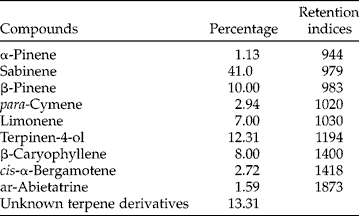
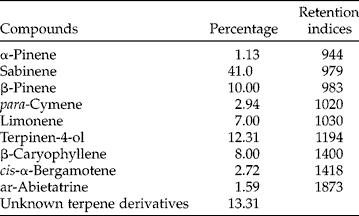
The density of the essential oil extracted from H. suaveolens leaf was 0.921 ± 0.815 g/ml. Sabinene (41.0%), terpinen-4-ol (12.31%), β-pinene (10.0%) and β-caryophyllene (8.0%) were the four major constituents, accounting for 71.3% of the essential oil's composition (Table 1).
Constituents of Hyptis suaveolens leaf essential oil by gas chromatography analysis
Repellency
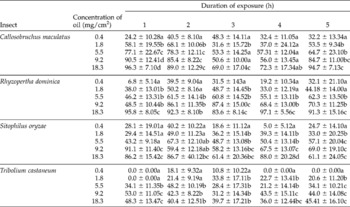
H. suaveolens essential oil showed dose-dependent repellency against the four coleopterans, with overall repellency after 5 h in the range of 20–94.7% at the highest dose tested, 18.3 mg/cm2 (Table 2). Of the four beetle species exposed to highest concentration of H. suaveolens oil, TC adults were twofold less strongly repelled than CM, RD and SO adults. A significant repellent effect was observed against the adults of RD. No significant difference was detected in the repellency of acetone-impregnated and untreated filter papers in tests designed to check for any possible influence of acetone.
Repellency of Hyptis suaveolens leaf essential oil against four storage pests

Values are means ± SD (% repellency). For each species, means in a column followed by the same letter do not differ significantly (P = 0.05) by Tukey's test. 10 insects/replication, 10 replications/concentration; thus n = 100 insects for each concentration.
Fumigant toxicity
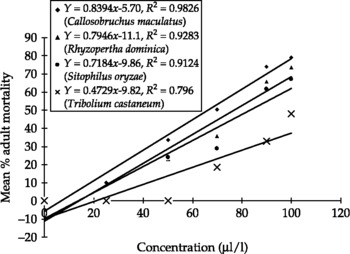
The essential oil of H. suaveolens exerted a toxic fumigant effect against the four beetle species (Table 3). On the basis of their LC50 and LC95 values, CM and SO adults were more susceptible to the oil than RD and TC under empty-jar conditions. Regression analysis of the data also showed significant vapour toxicity towards adults of CM (F = 226.18, df = 5, P < 0.0001), RD (F = 51.76, df = 5, P < 0.001), SO (F = 46.65, df = 5, P < 0.002) and TC (F = 15.60, df = 5, P < 0.01; Fig. 1). However, in jars containing grain, CM required 15 times the dose needed in empty-jar conditions to achieve the same LC50 value (Table 3). The other species also required higher oil dosages in grain treatment than those in empty-jar conditions.
Fumigant toxicity of Hyptis suaveolens leaf essential oil against four storage pests

20 insects/replication, 10 replications/concentration; thus n = 200 insects for each concentration.
Dose–response relationships of Hyptis suaveolens oil towards four stored-grain insects in fumigant toxicity assays

Contact toxicity
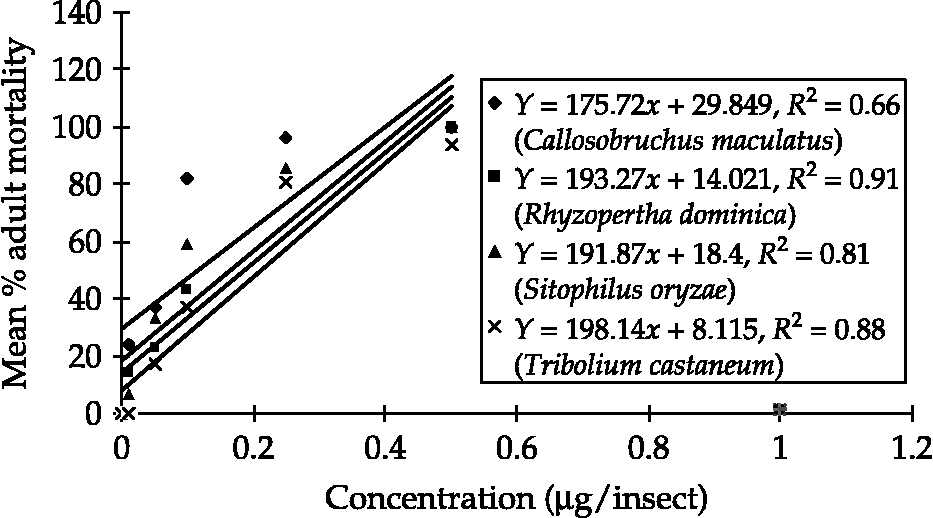
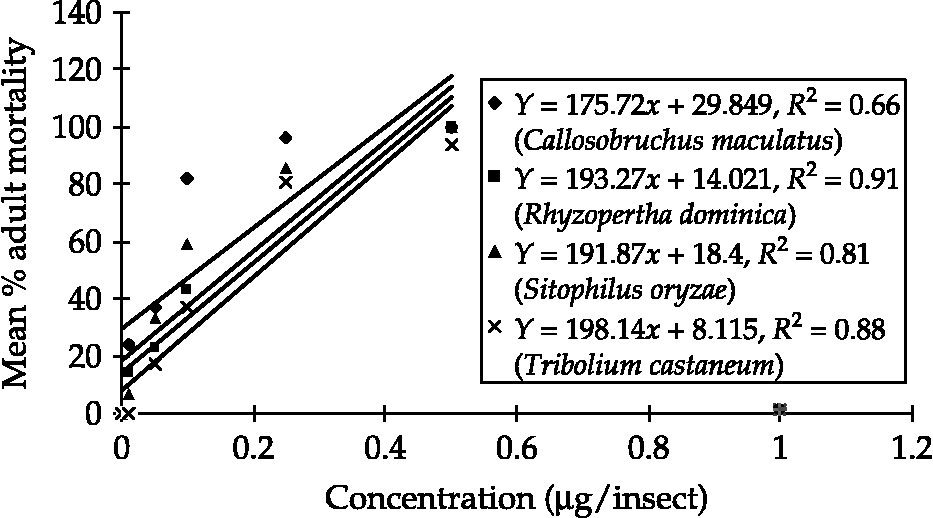
The essential oil of H. suaveolens was found to be toxic to all the four coleopteran species when applied topically (Table 4). CM was more susceptible to H. suaveolens oil than RD, SO and TC. Regression analysis of the data showed significant contact toxicity towards adults of CM (F = 7.820, df = 5, P < 0.04), RD (F = 38.847, df = 5, P < 0.003), SO (F = 17.320, df = 5, P < 0.014) and TC (F = 30.280, df = 5, P < 0.005; Fig. 2). Adults of TC exhibited a high tolerance to the toxic effects of the oil.
Contact toxicity of Hyptis suaveolens leaf essential oil against adults of four storage pests

10 insects/replication, 10 replications/concentration; thus n = 100 insects for each concentration.
Dose–response relationships of Hyptis suaveolens oil towards four stored-grain insects in contact toxicity assays
Persistence
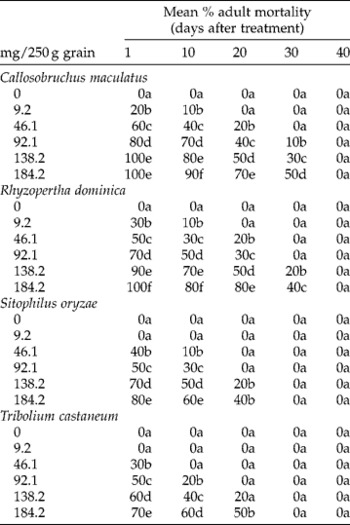
Table 5 shows that in general, H. suaveolens oil was persistent up to 20 days at the dosage of 92.1 mg/250 g grain and above. Beyond 20 days, the mortality of SO and TC was zero. However, CM and RD remained sensitive to the oil for up to 30 days. After 40 days of storage, the essential oil lost its toxicity against all the four beetle species, indicating its low persistence.
Mortality over time of four adult beetle species in grain treated with Hyptis suaveolens leaf essential oil, indicating the oil's persistence

For each test insect species, means in a column followed by the same letter do not differ significantly (P < 0.05) at α = 0.05 by Tukey's HSD test. 5 pairs of adults/replication, 10 replications/concentration; thus n = 50 pairs of adults of each test insect for each concentration.
Discussion
Essential oils of plants belonging to the families Apiaceae, Lamiaceae, Lauraceae and Myrtaceae and their constituents have been reported to be effective against storage insect pests (Rajendran and Sriranjini, Reference Rajendran and Sriranjini2008). Lamiaceae has species whose essential oils have been exploited by humans since ancient times around the world (Naghibi et al., Reference Naghibi, Mosaddegh, Mohammadi Motamed and Ghorbani2005). The results of the present study indicate that the essential oil of H. suaveolens leaves was toxic and repellent to the four beetle species tested.
The major constituents of H. suaveolens leaf essential oil found were sabinene, terpinen-4-ol, β-caryophyllene and β-pinene. These constituents are also found in other plants with biological activity against various insect species. Sabinene and (E)-β-ocimene are the most common compounds in leaf essential oil of Vepris heterophylla, which have toxicity against adults of TC (Ngamo et al., Reference Ngamo, Noudjou, Ngassoum and Mapongmestsen2007). Terpinen-4-ol has fumigant toxicity against stored-product insects (Lee et al., Reference Lee, Choi, Lee and Park2001; Stamopoulos et al., Reference Stamapoulos, Damos and Karagianidou2007). β-Caryophyllene is an important constituent of the essential oil of Lippia turbinata, which shows adulticidal activities against mosquitoes (Gleiser and Zygadlo, Reference Gleiser and Zygadlo2007). In addition, β-pinene and limonene are also known to have insecticidal activities against storage insects (Rozman et al., Reference Rozman, Kalinovic and Korunic2007).
Other Lamiaceae species have been reported to possess repellent effects against stored-grain insects. For instance, the essential oil of Anethum sowa is rich in d-carvone, and caused complete repellency of 60 μl/half disc towards adults of TC (Tripathi et al., Reference Tripathi, Prajapati, Aggarwal, Khanuja and Kumar2001).
The oil of H. suaveolens, when applied topically, killed all the adults of the four coleopteran species at the highest dose of 460.5 μg/mg body weight of insect. Keita et al. (Reference Keita, Umoetok and Smith2006) reported insecticidal activity of a petroleum ether extract of H. suaveolens seed against Plutella xylostella (L.). Similarly, a crude aqueous extract of H. suaveolens showed larvicidal action against Aedes aegypti (L.) (Tanprasit and Indrapichate, Reference Tanprasit and Indrapichate2004), and an ethyl acetate extract showed antifeedant and ovicidal activity against the lepidopterans Helicoverpa armigera (Hubner) and Spodoptera litura (F.) (Raja et al., Reference Raja, Jeyasankar, Venkatesan and Ignacimuthu2005). A novel 8.4 kDa trypsin inhibitor from H. suaveolens has also been purified which is active against Prostephanus truncatus (Horn) (Aguirre et al., Reference Aguirre, Silvia, Guillermo, Arturo and Alejandro2004).
Used as a fumigant, H. suaveolens oil killed all beetle species in empty-jar assays, with LC50 values ranging from 4.7 to 23.2 mg/l air. Other workers have shown comparable fumigant toxicities of Lamiaceae species against diverse storage pests. For instance, Evodia rutaecarpa essential oil against S. zeamais and TC (Liu and Ho, Reference Liu and Ho1999); L. cubeba oil against S. zeamais and TC (Ko et al., Reference Ko, Juntarajumnong and Chandrapatya2009); Artemisia sieberi oil against TC (Negahban et al., Reference Negahban, Moharramipour and Sefidkon2007); Ocimum gratissimum oil against adults of RD, SO, TC, Oryzaephilus surinamensis and CM (Ogendo et al., Reference Ogendo, Kostjukovsky, Ravid, Matasyoh, Deng, Omolo, Kariuki and Shaaya2008); and Mentha longifolia oil against S. zeamais (Odeyemi et al., Reference Odeyemi, Masika and Afolayan2008). Essential oil of O. basilicum and O. gratissimum caused 80 and 70% mortality of CM adults at a dose of 25 μl/vial (Keita et al., Reference Keita, Vincent, Schmit, Arnason and Belanger2001).
The fumigant toxicity of H. suaveolens oil may be possibly due to individual and synergistic effects of its different constituents. The possible mode of fumigant action may be attributed to octopamine receptor blockage and respiratory arrest (Priestley et al., Reference Priestley, Burgess and Williamson2006). Compared with the synthetic fumigant phosphine, which had LC50 of 8–12 μg/l air in tests with SO, RD, TC and O. surinamensis (Busvine, Reference Busvine1980), H. suaveolens oil had LC50 of 4.7–23.2 mg/l air.
The fumigant toxicity of H. suaveolens oil admixed in grain was low even with high oil doses. This may be due to the absorption of H. suaveolens oil by the grain. Lee et al. (Reference Lee, Annis, Tumaalii, Wright, Webb and Highley2003) also demonstrated in laboratory tests that plant essential oils were less effective in the presence of a stored product, such as wheat than in its absence. Essential oils of horseradish (Cocholeria aroracia) and cinnamon (Cinnamomum cassia) have been reported to be more highly effective against SO adults in closed containers than in open ones (Kim et al., Reference Kim, Roh, Kim, Lee and Ahn2003).
Essential oils of plants are popular grain protectants with low persistence. The activity of H. suaveolens essential oil decreased with time because of its high volatility. Ngamo et al. (Reference Ngamo, Goudoum, Ngassoum, Mapongmestsen, Kouninki and Hance2004) tested the persistence of the activity of five aromatic plants: Annona senegalensis, Eucalyptus citriodora, E. saligna, Lippia rugosa and O. gratissimum. They found significant insecticidal activity on S. zeamais in the first day of application, which decreased with time. Oils with high content of hydrogenated compounds lose their activity faster than those containing mainly oxygenated compounds (Huang and Ho, Reference Huang and Ho1998; Regnault-Roger et al., Reference Regnault-Roger, Philogene and Vincent2002). The speed of oxidation of hydrogenated monoterpenes is greater for compounds, such as sabinene, 1,8-cineole and α-pinene found in the essential oil of H. suaveolens (Kim et al., Reference Kim, Roh and Kim2002). This oxidation leads to a reduction of the insecticidal effects of the oil. Furthermore, the persistence of the insecticidal activity of essential oils is influenced by the sensitivity of the target pest to their active constituents (Obeng-Ofori et al., Reference Obeng-Ofori, Reichmuth, Bekele and Hassanali1997).
Conclusion
The essential oil extracted from the leaves of H. suaveolens, whose major constituents are sabinene, terpinen-4-ol, limonene and β-pinene, showed repellent and insecticidal activities against four stored-grain beetles. H. suaveolens grows wild in India and is easily available. Dried plant parts could be used in traditional post-harvest storage systems without extraction. Since tainting of stored grain is a major disadvantage of essential oil fumigants (Liu and Ho, Reference Liu and Ho1999), further studies on the effect of such treatment on the nutritional quality of foodstuffs are needed. In addition, proper formulation and application technologies for varied storage conditions would need to be designed.
Acknowledgements
The authors thank the Council of Scientific and Industrial Research, Delhi for providing financial assistance to carry out this work and the Director, Central Institute of Medicinal and Aromatic Plants, Lucknow, India for providing research facilities.