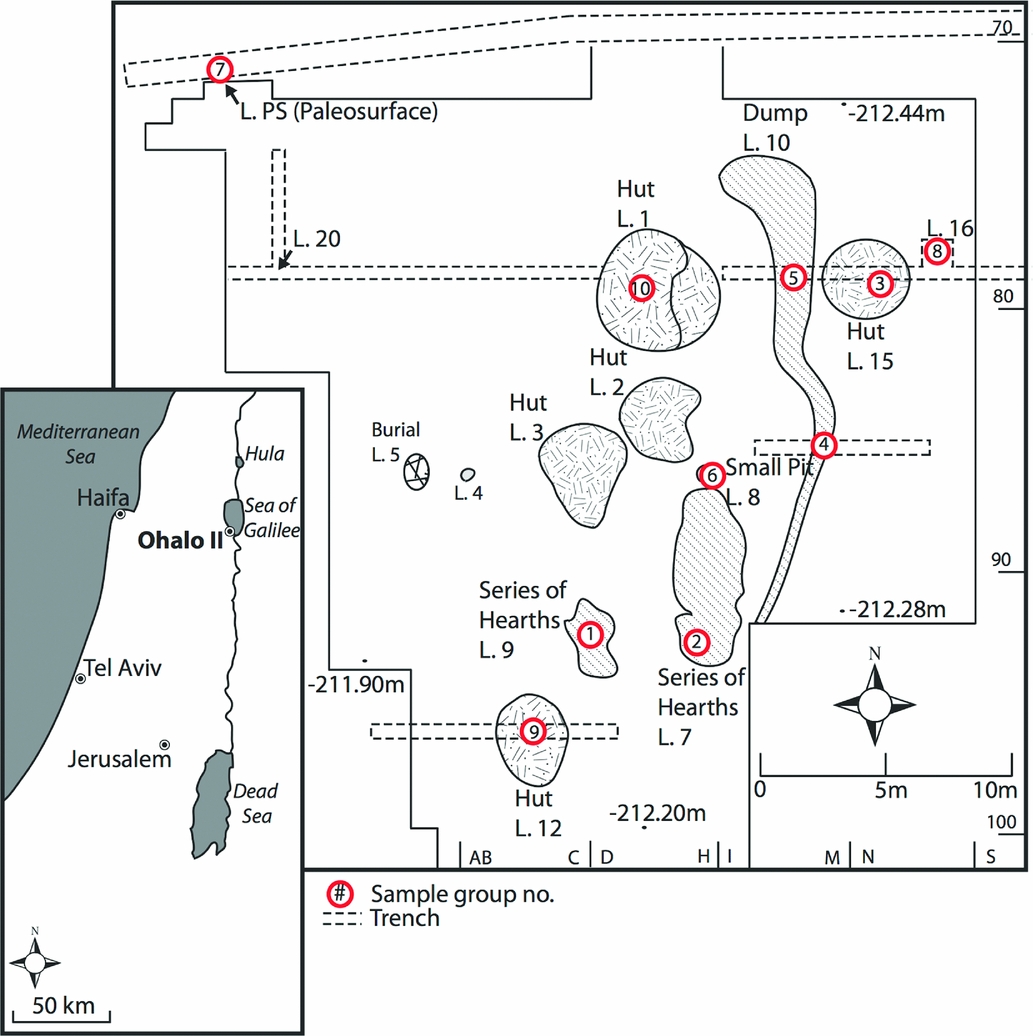


Our understanding of Late Pleistocene human-environmental interactions in the ancient Near East is structured by a wealth of sites in diverse environmental zones and an abundance of faunal remains at many of these sites (Bar-Oz Reference Bar-Oz2004; Munro Reference Munro and Delage2004, Reference Munro and Hublin2009, Reference Munro, Bar-Yosef and Valla2013; Stiner et al. Reference Stiner, Munro and Surovell2000; Yeshurun et al. Reference Yeshurun, Bar-Oz, Kaufman, Weinstein-Evron, Bar-Yosef and Valla2013). Less well known is how these hunter-gatherers used plants and how their plant use adapted to changing climatic conditions, because few Late Pleistocene sites have yielded significant assemblages of macrobotanical remains. Those that have include Syria's Abu Hureyra (Colledge and Conolly Reference Colledge and Conolly2010; Hillman, Colledge, and Harris Reference Hillman, Colledge, Harris, Harris and Hillman1989; Hillman et al. Reference Hillman, Hedges, Moore, Colledge and Pettitt2001), Egypt's Wadi Kubbaniya sites (Hillman Reference Hillman, Madeyska, Hather, Wendorf, Schild and Close1989; Hillman, Madeyska, and Hather Reference Hillman, Madeyska, Hather, Wendorf, Schild and Close1989), and the late glacial Upper Paleolithic/Early Epipaleolithic site of Ohalo II in Israel (Figure 1). Thus, Ohalo II is important for our understanding of Late Pleistocene human use of plant resources in Southwest Asia, and for building models of hunter-gatherer resource use during episodes of environmental change. Exceptional organic preservation at Ohalo II was the fortuitous result of inundation by rising water levels and lake sediments (Belitzky and Nadel Reference Belitzky and Nadel2002; Tsatskin and Nadel Reference Tsatskin and Nadel2003). As a result, Ohalo II provides one of the most comprehensive and important botanical assemblages in Southwest Asia for the Epipaleolithic period (ca. 23,000–11,700 cal BP). A variety of archaeobotanical analyses already exist for this assemblage, including macrobotanical, starch, and pollen; here we add phytoliths.
Location map of Ohalo II and detailed site plan with phytolith sample locations.

Rethinking Late Pleistocene Hunter-Gatherer Plant Use
Southwest Asia is one of the world's centers of agriculture development, and understanding the processes and timing of the adoption of cereal cultivation has preoccupied archaeological research in the region for decades (Asouti and Fuller Reference Asouti and Fuller2012; Bar-Yosef and Belfer-Cohen Reference Bar-Yosef, Kislev, Harris and Hillman1989; Bar-Yosef and Kislev Reference Bar-Yosef, Belfer-Cohen and Garcea1989; Bar-Yosef and Meadows Reference Bar-Yosef, Meadows, Douglas and Gebauer1995; Childe Reference Childe1936; Cohen Reference Cohen1977; Flannery Reference Flannery1973; Kislev et al. Reference Kislev, Weiss and Hartmann2004; Kuijt and Goring-Morris Reference Kuijt and Goring-Morris2002; McCorriston and Hole Reference McCorriston and Hole1991; Sauer Reference Sauer1952; Vavilov Reference Vavilov1926). Many researchers see Epipaleolithic foragers as the transition between a foraging and a Neolithic farming economy (ca. 11,500–8,000 cal BP), with the most intense scrutiny given to the Late Epipaleolithic (Natufian period, ca. 15,500–11,500 cal BP; Anderson Reference Anderson, Bar-Yosef and Valla1991; Bar-Yosef Reference Bar-Yosef1998; Barlow and Heck Reference Barlow, Heck, Mason and Hather2002; Belfer-Cohen Reference Belfer-Cohen1991; Boyd Reference Boyd2006; Byrd and Colledge Reference Byrd, Colledge, Bar-Yosef and Valla1991; Edwards Reference Edwards1989, Reference Edwards2013; Garrod Reference Garrod1957; Garrod and Bate Reference Garrod and Bate1937; Hayden Reference Hayden and Delage2004; Henry Reference Henry and Clark1991; Olszewski Reference Olszewski and Delage2004; Rosen 2007b, Reference Rosen2010, Reference Rosen, Miller, Moore and Ryan2011, Reference Rosen, Parker and Foster2012, Reference Rosen, Bar-Yosef and Valla2013; Sellars Reference Sellars and Henry1998; Twiss Reference Twiss and Delage2004; Valla Reference Valla and Levy1995, Reference Valla2012; Weinstein-Evron Reference Weinstein-Evron2009).
As pointed out by Rosen (Reference Rosen2010:113; Reference Rosen, Miller, Moore and Ryan2011:139; see also Savard et al. Reference Savard, Nesbitt and Jones2006; Wollstonecroft Reference Wollstonecroft, Fairbairn and Weiss2009:127; Wollstonecroft et al. Reference Wollstonecroft, Ellis, Hillman and Fuller2008), this focus on early cultivation among the complex hunter-gatherers of the late Epipaleolithic has biased research in favor of cereals. Wild plant exploitation among Early and Middle Epipaleolithic hunter-gatherers (ca. 23,000–15,500 cal BP) has received comparatively less scholarly attention or study, mostly due to the scarcity of sites in this time period with well-preserved macrobotanical remains (Bar-Yosef and Belfer-Cohen Reference Bar-Yosef, Belfer-Cohen and Garcea2010; but see Ramsey et al. Reference Ramsey, Jones, Richter and Rosen2015; Ramsey et al. Reference Ramsey, Maher, Macdonald and Rosen2016; Ramsey and Rosen Reference Ramsey and Rosen2016).
This has produced a clear bias in the study of plant use during the Epipaleolithic period toward identifying and modeling the dietary shift to cereals and in some cases small-grained grasses (Weiss, Kislev, et al. Reference Weiss, Kislev, Simchoni and Nadel2004), although a few recent studies have focused on a wider range of plant resources, including faba beans (Caracuta et al. Reference Caracuta, Weinstein-Evron, Kaufman, Yeshurun, Silvent and Boaretto2016). The search for “prime movers” that led to a change in the subsistence of late Pleistocene hunter-gatherers has taken many turns, but many explanations center on the abrupt climatic changes between the end of the Last Glacial Maximum (LGM) and the Holocene, and especially on the Younger Dryas, a cold/dry period of 1,300 years (ca. 13,000–11,700 cal BP; Alley Reference Alley2000; Bar-Matthews et al. Reference Bar-Matthews, Ayalon and Kaufman1997; Grosman Reference Grosman, Bar-Yosef and Valla2013). Several researchers have modeled the shift to new plant exploitation strategies on the part of Near Eastern foragers, including the targeting of cereals, as a solution to declining forest resources at that time (Bar-Yosef and Belfer-Cohen Reference Bar-Yosef, Belfer-Cohen, Cappers and Bottema2002; McCorriston and Hole Reference McCorriston and Hole1991; Moore and Hillman Reference Moore and Hillman1992). However, recent work, based on data from plant genetics and further archaeological evidence, suggests that the cultivation of wild cereals began much earlier than the Younger Dryas, even during the LGM itself, and, importantly, did not consist of a steady march to more intensive farming. Rather, new data suggest that Epipaleolithic peoples practiced low-level cultivation on an opportunistic basis, with casual use of wild cereal cultivation in the fields of wild cereals (Asouti and Fuller Reference Asouti and Fuller2012; Fuller et al. Reference Fuller, Asouti and Purugganan2011). Indeed, researchers have argued persuasively for early low-key cereal cultivation based on the Ohalo II data (Grosman-Yaroslavski et al. Reference Grosman-Yaroslavski, Weiss and Nadel2016; Snir, Nadel, Grosman-Yaroslavski, et al. Reference Snir, Nadel, Grosman-Yaroslavski, Melamed, Sternberg, Bar-Yosef and Weiss2015).
The focus on the Younger Dryas as the primary force pushing hunter-gatherers toward intensive cereal collection drew attention away from studies of how hunter-gatherers in semi-arid regions actually adapt to abrupt and variable environmental changes. Rosen and Rivera-Collazo (Reference Rosen and Rivera-Collazo2012) suggested that Epipaleolithic foragers used an adaptive strategy that cycled in predictable ways from a warm/wet-phase focus on forest resources to cold/dry-phase adaptations that targeted steppe resources—shifting easily back and forth. This shifting adaptation suggests a great resilience in the Epipaleolithic responses to major climatic changes. Likewise, we argue here that we must first understand late Pleistocene Epipaleolithic communities as hunter-gatherers and not only as the precursors of the yet-to-be-adopted Neolithic economy. Moreover, we must consider how they employed the unique microhabitats that were available in their local environments before we can understand changes in lifeways that might have eventually led to full-fledged sedentism and the agricultural economic system of the Holocene. The site of Ohalo II is an ideal test case for such a study; in particular, it highlights the importance of wetland exploitation within these late Pleistocene adaptive cycles.
Ohalo II and the Contribution of Phytoliths
Ohalo II is situated on the southwestern shore of the Sea of Galilee (Lake Kinneret), Israel (Figure 1). The site was inhabited during the LGM, ca. 23,000 years ago, and is unique due to its exceptional organic preservation (Belitzky and Nadel Reference Belitzky and Nadel2002; Nadel et al. Reference Nadel, Carmi and Segal1995; Tsatskin and Nadel Reference Tsatskin and Nadel2003; Weiss et al. Reference Weiss, Kislev, Simchoni, Nadel and Gyulai2011). Six seasons of excavations between 1989–1991 and 1999–2001 exposed the remains of six brush huts with intact floors, several open-air hearth concentrations, a dumping zone, a pit, a stone installation, and a burial (Nadel et al. Reference Nadel, Danin, Werker, Schick, Kislev and Stewart1994; Nadel et al. Reference Nadel, Weiss, Simchoni, Tsatskin, Danin and Kislev2004; Nadel and Werker Reference Nadel and Werker1999). The repeated use of the site in a consistent and organized pattern led the investigators to conclude that Ohalo II represents a camp visited several times by the same group (Nadel et al. Reference Nadel, Carmi and Segal1995). Indeed, the floral and faunal remains suggest that there may have been year-round occupation at the camp (Kislev et al. Reference Kislev, Nadel and Carmi1992; Simmons and Nadel Reference Simmons and Nadel1998; Snir, Nadel, and Weiss Reference Snir, Nadel, Grosman-Yaroslavski, Melamed, Sternberg, Bar-Yosef and Weiss2015; Weiss et al. Reference Weiss, Kislev, Simchoni, Nadel and Tschauner2008).
Studies of the large macrobotanical assemblage (ca. 150,000 specimens) demonstrate that the site's inhabitants used over 140 plant species to meet their subsistence, construction, and fuel needs (Kislev et al. Reference Kislev, Nadel and Carmi1992; Nadel et al. Reference Nadel, Danin, Werker, Schick, Kislev and Stewart1994, Reference Nadel, Grinberg, Boaretto and Werker2006; Nadel and Werker Reference Nadel and Werker1999; Simchoni Reference Simchoni1998; Snir, Nadel, Grosman-Yaroslavski, et al. Reference Snir, Nadel, Grosman-Yaroslavski, Melamed, Sternberg, Bar-Yosef and Weiss2015; Snir, Nadel, and Weiss Reference Snir, Nadel, Grosman-Yaroslavski, Melamed, Sternberg, Bar-Yosef and Weiss2015; Weiss Reference Weiss2002; Weiss et al. Reference Weiss, Kislev, Simchoni, Nadel and Tschauner2008). The charred seed assemblage includes wild progenitors of domestic cereals, wheat (Triticum dicoccoides) and barley (Hordeum spontaneum), alongside a broad array of edible large-grained grasses, including goat grass (Aegilops sp.), as well as edible small-grained grasses such as brome (Bromus sp.) and small-grained barleys (Hordeum marinum/hystrix; Weiss, Kislev, et al. Reference Weiss, Kislev, Simchoni and Nadel2004; Weiss, Wetterstrom, et al. Reference Weiss, Wetterstrom, Nadel and Bar-Yosef2004).
Microscopic starch grains from barley, wheat, and oats (Avena sp.) were recovered from a grinding stone found in situ on a brush hut floor, emphasizing the importance of cereals to the diet at Ohalo II (Nadel et al. Reference Nadel, Piperno, Holst, Snir and Weiss2012; Piperno et al. Reference Piperno, Weiss, Holst and Nadel2004). Snir and colleagues propose that the site offers the earliest evidence for wild-cereal cultivation due to its high frequency of weed taxa commonly found in later domesticated cereal fields, its high percentage of rough (domestic-type) rachis disarticulation scars in the wild barley and wheat assemblages, and the presence of sickle blades with gloss typical of cereal harvesting (Snir, Nadel, Grosman-Yaroslavski, et al. Reference Snir, Nadel, Grosman-Yaroslavski, Melamed, Sternberg, Bar-Yosef and Weiss2015).
Pollen samples extracted from three on-site contexts (Loci 2, 7, and 20) support the general macrobotanical results, with high Poaceae and Cerealia-type pollen strongly suggesting the close proximity and importance of grass and cereal resources (Weinstein-Evron et al. Reference Weinstein-Evron, Langgut, Chaim, Tsatskin and Nadel2015). High arboreal pollen values, especially oak (Quercus ithaburensis) and Chenopodiaceae/Amaranthaceae (Cheno/Ams), provide evidence of an open parkland environment, while Cyperaceae and other hydrophilous pollen taxa indicate an adjacent wetland setting (Weinstein-Evron et al. Reference Weinstein-Evron, Langgut, Chaim, Tsatskin and Nadel2015). The close proximity of these diverse ecozones shows that the landscape supported a wide range of plant collection opportunities, as seen in the seed and charcoal assemblages (Kislev and Simchoni Reference Kislev, Simchoni, Mason and Hather2002).
The paleoethnobotanical analyses from this site play a central role in understanding how Epipaleolithic peoples of Southwest Asia used plants in their local microhabitats, including wild cereals and grasses. While the macrobotanical remains are undeniably the proverbial jewel in Ohalo's crown, the addition of complementary botanical analyses helps reevaluate the importance of underrepresented taxa in the macrobotanical assemblage. For example, starch analysis demonstrated the importance of oats (Nadel et al. Reference Nadel, Piperno, Holst, Snir and Weiss2012; Piperno et al. Reference Piperno, Weiss, Holst and Nadel2004), and pollen analysis helped indicate the availability of certain economically important plant taxa, such as Cyperaceae (Weinstein-Evron et al. Reference Weinstein-Evron, Langgut, Chaim, Tsatskin and Nadel2015).
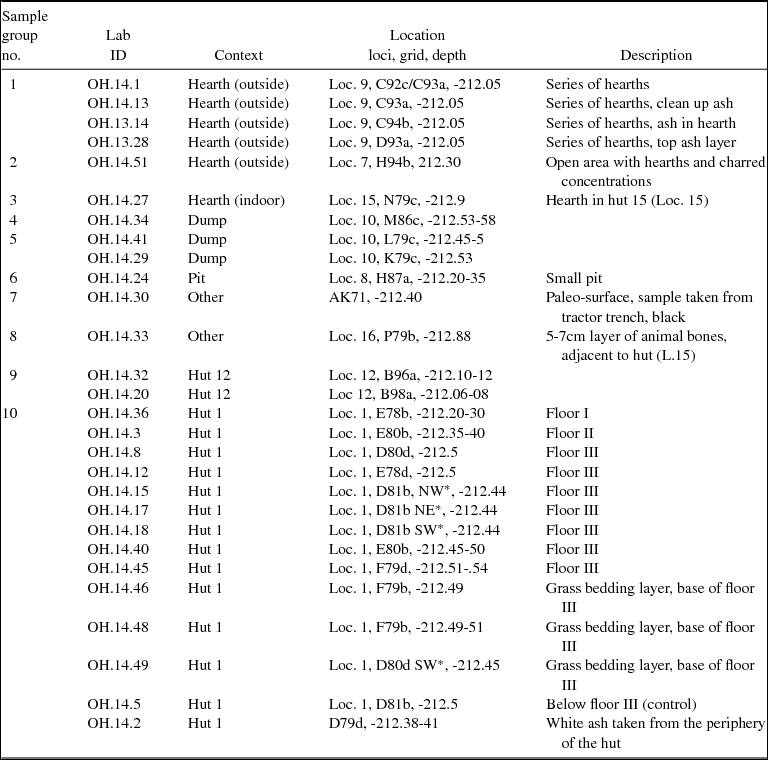
In this paper, we report on new phytolith evidence from Ohalo II. Through the study of 28 on-site sediment samples (Table 1) we follow three key lines of inquiry that enable us to contribute toward archaeological understandings of Late Pleistocene hunter-gatherer plant use and Epipaleolithic adaptive cycles. First, we compare the results of our phytolith analysis to a sample of the macrobotanical remains at Ohalo II (Weiss Reference Weiss2002). By categorizing the phytolith and macrobotanical taxa into ecozone-types (Ramsey and Rosen Reference Ramsey and Rosen2016; Table 2), a method that facilitates broad direct comparisons of these different datasets, we provide a comprehensive baseline that will aid in the interpretation of phytolith assemblages at other Late Pleistocene and Early Holocene sites in Southwest Asia that do not benefit from macrobotanical preservation. Second, we provide new botanical evidence from hearths, middens, and hut contexts at the site to consider the types of plant collection and processing activities that occurred. Third, we use our phytolith evidence in conjunction with ethnographic data from the American Great Basin and site data, including the remains of fish (Nadel and Hershkovitz Reference Nadel and Hershkovitz1991) and birds (Simmons and Nadel Reference Simmons and Nadel1998), as well as macrobotanical remains (Nadel et al. Reference Nadel, Danin, Werker, Schick, Kislev and Stewart1994; Nadel et al. Reference Nadel, Grinberg, Boaretto and Werker2006), to emphasize the significance of wetland plant resources. Indeed, the location of the site itself, on the shore of Lake Kinneret, only emphasizes this interpretation, especially given the arid conditions that existed when the site was occupied (Langgut et al. Reference Dafna, Almogi-Labin, Bar-Matthews and Weinstein-Evron2011; Rosen Reference Rosen2007a). By integrating the new phytolith evidence with all other data from Ohalo II, we offer a perspective on Southwest Asian hunter-gatherer adaptation that integrates parkland, steppe, woodland, and wetland plant resources. By demonstrating the importance of wetland resources during the cold/dry LGM phase, this work also contributes to our understanding of Epipaleolithic adaptive cycles (Rosen and Rivera-Collazo Reference Rosen and Rivera-Collazo2012).
Sample List with Loci Descriptions, Contexts, and Lab Numbers.

*Sampled from curated 0.5m × 0.5m sediment blocks.
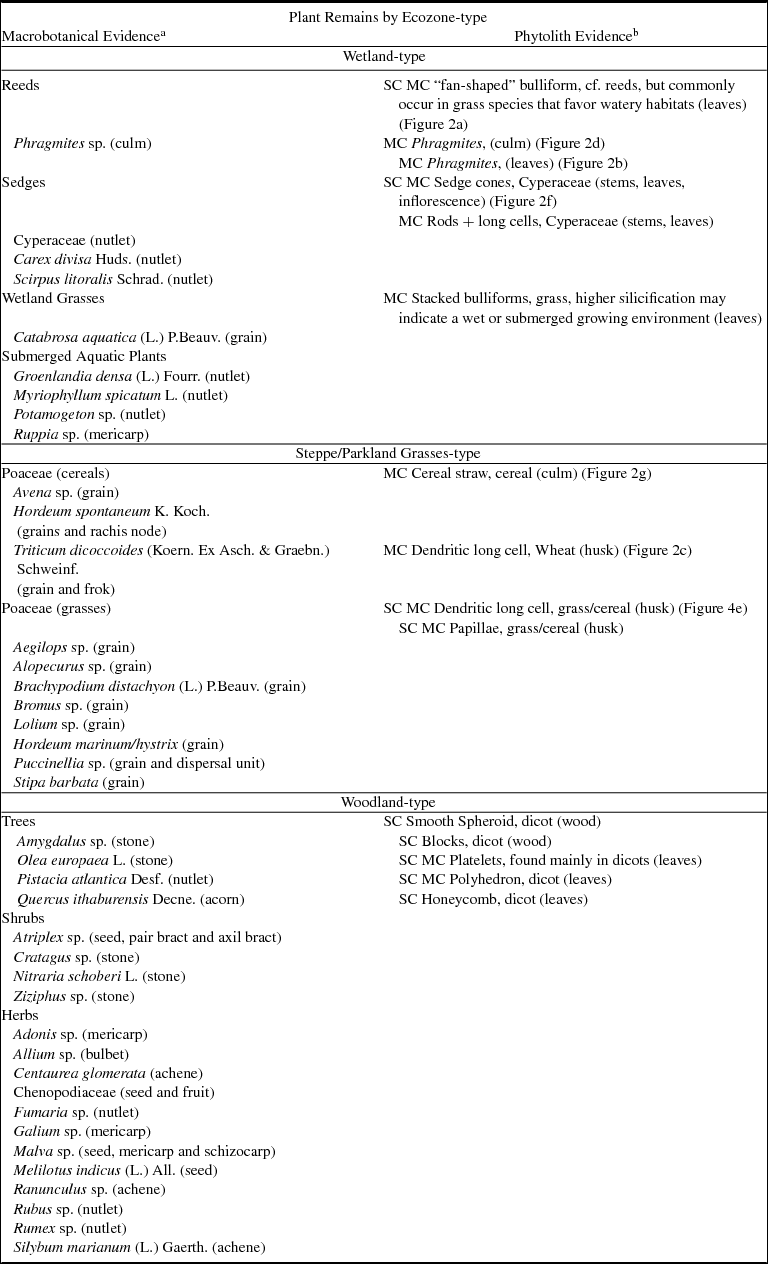
Plant Remains by Ecozone-Type.

Note: See Supplemental Table 2 for phytolith morphology and identification details, including references.
a See Weiss (Reference Weiss2002:54-61) for more details. Suaeda sp. and Chara sp. not included.
b SC: single-cell; MC: multi-cell
While the exceptional macrobotanical assemblage may overshadow the potential contribution of phytolith analysis to the already well-studied plant assemblage at Ohalo II, phytolith analysis could produce evidence of plant use that charring or subsequent waterlogging may not have preserved. For example, phytolith analysis can identify delicate leaves and stems that generally do not preserve macrobotanically. Therefore, while the assemblage at Ohalo II does include a wide range of fragile macrobotanical remains, phytoliths can substantially broaden the picture of plant use. However, one of the most important contributions of the phytolith analysis at Ohalo II is the use of this assemblage in concert with the macrobotanical assemblage as a comparative baseline to shed light on plant use at contemporaneous sites in the Levant that do not benefit from well-preserved macrobotanical assemblages. Such sites constitute the vast majority of Epipaleolithic sites in the Near East (for Materials and Methods, see Supplemental Text).
Results and Discussion
Considering the Macrobotanical and Phytolith Trends
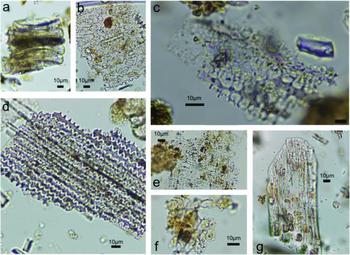
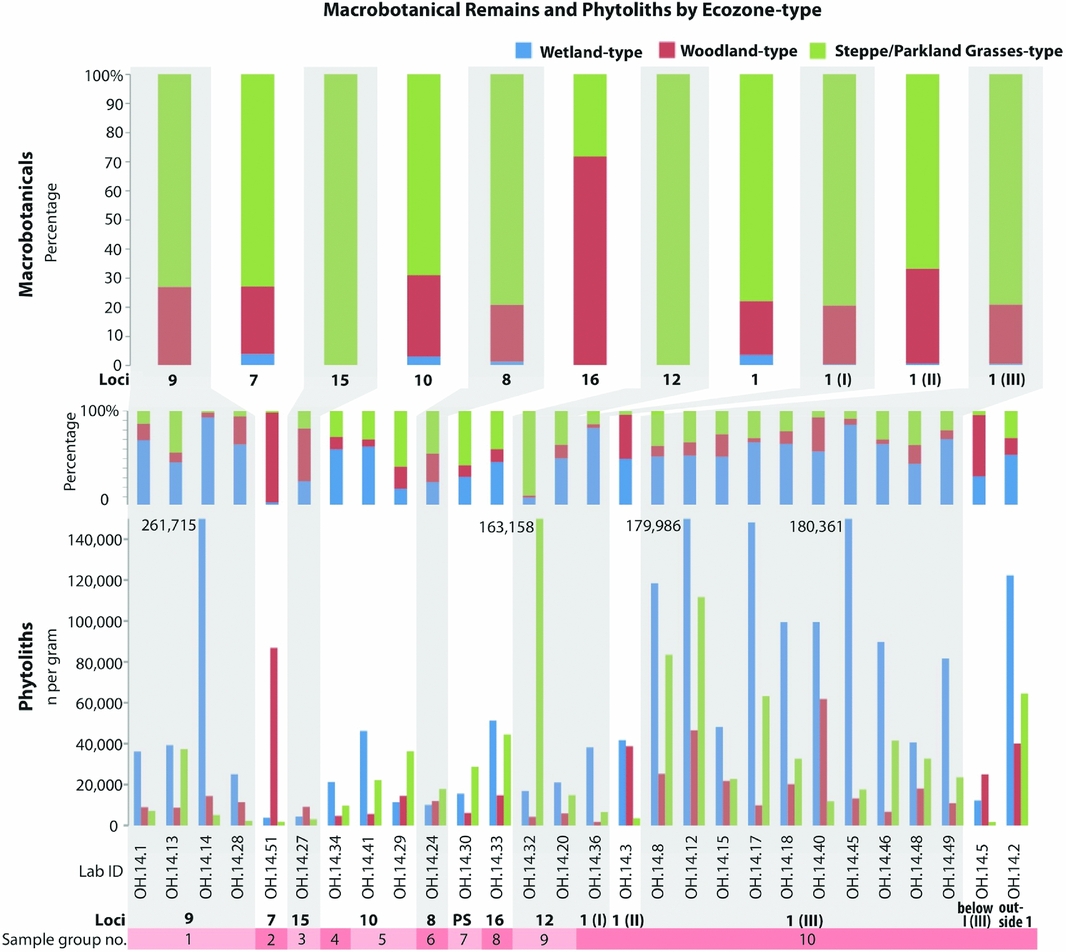
To facilitate comparison between the phytolith and macrobotanical samples (Weiss Reference Weiss2002:54–61; see Supplemental Table 1), the remains are grouped into three major ecozone-types: wetland, steppe/parkland grasses, and woodland (Figures 2a–g and 3; Table 1; for further information regarding phytolith morphotypes, see Supplemental Table 2). These categories do not necessarily conform to traditional vegetation zones (Mediterranean, Irano-Turanian, etc.; Zohary Reference Zohary1980), but rather provide a picture of the types of microhabitats that were available and exploited around the site. Ramsey and Rosen (Reference Ramsey and Rosen2016) discuss the use of ecozone categorization with phytolith data. The macrobotanical data were arranged into the ecozone categories according to the type of phytolith evidence such remains would provide. For example, all macrobotanical remains of woody shrubs and trees (dicotyledons or “dicots”) are listed under the broad woodland category, as the phytolith assemblage produced by these taxa falls under this category (see Table 2 for details).
Phytoliths from Ohalo II: (a) Stacked “fan-shaped” bulliforms (cf. reed) (OH.14.45); (b) Phragmites leaf (OH.14.30); (c) cf. Wild wheat husk (OH.14.32); (d) Phragmites culm (OH.14.30); (e) Wild grass husk (OH.14.40) (f) Sedge cones cf. Scirpus (OH.14.41); (g) Cereal straw (OH.14.32).

Histogram of ecozone-type phytoliths and macrobotanical sample. The bottom histogram displays the absolute count ecozone-type phytolith evidence (number per gram of sediment), while the middle histogram displays the phytolith percentages. The top histogram displays the ecozone-type macrobotanicals as a percentage.

The macrobotanical and phytolith ecozone-type results (Figure 3) clearly demonstrate the identification limitations and advantages of each method. Steppe/parkland grass-type resources dominate the macrobotanical assemblage, whereas wetland-type resources dominate the phytolith assemblage. Macrobotanical identifications rely on good botanical preservation and, as such, tend to focus on more robust remains such as seeds and wood charcoal. Because phytoliths are inorganic, they are largely resistant to decay and many of the other taphonomic factors that adversely affect macrobotanical remains. However, phytolith identifications are limited by in vivo phytolith production, which is rare or nonexistent in some plant families, including aroids (Araceae family), Amaranthaceae, and Chenopodiaceae (Piperno Reference Piperno2006), and phytolith redundancy, which means that different plants can produce the same kinds of phytoliths. On the other hand, monocotyledons, particularly grasses, reeds, sedges, and palms, tend to produce phytoliths, often distinctive to plant family, genus, and, more rarely, species, and therefore tend to be the focus of phytolith identifications. They also derive from both husks and the shoots of grasses and sedges. The delicate shoots of these plants are rarely preserved in the macrobotanical record. This discrepancy emphasizes the importance of employing both lines of evidence to understand the full spectrum of plant use at Ohalo II and other sites.
Integrating the Phytolith Evidence: New Patterns of Plant Use
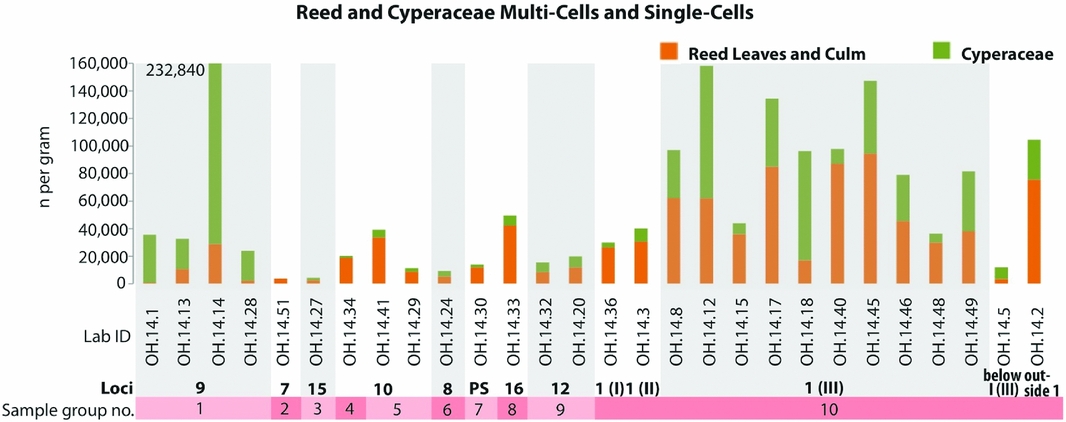
Emphasis on wetland-type resources from the perspective of the phytolith assemblage at Ohalo II reflects the intense use of phytolith-rich reed and sedge (Cyperaceae) stems and leaves, likely for craft and construction purposes, as well as byproducts of food-plant collection (Figures 3 and 4). These types of delicate plant parts are largely invisible to macrobotanical methods (but see Nadel et al. Reference Nadel, Danin, Werker, Schick, Kislev and Stewart1994; Nadel et al. Reference Nadel, Grinberg, Boaretto and Werker2006; Nadel et al. Reference Nadel, Weiss, Simchoni, Tsatskin, Danin and Kislev2004).
Histogram of reed and Cyperaceae multi-cell and single-cell phytoliths.

In Locus 9 (sample group 1), a set of hearths, high concentrations of wetland-type phytoliths (Figure 3) are the result of a large input of Cyperaceae (Figure 4). This pattern poses several possibilities. First, site inhabitants may have disposed of waste associated with Cyperaceae craftwork or hut construction and maintenance in this series of hearths. Supporting this interpretation, reeds (including Phragmites sp. leaf and culm, and fan-shaped bulliform SCs and MCs), a resource that appears to have been an important material in hut construction, are highly correlated with Cyperaceae (0.92; Figure 4). Alternatively, site inhabitants may have used dried Cyperaceae and reeds, plentiful lakeside resources, as fuel. A third possibility is that the concentration resulted from the disposal of food preparation waste (of Cyperaceae tubers and rhizomes, and perhaps even seeds or “nutlets” [see Simpson and Inglis Reference Simpson and Inglis2001]). Macrobotanical remains of sedge nutlets (Scirpus litoralis, and Cyperaceae cf.) were recovered from nine contexts at the site, and hundreds of “bulbets” (unidentified root tissues) were recovered from three loci (Weiss Reference Weiss2002).
Another point of interest lies in Locus 7 (sample group 2), an area of open-air hearths. Here, according to the macrobotanical remains, there is an emphasis on steppe/parkland grasses, whereas woodland-type resources almost exclusively dominate the phytolith remains (Figure 3). The sampled macrobotanical assemblage consists of 769 grass/cereal grains, including 340 Puccinellia sp., 129 Alopecurus sp., and 118 Hordeum spontaneum. The lack of steppe/parkland grass-type evidence from the phytolith assemblage suggests that the grains found in the hearths were already dehusked, since phytoliths form in the husk surrounding the grain. The grains from Locus 7 may result from a later processing stage in which inhabitants had already discarded the inedible husk; husk removal is easier when the grains come from the fresh green florets rather than the dried ripe form (Hillman Reference Hillman1973, Reference Hillman and Mercer1981; Jones Reference Jones1987). The discord between the macobotanical and phytolith evidence in this context provides interesting insights into the use of hearths in Locus 7.
In contrast to Loci 9 and 7, the hearth on the floor of Brush Hut 15 (sample group 3) features a more balanced distribution of wetland monocotyledons, steppe/parkland grasses, and woodland-type resources, suggesting a generalized pattern of use. Likewise, the midden material (Locus 10, sample groups 4 and 5), which extends across the site in a north-south axis (Figure 1), appears to have been an area of general refuse disposal (Nadel and Werker Reference Nadel and Werker1999), with a generalized mixed assemblage (Figure 3). Phytolith samples come from three contexts; a pit filled with debris (Locus 8, sample group 6), a dark paleo-surface (Locus PS, sample group 7), and a faunal-rich surface (Locus 16, sample group 8) adjacent to Brush Hut 15 also tend to display a generalized mixed assemblage (Figure 2).
Phytolith Evidence for “Indoor” Cereal Processing
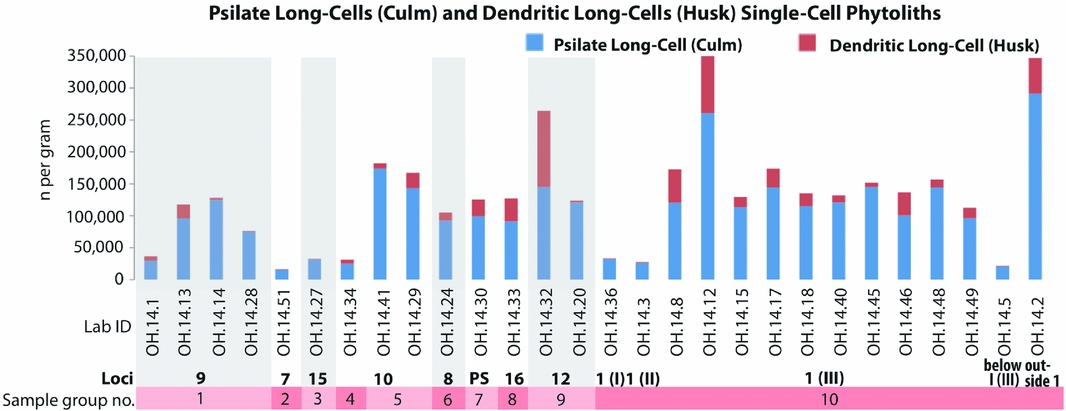
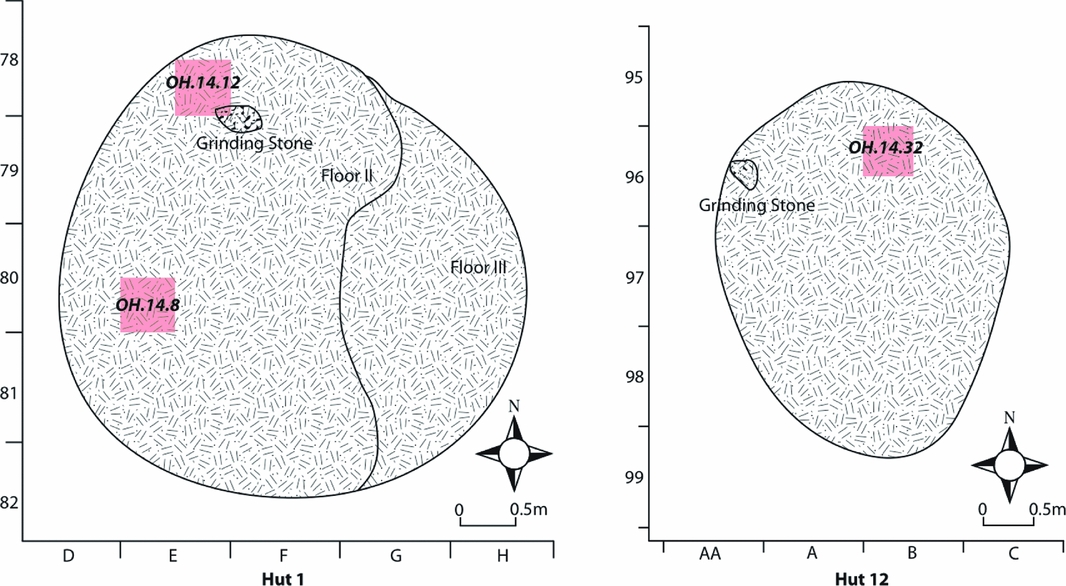
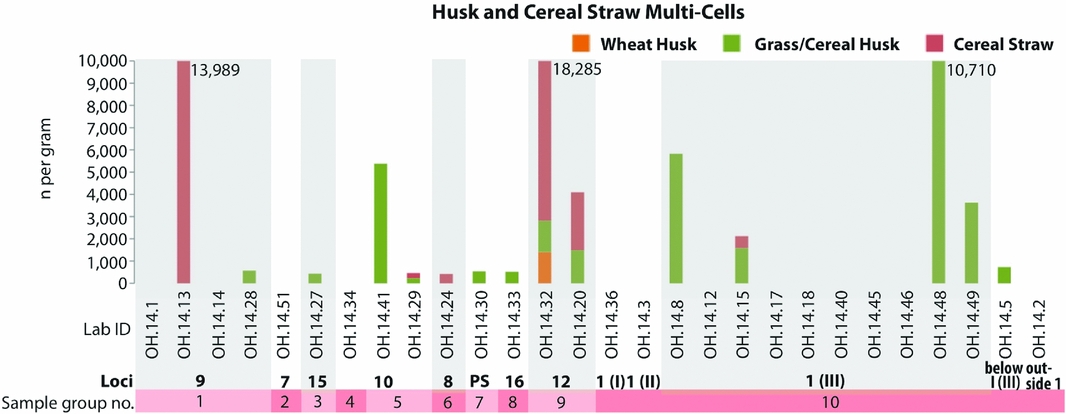
Phytolith evidence corroborates macrobotanical and starch evidence from the site (Nadel et al. Reference Nadel, Piperno, Holst, Snir and Weiss2012; Piperno et al. Reference Piperno, Weiss, Holst and Nadel2004; Snir, Nadel, and Weiss Reference Snir, Nadel, Grosman-Yaroslavski, Melamed, Sternberg, Bar-Yosef and Weiss2015; Weiss et al. Reference Weiss, Kislev, Simchoni, Nadel and Tschauner2008), suggesting that the hut interiors were important venues for plant food preparation. Indeed, there are three peaks in husk concentrations (Figures 5 and 6) in the assemblage, all from hut contexts: one in Brush Hut 12 (Locus 12; lab number OH.14.32) and two in Brush Hut 1 (Locus 1; OH.14.8; OH.14.12). These husk concentrations suggest that the husks are unlikely to represent incidental inclusion as part of the bedding or hut construction. Accordingly, these samples may represent key plant-use activity areas associated with wild cereal and wild grass seed-processing, eating, storage, and/or discard. But most importantly, the phytolith evidence, or lack of husk-phytolith evidence in the outdoor hearths, particularly Locus 7 (Figure 5), strongly suggests that wild grass and wild cereal seed processing (dehusking) did not occur to any substantial extent around the outdoor hearths. Rather, these activities appear to have been primarily restricted to the indoor spaces. It is possible that, at the height of the LGM, the protection and relative comfort afforded by the huts would have made them a focus for daily activity, especially during the winter seasons. In situ cereal grinding was identified for Floor II in Brush Hut 1, according to the presence of a grinding stone with diagnostic starch residues and use-wear evidence that was also surrounded by cereal grains (Piperno et al. Reference Piperno, Weiss, Holst and Nadel2004; Weiss et al. Reference Weiss, Kislev, Simchoni, Nadel and Tschauner2008). Phytolith evidence supports this finding, with a concentration of husk phytoliths on Floor III (OH.14.12) below the grinding stone. This concentration of husk phytoliths on Floor III below the grinding stone on Floor II may indicate continued use of that area of Brush Hut 1 for wild cereal and grass seed-processing, an interpretation supported by macrobotanical evidence indicating that similar activities took place on Floors II and III (Snir, Nadel, and Weiss Reference Snir, Nadel, Grosman-Yaroslavski, Melamed, Sternberg, Bar-Yosef and Weiss2015). Furthermore, a large grinding stone was found upside down on the floor of Brush Hut 12, close to another concentration of husk phytoliths (OH.14.32). Thus, the largest concentrations of husk phytoliths mirror the locations of grinding stones.
Histogram of psilate long-cell (stem) and dendritic long-cell (husk), single-cell phytoliths.

Plan view map of Hut 1 and 12. Grinding stone and husk concentration locations.

Phytolith Evidence toward an Understanding of Harvesting Practices
Several researchers suggest that Epipaleolithic groups harvested wild cereals before they were fully ripe to avoid grain loss (Rosen Reference Rosen, Pearsall and Piperno1993; Snir, Nadel, Grosman-Yaroslavski, et al. Reference Snir, Nadel, Grosman-Yaroslavski, Melamed, Sternberg, Bar-Yosef and Weiss2015; Tanno and Wilcox Reference Tanno and Wilcox2006). At Ohalo II, several lines of evidence, including phytoliths, support this suggestion. As mentioned, the macrobotanical assemblage of Locus 7 suggests that inhabitants used this area to prepare/process wild cereal and grass resources. However, the negligible phytolith-husk evidence suggests that these grains had already been dehusked, a task more easily accomplished when the grains come from the fresh green florets, rather than the dried ripe form. Further evidence for semi-ripe cereal harvesting comes from Brush Hut 12, where there is a peak in husks, which includes wheat husks, and cereal straw (Figure 7). The combination of cereal husk and straw parts suggests that inhabitants may have brought these resources back to the site together (although a larger sample size is needed to test this interpretation). However, because cereals have a brittle rachis that breaks when ripe to facilitate natural grain dispersal, this would also suggest that inhabitants collected the cereal before it was ripe. By collecting the plants while the grains were only milk-ripe or green, the hunter-gatherers at Ohalo II could have more easily collected and transported the grains and straw resources back to the site together.
Histogram of husk and cereal straw multi-cell phytoliths.

Snir and colleagues provide other evidence to support an interpretation of semi-ripe cereal harvesting (Snir, Nadel, Grosman-Yaroslavski, et al. Reference Snir, Nadel, Grosman-Yaroslavski, Melamed, Sternberg, Bar-Yosef and Weiss2015). One of the characteristics used to distinguish between domesticated versus wild cereals is the type of disarticulation scars in their rachises. Smooth disarticulation scars, common in wild varieties, break easily when ripe to facilitate grain dispersal, whereas rough disarticulation scars, common in domestic varieties, break less easily, meaning that the ripe grains remain attached to the ears. Rough disarticulation (domestic-type) scars are a recessive trait and are displayed in up to 10% of wild barley populations (Kislev Reference Kislev and Hershkovitz1989). At Ohalo II, 36% of the wild barley rachises and 25% of the wild wheat rachises have rough (domestic-type) scars (Snir, Nadel, Grosman-Yaroslavski, et al. Reference Snir, Nadel, Grosman-Yaroslavski, Melamed, Sternberg, Bar-Yosef and Weiss2015). This increase in the percentage of rough (domestic-type) scars may plausibly be linked to harvesting practices. For example, grains harvested using a beater and basket method of collection or ground gathering would preferentially harvest grains that easily disarticulate (smooth scars, wild-type), while harvesting whole semi-ripe cereal ears with a sickle or uprooting of the whole stalk would preferentially harvest grains that do not easily disarticulate (rough scars, domestic-type). The latter harvesting methods could therefore account for the higher rates of rough scars seen in the Ohalo II assemblage.
This interpretation for semi-ripe cereal harvesting is further reinforced by the identification of several flint blades at the site with a gloss typical of cereal harvesting at a semi-ripe stage (Snir, Nadel, Grosman-Yaroslavski, et al. Reference Snir, Nadel, Grosman-Yaroslavski, Melamed, Sternberg, Bar-Yosef and Weiss2015). In addition, a use-wear study of five sickle blades shows that cereal harvesting using composite tools with hafted large blades took place at the site (Grosman-Yaroslavski et al. Reference Grosman-Yaroslavski, Weiss and Nadel2016). However, the number of such tools and the low-intensity level of the gloss indicate that this practice of cereal collection was not widespread at the site, perhaps indicating that an “uprooting” collection method was more prevalent.
Phytolith Evidence for Hut Construction—Wetland Resources Reconsidered
While the macrobotanical, starch, and phytolith evidence demonstrates that grass and cereal resources were important aspects of diet at Ohalo II, the phytolith evidence highlights other less-considered micro habitats, specifically the contribution of wetland-type resources to Late Pleistocene hunter-gatherer dietary and material needs. The use of these wetland resources is especially clear in Brush Hut 1 (sample group 10), where large wetland-type phytolith counts (Figure 3) translate to high reed and Cyperaceae numbers compared to other contexts (Figure 4). Reed culms may have been a significant component in the structure of the hut, while inhabitants may have employed the reed leaves and sedges as thatching and/or floor covering and bedding (see Ramsey et al. Reference Ramsey, Rosen, Macdonald, Maher and Nadel2017). This evidence demonstrates that wetland plant resources, such as reeds and sedges, featured more prominently in Late Pleistocene hut construction and, likely, in floor bedding, than macrobotanical remains alone suggest (Nadel and Werker Reference Nadel and Werker1999); it also brings into question the use of dryland forager ethnographic analogies that have been traditionally employed (Spencer and Gillen Reference Spencer and Gillen1998 [1898]; Yellen Reference Yellen, Lee and DeVore1976), to the exclusion of other potentially relevant analogs, such as the wetland-oriented hunter-gatherers in the American Great Basin (Fowler Reference Fowler1990; Steward Reference Steward1933).
A Wetland-Centered Analog: The Great Basin
Our phytolith evidence unequivocally demonstrates the critical contribution of wetland plants to the inhabitants of Ohalo II, which requires us to reconsider plant-use dynamics at the site. To help illustrate how and why the wetlands may have been so central to the inhabitants at Ohalo II and to put the focus on grass and cereal use into perspective, we suggest that an analog based on hunter-gatherers who focused on wetland/marsh environments and adaptations may provide additional insights. Therefore, we draw on ethnographic analogy from the American Great Basin, with an emphasis on the “tule technology” of the Northern Paiute of Western Nevada.
The term “tule” (from the Nahuatl word “tullin”) refers to sedges. The broader term “tule technology” describes the traditional use of wetland resources, primarily Scirpus (bulrushes), but also Typha (cattails), Phragmites australis (common cane or reed), Eleocharis (spike rushes), and Juncas (rushes), to manufacture cordage, baskets, bags, sandals, duck decoys, cattail houses, and tule balsa boats (Fowler Reference Fowler1990). Tule technology was critical to the collection of many plant and animal resources in the Great Basin. It was likely also of great importance to the inhabitants at Ohalo II, perhaps in similar ways to those used in the Great Basin. Phytolith evidence at Ohalo II, demonstrating a heavy reliance on wetland reed and sedge resources and macrobotanical finds (i.e., cordage—potential fishing nets or net bags, and the presence of long reed leaves; Nadel et al. Reference Nadel, Danin, Werker, Schick, Kislev and Stewart1994), supports this inference. Ethnobotanical studies from the Great Basin also provide evidence for how hunter-gatherers used these rushes and reeds for food. Where possible, we also reference archaeological and/or experimental evidence concerning the dietary use of these plants from other Late Pleistocene and Early Holocene sites in the Near East.
Scirpus sp. (bulrush)
The rhizomes were pounded into flour; the pollen was used to make cakes; and the young shoots were eaten raw or cooked. In addition, the seeds were an important food resource. Alkali bulrush (Bolboschoenus maritimus; formerly S. maritimus, also known as Sea club-rush) seeds were scooped up along a wetland's shore after dropping from the plant into the water. These were then parched on coals and stored for later use (Fowler Reference Fowler1990:74). In the Near East, Sea club-rush seeds (nutlets) are often recovered from Late Pleistocene and Early Holocene sites (see Hillman, Colledge, and Harris Reference Hillman, Colledge, Harris, Harris and Hillman1989; Savard et al. Reference Savard, Nesbitt and Jones2006). Hillman's (2000) experiments show that Sea club-rush seeds can be roasted before being ground into flour and suggest that these archaeological remains had a dietary use at Abu Hureyra. Experimental work with Sea club-rush also shows that pulverizing the roots increases nutritional accessibility by disrupting the cell walls, softening the tissues and facilitating access to intracellular nutrients (Wollstonecroft et al. Reference Wollstonecroft, Ellis, Hillman and Fuller2008; Wollstonecroft and Erkal Reference Wollstonecroft and Erkal1999; Wollstonecroft et al. Reference Wollstonecroft, Hrudová, Hillman and Fuller2011). Indeed, one use for the increasing array of ground stone technology witnessed during the Epipaleolithic (Wright Reference Wright1991, 1994) may have been processing fibrous tubers, like Sea club-rush or nut-grass (Cyperus rotundus), by grinding and pounding them into flour (Hillman, Madeyska, and Hather Reference Hillman, Madeyska, Hather, Wendorf, Schild and Close1989; Stahl Reference Stahl, Harris and Hillman1989), similar to the technique used in the Great Basin. At Wadi Kubbaniya, the remains of Sea club-rush root tissue and seeds in charred human feces provide indisputable evidence of this plant's prehistoric dietary use. Moreover, the seeds appear to be more charred than the surrounding fecal material, suggesting that the seeds were roasted prior to consumption (Hillman, Madeyska, and Hather Reference Hillman, Madeyska, Hather, Wendorf, Schild and Close1989:166). Additionally, at Wadi Kubbaniya, charred Cyperus and Scirpus tubers are among the most abundant botanical remains (Hillman, Madeyska, and Hather Reference Hillman, Madeyska, Hather, Wendorf, Schild and Close1989). Hillman, Colledge, and Harris (Reference Hillman, Colledge, Harris, Harris and Hillman1989:264) suggest that these resources (tubers) would have been at their prime during the summer months. Hillman, Madeyska, and Hather (Reference Hillman, Madeyska, Hather, Wendorf, Schild and Close1989:182–191) outline the ecological characteristics, processing methods, and dietary use of Cyperus tubers worldwide.
Typha sp. (cattail)
The roots and young shoots were among the first fresh vegetables in the spring. The shoots were eaten with little processing, and the roots were split into strips, dried, and then pounded into a meal (Fowler Reference Fowler1990:70–71). The pollen was prepared by roasting it in its leaves, which transformed it into a hard or bread-like sweet “candy” (Ebeling Reference Ebeling1986; Fowler Reference Fowler1990). The seeds were also eaten and obtained by gathering the woolly seed heads, then spreading out and burning off the floss, leaving the parched seeds (Ebeling Reference Ebeling1986:115). In the Near East, to our knowledge, archaeologists have not recovered cattails from any Late Pleistocene or Early Holocene sites. However, Hillman (Reference Hillman, Madeyska, Hather, Wendorf, Schild and Close1989; Hillman, Madeyska, and Hather Reference Hillman, Madeyska, Hather, Wendorf, Schild and Close1989:209–210) suggests that the rhizomes would have been an important food, particularly during the winter, when they would have been their most palatable.
Phragmites australis (common cane or reed)
The tender roots were eaten raw, roasted, or boiled. The young shoots and leaves were boiled as a potherb (cf. evidence for leaf-eating at Wadi Kubbaniya [Hillman Reference Hillman, Madeyska, Hather, Wendorf, Schild and Close1989]). The seeds, which are nutritious, were dried and ground into flour or boiled whole (Ebeling Reference Ebeling1986:116). The plant was a valuable source of “honey dew,” which was dissolved in water to make a sweet drink. This source of sugar was widely used in the Great Basin (Ebeling Reference Ebeling1986:142; Fowler Reference Fowler1990:75; Steward Reference Steward1933:245). In the Near East, to our knowledge, macrobotanical evidence of Phragmites (or other reeds, e.g., Arundo sp.) from Late Pleistocene or Early Holocene sites is rare and mainly limited to the turgid culm (such as at Ohalo II). As with cattail, the rhizomes of Phragmites could have been an important winter food, when they would have been most palatable (Hillman (Reference Hillman, Harris and Hillman1989; Hillman, Madeyska, and Hather Reference Hillman, Madeyska, Hather, Wendorf, Schild and Close1989:209–210).
Eleocharis sp
(spike rushes) and Juncas sp (rushes) had few edible parts, although the seeds were an important source of food in the winter (Fowler Reference Fowler1990) and the stems of both spike rushes and rushes were used to make an “intoxicating beverage from the sap in the stems” (Fowler Reference Fowler1990:74).
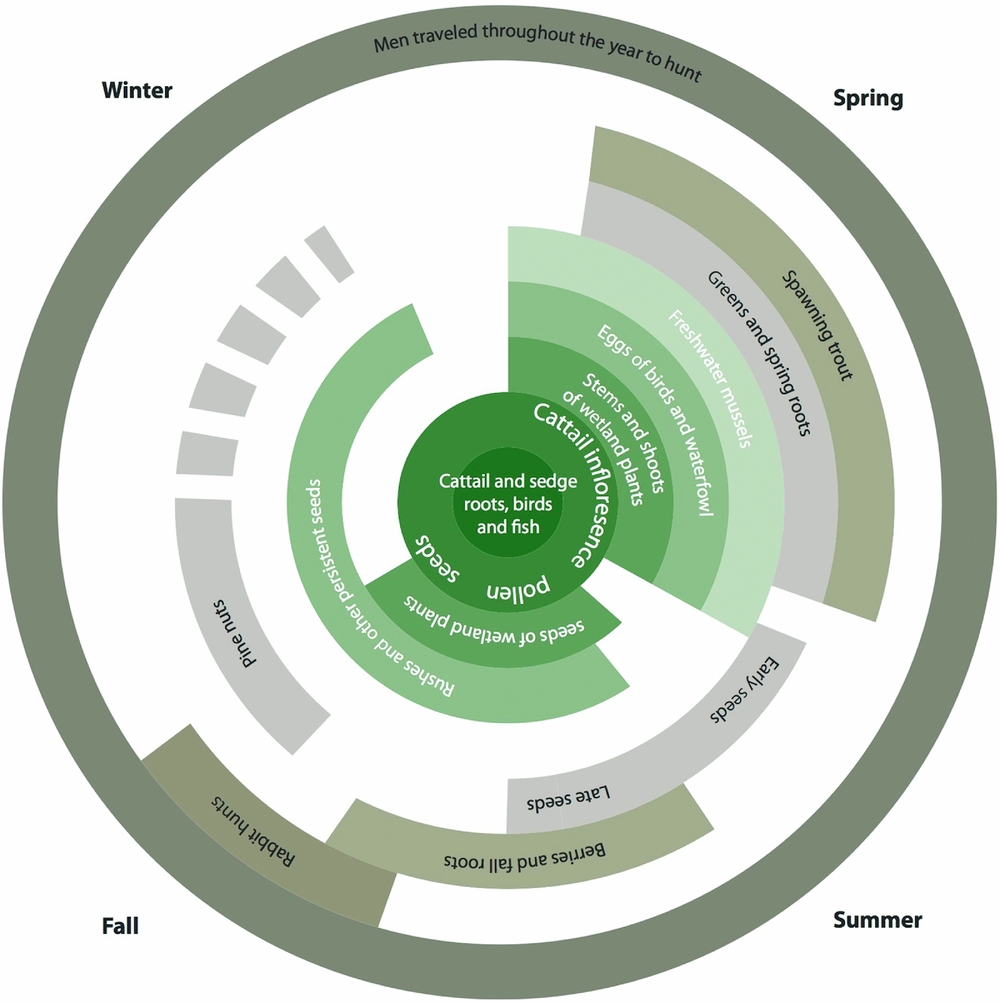
For those groups in the Great Basin that practiced a wetland-based adaptation, resource exploitation radiated out from the wetland and, according to Fowler (Reference Fowler, Williams and Hunn1982, Reference Fowler1990) and Madsen and Kelly (Reference Madsen, Kelly, Fowler and Fowler2008), can be summarized as indicated in Figure 8. Certain wetland plant resources, such as cattails and sedges, are available year round in the Great Basin, providing a secure food and craft-material supply. This resource security would have been an important draw to the wetland zones and, in turn, would have facilitated exploitation of resources beyond the wetland. Figure 8 helps to clarify and make plain the choices hunter-gatherers in the Great Basin faced and, by analogy, the choices that the inhabitants at Ohalo II may have faced.
Schematic diagram illustrating American Great Basin resource exploitation strategies according to Fowler (Reference Fowler, Williams and Hunn1982, Reference Fowler1990), and Madsen and Kelly (Reference Madsen, Kelly, Fowler and Fowler2008). The inner rings in green describe those resources exploited within the wetlands. Outside of this, bound by the brown rings, are all of the resources exploited outside the wetland zones. These resources are then organized clockwise according to season of exploitation.

Revisiting the Epipaleolithic Adaptive Cycle: Wetland Use during Cold/Dry Phases
The attractiveness of wetland environments to humans has been widely documented, both geographically and temporally (Nicholas Reference Nicholas1998). One reason for this attraction is that wetlands generally have high resource productivity, diversity, and reliability relative to other habitats. This contrast can be more evident during periods of drought (cold/dry phases; Nicholas Reference Nicholas, Menotti and O'Sullivan2013). For example, in the Great Basin, wetlands were used more intensively in the Holocene as the productivity of those settings increased relative to the surrounding dryland environments (Kelly Reference Kelly2001). Similar dynamics have been described by Nicholas (2007:247–248) for the Paleoindian and Early Archaic hunter-gatherers at Robbins Swamp in the northeastern United States and by Ramsey et al. (Reference Ramsey, Maher, Macdonald and Rosen2016) for the Early and Middle Epipaleolithic hunter-gatherers at Kharaneh IV in the Azraq Basin, Jordan.
Lee and DeVore (Reference Lee and DeVore1968:12) described the use of wetland environments by hunter-gatherers as comparable to a storehouse. Following this logic, we suggest that the lakeside setting of Ohalo II was used as a type of natural storage (Ramsey and Rosen Reference Ramsey and Rosen2016), particularly important during periods of climatic deterioration such as the cold/dry LGM. The “stores” of sedges, reeds, and rushes bordering the lake, not to mention the fish and waterfowl, would have provided a reliable source of food and craft materials. At Ohalo II, employing the natural storage of the wetlands appears to have been a resilient long-term strategy. Accordingly, at Ohalo II, wetland exploitation is central to understanding plant-use and subsistence patterns more broadly. In support of this interpretation, phytolith evidence from several Late Pleistocene sites in the Eastern Levant reveals comparable evidence, demonstrating that foragers during the LGM focused their subsistence and settlement around reliable wetland zones (Ramsey and Rosen Reference Ramsey and Rosen2016). Additionally, the Wadi Kubbaniya sites that were occupied during the LGM also feature macrobotanical assemblages that demonstrate a heavy reliance on wetland sedge resources (Hillman Reference Hillman, Harris and Hillman1989; Hillman, Madeyska, and Hather Reference Hillman, Madeyska, Hather, Wendorf, Schild and Close1989).
Considering the regional breadth of this pattern, it is plausible that this risk-adverse wetland-centered adaptation was a response to the cold/dry climate of the LGM. Wetland use however, might not have necessarily been the pattern Epipaleolithic peoples chose to employ during periods of climatic amelioration (Rosen and Rivera-Collazo Reference Rosen and Rivera-Collazo2012). Accordingly, wetland use may have formed a key part in the long-term adaptive cycle, a fallback adaptation reinforced by climatic deterioration (Rosen and Rivera-Collazo Reference Rosen and Rivera-Collazo2012) and local environmental conditions (i.e., micro habitat availability) (Ramsey and Rosen Reference Ramsey and Rosen2016), informed by innovation and/or social memory.
Conclusions
We have addressed three issues in the study of the Ohalo II phytoliths. First, categorizing the phytolith and macrobotanical taxa into ecozone-types (Ramsey and Rosen Reference Ramsey and Rosen2016) provides a comprehensive baseline that will facilitate interpretation of phytolith assemblages at other Late Pleistocene and Early Holocene sites in Southwest Asia that do not benefit from macrobotanical preservation. Second, the results of the phytolith analysis highlight three patterns of plant use at Ohalo II: (1) The phytoliths corroborate macrobotanical and starch evidence from the site (Nadel et al. Reference Nadel, Piperno, Holst, Snir and Weiss2012; Piperno et al. Reference Piperno, Weiss, Holst and Nadel2004; Snir, Nadel, and Weiss Reference Snir, Nadel, Grosman-Yaroslavski, Melamed, Sternberg, Bar-Yosef and Weiss2015; Weiss et al. Reference Weiss, Kislev, Simchoni, Nadel and Tschauner2008), suggesting that the hut interiors were important venues for plant food preparation. (2) The results indicate that both wild-wheat husks and stems may have been transported back to the site together, supporting the hypothesis that cereal harvesting occurred at the semi-ripe (milk-ripe/green) stage. This agrees with the conclusions derived from rachis scar-type percentages and the use-wear analysis of the sickle blades. (3) The phytolith evidence demonstrates that wetland materials were employed to a greater extent in the construction of Brush Hut 1 (Locus 1) than previously recognized. Third, employing ethnographic analogy from the American Great Basin, in conjunction with previous work concerning Late Pleistocene and Early Holocene plant use in the Near East (Hillman Reference Hillman, Harris and Hillman1989, 2000; Hillman, Colledge, and Harris Reference Hillman, Colledge, Harris, Harris and Hillman1989; Hillman, Madeyska, and Hather Reference Hillman, Madeyska, Hather, Wendorf, Schild and Close1989), has proven significant for reevaluating the resource choices Early Epipaleolithic hunter-gatherers at Ohalo II may have faced. This is especially important given the pivotal role Ohalo II plays in our understanding of Late Pleistocene human-environment interactions in Southwest Asia.
In sum, we suggest that plant-use and subsistence strategies at the site relied on wetland resources to a previously unrecognized extent. Comparable phytolith evidence from sites in the Eastern Levant suggests that the wetland-centered lifeway at Ohalo II is representative of a wider regional phenomenon (Ramsey and Rosen Reference Ramsey and Rosen2016), an adaptive strategy informed by innovation and/or social memory that cycled in predictable ways in response to major climatic changes and local environmental conditions. Moreover, this trend is matched by evidence in the Azraq Basin for increasing fire disturbance and changing vegetation in the local wetland environments, evidence perhaps for increasing human interest and impact in the wetland (Ramsey et al. Reference Ramsey, Jones, Richter and Rosen2015). Together, these lines of evidence demonstrate the importance of wetland resources to hunter-gatherers during the cold/dry climate phase of the LGM.
Acknowledgments
Phytolith analysis and counting was conducted in the Environmental Archaeology Laboratory at the University of Texas at Austin. We thank Prof. Ehud Weiss for kindly allowing us to use data from his PhD dissertation in this study and Dr. Iris Groman-Yaroslavski for her advice. We are also very grateful to Lara Sanchez Morales and Luisa Aebersold for their help in translating the abstract to Spanish. The Ohalo II project was generously supported by the Irene Levi-Sala Care Archaeological Foundation, the Israel Antiquities Authority, the Israel Science Foundation, the Jerusalem Center for Anthropological Studies, the L.S.B. Leakey Foundation, the MAFCAF Foundation, the National Geographic Society, and the Stekelis Museum of Prehistory in Haifa. This research was supported by a Canadian Social Science and Humanities Research Council (SSHRC) PhD fellowship [award number 752-2011-1728], a National Science Foundation SBE DDIG [grant number BCS-1418462], and two Council for British Research in the Levant (CBRL) travel grants (2011, 2012) awarded to M. N. Ramsey. This manuscript was written during the tenure of M. N. Ramsey's Canadian SSHRC Post doctoral Fellowship [award number 756-2015-0408].
Data Availability Statement
All necessary permits were obtained for the described study from the Israel Antiquity Authorities (Excavation permits: 1989: L. 1634; 1990: L.1724; 1991: 93/91; 1998: 160/98; 1999: G-61/99; 2000: G-20/2000; 2001: G-73/2001), which complied with all relevant regulations. The data that informs this paper are available as supplemental materials.
Supplemental Materials
For supplemental material accompanying this paper, visit login at https://doi.org//10.1017/aaq.2017.37.
Supplemental Text. Materials and Methods
Supplemental Table 1. Phytolith and Macrobotanical Data
Supplemental Table 2. Phytolith Identification Details