

Introduction
The relationship between the livestock farm and the environment is multi-faceted and this complexity opens a broad range of possibilities adapted to different situations and stakes in an attempt to change the situation in a positive direction.
Improve the nitrogen input use efficiency
A large body of scientific work has focused (and still does) on nitrogen efficiency in livestock farms and many innovations have been proposed, even if they are far from being generalised in animal production systems. Improvement of efficiency concerns all types of production (Delaby et al., Reference Langlais, Nicourt, Bourblanc and Gaigné2014, in this issue), from organic farming or systems with very low inputs - where the goal is to maximise profit from an often limited resource, all the way to the most intensive systems in regions with a high animal density, where the stakes are to limit leakages into the environment. Nitrogen losses are inevitable but also involve financial stakes as nitrogen is most often purchased (except when it arises from symbiotic nitrogen fixation). In addition, the price differential spread between fertilisers and animal feed on the one hand, and animal products on the other hand should increasingly encourage animal producers to economise, to better recycle or capture atmospheric nitrogen by legumes. The cost of inorganic fertilisers closely follows energy prices that will increase in the long term. It could even increase at a greater rate than energy costs as a result of increasing demand by emerging economies and the concentration of fertiliser producers that are increasingly in a position of an oligopoly (a small number of large firms), even a monopoly at the local level (see Langlais et al., 2014, in this issue). An entire spectrum of innovations is possible, from incremental changes of existing systems all the way to the design of alternative systems (Table 1).
Objectives depending on the nature and level of changes required

Minimise nitrogen leakages in regions with elevated environmental stakes
In some regions, environmental stakes are such that radical choices are required in terms of land allocation and use, and agricultural practices (see Cellier et al., Reference Cellier, Rochette, Durand, Faverdin, Kuikman and Peyraud2014, in this issue). Drinking water catchment areas are thus covered by a strict regulatory framework enabling highly significant changes in agricultural systems and practices. Several regional projects on water supplies to cities or on a mineral water source have proven their effectiveness and long-term viability. Catchment areas upstream from coastlines subjected to green tides are also regions with high environmental stakes. The reduction of algal biomass presupposes a drastic decrease in the nitrate content of surface water, far below drinking water standards. These levels of requirements thus dictate the development of technical or organisational innovations that make a clean break from the past and that consistently involve reducing the animal density.
Increased added value of products from livestock farming systems with high environmental performance
Organic farming, quality labels, indication of origin, etc. certifications linked to contract conditions result in added market value and the consumer voluntarily accepts paying a higher price. This market segmentation is orienting trends and downstream players are increasingly more attentive to the image of products. In the area of milk production, and even though milk is a mass marketed product, some processors are seeking a means of standing out in the form of new demands made on animal producers. Thus, Ireland is currently attempting to increase the ‘green’ image of its bovine meat and milk for export, in particular to France. The carbon impact of Irish beef is now being measured on a large scale (72% of national production, 32 000 certified livestock farming systems) and this criterion includes a Quality Assurance Charter. The impact on water and biodiversity will also be evaluated.
Several features of nitrogen pollution analysed in the preceding articles may discourage the participants concerned or reveal the unsuitability of measures taken. The time required by the environment to respond to changes is without doubt a major difficulty for motivating changes of practices, as efforts made are not rapidly manifested by a perceptible reduction of impacts, for example a reduction of green algal development. The second difficulty results from the diversity of forms of reactive nitrogen and their instability, such that measures targeting certain emissions could be in contradiction to others. Finally, not all environment compartments have the same sensitivity as damage to ecosystems depends on land use, climate, soil characteristics and hydrology of the sites concerned, and also depends on the position of sources of agricultural pollution with respect to the zones targeted.
Tools adapted to objectives
To propose relevant directions for actions, it is necessary to have ideas that span several scales, giving preference to the level of the farm as it is the focal point of farmers’ choices among different priorities. This can be achieved by including:
1. the different aspects contributing to the performances of the farm and their interactions (animal production facilities, management of waste and of cultures);
2. more inclusive levels such as groups of farms or cooperatives that provide new manoeuvring room (exchanges of nitrogen flows) and regions where the impacts of agricultural activity are assessed, and where new possibilities for controlling flows into the environment can be implemented (improvements and reorganisation of activities); and
3. the level of public and regional policy makers (regional governments, basin management agencies, natural parks, regional institutions, etc.) and industrial segments that can orient the actions of animal producers.
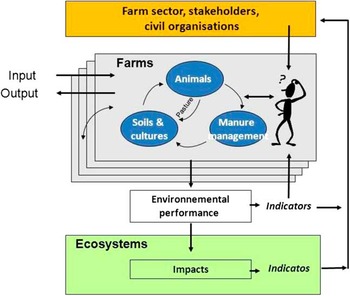
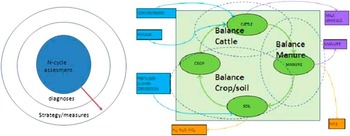
A procedure aiming at progress requires that indicators be used to determine sources of ineffectiveness and to measure improvements following changes of practices. Indicators based on the calculation of a balance or an excess are most often used and are relatively uncomplicated in practice (see Bockstaller et al., 2014, in this issue). The overall nitrogen balance (ONB) is the balance assessment tool currently used to determine public policies in France. It provides sound arguments on the fertilisation balance and is a tool accepted by farmers, as it confers on them an advantage in the context of regulatory application. Nevertheless, it considers only one aspect, whereas others are also sources of losses. The farm-gate balance is more inclusive but assumes its full meaning only if it is combined with calculations of balances at the level of different subunits of the farm. The soil vegetation balance (ONB type) could be an integral part of this tool, alongside a balance at the scale of the herd and a waste management balance (Figure 1). This tool can rank the major sources of ineffectiveness and thus suggest corrective practices that are best adapted to the individual situation of each farm. This concept is currently being implemented in The Netherlands, in particular at the request of producers who see a means of lowering their overheads by reducing the purchases of nitrogen (Figure 2). A tool to provide logical arguments for nitrogen use efficiency remains to be designed. It is nevertheless this procedure that we will use in the remainder of this work to envision the principal paths for progress, in addition to practices already recommended, for example creating forecast fertilising plans.
A frame for livestock farming systems.

Stages to reduce the losses of nitrogen in a dairy farm. From the evaluation of the nitrogen cycle according to inputs and products, declined according to three balances: cattle balance, manure balance and the crop/soil balance (figure by F. Aarts).

In this context, the development of farm monitoring networks is very valuable for the life-size study of a broad diversity of situations, for acquiring more understanding of practices used on farms and for better quantifying the direct or indirect effects of innovations implemented (Aarts et al., Reference Aarts, Biewing and van Keulen1992).
Improving nitrogen efficiency in animal production systems
This section summarises the types of leverage for action for different aspects of animal production systems. The overall efficiency of the system presupposes a consistent overall management, while remembering that any deviation in a given step could be highly detrimental to efforts undertaken.
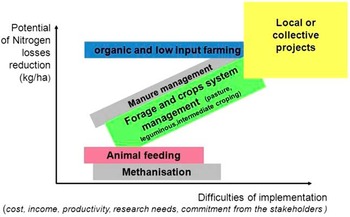
There is a general consensus in the literature that better use of nitrogen in excreta is a major path for improving nitrogen efficiency on livestock farms. The management of fodder systems and cropping systems is also an important path for more efficient nitrogen management; however, in this case there remains substantial research needs targeting technical innovations, in particular to preserve good productivity of legumes. Managing animals and their feeds are actions with room for progress but future efficiency increases should be more modest than in the past as this has been subject to considerable research and development and considerable progress has already been made. Actions at the level of the region are also possible, involving other participants and often requiring a reduction in the intensiveness of agricultural production systems. They require local support and economic regulation explaining why they are difficult to implement but they nonetheless lead to evident progress. Figure 3 shows the sequencing of various aspects according to their estimated implementation difficulties and their efficiency in terms of reducing nitrogen losses. There are wide range of difficulties, including costs of implementation, reduced productivity, more research needs as the solution is not yet available, a presumed reticence by those involved to accept, etc. This representation resulted from a literature search but also includes a proportion of subjectivity as aspects of difficulties remain qualitative.
Schematic representation of different paths according to difficulties of implementation and potential of reduction expected from nitrogen losses.

Managing the effluents
The first path involves optimising all the links in the waste management chain
One path involves acting at the ‘source’ by reducing protein supplies in feed that reduces the excretion of urea and the quantity of nitrogen in animal effluents. The mechanisms for managing waste in livestock housing also affect emissions (emissions of NH3 from liquid manure<straw bedding<sawdust for pigsties; open housing on liquid manure>animals attached with removal of solid manure for cattle) and are decisive for the regulation of volumes of waste to manage.
Innovations have been developed to better handle nitrogen losses, especially NH3, in livestock housing (emission from excreta), during storage (covering pits) and manuring (selective application by spraying ramps or systems for injection in the soil). It remains necessary to control the entire storage and manuring chain to preserve nitrogen: interactions between different steps in management are thus important. For example, covering the pit reduces ammonia emissions during storage, but if manuring conditions do not preserve nitrogen, more ammonia will be released at this stage as there will be increased leakages from nitrate leaching. The requirements for specific and costly equipment can be overcome by collective organisation, for example, CUMA, or by entrepreneurship.
The other path gives preference to technological treatment of waste
The underlying idea is to preserve nitrogen emitted by animals and recycle it for export (also true for phosphorus) outside livestock farming zones in order to ‘offload’ nitrogen from certain regions. Composts, dehydrated residues or dried sludge can be exported outside livestock farm zones. The systems of marketing these fertilisers (NF (French standard) certified fertilisers or organic soil improvements) are developing at local (local exchanges between producers), regional or national scales (specialised companies).
Drying sludge requires energy. Some groups of pig producers collect and recycle the co-products of their members by integrating drying in their industrial organisation in order to, for example, use heat available at a given step (slaughterhouse) to dry sludge. Increasingly, strict regulations on phosphorus will give impetus to these practices that have not yet been extensively studied. In the case of liquid manure, a preliminary step is the separation of phases that yields a solid phase with much higher concentrations of total nitrogen and phosphorus (2 and 4 to 5 times higher) than the starting product. In the case of solid manure, composting results in a final product enriched in fertilising elements (N, P, K) compared with initial solid manure. However, there are increased losses as ammonia and N2O and thus this practice does not conserve nitrogen.
Methanation produces energy that can be used to dry co-products of livestock farm waste or methanation sludge itself. On the other hand, this technology increases the proportions of ammoniacal nitrogen in residues and thus increases the risks of emissions during storage and manuring (+15% NH3 emissions, unknown for N2O). It can even cause an increase in the nitrogen load at the scale of the farm or the region as livestock farm waste is not very suitable for methanation and so other components containing nitrogen must be added (green waste, silage maize, etc.) to the biogas digester.
Aerobic digestion is used primarily for liquid pig manure and leads to the elimination of about 60% to 70% of nitrogen of liquid manure entering the system in the form of N2. This technique is effective but does not preserve the ‘nitrogen’ resource and in the future could become costly as energy costs continue to increase.
Managing fodder and crop systems
The literature shows that it is possible to better recover nitrogen by developing the use of pastures, especially if they are planted with legumes. In addition, the use of intermediate cultures in rotation schemes limits leakages by nitrate leaching.
The role of pastures and legumes in the regulation of nitrogen flows in production systems
The value of pastures in terms of water quality is increased if the levels of nitrogen fertilisation are low and if the pastures are permanent. Pastures used for rotation require good technical knowledge to reap the best benefits. The literature shows that there are optima to define the balance between the desired productivity of land surfaces and the risks of nitrate leaching, and that there is interest in avoiding excessively frequent pasture rotations (a time frame of 5 to 6 years seems optimal). In addition, the destruction of pastures in the spring (rather than in the autumn) not only reduces the risk of leaching during the drainage period, but also provides high crop yields in the following spring, for example in maize yields compared with maize produced in classical crop rotation). As the risks of leaching from cut pastures are low, the practice of zero grazing (green fodder provided to housed animals) is interesting, all the more as it enables the recycling of liquid manure, but on the other hand is costly in terms of material and energy. Finally, introducing forage legumes in mixed pasture is above all profitable in relation with savings in inorganic nitrogen. Besides they provide a high quality feed. However, their value for limiting risks of nitrate leaching remains controversial and does not appear to be a determining factor. In the case of large-scale farming, however, the introduction of an alfalfa field for 3 years notably reduces nitrate leaching. Life cycle analyses (LCA) analyses have also shown that legumes reduce the eutrophication potential.
The role of catch crops and crop rotations to reduce the risks of leaching
It has been known for a long time and this practice is currently used in vulnerable zones. Catch crops make a strong contribution to reducing wintertime losses by leaching but since they increase the stock of organic matter in soil, their use must be assessed on the long term. Several publications have shown that it is possible to substantially use nitrogen released after ploughing a temporary pasture. In particular, beets are a ‘nitrate trap’ crop that is effective when planted after a grazing pasture (400 kg of N removed/ha). Leguminous seed plants in crop systems are also excellent as the first crop in a rotation as they have positive effects on the yields of subsequent crops, for example wheat after peas.
Permanent cropping systems
Permanent cropping systems eliminate uncovered ground are interesting but require more research before becoming operational. Thus, the development of cereals over permanent covers of legumes provides both nitrogen and protection against leaching, but remains poorly controlled at the present. Similarly, attempts to plant cereals after a grazing pasture with its destruction are thus far inconclusive, as grass covers compete and do not easily enable the correct development of the cereal planted.
Actions involving feed and herd management
The constantly increasing knowledge on nitrogen nutrition should lead to even further reductions of total supplies, provided the economic cost of these strategies does not become a limiting factor.
The sectors of monogastric animals are already well aware of the correct control of animal nutrition for reasons of cost and also because feed is quantitatively the leading source of nitrogen inputs to the farm (see Delaby et al., 2014, in this issue). In the case of pig farms, the implementation of CORPEN ‘biphasic’ references in 1996 was a milestone, resulting in a considerable reduction of excretion of nitrogen (15% to 20%) and phosphorus (20% to 25%). Progress continued with the use of synthetic amino acids that better cover animal needs at the same time as reducing the nitrogen contents of feed rations. There are also perspectives for improvement resulting from precision feeding and surrounding environmental conditions. A similar procedure is used in poultry farms but in this case, performance appears to degrade more rapidly with a reduction of the protein content in feed than in the case of swine.
In ruminants, the risks of losses depend more in the animal density than animal nitrogen discharge per se. Ruminant farmers often adopt safety margins in comparison with recommendations, especially while animal feeding stuffs remain inexpensive. Eliminating these margins would rapidly reduce losses with no effect on animal productivity. Finding innovations to reduce the degradation of feed proteins in the rumen is another challenge. The use of tannin-containing proteins is a French specificity, but it is called into question for reasons of public health as the tanning process involves formaldehyde treatment. Considerable work is addressing the use of natural tannins or essential oils but convincing demonstrations have not yet been made.
Genetic improvement of animals is continuing and is contributing to reducing excreta per unit produced. Thus, in the last 25 years, the quantity of nitrogen excreted per kg of pig produced has decreased by 30%. In dairy ruminants, efficiency also increases with production potential, but in a market regulated by quotas or because of limited commercial prospects, increased milk production per animal leads to reduction in herd size. Furthermore, the nitrogen balance of the farm will, above all, depend on the use of the land surfaces made available. Finally, increasing the milk potential always goes hand in hand with increases in needs for concentrates, most often purchased by the farm.
Managing nitrogen in sensitive regions
Options in regions with high animal density
A number of strategies can limit certain impacts resulting from the concentration of specialised livestock farming systems and can favour the roles of pollution abatement by environment compartments. Synergies between specialised farms in complementary sectors can be envisaged at a regional scale compatible with logistic restrictions. Technologies for the treatment of waste participate at this level to the extent that they enable better control of the agricultural value of waste, to transport them more easily and protect the conditions of their use (deodorising, sanitising). This is the case for methanation of digestates as well as solid manure compost, often advanced as a possibility for broadening their use for crops (cereals).
At the scale of landscapes, hedgerows and woody areas contribute to capturing diffuse or spot emissions (NH3) and wetlands contribute to reduce nitrate losses, even if these zones cannot denitrify very large quantities, especially because their surface is most often limited to only a few percent of regions. All these types of land improvement must be considered in an overall framework and in the long term in order to obtain overall consistency, and to prevent the risk of pollution transfer.
A more radical transformation towards systems with low inputs and very low nitrogen leakages
Low input livestock farms are those that limit purchases of nitrogen inputs but their levels of productivity are often also lower in light of techniques currently available today. These systems can fulfil regional concerns, where the control of nitrogen has become a priority but they probably cannot be generalised to the entire sector.
Low inputs in conventional agriculture
In low input systems, the balance between feed production potential and the production level of animals, as well as the use of local resources for feed self-sufficiency, guarantee a high nitrogen efficiency on farm. Several publications have confirmed, as least for ruminant livestock farms, that these strategies do not erode farmers’ incomes, even increase it in certain cases, particularly because of the substantial decrease of overhead and operating costs.
Organic farming
Manoeuvring room for organic farming is greater on ruminant livestock farms than monogastric animal farms. All published studies have concluded that there is a much lower nitrogen balance and a higher nitrogen efficiency on dairy farms compared with conventional systems. The absence of inorganic fertilisation and moderate animal density, combined with optimised crop rotations, lead to low levels of leaching: a survey conducted in 18 European countries showed a reduction of 50% (Knudsen et al., Reference Knudsen, Kristensen, Berntsen, Petersen and Kristensen2006).
Indirect effects of measures taken to improve nitrogen efficiency on other aspects of farm performance
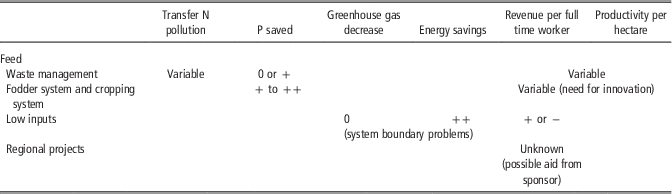
Most publications in this field deal with the effect of factors on a single environmental flow (nitrate leaching, NH3 emission, etc.) and very little work has addressed multi-criterion approaches. Even so, several conclusions can be drawn by placing all the data in perspective. They involve the effects of measures on nitrogen, on risks of pollution transfer between the different pathways of nitrogen losses (to the air or water), on the risks of phosphorus leakage, on greenhouse gas emissions, fossil fuel consumption, revenue of farmers and the productivity of land surfaces. The lack of precise information explains why the indirect effects of actions are qualified by mathematical symbols (+ and −) in Table 2.
Indirect effects of measures taken to improve nitrogen efficiency on other aspects of farm performance

0: no effect; +: gain for nitrogen is accompanied by a gain of another criterion, −: the effects are antagonistic.
Actions involving feed and herd management
By reducing nitrogen excretion, especially that in urine, the risks of losses by leaching and emissions of NH3 and N2O are reduced. These actions have little effect on other criteria of interest or tend to increase them only slightly. In particular, we can count on a reduction of greenhouse gas emissions.
Actions on the management of effluents
Their effects are less clear-cut, as incomplete control of the various steps may lead to pollution transfers. Correct management of nitrogen in animal waste, however, can reduce greenhouse gas emissions and fossil fuel consumption by reducing the needs for inorganic fertilisers. Effects on productivity are not significant and those on revenue will depend on the cost of inorganic fertilisers.
Possible leads for managing fodder and crop systems
Possible leads for managing fodder and crop systems to reduce losses by leaching also limit the risks of phosphorus runoff, greenhouse gas emissions and energy consumption, once they enable reduction of the use of inorganic fertilisers. On the other hand, these steps could reduce the productivity of land surfaces. Innovations are required to successfully put these potentials into practice.
Low input and organic farming systems
Low input and organic farming systems reduce nitrogen losses, consumption of non-renewable energy to a notable extent and losses of phosphorus. In general, the comparative balance between these systems and conventional systems is variable, depending on whether the factor used is per unit of product or per hectare of land used. In particular, the greenhouse gas balance of these systems is controversial and several publications have concluded that greenhouse gas emission per unit of product is higher for organic farming. These systems evidently reduce the productivity of surfaces but can ensure correct revenue when they are well controlled. In these systems, however, production is reduced per unit of land surface and if consumption remains constant, which is probable, these systems may result in increased production in another region or another part of the world, with increased use of agricultural land. This explains why it is difficult to determine the global environmental balance for greenhouse gases, energy consumption and land surface use, whereas the local effect is very positive on the impacts of eutrophication and acidification.
Regional projects
Regional projects aim primarily at reducing losses by nitrate leaching. Several of these projects propose low input systems and so refer to the preceding point.
Possible paths for public action
Economic strategy depends on the relationship between the site that is damaged and the emission of pollution
When the damage site is independent of the source of pollution
When the damage site is independent of the source of pollution, as is the case for greenhouse gases, the simplest instrument is theoretically tax based on a common and uniform indicator (tonne of CO2 equivalent), applicable to all polluting activities whether heating, transport, rumination (CH4), handling livestock farm waste or fertilisation. Implementing such a tax for nitrogen fertilisation is complicated by the fact that the emission coefficient is highly dependent on conditions prevailing at the moment of fertilisation: temperature, humidity and type of soil. Similarly, a tax on solid and liquid manure as emitters of greenhouse gases presupposes registration and costly monitoring of the quantities of nitrogen concerned.
Implementing individual and exchangeable emission quotas is a classical alternative to a tax in the context of a national or European quota that is digressive over time. There are several advantages to this alternative: it enables nitrogen-containing greenhouse gas quotas to be managed in the same context as those of carbon; in the beginning, quotas could be distributed to farmers free of charge (while a tax must be paid immediately). Its operational practicality on the other hand is less clear-cut as is shown by the fact that the market of CO2 quotas for major industrial emitters currently does not work very well. Simulations are beginning to estimate the cost of including agriculture in European climate policy by a tax or quotas.
In addition, the creation of quotas market is an option preferred by economists (see Le Goffe and Donnars, 2014, in this issue). The manuring market arose from legal dispositions limiting the possibilities of manuring in zones saturated in nitrogen and is promising in the framework of supply and demand logic. Even so, this mechanism faces certain de facto situations. Traditionally and also for more practical reasons of transport costs, livestock farm waste are managed in proximity. The zones concerned are already highly saturated in nitrogen, thereby limiting the possibilities of this market of rights. Within these saturated zones, however, a tightly regulated market (local nitrogen quota stockpile) exists. One of its features is to open access to land to livestock farmers who in other circumstances probably would have been excluded. According to this hypothesis, the system is more of a policing measure than a genuine market of rights, similar to the situation existing for greenhouse gas emission quotas.
When the damage depends on the site of polluting emissions
the geographic variability of damage implies a geographic differentiation of policy. This is the case for water pollution and pollution in proximity resulting from sources of ammonia. According to this logic, for example, in locations where environment issues resulting from nitrogen pressure are judged severe, the marginal costs of abatement and reduction of emissions could be set at higher thresholds.
Finally, the vulnerability of certain environment compartments prohibits certain land uses such as annual cultures or even grazing in the most acute cases. In special cases, public action could require considering taking over the control of agricultural land and compensating the farms involved.
Paths little explored until the present
The notion of critical load
The notion of critical load is the foundation of negotiations on long distance atmospheric pollution transfers (Geneva Convention, Gothenburg Protocol) concerning emission ceilings to minimise impacts on natural ecosystems by providing objectives quantified in terms of exceeding critical loads over a defined time frame. This notion of critical load could be applicable to all nitrogen emissions in a given region by considering emissions towards air and water, and the sensitivity of receiving compartments in proximity (sensitive ecosystems, masses of underground, surface and ocean waters) and distant (atmosphere for greenhouse gases and long distance transfers in other cases). Policies resulting from the French ‘Grenelle de l'Evironnement’ involve an approach including critical load in their application to regional institutions (French decree 2011-687 of 17 June 2011).
The most relevant scales are the production area (economic logic), the small agricultural region (agro-environmental logic) or the source zone of a sensitive target (environmental logic: bay sensitive to algal blooms, protected natural areas, etc.). The factors of variation of this critical load are thus not only the local features of the region, but also their possible proximity to sensitive or public areas (drinking water supply areas) via risks of horizontal transfer of ammonia and nitrate. This approach would overcome the disadvantages of the uniform standard of 170 kg of organic nitrogen (even 210 kg total nitrogen) by proposing the use of a more comprehensive criterion and by adapting it according to the potentials of the local environment and risks, or possibly the proportion of grassland surfaces at the scale of individual farms. In theory, the effectiveness of this path is high as it enables actions to be adapted to local environmental stakes, but it would require the participation of all players to approve and accept to procedure, the development of a tool to calculate this load and an assessment before and after implementing the measures adopted.
Geographical location and organisation of farming systems at the regional or national scale
Although the literature explains the concentration of businesses associated with livestock farming systems, there is, to our knowledge, no published study on the possibilities of partial relocalisation of production with the goal of reducing the intensity of livestock farming systems in certain regions. A literature search, however, points out potentials, undoubtedly technically realistic, and that require an analysis of organisational, social and economic feasibility. French livestock farming regions are distinguished by very large differences in nitrogen balance excesses per unit of surface, some cannot (or only partly) manage nitrogen excesses while other could increase their animal density. This observation can also be applied between different townships in the same region. There are undoubtedly compensations to find reduced environmental impacts in certain production areas at the same time as preserving their competitiveness and a dynamic agriculture in other regions. For example, outsourcing of heifer rearing from dairy herds in western France to traditional suckler cows areas of the Massif Central could reduce the nitrogen load in the west without affecting the regional production potential.
The environmental land lease.
Since rural land leasing was changed by the French agricultural orientation act of 5 January 2006, it is now possible to sign environmental land leases between private parties and also with public authorities or environment protection associations. The land lease with environmental clauses is planned for areas involved by the protection of water (water catchment, wetlands, etc.), natural areas (nature reserves, regional nature parks, etc.) or for the protection of biodiversity (Natura 2000 zones for example). Among these environmental clauses, some have an obvious value in the context of the fight against nitrogen pollution (not ploughing pastures, periodic or permanent plant cover of ground, etc.). Even though this tool is potentially very interesting, it has been used little or not at all since its creation.
What is the relevant level of organisation for the application of environmental regulation measures?
Economic studies have shown that it could be effective to penalise the purchaser of a product obtained from the polluter rather than the polluter himself. In the case of livestock farming systems, it can thus be asked if it is more effective to target measures on the farmer or the chain of animal industry businesses (cooperatives, slaughterhouses, meat cutting and processing or dairy sectors) that are predominantly supplied by farmers localised in SEZ townships. Economists are thus developing a series of arguments to show that environmental regulation could be more effective if it was also applied to these players. Authors have shown that the costs resulting from the administration of the Nitrates Directive, for example, would be significantly lower if regulation involved demand and not supply, as the number of businesses in the chain (demand side) is smaller than the number of farmers (supply side). In addition, the phenomenon of concentration of livestock farming systems responsible for nitrogen excesses concomitantly contributes to reducing production costs by businesses in the animal production chain. Finally, other work has shown that when livestock farmers and businesses are linked by reciprocal contracts (businesses supply inputs to livestock farmers who sell their production back to the suppliers) the implementation of a pollution tax becomes optimal if it includes farmers and businesses, especially because contracts signed do not internalise the environmental impact of livestock farming activities. The last argument advanced is that the financial capacities of upstream and downstream businesses in the animal production chain are greater than those of farmers and so they would be more prone to implementing innovations to better profit from nitrogen waste (and also phosphorus).
Innovative tools still under discussion
Payments for environmental services (PES)
The concept of ecosystem services was initially advanced to point out the contribution of biodiversity to the creation of wealth. The Millennium Ecosystem Assessment (2005) then proposed a classification of the different types of services rendered by ecosystems. The notion of an ecosystem service is defined by Directive 2004/35 on environmental responsibility. PES are intended to be a tool for the prevention or repair of environmental damage. The literature on PES is currently focused on the principle itself but contains little concerning their application or case studies. The preferred form of these payments appears to be that of contracts between receivers and suppliers of environmental services. Concerning remuneration for services rendered to water, the example of Vittel is mentioned often. A number of aspects of PES remain unclear and even the legality of these payments is controversial. For example, the ownership of services sold that are generally public holdings, cost of services, taking scientific unknowns into account, antagonistic ecological effects, etc. It may be asked if this notion can contribute to renewing the interest of manuring organic matter for soil quality. This is the belief of some authors and is the orientation of some ongoing soil research (Chevassus-au-Louis, Reference Chevassus-au-Louis2006; Boisset, Reference Boisset2008; Doussan, Reference Doussan2008; Aznar, Jeanneaux et al., Reference Aznar, Jeanneaux and Deprés2009; Académie d'Agriculture de France, 2010).
Considerations of the status of waste, that is, effluents
Although livestock farm wastes are organic fertilisers, their nature is such that they are legally qualified as ‘waste’ (Langlais, Reference Langlais2004). This qualification was rejected by the European Court of Justice (2005) that placed animal waste in the category of ‘by-products’, which exists now as a legal status (new legal framework of waste). Little attention has been paid to this topic in the scientific literature and the qualification of ‘waste’ has not been accepted by farmers. According to the concepts of European law, qualifying something as ‘waste’ is not an attempt to prevent its use. When applied to animal waste, it is not intended to condemn their fertilising potential but rather to supervise it. The management of waste is in fact based on a hierarchy of actions that favours, in the following order: prevention, preparation for re-use, recycling, followed by any other form of utilisation, in particular for energy, and lastly elimination (incineration without recovering energy or elimination in landfills). Crop manuring with livestock farm waste would thus be the preferred solution in the context of this European logic. Adopting the qualification of waste, on the other hand, also implies more stringent management conditions. As is the case for spreading WWTP sludge, its traceability, agricultural monitoring, effects on the quality of soil, water and air, could be required and the responsibility of the manuring sector clarified. Finally, legislation stipulates that a given waste can be qualified as a ‘product’ once a processing operation enables the resulting substance to assume the quality of product, in which case the legislative framework is less restrictive. Waste resulting from composting, bacterial treatment or any other technological treatment could claim this status of ‘products’ (Doussan, Reference Doussan2005).
Factors that could affect the management of nitrogen in production systems
Energy cost increases
They could make the energy balance of farms more strategic in the comparative analysis of different production systems. Economic simulations have logically concluded that technical systems consuming less energy are preferred. Thus, the spike in energy prices in 2008 and the concomitant proportional cost increase of inorganic fertilisers led to a direct decrease in their use. At the same time, however, the use of livestock farm waste depends on the associated quantity of work. The development of technical organic fertilisers that can be transported to crop farming regions would circumvent the issue of the quantity of land available for manuring by exporting products and could thus contribute to reinforcing the phenomenon of animal production concentration.
Continuing deregulation of agricultural markets
Modelling work has indicated that continuing deregulation could affect the economic and spatial organisation of the various sectors. Concerning the nitrogen issue, the supply of nitrogen by inorganic fertilisers and imported proteins (primarily soya beans) could change, but little research has thus far addressed this question. It is not possible to choose between two evolutionary paths:
1. a greater concentration of production that would augment the existing advantages of concentration (in particular, if there is development of exportable organic fertilisers);
2. or the quest for greater regional self-sufficiency in resources by integrating crop and livestock farming (cereal crops in regions of livestock farming would increase in order to ensure supplies).
Growth in the size of farms
Large-sized farms and an improved price of cereals could lead an increased number of farms to stop animal production in favour of cereals. This has already been observed in some French regions. Several recent foresight studies have concluded that a reduction of livestock farming systems in Europe would be greater in regions that are already the least productive.
Changes in the consumption of animal products
Animal production is currently the object of criticism concerning the impact on the environment, their use of large land surfaces and also for reasons of animal well-being and health of consumers. Results have predicted reduced consumption of meat (a trend seen in some countries or certain segments of the population) that would result in a reduction of animal production if the trend is not compensated by exports (strong increases in demand by Asian countries).