INTRODUCTION
The family Lutjanidae (snappers) includes 109 species in 17 genera which are mainly confined to tropical and subtropical marine waters, with few occurring in estuaries (Allen, Reference Allen1985; Eschmeyer, Reference Eschmeyer2013). The genus Macolor Bleeker is represented by two valid species: M. niger Forsskål, Reference Forsskål1775 (black and white snapper) and M. macularis Fowler, Reference Fowler1931 (Midnight Snapper). Macolor macularis inhabits mostly coral reef areas and is widely distributed in the Indo-Pacific (Anderson & Allen, Reference Anderson, Allen, Carpenter and Niem2001). Macolor macularis is widely distributed on the coasts of the western Pacific to Western Australia, north Australia to Taiwan (Kishimoto et al., Reference Kishimoto, Amaoka, Kohno and Hamaguchi1987; Eschmeyer, Reference Eschmeyer2013), Fiji (Allen & Steene, Reference Allen and Steene1988), Madagascar (Webster & McMahon, Reference Webster, McMahon, Linden, Souter, Wilhelmsson and Obura2002) and the Maldives (Randall & Anderson, Reference Randall and Anderson1993) in the western Indian Ocean. Only M. niger has been reported off Indian waters (Jones, Reference Jones1969; Allen, Reference Allen1985). The report of two specimens of M. macularis on the south-western coast of India represents a considerable range extension from its previously known localities.
MATERIALS AND METHODS
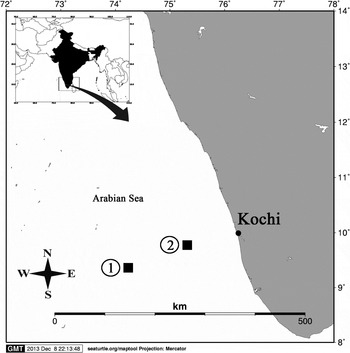
Two specimens of M. macularis (Figure 1) of standard length (SL) 312.19 mm and 266.56 mm were purchased from the Cochin Fisheries Harbour on the south-west coast of India in December 2012 and October 2013. The fish were caught by gill net in a depth of 50–80 m off the Kerala coast (9°29′57″N 74°48′05″E and 9°51′05″N 75°26′23″E) (Figure 2). Morphometric measurements were taken to the nearest millimetre using digital calipers according to the method of Hubbs & Lagler (Reference Hubbs and Lagler1958).
Macolor macularis: total length, 361.88 mm.

Map showing the capture locations of Macolor macularis (black boxes).

RESULTS
SYSTEMATICS
Order PERCIFORMES
Family LUTJANIDAE
Genus Macolor Bleeker, 1860
Macolor macularis Fowler, Reference Fowler1931
MATERIAL EXAMINED
Two specimens of M. macularis Fowler, Reference Fowler1931 of SL 312.19 mm and 266.56 mm were collected by gill netters operating at 50 m depth off Cochin. The specimens are deposited at the National Marine Biodiversity Referral Museum at the Central Marine Fisheries Research Institute, Kochi, India with the Accession No. GB. 31.88.8.5.
DESCRIPTION
Dorsal fin X, 13–14; anal fin III, 10–11; pectoral fin rays 16–17; lateral line scales 54–55; gill rakers (39–45) + (74–76). Dorsal profile convex, body deep with a deep notch in operculum, elongated pectoral fin and emarginate caudal fin. Colour uniformly black with a yellow iris.
Body deep, laterally compressed depth 1.8–2.1 in SL; head length 2–2.4 in SL; dorsal profile of head convex; snout blunt; eyes big, high on head, diameter 4.3–5.1 in head length (HL); mouth large, terminal, with a row of conical teeth in jaws; lower jaw protruding slightly when mouth closed; maxilla ends on a vertical through, middle of eye; pre-operculum serrated with a deep notch just above lower edge; operculum with a flat inter opercular spine. Dorsal-fin spine sharp, slender, fin distinctly notched; 4th–5th dorsal spine longest, length 2.8–3.7 in HL; posterior portion of soft dorsal and anal fin long, pointed; longest dorsal-fin spine 1.6–1.9 in longest dorsal-fin ray; longest anal-fin spine 1.9–2.2 in longest dorsal-fin ray. Pectoral fin long, falcate, length 2.3–2.5 in SL; pelvic fin 1.7–1.9 in pectoral fin; caudal peduncle moderately deep, depth 2.8–3.3 in HL. Caudal fin emarginate.
COLOUR
Body brownish black above with faint white spots, yellowish below; head with bluish irregular wavy lines, lines becoming wider in operculum region; dorsal, anal and caudal fins dark brown to black with small white spots; pectoral and pelvic fins darker.
DISCUSSION
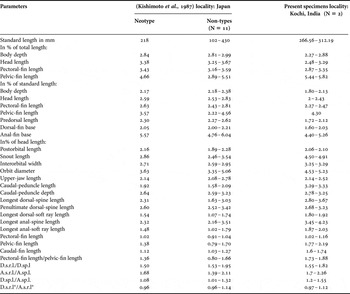
Forsskål (Reference Forsskål1775) described Sciaena nigra based on an adult specimen from Djiddae, Red Sea; that species was subsequently placed in Macolor by Fowler (Reference Fowler1931). Macolor macularis was described on the basis of two distinct species of the genus collected from the South China Sea and Japanese waters. The holotype of M. macularis was presumed to be lost, so a 306 mm SL paratype was designated as neotype and redescribed in detail (Kishimoto et al., Reference Kishimoto, Amaoka, Kohno and Hamaguchi1987). The meristic and morphometric characteristics of the specimens agree with that of neotype and other non-types (Table 1). However, M. niger, which is the only other species in the genus, differs from M. macularis by having 87–107 gill rakers (110–122 in M. macularis); anal fin mostly III, 11, rarely III, 10 (mostly III, 10); lateral line scale ranges from 49–58 (vs 50–55). Dorsal fin is slightly notched in M. niger (deeply notched in M. macularis); rounded, short pelvic fin (vs pointed, long pelvic fin, mostly reaches the anal-fin origin). The colour pattern of adult M. niger and M. macularis after death is very similar, both having dark coloration. However, freshly collected specimens of M. niger can be distinguished by having a uniform brown black head with a reticulate pattern of blue lines (M. macularis has a yellowish-brown head with blue round spots and short lines).
Comparison of morphometric characters of Macolor macularis from Kochi with previous records (Kishimoto et al., Reference Kishimoto, Amaoka, Kohno and Hamaguchi1987).

D.s.r.l., longest dorsal-soft ray length; D.sp.l., longest dorsal-spine length; A.s.r.l., longest anal-soft ray length; A.sp.l., longest anal-spine length.
Macolor macularis has been recorded from different parts of the world, but not from India's exclusive economic zone. This is the first report from these waters.
ACKNOWLEDGEMENTS
The authors thank Dr A. Gopalakrishnan, Director, Central Marine Fisheries Research Institute, Cochin, India for the facilities provided, and the Head of Divisions Dr P.U. Zacharia, and Dr T.V. Sathianandan, of Demersal Fisheries and Fisheries Resource Assessment for their constant encouragement and support. The authors also thank the two referees who have greatly contributed to the quality of this paper. The financial support from the Ministry of Environment and Forests is gratefully acknowledged. Online GIS program MAPTOOL, provided by SEATURTLE. ORG is also acknowledged.